×
Request Free Sample ×

Kindly complete the form below to receive a free sample of this Report

* Please use a valid business email

Leading companies partner with us for data-driven Insights

clients tt-cursor
Hero Background

Germany Data Center Infrastructure Market

ID: MRFR/ICT/44346-HCR
200 Pages
Garvit Vyas
February 2026

Germany Data Center Infrastructure Market Size, Share and Trends Analysis Report By Components (Hardware, Software, Service), By User Type (SmallMedium-Sized Enterprises, Large-Scale Enterprises), By Deployment (On-cloud, On-premises) andBy End User (BFSI, ITTelecom, Retail, Healthcare)- Forecast to 2035

Share:
Download PDF ×

We do not share your information with anyone. However, we may send you emails based on your report interest from time to time. You may contact us at any time to opt-out.

Germany Data Center Infrastructure Market Infographic
Purchase Options

Germany Data Center Infrastructure Market Summary

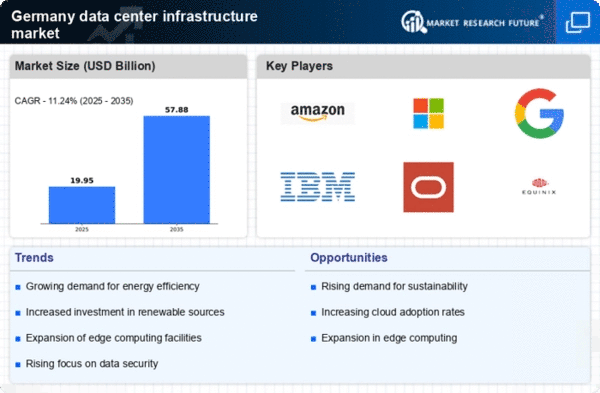
As per Market Research Future analysis, the Germany data center-infrastructure market Size was estimated at 17.93 USD Billion in 2024. The Germany data center-infrastructure market is projected to grow from 19.95 USD Billion in 2025 to 57.88 USD Billion by 2035, exhibiting a compound annual growth rate (CAGR) of 11.2% during the forecast period 2025 - 2035

Key Market Trends & Highlights

The Germany data center-infrastructure market is experiencing robust growth driven by technological advancements and sustainability initiatives.

  • The demand for cloud services continues to surge, positioning the cloud segment as the largest in the market.
  • Sustainability efforts are increasingly influencing infrastructure decisions, with a notable shift towards renewable energy sources.
  • Advanced technologies, including AI and machine learning, are being rapidly adopted, making this segment the fastest-growing.
  • Rising data consumption and regulatory compliance requirements are key drivers propelling market expansion.

Market Size & Forecast

2024 Market Size 17.93 (USD Billion)
2035 Market Size 57.88 (USD Billion)
CAGR (2025 - 2035) 11.24%

Major Players

Amazon (US), Microsoft (US), Google (US), IBM (US), Oracle (US), Equinix (US), Digital Realty (US), Alibaba (CN), NTT Communications (JP)

Our Impact
Enabled $4.3B Revenue Impact for Fortune 500 and Leading Multinationals
Partnering with 2000+ Global Organizations Each Year
30K+ Citations by Top-Tier Firms in the Industry

Germany Data Center Infrastructure Market Trends

The data center infrastructure market is currently experiencing a transformative phase, driven by the increasing demand for cloud services and digital transformation initiatives across various sectors. As organizations continue to migrate their operations to the cloud, the need for robust and efficient data center infrastructure becomes paramount. This shift is further fueled by advancements in technology, such as artificial intelligence and machine learning, which require substantial computational power and storage capabilities. Consequently, companies are investing in modernizing their data center facilities to enhance performance, scalability, and energy efficiency. Moreover, sustainability has emerged as a critical focus within the data center-infrastructure market. With growing awareness of environmental issues, organizations are seeking to implement greener practices in their operations. This includes utilizing renewable energy sources, optimizing cooling systems, and adopting energy-efficient hardware. The German government has also been proactive in promoting sustainable practices, providing incentives for companies that prioritize eco-friendly solutions. As a result, the market is likely to witness a surge in innovative technologies aimed at reducing carbon footprints and improving overall sustainability in data center operations.

Increased Demand for Cloud Services

The ongoing digital transformation across various industries is driving a heightened demand for cloud services. Organizations are increasingly migrating their operations to the cloud, necessitating the development of advanced data center infrastructure to support this transition. This trend indicates a shift towards more scalable and flexible solutions that can accommodate fluctuating workloads.

Focus on Sustainability

Sustainability has become a pivotal concern within the data center-infrastructure market. Companies are actively seeking to implement eco-friendly practices, such as utilizing renewable energy sources and optimizing energy consumption. This trend is further supported by government initiatives aimed at promoting environmentally responsible operations.

Adoption of Advanced Technologies

The integration of advanced technologies, such as artificial intelligence and machine learning, is reshaping the data center-infrastructure market. These technologies require significant computational resources, prompting organizations to invest in modern infrastructure that can handle increased processing demands and enhance operational efficiency.

Germany Data Center Infrastructure Market Drivers

Rising Data Consumption

The data center infrastructure market is experiencing a surge in demand driven by the exponential growth of data consumption. With the increasing reliance on digital services, businesses are generating vast amounts of data that require robust infrastructure to store and process. Reports indicate that data traffic in Germany is projected to grow by over 30% annually, necessitating the expansion of data center capabilities. This trend compels organizations to invest in advanced data center technologies to ensure efficient data management and accessibility. Consequently, the rising data consumption is a pivotal driver for the data center-infrastructure market, as companies seek to enhance their operational efficiency and meet customer expectations.

Shift Towards Edge Computing

The data center infrastructure market is witnessing a notable shift towards edge computing, driven by the need for low-latency processing and real-time data analysis. As industries increasingly adopt IoT devices and smart technologies, the demand for localized data processing becomes critical. Edge computing reduces the distance data must travel, thereby enhancing response times and improving overall system performance. This trend is particularly relevant in sectors such as manufacturing and healthcare, where timely data access is essential. Consequently, the transition to edge computing is likely to propel investments in data center infrastructure, as organizations seek to optimize their operations and leverage the benefits of real-time data processing.

Regulatory Compliance Requirements

In Germany, stringent regulatory frameworks are shaping the data center-infrastructure market. Organizations are mandated to comply with various data protection laws, such as the General Data Protection Regulation (GDPR), which imposes strict guidelines on data handling and storage. This regulatory environment compels businesses to invest in secure and compliant data center solutions. The need for compliance not only drives infrastructure upgrades but also influences the design and operation of data centers. As companies strive to avoid hefty fines and reputational damage, the focus on regulatory compliance emerges as a significant driver for the data center-infrastructure market, prompting investments in secure technologies and practices.

Increased Investment in Renewable Energy

The data center-infrastructure market in Germany is significantly influenced by the growing emphasis on renewable energy sources. As sustainability becomes a priority for businesses, many data centers are transitioning to renewable energy to power their operations. Reports suggest that over 50% of data centers in Germany are now utilizing renewable energy sources, such as wind and solar power. This shift not only aligns with environmental goals but also reduces operational costs in the long run. The commitment to renewable energy is a crucial driver for the data center-infrastructure market, as organizations seek to enhance their sustainability profiles while maintaining efficient and reliable operations.

Technological Advancements in Infrastructure

The data center-infrastructure market in Germany is propelled by rapid technological advancements that enhance operational efficiency and performance. Innovations such as artificial intelligence, machine learning, and automation are transforming how data centers operate. These technologies enable predictive maintenance, optimize resource allocation, and improve energy efficiency. As organizations strive to remain competitive, the adoption of these advanced technologies is becoming increasingly prevalent. The integration of cutting-edge solutions not only boosts the performance of data centers but also reduces operational costs. Thus, technological advancements serve as a vital driver for the data center-infrastructure market, encouraging continuous investment in modern infrastructure.

Market Segment Insights

By Component: Hardware (Largest) vs. Services (Fastest-Growing)

In the Germany data center-infrastructure market, the market share distribution among the component values reveals that Hardware holds the largest segment, reflecting the critical foundational role it plays in data center operations. This segment comprises servers, storage devices, and networking equipment, which are essential for managing data workloads efficiently. On the other hand, Services, encompassing a range of offerings from support to consulting, is gaining traction, indicating a shift towards comprehensive solutions that enhance operational efficiency through managed services and cloud integration. Growth trends in the Germany data center-infrastructure market indicate a robust increase in the demand for Software and Services, driven by advancements in cloud computing and the need for agile IT solutions. Organizations are increasingly seeking to optimize their infrastructure through automation and virtualization, which bolster the role of Software. As businesses embrace digital transformation, the Services segment experiences accelerated growth as providers offer innovative solutions tailored to evolving operational needs.

Hardware: Dominant vs. Services: Emerging

The Hardware segment remains dominant in the Germany data center-infrastructure market due to its integral role in providing the necessary infrastructure for data processing and storage. This segment is characterized by continuous innovations in hardware technology, including high-performance servers and energy-efficient storage solutions. Meanwhile, the Services segment is emerging rapidly, driven by the increasing complexity of data management and the demand for specialized support. While Hardware serves as the backbone, Services are becoming essential for businesses aiming to leverage technology efficiently. The interplay between these two segments highlights a trend where investment in advanced Hardware is complemented by a growing reliance on tailored Services to maximize operational performance in data centers.

By Data Center Type: Colocation Data Center (Largest) vs. Edge Data Center (Fastest-Growing)

Within the Germany data center-infrastructure market, the distribution of market share reveals that colocation data centers dominate the landscape, catering to a diverse range of businesses seeking scalable and flexible solutions. In contrast, cloud and enterprise data centers hold a significant portion of the market, primarily supporting larger organizations with robust data needs. Edge data centers, while currently smaller in share, are rapidly gaining traction as businesses recognize the need for low-latency processing and localized data management. The growth trends within the data center type segment in Germany are largely driven by the increasing reliance on digital services and the demand for efficient data processing solutions. Colocation data centers benefit from this trend, providing vital infrastructure for distributed networks. Meanwhile, edge data centers are emerging as a critical component of the evolving landscape, addressing the rising challenges of real-time data processing by bringing data closer to the source, thereby enhancing performance and operational efficiency.

Colocation Data Center (Dominant) vs. Edge Data Center (Emerging)

Colocation data centers are characterized by their ability to offer shared facilities that enable multiple tenants to house their IT equipment within secure and reliable environments, making them the dominant choice for many organizations in the Germany data center-infrastructure market. They provide businesses with essential connectivity options, energy efficiency, and scalability, which are crucial for supporting growing data needs. On the other hand, edge data centers represent an emerging trend focused on optimizing data processing speed and efficiency by situating smaller facilities closer to end-users. This model appeals particularly to sectors requiring immediate data processing, such as IoT applications and real-time analytics, indicating a significant shift towards more decentralized data management solutions.

By Tier Type: Tier 3 (Largest) vs. Tier 4 (Fastest-Growing)

In the Germany data center-infrastructure market, the distribution of market share among tier types reveals that Tier 3 dominates the landscape, serving as the backbone for many data center operations due to its balance of efficiency and reliability. Meanwhile, Tier 4 is witnessing rapid adoption, driven by the increasing demand for high-availability infrastructure that can manage critical workloads and support business continuity. The growth trends in this segment are significantly influenced by technological advancements and a push towards increased operational efficiency. Enterprises are particularly gravitating towards Tier 4 solutions, recognizing their capacity for minimizing downtime and their robust security features. This trend is expected to enhance market dynamics, further propelling the growth of Tier 4 setups as organizations prioritize resilience in their digital infrastructure.

Tier 3 (Dominant) vs. Tier 4 (Emerging)

Tier 3 facilities are characterized by their redundant capacity components, ensuring that systems can remain operational even during maintenance or outages. This tier is widely regarded as the standard for most businesses, offering a well-defined balance of performance, efficiency, and cost. In contrast, Tier 4 represents the pinnacle of data center design with complete fault tolerance, allowing for continuous operation without disruptions. This segment appeals to organizations with mission-critical operations, reflecting the growing trend towards higher standards of reliability in infrastructure. As businesses evolve, the emphasis on Tier 4 facilities is becoming more pronounced, indicating a shift towards maximizing uptime and operational stability.

By Vertical: IT & Telecom (Largest) vs. Healthcare (Fastest-Growing)

The market share distribution in the Germany data center-infrastructure market indicates that the IT & Telecom sector holds the largest share, driven by the ongoing digitization and demand for cloud services. Other significant sectors like Healthcare, Financial Services, and Retail also contribute to the market, but their shares are comparatively smaller, representing diverse applications in data handling and processing requirements. Growth trends in this market show that the Healthcare segment is emerging as the fastest-growing vertical, fueled by increased investments in technology to improve patient care and regulatory requirements for data security. Additionally, sectors such as Manufacturing and Energy are also witnessing growth as they adapt digital transformations and sustainable practices, thereby enhancing their infrastructure capabilities.

IT & Telecom (Dominant) vs. Healthcare (Emerging)

The IT & Telecom sector serves as the dominant force in the Germany data center-infrastructure market, characterized by large-scale operations and robust infrastructure to support vast networks and data traffic. This sector is essential for enabling seamless communication and connectivity. In contrast, the Healthcare sector is gaining momentum as an emerging segment, driven by the need for advanced technology in patient management and telemedicine. These two sectors exhibit distinct characteristics, with IT & Telecom focusing on high-capacity data management, while Healthcare emphasizes secure, compliant infrastructures to protect sensitive patient information and improve operational efficiencies.

Get more detailed insights about Germany Data Center Infrastructure Market

Key Players and Competitive Insights

The data center-infrastructure market in Germany is characterized by a dynamic competitive landscape, driven by increasing demand for cloud services, data storage, and digital transformation initiatives. Major players such as Amazon (US), Microsoft (US), and Google (US) are strategically positioned to leverage their extensive resources and technological expertise. Amazon (US) focuses on expanding its AWS services, while Microsoft (US) emphasizes its Azure platform, both aiming to capture a larger share of the growing enterprise market. Google (US) is also enhancing its cloud offerings, indicating a collective push towards innovation and service diversification that shapes the competitive environment.
Key business tactics employed by these companies include localizing operations and optimizing supply chains to enhance service delivery. The market appears moderately fragmented, with a mix of established giants and emerging players. This structure allows for competitive dynamics where larger firms can exert significant influence, yet smaller entities can carve out niches through specialized services or regional focus.
In October 2025, Amazon (US) announced the opening of a new data center in Frankfurt, aimed at bolstering its AWS infrastructure in Europe. This strategic move is likely to enhance its service reliability and reduce latency for European customers, thereby strengthening its competitive position in the region. The expansion aligns with the growing demand for cloud services, particularly among enterprises seeking robust data solutions.
In September 2025, Microsoft (US) unveiled a partnership with a local energy provider to implement renewable energy solutions for its data centers in Germany. This initiative not only underscores Microsoft's commitment to sustainability but also positions the company favorably in a market increasingly focused on environmentally responsible practices. Such partnerships may enhance Microsoft's brand reputation and appeal to eco-conscious clients.
In August 2025, Google (US) launched a new AI-driven analytics tool integrated into its cloud services, aimed at optimizing data management for businesses. This innovation reflects a broader trend towards AI integration within data center operations, potentially providing Google with a competitive edge by offering advanced capabilities that meet evolving customer needs. The emphasis on AI suggests a shift towards more intelligent data solutions, which could redefine service offerings in the market.
As of November 2025, current trends in the data center-infrastructure market include a pronounced focus on digitalization, sustainability, and AI integration. Strategic alliances are increasingly shaping the competitive landscape, enabling companies to pool resources and expertise. The evolution of competitive differentiation appears to be moving away from price-based competition towards innovation, technology, and supply chain reliability. This shift indicates that companies that prioritize these aspects may be better positioned to thrive in the future.

Key Companies in the Germany Data Center Infrastructure Market include

Industry Developments

Recent developments in the Germany Data Center Infrastructure Market have shown significant growth and evolution, marked by companies like Deutsche Telekom and Equinix expanding their footprints. In October 2023, Deutsche Telekom announced plans to enhance its data center services, emphasizing sustainability and efficiency. NTT Communications has also made strides in energy-efficient designs, propelling advancements in green technology within data centers. In terms of mergers and acquisitions, in August 2023, Digital Realty acquired a data center facility in Frankfurt from a leading regional firm, enhancing its operational capability in Germany.

The market is witnessing increasing interest from major players like Amazon Web Services and IBM as they target the growing demand for cloud services among enterprises in Germany. The German government has been actively promoting digital infrastructure, which has led to an uptick in investments within the sector. Companies like CyrusOne and Telehouse are also enhancing their offerings, maintaining competitiveness in a rapidly evolving landscape. These advancements underline the rapidly growing market, focusing on efficiency and sustainability to meet the increasing demand for data processing and storage solutions in Germany.

Future Outlook

Germany Data Center Infrastructure Market Future Outlook

The data center-infrastructure market in Germany is poised for growth at 11.24% CAGR from 2025 to 2035, driven by increased cloud adoption, energy efficiency demands, and technological advancements.

New opportunities lie in:

  • Development of modular data center solutions for rapid deployment.
  • Investment in AI-driven energy management systems to optimize efficiency.
  • Expansion of edge computing facilities to enhance service delivery.

By 2035, the market is expected to achieve robust growth, reflecting evolving technological needs.

Market Segmentation

Germany Data Center Infrastructure Market Vertical Outlook

  • IT & Telecom
  • Healthcare
  • Financial Services
  • Retail
  • Manufacturing
  • Energy
  • Government
  • Others

Germany Data Center Infrastructure Market Component Outlook

  • Hardware
  • Software
  • Services

Germany Data Center Infrastructure Market Tier Type Outlook

  • Tier 1
  • Tier 2
  • Tier 3
  • Tier 4

Germany Data Center Infrastructure Market Data Center Type Outlook

  • Enterprise Data Center
  • Colocation Data Center
  • Cloud Data Center
  • Edge Data Center

Report Scope

MARKET SIZE 2024 17.93(USD Billion)
MARKET SIZE 2025 19.95(USD Billion)
MARKET SIZE 2035 57.88(USD Billion)
COMPOUND ANNUAL GROWTH RATE (CAGR) 11.24% (2025 - 2035)
REPORT COVERAGE Revenue Forecast, Competitive Landscape, Growth Factors, and Trends
BASE YEAR 2024
Market Forecast Period 2025 - 2035
Historical Data 2019 - 2024
Market Forecast Units USD Billion
Key Companies Profiled Amazon (US), Microsoft (US), Google (US), IBM (US), Oracle (US), Equinix (US), Digital Realty (US), Alibaba (CN), NTT Communications (JP)
Segments Covered Component, Data Center Type, Tier Type, Vertical
Key Market Opportunities Adoption of sustainable energy solutions drives growth in the data center-infrastructure market.
Key Market Dynamics Growing demand for energy-efficient solutions drives innovation in the data center-infrastructure market.
Countries Covered Germany
Leave a Comment

FAQs

What is the expected market size of the Germany Data Center Infrastructure Market in 2024?

The Germany Data Center Infrastructure Market is expected to be valued at 20.54 USD Billion in 2024.

What will the market size of the Germany Data Center Infrastructure Market be in 2035?

By 2035, the Germany Data Center Infrastructure Market is projected to reach a value of 61.63 USD Billion.

What is the expected compound annual growth rate (CAGR) for the Germany Data Center Infrastructure Market from 2025 to 2035?

The market is anticipated to grow at a CAGR of 10.504% from 2025 to 2035.

What is the market size for hardware in the Germany Data Center Infrastructure Market in 2024?

The hardware segment of the Germany Data Center Infrastructure Market is anticipated to be valued at 8.0 USD Billion in 2024.

What will be the market value of services in the Germany Data Center Infrastructure Market by 2035?

The services segment is expected to reach a market value of 22.63 USD Billion by 2035.

Who are the key players in the Germany Data Center Infrastructure Market?

Major players in the market include globally recognized names such as CyrusOne, Global Switch, NTT Communications, and Equinix.

What is the projected market size for software in the Germany Data Center Infrastructure Market in 2035?

The software segment is projected to grow to a market size of 15.0 USD Billion by 2035.

What are some emerging trends in the Germany Data Center Infrastructure Market?

Key emerging trends include increased demand for cloud services and advancements in energy-efficient infrastructure.

What opportunities does the Germany Data Center Infrastructure Market present?

The market offers opportunities driven by the ongoing digital transformation and rising data center needs across various sectors.

What growth drivers are influencing the Germany Data Center Infrastructure Market?

Growth drivers include cloud computing adoption, rising data storage needs, and increasing consumption of digital content.

Download Free Sample

Kindly complete the form below to receive a free sample of this Report

Compare Licence

×
Features License Type
Single User Multiuser License Enterprise User
Price $4,950 $5,950 $7,250
Maximum User Access Limit 1 User Upto 10 Users Unrestricted Access Throughout the Organization
Free Customization
Direct Access to Analyst
Deliverable Format
Platform Access
Discount on Next Purchase 10% 15% 15%
Printable Versions