×
Request Free Sample ×

Kindly complete the form below to receive a free sample of this Report

* Please use a valid business email

Leading companies partner with us for data-driven Insights

clients tt-cursor
Hero Background

Germany Chocolate Market

ID: MRFR/FnB/42836-HCR
128 Pages
Snehal Singh
February 2026

Germany Chocolate Market Size, Share, Industry Trend & Analysis Research Report By Chocolate Products Outlook (Dark Chocolate, Milk Chocolate, White Chocolate, Cocoa Powder), By Chocolate Form Outlook (Chocolate Bars, Liquid Chocolate, Truffles Chocolate) and By Chocolate Category Outlook (Conventional, Organic, Lactose-Free, Gluten-Free, Reduced Sugar, Zero Sugar, Multi-Claim)- Forecast to 2035

Share:
Download PDF ×

We do not share your information with anyone. However, we may send you emails based on your report interest from time to time. You may contact us at any time to opt-out.

Germany Chocolate Market Infographic
Purchase Options

Germany Chocolate Market Summary

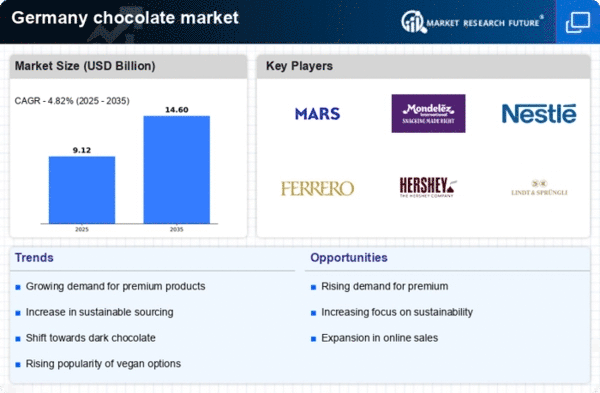
As per Market Research Future analysis, the Germany chocolate market Size was estimated at 8.7 USD Billion in 2024. The Germany chocolate market is projected to grow from 9.12 USD Billion in 2025 to 14.6 USD Billion by 2035, exhibiting a compound annual growth rate (CAGR) of 4.8% during the forecast period 2025 - 2035

Key Market Trends & Highlights

The Germany chocolate market is experiencing a dynamic shift towards premiumization and health-conscious options.

  • The premiumization trend is driving consumers towards higher-quality chocolate products, particularly in the largest segment of dark chocolate.
  • Plant-based chocolate options are rapidly gaining traction, making them the fastest-growing segment in the market.
  • E-commerce is becoming an increasingly important channel for chocolate sales, reflecting changing consumer shopping behaviors.
  • Health consciousness and sustainability initiatives are major drivers influencing chocolate consumption patterns.

Market Size & Forecast

2024 Market Size 8.7 (USD Billion)
2035 Market Size 14.6 (USD Billion)
CAGR (2025 - 2035) 4.82%

Major Players

Mars Inc (US), Mondelez International (US), Nestle SA (CH), Ferrero Group (IT), Hershey Co (US), Lindt & Sprüngli AG (CH), Côte d'Or (BE), Ghirardelli Chocolate Company (US), Godiva Chocolatier (BE)

Our Impact
Enabled $4.3B Revenue Impact for Fortune 500 and Leading Multinationals
Partnering with 2000+ Global Organizations Each Year
30K+ Citations by Top-Tier Firms in the Industry

Germany Chocolate Market Trends

The chocolate market in Germany exhibits a dynamic landscape characterized by evolving consumer preferences and innovative product offerings. As of November 2025, there is a noticeable shift towards premium and artisanal chocolates, reflecting a growing demand for high-quality ingredients and unique flavors. This trend appears to be driven by consumers' increasing awareness of health and sustainability, leading them to seek out products that align with their values. Furthermore, the rise of e-commerce platforms has transformed the way consumers access chocolate, allowing for greater variety and convenience in purchasing decisions. In addition to premiumization, the chocolate market is witnessing a surge in demand for plant-based and organic options. This shift suggests that consumers are becoming more health-conscious and environmentally aware, prompting manufacturers to adapt their offerings accordingly. The emphasis on transparency in sourcing and production processes is also becoming more pronounced, as consumers seek assurance regarding the ethical implications of their purchases. Overall, the chocolate market in Germany is evolving rapidly, with trends indicating a future that prioritizes quality, sustainability, and consumer engagement.

Premiumization of Chocolate Products

There is a growing trend towards premium and artisanal chocolates, as consumers increasingly seek high-quality ingredients and unique flavors. This shift reflects a desire for indulgence and a willingness to pay more for superior products.

Rise of Plant-Based Options

The demand for plant-based and organic chocolates is on the rise, driven by health-conscious consumers. This trend indicates a shift towards more sustainable and ethical consumption patterns.

E-Commerce Growth in Chocolate Sales

The expansion of e-commerce platforms is transforming the chocolate market, providing consumers with greater access to a diverse range of products. This trend enhances convenience and variety in purchasing decisions.

Germany Chocolate Market Drivers

Cultural Celebrations and Chocolate Gifting

Cultural traditions and celebrations play a pivotal role in shaping the chocolate market in Germany. Events such as Easter and Christmas see a surge in chocolate gifting, with consumers purchasing premium products for family and friends. This seasonal demand contributes significantly to overall sales, with estimates suggesting that holiday-related chocolate sales account for nearly 40% of annual revenue in the market. As gifting remains a cherished tradition, the chocolate market is poised to benefit from continued consumer engagement during festive periods, driving sustained growth.

Health Consciousness and Chocolate Consumption

The increasing awareness of health and wellness among consumers appears to be influencing the chocolate market in Germany. As individuals seek indulgent yet healthier options, manufacturers are responding by developing products with reduced sugar, organic ingredients, and added health benefits. For instance, the market for dark chocolate, known for its antioxidant properties, has seen a notable rise, with sales increasing by approximately 15% in recent years. This trend suggests that health-conscious consumers are willing to pay a premium for chocolate products that align with their dietary preferences, thereby driving growth in the chocolate market.

Sustainability Initiatives in Chocolate Production

Sustainability has emerged as a critical driver in the chocolate market, particularly in Germany, where consumers are increasingly concerned about ethical sourcing and environmental impact. Many companies are adopting sustainable practices, such as sourcing cocoa from certified farms and implementing eco-friendly packaging solutions. This shift is not only appealing to environmentally conscious consumers but also aligns with regulatory pressures for sustainable practices. Reports indicate that around 30% of chocolate products in Germany now carry sustainability certifications, reflecting a significant commitment to responsible sourcing and production within the chocolate market.

Technological Advancements in Chocolate Manufacturing

Technological innovations are transforming the chocolate market in Germany, enhancing production efficiency and product quality. Advances in processing techniques, such as conching and tempering, allow manufacturers to create smoother textures and richer flavors. Additionally, automation in production lines is reducing costs and improving consistency. Market analysis indicates that companies investing in technology are likely to see a competitive edge, as consumers increasingly demand high-quality products. This trend suggests that the chocolate market will continue to evolve, driven by the integration of cutting-edge technology in manufacturing processes.

Innovative Flavor Profiles and Product Diversification

The chocolate market in Germany is experiencing a wave of innovation, with manufacturers introducing unique flavor profiles and product variations to attract diverse consumer segments. From exotic spices to local ingredients, the incorporation of unconventional flavors is becoming increasingly popular. This trend is supported by market data indicating that specialty chocolate products have seen a growth rate of approximately 20% over the past year. As consumers seek novel experiences, the chocolate market is likely to continue evolving, with brands experimenting with limited-edition flavors and artisanal offerings to capture consumer interest.


Market Segment Insights

By Type: Milk Chocolate (Largest) vs. Dark Chocolate (Fastest-Growing)

In the Germany chocolate market, Milk Chocolate holds the largest share among the different types, appealing to a broad customer base due to its creamy texture and sweetness. Following closely, Dark Chocolate is gaining traction, especially among health-conscious consumers, contributing to an evolving market landscape. White Chocolate and Ruby Chocolate, while niche, are also making their presence felt by targeting specific consumer segments with unique flavor profiles.

Milk Chocolate: Dominant vs. Dark Chocolate: Emerging

Milk Chocolate is characterized by its rich, sweet flavor and smooth texture, making it a staple in the chocolate industry. Its widespread popularity encompasses various product forms, from bars to confections, catering to diverse taste preferences. On the other hand, Dark Chocolate is emerging rapidly, prized for its health benefits and higher cocoa content. This segment is favored by consumers seeking indulgence without compromising on wellness, effectively driving innovation and variety in product offerings.

By Distribution Channel: Supermarkets (Largest) vs. Online Retail (Fastest-Growing)

In the Germany chocolate market, supermarkets hold the largest share of distribution channels, dominating through their wide reach and extensive product ranges. Convenience stores and specialty stores also play significant roles, though they cater to niche segments and have a smaller market presence. Online retail is gaining traction, showcasing an evolving consumer preference for shopping convenience and accessibility through e-commerce platforms. The growth trends in the distribution channel segment are driven by changing consumer behaviors and technological advancements. The shift towards online shopping has made online retail the fastest-growing channel, supported by an increasing number of consumers opting for delivery services. Meanwhile, supermarkets continue to thrive due to their established customer base and ability to combine in-store promotions with online offerings, thus maintaining their dominant position.

Supermarkets: Dominant vs. Online Retail: Emerging

Supermarkets are the dominant distribution channel in the Germany chocolate market, leveraging their extensive networks and attractive in-store displays to capture consumer attention. Their ability to provide variety and competitive pricing makes them a preferred choice for many shoppers. Meanwhile, online retail, though emerging, is rapidly carving out its niche, appealing particularly to the tech-savvy demographic that values convenience and home delivery services. The growth of online platforms is accentuated by innovative marketing strategies and partnerships with local chocolate brands, further enhancing the consumer experience. As a result, while supermarkets remain at the forefront, online retail is poised for significant expansion in the coming years.

By Formulation: Bars (Largest) vs. Chips (Fastest-Growing)

In the Germany chocolate market, the formulation segment is led by Bars, which command the largest market share due to their popularity and versatility. Chips and Beverages follow, capturing notable segments of the market, while Pouches hold a smaller share. The distribution reflects consumer preferences for convenient and indulgent chocolate options, with Bars being widely favored across various demographics. Chips have gained remarkable traction as a baking ingredient and snack option, further contributing to the segment's diverse dynamics. The growth trends in this segment are primarily driven by the increasing demand for innovative flavors and formats. Health-conscious consumers are shifting towards products with premium ingredients, creating growth opportunities for high-quality Chips and innovative Beverages. Moreover, the rise of e-commerce has enhanced accessibility, allowing consumers to explore a wider range of chocolate formulations. The trend towards sustainable practices is also influencing manufacturing choices, thereby promoting the growth of Bars and eco-friendly packaging in Pouches.

Bars (Dominant) vs. Pouches (Emerging)

Bars are the dominant force in the Germany chocolate market, characterized by a wide array of flavors, formats, and sizes that cater to a broad audience. Their status is bolstered by strong brand loyalty and a variety of marketing strategies targeting diverse consumer segments. In contrast, Pouches represent an emerging segment, appealing particularly to on-the-go consumers who prioritize convenience and portion control. These products often feature resealable packaging, enhancing their attractiveness. As manufacturers innovate with flavor combinations and health-oriented options, Pouches are positioned to capture niche markets, indicating a positive growth trajectory in response to changing consumer preferences.

By End Use: Baking (Largest) vs. Confectionery (Fastest-Growing)

In the Germany chocolate market, the end use segments showcase distinct market shares with significant characteristics. Baking holds the largest share due to its traditional usage, being heavily integrated into desserts and pastries. Confectionery follows closely, but it represents a dynamic market with a growing presence in various sweet products. Snacking, though present, occupies a smaller share compared to the leaders, reflecting its role as an emerging segment that is gradually gaining attention. The growth trends in the chocolate market, especially in relation to these segments, suggest that convenience and indulgence are primary drivers. Confectionery is rapidly evolving, attracting consumers with innovative flavors and packaging. Meanwhile, baking remains steadfast, driven by consistent demand for wholesome and artisanal products. Snacking is expected to grow as consumers increasingly seek on-the-go options and healthier choices, indicating a shift in preferences towards more versatile chocolate forms.

Baking: Traditional (Dominant) vs. Snacking (Emerging)

The baking segment in the Germany chocolate market is characterized by its traditional use in a wide array of baked goods, from cakes to cookies, making it a dominant force. This segment thrives on its established consumer base that values quality and indulgence in their desserts. In contrast, the snacking segment is emerging, driven by changing consumer lifestyles that favor quick, portable chocolate options. Snacking products are often marketed as healthier alternatives, catering to a growing demand for convenience and variety. Brands are innovating continuously in this area, aiming to capture a segment of on-the-go consumers, thus shaping an evolving competitive landscape.

Get more detailed insights about Germany Chocolate Market

Key Players and Competitive Insights

The chocolate market in Germany exhibits a dynamic competitive landscape characterized by a blend of innovation, sustainability, and strategic partnerships. Key players such as Mars Inc (US), Mondelez International (US), and Lindt & Sprüngli AG (CH) are actively shaping the market through diverse operational focuses. Mars Inc (US) emphasizes product innovation, particularly in the realm of health-conscious offerings, while Mondelez International (US) is enhancing its digital transformation efforts to better engage consumers. Lindt & Sprüngli AG (CH), on the other hand, is concentrating on premiumization and expanding its presence in the e-commerce sector. Collectively, these strategies contribute to a competitive environment that is increasingly focused on meeting evolving consumer preferences and leveraging technology.
In terms of business tactics, companies are localizing manufacturing to reduce supply chain vulnerabilities and optimize costs. The market structure appears moderately fragmented, with several key players holding substantial market shares. This fragmentation allows for a variety of product offerings, catering to diverse consumer tastes. However, the influence of major companies remains significant, as they set trends and standards that smaller players often follow.
In October 2025, Mondelez International (US) announced a partnership with a leading tech firm to enhance its supply chain efficiency through AI-driven analytics. This strategic move is likely to streamline operations, reduce costs, and improve responsiveness to market demands. By integrating advanced technology into its supply chain, Mondelez aims to maintain its competitive edge in a rapidly evolving market.
In September 2025, Lindt & Sprüngli AG (CH) launched a new line of organic chocolate products, reflecting a growing consumer preference for sustainable and ethically sourced ingredients. This initiative not only aligns with current market trends but also positions Lindt as a leader in the premium chocolate segment. The emphasis on organic offerings may attract health-conscious consumers and enhance brand loyalty.
In August 2025, Mars Inc (US) expanded its product range by introducing a new line of plant-based chocolates. This strategic decision appears to be a response to the increasing demand for vegan and plant-based options among consumers. By diversifying its product portfolio, Mars is likely to capture a broader audience and strengthen its market position.
As of November 2025, the chocolate market is witnessing trends such as digitalization, sustainability, and the integration of AI technologies. Strategic alliances are becoming increasingly important, as companies collaborate to enhance their capabilities and market reach. The competitive differentiation is expected to evolve, shifting from traditional price-based competition to a focus on innovation, technology, and supply chain reliability. This transition suggests that companies that prioritize these aspects will likely thrive in the future.

Key Companies in the Germany Chocolate Market include

Industry Developments

The Germany Chocolate Market has witnessed several noteworthy developments. As of September 2023, the market has shown resilience, with key players like Mars and Ferrero reporting a significant increase in sales due to growing consumer preference for premium chocolates. In August 2023, Storck announced the launch of a new organic chocolate line, emphasizing sustainability and health-conscious options, which align with evolving consumer trends. Häagen-Dazs has also expanded its offerings by introducing a range of artisan chocolates, catering to the premium segment of the market.

In terms of mergers, there have been no publicly confirmed acquisitions relating to the mentioned companies that have emerged in recent months. However, significant growth in the chocolate sector has been driven by innovations in flavors and healthier options, reflecting the broader trends in German confectionery. Additionally, Ritter Sport has been proactive in sustainable packaging, which is becoming increasingly important to environmentally aware consumers. The market continues to evolve with an increasing emphasis on quality and sustainability, which is shaping consumer choices in Germany's competitive chocolate landscape.

Future Outlook

Germany Chocolate Market Future Outlook

The Chocolate Market in Germany is projected to grow at 4.82% CAGR from 2025 to 2035, driven by increasing consumer demand for premium products and innovative flavors.

New opportunities lie in:

  • Expansion of e-commerce platforms for direct-to-consumer sales.
  • Development of sustainable sourcing programs to attract eco-conscious consumers.
  • Introduction of personalized chocolate subscription services for enhanced customer engagement.

By 2035, the chocolate market is expected to achieve robust growth, reflecting evolving consumer preferences and innovative strategies.

Market Segmentation

Germany Chocolate Market Type Outlook

  • Milk Chocolate
  • Dark Chocolate
  • White Chocolate
  • Ruby Chocolate

Germany Chocolate Market End Use Outlook

  • Baking
  • Confectionery
  • Snacking

Germany Chocolate Market Formulation Outlook

  • Bars
  • Chips
  • Beverages
  • Pouches

Germany Chocolate Market Distribution Channel Outlook

  • Supermarkets
  • Convenience Stores
  • Online Retail
  • Specialty Stores

Report Scope

MARKET SIZE 2024 8.7(USD Billion)
MARKET SIZE 2025 9.12(USD Billion)
MARKET SIZE 2035 14.6(USD Billion)
COMPOUND ANNUAL GROWTH RATE (CAGR) 4.82% (2025 - 2035)
REPORT COVERAGE Revenue Forecast, Competitive Landscape, Growth Factors, and Trends
BASE YEAR 2024
Market Forecast Period 2025 - 2035
Historical Data 2019 - 2024
Market Forecast Units USD Billion
Key Companies Profiled Mars Inc (US), Mondelez International (US), Nestle SA (CH), Ferrero Group (IT), Hershey Co (US), Lindt & Sprüngli AG (CH), Côte d'Or (BE), Ghirardelli Chocolate Company (US), Godiva Chocolatier (BE)
Segments Covered Type, Distribution Channel, Formulation, End Use
Key Market Opportunities Growing demand for premium and sustainable chocolate products driven by changing consumer preferences.
Key Market Dynamics Shifting consumer preferences towards premium and sustainable chocolate products influence market dynamics in Germany.
Countries Covered Germany
Leave a Comment

FAQs

What is the expected market size of the Germany Chocolate Market in 2024?

The Germany Chocolate Market is expected to be valued at 8.9 billion USD in 2024.

What will be the market size of the Germany Chocolate Market in 2035?

The market is projected to reach a valuation of 15.0 billion USD by 2035.

What is the expected CAGR for the Germany Chocolate Market from 2025 to 2035?

The compound annual growth rate for the market is anticipated to be 4.86 percent from 2025 to 2035.

What are the market values for Dark Chocolate in 2024 and 2035?

In 2024, the market value for Dark Chocolate is expected to be 2.2 billion USD and will grow to 3.7 billion USD by 2035.

What is the market value of Milk Chocolate in 2024?

The Milk Chocolate segment is expected to be valued at 4.3 billion USD in 2024.

What will the market value of White Chocolate be in 2035?

The market value of White Chocolate is projected to reach 1.8 billion USD by 2035.

What is the expected market value for Cocoa Powder in 2024?

The Cocoa Powder segment is expected to be valued at 1.4 billion USD in 2024.

Who are the key players in the Germany Chocolate Market?

Key players in the market include Mars, Storck, Toblerone, Häagen-Dazs, and Ferrero among others.

What market opportunities are driving growth in the Germany Chocolate Market?

Increasing demand for premium and dark chocolate options is driving growth opportunities in the market.

What challenges are currently faced by the Germany Chocolate Market?

Challenges include rising raw material costs and changing consumer preferences towards healthier options.

Download Free Sample

Kindly complete the form below to receive a free sample of this Report

Compare Licence

×
Features License Type
Single User Multiuser License Enterprise User
Price $4,950 $5,950 $7,250
Maximum User Access Limit 1 User Upto 10 Users Unrestricted Access Throughout the Organization
Free Customization
Direct Access to Analyst
Deliverable Format
Platform Access
Discount on Next Purchase 10% 15% 15%
Printable Versions