Government Initiatives and Support
The GCC Healthcare Artificial Intelligence Market is significantly influenced by proactive government initiatives aimed at enhancing healthcare delivery through technology. Governments in the region are increasingly recognizing the potential of AI to improve healthcare services and are investing in infrastructure and policies that support its integration. For instance, the Saudi Vision 2030 and the UAE's National Strategy for Artificial Intelligence emphasize the role of AI in transforming healthcare. These initiatives are likely to foster an environment conducive to innovation, encouraging private sector investment and collaboration. As a result, the market is expected to expand, with government-backed projects driving the development and implementation of AI solutions across various healthcare sectors.
Growing Focus on Telemedicine Solutions
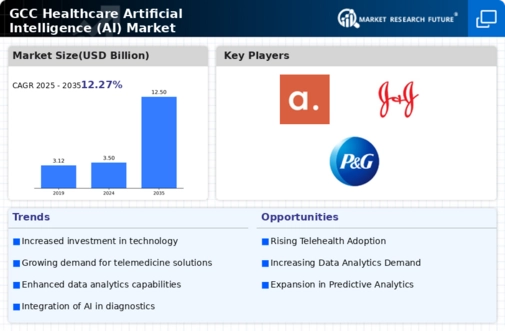
The GCC Healthcare Artificial Intelligence Market is experiencing a surge in the adoption of telemedicine solutions, particularly in light of the increasing need for remote healthcare services. Telemedicine, powered by AI, enables healthcare providers to offer consultations and monitor patients from a distance, thereby improving access to care. The GCC region has seen a significant rise in telehealth platforms, with estimates indicating that the telemedicine market could reach USD 1.5 billion by 2026. This growth is likely to be fueled by the integration of AI technologies that enhance patient engagement and streamline clinical workflows. As healthcare systems in the GCC continue to evolve, the role of AI in telemedicine is expected to expand, driving further investment and innovation in the sector.
Integration of AI in Diagnostic Imaging
The integration of AI technologies in diagnostic imaging is emerging as a pivotal driver for the GCC Healthcare Artificial Intelligence Market. AI algorithms are increasingly being utilized to enhance the accuracy and efficiency of imaging processes, such as MRI and CT scans. This integration not only reduces the time required for diagnosis but also minimizes human error, leading to improved patient outcomes. According to recent data, the market for AI in diagnostic imaging within the GCC is projected to reach USD 1 billion by 2027, reflecting a growing recognition of the benefits that AI can bring to radiology. As healthcare providers continue to adopt these technologies, the demand for AI-driven diagnostic solutions is likely to surge, further propelling market growth.
Rising Demand for Personalized Medicine
The GCC Healthcare Artificial Intelligence Market is witnessing a notable shift towards personalized medicine, driven by the increasing demand for tailored healthcare solutions. Patients are increasingly seeking treatments that are specifically designed to meet their individual needs, which necessitates the integration of AI technologies. AI can analyze vast amounts of patient data, including genetic information, to provide insights that lead to more effective treatment plans. In the GCC region, the market for personalized medicine is projected to grow significantly, with estimates suggesting a compound annual growth rate of over 10% in the coming years. This trend is likely to propel the adoption of AI solutions that facilitate personalized healthcare, thereby enhancing patient outcomes and optimizing resource allocation within healthcare systems.
Advancements in Healthcare Data Management
Advancements in healthcare data management are playing a crucial role in shaping the GCC Healthcare Artificial Intelligence Market. The ability to collect, store, and analyze vast amounts of healthcare data is essential for the effective implementation of AI solutions. In the GCC, healthcare organizations are increasingly investing in data management systems that leverage AI to improve data accuracy and accessibility. This trend is underscored by the fact that the region's healthcare data market is projected to grow at a compound annual growth rate of 12% over the next five years. Enhanced data management capabilities not only facilitate better decision-making but also enable healthcare providers to harness AI for predictive analytics and personalized care, thereby driving the overall growth of the market.