×
Request Free Sample ×

Kindly complete the form below to receive a free sample of this Report

* Please use a valid business email

Leading companies partner with us for data-driven Insights

clients tt-cursor
Hero Background

France E Commerce Market

ID: MRFR/ICT/44624-HCR
200 Pages
Aarti Dhapte
February 2026

France E-Commerce Market Size, Share and Trends Analysis Report By E-commerce Type (Business to Business (B2B), Business to Consumer (B2C)) and By E-commerce Application (Home Appliances, Fashion Products, Groceries, Books, Others) - Forecast to 2035

Share:
Download PDF ×

We do not share your information with anyone. However, we may send you emails based on your report interest from time to time. You may contact us at any time to opt-out.

France E Commerce Market Infographic
Purchase Options

France E Commerce Market Summary

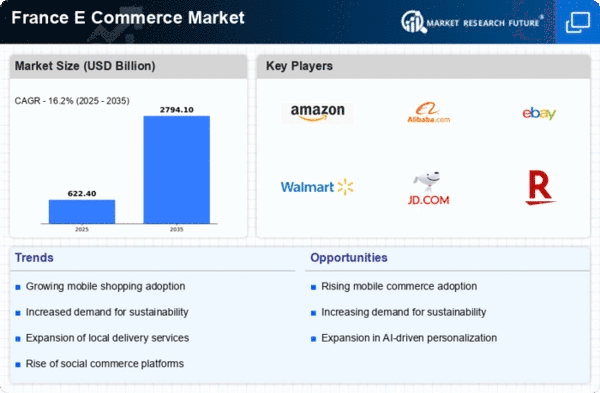
As per Market Research Future analysis, the France E Commerce Market size was estimated at 535.63 USD Billion in 2024. The E Commerce market is projected to grow from 622.4 USD Billion in 2025 to 2794.1 USD Billion by 2035, exhibiting a compound annual growth rate (CAGR) of 16% during the forecast period 2025 - 2035

Key Market Trends & Highlights

The France e commerce market is experiencing robust growth driven by technological advancements and evolving consumer preferences.

  • Mobile commerce is rapidly expanding, indicating a shift towards more convenient shopping experiences.
  • Social commerce is gaining traction, reflecting the increasing influence of social media on consumer purchasing decisions.
  • Sustainability is becoming a focal point for consumers, suggesting a growing demand for eco-friendly products and practices.
  • Technological advancements and changing consumer behavior are key drivers propelling the market forward.

Market Size & Forecast

2024 Market Size 535.63 (USD Billion)
2035 Market Size 2794.1 (USD Billion)
CAGR (2025 - 2035) 16.2%

Major Players

Amazon (US), Alibaba (CN), eBay (US), Walmart (US), JD.com (CN), Rakuten (JP), Zalando (DE), Shopify (CA), Otto (DE)

Our Impact
Enabled $4.3B Revenue Impact for Fortune 500 and Leading Multinationals
Partnering with 2000+ Global Organizations Each Year
30K+ Citations by Top-Tier Firms in the Industry

France E Commerce Market Trends

The France E Commerce Market in France is currently experiencing a dynamic transformation, driven by evolving consumer behaviors and technological advancements. As digitalization continues to permeate various sectors, the market is witnessing a notable shift towards mobile commerce, with consumers increasingly favoring shopping via smartphones and tablets. This trend is further supported by the proliferation of mobile payment solutions, which enhance convenience and security for online transactions. Additionally, the rise of social commerce is reshaping how brands engage with consumers, as social media platforms become vital channels for product discovery and purchase. Moreover, sustainability is emerging as a key consideration for consumers in the e commerce market. Shoppers are becoming more conscious of their purchasing decisions, often favoring brands that demonstrate a commitment to environmental responsibility. This shift is prompting retailers to adopt sustainable practices, such as eco-friendly packaging and carbon-neutral shipping options. As the market evolves, it appears that businesses must adapt to these changing preferences to remain competitive and relevant. Overall, the e commerce market in France is poised for continued growth, driven by innovation and a focus on consumer-centric strategies.

Mobile Commerce Growth

The e commerce market is witnessing a significant increase in mobile commerce, as consumers increasingly prefer shopping through smartphones and tablets. This trend is fueled by advancements in mobile payment technologies, which offer enhanced convenience and security for online transactions.

Rise of Social Commerce

Social media platforms are becoming essential for product discovery and purchase in the e commerce market. Brands are leveraging these channels to engage with consumers, creating a seamless shopping experience that integrates social interaction with online buying.

Sustainability Focus

Consumers in the e commerce market are increasingly prioritizing sustainability in their purchasing decisions. This trend is prompting retailers to adopt eco-friendly practices, such as sustainable packaging and carbon-neutral shipping, to meet the growing demand for environmentally responsible options.

France E Commerce Market Drivers

Changing Consumer Behavior

Consumer behavior in France is shifting significantly, impacting the E-commerce market. A growing number of consumers are prioritizing convenience and speed, leading to an increase in demand for same-day delivery services. Recent statistics indicate that around 40% of French online shoppers expect their orders to arrive within 24 hours. This trend is pushing retailers to optimize their logistics and supply chain operations to meet these expectations. Additionally, the rise of mobile shopping is altering purchasing habits, with mobile devices accounting for over 50% of all e commerce transactions in France. This shift necessitates that businesses adapt their strategies to cater to mobile users, ensuring that their platforms are mobile-friendly and efficient. As consumer preferences continue to evolve, the e commerce market must remain agile to capture these changing dynamics.

Rise of Subscription Services

The E-commerce market in France is witnessing a surge in subscription-based services, which are reshaping consumer purchasing patterns. This model offers consumers convenience and cost savings, appealing particularly to younger demographics. Recent data suggests that subscription services account for approximately 15% of total online sales in France, indicating a growing trend. Retailers are leveraging this model to foster customer loyalty and ensure recurring revenue streams. By providing curated products or exclusive access to services, businesses can enhance customer engagement and satisfaction. As more consumers embrace this model, the e commerce market is likely to see an increase in subscription offerings, further diversifying the landscape and creating new opportunities for growth.

Regulatory Environment and Compliance

The regulatory landscape in France is increasingly shaping the E-commerce market. Stricter data protection laws, such as the General Data Protection Regulation (GDPR), require businesses to implement robust data security measures. Compliance with these regulations is not only essential for legal operation but also builds consumer trust. Approximately 70% of French consumers express concerns about data privacy, indicating that businesses prioritizing compliance may gain a competitive edge. Furthermore, regulations surrounding e commerce practices, including consumer rights and return policies, are becoming more stringent. Companies that navigate these regulations effectively are likely to enhance their reputation and customer loyalty, thereby positively influencing their market position within the e commerce sector.

Technological Advancements in E Commerce

The E-commerce market in France is experiencing a notable transformation due to rapid technological advancements. Innovations such as artificial intelligence (AI) and machine learning are enhancing customer experiences through personalized recommendations and improved search functionalities. Furthermore, the integration of augmented reality (AR) allows consumers to visualize products in their own environment before making a purchase. According to recent data, approximately 30% of French consumers express a preference for retailers that utilize AR technology. Additionally, the rise of secure payment gateways and mobile wallet solutions is facilitating smoother transactions, thereby increasing consumer confidence in online shopping. As these technologies continue to evolve, they are likely to drive further growth in the e commerce market, making it more competitive and customer-centric.

Impact of Social Media on Shopping Habits

Social media platforms are increasingly influencing shopping habits within the E-commerce market in France. With over 70% of the population actively using social media, these platforms serve as vital channels for product discovery and brand engagement. Influencer marketing has emerged as a powerful tool, with many consumers relying on recommendations from social media personalities before making purchases. Recent studies indicate that approximately 40% of French consumers have made a purchase directly through social media platforms. This trend underscores the importance of integrating social media strategies into e commerce operations. As brands continue to harness the power of social media, the e commerce market is likely to evolve, creating new avenues for customer interaction and sales.


Market Segment Insights

By Product Category: Fashion (Largest) vs. Electronics (Fastest-Growing)

In the France e commerce market, the product category distribution is diverse, with Fashion leading significantly in market share. This category appeals to a wide demographic, providing a range of products that fluctuate with seasonal trends. Electronics follow closely, characterized by a constant demand for the latest gadgets and technology, but at a smaller share than Fashion. Home Goods, Groceries, and Health and Beauty segments also contribute to the market but are not as dominant. Growth trends in the France e commerce market indicate a promising trajectory for Electronics, driven by technological advancements and increased consumer interest in smart home devices. Fashion continues to thrive due to changing consumer preferences towards online shopping. The rise of mobile commerce and social media marketing also plays a critical role in driving sales across all segments, particularly in Electronics where online reviews and digital advertising significantly influence purchase decisions.

Fashion: Dominant vs. Electronics: Emerging

Fashion remains the dominant product category in the France e commerce market, characterized by extensive variety and high consumer engagement. Retailers leverage direct-to-consumer models, social media strategies, and influencer partnerships to maximize brand visibility and reach potential customers. Meanwhile, Electronics, positioned as an emerging segment, showcases rapid innovation and adaptability. With increasing consumer reliance on technology, the demand for smart devices, wearables, and home automation products has surged. Retailers in this sector focus on offering competitive pricing, enhanced customer service, and responsive online shopping experiences to capture a more substantial market share. As technology becomes integrated into daily life, these segments are forecasted to further intertwine, creating synergies in consumer preferences.

By Business Model: B2C (Largest) vs. B2B (Fastest-Growing)

In the France e commerce market, the B2C segment currently holds the largest share, dominating the landscape with a significant portion of transactions. Following closely is the B2B segment, which, although smaller in comparison, is rapidly expanding its footprint and gaining traction in the market. The C2C and C2B models, while present, contribute lesser proportions to the overall share, reflecting a niche yet valuable market presence. Growth trends in the France e commerce market indicate a robust trajectory for both B2C and B2B segments. B2C continues to thrive due to the increasing preference for online shopping among consumers, coupled with advancements in logistics and delivery services. Conversely, the B2B segment is experiencing the fastest growth, driven by the surge in digital transformation among businesses and the rising adoption of e commerce platforms for wholesale transactions, reflecting an evolving business landscape.

B2C: Dominant vs. B2B: Emerging

The B2C model represents the dominant force in the France e commerce market, characterized by its direct engagement with consumers. This model benefits from the vast array of products and services available online, coupled with tailored marketing strategies that enhance customer experience. In contrast, the B2B model, while emerging, is becoming increasingly important as businesses seek efficiency in procurement and supply chain management through digital channels. B2B transactions typically involve larger order volumes, which provide significant revenue opportunities. As both models evolve, the interconnectivity between them may also foster synergies, allowing for enhanced customer insights and innovative service offerings.

By Payment Method: Credit Card (Largest) vs. Digital Wallet (Fastest-Growing)

In the France e commerce market, the most prevalent payment method is Credit Card, holding significant market share. Following closely are Digital Wallets, which are rapidly gaining traction among consumers due to their convenience and security features. Bank Transfer and Cash on Delivery remain relevant, but they lag behind in terms of modern consumer preference and adaptability to digital transactions. The growth trends in this segment indicate a marked shift towards Digital Wallets as more users adopt mobile payment solutions. This shift is driven by increasing smartphone penetration and a growing preference for contactless payment options, especially post-pandemic. Meanwhile, Credit Cards maintain dominance, but to retain their market position, they must innovate to compete with emerging payment technologies.

Credit Card (Dominant) vs. Bank Transfer (Emerging)

Credit Cards serve as the dominant payment method in the France e commerce market, providing extensive acceptance across most online platforms and offering consumer protections that build trust. Additionally, loyalty programs linked to Credit Card usage incentivize customers to choose this method. In contrast, Bank Transfers are emerging, appealing to cost-conscious consumers who value security and simplicity. Although slower to process compared to real-time digital options, Bank Transfers are favored for larger purchases where fees associated with Credit Cards may be more significant. As consumer behaviors evolve, enhancing user experience in payment processes will be crucial for both segments.

By Customer Type: Individual Consumers (Largest) vs. Small Businesses (Fastest-Growing)

The France e commerce market exhibits a diverse customer type distribution, with individual consumers taking the largest market share. Small businesses are gaining momentum, increasingly contributing to the overall dynamics of the market. Large enterprises, while significant, occupy a comparatively smaller segment of the overall e commerce landscape. Market preferences reflect a strong inclination towards individual purchases, highlighting the consumer-centric nature of this market segment. Growth trends indicate that individual consumers are driven by a preference for convenience and a wider array of products available online. Meanwhile, small businesses are rapidly embracing e commerce as a means to reach a larger audience and streamline operations. The expansion of digital payment options and enhanced logistics support further fuels this growth, while large enterprises continue to innovate to retain market relevance.

Individual Consumers (Dominant) vs. Small Businesses (Emerging)

Individual consumers in the France e commerce market represent a dominant force, characterized by their diverse shopping preferences and strong inclination towards convenience. Their purchasing power drives a considerable portion of online transactions, making them a pivotal segment. In contrast, small businesses are emerging as a significant player, leveraging e commerce platforms to enhance their reach and engagement. These businesses often focus on niche markets and personalized services, catering to specific consumer needs. As they adapt to the digital landscape, small businesses benefit from lower operating costs and increased visibility. The ongoing integration of technology and innovation positions both segments uniquely, as they respond to evolving market trends.

Get more detailed insights about France E Commerce Market

Key Players and Competitive Insights

The e commerce market in France is characterized by a dynamic competitive landscape, driven by rapid technological advancements and shifting consumer preferences. Major players such as Amazon (US), Alibaba (CN), and Zalando (DE) are at the forefront, each employing distinct strategies to enhance their market presence. Amazon (US) continues to innovate through its Prime membership, which offers a plethora of services beyond traditional shopping, thereby fostering customer loyalty. Meanwhile, Alibaba (CN) focuses on expanding its ecosystem through strategic partnerships and investments in logistics, enhancing its operational efficiency and reach. Zalando (DE), on the other hand, emphasizes sustainability and personalized shopping experiences, which resonate well with the environmentally conscious consumer base in France. Collectively, these strategies contribute to a competitive environment that is increasingly focused on customer-centric approaches and technological integration.
Key business tactics within this market include localizing supply chains and optimizing logistics to meet the demands of a diverse consumer base. The competitive structure appears moderately fragmented, with a mix of The e commerce market share. This fragmentation allows for niche opportunities, particularly in specialized segments such as fashion and electronics, where tailored offerings can attract specific consumer demographics. The influence of key players is substantial, as their operational strategies often set benchmarks for emerging competitors.
In October 2025, Amazon (US) announced the launch of its new AI-driven shopping assistant, designed to enhance user experience by providing personalized product recommendations. This move is strategically significant as it aligns with the growing trend of digitalization in retail, potentially increasing customer engagement and sales conversion rates. By leveraging AI, Amazon (US) not only improves its service offering but also reinforces its position as a leader in technological innovation within the e commerce sector.
In September 2025, Alibaba (CN) unveiled its latest logistics hub in France, aimed at streamlining cross-border e commerce operations. This development is crucial as it enhances Alibaba's ability to serve European customers more efficiently, reducing delivery times and costs. The establishment of this hub signifies Alibaba's commitment to expanding its footprint in the European market, which could lead to increased competition for local players and a shift in consumer preferences towards faster delivery options.
In August 2025, Zalando (DE) launched a new sustainability initiative, pledging to achieve carbon neutrality across its operations by 2026. This initiative is particularly relevant in the current market context, as consumers increasingly prioritize sustainability in their purchasing decisions. By positioning itself as a leader in sustainable fashion, Zalando (DE) not only differentiates itself from competitors but also aligns with broader societal trends that favor environmentally responsible business practices.
As of November 2025, the competitive trends shaping the e commerce landscape include a pronounced focus on digitalization, sustainability, and the integration of AI technologies. Strategic alliances are becoming increasingly prevalent, as companies seek to enhance their capabilities and market reach through collaboration. Looking ahead, competitive differentiation is likely to evolve from traditional price-based strategies to a more nuanced approach that emphasizes innovation, technological advancements, and supply chain reliability. This shift suggests that companies that can effectively leverage these trends will be better positioned to thrive in an increasingly competitive environment.

Key Companies in the France E Commerce Market include

Industry Developments

Recent developments in the France E-Commerce Market indicate significant growth and evolving consumer behavior. Major players like Amazon and Cdiscount have reported increased sales, driven by advancements in logistics and customer engagement strategies. In terms of mergers and acquisitions, Fnac Darty made headlines in October 2023 with its acquisition of a notable tech startup, aimed at enhancing its online services. 

Meanwhile, Veepee continues to expand its product offerings, establishing collaborations with various brands to enhance its market position. Additionally, Zalando has maintained a strong presence by launching localized services catering specifically to French consumers, thus boosting its sales trajectory. Companies like Carrefour and Monoprix have also seen growth due to their online grocery offerings, which have become increasingly popular post-pandemic. The French government has also been supportive of digital transformations in retail, with initiatives to enhance internet accessibility, further facilitating rapid growth in the E-Commerce sector. 

Notably, the overall valuation of the France E-Commerce Market reached approximately 110 billion euros in early 2023, reflecting a robust recovery and expansion post-COVID-19. This burgeoning landscape highlights the importance of technology and adaptability in a competitive market environment.

    •  

Future Outlook

France E Commerce Market Future Outlook

The e commerce market in France is projected to grow at a 16.2% CAGR from 2025 to 2035, driven by technological advancements, changing consumer behaviors, and increased mobile commerce.

New opportunities lie in:

  • Integration of AI-driven personalized shopping experiences
  • Expansion of subscription-based e commerce models
  • Development of sustainable packaging solutions for online deliveries

By 2035, the e commerce market is expected to be robust, reflecting substantial growth and innovation.

Market Segmentation

France E Commerce Market Customer Type Outlook

  • Individual Consumers
  • Small Businesses
  • Large Enterprises

France E Commerce Market Business Model Outlook

  • B2C
  • B2B
  • C2C
  • C2B

France E Commerce Market Payment Method Outlook

  • Credit Card
  • Digital Wallet
  • Bank Transfer
  • Cash on Delivery

France E Commerce Market Product Category Outlook

  • Electronics
  • Fashion
  • Home Goods
  • Groceries
  • Health and Beauty

Report Scope

MARKET SIZE 2024 535.63(USD Billion)
MARKET SIZE 2025 622.4(USD Billion)
MARKET SIZE 2035 2794.1(USD Billion)
COMPOUND ANNUAL GROWTH RATE (CAGR) 16.2% (2025 - 2035)
REPORT COVERAGE Revenue Forecast, Competitive Landscape, Growth Factors, and Trends
BASE YEAR 2024
Market Forecast Period 2025 - 2035
Historical Data 2019 - 2024
Market Forecast Units USD Billion
Key Companies Profiled Amazon (US), Alibaba (CN), eBay (US), Walmart (US), JD.com (CN), Rakuten (JP), Zalando (DE), Shopify (CA), Otto (DE)
Segments Covered Product Category, Business Model, Payment Method, Customer Type
Key Market Opportunities Integration of artificial intelligence for personalized shopping experiences in the e commerce market.
Key Market Dynamics Rising consumer preference for sustainable products drives innovation in the e commerce market.
Countries Covered France
Leave a Comment

FAQs

What was the market size of the France E-Commerce Market in 2024?

The France E-Commerce Market was valued at 500.0 USD Billion in 2024.

What is the projected market size of the France E-Commerce Market by 2035?

By 2035, the France E-Commerce Market is projected to be valued at 1200.0 USD Billion.

What is the expected compound annual growth rate for the France E-Commerce Market from 2025 to 2035?

The expected CAGR for the France E-Commerce Market from 2025 to 2035 is 8.284 percent.

Which segment dominated the France E-Commerce Market in 2024?

In 2024, the Business to Consumer (B2C) segment dominates the France E-Commerce Market, valued at 400.0 USD Billion.

What is the expected market size of the Business to Business (B2B) segment in 2035?

The Business to Business (B2B) segment is expected to reach 240.0 USD Billion by 2035 in the France E-Commerce Market.

What key players are prominent in the France E-Commerce Market?

Major players include Amazon, Veepee, Fnac Darty, and Cdiscount, among others.

How large is the Business to Consumer (B2C) segment projected to be in 2035?

The Business to Consumer (B2C) segment is projected to be valued at 960.0 USD Billion in 2035.

What are the growth drivers for the France E-Commerce Market from 2025 to 2035?

Key growth drivers include technological advancements, increasing internet penetration, and changing consumer behaviors.

How is the France E-Commerce Market expected to evolve in response to current global trends?

The France E-Commerce Market is expected to adapt by integrating innovative solutions and enhancing customer experiences.

What challenges are anticipated for the France E-Commerce Market in the coming years?

Anticipated challenges include regulatory compliance and increasing competition among e-commerce platforms.

Download Free Sample

Kindly complete the form below to receive a free sample of this Report

Compare Licence

×
Features License Type
Single User Multiuser License Enterprise User
Price $4,950 $5,950 $7,250
Maximum User Access Limit 1 User Upto 10 Users Unrestricted Access Throughout the Organization
Free Customization
Direct Access to Analyst
Deliverable Format
Platform Access
Discount on Next Purchase 10% 15% 15%
Printable Versions