Request Free Sample ×

Kindly complete the form below to receive a free sample of this Report

* Please use a valid business email

Leading companies partner with us for data-driven Insights

clients tt-cursor
Hero Background
English
Chinese
French
Japanese
Korean
German
Spanish

Food Preservatives Market Trends

ID: MRFR/FnB/0858-CR
200 Pages
Varsha More
April 2025

Food Preservatives Market Size, Share, Industry Trend & Analysis Research Report By Type (Natural Preservatives, Synthetic Preservatives, Semi-Synthetic Preservatives), By Function (Antimicrobial, Antioxidant, Texture Enhancer, Color Retainer), By Application (Bakery Products, Dairy Products, Meat Products, Beverages, Prepared Foods), By End Use (Household, Food Processing Industry, Food Service Industry) and By Regional (North America, Europe, South America, Asia Pacific, Middle East and Africa)- Forecast to 2035

Share:
Download PDF ×

We do not share your information with anyone. However, we may send you emails based on your report interest from time to time. You may contact us at any time to opt-out.

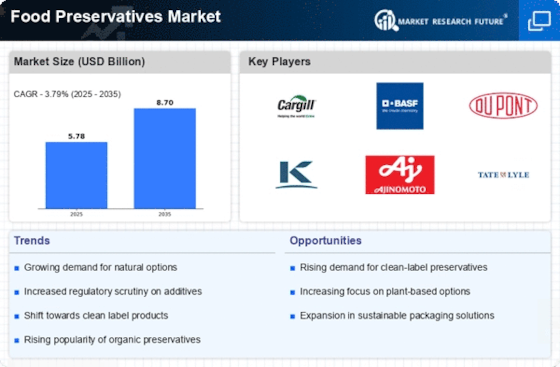
Food preservatives Market Infographic
Purchase Options

Market Trends

Key Emerging Trends in the Food preservatives Market

The Food Preservatives Market is undergoing transformative trends that reflect the evolving landscape of the food and beverage industry. One prominent trend revolves around the increasing consumer preference for clean label products. As consumers become more health-conscious, there is a growing demand for food products with minimal additives and preservatives. This altered consumer conduct is forcing food makers to search for natural and clean-label preservatives to satisfy the infrastructure openness in food component demand which is growing.

Another instance one can point at is the generation there is in natural and organic food preservatives and their popularity. Given a contributing factor of the increasing population and a health and wellness industry, consumers are eager to find preservative sources which are clean, composed of herbs, spices, and plants. Organic conservation chemical not only respond to consumer needs in reference to synthetic additives, but also they run with the general theme which nutrition experts are advocating for (clean eating). This is actually the one that change from one time to another and consequently it affects product and company formulations which thus restructures the strategic coming and going of food preservatives market.

Along with a rise in the functional food segment, also is a rise in market trends experienced by food preservatives industry. It is more likely than not that people have become fond of foods that provide both nutrition and health advantages on top of the basics. Consequently, the search for preservatives that are able to prolong the shelf life and have a positive contribution to the product's functional features becomes prominent. Nevertheless, we are observing that active preservatives that possess antioxidant properties are acquiring increasing popularity in order to enhance health effects among consumers.

Consumers nowadays long for products with clean labels which, in turns, makes food manufacturers to use different preservative ingredients during production. The common trend among consumers is a rejection of products bearing unrecognizable and complex ingredients, hence, an overwhelming preference for those comprising of simple and basic components. This is although it is inspiring a shift in processing and food manufacturing, where they use natural additives to replace the chemical preservatives. Hence, rosemary extracts, tocopherols, and citric acid which act as natural preservatives are enjoying a renewed public interest.

A quickening effect connected to the global corporate world occurred during the course of the food preservatives market due to the COVID-19 pandemic. With consumers prioritizing health and immunity, there is a growing interest in products that contribute to overall well-being. This has resulted in increased demand for preservatives with functional health benefits, aligning with the broader focus on preventive healthcare.


Author
Author Profile
Varsha More
Senior Research Analyst

Experienced business professional with a demonstrated history of working in the CFnB industry. Skilled in market research, and market estimation. Strong professional with a Masters focused in marketing management.

Leave a Comment

FAQs

What is the projected market valuation for the Food Preservatives Market in 2035?

<p>The Food Preservatives Market is projected to reach a valuation of 8.702 USD Billion by 2035.</p>

What was the market valuation of the Food Preservatives Market in 2024?

<p>In 2024, the Food Preservatives Market was valued at 5.78 USD Billion.</p>

What is the expected CAGR for the Food Preservatives Market during the forecast period 2025 - 2035?

<p>The expected CAGR for the Food Preservatives Market during the forecast period 2025 - 2035 is 3.79%.</p>

Which segment of food preservatives had the highest valuation in 2024?

<p>In 2024, the Synthetic Preservatives segment had the highest valuation at 2.5 USD Billion.</p>

What are the key functions of food preservatives in the market?

<p>The key functions of food preservatives include Antimicrobial, Antioxidant, Texture Enhancer, and Color Retainer.</p>

Which application segment is projected to grow the most by 2035?

<p>The Food Processing Industry segment is projected to grow significantly, reaching 4.0 USD Billion by 2035.</p>

Who are the leading companies in the Food Preservatives Market?

<p>Key players in the Food Preservatives Market include Cargill, BASF, DuPont, and Kerry Group.</p>

What was the valuation of Natural Preservatives in 2024?

<p>The valuation of Natural Preservatives in 2024 was 1.5 USD Billion.</p>

How does the market for Semi-Synthetic Preservatives compare to other types?

<p>In 2024, Semi-Synthetic Preservatives were valued at 1.78 USD Billion, indicating a moderate position compared to Natural and Synthetic types.</p>

What is the expected growth for the Dairy Products application segment by 2035?

<p>The Dairy Products application segment is expected to grow to 1.8 USD Billion by 2035.</p>

Market Summary

As per Market Research Future analysis, the Food Preservatives Market Size was estimated at 5.78 USD Billion in 2024. The Food Preservatives industry is projected to grow from 5.999 USD Billion in 2025 to 8.702 USD Billion by 2035, exhibiting a compound annual growth rate (CAGR) of 3.79% during the forecast period 2025 - 2035

Key Market Trends & Highlights

The Food Preservatives Market is experiencing a notable shift towards natural solutions and clean label products, driven by consumer preferences and regulatory influences.

  • The market is witnessing a significant shift towards natural preservatives, particularly in North America, which remains the largest market. Asia-Pacific is emerging as the fastest-growing region, with a rising demand for clean label products among consumers. Natural preservatives dominate the market, while synthetic preservatives are rapidly gaining traction due to technological advancements. Key drivers include the increasing demand for processed foods and rising awareness of food safety, influencing preservation practices across segments.

Market Size & Forecast

2024 Market Size 5.78 (USD Billion)
2035 Market Size 8.702 (USD Billion)
CAGR (2025 - 2035) 3.79%
Largest Regional Market Share in 2024 North America

Major Players

<p>Cargill (US), BASF (DE), DuPont (US), <a href="https://www.kerry.com/products/food-protection-and-preservation">Kerry Group (IE)</a>, Ajinomoto (JP), Tate &amp; Lyle (GB), SABIC (SA), Archer Daniels Midland (US), Sensient Technologies (US)</p>

Market Trends

The Food Preservatives Market is currently experiencing a dynamic evolution, driven by a confluence of consumer preferences and regulatory frameworks. As health consciousness rises, there is a discernible shift towards natural preservatives, which are perceived as safer alternatives to synthetic options. This trend is further fueled by increasing awareness regarding the potential health risks associated with artificial additives. The natural food preservatives market is gaining strong traction as consumers increasingly prefer clean-label and naturally sourced ingredients over synthetic additives. Consequently, manufacturers are compelled to innovate and reformulate their products to align with these changing consumer demands, thereby enhancing their market positioning. Moreover, the Food Preservatives Market is witnessing a growing emphasis on clean label products. Consumers are increasingly scrutinizing ingredient lists, seeking transparency and simplicity in food formulations. This has prompted food producers to adopt more straightforward preservation methods, often utilizing ingredients that are recognizable and easily understood. As a result, the market landscape is becoming increasingly competitive, with companies striving to balance efficacy and consumer expectations. The ongoing evolution in this sector suggests a promising future, where the integration of health-oriented practices and consumer-centric approaches will likely shape the trajectory of food preservation strategies. The food preservatives market is influenced by evolving market trends and rising demand for preserved and processed food products, driven by changing consumer lifestyles and urbanization.

Shift Towards Natural Preservatives

There is a notable trend towards the adoption of natural preservatives as consumers become more health-conscious. This shift is driven by a desire for safer food options, leading manufacturers to explore alternatives that align with consumer preferences.

Rise of Clean Label Products

The demand for clean label products is on the rise, as consumers seek transparency in food ingredients. This trend encourages food producers to simplify their formulations, opting for recognizable ingredients that resonate with health-oriented consumers.

Regulatory Influence on Preservation Practices

Regulatory frameworks are increasingly shaping the Food Preservatives Market. Stricter guidelines regarding food safety and labeling are prompting manufacturers to adapt their preservation methods, ensuring compliance while meeting consumer expectations.

Food preservatives Market Market Drivers

Rising Awareness of Food Safety

The Food Preservatives Market is significantly influenced by the growing awareness of food safety among consumers. As incidents of foodborne illnesses continue to garner attention, consumers are increasingly vigilant about the safety and quality of the food they consume. This heightened awareness drives demand for preservatives that ensure food safety and extend shelf life. Market data indicates that the food safety segment is projected to grow at a rate of 5% annually, reflecting the increasing consumer focus on health and wellness. Consequently, manufacturers are compelled to prioritize the use of effective preservatives that comply with safety regulations and standards. This trend not only enhances consumer trust but also propels the Food Preservatives Market forward, as companies strive to meet the stringent demands of safety-conscious consumers.

Regulatory Compliance and Standards

The Food Preservatives Market is significantly shaped by the need for regulatory compliance and adherence to food safety standards. Governments and regulatory bodies worldwide impose stringent regulations on food additives, including preservatives, to ensure consumer safety. This regulatory landscape compels manufacturers to invest in research and development to create preservatives that meet these standards. Market data indicates that compliance costs can account for up to 15% of total production costs, influencing pricing strategies and product formulations. As a result, companies in the Food Preservatives Market must navigate these regulations carefully while striving to innovate. This dynamic creates both challenges and opportunities, as manufacturers seek to develop preservatives that not only comply with regulations but also resonate with consumer preferences for safety and quality.

Increasing Demand for Processed Foods

The Food Preservatives Market experiences a notable surge in demand for processed foods, driven by changing consumer lifestyles and preferences. As urbanization continues to rise, consumers increasingly seek convenience, leading to a higher consumption of ready-to-eat meals and snacks. This trend is reflected in market data, which indicates that the processed food sector is projected to grow at a compound annual growth rate of approximately 4.5% over the next five years. Consequently, the need for effective food preservatives becomes paramount to ensure product longevity and safety. Manufacturers are thus compelled to innovate and incorporate preservatives that not only extend shelf life but also meet consumer expectations for quality and safety. This dynamic creates a robust environment for the Food Preservatives Market, as companies strive to balance convenience with health-conscious choices.

Expansion of the Food and Beverage Sector

The Food Preservatives Market is poised for growth due to the expansion of the food and beverage sector. As the global population continues to rise, the demand for food products is expected to increase, leading to a corresponding rise in the need for preservatives. Market data suggests that the food and beverage industry is anticipated to grow at a compound annual growth rate of 3.8% over the next five years. This growth is driven by factors such as increased disposable income and changing dietary preferences. As manufacturers seek to meet this rising demand, the use of preservatives becomes essential to ensure product quality and longevity. Thus, the Food Preservatives Market stands to benefit from the overall expansion of the food and beverage sector, as companies invest in innovative preservation solutions to cater to a diverse consumer base.

Technological Advancements in Preservation Techniques

Technological innovations play a crucial role in shaping the Food Preservatives Market. Advances in preservation techniques, such as high-pressure processing and modified atmosphere packaging, enhance the efficacy of preservatives while maintaining food quality. These technologies allow for the reduction of chemical preservatives, aligning with consumer preferences for cleaner labels. Market data suggests that the adoption of such technologies is expected to increase by 20% in the next few years, as manufacturers seek to improve product safety and extend shelf life. Furthermore, the integration of smart packaging solutions, which can indicate freshness and spoilage, is likely to revolutionize the industry. As a result, the Food Preservatives Market is positioned to benefit from these advancements, as they not only improve preservation methods but also cater to the evolving demands of health-conscious consumers.

Market Segment Insights

By Type: Natural Preservatives (Largest) vs. Synthetic Preservatives (Fastest-Growing)

<p>The Food Preservatives Market exhibits a distinct market share distribution among its primary categories, with natural preservatives leading the pack as the most prominent segment. This dominance reflects growing consumer preferences for clean-label products and the increasing demand for healthier food options. On the other hand, synthetic preservatives, while not as widely embraced, are gaining ground and attracting attention due to their cost-effectiveness and longevity, thus appealing to a broader range of food manufacturers.</p>

<p>Natural Preservatives (Dominant) vs. Synthetic Preservatives (Emerging)</p>

<p>Natural preservatives are characterized by their origin from natural sources, often appealing to health-conscious consumers seeking organic options. This segment remains the dominant force in the market, supported by trends favoring sustainability and nutrition. In contrast, synthetic preservatives are emerging as a practical choice for many manufacturers due to their effectiveness in extending shelf life and preventing spoilage. Although they face scrutiny from health advocates, their low cost and performance efficiency position them as a compelling alternative, driving their growth amid changing regulatory landscapes and evolving consumer preferences.</p>

By Function: Antimicrobial (Largest) vs. Antioxidant (Fastest-Growing)

<p>In the Food Preservatives Market, the function segment is primarily composed of Antimicrobial agents, which hold the largest market share. Antimicrobial agents are essential for prolonging the shelf life of food products by preventing the growth of bacteria and mold, making them indispensable in the food industry. Following closely are antioxidants, which have seen a rapid increase in demand for their role in preventing oxidative spoilage and maintaining food quality, indicating a growing consumer preference for products that retain freshness and flavor.</p>

<p>Antimicrobial (Dominant) vs. Antioxidant (Emerging)</p>

<p>The Antimicrobial segment remains dominant in the Food Preservatives Market due to its critical function in enhancing food safety and extending product longevity. As consumers become more health-conscious, the demand for naturally derived antimicrobial agents is surging, prompting manufacturers to innovate and introduce plant-based preservatives. On the other hand, the Antioxidant segment is emerging swiftly, driven by increased awareness of the health benefits associated with <a href="https://www.marketresearchfuture.com/reports/antioxidants-market-10309" target="_blank" rel="noopener">antioxidants</a>, such as reducing the risk of chronic diseases. As food manufacturers strive to develop cleaner labels and improve product quality, the Antioxidant segment is poised to gain a larger share of the market, appealing to health-oriented consumers.</p>

By Application: Bakery Products (Largest) vs. Meat Products (Fastest-Growing)

<p>The Food Preservatives Market showcases notable diversity among its application segments. <a href="https://www.marketresearchfuture.com/reports/bakery-products-market-1985" target="_blank" rel="noopener">bakery products</a> hold the largest share, driven by a robust consumer demand for bread and other baked goods that require effective preservation methods. Meanwhile, <a href="https://www.marketresearchfuture.com/reports/dairy-market-11483" target="_blank" rel="noopener">dairy</a> Products and Beverages also command significant portions of the market, as they rely on preservatives to maintain freshness and shelf life. While these segments remain strong, Meat Products are emerging rapidly, capturing increased attention due to a rising consumer focus on protein-based foods.</p>

<p><a href="https://www.marketresearchfuture.com/reports/bakery-products-market-1985" target="_blank" rel="noopener">bakery products</a> (Dominant) vs. Meat Products (Emerging)</p>

<p>Bakery Products represent a dominant force in the Food Preservatives Market, primarily due to the widespread consumption of items like bread, cakes, and pastries that necessitate shelf stability and extended freshness. These products often utilize preservatives such as calcium propionate and sorbic acid to inhibit mold growth and enhance durability. On the other hand, Meat Products are fast emerging as a critical segment, fueled by the global trend toward higher protein diets and convenience foods. The demand for processed and ready-to-eat meats drives the need for preservatives like sodium nitrite and natural alternatives, reflecting a shift towards healthier and more sustainable food options.</p>

By End Use: Household (Largest) vs. Food Processing Industry (Fastest-Growing)

<p>In the Food Preservatives Market, the household segment holds the largest share as it is driven by increasing consumer demand for convenience and longer shelf life for food products. This segment is characterized by a diverse range of preservatives used by consumers, including natural and synthetic options, enabling them to ensure food safety and minimize waste. Meanwhile, the food processing industry is gaining momentum, leveraging food preservatives to enhance the quality, flavor, and shelf life of mass-produced food items, catering to an evolving consumer base that values both health and convenience.</p>

<p>Household (Dominant) vs. Food Processing Industry (Emerging)</p>

<p>The household segment is deemed dominant in the food preservatives market due to the growing trend of home cooking and food preservation among consumers. This segment features a wide variety of preservatives, including salt, vinegar, sugar, and more recently, natural preservatives that resonate with health-conscious consumers. Conversely, the food processing industry represents an emerging segment, as manufacturers focus on improving food stability and extending shelf life through innovative preservation techniques. This urgency stems from the global demand for processed foods combined with rising health consciousness, leading to a new wave of preservative development that meets both consumer and regulatory standards.</p>

Get more detailed insights about Food Preservatives Market Research Report - Forecast to 2035

Regional Insights

North America : Innovation and Regulation Hub

North America is the largest market for food preservatives, holding approximately 40% of the global share. The region's growth is driven by increasing consumer demand for processed foods, stringent food safety regulations, and a rising focus on shelf-life extension. The U.S. leads this market, followed closely by Canada, as both countries implement advanced preservation technologies and sustainable practices to meet consumer preferences. The competitive landscape is dominated by key players such as Cargill, DuPont, and Archer Daniels Midland, who are investing in research and development to innovate new preservatives. The presence of these major companies fosters a dynamic market environment, encouraging smaller firms to explore niche segments. Additionally, regulatory bodies like the FDA ensure compliance with safety standards, further shaping the market dynamics.

Europe : Regulatory Framework and Innovation

Europe is the second-largest market for food preservatives, accounting for around 30% of the global market share. The region's growth is propelled by increasing health consciousness among consumers, leading to a demand for natural preservatives. Stringent regulations from the European Food Safety Authority (EFSA) also play a crucial role in shaping market trends, as they promote the use of safer and more sustainable food preservation methods. Leading countries in this region include Germany, France, and the UK, where companies like BASF and Kerry Group are at the forefront of innovation. The competitive landscape is characterized by a mix of large multinationals and smaller, specialized firms focusing on organic and natural preservatives. This diversity fosters a robust market environment, encouraging continuous improvement and adaptation to consumer preferences.

Asia-Pacific : Emerging Market with Potential

Asia-Pacific is witnessing rapid growth in the food preservatives market, holding approximately 25% of the global share. The region's expansion is driven by increasing urbanization, rising disposable incomes, and a growing demand for convenience foods. Countries like China and India are leading this growth, supported by favorable government policies aimed at enhancing food safety and quality standards, which are crucial for market development. The competitive landscape is evolving, with key players such as Ajinomoto and Tate & Lyle expanding their presence in the region. Local manufacturers are also emerging, focusing on cost-effective solutions to cater to the diverse consumer base. The market is characterized by a mix of traditional and modern preservation techniques, reflecting the region's rich culinary heritage and evolving consumer preferences.

Middle East and Africa : Resource-Rich and Growing Demand

The Middle East and Africa region is gradually emerging as a significant player in the food preservatives market, holding about 5% of the global share. The growth is driven by increasing food production, urbanization, and a rising demand for processed foods. Countries like South Africa and the UAE are at the forefront, with government initiatives aimed at improving food safety and quality standards, which are essential for market growth. The competitive landscape is characterized by a mix of local and international players, with companies like SABIC and Sensient Technologies leading the charge. The market is witnessing an influx of investments aimed at enhancing production capabilities and expanding product offerings. As consumer awareness regarding food safety increases, the demand for effective preservatives is expected to rise, further propelling market growth.

Key Players and Competitive Insights

The Food Preservatives Market is currently characterized by a dynamic competitive landscape, driven by increasing consumer demand for longer shelf life and food safety. Key players such as Cargill (US), BASF (DE), and DuPont (US) are strategically positioned to leverage innovation and sustainability in their operations. Cargill (US) focuses on developing natural preservatives, aligning with the growing trend towards clean label products. Meanwhile, BASF (DE) emphasizes its commitment to sustainability through the development of bio-based preservatives, which not only cater to consumer preferences but also comply with stringent regulatory standards. DuPont (US) is enhancing its market presence through strategic partnerships aimed at expanding its product portfolio, thereby shaping a competitive environment that prioritizes innovation and sustainability.

The competitive structure of the Food Preservatives Market appears moderately fragmented, with several players vying for market share. Key business tactics such as localizing manufacturing and optimizing supply chains are increasingly prevalent among these companies. For instance, regional expansions are being pursued to better serve local markets, which enhances responsiveness to consumer preferences and regulatory requirements. This collective influence of major players fosters a competitive atmosphere where agility and adaptability are paramount.

In August 2025, Cargill (US) announced the launch of a new line of plant-based preservatives aimed at the snack food sector. This strategic move not only reinforces Cargill's commitment to sustainability but also positions the company to capitalize on the growing demand for healthier snack options. By focusing on plant-based solutions, Cargill is likely to attract health-conscious consumers, thereby enhancing its competitive edge in the market.

In September 2025, BASF (DE) unveiled a new bio-based preservative derived from renewable resources, which is expected to reduce the environmental impact of food preservation. This initiative underscores BASF's strategic focus on sustainability and innovation, potentially setting a new benchmark in the industry. The introduction of such products may compel competitors to accelerate their own sustainability efforts, thereby reshaping the competitive landscape.

In October 2025, DuPont (US) entered into a strategic partnership with a leading food technology firm to co-develop advanced preservation solutions that utilize artificial intelligence for enhanced shelf-life prediction. This collaboration signifies a shift towards integrating technology in food preservation, which could revolutionize the market by providing more precise and effective solutions. The implications of such technological advancements may lead to a competitive differentiation based on innovation rather than traditional pricing strategies.

As of October 2025, the Food Preservatives Market is witnessing a pronounced trend towards digitalization, sustainability, and the integration of artificial intelligence. Strategic alliances are increasingly shaping the competitive landscape, enabling companies to pool resources and expertise for enhanced innovation. Looking ahead, it is anticipated that competitive differentiation will evolve, with a marked shift from price-based competition to a focus on technological advancements, sustainability, and supply chain reliability. This evolution suggests that companies that prioritize innovation and adaptability will likely emerge as leaders in the market.

Key Companies in the Food preservatives Market include

Industry Developments

Recent developments in the Food Preservatives Market show significant activity and growth among key players. For instance, Kerry Group has been expanding its product range, emphasizing natural and clean-label preservatives to meet consumer demand for healthier options. DuPont is also focusing on innovative preservation solutions while adapting to regulatory changes affecting food safety. In May 2023, FMC Corporation completed the acquisition of a specialty ingredients business, further strengthening its position in the market. 

Naturex, a part of Givaudan, has been enhancing its functionalities in natural food preservation, contributing to a growing interest in plant-based ingredients. Meanwhile, Cargill's acquisition of several natural preservatives has positioned it to better address market trends influenced by health-conscious consumers. Additionally, Archer Daniels Midland and Tate and Lyle are enhancing their portfolios through strategic partnerships aimed at optimizing food preservation techniques. 

The market's valuation has been positively impacted by these developments, reflecting a growing awareness and demand for effective and safe preservation methods globally. Recent studies show that the market is projected to continue its trajectory of expansion, focusing on sustainability and innovation through the infusion of technology and research.

Future Outlook

Food preservatives Market Future Outlook

<p>The Food Preservatives Market is projected to grow at a 3.79% CAGR from 2025 to 2035, driven by increasing demand for shelf-stable products and health-conscious consumer trends.</p>

New opportunities lie in:

  • <p>Development of clean-label preservatives to meet consumer demand for transparency.</p>
  • <p> </p>
  • <p>Investment in innovative packaging solutions to enhance product shelf life.</p>
  • <p>Expansion into emerging markets with tailored preservative solutions for local cuisines.</p>

<p>By 2035, the Food Preservatives Market is expected to be robust, reflecting evolving consumer preferences and technological advancements.</p>

Market Segmentation

Food preservatives Market Type Outlook

  • Natural Preservatives
  • Synthetic Preservatives
  • Semi-Synthetic Preservatives

Food preservatives Market End Use Outlook

  • Household
  • Food Processing Industry
  • Food Service Industry

Food preservatives Market Function Outlook

  • Antimicrobial
  • Antioxidant
  • Texture Enhancer
  • Color Retainer

Food preservatives Market Application Outlook

  • Bakery Products
  • Dairy Products
  • Meat Products
  • Beverages
  • Prepared Foods

Report Scope

MARKET SIZE 2024 5.78(USD Billion)
MARKET SIZE 2025 5.999(USD Billion)
MARKET SIZE 2035 8.702(USD Billion)
COMPOUND ANNUAL GROWTH RATE (CAGR) 3.79% (2025 - 2035)
REPORT COVERAGE Revenue Forecast, Competitive Landscape, Growth Factors, and Trends
BASE YEAR 2024
Market Forecast Period 2025 - 2035
Historical Data 2019 - 2024
Market Forecast Units USD Billion
Key Companies Profiled Cargill (US), BASF (DE), DuPont (US), Kerry Group (IE), Ajinomoto (JP), Tate & Lyle (GB), SABIC (SA), Archer Daniels Midland (US), Sensient Technologies (US)
Segments Covered Type, Function, Application, End Use, Regional
Key Market Opportunities Growing demand for natural preservatives driven by consumer preference for clean-label products in the Food Preservatives Market.
Key Market Dynamics Rising consumer demand for natural preservatives drives innovation and regulatory scrutiny in the food preservatives market.
Countries Covered North America, Europe, APAC, South America, MEA

FAQs

What is the projected market valuation for the Food Preservatives Market in 2035?

<p>The Food Preservatives Market is projected to reach a valuation of 8.702 USD Billion by 2035.</p>

What was the market valuation of the Food Preservatives Market in 2024?

<p>In 2024, the Food Preservatives Market was valued at 5.78 USD Billion.</p>

What is the expected CAGR for the Food Preservatives Market during the forecast period 2025 - 2035?

<p>The expected CAGR for the Food Preservatives Market during the forecast period 2025 - 2035 is 3.79%.</p>

Which segment of food preservatives had the highest valuation in 2024?

<p>In 2024, the Synthetic Preservatives segment had the highest valuation at 2.5 USD Billion.</p>

What are the key functions of food preservatives in the market?

<p>The key functions of food preservatives include Antimicrobial, Antioxidant, Texture Enhancer, and Color Retainer.</p>

Which application segment is projected to grow the most by 2035?

<p>The Food Processing Industry segment is projected to grow significantly, reaching 4.0 USD Billion by 2035.</p>

Who are the leading companies in the Food Preservatives Market?

<p>Key players in the Food Preservatives Market include Cargill, BASF, DuPont, and Kerry Group.</p>

What was the valuation of Natural Preservatives in 2024?

<p>The valuation of Natural Preservatives in 2024 was 1.5 USD Billion.</p>

How does the market for Semi-Synthetic Preservatives compare to other types?

<p>In 2024, Semi-Synthetic Preservatives were valued at 1.78 USD Billion, indicating a moderate position compared to Natural and Synthetic types.</p>

What is the expected growth for the Dairy Products application segment by 2035?

<p>The Dairy Products application segment is expected to grow to 1.8 USD Billion by 2035.</p>

  1. SECTION I: EXECUTIVE SUMMARY AND KEY HIGHLIGHTS
    1. | 1.1 EXECUTIVE SUMMARY
    2. | | 1.1.1 Market Overview
    3. | | 1.1.2 Key Findings
    4. | | 1.1.3 Market Segmentation
    5. | | 1.1.4 Competitive Landscape
    6. | | 1.1.5 Challenges and Opportunities
    7. | | 1.1.6 Future Outlook
  2. SECTION II: SCOPING, METHODOLOGY AND MARKET STRUCTURE
    1. | 2.1 MARKET INTRODUCTION
    2. | | 2.1.1 Definition
    3. | | 2.1.2 Scope of the study
    4. | | | 2.1.2.1 Research Objective
    5. | | | 2.1.2.2 Assumption
    6. | | | 2.1.2.3 Limitations
    7. | 2.2 RESEARCH METHODOLOGY
    8. | | 2.2.1 Overview
    9. | | 2.2.2 Data Mining
    10. | | 2.2.3 Secondary Research
    11. | | 2.2.4 Primary Research
    12. | | | 2.2.4.1 Primary Interviews and Information Gathering Process
    13. | | | 2.2.4.2 Breakdown of Primary Respondents
    14. | | 2.2.5 Forecasting Model
    15. | | 2.2.6 Market Size Estimation
    16. | | | 2.2.6.1 Bottom-Up Approach
    17. | | | 2.2.6.2 Top-Down Approach
    18. | | 2.2.7 Data Triangulation
    19. | | 2.2.8 Validation
  3. SECTION III: QUALITATIVE ANALYSIS
    1. | 3.1 MARKET DYNAMICS
    2. | | 3.1.1 Overview
    3. | | 3.1.2 Drivers
    4. | | 3.1.3 Restraints
    5. | | 3.1.4 Opportunities
    6. | 3.2 MARKET FACTOR ANALYSIS
    7. | | 3.2.1 Value chain Analysis
    8. | | 3.2.2 Porter's Five Forces Analysis
    9. | | | 3.2.2.1 Bargaining Power of Suppliers
    10. | | | 3.2.2.2 Bargaining Power of Buyers
    11. | | | 3.2.2.3 Threat of New Entrants
    12. | | | 3.2.2.4 Threat of Substitutes
    13. | | | 3.2.2.5 Intensity of Rivalry
    14. | | 3.2.3 COVID-19 Impact Analysis
    15. | | | 3.2.3.1 Market Impact Analysis
    16. | | | 3.2.3.2 Regional Impact
    17. | | | 3.2.3.3 Opportunity and Threat Analysis
  4. SECTION IV: QUANTITATIVE ANALYSIS
    1. | 4.1 Food, Beverages & Nutrition, BY Type (USD Billion)
    2. | | 4.1.1 Natural Preservatives
    3. | | 4.1.2 Synthetic Preservatives
    4. | | 4.1.3 Semi-Synthetic Preservatives
    5. | 4.2 Food, Beverages & Nutrition, BY Function (USD Billion)
    6. | | 4.2.1 Antimicrobial
    7. | | 4.2.2 Antioxidant
    8. | | 4.2.3 Texture Enhancer
    9. | | 4.2.4 Color Retainer
    10. | 4.3 Food, Beverages & Nutrition, BY Application (USD Billion)
    11. | | 4.3.1 Bakery Products
    12. | | 4.3.2 Dairy Products
    13. | | 4.3.3 Meat Products
    14. | | 4.3.4 Beverages
    15. | | 4.3.5 Prepared Foods
    16. | 4.4 Food, Beverages & Nutrition, BY End Use (USD Billion)
    17. | | 4.4.1 Household
    18. | | 4.4.2 Food Processing Industry
    19. | | 4.4.3 Food Service Industry
    20. | 4.5 Food, Beverages & Nutrition, BY Region (USD Billion)
    21. | | 4.5.1 North America
    22. | | | 4.5.1.1 US
    23. | | | 4.5.1.2 Canada
    24. | | 4.5.2 Europe
    25. | | | 4.5.2.1 Germany
    26. | | | 4.5.2.2 UK
    27. | | | 4.5.2.3 France
    28. | | | 4.5.2.4 Russia
    29. | | | 4.5.2.5 Italy
    30. | | | 4.5.2.6 Spain
    31. | | | 4.5.2.7 Rest of Europe
    32. | | 4.5.3 APAC
    33. | | | 4.5.3.1 China
    34. | | | 4.5.3.2 India
    35. | | | 4.5.3.3 Japan
    36. | | | 4.5.3.4 South Korea
    37. | | | 4.5.3.5 Malaysia
    38. | | | 4.5.3.6 Thailand
    39. | | | 4.5.3.7 Indonesia
    40. | | | 4.5.3.8 Rest of APAC
    41. | | 4.5.4 South America
    42. | | | 4.5.4.1 Brazil
    43. | | | 4.5.4.2 Mexico
    44. | | | 4.5.4.3 Argentina
    45. | | | 4.5.4.4 Rest of South America
    46. | | 4.5.5 MEA
    47. | | | 4.5.5.1 GCC Countries
    48. | | | 4.5.5.2 South Africa
    49. | | | 4.5.5.3 Rest of MEA
  5. SECTION V: COMPETITIVE ANALYSIS
    1. | 5.1 Competitive Landscape
    2. | | 5.1.1 Overview
    3. | | 5.1.2 Competitive Analysis
    4. | | 5.1.3 Market share Analysis
    5. | | 5.1.4 Major Growth Strategy in the Food, Beverages & Nutrition
    6. | | 5.1.5 Competitive Benchmarking
    7. | | 5.1.6 Leading Players in Terms of Number of Developments in the Food, Beverages & Nutrition
    8. | | 5.1.7 Key developments and growth strategies
    9. | | | 5.1.7.1 New Product Launch/Service Deployment
    10. | | | 5.1.7.2 Merger & Acquisitions
    11. | | | 5.1.7.3 Joint Ventures
    12. | | 5.1.8 Major Players Financial Matrix
    13. | | | 5.1.8.1 Sales and Operating Income
    14. | | | 5.1.8.2 Major Players R&D Expenditure. 2023
    15. | 5.2 Company Profiles
    16. | | 5.2.1 Cargill (US)
    17. | | | 5.2.1.1 Financial Overview
    18. | | | 5.2.1.2 Products Offered
    19. | | | 5.2.1.3 Key Developments
    20. | | | 5.2.1.4 SWOT Analysis
    21. | | | 5.2.1.5 Key Strategies
    22. | | 5.2.2 BASF (DE)
    23. | | | 5.2.2.1 Financial Overview
    24. | | | 5.2.2.2 Products Offered
    25. | | | 5.2.2.3 Key Developments
    26. | | | 5.2.2.4 SWOT Analysis
    27. | | | 5.2.2.5 Key Strategies
    28. | | 5.2.3 DuPont (US)
    29. | | | 5.2.3.1 Financial Overview
    30. | | | 5.2.3.2 Products Offered
    31. | | | 5.2.3.3 Key Developments
    32. | | | 5.2.3.4 SWOT Analysis
    33. | | | 5.2.3.5 Key Strategies
    34. | | 5.2.4 Kerry Group (IE)
    35. | | | 5.2.4.1 Financial Overview
    36. | | | 5.2.4.2 Products Offered
    37. | | | 5.2.4.3 Key Developments
    38. | | | 5.2.4.4 SWOT Analysis
    39. | | | 5.2.4.5 Key Strategies
    40. | | 5.2.5 Ajinomoto (JP)
    41. | | | 5.2.5.1 Financial Overview
    42. | | | 5.2.5.2 Products Offered
    43. | | | 5.2.5.3 Key Developments
    44. | | | 5.2.5.4 SWOT Analysis
    45. | | | 5.2.5.5 Key Strategies
    46. | | 5.2.6 Tate & Lyle (GB)
    47. | | | 5.2.6.1 Financial Overview
    48. | | | 5.2.6.2 Products Offered
    49. | | | 5.2.6.3 Key Developments
    50. | | | 5.2.6.4 SWOT Analysis
    51. | | | 5.2.6.5 Key Strategies
    52. | | 5.2.7 SABIC (SA)
    53. | | | 5.2.7.1 Financial Overview
    54. | | | 5.2.7.2 Products Offered
    55. | | | 5.2.7.3 Key Developments
    56. | | | 5.2.7.4 SWOT Analysis
    57. | | | 5.2.7.5 Key Strategies
    58. | | 5.2.8 Archer Daniels Midland (US)
    59. | | | 5.2.8.1 Financial Overview
    60. | | | 5.2.8.2 Products Offered
    61. | | | 5.2.8.3 Key Developments
    62. | | | 5.2.8.4 SWOT Analysis
    63. | | | 5.2.8.5 Key Strategies
    64. | | 5.2.9 Sensient Technologies (US)
    65. | | | 5.2.9.1 Financial Overview
    66. | | | 5.2.9.2 Products Offered
    67. | | | 5.2.9.3 Key Developments
    68. | | | 5.2.9.4 SWOT Analysis
    69. | | | 5.2.9.5 Key Strategies
    70. | 5.3 Appendix
    71. | | 5.3.1 References
    72. | | 5.3.2 Related Reports
  6. LIST OF FIGURES
    1. | 6.1 MARKET SYNOPSIS
    2. | 6.2 NORTH AMERICA MARKET ANALYSIS
    3. | 6.3 US MARKET ANALYSIS BY TYPE
    4. | 6.4 US MARKET ANALYSIS BY FUNCTION
    5. | 6.5 US MARKET ANALYSIS BY APPLICATION
    6. | 6.6 US MARKET ANALYSIS BY END USE
    7. | 6.7 CANADA MARKET ANALYSIS BY TYPE
    8. | 6.8 CANADA MARKET ANALYSIS BY FUNCTION
    9. | 6.9 CANADA MARKET ANALYSIS BY APPLICATION
    10. | 6.10 CANADA MARKET ANALYSIS BY END USE
    11. | 6.11 EUROPE MARKET ANALYSIS
    12. | 6.12 GERMANY MARKET ANALYSIS BY TYPE
    13. | 6.13 GERMANY MARKET ANALYSIS BY FUNCTION
    14. | 6.14 GERMANY MARKET ANALYSIS BY APPLICATION
    15. | 6.15 GERMANY MARKET ANALYSIS BY END USE
    16. | 6.16 UK MARKET ANALYSIS BY TYPE
    17. | 6.17 UK MARKET ANALYSIS BY FUNCTION
    18. | 6.18 UK MARKET ANALYSIS BY APPLICATION
    19. | 6.19 UK MARKET ANALYSIS BY END USE
    20. | 6.20 FRANCE MARKET ANALYSIS BY TYPE
    21. | 6.21 FRANCE MARKET ANALYSIS BY FUNCTION
    22. | 6.22 FRANCE MARKET ANALYSIS BY APPLICATION
    23. | 6.23 FRANCE MARKET ANALYSIS BY END USE
    24. | 6.24 RUSSIA MARKET ANALYSIS BY TYPE
    25. | 6.25 RUSSIA MARKET ANALYSIS BY FUNCTION
    26. | 6.26 RUSSIA MARKET ANALYSIS BY APPLICATION
    27. | 6.27 RUSSIA MARKET ANALYSIS BY END USE
    28. | 6.28 ITALY MARKET ANALYSIS BY TYPE
    29. | 6.29 ITALY MARKET ANALYSIS BY FUNCTION
    30. | 6.30 ITALY MARKET ANALYSIS BY APPLICATION
    31. | 6.31 ITALY MARKET ANALYSIS BY END USE
    32. | 6.32 SPAIN MARKET ANALYSIS BY TYPE
    33. | 6.33 SPAIN MARKET ANALYSIS BY FUNCTION
    34. | 6.34 SPAIN MARKET ANALYSIS BY APPLICATION
    35. | 6.35 SPAIN MARKET ANALYSIS BY END USE
    36. | 6.36 REST OF EUROPE MARKET ANALYSIS BY TYPE
    37. | 6.37 REST OF EUROPE MARKET ANALYSIS BY FUNCTION
    38. | 6.38 REST OF EUROPE MARKET ANALYSIS BY APPLICATION
    39. | 6.39 REST OF EUROPE MARKET ANALYSIS BY END USE
    40. | 6.40 APAC MARKET ANALYSIS
    41. | 6.41 CHINA MARKET ANALYSIS BY TYPE
    42. | 6.42 CHINA MARKET ANALYSIS BY FUNCTION
    43. | 6.43 CHINA MARKET ANALYSIS BY APPLICATION
    44. | 6.44 CHINA MARKET ANALYSIS BY END USE
    45. | 6.45 INDIA MARKET ANALYSIS BY TYPE
    46. | 6.46 INDIA MARKET ANALYSIS BY FUNCTION
    47. | 6.47 INDIA MARKET ANALYSIS BY APPLICATION
    48. | 6.48 INDIA MARKET ANALYSIS BY END USE
    49. | 6.49 JAPAN MARKET ANALYSIS BY TYPE
    50. | 6.50 JAPAN MARKET ANALYSIS BY FUNCTION
    51. | 6.51 JAPAN MARKET ANALYSIS BY APPLICATION
    52. | 6.52 JAPAN MARKET ANALYSIS BY END USE
    53. | 6.53 SOUTH KOREA MARKET ANALYSIS BY TYPE
    54. | 6.54 SOUTH KOREA MARKET ANALYSIS BY FUNCTION
    55. | 6.55 SOUTH KOREA MARKET ANALYSIS BY APPLICATION
    56. | 6.56 SOUTH KOREA MARKET ANALYSIS BY END USE
    57. | 6.57 MALAYSIA MARKET ANALYSIS BY TYPE
    58. | 6.58 MALAYSIA MARKET ANALYSIS BY FUNCTION
    59. | 6.59 MALAYSIA MARKET ANALYSIS BY APPLICATION
    60. | 6.60 MALAYSIA MARKET ANALYSIS BY END USE
    61. | 6.61 THAILAND MARKET ANALYSIS BY TYPE
    62. | 6.62 THAILAND MARKET ANALYSIS BY FUNCTION
    63. | 6.63 THAILAND MARKET ANALYSIS BY APPLICATION
    64. | 6.64 THAILAND MARKET ANALYSIS BY END USE
    65. | 6.65 INDONESIA MARKET ANALYSIS BY TYPE
    66. | 6.66 INDONESIA MARKET ANALYSIS BY FUNCTION
    67. | 6.67 INDONESIA MARKET ANALYSIS BY APPLICATION
    68. | 6.68 INDONESIA MARKET ANALYSIS BY END USE
    69. | 6.69 REST OF APAC MARKET ANALYSIS BY TYPE
    70. | 6.70 REST OF APAC MARKET ANALYSIS BY FUNCTION
    71. | 6.71 REST OF APAC MARKET ANALYSIS BY APPLICATION
    72. | 6.72 REST OF APAC MARKET ANALYSIS BY END USE
    73. | 6.73 SOUTH AMERICA MARKET ANALYSIS
    74. | 6.74 BRAZIL MARKET ANALYSIS BY TYPE
    75. | 6.75 BRAZIL MARKET ANALYSIS BY FUNCTION
    76. | 6.76 BRAZIL MARKET ANALYSIS BY APPLICATION
    77. | 6.77 BRAZIL MARKET ANALYSIS BY END USE
    78. | 6.78 MEXICO MARKET ANALYSIS BY TYPE
    79. | 6.79 MEXICO MARKET ANALYSIS BY FUNCTION
    80. | 6.80 MEXICO MARKET ANALYSIS BY APPLICATION
    81. | 6.81 MEXICO MARKET ANALYSIS BY END USE
    82. | 6.82 ARGENTINA MARKET ANALYSIS BY TYPE
    83. | 6.83 ARGENTINA MARKET ANALYSIS BY FUNCTION
    84. | 6.84 ARGENTINA MARKET ANALYSIS BY APPLICATION
    85. | 6.85 ARGENTINA MARKET ANALYSIS BY END USE
    86. | 6.86 REST OF SOUTH AMERICA MARKET ANALYSIS BY TYPE
    87. | 6.87 REST OF SOUTH AMERICA MARKET ANALYSIS BY FUNCTION
    88. | 6.88 REST OF SOUTH AMERICA MARKET ANALYSIS BY APPLICATION
    89. | 6.89 REST OF SOUTH AMERICA MARKET ANALYSIS BY END USE
    90. | 6.90 MEA MARKET ANALYSIS
    91. | 6.91 GCC COUNTRIES MARKET ANALYSIS BY TYPE
    92. | 6.92 GCC COUNTRIES MARKET ANALYSIS BY FUNCTION
    93. | 6.93 GCC COUNTRIES MARKET ANALYSIS BY APPLICATION
    94. | 6.94 GCC COUNTRIES MARKET ANALYSIS BY END USE
    95. | 6.95 SOUTH AFRICA MARKET ANALYSIS BY TYPE
    96. | 6.96 SOUTH AFRICA MARKET ANALYSIS BY FUNCTION
    97. | 6.97 SOUTH AFRICA MARKET ANALYSIS BY APPLICATION
    98. | 6.98 SOUTH AFRICA MARKET ANALYSIS BY END USE
    99. | 6.99 REST OF MEA MARKET ANALYSIS BY TYPE
    100. | 6.100 REST OF MEA MARKET ANALYSIS BY FUNCTION
    101. | 6.101 REST OF MEA MARKET ANALYSIS BY APPLICATION
    102. | 6.102 REST OF MEA MARKET ANALYSIS BY END USE
    103. | 6.103 KEY BUYING CRITERIA OF FOOD, BEVERAGES & NUTRITION
    104. | 6.104 RESEARCH PROCESS OF MRFR
    105. | 6.105 DRO ANALYSIS OF FOOD, BEVERAGES & NUTRITION
    106. | 6.106 DRIVERS IMPACT ANALYSIS: FOOD, BEVERAGES & NUTRITION
    107. | 6.107 RESTRAINTS IMPACT ANALYSIS: FOOD, BEVERAGES & NUTRITION
    108. | 6.108 SUPPLY / VALUE CHAIN: FOOD, BEVERAGES & NUTRITION
    109. | 6.109 FOOD, BEVERAGES & NUTRITION, BY TYPE, 2024 (% SHARE)
    110. | 6.110 FOOD, BEVERAGES & NUTRITION, BY TYPE, 2024 TO 2035 (USD Billion)
    111. | 6.111 FOOD, BEVERAGES & NUTRITION, BY FUNCTION, 2024 (% SHARE)
    112. | 6.112 FOOD, BEVERAGES & NUTRITION, BY FUNCTION, 2024 TO 2035 (USD Billion)
    113. | 6.113 FOOD, BEVERAGES & NUTRITION, BY APPLICATION, 2024 (% SHARE)
    114. | 6.114 FOOD, BEVERAGES & NUTRITION, BY APPLICATION, 2024 TO 2035 (USD Billion)
    115. | 6.115 FOOD, BEVERAGES & NUTRITION, BY END USE, 2024 (% SHARE)
    116. | 6.116 FOOD, BEVERAGES & NUTRITION, BY END USE, 2024 TO 2035 (USD Billion)
    117. | 6.117 BENCHMARKING OF MAJOR COMPETITORS
  7. LIST OF TABLES
    1. | 7.1 LIST OF ASSUMPTIONS
    2. | | 7.1.1
    3. | 7.2 North America MARKET SIZE ESTIMATES; FORECAST
    4. | | 7.2.1 BY TYPE, 2025-2035 (USD Billion)
    5. | | 7.2.2 BY FUNCTION, 2025-2035 (USD Billion)
    6. | | 7.2.3 BY APPLICATION, 2025-2035 (USD Billion)
    7. | | 7.2.4 BY END USE, 2025-2035 (USD Billion)
    8. | 7.3 US MARKET SIZE ESTIMATES; FORECAST
    9. | | 7.3.1 BY TYPE, 2025-2035 (USD Billion)
    10. | | 7.3.2 BY FUNCTION, 2025-2035 (USD Billion)
    11. | | 7.3.3 BY APPLICATION, 2025-2035 (USD Billion)
    12. | | 7.3.4 BY END USE, 2025-2035 (USD Billion)
    13. | 7.4 Canada MARKET SIZE ESTIMATES; FORECAST
    14. | | 7.4.1 BY TYPE, 2025-2035 (USD Billion)
    15. | | 7.4.2 BY FUNCTION, 2025-2035 (USD Billion)
    16. | | 7.4.3 BY APPLICATION, 2025-2035 (USD Billion)
    17. | | 7.4.4 BY END USE, 2025-2035 (USD Billion)
    18. | 7.5 Europe MARKET SIZE ESTIMATES; FORECAST
    19. | | 7.5.1 BY TYPE, 2025-2035 (USD Billion)
    20. | | 7.5.2 BY FUNCTION, 2025-2035 (USD Billion)
    21. | | 7.5.3 BY APPLICATION, 2025-2035 (USD Billion)
    22. | | 7.5.4 BY END USE, 2025-2035 (USD Billion)
    23. | 7.6 Germany MARKET SIZE ESTIMATES; FORECAST
    24. | | 7.6.1 BY TYPE, 2025-2035 (USD Billion)
    25. | | 7.6.2 BY FUNCTION, 2025-2035 (USD Billion)
    26. | | 7.6.3 BY APPLICATION, 2025-2035 (USD Billion)
    27. | | 7.6.4 BY END USE, 2025-2035 (USD Billion)
    28. | 7.7 UK MARKET SIZE ESTIMATES; FORECAST
    29. | | 7.7.1 BY TYPE, 2025-2035 (USD Billion)
    30. | | 7.7.2 BY FUNCTION, 2025-2035 (USD Billion)
    31. | | 7.7.3 BY APPLICATION, 2025-2035 (USD Billion)
    32. | | 7.7.4 BY END USE, 2025-2035 (USD Billion)
    33. | 7.8 France MARKET SIZE ESTIMATES; FORECAST
    34. | | 7.8.1 BY TYPE, 2025-2035 (USD Billion)
    35. | | 7.8.2 BY FUNCTION, 2025-2035 (USD Billion)
    36. | | 7.8.3 BY APPLICATION, 2025-2035 (USD Billion)
    37. | | 7.8.4 BY END USE, 2025-2035 (USD Billion)
    38. | 7.9 Russia MARKET SIZE ESTIMATES; FORECAST
    39. | | 7.9.1 BY TYPE, 2025-2035 (USD Billion)
    40. | | 7.9.2 BY FUNCTION, 2025-2035 (USD Billion)
    41. | | 7.9.3 BY APPLICATION, 2025-2035 (USD Billion)
    42. | | 7.9.4 BY END USE, 2025-2035 (USD Billion)
    43. | 7.10 Italy MARKET SIZE ESTIMATES; FORECAST
    44. | | 7.10.1 BY TYPE, 2025-2035 (USD Billion)
    45. | | 7.10.2 BY FUNCTION, 2025-2035 (USD Billion)
    46. | | 7.10.3 BY APPLICATION, 2025-2035 (USD Billion)
    47. | | 7.10.4 BY END USE, 2025-2035 (USD Billion)
    48. | 7.11 Spain MARKET SIZE ESTIMATES; FORECAST
    49. | | 7.11.1 BY TYPE, 2025-2035 (USD Billion)
    50. | | 7.11.2 BY FUNCTION, 2025-2035 (USD Billion)
    51. | | 7.11.3 BY APPLICATION, 2025-2035 (USD Billion)
    52. | | 7.11.4 BY END USE, 2025-2035 (USD Billion)
    53. | 7.12 Rest of Europe MARKET SIZE ESTIMATES; FORECAST
    54. | | 7.12.1 BY TYPE, 2025-2035 (USD Billion)
    55. | | 7.12.2 BY FUNCTION, 2025-2035 (USD Billion)
    56. | | 7.12.3 BY APPLICATION, 2025-2035 (USD Billion)
    57. | | 7.12.4 BY END USE, 2025-2035 (USD Billion)
    58. | 7.13 APAC MARKET SIZE ESTIMATES; FORECAST
    59. | | 7.13.1 BY TYPE, 2025-2035 (USD Billion)
    60. | | 7.13.2 BY FUNCTION, 2025-2035 (USD Billion)
    61. | | 7.13.3 BY APPLICATION, 2025-2035 (USD Billion)
    62. | | 7.13.4 BY END USE, 2025-2035 (USD Billion)
    63. | 7.14 China MARKET SIZE ESTIMATES; FORECAST
    64. | | 7.14.1 BY TYPE, 2025-2035 (USD Billion)
    65. | | 7.14.2 BY FUNCTION, 2025-2035 (USD Billion)
    66. | | 7.14.3 BY APPLICATION, 2025-2035 (USD Billion)
    67. | | 7.14.4 BY END USE, 2025-2035 (USD Billion)
    68. | 7.15 India MARKET SIZE ESTIMATES; FORECAST
    69. | | 7.15.1 BY TYPE, 2025-2035 (USD Billion)
    70. | | 7.15.2 BY FUNCTION, 2025-2035 (USD Billion)
    71. | | 7.15.3 BY APPLICATION, 2025-2035 (USD Billion)
    72. | | 7.15.4 BY END USE, 2025-2035 (USD Billion)
    73. | 7.16 Japan MARKET SIZE ESTIMATES; FORECAST
    74. | | 7.16.1 BY TYPE, 2025-2035 (USD Billion)
    75. | | 7.16.2 BY FUNCTION, 2025-2035 (USD Billion)
    76. | | 7.16.3 BY APPLICATION, 2025-2035 (USD Billion)
    77. | | 7.16.4 BY END USE, 2025-2035 (USD Billion)
    78. | 7.17 South Korea MARKET SIZE ESTIMATES; FORECAST
    79. | | 7.17.1 BY TYPE, 2025-2035 (USD Billion)
    80. | | 7.17.2 BY FUNCTION, 2025-2035 (USD Billion)
    81. | | 7.17.3 BY APPLICATION, 2025-2035 (USD Billion)
    82. | | 7.17.4 BY END USE, 2025-2035 (USD Billion)
    83. | 7.18 Malaysia MARKET SIZE ESTIMATES; FORECAST
    84. | | 7.18.1 BY TYPE, 2025-2035 (USD Billion)
    85. | | 7.18.2 BY FUNCTION, 2025-2035 (USD Billion)
    86. | | 7.18.3 BY APPLICATION, 2025-2035 (USD Billion)
    87. | | 7.18.4 BY END USE, 2025-2035 (USD Billion)
    88. | 7.19 Thailand MARKET SIZE ESTIMATES; FORECAST
    89. | | 7.19.1 BY TYPE, 2025-2035 (USD Billion)
    90. | | 7.19.2 BY FUNCTION, 2025-2035 (USD Billion)
    91. | | 7.19.3 BY APPLICATION, 2025-2035 (USD Billion)
    92. | | 7.19.4 BY END USE, 2025-2035 (USD Billion)
    93. | 7.20 Indonesia MARKET SIZE ESTIMATES; FORECAST
    94. | | 7.20.1 BY TYPE, 2025-2035 (USD Billion)
    95. | | 7.20.2 BY FUNCTION, 2025-2035 (USD Billion)
    96. | | 7.20.3 BY APPLICATION, 2025-2035 (USD Billion)
    97. | | 7.20.4 BY END USE, 2025-2035 (USD Billion)
    98. | 7.21 Rest of APAC MARKET SIZE ESTIMATES; FORECAST
    99. | | 7.21.1 BY TYPE, 2025-2035 (USD Billion)
    100. | | 7.21.2 BY FUNCTION, 2025-2035 (USD Billion)
    101. | | 7.21.3 BY APPLICATION, 2025-2035 (USD Billion)
    102. | | 7.21.4 BY END USE, 2025-2035 (USD Billion)
    103. | 7.22 South America MARKET SIZE ESTIMATES; FORECAST
    104. | | 7.22.1 BY TYPE, 2025-2035 (USD Billion)
    105. | | 7.22.2 BY FUNCTION, 2025-2035 (USD Billion)
    106. | | 7.22.3 BY APPLICATION, 2025-2035 (USD Billion)
    107. | | 7.22.4 BY END USE, 2025-2035 (USD Billion)
    108. | 7.23 Brazil MARKET SIZE ESTIMATES; FORECAST
    109. | | 7.23.1 BY TYPE, 2025-2035 (USD Billion)
    110. | | 7.23.2 BY FUNCTION, 2025-2035 (USD Billion)
    111. | | 7.23.3 BY APPLICATION, 2025-2035 (USD Billion)
    112. | | 7.23.4 BY END USE, 2025-2035 (USD Billion)
    113. | 7.24 Mexico MARKET SIZE ESTIMATES; FORECAST
    114. | | 7.24.1 BY TYPE, 2025-2035 (USD Billion)
    115. | | 7.24.2 BY FUNCTION, 2025-2035 (USD Billion)
    116. | | 7.24.3 BY APPLICATION, 2025-2035 (USD Billion)
    117. | | 7.24.4 BY END USE, 2025-2035 (USD Billion)
    118. | 7.25 Argentina MARKET SIZE ESTIMATES; FORECAST
    119. | | 7.25.1 BY TYPE, 2025-2035 (USD Billion)
    120. | | 7.25.2 BY FUNCTION, 2025-2035 (USD Billion)
    121. | | 7.25.3 BY APPLICATION, 2025-2035 (USD Billion)
    122. | | 7.25.4 BY END USE, 2025-2035 (USD Billion)
    123. | 7.26 Rest of South America MARKET SIZE ESTIMATES; FORECAST
    124. | | 7.26.1 BY TYPE, 2025-2035 (USD Billion)
    125. | | 7.26.2 BY FUNCTION, 2025-2035 (USD Billion)
    126. | | 7.26.3 BY APPLICATION, 2025-2035 (USD Billion)
    127. | | 7.26.4 BY END USE, 2025-2035 (USD Billion)
    128. | 7.27 MEA MARKET SIZE ESTIMATES; FORECAST
    129. | | 7.27.1 BY TYPE, 2025-2035 (USD Billion)
    130. | | 7.27.2 BY FUNCTION, 2025-2035 (USD Billion)
    131. | | 7.27.3 BY APPLICATION, 2025-2035 (USD Billion)
    132. | | 7.27.4 BY END USE, 2025-2035 (USD Billion)
    133. | 7.28 GCC Countries MARKET SIZE ESTIMATES; FORECAST
    134. | | 7.28.1 BY TYPE, 2025-2035 (USD Billion)
    135. | | 7.28.2 BY FUNCTION, 2025-2035 (USD Billion)
    136. | | 7.28.3 BY APPLICATION, 2025-2035 (USD Billion)
    137. | | 7.28.4 BY END USE, 2025-2035 (USD Billion)
    138. | 7.29 South Africa MARKET SIZE ESTIMATES; FORECAST
    139. | | 7.29.1 BY TYPE, 2025-2035 (USD Billion)
    140. | | 7.29.2 BY FUNCTION, 2025-2035 (USD Billion)
    141. | | 7.29.3 BY APPLICATION, 2025-2035 (USD Billion)
    142. | | 7.29.4 BY END USE, 2025-2035 (USD Billion)
    143. | 7.30 Rest of MEA MARKET SIZE ESTIMATES; FORECAST
    144. | | 7.30.1 BY TYPE, 2025-2035 (USD Billion)
    145. | | 7.30.2 BY FUNCTION, 2025-2035 (USD Billion)
    146. | | 7.30.3 BY APPLICATION, 2025-2035 (USD Billion)
    147. | | 7.30.4 BY END USE, 2025-2035 (USD Billion)
    148. | 7.31 PRODUCT LAUNCH/PRODUCT DEVELOPMENT/APPROVAL
    149. | | 7.31.1
    150. | 7.32 ACQUISITION/PARTNERSHIP
    151. | | 7.32.1

Food, Beverages & Nutrition Market Segmentation

Food, Beverages & Nutrition By Type (USD Billion, 2025-2035)

  • Natural Preservatives
  • Synthetic Preservatives
  • Semi-Synthetic Preservatives

Food, Beverages & Nutrition By Function (USD Billion, 2025-2035)

  • Antimicrobial
  • Antioxidant
  • Texture Enhancer
  • Color Retainer

Food, Beverages & Nutrition By Application (USD Billion, 2025-2035)

  • Bakery Products
  • Dairy Products
  • Meat Products
  • Beverages
  • Prepared Foods

Food, Beverages & Nutrition By End Use (USD Billion, 2025-2035)

  • Household
  • Food Processing Industry
  • Food Service Industry
Infographic

Free Sample Request

Kindly complete the form below to receive a free sample of this Report

Get Free Sample

Customer Strories

Compare Licence

×
Features License Type
Single User Multiuser License Enterprise User
Price $4,950 $5,950 $7,250
Maximum User Access Limit 1 User Upto 10 Users Unrestricted Access Throughout the Organization
Free Customization
Direct Access to Analyst
Deliverable Format
Platform Access
Discount on Next Purchase 10% 15% 15%
Printable Versions