Rising Security Concerns
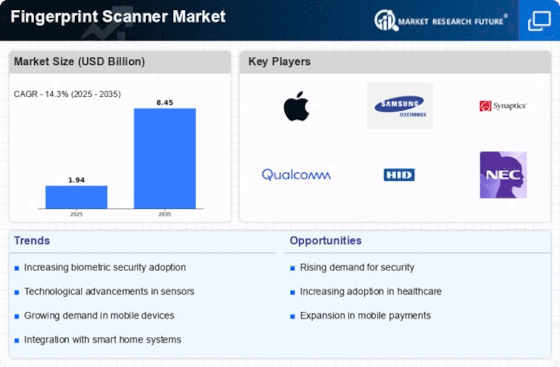
The increasing prevalence of security breaches and identity theft has heightened the demand for advanced security solutions, particularly in the Fingerprint Scanner Market. Organizations across various sectors are investing in biometric technologies to enhance their security protocols. According to recent data, the biometric market is projected to reach a valuation of approximately 50 billion dollars by 2026, with fingerprint scanners being a significant contributor. This trend indicates a shift towards more secure authentication methods, as traditional passwords are deemed insufficient. Consequently, the Fingerprint Scanner Market is experiencing robust growth, driven by the need for reliable and efficient security measures.
Technological Advancements
Continuous advancements in fingerprint scanning technology are reshaping the Fingerprint Scanner Market. Innovations such as 3D fingerprint recognition and multispectral imaging are enhancing the accuracy and reliability of biometric systems. These technologies not only improve security but also expand the application scope of fingerprint scanners across various industries, including finance, healthcare, and retail. Market analysts project that the adoption of these advanced technologies will lead to a significant increase in market share, with the fingerprint scanner segment expected to grow by approximately 20% by 2027. This trend highlights the importance of technological evolution in driving the Fingerprint Scanner Market.
Integration with Mobile Devices
The proliferation of smartphones and tablets equipped with fingerprint scanning technology has transformed the Fingerprint Scanner Market. As mobile device manufacturers increasingly incorporate biometric authentication features, consumer acceptance and demand for fingerprint scanners have surged. Reports suggest that over 70% of smartphones sold in 2025 are expected to feature fingerprint recognition capabilities. This integration not only enhances user convenience but also reinforces security, making it a preferred choice for consumers. The Fingerprint Scanner Market is thus poised for expansion, as more devices adopt this technology, creating a seamless user experience.
Government Initiatives and Regulations
Government initiatives aimed at enhancing security and identity verification processes are significantly influencing the Fingerprint Scanner Market. Various countries are implementing regulations that mandate the use of biometric systems for identification purposes in sectors such as banking, travel, and law enforcement. For instance, initiatives to digitize national identification systems are driving the adoption of fingerprint scanners. This regulatory push is expected to propel the market, with estimates indicating a compound annual growth rate of around 15% in the coming years. Such developments underscore the critical role of government policies in shaping the Fingerprint Scanner Market.
Growing Adoption in Financial Services
The financial services sector is increasingly adopting fingerprint scanning technology to enhance security and streamline customer experiences. With the rise of digital banking and online transactions, financial institutions are seeking robust authentication methods to protect sensitive information. The Fingerprint Scanner Market is witnessing a surge in demand as banks and payment service providers implement biometric solutions to prevent fraud. Recent statistics indicate that nearly 60% of financial institutions plan to integrate biometric authentication by 2026. This growing trend underscores the critical role of fingerprint scanners in securing financial transactions and highlights the potential for growth within the Fingerprint Scanner Market.