×
Request Free Sample ×

Kindly complete the form below to receive a free sample of this Report

* Please use a valid business email

Leading companies partner with us for data-driven Insights

clients tt-cursor
Hero Background
English
Chinese
French
Japanese
Korean
German
Spanish

Europe Residential Energy Storage System Market Analysis

ID: MRFR/EnP/11163-HCR
128 Pages
Chitranshi Jaiswal
October 2025

Europe Residential Energy Storage System Market Research Report Information By Battery Type (Lithium-ion Battery, Lead-acid Battery, Flow Battery, and Other Battery Types), By Application (Utility, Residential, Commercial, and Industrial) – and Europe Market Forecast Till 2035

Share:
Download PDF ×

We do not share your information with anyone. However, we may send you emails based on your report interest from time to time. You may contact us at any time to opt-out.

Europe Residential Energy Storage System Market Infographic
×
Europe Residential Energy Storage System Market Infographic Full View
Purchase Options

Market Analysis

In-depth Analysis of Europe Residential Energy Storage System Market Industry Landscape

The residential energy storage system market in Europe is experiencing dynamic shifts driven by several factors. Firstly, the increasing emphasis on renewable energy sources, such as solar and wind, has propelled the demand for energy storage solutions among homeowners. With the growing awareness of environmental sustainability and the need to reduce carbon emissions, many households are investing in residential energy storage systems to store excess energy generated from renewables for later use, thereby reducing dependence on traditional energy sources.

Moreover, government policies and incentives play a significant role in shaping the market dynamics of residential energy storage systems in Europe. Subsidies, tax credits, and feed-in tariffs provided by various European countries encourage homeowners to adopt energy storage solutions, making them more financially viable and attractive. Additionally, regulations promoting energy efficiency and grid resilience further drive the adoption of residential energy storage systems, as they enable consumers to optimize their energy usage and contribute to overall grid stability.

Another factor influencing the market dynamics is technological advancements in energy storage technologies. Innovations in battery storage systems, such as lithium-ion batteries, have led to improvements in efficiency, performance, and cost-effectiveness, making residential energy storage systems more accessible to a wider range of consumers. Furthermore, the integration of smart technologies and energy management systems allows homeowners to monitor and control their energy consumption, maximizing the benefits of their energy storage systems.

The competitive landscape of the Europe residential energy storage system market is characterized by the presence of both established players and emerging startups. Key players in the market are continually investing in research and development to enhance their product offerings and gain a competitive edge. Moreover, partnerships and collaborations between energy storage providers, utilities, and technology companies are becoming increasingly common, driving innovation and expanding market reach.

Consumer preferences and behavior also influence market dynamics, with factors such as cost, reliability, and ease of installation playing significant roles in purchasing decisions. As the residential energy storage market matures, consumers are becoming more discerning and demanding, seeking solutions that not only meet their energy needs but also provide long-term value and peace of mind.

Furthermore, the COVID-19 pandemic has had both short-term and long-term impacts on the Europe residential energy storage system market. While the initial disruptions in supply chains and project installations caused setbacks, the pandemic has also accelerated certain trends, such as remote work and digitalization, which have increased the demand for residential energy storage solutions.

Looking ahead, the Europe residential energy storage system market is expected to continue its growth trajectory, driven by ongoing advancements in technology, supportive government policies, and evolving consumer preferences. However, challenges such as regulatory uncertainties, grid integration issues, and competition from other energy storage options remain, highlighting the need for stakeholders to collaborate and innovate to address these challenges and unlock the full potential of residential energy storage systems in Europe.

Author
Chitranshi Jaiswal
Research Analyst Level I

In her 3 years of experience in the market research field, she has handled critical cross-domain projects. She has an in-depth knowledge of market estimation & analysis, problem-solving, primary as well as secondary research, and team management.She holds an engineering degree and is an MBA professional from a well-known university, capable of evaluating the market and competitive conditions. An exceptional strategist with excellent communication skills and a passion for delivering cutting-edge & practical insights for the market. Proficient in multi-tasking, and can successfully deal with competing demands, while maintaining complete confidentiality. Generated business through active client and project development, networking, and high-quality responses. Her knowledge and skills have helped in making solid business decisions, securing funding from investors, and avoiding business failures.

Leave a Comment

FAQs

What is the projected market valuation for the Europe Residential Energy Storage System Market by 2035?

<p>The market is projected to reach approximately 7.78 USD Billion by 2035.</p>

What was the market valuation for the Europe Residential Energy Storage System Market in 2024?

<p>The market valuation stood at 1.8 USD Billion in 2024.</p>

What is the expected CAGR for the Europe Residential Energy Storage System Market during the forecast period 2025 - 2035?

<p>The expected CAGR for this market is 14.23% during the forecast period.</p>

Which companies are considered key players in the Europe Residential Energy Storage System Market?

<p>Key players include Tesla, LG Energy Solution, Sonnen, BYD, Enphase Energy, VARTA, Fronius, Eaton, and SMA Solar Technology.</p>

What are the projected valuations for the residential segment of the market by 2035?

<p>The residential segment is projected to grow from 0.72 USD Billion to 2.99 USD Billion by 2035.</p>

How does the performance of lithium-ion technology compare to other technologies in the market?

Lithium-ion technology is expected to grow from 0.9 USD Billion to 3.5 USD Billion, outperforming other technologies.

What is the anticipated growth for the energy management segment by 2035?

The energy management segment is projected to increase from 0.54 USD Billion to 2.3 USD Billion by 2035.

What is the expected market size for backup power solutions in the Europe Residential Energy Storage System Market?

The backup power segment is anticipated to grow from 0.36 USD Billion to 1.5 USD Billion by 2035.

What role does renewable integration play in the market's growth?

Renewable integration is projected to expand from 0.45 USD Billion to 2.18 USD Billion, indicating its importance in market growth.

How does the commercial segment's growth compare to the residential segment by 2035?

The commercial segment is expected to grow from 0.36 USD Billion to 1.49 USD Billion, which is less than the residential segment's growth.

Market Summary

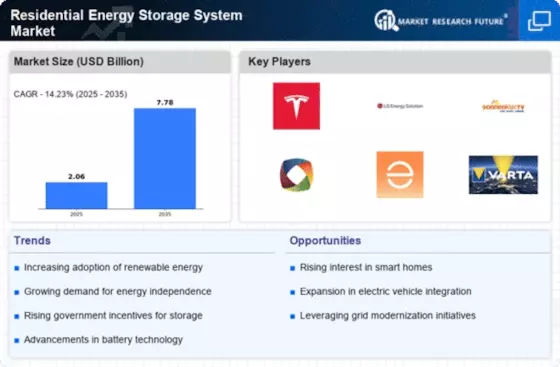
As per analysis, the Europe Residential Energy Storage System Market is projected to grow from USD 2.08 Billion in 2025 to USD 7.78 Billion by 2035, exhibiting a compound annual growth rate (CAGR) of 14.23% during the forecast period (2025 - 2035).

Key Market Trends & Highlights

The Europe Residential Energy Storage System Market is experiencing robust growth driven by renewable energy adoption and technological advancements.

  • Germany remains the largest market for residential energy storage systems, reflecting a strong commitment to renewable energy integration.
  • The UK is emerging as the fastest-growing region, propelled by increasing consumer awareness and demand for energy independence.
  • The residential segment dominates the market, while the commercial segment is witnessing rapid growth due to evolving energy needs.
  • Key market drivers include advancements in battery technology and rising electricity prices, which are fostering greater adoption of energy storage solutions.

Market Size & Forecast

2024 Market Size 1.8 (USD Billion)
2035 Market Size 7.78 (USD Billion)
CAGR (2025 - 2035) 14.23%

Major Players

<p>Tesla (US), LG Energy Solution (KR), Sonnen (DE), BYD (CN), Enphase Energy (US), VARTA (DE), Fronius (AT), Eaton (IE), SMA Solar Technology (DE)</p>

Market Trends

The Europe Residential Energy Storage System Market is currently experiencing a notable transformation, driven by a confluence of technological advancements and regulatory support. The increasing emphasis on renewable energy sources, particularly solar and wind, has catalyzed the adoption of energy storage solutions among residential consumers. This shift is further bolstered by government initiatives aimed at reducing carbon emissions and enhancing energy efficiency. As households seek to optimize their energy consumption and reduce reliance on traditional grid systems, the demand for residential energy storage systems is likely to escalate. Moreover, the integration of smart technologies into energy storage systems appears to enhance their appeal. Homeowners are increasingly inclined to invest in systems that not only store energy but also provide real-time data and analytics. This trend suggests a growing consumer preference for solutions that offer both functionality and intelligence. As the market evolves, it is anticipated that innovations in battery technology and energy management systems will play a pivotal role in shaping the future landscape of the Europe Residential Energy Storage System Market.

Increased Adoption of Renewable Energy

The shift towards renewable energy sources is a primary driver in the Europe Residential Energy Storage System Market. As more households install solar panels, the need for efficient energy storage solutions becomes apparent. This trend is supported by various government incentives aimed at promoting clean energy usage.

Integration of Smart Technologies

The incorporation of smart technologies into residential energy storage systems is gaining traction. Homeowners are increasingly interested in systems that offer advanced features such as real-time monitoring and automated energy management, enhancing user experience and efficiency.

Regulatory Support and Incentives

Government policies across Europe are increasingly favoring the adoption of residential energy storage systems. Incentives and subsidies are being introduced to encourage homeowners to invest in these technologies, thereby fostering market growth and sustainability.

Europe Residential Energy Storage System Market Market Drivers

Rising Electricity Prices

Rising electricity prices across Europe are acting as a catalyst for the growth of the Residential Energy Storage System Market. As utility rates continue to climb, consumers are increasingly motivated to seek alternative solutions to manage their energy costs. In countries like Italy and Spain, where electricity prices have seen substantial increases, homeowners are turning to energy storage systems as a means to store energy during off-peak hours and utilize it during peak demand periods. This shift not only helps in reducing electricity bills but also contributes to grid stability. Market analysts project that the demand for residential energy storage systems will continue to rise as consumers look for ways to mitigate the impact of escalating energy costs.

Supportive Government Policies

The Europe Residential Energy Storage System Market benefits from a range of supportive government policies aimed at promoting renewable energy and energy storage solutions. Various European nations have implemented incentives such as tax credits, grants, and subsidies to encourage the adoption of residential energy storage systems. For example, the United Kingdom's Smart Export Guarantee allows homeowners to receive payments for excess energy exported back to the grid, thereby enhancing the economic viability of energy storage systems. Additionally, the European Union's Green Deal aims to achieve climate neutrality by 2050, which includes significant investments in energy storage technologies. These supportive policies are likely to create a favorable environment for market growth, driving increased adoption of residential energy storage solutions across Europe.

Advancements in Battery Technology

Technological advancements in battery technology are significantly influencing the Europe Residential Energy Storage System Market. Innovations in lithium-ion batteries, flow batteries, and solid-state batteries are enhancing the efficiency, lifespan, and safety of energy storage systems. For instance, the energy density of lithium-ion batteries has improved, allowing for more compact storage solutions that can be easily integrated into residential settings. As of January 2026, the average cost of battery storage systems has decreased by approximately 30% over the past five years, making them more accessible to consumers. This reduction in costs, coupled with improved performance, is expected to stimulate market growth as homeowners increasingly adopt energy storage systems to complement their renewable energy installations.

Increased Awareness of Sustainability

There is a growing awareness of sustainability and environmental responsibility among European consumers, which is positively impacting the Europe Residential Energy Storage System Market. As individuals become more conscious of their carbon footprints, many are seeking ways to integrate renewable energy sources into their homes. Energy storage systems play a crucial role in this transition by enabling homeowners to store excess energy generated from solar panels or wind turbines for later use. Recent surveys indicate that over 60% of European homeowners express interest in adopting energy storage solutions as part of their sustainability efforts. This heightened awareness is likely to drive demand for residential energy storage systems, as consumers increasingly prioritize eco-friendly solutions in their energy consumption practices.

Growing Demand for Energy Independence

The Europe Residential Energy Storage System Market is experiencing a notable surge in demand for energy independence among consumers. As energy prices fluctuate and geopolitical tensions impact energy supply chains, households are increasingly seeking ways to reduce reliance on external energy sources. This trend is particularly pronounced in countries like Germany and France, where energy storage systems are viewed as a means to achieve self-sufficiency. According to recent data, the residential energy storage capacity in Europe is projected to reach over 20 GWh by 2026, indicating a robust growth trajectory. This growing demand for energy independence is likely to drive investments in residential energy storage solutions, thereby enhancing the overall market landscape.

Market Segment Insights

By Application: Residential (Largest) vs. Commercial (Fastest-Growing)

<p>In the Europe Residential Energy Storage System Market, the application segment showcases a diverse landscape with the residential sector leading in market share. Residential systems primarily serve individual households, making up a significant portion of the overall sales. The commercial segment follows, characterized by larger systems set up for businesses and institutions. Though it holds a smaller market share compared to residential systems, it is witnessing rapid adoption as businesses increasingly focus on sustainability and energy independence.</p>

<p>Application: Residential (Dominant) vs. Commercial (Emerging)</p>

<p>Residential energy storage systems dominate the European market due to their capability to effectively store renewable energy from solar panels, offering homeowners energy independence and cost savings. These systems are generally smaller, designed for household use, and benefit from government incentives promoting renewable energy. On the other hand, the commercial segment is emerging as a vital component, driven by business investments in sustainability and energy efficiency. These systems typically cater to larger energy requirements and are suitable for diverse commercial applications, making them appealing as governments and regulatory policies lean towards renewable energy integration and carbon footprint reduction.</p>

By Technology: Lithium Ion (Largest) vs. Lead Acid (Fastest-Growing)

<p>In the Europe Residential Energy Storage System Market, Lithium Ion technology holds the largest market share due to its high energy density, efficiency, and decreasing costs, making it a preferred choice among consumers. Lead Acid, although having a smaller share, is witnessing rapid growth, driven by its affordability and established technology reliability, appealing to budget-conscious homeowners seeking energy storage solutions.</p>

<p>Technology: Lithium Ion (Dominant) vs. Lead Acid (Emerging)</p>

<p>Lithium Ion batteries dominate the European residential energy storage market owing to their superior performance characteristics such as higher energy density and longer cycle life. The technology has seen rapid advancements, leading to more efficient battery management systems and scaling production capabilities. In contrast, Lead Acid batteries are emerging in popularity due to their lower upfront costs and wide availability. While they may not match the efficiency of Lithium Ion batteries, they are favored for specific applications due to their robust performance and reliability. As the market continues to evolve, both technologies are expected to play significant roles in the energy transition, catering to differing consumer needs.</p>

By End Use: Backup Power (Largest) vs. Renewable Integration (Fastest-Growing)

<p>In the Europe Residential Energy Storage System Market, the 'End Use' segment is characterized by diverse applications that greatly structure energy management solutions. Among these, Backup Power holds the largest market share, reflecting consumers' demand for reliable energy solutions amid increasing grid instabilities. Conversely, Renewable Integration is quickly becoming a crucial component as more households adopt renewable energy sources, driving its rapid growth and allowing for synergy with energy management technologies.</p>

<p>Backup Power (Dominant) vs. Renewable Integration (Emerging)</p>

<p>In the current market scenario, Backup Power is the dominant segment due to its essential role in ensuring energy reliability during outages, resonating with consumer priorities around energy independence. This segment appeals to homeowners seeking stability in energy access. On the other hand, Renewable Integration is emerging as a transformative segment, focusing on incorporating solar panels and other renewable sources into residential energy systems. This shift not only enhances energy self-sufficiency but also aligns with the broader initiative towards sustainability, attracting environmentally conscious consumers and prompting innovation in energy storage solutions.</p>

Get more detailed insights about Europe Residential Energy Storage System Market Research Report—Forecast till 2035

Regional Insights

Germany : Strong Demand and Innovation Hub

Key markets include major cities such as Hamburg, Stuttgart, and Frankfurt, where the competitive landscape is dominated by local players like Sonnen and VARTA, alongside international giants like Tesla and LG Energy Solution. The business environment is favorable, with a strong emphasis on innovation and technology. The residential sector is particularly active, with applications in solar energy integration and smart home solutions. This dynamic market is characterized by a growing trend towards energy self-sufficiency and sustainability.

UK : Government Support Fuels Growth

Key markets include London, Birmingham, and Manchester, where competition is intensifying among major players like Tesla, LG Energy Solution, and local firms. The business environment is characterized by a mix of established companies and innovative startups, fostering a dynamic landscape. The residential sector is increasingly adopting energy storage for solar integration and backup power solutions, reflecting a shift towards sustainable energy practices and energy independence.

France : Diverse Market with Unique Challenges

Key markets include Paris and Lyon, where competition is growing among major players like Enphase Energy and BYD. The business environment is shaped by regulatory frameworks that encourage innovation and investment in energy storage technologies. The residential sector is increasingly integrating energy storage with solar PV systems, reflecting a trend towards self-consumption and energy efficiency. However, challenges remain in terms of market penetration and consumer awareness.

Russia : Growing Interest in Energy Solutions

Key markets include Moscow and St. Petersburg, where competition is beginning to emerge among local and international players. Major companies like Tesla and LG Energy Solution are exploring opportunities in this market. The business environment is evolving, with a growing interest in renewable energy and energy storage solutions. The residential sector is starting to adopt energy storage for backup power and integration with renewable sources, reflecting a shift towards modern energy practices.

Italy : Focus on Renewable Integration

Key markets include Milan and Rome, where competition is intensifying among major players like Enphase Energy and Sonnen. The business environment is favorable, with a mix of established companies and innovative startups. The residential sector is increasingly adopting energy storage for solar integration and energy management solutions, reflecting a trend towards sustainability and energy independence. However, challenges remain in terms of market awareness and regulatory complexities.

Spain : Strong Solar Energy Integration

Key markets include Barcelona and Madrid, where competition is growing among major players like Tesla and BYD. The business environment is characterized by a mix of established companies and emerging startups, fostering innovation. The residential sector is increasingly integrating energy storage with solar PV systems, reflecting a trend towards energy independence and sustainability. However, challenges remain in terms of regulatory frameworks and market penetration.

Rest of Europe : Varied Growth Across Regions

Key markets include cities across Scandinavia and Eastern Europe, where competition is emerging among local and international players. Major companies like Fronius and SMA Solar Technology are exploring opportunities in these markets. The business environment is evolving, with a growing interest in energy storage solutions. The residential sector is beginning to adopt energy storage for solar integration and backup power, reflecting a shift towards modern energy practices.

Key Players and Competitive Insights

The Residential Energy Storage System Market in Europe is characterized by a dynamic competitive landscape, driven by increasing demand for renewable energy solutions and the need for energy independence. Key players such as Tesla (US), LG Energy Solution (KR), and Sonnen (DE) are at the forefront, each adopting distinct strategies to enhance their market positioning. Tesla (US) continues to innovate with its Powerwall product line, focusing on integrating advanced battery technology and software solutions to optimize energy management. Meanwhile, LG Energy Solution (KR) emphasizes partnerships with local energy providers to expand its reach and enhance service offerings, thereby strengthening its competitive edge. Sonnen (DE) is leveraging its community energy storage model, which promotes shared energy resources among users, reflecting a shift towards collaborative consumption in the energy sector.

The business tactics employed by these companies include localizing manufacturing to reduce costs and enhance supply chain efficiency. The market structure appears moderately fragmented, with several players vying for market share, yet the influence of major companies remains substantial. This competitive environment fosters innovation and drives advancements in technology, as companies strive to differentiate themselves through unique value propositions.

In November 2025, Tesla (US) announced a strategic partnership with a leading European utility company to develop integrated energy solutions that combine solar generation with energy storage. This collaboration is poised to enhance Tesla's market penetration in Europe, allowing it to offer comprehensive energy solutions that cater to the growing demand for sustainable energy. The strategic importance of this partnership lies in its potential to create synergies that could lead to increased customer adoption of Tesla's products.

In December 2025, LG Energy Solution (KR) unveiled a new manufacturing facility in Germany, aimed at boosting production capacity for its residential energy storage systems. This move is significant as it not only localizes production but also aligns with the European Union's sustainability goals, potentially reducing carbon emissions associated with transportation. The facility is expected to enhance LG's responsiveness to market demands and strengthen its competitive position in the region.

In January 2026, Sonnen (DE) launched an innovative software platform designed to optimize energy consumption for residential users. This platform integrates artificial intelligence to analyze energy usage patterns and provide personalized recommendations for energy savings. The introduction of this technology underscores Sonnen's commitment to digital transformation and positions it as a leader in the smart energy management space, likely attracting tech-savvy consumers.

As of January 2026, the competitive trends in the Residential Energy Storage System Market are increasingly defined by digitalization, sustainability, and the integration of AI technologies. Strategic alliances are becoming more prevalent, as companies recognize the value of collaboration in enhancing their offerings and expanding their market reach. Looking ahead, competitive differentiation is expected to evolve, with a notable shift from price-based competition towards innovation, technological advancements, and supply chain reliability. This transition may redefine the competitive landscape, compelling companies to invest in R&D and forge strategic partnerships to maintain their market positions.

Key Companies in the Europe Residential Energy Storage System Market include

Industry Developments

Future Outlook

Europe Residential Energy Storage System Market Future Outlook

The Europe Residential Energy Storage System Market is poised for growth at a 14.23% CAGR from 2025 to 2035, driven by renewable energy adoption, regulatory support, and technological advancements.

New opportunities lie in:

  • Integration of AI for predictive energy management solutions.
  • Development of modular storage systems for urban residential areas.
  • Partnerships with utility companies for demand response programs.

By 2035, the market is expected to be robust, driven by innovation and strategic partnerships.

Market Segmentation

Europe Residential Energy Storage System Market End Use Outlook

  • Energy Management
  • Backup Power
  • Peak Shaving
  • Demand Response
  • Renewable Integration

Europe Residential Energy Storage System Market Technology Outlook

  • Lithium Ion
  • Lead Acid
  • Flow Battery
  • Sodium Sulfur
  • Nickel Cadmium

Europe Residential Energy Storage System Market Application Outlook

  • Residential
  • Commercial
  • Industrial
  • Utility
  • Microgrid

Report Scope

MARKET SIZE 20241.8(USD Billion)
MARKET SIZE 20252.08(USD Billion)
MARKET SIZE 20357.78(USD Billion)
COMPOUND ANNUAL GROWTH RATE (CAGR)14.23% (2024 - 2035)
REPORT COVERAGERevenue Forecast, Competitive Landscape, Growth Factors, and Trends
BASE YEAR2024
Market Forecast Period2025 - 2035
Historical Data2019 - 2024
Market Forecast UnitsUSD Billion
Key Companies ProfiledTesla (US), LG Energy Solution (KR), Sonnen (DE), BYD (CN), Enphase Energy (US), VARTA (DE), Fronius (AT), Eaton (IE), SMA Solar Technology (DE)
Segments CoveredApplication, Technology, End Use
Key Market OpportunitiesGrowing demand for sustainable energy solutions drives innovation in the Europe Residential Energy Storage System Market.
Key Market DynamicsGrowing regulatory support and technological advancements drive the expansion of the Europe Residential Energy Storage System Market.
Countries CoveredGermany, UK, France, Russia, Italy, Spain, Rest of Europe

FAQs

What is the projected market valuation for the Europe Residential Energy Storage System Market by 2035?

<p>The market is projected to reach approximately 7.78 USD Billion by 2035.</p>

What was the market valuation for the Europe Residential Energy Storage System Market in 2024?

<p>The market valuation stood at 1.8 USD Billion in 2024.</p>

What is the expected CAGR for the Europe Residential Energy Storage System Market during the forecast period 2025 - 2035?

<p>The expected CAGR for this market is 14.23% during the forecast period.</p>

Which companies are considered key players in the Europe Residential Energy Storage System Market?

<p>Key players include Tesla, LG Energy Solution, Sonnen, BYD, Enphase Energy, VARTA, Fronius, Eaton, and SMA Solar Technology.</p>

What are the projected valuations for the residential segment of the market by 2035?

<p>The residential segment is projected to grow from 0.72 USD Billion to 2.99 USD Billion by 2035.</p>

How does the performance of lithium-ion technology compare to other technologies in the market?

Lithium-ion technology is expected to grow from 0.9 USD Billion to 3.5 USD Billion, outperforming other technologies.

What is the anticipated growth for the energy management segment by 2035?

The energy management segment is projected to increase from 0.54 USD Billion to 2.3 USD Billion by 2035.

What is the expected market size for backup power solutions in the Europe Residential Energy Storage System Market?

The backup power segment is anticipated to grow from 0.36 USD Billion to 1.5 USD Billion by 2035.

What role does renewable integration play in the market's growth?

Renewable integration is projected to expand from 0.45 USD Billion to 2.18 USD Billion, indicating its importance in market growth.

How does the commercial segment's growth compare to the residential segment by 2035?

The commercial segment is expected to grow from 0.36 USD Billion to 1.49 USD Billion, which is less than the residential segment's growth.

  1. SECTION I: EXECUTIVE SUMMARY AND KEY HIGHLIGHTS
    1. | 1.1 EXECUTIVE SUMMARY
  2. SECTION II: SCOPING, METHODOLOGY AND MARKET STRUCTURE
    1. | 2.1 MARKET INTRODUCTION
    2. | 2.2 RESEARCH METHODOLOGY
  3. SECTION III: QUALITATIVE ANALYSIS
    1. | 3.1 MARKET DYNAMICS
    2. | 3.2 MARKET FACTOR ANALYSIS
  4. SECTION IV: QUANTITATIVE ANALYSIS
    1. | 4.1 Energy & Power, BY Application (USD Billion)
    2. | 4.2 Energy & Power, BY Technology (USD Billion)
    3. | 4.3 Energy & Power, BY End Use (USD Billion)
  5. SECTION V: COMPETITIVE ANALYSIS
    1. | 5.1 Competitive Landscape
    2. | 5.2 Company Profiles
    3. | 5.3 Appendix

Europe Residential Energy Storage System Market Segmentation

Market Segmentation Overview

  • Detailed segmentation data will be available in the full report
  • Comprehensive analysis by multiple parameters
  • Regional and country-level breakdowns
  • Market size forecasts by segment
Infographic

Free Sample Request

Kindly complete the form below to receive a free sample of this Report

Get Free Sample

Customer Strories

Compare Licence

×
Features License Type
Single User Multiuser License Enterprise User
Price $4,950 $5,950 $7,250
Maximum User Access Limit 1 User Upto 10 Users Unrestricted Access Throughout the Organization
Free Customization
Direct Access to Analyst
Deliverable Format
Platform Access
Discount on Next Purchase 10% 15% 15%
Printable Versions