×
Request Free Sample ×

Kindly complete the form below to receive a free sample of this Report

* Please use a valid business email

Leading companies partner with us for data-driven Insights

clients tt-cursor
Hero Background
English
Chinese
French
Japanese
Korean
German
Spanish

Epoxy Grout Market Trends

ID: MRFR/CnM/6838-HCR
111 Pages
Anshula Mandaokar
February 2026

Epoxy Grout Market Research Report Information By Type (Resin and Hardener), By Application (Residential, Commercial, Industrial), And By Region (North America, Europe, Asia-Pacific, And Rest Of The World) –Market Forecast Till 2035

Share:
Download PDF ×

We do not share your information with anyone. However, we may send you emails based on your report interest from time to time. You may contact us at any time to opt-out.

Epoxy Grout Market Infographic
Purchase Options

Market Trends

Key Emerging Trends in the Epoxy Grout Market

There has been an increase in demand for Epoxy Grout with diverse applications in industries over time, thereby making it trend significantly. The construction industry continues to favor epoxy grouts that demonstrate high resistance to stains, chemicals, and durability. One noticeable trend is the increased use of epoxy grouts in tile installations. Another important thing observed within the market for epoxy grouts is its utilization within the healthcare sector. The healthcare industry has turned to these products due to health concerns necessitating seamless surfaces that are sanitary, requiring tight hygiene measures such as those needed within hospitals or labs where sterilization must be done 24/7, hence the necessary use of infection control-compliant floorings like mold-resistant and easily cleanable surfaces, i.e., hospital grade floors. Environmental sustainability is becoming a critical factor in material selection across different sectors, including the epoxy grout market. A notable rising trend involves environmentally friendly production techniques, resulting in eco-friendly formulations of these materials being adopted increasingly in society today. Also, we see an emerging trend whereby infrastructure projects utilize more of these kinds instead of cementitious ones, as well as a movement toward the use of epoxies rather than traditional ones in construction processes. Epoxy grouts possess high load-bearing capabilities and are resistant to heavy loads. Therefore, they are ideal for applications such as bridge-bearing installations and critical structural element anchoring. This trend stems from the need to provide reliable and durable solutions in civil engineering projects, ensuring that key infrastructure stands intact. The DIY (Do-It-Yourself) market is another source of growth for the epoxy grout market. The increasing do-it-yourself (DIY) home improvement trend has led to the growing popularity of epoxy grouts due to their ease of application and professional results. Many experienced DYI users value the stain resistance and durability of epoxy grouts, which makes them a good option when working on kitchen backsplashes or renovating bathrooms. In addition, the number of collaborations and partnerships within the epoxy grout market is rising day by day as companies try to combine their knowledge in epoxy formulation production techniques as well as experience in product development processes. Furthermore, technological breakthroughs have also become prevalent within this particular industry, wherein improved grades with higher effectiveness have been developed, leading to quicker setting times.

Author
Anshula Mandaokar
Team Lead - Research

Anshula Mandaokar holds an academic degree in Chemical Engineering and has been contributing to the field for more than 5 years. She has expertise in Market Research and Business Consulting and serves as a Team Lead for a reputed Market Research firm under the Chemicals and Materials domain spectrum. She has worked on multiple projects, generating explicit results in a quick turnaround time. Her understanding of data interpretation justifies her role as a leader.

Leave a Comment

FAQs

What is the current valuation of the Epoxy Grout Market as of 2024?

<p>The Epoxy Grout Market was valued at 0.62 USD Billion in 2024.</p>

What is the projected market valuation for the Epoxy Grout Market in 2035?

<p>The market is projected to reach 1.212 USD Billion by 2035.</p>

What is the expected CAGR for the Epoxy Grout Market during the forecast period 2025 - 2035?

<p>The expected CAGR for the Epoxy Grout Market during 2025 - 2035 is 6.28%.</p>

Which companies are considered key players in the Epoxy Grout Market?

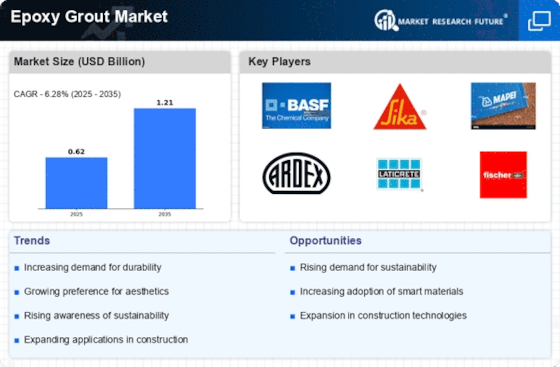
<p>Key players include BASF SE, Sika AG, MAPEI S.p.A., and Laticrete International, Inc.</p>

How does the market segment for Resin compare to Hardener in terms of valuation?

<p>In 2024, the Resin segment was valued at 0.372 USD Billion, while the Hardener segment was valued at 0.248 USD Billion.</p>

What are the projected valuations for the Residential and Commercial applications of epoxy grout?

<p>Both the Residential and Commercial applications are projected to reach 0.372 USD Billion by 2035.</p>

What is the expected growth for the Industrial application segment of the Epoxy Grout Market?

The Industrial application segment is expected to grow from 0.248 USD Billion in 2024 to 0.468 USD Billion by 2035.

How do the valuations of the different application segments compare in 2024?

In 2024, the valuations were 0.186 USD Billion for Residential, 0.186 USD Billion for Commercial, and 0.248 USD Billion for Industrial.

What trends are influencing the growth of the Epoxy Grout Market?

The growth appears to be influenced by increasing demand in construction and renovation sectors.

What role do companies like Ardex GmbH and Bostik play in the Epoxy Grout Market?

Companies like Ardex GmbH and Bostik are pivotal in driving innovation and competition within the Epoxy Grout Market.

Market Summary

As per Market Research Future analysis, the Epoxy Grout Market Size was estimated at 0.62 USD Billion in 2024. The Epoxy Grout industry is projected to grow from USD 0.6589 Billion in 2025 to USD 1.212 Billion by 2035, exhibiting a compound annual growth rate (CAGR) of 6.28% during the forecast period 2025 - 2035

Key Market Trends & Highlights

The Epoxy Grout Market is experiencing a dynamic shift towards sustainability and aesthetic customization.

  • North America remains the largest market for epoxy grout, driven by robust construction activities.
  • The Asia-Pacific region is emerging as the fastest-growing market, fueled by rapid urbanization and infrastructure development.
  • The resin segment dominates the market, while the hardener segment is witnessing the fastest growth due to technological advancements.
  • Rising construction activities and increased demand for aesthetic solutions are key drivers propelling market expansion.

Market Size & Forecast

2024 Market Size 0.62 (USD Billion)
2035 Market Size 1.212 (USD Billion)
CAGR (2025 - 2035) 6.28%
Largest Regional Market Share in 2024 North America

Major Players

BASF SE (DE), Sika AG (CH), MAPEI S.p.A. (IT), Ardex GmbH (DE), Laticrete International, Inc. (US), Fischer Group (DE), Dunlop Adhesives (GB), Bostik (FR), Weber (FR)

Market Trends

The Epoxy Grout Market is currently experiencing a notable transformation, driven by various factors that influence consumer preferences and industry standards. The increasing demand for durable and high-performance materials in construction and renovation projects appears to be a primary catalyst for this shift. As builders and contractors seek solutions that offer superior resistance to moisture, chemicals, and stains, epoxy grout emerges as a favored choice. Furthermore, the growing trend towards sustainable building practices suggests that manufacturers are likely to innovate in terms of eco-friendly formulations, which may enhance the appeal of epoxy grout in environmentally conscious markets. In addition to performance attributes, aesthetic considerations are also shaping the Epoxy Grout Market. Consumers increasingly prioritize design flexibility, leading to a rise in the availability of various colors and finishes. This trend indicates a shift towards personalization in home and commercial spaces, where the visual impact of materials plays a crucial role. As the market evolves, it seems that the integration of advanced technologies in production processes could further enhance the properties of epoxy grout, making it an even more attractive option for a wide range of applications. Overall, the Epoxy Grout Market appears poised for growth, driven by a combination of performance, sustainability, and aesthetic appeal.

Sustainability Initiatives

The Epoxy Grout Market is witnessing a growing emphasis on sustainability, as manufacturers explore eco-friendly formulations. This trend reflects a broader industry movement towards reducing environmental impact, appealing to consumers who prioritize green building materials.

Aesthetic Customization

There is an increasing demand for aesthetic customization within the Epoxy Grout Market. Consumers are seeking diverse color options and finishes, allowing for greater personalization in design, which enhances the visual appeal of spaces.

Technological Advancements

Technological innovations are playing a crucial role in the evolution of the Epoxy Grout Market. Enhanced production techniques are likely to improve the performance characteristics of epoxy grout, making it more durable and versatile for various applications.

Epoxy Grout Market Market Drivers

Expansion of the DIY Market

The expansion of the do-it-yourself (DIY) market is emerging as a significant driver for the Epoxy Grout Market. With an increasing number of homeowners engaging in renovation and improvement projects, the demand for user-friendly and effective grouting solutions is on the rise. Epoxy grout, known for its ease of use and durability, is becoming a popular choice among DIY enthusiasts. Market Research Future indicates that the DIY home improvement sector is expected to grow at a steady pace, further fueling the need for accessible and high-quality materials. Consequently, the Epoxy Grout Market stands to gain from this trend, as it caters to the needs of a growing segment of consumers who prefer to undertake their own projects.

Rising Construction Activities

The resurgence in construction activities across various sectors appears to be a primary driver for the Epoxy Grout Market. With urbanization and infrastructure development gaining momentum, the demand for durable and high-performance materials is increasing. Epoxy grout, known for its superior bonding and resistance to moisture, is becoming a preferred choice among contractors and builders. According to recent data, the construction sector is projected to grow at a compound annual growth rate of approximately 5% over the next few years. This growth is likely to bolster the epoxy grout market, as more projects require materials that can withstand heavy use and environmental challenges. Consequently, the Epoxy Grout Market is expected to benefit significantly from this trend, as it aligns with the needs of modern construction practices.

Increased Demand for Aesthetic Solutions

The growing emphasis on aesthetics in both residential and commercial spaces is driving the Epoxy Grout Market. Consumers and designers are increasingly seeking materials that not only perform well but also enhance the visual appeal of surfaces. Epoxy grout offers a wide range of colors and finishes, allowing for customization that meets diverse design preferences. This trend is particularly evident in the tiling industry, where the demand for visually striking installations is on the rise. Market data suggests that the decorative tile segment is expanding, which in turn fuels the need for high-quality epoxy grout. As a result, the Epoxy Grout Market is likely to see a surge in demand as it caters to the aesthetic aspirations of consumers and professionals alike.

Technological Innovations in Grouting Solutions

Technological advancements in the formulation and application of epoxy grout are significantly influencing the Epoxy Grout Market. Innovations such as improved curing processes and enhanced chemical resistance are making epoxy grout more appealing to end-users. These advancements not only increase the performance characteristics of the product but also reduce application time and labor costs. Recent studies indicate that the introduction of new formulations has led to a 20% increase in efficiency during installation. As technology continues to evolve, the Epoxy Grout Market is poised to benefit from these improvements, attracting a broader customer base that values efficiency and performance.

Growing Awareness of Environmental Sustainability

The rising awareness of environmental sustainability is becoming a crucial driver for the Epoxy Grout Market. Consumers and businesses are increasingly prioritizing eco-friendly materials in their construction and renovation projects. Epoxy grout manufacturers are responding by developing products that meet stringent environmental standards, which may include low VOC emissions and recyclable components. This shift towards sustainable practices is not only beneficial for the environment but also aligns with regulatory trends that favor green building materials. As a result, the Epoxy Grout Market is likely to experience growth as more stakeholders seek sustainable solutions that do not compromise on performance.

Market Segment Insights

By Type: Resin (Largest) vs. Hardener (Fastest-Growing)

<p>In the Epoxy Grout Market, the segment distribution reveals that Resin holds the largest share, dominating the landscape due to its superior performance and versatility in various applications. Resin-based epoxy grouts are preferred for their excellent adhesion, durability, and resistance to chemicals, making them suitable for numerous industries, including construction and automotive. Conversely, Hardener, while smaller in share, demonstrates significant potential for rapid growth as manufacturers increasingly innovate to enhance their properties, offering better curing rates and application ease.</p>

<p>Epoxy Grout: Resin (Dominant) vs. Hardener (Emerging)</p>

<p>Resin stands out as the dominant segment in the Epoxy Grout Market, known for its outstanding physical and chemical properties which contribute to its persistent preference across various sectors. Its ability to withstand harsh conditions and provide lasting bonds makes it a favored choice for both indoor and outdoor applications. On the other hand, Hardener, although emerging, is gaining traction due to advancements in formulation that improve performance attributes, such as faster cure times and superior strength. As end-users seek efficiency and reliability, both segment values are poised to shape the market dynamics significantly.</p>

By Application: Residential (Largest) vs. Commercial (Fastest-Growing)

<p>In the epoxy grout market, the application segment is primarily divided into three categories: residential, commercial, and industrial. Among these, the residential sector holds the largest market share, driven by increased home renovations and construction activities. Consumers in this segment prefer epoxy grout for its durability and aesthetic appeal, which augments its dominance compared to other applications. Commercial and industrial applications are also significant, but they follow at a distance in terms of overall share, catering to specific needs within business environments and manufacturing processes. Growth trends indicate that the commercial segment is rapidly gaining traction, emerging as the fastest-growing due to rising infrastructural developments and increased investments in commercial properties. The shift towards high-performance materials in commercial settings, driven by sustainability and regulatory standards, has propelled the demand for epoxy grout. Additionally, the industrial segment shows steady growth as manufacturers seek robust solutions for flooring and maintenance needs, yet it remains overshadowed by the explosive growth in commercial applications.</p>

<p>Residential (Dominant) vs. Commercial (Emerging)</p>

<p>The residential application of epoxy grout remains dominant in the market due to the increasing trend of DIY home improvement projects and the growing popularity of tiles and stone flooring among homeowners. This segment thrives on consumers' desire for aesthetic enhancement, coupled with the longevity and strength that epoxy grout provides. In contrast, the commercial application is emerging as a vital segment due to the expansion of retail, hospitality, and office sectors where durable and easy-to-maintain flooring systems are essential. Commercial spaces require grout solutions that withstand heavy foot traffic and environmental stressors, thus contributing to its growth. As businesses prioritize operational efficiency and aesthetic appeal, the demand for commercial epoxy grout continues to rise.</p>

Get more detailed insights about Epoxy Grout Market Research Report - Global Forecast till 2035

Regional Insights

North America : Market Leader in Innovation

North America is the largest market for epoxy grout, holding approximately 40% of the global share. The growth is driven by increasing construction activities, particularly in the residential and commercial sectors, alongside stringent regulations promoting high-quality materials. The demand for durable and chemical-resistant grouts is also on the rise, fueled by advancements in technology and product innovation. The United States is the leading country in this region, with significant contributions from Canada. Key players such as Laticrete International, Inc. and BASF SE dominate the market, focusing on innovative solutions and sustainability. The competitive landscape is characterized by a mix of established companies and emerging players, all vying for market share through product differentiation and strategic partnerships.

Europe : Regulatory-Driven Market Growth

Europe is the second-largest market for epoxy grout, accounting for around 30% of the global market share. The region's growth is significantly influenced by stringent environmental regulations and a strong emphasis on sustainability. Countries are increasingly adopting eco-friendly construction practices, which drives demand for high-performance, low-emission epoxy grouts. The construction sector's recovery post-pandemic also contributes to this upward trend. Germany and France are the leading countries in this market, with a robust presence of key players like Sika AG and Weber. The competitive landscape is marked by innovation and a focus on sustainable products. Companies are investing in R&D to develop advanced formulations that meet regulatory standards while enhancing performance, ensuring they remain competitive in a rapidly evolving market.

Asia-Pacific : Emerging Market Potential

Asia-Pacific is witnessing rapid growth in the epoxy grout market, holding approximately 25% of the global share. The region's expansion is driven by booming construction activities, particularly in countries like China and India, where urbanization and infrastructure development are at an all-time high. Government initiatives aimed at improving housing and commercial spaces further catalyze demand for epoxy grouts, which are favored for their durability and resistance to harsh conditions. China is the largest market in this region, followed by India and Japan. The competitive landscape features both local and international players, including MAPEI S.p.A. and Ardex GmbH. Companies are focusing on expanding their distribution networks and enhancing product offerings to cater to the growing demand. The presence of a diverse range of manufacturers contributes to a competitive environment, fostering innovation and price competitiveness.

Middle East and Africa : Resource-Rich Market Dynamics

The Middle East and Africa region is emerging as a significant market for epoxy grout, holding about 5% of the global share. The growth is primarily driven by increasing investments in infrastructure and real estate development, particularly in the Gulf Cooperation Council (GCC) countries. The region's focus on diversifying economies away from oil dependency is leading to a surge in construction projects, thereby boosting demand for high-quality construction materials like epoxy grout. The United Arab Emirates and South Africa are the leading countries in this market. The competitive landscape is characterized by a mix of local and international players, including Fischer Group and Dunlop Adhesives. Companies are increasingly focusing on product innovation and sustainability to meet the evolving needs of the construction sector, ensuring they remain competitive in this dynamic market.

Key Players and Competitive Insights

Leading market companies are extensively spending R&D on increasing their product lines, which will help the Epoxy Grout Market grow even more. Important market developments include new product releases, contractual agreements, acquisitions and mergers, greater investments, and collaboration with other organizations. The Epoxy Grout industry must produce cost-effective merchandise to flourish and thrive in a more competitive and increasing market climate.

Manufacturing locally to reduce operating costs is an effective business strategy manufacturers use in the worldwide Epoxy Grout industry to serve clients and expand the market sector. The Epoxy Grout industry has provided some of the most important benefits recently. Major players in the Epoxy Grout Market, including Roff., Euclid Chemical Company, and others, are attempting to increase market demand by investing in research and development operations.

One of India's top tile adhesive businesses is Roff, which comes from the Pidilite Industries Ltd. family. We are dedicated to offering their clients state-of-the-art tile and stone-repairing solutions. Technology-advanced Pidilite Roff products combine local knowledge with experience. To be at the forefront of our industry about their offers, they are dedicated to a continuous process of innovation and consistency.

In March Leading tile and stone solutions company Roff, owned by Pidilite Industries, has announced several steps to increase its visibility in Kerala.

The business has unveiled a full line of high-quality solutions, including Power Fix Adhesives and Master Fix Adhesives for fastening exterior tiles and stones at any height to various surfaces, including metal, plywood, and drywall. Roff has also introduced unique quartz technology-based, high-performance, two-component epoxy grouts for tile joints that are easy to clean and offered in various finishes.

The Euclid Chemical Company, with its headquarters in Cleveland, Ohio, has over a century of experience serving the building market as a manufacturer and supplier of specialty chemicals and technical support services for the concrete and masonry construction industry. Admixtures, fiber reinforcement, concrete repair solutions, flooring materials, ornamental concrete systems, and more are among the goods and technology offered by Euclid Chemical.

In February The Euclid Chemical Company stated that their dust-limiting aggregate, DL Technology, utilized in Euclid Chemical's line of E3 epoxy grouts, has been granted a new patent.

Researchers at Euclid Chemical created a unique method to improve worker safety by minimizing dust emitted into the environment when handling and mixing epoxy grout.

Key Companies in the Epoxy Grout Market include

Industry Developments

May 2022: To help with specification and color-matching, Mapei has added 12 new colors to its Ultracolor Plus line, a new line of epoxy grouts called Kerapoxy Easy Design and a companion Mapei Grout app.The 12 new Ultracolor Plus hues complement the current colors in the range and follow the most recent ceramic color trends. Ultracolor Plus, the company's signature cementitious grout, is a flexible polymer-modified grout that dries quickly and is intended for use with interior and outdoor wall and floor tiles.

September 2022: One of the most well-known makers of wall-care products, Trimurti, is getting ready to introduce its new Tile Grout, Tile Cleaner, Epoxy Grout Market, Tile Spacer, and Nozz Trowel products. One of the most well-known brands for producing wall-care products is Trimurti. For the past 20 years, they have led the way in developing wall-finishing goods, and they are currently working to establish India as the worldwide face of wall care products.

Mapei introduced 12 new hues to its Ultracolor Plus range in May 2022 as part of a major product lineup update. The company also launched a new epoxy grout line, Kerapoxy Easy Design, and the Mapei Grout app. This move exemplifies the company's persistent dedication to providing improved user experiences in the tile installation business and staying ahead of design trends.

Because of its adaptability, rapid drying time, and appropriateness for indoor and outdoor use, Ultracolor Plus cementitious grout has earned a stellar reputation. Its enhanced performance, durability, and stain resistance are all results of its polymer modification.

The range's adaptability has been further enhanced with the inclusion of 12 additional colors, allowing designers and tile installers to more accurately match grout hues to modern ceramic tile colors and the most recent design trends. Ultracolor Plus allows users to generate more seamless and aesthetically pleasing results for a variety of environments, from residences to commercial enterprises, by aligning with modern color palettes.

Future Outlook

Epoxy Grout Market Future Outlook

The Epoxy Grout Market is projected to grow at a 6.28% CAGR from 2025 to 2035, driven by increasing construction activities, demand for durable materials, and technological advancements.

New opportunities lie in:

  • Expansion into eco-friendly epoxy formulations
  • Development of automated mixing and application equipment
  • Strategic partnerships with construction firms for bulk supply agreements

By 2035, the market is expected to achieve robust growth, solidifying its position as a key player in construction materials.

Market Segmentation

Epoxy Grout Market Type Outlook

  • Resin
  • Hardener

Epoxy Grout Market Application Outlook

  • Residential
  • Commercial
  • Industrial

Report Scope

MARKET SIZE 2024 0.62(USD Billion)
MARKET SIZE 2025 0.6589(USD Billion)
MARKET SIZE 2035 1.212(USD Billion)
COMPOUND ANNUAL GROWTH RATE (CAGR) 6.28% (2025 - 2035)
REPORT COVERAGE Revenue Forecast, Competitive Landscape, Growth Factors, and Trends
BASE YEAR 2024
Market Forecast Period 2025 - 2035
Historical Data 2019 - 2024
Market Forecast Units USD Billion
Key Companies Profiled BASF SE (DE), Sika AG (CH), MAPEI S.p.A. (IT), Ardex GmbH (DE), Laticrete International, Inc. (US), Fischer Group (DE), Dunlop Adhesives (GB), Bostik (FR), Weber (FR)
Segments Covered Type, Application, Region
Key Market Opportunities Growing demand for eco-friendly epoxy grout solutions driven by consumer preference for sustainable building materials.
Key Market Dynamics Rising demand for durable flooring solutions drives innovation and competition in the epoxy grout market.
Countries Covered North America, Europe, APAC, South America, MEA

FAQs

What is the current valuation of the Epoxy Grout Market as of 2024?

<p>The Epoxy Grout Market was valued at 0.62 USD Billion in 2024.</p>

What is the projected market valuation for the Epoxy Grout Market in 2035?

<p>The market is projected to reach 1.212 USD Billion by 2035.</p>

What is the expected CAGR for the Epoxy Grout Market during the forecast period 2025 - 2035?

<p>The expected CAGR for the Epoxy Grout Market during 2025 - 2035 is 6.28%.</p>

Which companies are considered key players in the Epoxy Grout Market?

<p>Key players include BASF SE, Sika AG, MAPEI S.p.A., and Laticrete International, Inc.</p>

How does the market segment for Resin compare to Hardener in terms of valuation?

<p>In 2024, the Resin segment was valued at 0.372 USD Billion, while the Hardener segment was valued at 0.248 USD Billion.</p>

What are the projected valuations for the Residential and Commercial applications of epoxy grout?

<p>Both the Residential and Commercial applications are projected to reach 0.372 USD Billion by 2035.</p>

What is the expected growth for the Industrial application segment of the Epoxy Grout Market?

The Industrial application segment is expected to grow from 0.248 USD Billion in 2024 to 0.468 USD Billion by 2035.

How do the valuations of the different application segments compare in 2024?

In 2024, the valuations were 0.186 USD Billion for Residential, 0.186 USD Billion for Commercial, and 0.248 USD Billion for Industrial.

What trends are influencing the growth of the Epoxy Grout Market?

The growth appears to be influenced by increasing demand in construction and renovation sectors.

What role do companies like Ardex GmbH and Bostik play in the Epoxy Grout Market?

Companies like Ardex GmbH and Bostik are pivotal in driving innovation and competition within the Epoxy Grout Market.

  1. SECTION I: EXECUTIVE SUMMARY AND KEY HIGHLIGHTS
    1. | 1.1 EXECUTIVE SUMMARY
    2. | | 1.1.1 Market Overview
    3. | | 1.1.2 Key Findings
    4. | | 1.1.3 Market Segmentation
    5. | | 1.1.4 Competitive Landscape
    6. | | 1.1.5 Challenges and Opportunities
    7. | | 1.1.6 Future Outlook
  2. SECTION II: SCOPING, METHODOLOGY AND MARKET STRUCTURE
    1. | 2.1 MARKET INTRODUCTION
    2. | | 2.1.1 Definition
    3. | | 2.1.2 Scope of the study
    4. | | | 2.1.2.1 Research Objective
    5. | | | 2.1.2.2 Assumption
    6. | | | 2.1.2.3 Limitations
    7. | 2.2 RESEARCH METHODOLOGY
    8. | | 2.2.1 Overview
    9. | | 2.2.2 Data Mining
    10. | | 2.2.3 Secondary Research
    11. | | 2.2.4 Primary Research
    12. | | | 2.2.4.1 Primary Interviews and Information Gathering Process
    13. | | | 2.2.4.2 Breakdown of Primary Respondents
    14. | | 2.2.5 Forecasting Model
    15. | | 2.2.6 Market Size Estimation
    16. | | | 2.2.6.1 Bottom-Up Approach
    17. | | | 2.2.6.2 Top-Down Approach
    18. | | 2.2.7 Data Triangulation
    19. | | 2.2.8 Validation
  3. SECTION III: QUALITATIVE ANALYSIS
    1. | 3.1 MARKET DYNAMICS
    2. | | 3.1.1 Overview
    3. | | 3.1.2 Drivers
    4. | | 3.1.3 Restraints
    5. | | 3.1.4 Opportunities
    6. | 3.2 MARKET FACTOR ANALYSIS
    7. | | 3.2.1 Value chain Analysis
    8. | | 3.2.2 Porter's Five Forces Analysis
    9. | | | 3.2.2.1 Bargaining Power of Suppliers
    10. | | | 3.2.2.2 Bargaining Power of Buyers
    11. | | | 3.2.2.3 Threat of New Entrants
    12. | | | 3.2.2.4 Threat of Substitutes
    13. | | | 3.2.2.5 Intensity of Rivalry
    14. | | 3.2.3 COVID-19 Impact Analysis
    15. | | | 3.2.3.1 Market Impact Analysis
    16. | | | 3.2.3.2 Regional Impact
    17. | | | 3.2.3.3 Opportunity and Threat Analysis
  4. SECTION IV: QUANTITATIVE ANALYSIS
    1. | 4.1 Chemicals and Materials, BY Type (USD Billion)
    2. | | 4.1.1 Resin
    3. | | 4.1.2 Hardener
    4. | 4.2 Chemicals and Materials, BY Application (USD Billion)
    5. | | 4.2.1 Residential
    6. | | 4.2.2 Commercial
    7. | | 4.2.3 Industrial
    8. | 4.3 Chemicals and Materials, BY Region (USD Billion)
    9. | | 4.3.1 North America
    10. | | | 4.3.1.1 US
    11. | | | 4.3.1.2 Canada
    12. | | 4.3.2 Europe
    13. | | | 4.3.2.1 Germany
    14. | | | 4.3.2.2 UK
    15. | | | 4.3.2.3 France
    16. | | | 4.3.2.4 Russia
    17. | | | 4.3.2.5 Italy
    18. | | | 4.3.2.6 Spain
    19. | | | 4.3.2.7 Rest of Europe
    20. | | 4.3.3 APAC
    21. | | | 4.3.3.1 China
    22. | | | 4.3.3.2 India
    23. | | | 4.3.3.3 Japan
    24. | | | 4.3.3.4 South Korea
    25. | | | 4.3.3.5 Malaysia
    26. | | | 4.3.3.6 Thailand
    27. | | | 4.3.3.7 Indonesia
    28. | | | 4.3.3.8 Rest of APAC
    29. | | 4.3.4 South America
    30. | | | 4.3.4.1 Brazil
    31. | | | 4.3.4.2 Mexico
    32. | | | 4.3.4.3 Argentina
    33. | | | 4.3.4.4 Rest of South America
    34. | | 4.3.5 MEA
    35. | | | 4.3.5.1 GCC Countries
    36. | | | 4.3.5.2 South Africa
    37. | | | 4.3.5.3 Rest of MEA
  5. SECTION V: COMPETITIVE ANALYSIS
    1. | 5.1 Competitive Landscape
    2. | | 5.1.1 Overview
    3. | | 5.1.2 Competitive Analysis
    4. | | 5.1.3 Market share Analysis
    5. | | 5.1.4 Major Growth Strategy in the Chemicals and Materials
    6. | | 5.1.5 Competitive Benchmarking
    7. | | 5.1.6 Leading Players in Terms of Number of Developments in the Chemicals and Materials
    8. | | 5.1.7 Key developments and growth strategies
    9. | | | 5.1.7.1 New Product Launch/Service Deployment
    10. | | | 5.1.7.2 Merger & Acquisitions
    11. | | | 5.1.7.3 Joint Ventures
    12. | | 5.1.8 Major Players Financial Matrix
    13. | | | 5.1.8.1 Sales and Operating Income
    14. | | | 5.1.8.2 Major Players R&D Expenditure. 2023
    15. | 5.2 Company Profiles
    16. | | 5.2.1 BASF SE (DE)
    17. | | | 5.2.1.1 Financial Overview
    18. | | | 5.2.1.2 Products Offered
    19. | | | 5.2.1.3 Key Developments
    20. | | | 5.2.1.4 SWOT Analysis
    21. | | | 5.2.1.5 Key Strategies
    22. | | 5.2.2 Sika AG (CH)
    23. | | | 5.2.2.1 Financial Overview
    24. | | | 5.2.2.2 Products Offered
    25. | | | 5.2.2.3 Key Developments
    26. | | | 5.2.2.4 SWOT Analysis
    27. | | | 5.2.2.5 Key Strategies
    28. | | 5.2.3 MAPEI S.p.A. (IT)
    29. | | | 5.2.3.1 Financial Overview
    30. | | | 5.2.3.2 Products Offered
    31. | | | 5.2.3.3 Key Developments
    32. | | | 5.2.3.4 SWOT Analysis
    33. | | | 5.2.3.5 Key Strategies
    34. | | 5.2.4 Ardex GmbH (DE)
    35. | | | 5.2.4.1 Financial Overview
    36. | | | 5.2.4.2 Products Offered
    37. | | | 5.2.4.3 Key Developments
    38. | | | 5.2.4.4 SWOT Analysis
    39. | | | 5.2.4.5 Key Strategies
    40. | | 5.2.5 Laticrete International, Inc. (US)
    41. | | | 5.2.5.1 Financial Overview
    42. | | | 5.2.5.2 Products Offered
    43. | | | 5.2.5.3 Key Developments
    44. | | | 5.2.5.4 SWOT Analysis
    45. | | | 5.2.5.5 Key Strategies
    46. | | 5.2.6 Fischer Group (DE)
    47. | | | 5.2.6.1 Financial Overview
    48. | | | 5.2.6.2 Products Offered
    49. | | | 5.2.6.3 Key Developments
    50. | | | 5.2.6.4 SWOT Analysis
    51. | | | 5.2.6.5 Key Strategies
    52. | | 5.2.7 Dunlop Adhesives (GB)
    53. | | | 5.2.7.1 Financial Overview
    54. | | | 5.2.7.2 Products Offered
    55. | | | 5.2.7.3 Key Developments
    56. | | | 5.2.7.4 SWOT Analysis
    57. | | | 5.2.7.5 Key Strategies
    58. | | 5.2.8 Bostik (FR)
    59. | | | 5.2.8.1 Financial Overview
    60. | | | 5.2.8.2 Products Offered
    61. | | | 5.2.8.3 Key Developments
    62. | | | 5.2.8.4 SWOT Analysis
    63. | | | 5.2.8.5 Key Strategies
    64. | | 5.2.9 Weber (FR)
    65. | | | 5.2.9.1 Financial Overview
    66. | | | 5.2.9.2 Products Offered
    67. | | | 5.2.9.3 Key Developments
    68. | | | 5.2.9.4 SWOT Analysis
    69. | | | 5.2.9.5 Key Strategies
    70. | 5.3 Appendix
    71. | | 5.3.1 References
    72. | | 5.3.2 Related Reports
  6. LIST OF FIGURES
    1. | 6.1 MARKET SYNOPSIS
    2. | 6.2 NORTH AMERICA MARKET ANALYSIS
    3. | 6.3 US MARKET ANALYSIS BY TYPE
    4. | 6.4 US MARKET ANALYSIS BY APPLICATION
    5. | 6.5 CANADA MARKET ANALYSIS BY TYPE
    6. | 6.6 CANADA MARKET ANALYSIS BY APPLICATION
    7. | 6.7 EUROPE MARKET ANALYSIS
    8. | 6.8 GERMANY MARKET ANALYSIS BY TYPE
    9. | 6.9 GERMANY MARKET ANALYSIS BY APPLICATION
    10. | 6.10 UK MARKET ANALYSIS BY TYPE
    11. | 6.11 UK MARKET ANALYSIS BY APPLICATION
    12. | 6.12 FRANCE MARKET ANALYSIS BY TYPE
    13. | 6.13 FRANCE MARKET ANALYSIS BY APPLICATION
    14. | 6.14 RUSSIA MARKET ANALYSIS BY TYPE
    15. | 6.15 RUSSIA MARKET ANALYSIS BY APPLICATION
    16. | 6.16 ITALY MARKET ANALYSIS BY TYPE
    17. | 6.17 ITALY MARKET ANALYSIS BY APPLICATION
    18. | 6.18 SPAIN MARKET ANALYSIS BY TYPE
    19. | 6.19 SPAIN MARKET ANALYSIS BY APPLICATION
    20. | 6.20 REST OF EUROPE MARKET ANALYSIS BY TYPE
    21. | 6.21 REST OF EUROPE MARKET ANALYSIS BY APPLICATION
    22. | 6.22 APAC MARKET ANALYSIS
    23. | 6.23 CHINA MARKET ANALYSIS BY TYPE
    24. | 6.24 CHINA MARKET ANALYSIS BY APPLICATION
    25. | 6.25 INDIA MARKET ANALYSIS BY TYPE
    26. | 6.26 INDIA MARKET ANALYSIS BY APPLICATION
    27. | 6.27 JAPAN MARKET ANALYSIS BY TYPE
    28. | 6.28 JAPAN MARKET ANALYSIS BY APPLICATION
    29. | 6.29 SOUTH KOREA MARKET ANALYSIS BY TYPE
    30. | 6.30 SOUTH KOREA MARKET ANALYSIS BY APPLICATION
    31. | 6.31 MALAYSIA MARKET ANALYSIS BY TYPE
    32. | 6.32 MALAYSIA MARKET ANALYSIS BY APPLICATION
    33. | 6.33 THAILAND MARKET ANALYSIS BY TYPE
    34. | 6.34 THAILAND MARKET ANALYSIS BY APPLICATION
    35. | 6.35 INDONESIA MARKET ANALYSIS BY TYPE
    36. | 6.36 INDONESIA MARKET ANALYSIS BY APPLICATION
    37. | 6.37 REST OF APAC MARKET ANALYSIS BY TYPE
    38. | 6.38 REST OF APAC MARKET ANALYSIS BY APPLICATION
    39. | 6.39 SOUTH AMERICA MARKET ANALYSIS
    40. | 6.40 BRAZIL MARKET ANALYSIS BY TYPE
    41. | 6.41 BRAZIL MARKET ANALYSIS BY APPLICATION
    42. | 6.42 MEXICO MARKET ANALYSIS BY TYPE
    43. | 6.43 MEXICO MARKET ANALYSIS BY APPLICATION
    44. | 6.44 ARGENTINA MARKET ANALYSIS BY TYPE
    45. | 6.45 ARGENTINA MARKET ANALYSIS BY APPLICATION
    46. | 6.46 REST OF SOUTH AMERICA MARKET ANALYSIS BY TYPE
    47. | 6.47 REST OF SOUTH AMERICA MARKET ANALYSIS BY APPLICATION
    48. | 6.48 MEA MARKET ANALYSIS
    49. | 6.49 GCC COUNTRIES MARKET ANALYSIS BY TYPE
    50. | 6.50 GCC COUNTRIES MARKET ANALYSIS BY APPLICATION
    51. | 6.51 SOUTH AFRICA MARKET ANALYSIS BY TYPE
    52. | 6.52 SOUTH AFRICA MARKET ANALYSIS BY APPLICATION
    53. | 6.53 REST OF MEA MARKET ANALYSIS BY TYPE
    54. | 6.54 REST OF MEA MARKET ANALYSIS BY APPLICATION
    55. | 6.55 KEY BUYING CRITERIA OF CHEMICALS AND MATERIALS
    56. | 6.56 RESEARCH PROCESS OF MRFR
    57. | 6.57 DRO ANALYSIS OF CHEMICALS AND MATERIALS
    58. | 6.58 DRIVERS IMPACT ANALYSIS: CHEMICALS AND MATERIALS
    59. | 6.59 RESTRAINTS IMPACT ANALYSIS: CHEMICALS AND MATERIALS
    60. | 6.60 SUPPLY / VALUE CHAIN: CHEMICALS AND MATERIALS
    61. | 6.61 CHEMICALS AND MATERIALS, BY TYPE, 2024 (% SHARE)
    62. | 6.62 CHEMICALS AND MATERIALS, BY TYPE, 2024 TO 2035 (USD Billion)
    63. | 6.63 CHEMICALS AND MATERIALS, BY APPLICATION, 2024 (% SHARE)
    64. | 6.64 CHEMICALS AND MATERIALS, BY APPLICATION, 2024 TO 2035 (USD Billion)
    65. | 6.65 BENCHMARKING OF MAJOR COMPETITORS
  7. LIST OF TABLES
    1. | 7.1 LIST OF ASSUMPTIONS
    2. | | 7.1.1
    3. | 7.2 North America MARKET SIZE ESTIMATES; FORECAST
    4. | | 7.2.1 BY TYPE, 2025-2035 (USD Billion)
    5. | | 7.2.2 BY APPLICATION, 2025-2035 (USD Billion)
    6. | 7.3 US MARKET SIZE ESTIMATES; FORECAST
    7. | | 7.3.1 BY TYPE, 2025-2035 (USD Billion)
    8. | | 7.3.2 BY APPLICATION, 2025-2035 (USD Billion)
    9. | 7.4 Canada MARKET SIZE ESTIMATES; FORECAST
    10. | | 7.4.1 BY TYPE, 2025-2035 (USD Billion)
    11. | | 7.4.2 BY APPLICATION, 2025-2035 (USD Billion)
    12. | 7.5 Europe MARKET SIZE ESTIMATES; FORECAST
    13. | | 7.5.1 BY TYPE, 2025-2035 (USD Billion)
    14. | | 7.5.2 BY APPLICATION, 2025-2035 (USD Billion)
    15. | 7.6 Germany MARKET SIZE ESTIMATES; FORECAST
    16. | | 7.6.1 BY TYPE, 2025-2035 (USD Billion)
    17. | | 7.6.2 BY APPLICATION, 2025-2035 (USD Billion)
    18. | 7.7 UK MARKET SIZE ESTIMATES; FORECAST
    19. | | 7.7.1 BY TYPE, 2025-2035 (USD Billion)
    20. | | 7.7.2 BY APPLICATION, 2025-2035 (USD Billion)
    21. | 7.8 France MARKET SIZE ESTIMATES; FORECAST
    22. | | 7.8.1 BY TYPE, 2025-2035 (USD Billion)
    23. | | 7.8.2 BY APPLICATION, 2025-2035 (USD Billion)
    24. | 7.9 Russia MARKET SIZE ESTIMATES; FORECAST
    25. | | 7.9.1 BY TYPE, 2025-2035 (USD Billion)
    26. | | 7.9.2 BY APPLICATION, 2025-2035 (USD Billion)
    27. | 7.10 Italy MARKET SIZE ESTIMATES; FORECAST
    28. | | 7.10.1 BY TYPE, 2025-2035 (USD Billion)
    29. | | 7.10.2 BY APPLICATION, 2025-2035 (USD Billion)
    30. | 7.11 Spain MARKET SIZE ESTIMATES; FORECAST
    31. | | 7.11.1 BY TYPE, 2025-2035 (USD Billion)
    32. | | 7.11.2 BY APPLICATION, 2025-2035 (USD Billion)
    33. | 7.12 Rest of Europe MARKET SIZE ESTIMATES; FORECAST
    34. | | 7.12.1 BY TYPE, 2025-2035 (USD Billion)
    35. | | 7.12.2 BY APPLICATION, 2025-2035 (USD Billion)
    36. | 7.13 APAC MARKET SIZE ESTIMATES; FORECAST
    37. | | 7.13.1 BY TYPE, 2025-2035 (USD Billion)
    38. | | 7.13.2 BY APPLICATION, 2025-2035 (USD Billion)
    39. | 7.14 China MARKET SIZE ESTIMATES; FORECAST
    40. | | 7.14.1 BY TYPE, 2025-2035 (USD Billion)
    41. | | 7.14.2 BY APPLICATION, 2025-2035 (USD Billion)
    42. | 7.15 India MARKET SIZE ESTIMATES; FORECAST
    43. | | 7.15.1 BY TYPE, 2025-2035 (USD Billion)
    44. | | 7.15.2 BY APPLICATION, 2025-2035 (USD Billion)
    45. | 7.16 Japan MARKET SIZE ESTIMATES; FORECAST
    46. | | 7.16.1 BY TYPE, 2025-2035 (USD Billion)
    47. | | 7.16.2 BY APPLICATION, 2025-2035 (USD Billion)
    48. | 7.17 South Korea MARKET SIZE ESTIMATES; FORECAST
    49. | | 7.17.1 BY TYPE, 2025-2035 (USD Billion)
    50. | | 7.17.2 BY APPLICATION, 2025-2035 (USD Billion)
    51. | 7.18 Malaysia MARKET SIZE ESTIMATES; FORECAST
    52. | | 7.18.1 BY TYPE, 2025-2035 (USD Billion)
    53. | | 7.18.2 BY APPLICATION, 2025-2035 (USD Billion)
    54. | 7.19 Thailand MARKET SIZE ESTIMATES; FORECAST
    55. | | 7.19.1 BY TYPE, 2025-2035 (USD Billion)
    56. | | 7.19.2 BY APPLICATION, 2025-2035 (USD Billion)
    57. | 7.20 Indonesia MARKET SIZE ESTIMATES; FORECAST
    58. | | 7.20.1 BY TYPE, 2025-2035 (USD Billion)
    59. | | 7.20.2 BY APPLICATION, 2025-2035 (USD Billion)
    60. | 7.21 Rest of APAC MARKET SIZE ESTIMATES; FORECAST
    61. | | 7.21.1 BY TYPE, 2025-2035 (USD Billion)
    62. | | 7.21.2 BY APPLICATION, 2025-2035 (USD Billion)
    63. | 7.22 South America MARKET SIZE ESTIMATES; FORECAST
    64. | | 7.22.1 BY TYPE, 2025-2035 (USD Billion)
    65. | | 7.22.2 BY APPLICATION, 2025-2035 (USD Billion)
    66. | 7.23 Brazil MARKET SIZE ESTIMATES; FORECAST
    67. | | 7.23.1 BY TYPE, 2025-2035 (USD Billion)
    68. | | 7.23.2 BY APPLICATION, 2025-2035 (USD Billion)
    69. | 7.24 Mexico MARKET SIZE ESTIMATES; FORECAST
    70. | | 7.24.1 BY TYPE, 2025-2035 (USD Billion)
    71. | | 7.24.2 BY APPLICATION, 2025-2035 (USD Billion)
    72. | 7.25 Argentina MARKET SIZE ESTIMATES; FORECAST
    73. | | 7.25.1 BY TYPE, 2025-2035 (USD Billion)
    74. | | 7.25.2 BY APPLICATION, 2025-2035 (USD Billion)
    75. | 7.26 Rest of South America MARKET SIZE ESTIMATES; FORECAST
    76. | | 7.26.1 BY TYPE, 2025-2035 (USD Billion)
    77. | | 7.26.2 BY APPLICATION, 2025-2035 (USD Billion)
    78. | 7.27 MEA MARKET SIZE ESTIMATES; FORECAST
    79. | | 7.27.1 BY TYPE, 2025-2035 (USD Billion)
    80. | | 7.27.2 BY APPLICATION, 2025-2035 (USD Billion)
    81. | 7.28 GCC Countries MARKET SIZE ESTIMATES; FORECAST
    82. | | 7.28.1 BY TYPE, 2025-2035 (USD Billion)
    83. | | 7.28.2 BY APPLICATION, 2025-2035 (USD Billion)
    84. | 7.29 South Africa MARKET SIZE ESTIMATES; FORECAST
    85. | | 7.29.1 BY TYPE, 2025-2035 (USD Billion)
    86. | | 7.29.2 BY APPLICATION, 2025-2035 (USD Billion)
    87. | 7.30 Rest of MEA MARKET SIZE ESTIMATES; FORECAST
    88. | | 7.30.1 BY TYPE, 2025-2035 (USD Billion)
    89. | | 7.30.2 BY APPLICATION, 2025-2035 (USD Billion)
    90. | 7.31 PRODUCT LAUNCH/PRODUCT DEVELOPMENT/APPROVAL
    91. | | 7.31.1
    92. | 7.32 ACQUISITION/PARTNERSHIP
    93. | | 7.32.1

Chemicals and Materials Market Segmentation

Chemicals and Materials By Type (USD Billion, 2025-2035)

  • Resin
  • Hardener

Chemicals and Materials By Application (USD Billion, 2025-2035)

  • Residential
  • Commercial
  • Industrial
Infographic

Free Sample Request

Kindly complete the form below to receive a free sample of this Report

Get Free Sample

Customer Strories

Compare Licence

×
Features License Type
Single User Multiuser License Enterprise User
Price $4,950 $5,950 $7,250
Maximum User Access Limit 1 User Upto 10 Users Unrestricted Access Throughout the Organization
Free Customization
Direct Access to Analyst
Deliverable Format
Platform Access
Discount on Next Purchase 10% 15% 15%
Printable Versions