×
Hero Background
English
Chinese
French
Japanese
Korean
German
Spanish

Digital Marketing Software Market Size

ID: MRFR/ICT/3507-CR
100 Pages
Aarti Dhapte
October 2018

Digital Marketing Software Market Research Report Information By Type (Interaction Systems, Data & Analytics System, Content Production & Management, Management & Administration-Oriented Apps), By Application (Retail, Manufacturing, BFSI, High Tech & IT, Media & Entertainment, Others) - Forecast to 2035

Share:
Download PDF ×

We do not share your information with anyone. However, we may send you emails based on your report interest from time to time. You may contact us at any time to opt-out.

Digital Marketing Software Market Infographic
Purchase Options

Digitaling Software Size

Digital Marketing Software Market Growth Projections and Opportunities

A dynamic digital marketing market landscape influenced by technology innovations, ever-changing consumer habits, and businesses striving to develop a robust online presence. Increased use of the internet and the proliferation of digital gadgets have been among the major drivers for growth in the digital marketing market. As consumers increasingly adopt online platforms for information, entertainment, or shopping, companies have had to adapt their marketing strategies to reach their target audience effectively. Through outlets such as social media, search engines, email, and content marketing, businesses are provided with different ways of interacting with customers in a way that is more intimate and personal. Another factor affecting market dynamics in digital marketing is the data-driven nature of it. Digital marketers can collect large amounts of information, hence giving them insights into different customer preferences and behaviors. The evolving social media landscape is fundamental when defining how the digital marketing market appears today. Social media channels are used for brand building, engaging customers, and advertising. Mobile technology also drives change in the dynamics of the digital marketing market. The use of smartphones has had a great impact on consumer behavior due to people accessing information through these devices while they are making their purchase decisions. A range of players, including large global advertising agencies and small specialist digital marketing firms, characterizes this competitive landscape within which these companies operate. Innovative technologies and platforms that offer automation capabilities, personalization options, and optimization capabilities have emerged within this industry over time. Artificial intelligence (AI) and machine learning (ML) technologies are finding their way into digital marketing solutions for better-targeting accuracy besides automating repetitive tasks and delivering customized experiences. This means that there have been changes taking place in the marketplace since businesses closed down due to the globalization process. Globalization has made it necessary for organizations operating at an international level to develop different types of localized content relating to culture, language, or legal context. In future years, the market for digital advertising could be seen going through another phase of transformation. Privacy concerns will shape future digital marketing tactics, especially as users become more aware of their rights and how companies use data for targeted advertising. Transparency and consent are essential in all digital communications to balance personalization with user privacy.
Digital Marketing Software Market Size Graph
Author
Aarti Dhapte
Team Lead - Research

She holds an experience of about 6+ years in Market Research and Business Consulting, working under the spectrum of Information Communication Technology, Telecommunications and Semiconductor domains. Aarti conceptualizes and implements a scalable business strategy and provides strategic leadership to the clients. Her expertise lies in market estimation, competitive intelligence, pipeline analysis, customer assessment, etc.

Leave a Comment

FAQs

How big is the digital marketing software market?

The global digital marketing software market size was estimated at USD 320.135 billion in 2022 and is expected to reach USD 839.873 billion in 2032.

What are the different type-based segments profiled in this report?

Interaction systems, content production & management, data & analytics system, and management& administration-oriented apps are the types of digital marketing software profiled in this report.

At what CAGR is the data & analytics system segment expected to expand?

The data & analytics system segment is estimated to register 19.20% CAGR.

What factor is likely to have a positive influence on the growth pattern of the digital marketing software market?

The increasing penetration of smartphones, coupled with the rising popularity of social media platforms, is anticipated to influence the market growth positively.

Who are the leading players in Digital Marketing Software Market?

The report analyzes the profiles of key players operating in the digital marketing software market, such as Adobe Systems (USA) SAP SE (Germany) Oracle Corporation (USA) Microsoft Corporation (USA) SS Institute Inc. (USA) IBM Corporation (USA) HP Enterprise Development LP (USA) Hubspot Inc. (USA)

Market Summary

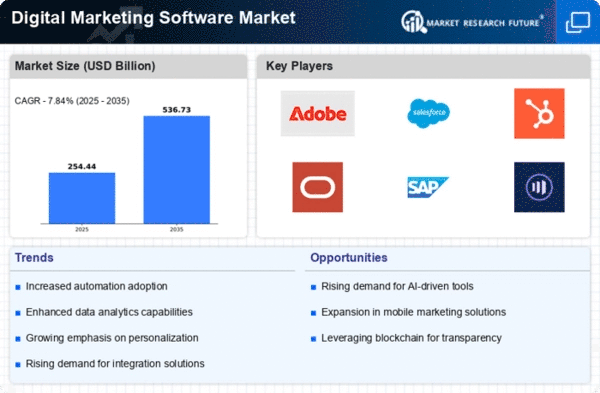
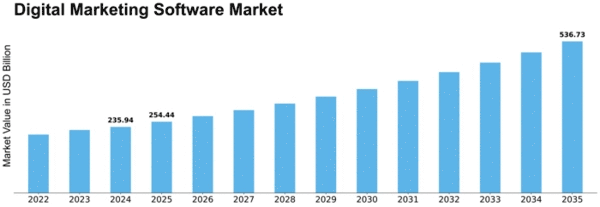
As per MRFR analysis, the Digital Marketing Software Market was estimated at 235.94 USD Billion in 2024. The Digital Marketing Software industry is projected to grow from 252.09 USD Billion in 2025 to 536.73 USD Billion by 2035, exhibiting a compound annual growth rate (CAGR) of 7.84 during the forecast period 2025 - 2035.

Key Market Trends & Highlights

The Digital Marketing Software Market is experiencing robust growth driven by technological advancements and evolving consumer preferences.

  • The market is witnessing an increased focus on personalization to enhance customer engagement.
  • Integration of AI and automation is becoming prevalent, streamlining marketing processes and improving efficiency.
  • Data privacy and compliance are gaining prominence as businesses adapt to regulatory changes and consumer expectations.
  • Rising demand for analytics and reporting tools, alongside the expansion of e-commerce and online retail, are key drivers propelling market growth.

Market Size & Forecast

2024 Market Size 235.94 (USD Billion)
2035 Market Size 536.73 (USD Billion)
CAGR (2025 - 2035) 7.84%
Largest Regional Market Share in 2024 North America

Major Players

<p>Adobe (US), Salesforce (US), HubSpot (US), Oracle (US), SAP (DE), Marketo (US), Mailchimp (US), Constant Contact (US), Zoho (IN), Pardot (US)</p>

Market Trends

The Digital Marketing Software Market is currently experiencing a transformative phase characterized by rapid technological advancements and evolving consumer behaviors. As businesses increasingly recognize the necessity of digital engagement, the demand for sophisticated marketing solutions continues to rise. This market encompasses a wide array of tools designed to enhance online visibility, streamline customer interactions, and optimize marketing strategies. Companies are now prioritizing data-driven decision-making, which appears to be a pivotal factor in shaping the future landscape of this sector. Furthermore, the integration of artificial intelligence and machine learning technologies is likely to redefine how marketing campaigns are executed, providing deeper insights and more personalized experiences for consumers. In addition to technological innovations, the Digital Marketing Software Market is also influenced by shifting regulatory frameworks and privacy concerns. Organizations are compelled to adapt their strategies to comply with new data protection laws, which may impact how they collect and utilize consumer information. This evolving regulatory environment suggests that companies must remain agile and responsive to maintain competitive advantages. As the market continues to mature, it seems that collaboration between software providers and businesses will be essential in developing solutions that not only meet marketing objectives but also adhere to ethical standards and consumer expectations.

Increased Focus on Personalization

The Digital Marketing Software Market is witnessing a pronounced emphasis on personalized marketing strategies. Businesses are leveraging advanced analytics to tailor their messaging and offerings to individual consumer preferences. This trend indicates a shift towards creating more relevant and engaging customer experiences, which may enhance brand loyalty and drive conversions.

Integration of AI and Automation

The integration of artificial intelligence and automation tools is becoming increasingly prevalent within the Digital Marketing Software Market. These technologies facilitate more efficient campaign management and enable marketers to analyze vast amounts of data swiftly. This trend suggests that organizations are seeking to optimize their marketing efforts while reducing manual workloads.

Emphasis on Data Privacy and Compliance

As data privacy concerns grow, the Digital Marketing Software Market is adapting to new regulatory requirements. Companies are prioritizing compliance with data protection laws, which may influence how they collect, store, and utilize consumer information. This trend indicates a broader commitment to ethical marketing practices and consumer trust.

Digital Marketing Software Market Market Drivers

Market Growth Projections

The Global Digital Marketing Software Market Industry is poised for substantial growth, with projections indicating a market size of 235.94 USD Billion in 2024 and an anticipated increase to 541.32 USD Billion by 2035. This growth trajectory suggests a compound annual growth rate of 7.84% from 2025 to 2035, reflecting the increasing reliance on digital marketing solutions across various sectors. The expansion of digital marketing software is driven by factors such as technological advancements, the rise of e-commerce, and the growing importance of data analytics. As businesses continue to invest in digital marketing strategies, the market is likely to flourish in the coming years.

Expansion of E-commerce Platforms

The expansion of e-commerce platforms significantly contributes to the growth of the Global Digital Marketing Software Market Industry. As more businesses transition to online sales, the need for effective digital marketing strategies becomes paramount. E-commerce companies require robust marketing software to manage their online presence, optimize product listings, and engage with customers through various digital channels. This shift is evidenced by the increasing number of online retailers and the growing volume of online transactions. The market is anticipated to grow substantially, with projections indicating a rise to 541.32 USD Billion by 2035, underscoring the vital role of digital marketing in the e-commerce landscape.

Growing Importance of Data Analytics

Data analytics plays a crucial role in shaping the Global Digital Marketing Software Market Industry. Businesses are increasingly leveraging data to gain insights into consumer behavior and preferences, which informs their marketing strategies. The ability to analyze large datasets allows companies to identify trends, measure campaign effectiveness, and optimize their marketing efforts. This trend is particularly relevant as organizations seek to enhance their return on investment in marketing. The demand for analytics-driven marketing solutions is likely to propel the market forward, with projections indicating a compound annual growth rate of 7.84% from 2025 to 2035, highlighting the critical role of data in modern marketing.

Increased Focus on Customer Experience

An increased focus on customer experience is reshaping the Global Digital Marketing Software Market Industry. Businesses are recognizing that delivering exceptional customer experiences is essential for retaining customers and fostering brand loyalty. As a result, there is a growing demand for marketing software that enables personalized communication and seamless interactions across multiple channels. Companies are investing in tools that facilitate customer journey mapping and feedback collection, allowing them to refine their marketing strategies. This emphasis on customer-centric approaches is likely to drive market growth, as organizations strive to differentiate themselves in a competitive landscape.

Rising Demand for Digital Marketing Solutions

The Global Digital Marketing Software Market Industry experiences a notable surge in demand as businesses increasingly recognize the necessity of digital presence. In 2024, the market is projected to reach 235.94 USD Billion, driven by the need for effective online engagement strategies. Companies are investing in software that enhances customer interaction and optimizes marketing efforts. This trend is particularly evident in sectors such as retail and e-commerce, where digital marketing tools facilitate targeted advertising and customer analytics. As organizations strive to adapt to changing consumer behaviors, the reliance on digital marketing software is likely to grow, indicating a robust future for the industry.

Technological Advancements in Marketing Tools

Technological innovations significantly influence the Global Digital Marketing Software Market Industry, as new tools and platforms emerge to enhance marketing efficiency. The integration of artificial intelligence and machine learning into marketing software allows for more personalized customer experiences and data-driven decision-making. For instance, predictive analytics tools enable businesses to anticipate consumer needs and tailor their marketing strategies accordingly. This technological evolution not only improves customer engagement but also streamlines marketing processes, making them more effective. As companies continue to adopt these advanced technologies, the market is expected to expand, reflecting a shift towards more sophisticated marketing solutions.

Market Segment Insights

By Application: Search Engine Optimization (Largest) vs. Social Media Marketing (Fastest-Growing)

<p>In the Digital Marketing Software Market, Search Engine Optimization (SEO) leads the application segment with the largest market share, as businesses continue to prioritize optimizing their online presence to enhance visibility and drive traffic. Social Media Marketing follows closely, rapidly gaining traction due to its significant engagement potential across various platforms. Other applications such as Email Marketing, Content Marketing, and Affiliate Marketing also contribute to the market but have comparatively smaller shares. The growth in the application segment is primarily driven by the rising importance of online visibility and engagement in the digital landscape. With more consumers turning to search engines and social media for information and shopping, the demand for effective marketing strategies has surged. The integration of advanced analytics, automation technologies, and personalized content has further fueled the growth of these applications, making them essential tools for marketers aiming to boost their outreach and conversion rates.</p>

<p>Search Engine Optimization (Dominant) vs. Content Marketing (Emerging)</p>

<p>Search Engine Optimization (SEO) is the dominant player in the Digital Marketing Software Market, recognized for its critical role in increasing website visibility and organic search rankings. Companies invest heavily in SEO strategies to enhance user experience and optimize content, ensuring they meet search engine algorithms. Conversely, Content Marketing has emerged as a vital strategy, focusing on delivering valuable information to attract and retain a clearly defined audience. It complements SEO efforts by providing the necessary content to boost rankings and engagement. As businesses increasingly recognize the synergistic effects of SEO and content marketing, they are allocating resources to develop integrated strategies that leverage both, positioning them favorably in the competitive digital landscape.</p>

By Deployment Type: Cloud-Based (Largest) vs. On-Premises (Fastest-Growing)

<p>The Digital Marketing Software Market demonstrates a clear distribution among its deployment types, with Cloud-Based solutions dominating the landscape. As businesses increasingly shift toward digitalization, Cloud-Based deployment has captured a substantial share of the market, favored for its flexibility, ease of access, and scalability. On the other hand, On-Premises solutions, while currently trailing, are gaining traction among organizations that prioritize control over their infrastructure and data security. Hybrid solutions also play a role, gaining popularity for combining the best of both worlds.</p>

<p>On-Premises (Dominant) vs. Hybrid (Emerging)</p>

<p>The On-Premises segment remains a dominant player in the Digital Marketing Software Market, especially among large enterprises that require comprehensive control over their data and systems. With customizable options and enhanced security, On-Premises solutions appeal to businesses seeking tailored marketing automation strategies without relying on external servers. In contrast, Hybrid deployment models are emerging, offering a balanced approach by integrating both Cloud-Based and On-Premises advantages. This flexibility allows organizations to maintain certain critical operations in-house while leveraging Cloud resources for scalability and innovative features, making it an attractive choice for mid-sized companies.</p>

By End User: Small and Medium Enterprises (Largest) vs. Marketing Agencies (Fastest-Growing)

<p>In the Digital Marketing Software Market, the end-user segment is characterized by a well-defined distribution among several key players, namely Small and Medium Enterprises (SMEs), Large Enterprises, Marketing Agencies, and E-commerce Businesses. SMEs occupy the largest share of the market, benefiting from a growing inclination towards digital solutions to enhance visibility and engagement. Conversely, Marketing Agencies have emerged as a significant influential force, capitalizing on the demand for tailored digital solutions that cater to diverse client needs, thus capturing a rapidly increasing market share.</p>

<p>Small and Medium Enterprises: Dominant vs. Marketing Agencies: Emerging</p>

<p>Small and Medium Enterprises (SMEs) are recognized as the dominant force in the Digital Marketing Software Market, primarily due to their agility in adopting new technologies and strategies that enhance their market presence. They invest heavily in digital marketing solutions to compete effectively and resonate with their target audience. Meanwhile, Marketing Agencies are the emerging players, characterized by their adaptability and expertise in leveraging advanced digital marketing tools. These agencies focus on customized solutions that cater to various businesses' needs, driving their growth in the market as they innovate in the services they provide. Both segments complement each other, with SMEs relying on the expertise of Marketing Agencies to amplify their marketing efforts.</p>

By Features: Analytics and Reporting (Largest) vs. Automation (Fastest-Growing)

<p>In the digital marketing software market, Analytics and Reporting holds the largest share among various features, catering to businesses that prioritize data-driven decisions. This segment enables marketers to track performance metrics and gain insights into customer behavior, leading to more effective campaigns. Meanwhile, Automation is emerging as a powerful trend, streamlining marketing processes and enhancing efficiency across campaigns, resulting in significant adoption among businesses looking to optimize resources. The growth of the Analytics and Reporting segment is driven by the increasing emphasis on performance measurement and the demand for actionable insights. Simultaneously, Automation is rapidly gaining traction, propelled by advancements in technology and the need for personalized customer interactions. As organizations strive for efficiency and better outcomes, the demand for automated solutions continues to climb, making it a focal area for innovation in the digital marketing landscape.</p>

<p>Analytics and Reporting (Dominant) vs. Automation (Emerging)</p>

<p>Analytics and Reporting serve as the backbone of the digital marketing software market, offering tools that help businesses analyze data and measure the success of their campaigns. This dominant segment empowers marketers to make informed decisions and adapt strategies based on quantifiable results. On the other hand, Automation is an emerging segment that provides extensive opportunities to enhance operational efficiencies. Businesses are increasingly integrating automation tools to streamline repetitive tasks, allowing teams to focus on strategic, high-value activities. While Analytics and Reporting emphasizes insight generation and performance tracking, Automation focuses on enhancing customer engagement through timely message delivery and personalized interactions, setting the stage for a future where marketing efforts become increasingly intelligent and responsive.</p>

Get more detailed insights about Digital Marketing Software Market Research Report - Forecast to 2035

Regional Insights

North America : Market Leader in Innovation

North America continues to lead the Digital Marketing Software Market, holding a significant share of 117.97 million in 2024. The region's growth is driven by rapid technological advancements, increasing internet penetration, and a strong focus on data-driven marketing strategies. Regulatory support for digital initiatives further fuels demand, as businesses seek to enhance customer engagement and optimize marketing ROI. The competitive landscape is robust, with key players like Adobe, Salesforce, and HubSpot dominating the market. The U.S. is the primary contributor, showcasing a high adoption rate of digital marketing tools across various sectors. Companies are increasingly investing in innovative solutions to stay ahead, making North America a hotbed for digital marketing advancements.

Europe : Emerging Digital Marketing Hub

Europe's Digital Marketing Software Market is valued at 66.78 million, reflecting a growing demand for sophisticated marketing solutions. The region benefits from a diverse economy and a strong emphasis on data privacy regulations, such as GDPR, which shape marketing strategies. Businesses are increasingly adopting digital tools to comply with regulations while enhancing customer experiences, driving market growth. Leading countries like Germany, the UK, and France are at the forefront, with a competitive landscape featuring major players like SAP and Oracle. The presence of innovative startups also contributes to a dynamic market environment. As European companies prioritize digital transformation, the demand for advanced marketing software is expected to rise significantly.

Asia-Pacific : Rapidly Growing Digital Market

The Asia-Pacific region, valued at 41.19 million, is witnessing rapid growth in the Digital Marketing Software Market. Factors such as increasing smartphone penetration, a young population, and rising internet usage are driving demand for digital marketing solutions. Additionally, government initiatives promoting digital economies are acting as catalysts for market expansion, making this region a focal point for investment. Countries like India and China are leading the charge, with a burgeoning number of startups and established players like Zoho making significant impacts. The competitive landscape is characterized by a mix of local and international companies, all vying for market share in this dynamic environment. As businesses increasingly recognize the importance of digital marketing, the region is set for substantial growth.

Middle East and Africa : Emerging Digital Frontier

The Middle East and Africa region, with a market size of 9.0 million, is gradually emerging as a significant player in the Digital Marketing Software Market. The growth is driven by increasing internet connectivity and a young, tech-savvy population eager to adopt digital solutions. Governments are also investing in digital infrastructure, which is expected to enhance market dynamics and attract foreign investment. Countries like the UAE and South Africa are leading the way, with a growing number of local and international players entering the market. The competitive landscape is evolving, with businesses increasingly recognizing the value of digital marketing tools to reach their target audiences effectively. As the region continues to develop, the demand for innovative marketing solutions is anticipated to rise.

Key Players and Competitive Insights

The Digital Marketing Software Market is currently characterized by a dynamic competitive landscape, driven by rapid technological advancements and evolving consumer preferences. Key players such as Adobe (US), Salesforce (US), and HubSpot (US) are at the forefront, each adopting distinct strategies to enhance their market positioning. Adobe (US) emphasizes innovation through its comprehensive suite of creative and marketing tools, while Salesforce (US) focuses on integrating AI capabilities into its customer relationship management (CRM) solutions. HubSpot (US), on the other hand, leverages its user-friendly platform to attract small and medium-sized enterprises (SMEs), thereby expanding its customer base and enhancing user engagement. Collectively, these strategies contribute to a competitive environment that is increasingly centered around technological integration and customer-centric solutions.

In terms of business tactics, companies are increasingly localizing their offerings to cater to regional markets, optimizing supply chains to enhance efficiency, and investing in digital transformation initiatives. The market structure appears moderately fragmented, with a mix of established players and emerging startups. This fragmentation allows for diverse offerings, yet the influence of key players remains substantial, as they set industry standards and drive innovation.

In November 2025, Adobe (US) announced the launch of its new AI-driven marketing analytics tool, which aims to provide businesses with deeper insights into consumer behavior. This strategic move is significant as it positions Adobe (US) to capitalize on the growing demand for data-driven marketing solutions, potentially enhancing its competitive edge in the market. The integration of AI into its offerings may also streamline marketing processes for clients, thereby increasing customer satisfaction and retention.

In October 2025, Salesforce (US) unveiled a partnership with a leading social media platform to enhance its marketing automation capabilities. This collaboration is noteworthy as it allows Salesforce (US) to expand its reach and provide clients with more robust tools for social media marketing. By integrating social media insights into its CRM solutions, Salesforce (US) is likely to improve customer engagement and drive higher conversion rates for its users.

In September 2025, HubSpot (US) introduced a new feature that allows users to create personalized marketing campaigns based on real-time data analytics. This development is crucial as it reflects HubSpot's commitment to enhancing user experience and meeting the evolving needs of its customers. By enabling more tailored marketing strategies, HubSpot (US) may strengthen its position among SMEs, which increasingly seek personalized solutions to drive growth.

As of December 2025, the competitive trends in the Digital Marketing Software Market are heavily influenced by digitalization, sustainability, and the integration of AI technologies. Strategic alliances are becoming increasingly prevalent, as companies recognize the value of collaboration in enhancing their service offerings. Looking ahead, competitive differentiation is likely to evolve, shifting from price-based competition to a focus on innovation, technological advancement, and supply chain reliability. This transition underscores the importance of adaptability and forward-thinking strategies in maintaining a competitive edge in a rapidly changing market.

Key Companies in the Digital Marketing Software Market market include

Industry Developments

  • Q2 2024: Omnicom’s planned US$13.5 billion acquisition of Interpublic Group (IPG) is aimed at joining Omnicom’s creative capabilities with IPG’s wealth of data Omnicom announced a planned $13.5 billion acquisition of Interpublic Group (IPG) in 2024, aiming to combine creative and data-driven marketing capabilities. The deal reflects ongoing consolidation in the digital advertising sector and is intended to strengthen Omnicom's position amid increasing competition and technological disruption.[3]
  • Q2 2024: Skydance and Redbird’s deal to buy Paramount Global for US$8 billion—was still awaiting regulatory approval at the time of writing Skydance and Redbird agreed to acquire Paramount Global for $8 billion in 2024, pending regulatory approval. This major transaction highlights continued M&A activity in the digital media and entertainment market.[3]
  • Q2 2024: Tencent’s US$1.3 billion investment in Ubisoft Chinese gaming giant Tencent made a $1.3 billion investment in Ubisoft in 2024, further expanding its presence in the global digital gaming and entertainment sector.[3]
  • Q2 2024: Italian TV group MFE-Mediaset’s full takeover offer for Germany’s ProSiebenSat MFE-Mediaset, an Italian TV group, made a full takeover offer for Germany’s ProSiebenSat in 2024, signaling further consolidation in the European digital media landscape.[3]
  • Q2 2024: Bertelsmann seeking another shot at the US$4.1 billion merger between French broadcasters M6 and TF1 that was blocked by EU regulators in 2022 Bertelsmann renewed efforts in 2024 to pursue a $4.1 billion merger between French broadcasters M6 and TF1, after a previous attempt was blocked by EU regulators in 2022.[3]
  • Q2 2024: Acquisition by Japanese entertainment group Toho of the North American animation producer and distributor GKIDS Japanese entertainment group Toho acquired North American animation producer and distributor GKIDS in 2024, expanding its footprint in the digital animation and streaming market.[3]

Influencer marketing

The ad-blockers have been the primary challenge for the marketing industry, as the customer might be annoyed if the ad content blocks their view. Over 27% of internet users intensively use the ad-blockers and are ready to pay for them. Hence analyzing the target audience and locations of posting the ads are essential. Current trends are focusing on influencer marketing as the customers have increased the usage of ad blockers.

Voice interaction marketing strategy

Siri, Google, Alexa are some of the smart devices that enable the user to interact actively. As these devices talk to people, customers are more likely to prefer this kind of interaction. This methodology is utilized to help the customers to discover things online for shopping or other essential activities.

Future Outlook

Digital Marketing Software Market Future Outlook

<p>The Digital Marketing Software Market is projected to grow at a 7.84% CAGR from 2024 to 2035, driven by advancements in AI, data analytics, and increasing digital ad spend.</p>

New opportunities lie in:

  • <p>Integration of AI-driven analytics for personalized marketing strategies.</p>
  • <p>Development of cross-channel marketing automation tools.</p>
  • <p>Expansion into emerging markets with localized digital solutions.</p>

<p>By 2035, the market is expected to be robust, reflecting substantial growth and innovation.</p>

Market Segmentation

Digital Marketing Software Market End User Outlook

  • Small and Medium Enterprises
  • Large Enterprises
  • Marketing Agencies
  • E-commerce Businesses

Digital Marketing Software Market Features Outlook

  • Analytics and Reporting
  • Automation
  • Customer Relationship Management
  • Content Management
  • Search Engine Marketing

Digital Marketing Software Market Application Outlook

  • Search Engine Optimization
  • Social Media Marketing
  • Email Marketing
  • Content Marketing
  • Affiliate Marketing

Digital Marketing Software Market Deployment Type Outlook

  • Cloud-Based
  • On-Premises
  • Hybrid

Report Scope

MARKET SIZE 2024235.94(USD Billion)
MARKET SIZE 2025252.09(USD Billion)
MARKET SIZE 2035536.73(USD Billion)
COMPOUND ANNUAL GROWTH RATE (CAGR)7.84% (2024 - 2035)
REPORT COVERAGERevenue Forecast, Competitive Landscape, Growth Factors, and Trends
BASE YEAR2024
Market Forecast Period2025 - 2035
Historical Data2019 - 2024
Market Forecast UnitsUSD Billion
Key Companies ProfiledAdobe (US), Salesforce (US), HubSpot (US), Oracle (US), SAP (DE), Marketo (US), Mailchimp (US), Constant Contact (US), Zoho (IN), Pardot (US)
Segments CoveredApplication, Deployment Type, End User, Features
Key Market OpportunitiesIntegration of artificial intelligence enhances personalization and efficiency in the Digital Marketing Software Market.
Key Market DynamicsRising demand for personalized marketing solutions drives innovation and competition in the Digital Marketing Software Market.
Countries CoveredNorth America, Europe, APAC, South America, MEA

FAQs

How big is the digital marketing software market?

The global digital marketing software market size was estimated at USD 320.135 billion in 2022 and is expected to reach USD 839.873 billion in 2032.

What are the different type-based segments profiled in this report?

Interaction systems, content production &amp; management, data &amp; analytics system, and management&amp; administration-oriented apps are the types of digital marketing software profiled in this report.

At what CAGR is the data & analytics system segment expected to expand?

The data &amp; analytics system segment is estimated to register 19.20% CAGR.

What factor is likely to have a positive influence on the growth pattern of the digital marketing software market?

The increasing penetration of smartphones, coupled with the rising popularity of social media platforms, is anticipated to influence the market growth positively.

Who are the leading players in Digital Marketing Software Market?

The report analyzes the profiles of key players operating in the digital marketing software market, such as Adobe Systems (USA) SAP SE (Germany) Oracle Corporation (USA) Microsoft Corporation (USA) SS Institute Inc. (USA) IBM Corporation (USA) HP Enterprise Development LP (USA) Hubspot Inc. (USA)

  1. Executive Summary
  2. Market Introduction
    1. Definition 12
    2. Scope Of The Study 12
    3. List Of Assumptions 13
    4. Market Structure 13
  3. Market Insights
  4. Research Methodology
    1. Research Process 17
    2. Forecast Model 21
  5. Market Dynamics
    1. Introduction 23
    2. Drivers 23
      1. Increase Adoption Of Social Media Platforms For Advertising 23
      2. Rise Of Mobile Advertisement Through Mobile Devices 25
      3. Drivers Impact Analysis 26
    3. Opportunity 26
      1. Integration Of Artificial Intelligence (AI) And Big Data Analytics In Digital Marketing 26
    4. Restraints 26
      1. Security And Data Privacy Concerns 26
  6. Market Factor Analysis
    1. Value Chain Analysis 28
    2. Porter’s Five Forces Model 28
      1. Threat Of New Entrants 29
      2. Bargaining Power Of Suppliers 29
      3. Bargaining Power Of Buyers 30
      4. Threat Of Substitutes 30
      5. Intensity Of Rivalry 30
  7. Global Digital Marketing Software Market, By Type
  8. Overview 32
  9. Interaction Systems 32
  10. Data & Analytics System 32
  11. Content Production & Management 32
  12. Management & Administration-Oriented Apps 32
  13. Global Digital Marketing Software Market, By Application
    1. Overview 36
      1. Retail 36
      2. Media & Entertainment 36
      3. Manufacturing 36
      4. High Tech & IT 36
      5. BFSI 37
      6. Others 37
  14. Global Digital Marketing Software Market, By Region
    1. US 41
    2. Europe 45
    3. China 49
    4. Japan 52
    5. India 56
    6. South-East Asia 59
  15. Competitive Landscape
    1. Competitive Landscape 64
  16. Company Profiles
    1. Oracle Corporation 67
      1. Company Overview 67
      2. Financial Overview 67
      3. Products/Services/Solutions Offered 68
      4. Key Developments 68
      5. SWOT Analysis 68
      6. Key Strategies 69
    2. IBM Corporation 70
      1. Company Overview 70
      2. Financial Overview 71
      3. Products/Services/Solutions Offered 71
      4. Key Developments 72
      5. SWOT Analysis 72
      6. Key Strategy 72
    3. SAP SE 73
      1. Company Overview 73
      2. Financial Overview 74
      3. Products/Services/Solutions Offered 74
      4. Key Developments 74
      5. SWOT Analysis 75
      6. Key Strategies 75
    4. Microsoft Corporation 76
      1. Company Overview 76
      2. Financial Overview 76
      3. Products/Services/Solutions Offered 77
      4. Key Developments 77
      5. SWOT Analysis 77
      6. Key Strategies 77
    5. SAS Institute Inc 78
      1. Company Overview 78
      2. Financial Overview 78
      3. Products/Services/Solutions Offered 79
      4. Key Developments 79
      5. SWOT Analysis 79
      6. Key Strategy 80
    6. Adobe Systems 81
      1. Company Overview 81
      2. Financial Overview 81
      3. Products/Services/Solutions Offered 82
      4. Key Developments 82
      5. SWOT Analysis 82
      6. Key Strategy 83
    7. HP Enterprise Development L.P 84
      1. Company Overview 84
      2. Financial Overview 84
      3. Products/Services/Solutions Offered 85
      4. Key Developments 85
      5. SWOT Analysis 86
      6. Key Strategy 86
    8. Hubspot Inc 87
      1. Company Overview 87
      2. Financial Overview 87
      3. Products/Services/Solutions Offered 88
      4. Key Developments 88
      5. SWOT Analysis 89
      6. Key Strategy 89
  17. List Of Tables
  18. MARKET SYNOPSIS 10
  19. LIST OF ASSUMPTIONS 13
  20. GLOBAL DIGITAL MARKETING SOFTWARE MARKET, BY TYPE, 2020-2027 (USD MILLION) 33
  21. GLOBAL DIGITAL MARKETING SOFTWARE MARKET, BY TYPE, 2020-2027 (USD MILLION) 34
  22. GLOBAL DIGITAL MARKETING SOFTWARE MARKET, BY APPLICATION, 2020-2027 (USD MILLION) 38
  23. GLOBAL DIGITAL MARKETING SOFTWARE MARKET, BY APPLICATION, 2020-2027 (USD MILLION) 39
  24. US DIGITAL MARKETING SOFTWARE MARKET, BY TYPE, 2020-2027 (USD MILLION) 41
  25. US DIGITAL MARKETING SOFTWARE MARKET, BY TYPE, 2020-2027(USD MILLION) 42
  26. US DIGITAL MARKETING SOFTWARE MARKET, BY APPLICATION, 2020-2027 (USD MILLION) 43
  27. US DIGITAL MARKETING SOFTWARE MARKET, BY APPLICATION, 2020-2027 (USD MILLION) 44
  28. EUROPE DIGITAL MARKETING SOFTWARE MARKET, BY TYPE, 2020-2027 (USD MILLION) 45
  29. EUROPE DIGITAL MARKETING SOFTWARE MARKET, BY TYPE, 2020-2027(USD MILLION) 46
  30. EUROPE DIGITAL MARKETING SOFTWARE MARKET, BY APPLICATION, 2020-2027 (USD MILLION) 47
  31. EUROPE DIGITAL MARKETING SOFTWARE MARKET, BY APPLICATION, 2020 TO 2027 (USD MILLION) 48
  32. CHINA DIGITAL MARKETING SOFTWARE MARKET, BY TYPE, 2020-2027 (USD MILLION) 49
  33. CHINA DIGITAL MARKETING SOFTWARE MARKET, BY TYPE, 2020-2027 (USD MILLION) 50
  34. CHINA DIGITAL MARKETING SOFTWARE MARKET, BY APPLICATION, 2020-2027 (USD MILLION) 51
  35. CHINA DIGITAL MARKETING SOFTWARE MARKET, BY APPLICATION, 2020-2027 (USD MILLION) 51
  36. JAPAN DIGITAL MARKETING SOFTWARE MARKET, BY TYPE, 2020-2027 (USD MILLION) 52
  37. JAPAN DIGITAL MARKETING SOFTWARE MARKET, BY TYPE, 2020-2027 (USD MILLION) 53
  38. JAPAN DIGITAL MARKETING SOFTWARE MARKET, BY APPLICATION, 2020-2027 (USD MILLION) 54
  39. JAPAN DIGITAL MARKETING SOFTWARE MARKET, BY APPLICATION, 2020-2027 (USD MILLION) 55
  40. INDIA DIGITAL MARKETING SOFTWARE MARKET, BY TYPE, 2020-2027 (USD MILLION) 56
  41. INDIA DIGITAL MARKETING SOFTWARE MARKET, BY TYPE, 2020-2027 (USD MILLION) 57
  42. INDIA DIGITAL MARKETING SOFTWARE MARKET, BY APPLICATION, 2020-2027 (USD MILLION) 58
  43. INDIA DIGITAL MARKETING SOFTWARE MARKET, BY APPLICATION, 2020-2027 (USD MILLION) 58
  44. SOUTH-EAST ASIA DIGITAL MARKETING SOFTWARE MARKET, BY TYPE, 2020-2027 (USD MILLION) 59
  45. SOUTH-EAST ASIA DIGITAL MARKETING SOFTWARE MARKET, BY TYPE, 2020-2027 (USD MILLION) 60
  46. SOUTH-EAST ASIA DIGITAL MARKETING SOFTWARE MARKET, BY APPLICATION, 2020-2027 (USD MILLION) 61
  47. SOUTH-EAST ASIA DIGITAL MARKETING SOFTWARE MARKET, BY APPLICATION, 2020-2027 (USD MILLION) 62
  48. List Of Figures
  49. GLOBAL DIGITAL MARKETING SOFTWARE MARKET: MARKET STRUCTURE 13
  50. GLOBAL MARKET SIZE & MARKET SHARE BY REGION/COUNTRY (2020 VS 2027) 15
  51. TOP DOWN & BOTTOM UP APPROACH 20
  52. DRO ANALYSIS OF GLOBAL DIGITAL MARKETING SOFTWARE MARKET 23
  53. SOCIAL MEDIA PLATFORMS BUSINESS VALUE 24
  54. AVERAGE CONVERSION RATE BY ADVERTISING CHANNEL 24
  55. SMARTPHONE ADOPTION 25
  56. DRIVERS IMPACT ANALYSIS: DIGITAL MARKETING SOFTWARE MARKET 26
  57. VALUE CHAIN: GLOBAL DIGITAL MARKETING SOFTWARE MARKET 28
  58. PORTER'S FIVE FORCES ANALYSIS OF THE GLOBAL DIGITAL MARKETING SOFTWARE MARKET 29
  59. GLOBAL DIGITAL MARKETING SOFTWARE MARKET, BY TYPE, 2020 TO 2027 (USD MILLION) 33
  60. GLOBAL DIGITAL MARKETING SOFTWARE MARKET, BY TYPE, 2020 TO 2027 (USD MILLION) 34
  61. GLOBAL DIGITAL MARKETING SOFTWARE MARKET, BY APPLICATION, 2020 TO 2027(USD MILLION) 38
  62. GLOBAL DIGITAL MARKETING SOFTWARE MARKET, BY APPLICATION, 2020 TO 2027 (USD MILLION) 39
  63. US DIGITAL MARKETING SOFTWARE MARKET, BY TYPE, 2020 TO 2027 (USD MILLION) 41
  64. US DIGITAL MARKETING SOFTWARE MARKET, BY TYPE, 2020 TO 2027 (USD MILLION) 42
  65. US DIGITAL MARKETING SOFTWARE MARKET, BY APPLICATION, 2020 TO 2027 (USD MILLION) 43
  66. US DIGITAL MARKETING SOFTWARE MARKET, BY APPLICATION, 2020 TO 2027 (USD MILLION) 44
  67. EUROPE DIGITAL MARKETING SOFTWARE MARKET, BY TYPE, 2020 TO 2027 (USD MILLION) 45
  68. EUROPE DIGITAL MARKETING SOFTWARE MARKET, BY TYPE, 2020 TO 2027 (USD MILLION) 46
  69. EUROPE DIGITAL MARKETING SOFTWARE MARKET, BY APPLICATION, 2020 TO 2027(USD MILLION) 47
  70. EUROPE DIGITAL MARKETING SOFTWARE MARKET, BY APPLICATION, 2020 TO 2027 (USD MILLION) 48
  71. CHINA DIGITAL MARKETING SOFTWARE MARKET, BY TYPE, 2020 TO 2027 (USD MILLION) 49
  72. CHINA DIGITAL MARKETING SOFTWARE MARKET, BY TYPE, 2020 TO 2027 (USD MILLION) 49
  73. CHINA DIGITAL MARKETING SOFTWARE MARKET, BY APPLICATION, 2020 TO 2027 (USD MILLION) 50
  74. CHINA DIGITAL MARKETING SOFTWARE MARKET, BY APPLICATION, 2020 TO 2027 (USD MILLION) 51
  75. JAPAN DIGITAL MARKETING SOFTWARE MARKET, BY TYPE, 2020 TO 2027 (USD MILLION) 52
  76. JAPAN DIGITAL MARKETING SOFTWARE MARKET, BY TYPE, 2020 TO 2027 (USD MILLION) 53
  77. JAPAN DIGITAL MARKETING SOFTWARE MARKET, BY APPLICATION, 2020 TO 2027 (USD MILLION) 54
  78. JAPAN DIGITAL MARKETING SOFTWARE MARKET, BY APPLICATION, 2020 TO 2027 (USD MILLION) 55
  79. INDIA DIGITAL MARKETING SOFTWARE MARKET, BY TYPE, 2020 TO 2027 (USD MILLION) 56
  80. INDIA DIGITAL MARKETING SOFTWARE MARKET, BY TYPE, 2020 TO 2027 (USD MILLION) 56
  81. INDIA DIGITAL MARKETING SOFTWARE MARKET, BY APPLICATION, 2020 TO 2027 (USD MILLION) 57
  82. INDIA DIGITAL MARKETING SOFTWARE MARKET, BY APPLICATION, 2020 TO 2027 (USD MILLION) 58
  83. SOUTH-EAST ASIA DIGITAL MARKETING SOFTWARE MARKET, BY TYPE, 2020 TO 2027 (USD MILLION) 59
  84. SOUTH-EAST ASIA DIGITAL MARKETING SOFTWARE MARKET, BY TYPE, 2020 TO 2027 (USD MILLION) 60
  85. SOUTH-EAST ASIA DIGITAL MARKETING SOFTWARE MARKET, BY APPLICATION, 2020 TO 2027 (USD MILLION) 61
  86. SOUTH-EAST ASIA DIGITAL MARKETING SOFTWARE MARKET, BY APPLICATION, 2020 TO 2027 (USD MILLION) 62
  87. COMPETITIVE BENCHMARKING OF THE MAJOR PLAYERS 65

Digital Market Segmentation

Market Segmentation Overview

  • Detailed segmentation data will be available in the full report
  • Comprehensive analysis by multiple parameters
  • Regional and country-level breakdowns
  • Market size forecasts by segment
Infographic

Free Sample Request

Kindly complete the form below to receive a free sample of this Report

Get Free Sample

Customer Strories

Compare Licence

×
Features License Type
Single User Multiuser License Enterprise User
Price $4,950 $5,950 $7,250
Maximum User Access Limit 1 User Upto 10 Users Unrestricted Access Throughout the Organization
Free Customization
Direct Access to Analyst
Deliverable Format
Platform Access
Discount on Next Purchase 10% 15% 15%
Printable Versions