×
Request Free Sample ×

Kindly complete the form below to receive a free sample of this Report

* Please use a valid business email

Leading companies partner with us for data-driven Insights

clients tt-cursor
Hero Background
English
Chinese
French
Japanese
Korean
German
Spanish

Diabetes Pen Market Analysis

ID: MRFR/MED/0146-HCR
105 Pages
Rahul Gotadki
October 2025

Americas Diabetes Pen Market Research Report Information By Type, By Route, By Therapy, And By Region (North America, Europe, Asia-Pacific, And Rest Of The World) - Growth & Industry Forecast 2025 To 2035

Share:
Download PDF ×

We do not share your information with anyone. However, we may send you emails based on your report interest from time to time. You may contact us at any time to opt-out.

Diabetes Pen Market Infographic
Purchase Options

Market Analysis

In-depth Analysis of Diabetes Pen Market Industry Landscape

The Americas diabetes pen market operates at the forefront of diabetes management, providing a convenient and effective means of insulin delivery for patients. Market dynamics in this region are shaped by various factors, including the increasing prevalence of diabetes, advancements in insulin delivery technology, patient preferences for user-friendly devices, and the emphasis on improving overall diabetes care. Diabetes pens, which offer a discreet and easy-to-use alternative to traditional insulin delivery methods, play a crucial role in the management of diabetes across the Americas.

One of the primary drivers influencing the dynamics of the Americas diabetes pen market is the rising prevalence of diabetes in the region. With an increasing number of individuals diagnosed with diabetes, there is a growing demand for efficient and patient-friendly insulin delivery solutions. Diabetes pens, with their ease of use and portability, have gained popularity among patients and healthcare professionals alike, contributing to the overall expansion of the diabetes pen market.

Advancements in insulin delivery technology significantly impact market dynamics. Continuous innovation in diabetes pen design, needle technology, and features such as dose memory and Bluetooth connectivity contribute to enhanced user experience and improved adherence to insulin regimens. Manufacturers strive to develop pens with advanced features that cater to the evolving needs of diabetes patients, ensuring better glycemic control and overall health outcomes.

Patient preferences for user-friendly devices play a crucial role in shaping the market dynamics of diabetes pens. The simplicity and convenience offered by pen devices contribute to increased patient satisfaction and compliance with insulin therapy. The ease of use, along with features like dose flexibility and discreetness, aligns with the preferences of diabetes patients, fostering a positive outlook for the diabetes pen market in the Americas.

The emphasis on improving overall diabetes care is a driving force in the market dynamics. Healthcare providers increasingly recognize the importance of patient-centered care and the role of convenient insulin delivery devices in fostering better adherence to treatment plans. Diabetes pens, with their intuitive design and reduced injection-related anxiety, contribute to a more positive patient experience, ultimately promoting better diabetes management and long-term health outcomes.

Regulatory considerations and adherence to quality standards are significant factors influencing market dynamics. Regulatory bodies, such as the U.S. Food and Drug Administration (FDA), play a crucial role in ensuring the safety and efficacy of diabetes pen devices. Manufacturers navigate regulatory pathways to obtain approvals and certifications, impacting product development and market access. Compliance with regulatory standards is essential for building trust among healthcare professionals and patients, driving the overall growth of the diabetes pen market.

The impact of global events, such as the COVID-19 pandemic, has underscored the importance of remote healthcare management and self-administration of medications. Diabetes pens, with their user-friendly design and reduced need for frequent healthcare visits, have become even more relevant in the context of pandemic-related restrictions. This has led to an increased recognition of the value of diabetes pens in ensuring uninterrupted insulin delivery and supporting diabetes patients during challenging times.


Author
Rahul Gotadki
Assistant Manager

He holds an experience of about 7+ years in Market Research and Business Consulting, working under the spectrum of Life Sciences and Healthcare domains. Rahul conceptualizes and implements a scalable business strategy and provides strategic leadership to the clients. His expertise lies in market estimation, competitive intelligence, pipeline analysis, customer assessment, etc. In addition to the above, his other responsibility includes strategic tracking of high growth markets & advising clients on the potential areas of focus they could direct their business initiatives

Leave a Comment

Market Summary

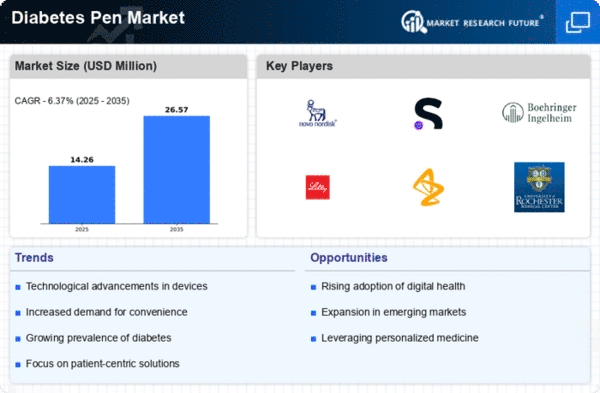
As per MRFR analysis, the Diabetes Pen Market Size was estimated at 13.41 USD Million in 2024. The Diabetes Pen industry is projected to grow from 14.42 USD Million in 2025 to 26.57 USD Million by 2035, exhibiting a compound annual growth rate (CAGR) of 6.37 during the forecast period 2025 - 2035.

Key Market Trends & Highlights

The Diabetes Pen Market is experiencing robust growth driven by technological advancements and increasing patient awareness.

  • Technological advancements in diabetes management are enhancing the efficacy of insulin delivery systems.
  • North America remains the largest market for diabetes pens, while Asia-Pacific is recognized as the fastest-growing region.
  • The insulin delivery segment dominates the market, whereas the glucose monitoring segment is witnessing rapid growth.
  • Rising prevalence of diabetes and innovations in diabetes management are key drivers propelling market expansion.

Market Size & Forecast

2024 Market Size 13.41 (USD Million)
2035 Market Size 26.57 (USD Million)
CAGR (2025 - 2035) 6.37%
Largest Regional Market Share in 2024 North America

Major Players

Novo Nordisk (DK), Sanofi (FR), Boehringer Ingelheim (DE), Eli Lilly and Company (US), AstraZeneca (GB), Roche (CH), Medtronic (US), Ypsomed (CH), Insulet Corporation (US)

Market Trends

The Diabetes Pen Market is currently experiencing a notable transformation, driven by advancements in technology and increasing awareness of diabetes management. The rise in the prevalence of diabetes globally has led to a heightened demand for efficient and user-friendly insulin delivery systems. As patients seek more convenient options, diabetes pens are becoming increasingly popular due to their ease of use and portability. Furthermore, the integration of smart technology into these devices appears to enhance patient adherence to treatment regimens, potentially improving overall health outcomes. In addition to technological innovations, the Diabetes Pen Market is influenced by changing demographics and lifestyle factors. An aging population, coupled with rising obesity rates, suggests a growing need for effective diabetes management solutions. Healthcare providers are also emphasizing personalized treatment plans, which may further drive the adoption of diabetes pens. As the market evolves, it seems likely that manufacturers will continue to focus on developing products that cater to the diverse needs of patients, ensuring that diabetes management becomes more accessible and efficient for all individuals affected by this condition.

Technological Advancements

The integration of smart technology into diabetes pens is reshaping the market landscape. These innovations may include features such as connectivity to mobile applications, which allow users to track their insulin usage and receive reminders for doses. Such advancements could enhance user experience and adherence to treatment.

Increased Patient Awareness

There appears to be a growing awareness among patients regarding the importance of effective diabetes management. This heightened consciousness may lead to a greater demand for diabetes pens, as individuals seek tools that facilitate better control over their condition.

Personalized Treatment Approaches

Healthcare providers are increasingly adopting personalized treatment strategies for diabetes management. This trend suggests that diabetes pens will be tailored to meet the specific needs of individual patients, potentially improving treatment outcomes and patient satisfaction.

Diabetes Pen Market Market Drivers

Market Segment Insights

By Application: Insulin Delivery (Largest) vs. Glucose Monitoring (Fastest-Growing)

The Diabetes Pen Market exhibits a diverse segmentation with Insulin Delivery holding the largest share. This segment primarily caters to the pressing needs of diabetes patients requiring frequent insulin administration, with a robust preference for user-friendly devices. On the other hand, Glucose Monitoring is witnessing rapid growth as more patients shift towards self-management of their condition, facilitated by innovations in technology and increased awareness about diabetes care. This trend reflects a growing market for digital health solutions that assist in constant glucose level monitoring. Growth trends within the Diabetes Pen Market are primarily driven by advancements in technology and increasing prevalence of diabetes globally. The Insulin Delivery segment benefits from advancements in pen technology, making injection processes discrete and manageable. Meanwhile, Glucose Monitoring's rapid adoption is attributed to the rise in continuous glucose monitors and smartphone integration, paving the way for better patient education and data management. Healthcare initiatives increasingly emphasize self-monitoring, further propelling this segment's growth as consumers look for more accessible and effective solutions to manage their diabetes.

Insulin Delivery (Dominant) vs. Patient Education (Emerging)

The Insulin Delivery segment remains dominant in the Diabetes Pen Market, characterized by innovative design and user-centric features that streamline insulin administration. With advancements such as pre-set dosages and disposable options, these devices enhance the patient experience by providing ease of use and reducing the emotional burden of regular injections. In contrast, the Patient Education segment is emerging with an increasing focus on equipping patients with the necessary tools and knowledge for effective diabetes management. This shift is driven by the recognition of empowered patients who are taking proactive roles in their care. The inclusion of educational resources and apps in diabetes care is becoming increasingly essential, reflecting a pivot toward holistic diabetes management beyond just medication.

By Type: Prefilled Pen (Largest) vs. Smart Pen (Fastest-Growing)

The Diabetes Pen Market is witnessing significant segmentation, with three primary types leading the charge: Prefilled Pens, Reusable Pens, and Smart Pens. Currently, Prefilled Pens hold the largest share of the market, attributed to their ease of use and convenience for patients requiring daily insulin administration. Following closely are Reusable Pens, which cater to a segment of users looking for cost-efficient solutions. Smart Pens are gaining momentum as they cleverly integrate technology with traditional delivery methods, capturing a niche audience focused on diabetes management monitoring.

Technology: Prefilled Pen (Dominant) vs. Smart Pen (Emerging)

Prefilled Pens dominate the Diabetes Pen Market due to their user-friendly nature and minimal preparation time, making them accessible for various patient demographics. These pens come pre-loaded with insulin, significantly reducing the hassle of managing diabetes. On the other hand, Smart Pens, though categorized as emerging, are rapidly carving a space for themselves by offering features like Bluetooth connectivity and mobile app integration. These devices provide advanced tracking and reminders, appealing to tech-savvy consumers eager for improved diabetes management. As patient preferences shift towards greater convenience and technological features, both Prefilled and Smart Pens are essential players in the evolving market landscape.

By End User: Homecare (Largest) vs. Hospitals (Fastest-Growing)

In the Diabetes Pen Market, the distribution of market share among end-user segments reveals that homecare settings constitute the largest share, driven by the increasing preference for self-administration and the convenience it offers patients. Hospitals, while not the largest, are emerging as a significant segment due to advancements in healthcare technology and the introduction of more efficient diabetes management systems. The presence of a growing number of diabetic patients seeking treatment in outpatient facilities further fuels this trend. The growth trends in this segment are influenced by the rising prevalence of diabetes globally, leading to an increasing demand for diabetes management solutions. Homecare is anticipated to remain a dominant force owing to the convenience of pen devices for self-injection and the growing emphasis on personalized patient care. In contrast, hospitals are rapidly adapting by incorporating innovative pen devices into their treatment protocols, marking them as the fastest-growing segment in this market.

Homecare (Dominant) vs. Hospitals (Emerging)

Homecare is recognized as the dominant segment in the Diabetes Pen Market because of its alignment with patients' preferences for at-home management. The rise of telemedicine and patient education has empowered individuals to manage their diabetes effectively at home, utilizing diabetes pens for convenient and discreet insulin administration. In contrast, hospitals serve as an emerging segment, adapting to the challenges of inpatient diabetes management with the rapid introduction of novel pen technologies. These facilities focus on streamlining processes and enhancing patient outcomes through efficient pen usage, driven by the increasing incidence of diabetes cases. While homecare offers flexibility and autonomy, hospitals are crucial in integrating new diabetic technologies into comprehensive patient care.

By Distribution Channel: Online (Largest) vs. Pharmacy Chains (Fastest-Growing)

In the Diabetes Pen Market, the distribution channels exhibit varied market share dynamics. Currently, the online channel stands out as the largest segment, capturing a significant portion of consumer purchases due to the rising trend of e-commerce. On the other hand, pharmacy chains, while smaller in comparison, are rapidly expanding their market presence by providing easy access to diabetes management solutions, thereby becoming an important player in the industry. Growth trends within this segment are notable, particularly for pharmacy chains which have begun to offer specialized services and convenience to attract customers. As more patients prefer the accessibility and consultative services provided by pharmacies, this channel is anticipated to grow at a healthy rate. Simultaneously, the online segment benefits from increased digital engagement and smartphone adoption, boosting sales through direct-to-consumer marketing strategies.

Online (Dominant) vs. Pharmacy Chains (Emerging)

The online distribution channel remains dominant in the Diabetes Pen Market, owing to its convenience and extensive product range. With consumers increasingly preferring to shop from home, online platforms have leveraged digital marketing and personalized services to capture a larger audience. This segment not only provides ease of access but also enables customers to compare products and prices effectively. Conversely, pharmacy chains are emerging rapidly in this space, focusing on enhancing the patient experience. They facilitate immediate access to diabetes pens, enabling patients to consult pharmacists for recommendations and support. This sector is innovating its services, including home delivery and patient education programs, thereby bolstering its position as a vital alternative to online purchasing.

By Patient Demographics: Type 2 Diabetes (Largest) vs. Type 1 Diabetes (Fastest-Growing)

The Diabetes Pen Market showcases a varied distribution among patient demographics, with Type 2 Diabetes holding the largest share. This segment is characterized by a high prevalence driven by lifestyle factors and an aging population. In contrast, Type 1 Diabetes represents the fastest-growing segment due to increasing awareness and diagnosis rates, particularly among younger populations. As more individuals are diagnosed, there is a growing demand for diabetes management solutions, including pens designed specifically for this demographic. Growth trends in the Diabetes Pen Market are heavily influenced by advancements in technology, accessibility, and diabetes education. Type 2 Diabetes remains dominant, fueled by an ongoing shift towards at-home diabetes management and continuous glucose monitoring systems. Meanwhile, the rapid growth of the Type 1 Diabetes segment highlights the importance of specialized treatment options and innovative delivery methods, leading to enhanced patient outcomes and adherence. These trends indicate a potential for substantial market evolution and product diversification in the coming years.

Type 2 Diabetes (Dominant) vs. Type 1 Diabetes (Emerging)

Type 2 Diabetes is currently the dominant segment in the Diabetes Pen Market, largely attributed to its higher prevalence among the adult population. This segment benefits from long-standing treatment methods and a wide variety of available products. The management of Type 2 Diabetes has evolved to focus on personalized treatment plans that incorporate lifestyle changes, medications, and insulin pen technologies. On the other hand, Type 1 Diabetes represents an emerging segment characterized by a younger patient base and increasing diagnoses. This segment is becoming increasingly significant as advancements in insulin delivery systems and smart pen technologies cater to the unique needs of Type 1 patients, emphasizing precision and convenience in diabetes management.

Get more detailed insights about Americas Diabetes Pen Market Research Report - Forecast 2035

Regional Insights

North America : Market Leader in Diabetes Care

North America is poised to maintain its leadership in the diabetes pen market, holding a significant share of 5.5 in 2024. The region's growth is driven by increasing diabetes prevalence, technological advancements in pen design, and supportive healthcare policies. Regulatory bodies are promoting innovative solutions to enhance patient compliance and outcomes, further fueling market demand. The United States stands as the largest market, with key players like Novo Nordisk, Eli Lilly, and Medtronic leading the charge. The competitive landscape is characterized by continuous innovation and strategic partnerships among these companies. As the market evolves, the focus on user-friendly devices and integrated diabetes management systems is expected to shape future growth.

Europe : Emerging Innovations in Diabetes Care

Europe's diabetes pen market is projected to reach a size of 4.0 by 2025, driven by rising diabetes cases and a growing emphasis on patient-centric care. Regulatory frameworks in the region are increasingly supportive of innovative medical devices, which enhances market accessibility. The European Medicines Agency (EMA) is actively working to streamline approval processes for new diabetes technologies, thus fostering growth. Leading countries such as Germany, France, and the UK are at the forefront of this market, with major players like Sanofi and Boehringer Ingelheim making significant contributions. The competitive landscape is marked by a focus on advanced delivery systems and personalized treatment options, ensuring that patients receive optimal care tailored to their needs.

Asia-Pacific : Rapid Growth in Diabetes Management

The Asia-Pacific region is witnessing rapid growth in the diabetes pen market, projected to reach 3.0 by 2025. This growth is fueled by increasing urbanization, lifestyle changes, and a rising prevalence of diabetes. Governments are implementing initiatives to improve healthcare access and promote diabetes management, which is expected to drive demand for diabetes pens. Countries like China and India are leading the market, with significant contributions from local and international players. Companies such as Roche and Ypsomed are expanding their presence in this region, focusing on affordability and accessibility. The competitive landscape is evolving, with an emphasis on innovative solutions that cater to the diverse needs of patients in various markets.

Middle East and Africa : Emerging Market Potential

The Middle East and Africa (MEA) diabetes pen market is estimated at 0.91, reflecting significant growth potential. The region faces a rising diabetes prevalence, driven by lifestyle changes and urbanization. Governments are increasingly recognizing the need for effective diabetes management solutions, leading to supportive policies and initiatives aimed at improving healthcare infrastructure. Countries like South Africa and the UAE are emerging as key markets, with a growing presence of international players such as Insulet Corporation. The competitive landscape is characterized by a mix of local and global companies striving to meet the increasing demand for diabetes management solutions. As awareness and access improve, the market is expected to expand rapidly.

Key Players and Competitive Insights

The Diabetes Pen Market is characterized by a dynamic competitive landscape, driven by innovation, strategic partnerships, and a growing emphasis on patient-centric solutions. Key players such as Novo Nordisk (DK), Sanofi (FR), and Eli Lilly and Company (US) are at the forefront, each adopting distinct strategies to enhance their market presence. Novo Nordisk (DK) focuses on continuous innovation in insulin delivery systems, while Sanofi (FR) emphasizes strategic collaborations to expand its product offerings. Eli Lilly and Company (US) is increasingly investing in digital health solutions, indicating a shift towards integrating technology with diabetes management. Collectively, these strategies not only enhance their competitive positioning but also contribute to a more robust market environment.In terms of business tactics, companies are increasingly localizing manufacturing to reduce costs and optimize supply chains. The market structure appears moderately fragmented, with several players vying for market share. However, the influence of major companies is substantial, as they leverage their resources to drive innovation and improve patient outcomes. This competitive structure fosters an environment where smaller players can also thrive, albeit with challenges in scaling operations and accessing advanced technologies.

In November Sanofi (FR) announced a strategic partnership with a leading digital health company to develop an integrated diabetes management platform. This collaboration aims to enhance patient engagement and adherence to treatment regimens, reflecting a growing trend towards holistic diabetes care. The strategic importance of this move lies in its potential to position Sanofi (FR) as a leader in the digital transformation of diabetes management, thereby attracting a tech-savvy patient demographic.

In October Eli Lilly and Company (US) launched a new smart insulin pen that incorporates advanced connectivity features, allowing real-time data sharing with healthcare providers. This innovation not only enhances patient monitoring but also aligns with the increasing demand for personalized healthcare solutions. The strategic significance of this launch is profound, as it underscores Eli Lilly's commitment to leveraging technology to improve diabetes management outcomes, potentially setting a new standard in the market.

In December Novo Nordisk (DK) unveiled a new initiative aimed at sustainability in its manufacturing processes, focusing on reducing carbon emissions by 30% by 2030. This initiative reflects a broader industry trend towards sustainability, which is becoming a critical factor in consumer decision-making. The strategic importance of this move is twofold: it enhances Novo Nordisk's (DK) brand reputation and aligns with global sustainability goals, potentially attracting environmentally conscious consumers.

As of December the competitive trends in the Diabetes Pen Market are increasingly defined by digitalization, sustainability, and the integration of artificial intelligence (AI) in product development. Strategic alliances are shaping the landscape, enabling companies to pool resources and expertise to drive innovation. Looking ahead, competitive differentiation is likely to evolve from traditional price-based competition to a focus on technological advancements, innovative solutions, and reliable supply chains. This shift indicates a promising future for companies that prioritize innovation and sustainability in their strategic frameworks.

Key Companies in the Diabetes Pen Market include

Industry Developments

Future Outlook

Diabetes Pen Market Future Outlook

The Diabetes Pen Market is projected to grow at a 6.37% CAGR from 2025 to 2035, driven by technological advancements, increasing diabetes prevalence, and enhanced patient compliance.

New opportunities lie in:

  • Development of smart insulin pens with connectivity features
  • Expansion into emerging markets with tailored pricing strategies
  • Partnerships with telehealth platforms for integrated diabetes management solutions

By 2035, the Diabetes Pen Market is expected to achieve substantial growth and innovation.

Market Segmentation

Diabetes Pen Market Type Outlook

  • Prefilled Pen
  • Reusable Pen
  • Smart Pen

Diabetes Pen Market End User Outlook

  • Hospitals
  • Clinics
  • Homecare
  • Pharmacies

Diabetes Pen Market Application Outlook

  • Insulin Delivery
  • Glucose Monitoring
  • Patient Education
  • Data Management

Diabetes Pen Market Distribution Channel Outlook

  • Online
  • Offline
  • Pharmacy Chains

Diabetes Pen Market Patient Demographics Outlook

  • Type 1 Diabetes
  • Type 2 Diabetes
  • Gestational Diabetes

Report Scope

MARKET SIZE 202413.41(USD Million)
MARKET SIZE 202514.42(USD Million)
MARKET SIZE 203526.57(USD Million)
COMPOUND ANNUAL GROWTH RATE (CAGR)6.37% (2025 - 2035)
REPORT COVERAGERevenue Forecast, Competitive Landscape, Growth Factors, and Trends
BASE YEAR2024
Market Forecast Period2025 - 2035
Historical Data2019 - 2024
Market Forecast UnitsUSD Million
Key Companies ProfiledNovo Nordisk (DK), Sanofi (FR), Boehringer Ingelheim (DE), Eli Lilly and Company (US), AstraZeneca (GB), Roche (CH), Medtronic (US), Ypsomed (CH), Insulet Corporation (US)
Segments CoveredApplication, Type, End User, Distribution Channel, Patient Demographics
Key Market OpportunitiesIntegration of smart technology in Diabetes Pen Market enhances user experience and adherence to treatment.
Key Market DynamicsRising demand for user-friendly diabetes pens drives innovation and competition among manufacturers in the market.
Countries CoveredNorth America, Europe, APAC, South America, MEA

FAQs

  1. SECTION I: EXECUTIVE SUMMARY AND KEY HIGHLIGHTS
    1. | 1.1 EXECUTIVE SUMMARY
    2. | 1.1.1 Market Overview
    3. | 1.1.2 Key Findings
    4. | 1.1.3 Market Segmentation
    5. | 1.1.4 Competitive Landscape
    6. | 1.1.5 Challenges and Opportunities
    7. | 1.1.6 Future Outlook
  2. SECTION II: SCOPING, METHODOLOGY AND MARKET STRUCTURE
    1. | 2.1 MARKET INTRODUCTION
    2. | 2.1.1 Definition
    3. | 2.1.2 Scope of the study
    4. |-- 2.1.2.1 Research Objective
    5. |-- 2.1.2.2 Assumption
    6. |-- 2.1.2.3 Limitations
    7. | 2.2 RESEARCH METHODOLOGY
    8. | 2.2.1 Overview
    9. | 2.2.2 Data Mining
    10. | 2.2.3 Secondary Research
    11. | 2.2.4 Primary Research
    12. |-- 2.2.4.1 Primary Interviews and Information Gathering Process
    13. |-- 2.2.4.2 Breakdown of Primary Respondents
    14. | 2.2.5 Forecasting Model
    15. | 2.2.6 Market Size Estimation
    16. |-- 2.2.6.1 Bottom-Up Approach
    17. |-- 2.2.6.2 Top-Down Approach
    18. | 2.2.7 Data Triangulation
    19. | 2.2.8 Validation
  3. SECTION III: QUALITATIVE ANALYSIS
    1. | 3.1 MARKET DYNAMICS
    2. | 3.1.1 Overview
    3. | 3.1.2 Drivers
    4. | 3.1.3 Restraints
    5. | 3.1.4 Opportunities
    6. | 3.2 MARKET FACTOR ANALYSIS
    7. | 3.2.1 Value chain Analysis
    8. | 3.2.2 Porter's Five Forces Analysis
    9. |-- 3.2.2.1 Bargaining Power of Suppliers
    10. |-- 3.2.2.2 Bargaining Power of Buyers
    11. |-- 3.2.2.3 Threat of New Entrants
    12. |-- 3.2.2.4 Threat of Substitutes
    13. |-- 3.2.2.5 Intensity of Rivalry
    14. | 3.2.3 COVID-19 Impact Analysis
    15. |-- 3.2.3.1 Market Impact Analysis
    16. |-- 3.2.3.2 Regional Impact
    17. |-- 3.2.3.3 Opportunity and Threat Analysis
  4. SECTION IV: QUANTITATIVE ANALYSIS
    1. | 4.1 Healthcare, BY Application (USD Million)
    2. | 4.1.1 Insulin Delivery
    3. | 4.1.2 Glucose Monitoring
    4. | 4.1.3 Patient Education
    5. | 4.1.4 Data Management
    6. | 4.2 Healthcare, BY Type (USD Million)
    7. | 4.2.1 Prefilled Pen
    8. | 4.2.2 Reusable Pen
    9. | 4.2.3 Smart Pen
    10. | 4.3 Healthcare, BY End User (USD Million)
    11. | 4.3.1 Hospitals
    12. | 4.3.2 Clinics
    13. | 4.3.3 Homecare
    14. | 4.3.4 Pharmacies
    15. | 4.4 Healthcare, BY Distribution Channel (USD Million)
    16. | 4.4.1 Online
    17. | 4.4.2 Offline
    18. | 4.4.3 Pharmacy Chains
    19. | 4.5 Healthcare, BY Patient Demographics (USD Million)
    20. | 4.5.1 Type 1 Diabetes
    21. | 4.5.2 Type 2 Diabetes
    22. | 4.5.3 Gestational Diabetes
    23. | 4.6 Healthcare, BY Region (USD Million)
    24. | 4.6.1 North America
    25. |-- 4.6.1.1 US
    26. |-- 4.6.1.2 Canada
    27. | 4.6.2 Europe
    28. |-- 4.6.2.1 Germany
    29. |-- 4.6.2.2 UK
    30. |-- 4.6.2.3 France
    31. |-- 4.6.2.4 Russia
    32. |-- 4.6.2.5 Italy
    33. |-- 4.6.2.6 Spain
    34. |-- 4.6.2.7 Rest of Europe
    35. | 4.6.3 APAC
    36. |-- 4.6.3.1 China
    37. |-- 4.6.3.2 India
    38. |-- 4.6.3.3 Japan
    39. |-- 4.6.3.4 South Korea
    40. |-- 4.6.3.5 Malaysia
    41. |-- 4.6.3.6 Thailand
    42. |-- 4.6.3.7 Indonesia
    43. |-- 4.6.3.8 Rest of APAC
    44. | 4.6.4 South America
    45. |-- 4.6.4.1 Brazil
    46. |-- 4.6.4.2 Mexico
    47. |-- 4.6.4.3 Argentina
    48. |-- 4.6.4.4 Rest of South America
    49. | 4.6.5 MEA
    50. |-- 4.6.5.1 GCC Countries
    51. |-- 4.6.5.2 South Africa
    52. |-- 4.6.5.3 Rest of MEA
  5. SECTION V: COMPETITIVE ANALYSIS
    1. | 5.1 Competitive Landscape
    2. | 5.1.1 Overview
    3. | 5.1.2 Competitive Analysis
    4. | 5.1.3 Market share Analysis
    5. | 5.1.4 Major Growth Strategy in the Healthcare
    6. | 5.1.5 Competitive Benchmarking
    7. | 5.1.6 Leading Players in Terms of Number of Developments in the Healthcare
    8. | 5.1.7 Key developments and growth strategies
    9. |-- 5.1.7.1 New Product Launch/Service Deployment
    10. |-- 5.1.7.2 Merger & Acquisitions
    11. |-- 5.1.7.3 Joint Ventures
    12. | 5.1.8 Major Players Financial Matrix
    13. |-- 5.1.8.1 Sales and Operating Income
    14. |-- 5.1.8.2 Major Players R&D Expenditure. 2023
    15. | 5.2 Company Profiles
    16. | 5.2.1 Novo Nordisk (DK)
    17. |-- 5.2.1.1 Financial Overview
    18. |-- 5.2.1.2 Products Offered
    19. |-- 5.2.1.3 Key Developments
    20. |-- 5.2.1.4 SWOT Analysis
    21. |-- 5.2.1.5 Key Strategies
    22. | 5.2.2 Sanofi (FR)
    23. |-- 5.2.2.1 Financial Overview
    24. |-- 5.2.2.2 Products Offered
    25. |-- 5.2.2.3 Key Developments
    26. |-- 5.2.2.4 SWOT Analysis
    27. |-- 5.2.2.5 Key Strategies
    28. | 5.2.3 Boehringer Ingelheim (DE)
    29. |-- 5.2.3.1 Financial Overview
    30. |-- 5.2.3.2 Products Offered
    31. |-- 5.2.3.3 Key Developments
    32. |-- 5.2.3.4 SWOT Analysis
    33. |-- 5.2.3.5 Key Strategies
    34. | 5.2.4 Eli Lilly and Company (US)
    35. |-- 5.2.4.1 Financial Overview
    36. |-- 5.2.4.2 Products Offered
    37. |-- 5.2.4.3 Key Developments
    38. |-- 5.2.4.4 SWOT Analysis
    39. |-- 5.2.4.5 Key Strategies
    40. | 5.2.5 AstraZeneca (GB)
    41. |-- 5.2.5.1 Financial Overview
    42. |-- 5.2.5.2 Products Offered
    43. |-- 5.2.5.3 Key Developments
    44. |-- 5.2.5.4 SWOT Analysis
    45. |-- 5.2.5.5 Key Strategies
    46. | 5.2.6 Roche (CH)
    47. |-- 5.2.6.1 Financial Overview
    48. |-- 5.2.6.2 Products Offered
    49. |-- 5.2.6.3 Key Developments
    50. |-- 5.2.6.4 SWOT Analysis
    51. |-- 5.2.6.5 Key Strategies
    52. | 5.2.7 Medtronic (US)
    53. |-- 5.2.7.1 Financial Overview
    54. |-- 5.2.7.2 Products Offered
    55. |-- 5.2.7.3 Key Developments
    56. |-- 5.2.7.4 SWOT Analysis
    57. |-- 5.2.7.5 Key Strategies
    58. | 5.2.8 Ypsomed (CH)
    59. |-- 5.2.8.1 Financial Overview
    60. |-- 5.2.8.2 Products Offered
    61. |-- 5.2.8.3 Key Developments
    62. |-- 5.2.8.4 SWOT Analysis
    63. |-- 5.2.8.5 Key Strategies
    64. | 5.2.9 Insulet Corporation (US)
    65. |-- 5.2.9.1 Financial Overview
    66. |-- 5.2.9.2 Products Offered
    67. |-- 5.2.9.3 Key Developments
    68. |-- 5.2.9.4 SWOT Analysis
    69. |-- 5.2.9.5 Key Strategies
    70. | 5.3 Appendix
    71. | 5.3.1 References
    72. | 5.3.2 Related Reports

Healthcare Market Segmentation

Healthcare By Application (USD Million, 2025-2035)

  • Insulin Delivery
  • Glucose Monitoring
  • Patient Education
  • Data Management

Healthcare By Type (USD Million, 2025-2035)

  • Prefilled Pen
  • Reusable Pen
  • Smart Pen

Healthcare By End User (USD Million, 2025-2035)

  • Hospitals
  • Clinics
  • Homecare
  • Pharmacies

Healthcare By Distribution Channel (USD Million, 2025-2035)

  • Online
  • Offline
  • Pharmacy Chains

Healthcare By Patient Demographics (USD Million, 2025-2035)

  • Type 1 Diabetes
  • Type 2 Diabetes
  • Gestational Diabetes
Infographic

Free Sample Request

Kindly complete the form below to receive a free sample of this Report

Get Free Sample

Customer Strories

Compare Licence

×
Features License Type
Single User Multiuser License Enterprise User
Price $4,950 $5,950 $7,250
Maximum User Access Limit 1 User Upto 10 Users Unrestricted Access Throughout the Organization
Free Customization
Direct Access to Analyst
Deliverable Format
Platform Access
Discount on Next Purchase 10% 15% 15%
Printable Versions