×
Request Free Sample ×

Kindly complete the form below to receive a free sample of this Report

* Please use a valid business email

Leading companies partner with us for data-driven Insights

clients tt-cursor
Hero Background

Commercial Airport Lighting Market

ID: MRFR/AD/1092-CR
133 Pages
Sejal Akre
November 2016

Commercial Airport Lighting Market Size, Share, Industry Trend & Analysis Research Report Information By Technology (LED, Non-LED), By Application (Airside Lighting, Terminal Lighting, Landside Lighting) - Forecast till 2035

Share:
Download PDF ×

We do not share your information with anyone. However, we may send you emails based on your report interest from time to time. You may contact us at any time to opt-out.

Commercial Airport Lighting Market Infographic
Purchase Options

Commercial Airport Lighting Market Summary

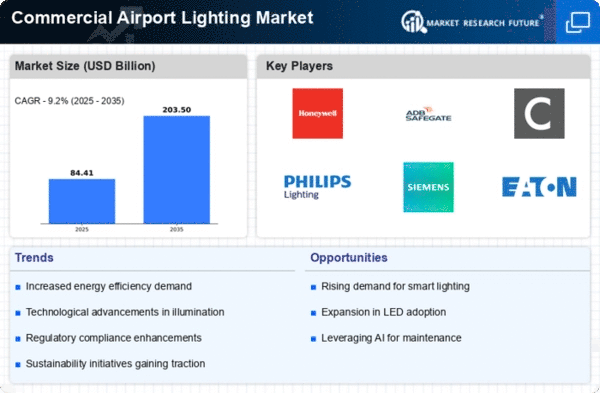
As per MRFR analysis, the Commercial Airport Lighting Market was estimated at 77.3 USD Billion in 2024. The Commercial Airport Lighting industry is projected to grow from 84.4 USD Billion in 2025 to 203.5 USD Billion by 2035, exhibiting a compound annual growth rate (CAGR) of 9.2 during the forecast period 2025 - 2035.

Key Market Trends & Highlights

The Commercial Airport Lighting Market is experiencing a transformative shift towards advanced technologies and sustainability.

  • The adoption of smart lighting technologies is reshaping the operational landscape of commercial airports.
  • North America remains the largest market, while the Asia-Pacific region is recognized as the fastest-growing area for airport lighting solutions.
  • Runway lighting continues to dominate the market, whereas taxiway lighting is emerging as the fastest-growing segment.
  • Key drivers include increasing air traffic and a strong focus on sustainability and environmental impact, propelling investment in airport infrastructure development.

Market Size & Forecast

2024 Market Size 77.3 (USD Billion)
2035 Market Size 203.5 (USD Billion)
CAGR (2025 - 2035) 9.2%

Major Players

Honeywell (US), ADB Safegate (BE), Cree, Inc. (US), Philips Lighting (NL), Eaton Corporation (US), Osram Licht AG (DE), Signify (NL), Thorn Lighting (GB), Littelfuse (US).

Our Impact
Enabled $4.3B Revenue Impact for Fortune 500 and Leading Multinationals
Partnering with 2000+ Global Organizations Each Year
30K+ Citations by Top-Tier Firms in the Industry

Commercial Airport Lighting Market Trends

The commercial airport lighting market trends indicate that the industry is currently experiencing a transformative phase, driven by advancements in technology and increasing safety regulations. The integration of LED lighting systems is becoming more prevalent, as these solutions offer enhanced energy efficiency and longer lifespans compared to traditional lighting options. Furthermore, the growing emphasis on sustainability is prompting airports to adopt eco-friendly lighting solutions, which not only reduce operational costs but also align with global environmental goals and promote the commercial airport lighting market trends. As airports expand and modernize, the demand for innovative lighting solutions that improve visibility and safety during both day and night operations is likely to rise.

In addition to technological advancements in the commercial airport lighting market trends, the commercial airport lighting market is influenced by the need for compliance with stringent safety standards. Regulatory bodies are continuously updating guidelines to ensure that lighting systems meet the necessary requirements for visibility and operational efficiency. This trend suggests that airports are increasingly investing in advanced lighting technologies that not only comply with regulations but also enhance the overall passenger experience. As the market evolves, stakeholders must remain vigilant to emerging commercial airport lighting market trends and adapt their strategies accordingly to maintain competitiveness in this dynamic environment.

Adoption of Smart Lighting Technologies

The shift towards LED technology in the commercial airport lighting market trends is notable. LED systems provide superior energy efficiency and longevity, which are crucial for reducing operational costs. Airports are increasingly recognizing the benefits of these systems, leading to widespread implementation.

Focus on Sustainability and Energy Efficiency

Sustainability is becoming a central theme in the commercial airport lighting market trends. Airports are prioritizing eco-friendly lighting solutions that minimize environmental impact. This trend aligns with global initiatives aimed at reducing carbon footprints and promoting greener practices.

Integration of Advanced Control Systems

The integration of advanced control systems is emerging as a key trend in the Commercial Airport Lighting Market. These systems allow for centralized management of lighting across airport facilities, improving operational efficiency and ensuring compliance with safety standards. Enhanced control capabilities enable airports to respond swiftly to changing conditions, thereby enhancing overall safety.

Regulatory Compliance and Safety Standards

The commercial airport lighting market is heavily influenced by evolving safety regulations. Airports are investing in lighting systems that not only meet compliance requirements but also enhance safety and visibility. This focus on regulatory adherence is shaping purchasing decisions.

Commercial Airport Lighting Market Drivers

Increased Air Traffic

Regulatory Compliance

Regulatory compliance plays a pivotal role in shaping the Global Commercial Airport Lighting Industry. Governments worldwide are implementing stringent regulations to enhance safety and environmental sustainability in airport operations. For example, the International Civil Aviation Organization (ICAO) has established guidelines for airport lighting that must be adhered to by member states. This regulatory framework compels airports to upgrade their lighting systems, thereby driving demand for advanced lighting solutions. As compliance becomes increasingly mandatory, the market is likely to witness significant growth, aligning with the projected increase in market value from 2.73 USD Billion in 2024 to 6.4 USD Billion by 2035.

Market Growth Projections

The Global Commercial Airport Lighting Industry is poised for substantial growth, with projections indicating an increase from 2.73 USD Billion in 2024 to 6.4 USD Billion by 2035. This growth trajectory reflects a compound annual growth rate (CAGR) of 8.05% from 2025 to 2035. Factors contributing to this expansion include advancements in technology, regulatory compliance, safety enhancements, sustainability initiatives, and increased air traffic. The convergence of these elements suggests a robust market environment, where investments in innovative lighting solutions are likely to flourish.

Sustainability Initiatives

Sustainability initiatives are increasingly influencing the Global Commercial Airport Lighting Industry. Airports are under pressure to reduce their carbon footprints and implement eco-friendly practices. The adoption of energy-efficient lighting solutions, such as solar-powered systems, is becoming more prevalent. For example, several airports have begun utilizing solar runway lights, which not only reduce energy costs but also contribute to sustainability goals. This shift towards greener technologies is likely to propel market growth, with projections indicating an increase from 2.73 USD Billion in 2024 to 6.4 USD Billion by 2035, driven by a CAGR of 8.05% from 2025 to 2035.

Technological Advancements

The Global Commercial Airport Lighting Industry is experiencing a surge in technological advancements, particularly in LED lighting systems. These systems are not only energy-efficient but also offer enhanced visibility and safety for aircraft operations. For instance, the transition to LED lighting can reduce energy consumption by up to 50%, which is crucial for airports aiming to lower operational costs. As airports increasingly adopt these technologies, the market is projected to grow from 2.73 USD Billion in 2024 to 6.4 USD Billion by 2035, reflecting a robust CAGR of 8.05% from 2025 to 2035.

Safety and Security Enhancements

Safety and security enhancements are paramount in the Global Commercial Airport Lighting Industry. Airports are investing in advanced lighting systems to improve visibility during night operations and adverse weather conditions. For instance, the installation of high-intensity runway lights has been shown to reduce the risk of accidents significantly. Furthermore, the integration of smart lighting systems that adapt to environmental changes is gaining traction. This focus on safety not only enhances operational efficiency but also aligns with the projected market growth, as the industry is expected to expand from 2.73 USD Billion in 2024 to 6.4 USD Billion by 2035.

Market Segment Insights

By Application: Runway Lighting (Largest) vs. Taxiway Lighting (Fastest-Growing)

The Commercial Airport Lighting Market is witnessing distinct trends across various application segments, with Runway Lighting dominating the commercial airport lighting market share due to its critical role in facilitating aircraft landing and takeoff operations. This segment's established infrastructure supports its continuous usage, making it a staple in commercial airport lighting systems. In contrast, Taxiway Lighting, while smaller in share, is emerging rapidly as more airports invest in enhancing taxiway safety and efficiency, reflecting a growing recognition of its importance in streamlining ground operations.

Runway Lighting (Dominant) vs. Apron Lighting (Emerging)

Runway lighting serves as the backbone of airport safety, providing pilots with precise visual guidance. It features various lighting systems, including approach lights, threshold lights, and runway edge lights, ensuring operational safety in diverse weather conditions. Runway lighting is highly regulated and consistently upgraded with advancements in technology, ensuring compliance with international aviation standards. In contrast, apron lighting is gaining traction as airports evolve to accommodate larger aircraft and increased passenger volumes. Designed to illuminate aircraft parking areas and service zones, apron lighting is focusing on energy efficiency and smart technologies, making it an emerging segment with significant growth potential in the Commercial Airport Lighting Market.

By Technology: LED Lighting (Largest) vs. Halogen Lighting (Fastest-Growing)

In the commercial airport lighting market, LED Lighting dominates the landscape, representing the largest commercial airport lighting market share due to its energy efficiency, longevity, and reduced maintenance costs. Halogen Lighting has established a significant presence, known for its brightness and color rendering capabilities, positioning itself prominently amidst competition. Fluorescent and incandescent lighting are gradually losing traction as airports transition towards more efficient solutions. Meanwhile, solar lighting is emerging as a novel alternative, reflecting the industry's shift towards sustainability.

Technology: LED (Dominant) vs. Halogen (Emerging)

LED Lighting has emerged as the dominant technology in the Commercial Airport Lighting Market due to its numerous advantages, including outstanding energy efficiency and a significantly longer lifespan compared to traditional lighting solutions. Consequently, many airports are transitioning towards LED systems to decrease operational costs and enhance the visual appeal of their facilities. On the other hand, Halogen Lighting, while traditionally considered less energy-efficient, is carving a niche within the market, emerging as a strong contender for applications requiring high luminance and instant illumination. As airport operators seek a balance between performance and energy use, Halogen is benefitting from innovations and enhancements that allow it to meet contemporary demands.

By End Use: Public Airports (Largest) vs. Cargo Airports (Fastest-Growing)

In the commercial airport lighting market, the distribution of market share is notably skewed towards commercial airports, which capture a significant commercial airport lighting market share due to their extensive operational hours and demand for reliable lighting solutions. Private airports and cargo airports follow behind, each attracting niche interest but not nearly matching the volume of commercial operations. Military airports and heliports, while valuable, occupy a smaller share of the market, reflecting their more specialized use cases within the aviation ecosystem.

Growth trends within this segment indicate a strong push towards modernization and sustainability, primarily influenced by increased air traffic and the evolving needs of airport authorities for energy-efficient lighting systems. Meanwhile, regulations aimed at enhancing safety and reducing environmental impact are propelling both military airports and heliports into the spotlight, leading to faster adoption rates of innovative lighting technologies. This includes advancements in LED and smart lighting solutions, aimed at improving operational efficiency and safety across all types of airfields.

Public Airport Lighting (Dominant) vs. Cargo Airport Lighting (Emerging)

Public Airport Lighting serves as the dominant segment within the Commercial Airport Lighting Market. Its robust infrastructure supports ongoing investments in advanced lighting technologies to enhance safety, efficiency, and passenger experience. On the other hand, Cargo Airport Lighting is emerging, fueled by the surge in e-commerce and the necessity for improved logistics facilities. This segment is gradually transforming to optimize operational efficiency and energy consumption, leading to the adoption of intelligent lighting systems. The dual focus on sustainability and technological advancements is setting Cargo Airport Lighting on a growth path, poised to capture a larger market share in the near future.

Get more detailed insights about Commercial Airport Lighting Market

Regional Insights

North America : Market Leader in Innovation

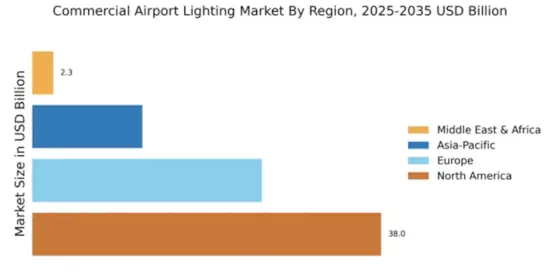
North America holds a commanding 38.0% commercial airport lighting market share, driven by robust infrastructure investments and a growing emphasis on energy-efficient lighting solutions. Regulatory frameworks promoting sustainability and safety standards are further catalyzing market growth. The increasing number of air travelers and the expansion of airport facilities are also significant demand drivers, pushing for advanced lighting technologies that enhance operational efficiency and safety.

The United States is the leading country in this region, hosting major players like Honeywell, Cree, and Eaton Corporation. The competitive landscape is characterized by innovation and strategic partnerships among key players, focusing on smart lighting solutions and IoT integration. The presence of established companies ensures a steady supply of advanced lighting systems, catering to both new and existing airport infrastructures.

Europe : Emerging Market with Regulations

Europe accounts for a significant 25.0% commercial airport lighting market share, driven by stringent regulations aimed at enhancing safety and energy efficiency. The European Union's commitment to reducing carbon emissions and promoting sustainable practices is a key catalyst for market growth. Additionally, the increasing number of international flights and airport expansions are contributing to the rising demand for advanced lighting solutions that comply with regulatory standards.

Leading countries in this region include Germany, France, and the UK, where companies like Philips Lighting and Osram Licht AG are prominent. The competitive landscape is marked by innovation and collaboration among manufacturers to develop cutting-edge lighting technologies. The presence of regulatory bodies ensures that products meet high safety and efficiency standards, fostering a competitive environment that drives continuous improvement in airport lighting solutions.

Asia-Pacific : Rapid Growth and Development

Asia-Pacific represents a growing segment of the commercial airport lighting market, supported by rapid urbanization and rising air traffic. The region is witnessing rapid urbanization and an increase in air travel, leading to significant investments in airport infrastructure. Governments are focusing on modernizing airports to accommodate rising passenger numbers, which is driving demand for advanced lighting solutions that enhance safety and operational efficiency. Regulatory support for energy-efficient technologies is also a key growth driver.

Countries like China and India are at the forefront of this growth, with substantial investments in airport expansions and upgrades. The competitive landscape features both local and international players, including companies like ADB Safegate and Signify. The presence of diverse market participants fosters innovation and the adoption of smart lighting technologies, positioning the region as a significant player in the global market.

Middle East and Africa : Emerging Market with Potential

The Middle East and Africa region holds a modest 2.3% commercial airport lighting market share of the commercial airport lighting market, but it presents significant growth opportunities. The region is experiencing an increase in air travel and airport development projects, driven by economic diversification efforts and tourism initiatives. Governments are investing in modernizing airport infrastructure, which is creating demand for advanced lighting solutions that meet international safety and efficiency standards.

Countries like the UAE and South Africa are leading the way in airport expansions, attracting investments from global players. The competitive landscape is evolving, with both local and international companies vying for market share. The presence of key players such as Thorn Lighting and Littelfuse is helping to drive innovation and improve the quality of airport lighting solutions in the region.


Commercial Airport Lighting Market Regional Image

Key Players and Competitive Insights

The commercial airport lighting market is currently characterized by a dynamic competitive landscape, driven by technological advancements and a growing emphasis on safety and efficiency. Key players such as Honeywell (US), ADB Safegate (BE), and Philips Lighting (NL) are strategically positioned to leverage innovation and partnerships to enhance their market presence. Honeywell (US) focuses on integrating smart technologies into its lighting solutions, aiming to improve operational efficiency and reduce energy consumption. ADB Safegate (BE) emphasizes its commitment to sustainability, developing eco-friendly lighting systems that align with global environmental standards. Philips Lighting (NL) is actively pursuing digital transformation, enhancing its product offerings with IoT capabilities to provide real-time data analytics for airport operations. Collectively, these strategies contribute to a competitive environment that prioritizes innovation and sustainability. In terms of business tactics, companies are increasingly localizing manufacturing to reduce lead times and optimize supply chains. The market appears moderately fragmented, with several players vying for market share while also collaborating on innovative projects. This competitive structure allows for a diverse range of products and services, catering to the varying needs of airports worldwide. The influence of key players is significant, as their strategic initiatives often set industry standards and drive technological advancements.

In November ADB Safegate (BE) announced the launch of its new range of LED lighting systems designed specifically for airport runways and taxiways. This strategic move is pivotal as it not only enhances safety through improved visibility but also aligns with the growing demand for energy-efficient solutions in airport operations. The introduction of these systems is expected to strengthen ADB Safegate's market position by addressing both regulatory requirements and customer preferences for sustainable practices.

In October Philips Lighting (NL) entered into a strategic partnership with a leading airport management company to implement smart lighting solutions across multiple international airports. This collaboration is significant as it underscores the trend towards digital transformation in airport infrastructure, allowing for real-time monitoring and management of lighting systems. Such initiatives are likely to enhance operational efficiency and reduce energy consumption, positioning Philips as a leader in the integration of technology within airport lighting.

In September Honeywell (US) unveiled its latest smart airport lighting technology, which incorporates AI-driven analytics to optimize lighting based on real-time conditions. This innovation is crucial as it not only improves safety but also reduces energy costs, reflecting a broader industry trend towards intelligent systems. Honeywell's focus on AI integration may provide a competitive edge, enabling airports to enhance their operational capabilities while minimizing environmental impact.

As of December the competitive trends in the Commercial Airport Lighting Market are increasingly defined by digitalization, sustainability, and the integration of AI technologies. Strategic alliances among key players are shaping the landscape, fostering innovation and collaboration. The shift from price-based competition to a focus on technological advancement and supply chain reliability is evident, suggesting that future differentiation will hinge on the ability to innovate and adapt to evolving market demands.

Key Companies in the Commercial Airport Lighting Market include

Industry Developments

  • Q2 2024: ADB SAFEGATE launches new LINC 360 Airfield Lighting Control and Monitoring System ADB SAFEGATE announced the launch of its LINC 360 system, a next-generation airfield lighting control and monitoring solution designed to enhance operational efficiency and safety at commercial airports.
  • Q2 2024: Honeywell unveils new LED-based runway lighting system for commercial airports Honeywell introduced a new energy-efficient LED runway lighting system aimed at reducing maintenance costs and improving visibility for pilots during low-visibility conditions.
  • Q2 2024: Signify secures contract to upgrade airfield lighting at Munich Airport Signify announced it has been awarded a contract to upgrade Munich Airport’s airfield lighting to advanced LED technology, supporting the airport’s sustainability and safety goals.
  • Q3 2024: Siemens partners with Dubai Airports for smart airfield lighting project Siemens signed a partnership agreement with Dubai Airports to implement a smart airfield lighting system, integrating IoT sensors and advanced controls to optimize airport operations.
  • Q3 2024: ADB SAFEGATE wins contract for new airfield lighting at Istanbul Airport expansion ADB SAFEGATE announced it has secured a major contract to supply and install airfield lighting systems for the new runway and taxiways at Istanbul Airport’s expansion project.
  • Q3 2024: Heathrow Airport completes installation of advanced LED taxiway lighting Heathrow Airport announced the completion of a major project to install advanced LED taxiway lighting, improving energy efficiency and operational safety across the airfield.
  • Q4 2024: ADB SAFEGATE opens new manufacturing facility for airfield lighting in Poland ADB SAFEGATE inaugurated a new manufacturing facility in Poland dedicated to producing advanced airfield lighting systems for commercial airports in Europe and beyond.
  • Q4 2024: Schreder launches new modular apron lighting solution for airports Schreder introduced a modular LED apron lighting system designed to provide flexible, high-performance illumination for airport aprons, enhancing safety and operational efficiency.
  • Q1 2025: Signify acquires airfield lighting specialist OCEM Airfield Technology Signify announced the acquisition of OCEM Airfield Technology, expanding its portfolio and strengthening its position in the global commercial airport lighting market.
  • Q1 2025: Honeywell wins contract to supply runway lighting for new terminal at Singapore Changi Airport Honeywell secured a contract to provide advanced runway lighting systems for the new terminal under construction at Singapore Changi Airport, supporting the airport’s expansion plans.
  • Q2 2025: ADB SAFEGATE announces partnership with FAA for next-generation airfield lighting research ADB SAFEGATE entered into a research partnership with the U.S. Federal Aviation Administration (FAA) to develop and test next-generation airfield lighting technologies aimed at improving safety and efficiency.
  • Q2 2025: Schreder secures contract to provide LED apron lighting for Los Angeles International Airport Schreder announced it has been awarded a contract to supply and install LED apron lighting at Los Angeles International Airport, supporting the airport’s modernization and sustainability initiatives.


Future Outlook

Commercial Airport Lighting Market Future Outlook

The commercial airport lighting market is projected to grow at a 9.2% CAGR from 2025 to 2035, driven by technological advancements, safety regulations, and increasing air traffic. 

New opportunities lie in:

  • Integration of smart lighting systems for enhanced energy efficiency. Development of LED-based runway lighting solutions to reduce operational costs. Expansion of maintenance services for airport lighting infrastructure.

By 2035, the market is expected to achieve substantial growth, reflecting evolving industry standards and technological innovations.

Market Segmentation

Commercial Airport Lighting Market End Use Outlook

  • Public Airports
  • Private Airports
  • Cargo Airports
  • Military Airports

Commercial Airport Lighting Market Technology Outlook

  • LED Lighting
  • Halogen Lighting
  • Fluorescent Lighting
  • Metal Halide Lighting
  • Incandescent Lighting

Commercial Airport Lighting Market Application Outlook

  • Runway Lighting
  • Taxiway Lighting
  • Apron Lighting
  • Terminal Lighting
  • Obstacle Lighting

Report Scope

MARKET SIZE 2024 77.3(USD Billion)
MARKET SIZE 2025 84.4(USD Billion)
MARKET SIZE 2035 203.5(USD Billion)
COMPOUND ANNUAL GROWTH RATE (CAGR) 9.2% (2025 - 2035)
REPORT COVERAGE Revenue Forecast, Competitive Landscape, Growth Factors, and Trends
BASE YEAR 2024
Market Forecast Period 2025 - 2035
Historical Data 2019 - 2024
Market Forecast Units USD Billion
Key Companies Profiled Honeywell (US), ADB Safegate (BE), Cree, Inc. (US), Philips Lighting (NL), Siemens (DE), Eaton Corporation (US), Astronics Corporation (US), Cavotec (CH)
Segments Covered Application, Technology, End Use
Key Market Opportunities Integration of smart lighting systems enhances safety and efficiency in the Commercial Airport Lighting Market.
Key Market Dynamics Technological advancements in energy-efficient lighting drive competitive dynamics in the Commercial Airport Lighting Market.
Countries Covered North America, Europe, APAC, South America, MEA

Market Highlights

Author
Sejal Akre
Senior Research Analyst

She has over 5 years of rich experience, in market research and consulting providing valuable market insights to client. Hands on expertise in management consulting, and extensive knowledge in domain including ICT, Automotive & Transportation and Aerospace & Defense. She is skilled in Go-to market strategy, industry analysis, market sizing, in depth company profiling, competitive intelligence & benchmarking and value chain amongst others.

Leave a Comment

FAQs

How Commercial Airport Lighting market Is Growing ?

Commercial Airport Lighting Market Size is expected to reach USD 6.4 Billion by 2035, registering a CAGR of 8.05% during 2025-2035

Who Are The Top Key vendors in Commercial Airport Lighting Industry ?

The major players of the Commercial Airport Lighting Market are : Honeywell International Inc. (US),voila GmBH (Germany),ADB SAFEGATE (US),atg airports limited (UK),HELLA GmBH& Co. KGaA (Germany),ABB (Switzerland),Eaton (Ireland),Avlite (Australia),Carmanah (Canada),Avionics Group (US)

Which factors are poised to drive the market growth?

The massive demand for commercial aircraft actuation systems driven by the growing air passenger traffic is the market's primary growth inducer.

Which technology is expected to witness the highest growth?

The LED segment is expected to observe substantial demand over the review period.

Which application is expected to observe the highest growth?

The airside lighting segment is expected to secure the highest CAGR.

Which region of the global Commercial Airport Lighting market expected to witness the highest growth?

The APAC segment is slated to expand as the fastest-growing segment.

Download Free Sample

Kindly complete the form below to receive a free sample of this Report

Compare Licence

×
Features License Type
Single User Multiuser License Enterprise User
Price $4,950 $5,950 $7,250
Maximum User Access Limit 1 User Upto 10 Users Unrestricted Access Throughout the Organization
Free Customization
Direct Access to Analyst
Deliverable Format
Platform Access
Discount on Next Purchase 10% 15% 15%
Printable Versions