×
Request Free Sample ×

Kindly complete the form below to receive a free sample of this Report

* Please use a valid business email

Leading companies partner with us for data-driven Insights

clients tt-cursor
Hero Background

China Peripheral Nerve Stimulators Market

ID: MRFR/HC/43232-HCR
200 Pages
Rahul Gotadki
February 2026

China Peripheral Nerve Stimulators Market Research Report By Product Type (Transcutaneous, Percutaneous, Implantable), By Device (Stimulators, CPNB Catheters, Pain Pumps, Others), By Stimulating Feature (Stimulator Machines with Train of Four (TOF) Monitoring Features, Machines Without TOF Features) and By End User (Hospitals and Clinics, Ambulatory Surgical Centers, Others) - Growth & Industry Forecast 2025 To 2035

Share:
Download PDF ×

We do not share your information with anyone. However, we may send you emails based on your report interest from time to time. You may contact us at any time to opt-out.

China Peripheral Nerve Stimulators Market Infographic
Purchase Options

China Peripheral Nerve Stimulators Market Summary

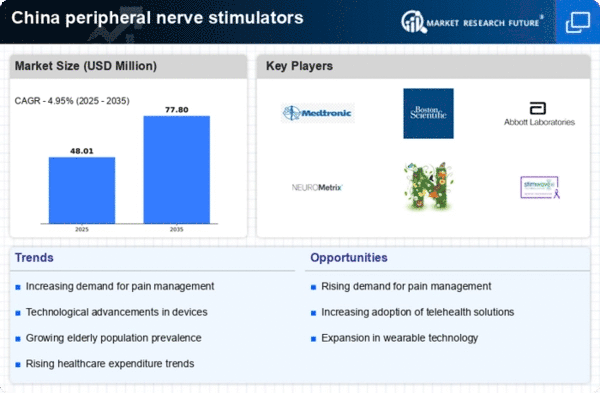
As per Market Research Future analysis, the China peripheral nerve stimulators market size was estimated at 45.75 USD Million in 2024. The China peripheral nerve-stimulators market is projected to grow from 48.01 USD Million in 2025 to 77.8 USD Million by 2035, exhibiting a compound annual growth rate (CAGR) of 4.9% during the forecast period 2025 - 2035

Key Market Trends & Highlights

The China peripheral nerve-stimulators market is poised for substantial growth driven by technological advancements and increasing demand for non-invasive treatments.

  • Technological advancements are enhancing the efficacy and usability of peripheral nerve stimulators.
  • The largest segment in the market is the pain management segment, while the fastest-growing segment is expected to be the rehabilitation segment.
  • Regulatory support is fostering innovation and market entry for new devices in the industry.
  • The increasing prevalence of neurological disorders and rising healthcare expenditure are key drivers propelling market growth.

Market Size & Forecast

2024 Market Size 45.75 (USD Million)
2035 Market Size 77.8 (USD Million)
CAGR (2025 - 2035) 4.95%

Major Players

Medtronic (US), Boston Scientific (US), Abbott (US), NeuroMetrix (US), Nuvectra (US), Stimwave (US), Stryker (US), Halyard Health (US)

Our Impact
Enabled $4.3B Revenue Impact for Fortune 500 and Leading Multinationals
Partnering with 2000+ Global Organizations Each Year
30K+ Citations by Top-Tier Firms in the Industry

China Peripheral Nerve Stimulators Market Trends

The peripheral nerve-stimulators market is currently experiencing notable growth, driven by advancements in technology and increasing demand for non-invasive pain management solutions. In China, the healthcare sector is evolving rapidly, with a focus on integrating innovative medical devices into clinical practice. This shift is largely influenced by the rising prevalence of chronic pain conditions and the growing awareness of alternative therapies. As healthcare providers seek effective treatments, peripheral nerve stimulators are becoming more prominent in pain management protocols. Furthermore, the regulatory environment in China is adapting to facilitate the introduction of new medical technologies, which may enhance market accessibility and foster competition among manufacturers. In addition, the peripheral nerve-stimulators market is likely to benefit from the increasing investment in healthcare infrastructure and research initiatives. The Chinese government has been actively promoting the development of advanced medical technologies, which could lead to enhanced product offerings and improved patient outcomes. As the population ages and the burden of chronic diseases rises, the demand for effective pain relief solutions is expected to grow. This trend suggests a promising future for the peripheral nerve-stimulators market, as stakeholders work collaboratively to address the evolving needs of patients and healthcare providers alike.

Technological Advancements

The peripheral nerve-stimulators market is witnessing rapid technological innovations, which enhance device efficacy and user experience. Newer models are being developed with improved features, such as wireless connectivity and user-friendly interfaces, making them more appealing to both patients and healthcare professionals.

Regulatory Support

The regulatory landscape in China is evolving to support the introduction of advanced medical devices. This shift is likely to streamline approval processes for peripheral nerve stimulators, encouraging manufacturers to invest in research and development, ultimately benefiting patient care.

Growing Demand for Non-Invasive Treatments

There is an increasing preference for non-invasive treatment options among patients suffering from chronic pain. This trend is driving the adoption of peripheral nerve stimulators, as they offer effective pain relief without the need for surgical interventions, aligning with patient desires for safer treatment alternatives.

China Peripheral Nerve Stimulators Market Drivers

Rising Healthcare Expenditure

China's increasing healthcare expenditure is a crucial factor driving the peripheral nerve-stimulators market. The government has been investing heavily in healthcare infrastructure, with spending projected to reach $1 trillion by 2025. This financial commitment aims to improve access to advanced medical technologies, including peripheral nerve stimulators. As healthcare budgets expand, hospitals and clinics are more likely to adopt innovative treatment modalities, thereby enhancing the market's growth potential. The focus on improving healthcare services aligns with the growing demand for effective pain management solutions, positioning the peripheral nerve-stimulators market favorably within the broader healthcare landscape.

Supportive Government Policies

The Chinese government is actively promoting the development and adoption of advanced medical technologies, including peripheral nerve stimulators. Policies aimed at enhancing healthcare access and improving treatment outcomes are being implemented, which may facilitate market growth. Initiatives such as subsidies for medical device manufacturers and streamlined regulatory processes are designed to encourage innovation in the healthcare sector. As a result, the peripheral nerve-stimulators market is likely to experience accelerated growth, driven by favorable government support that aims to enhance patient care and expand the availability of effective treatment options.

Advancements in Medical Technology

Technological innovations in the field of medical devices are significantly influencing the peripheral nerve-stimulators market. The introduction of advanced stimulation techniques, such as closed-loop systems and miniaturized devices, enhances the efficacy and safety of treatments. These innovations not only improve patient outcomes but also increase the adoption rates among healthcare professionals. In China, the medical technology sector is rapidly evolving, with investments in research and development reaching approximately $5 billion annually. This influx of capital is likely to foster further advancements in peripheral nerve stimulators, making them more accessible and effective for patients.

Growing Awareness of Pain Management Solutions

There is a notable increase in awareness regarding pain management solutions among both healthcare providers and patients in China. Educational initiatives and campaigns are promoting the benefits of non-invasive treatments, such as peripheral nerve stimulators, which are perceived as safer alternatives to traditional pain relief methods. This heightened awareness is likely to drive demand, as patients seek effective solutions for chronic pain conditions. The peripheral nerve-stimulators market is expected to benefit from this trend, as more individuals become informed about their treatment options and advocate for advanced therapies that improve their quality of life.

Increasing Prevalence of Neurological Disorders

The rising incidence of neurological disorders in China is a primary driver for the peripheral nerve-stimulators market. Conditions such as neuropathic pain, multiple sclerosis, and stroke are becoming more prevalent, affecting millions of individuals. According to recent health statistics, approximately 10% of the population suffers from some form of neurological disorder, which is expected to increase as the population ages. This growing patient base necessitates effective treatment options, thereby propelling the demand for peripheral nerve stimulators. The market is projected to expand as healthcare providers seek innovative solutions to manage these conditions, indicating a robust growth trajectory for the industry.


Market Segment Insights

By Product: Transcutaneous (Largest) vs. Implantable (Fastest-Growing)

In the China peripheral nerve-stimulators market, Transcutaneous stimulators currently hold the largest market share, driven by their ease of use and non-invasive nature, which appeals to a wide range of consumers. Percutaneous stimulators follow, offering a middle ground in invasiveness and effectiveness, while Implantable devices are gaining traction due to advancements in technology and growing awareness of chronic pain management solutions. Looking ahead, the market is witnessing a surge in the adoption of Implantable stimulators, which are recognized as the fastest-growing segment. This growth is primarily fueled by increasing investments in healthcare technology, rising incidences of neurological disorders, and a greater emphasis on pain management. Innovations in implantable device design are also making these solutions more accessible and effective for patients.

Transcutaneous (Dominant) vs. Implantable (Emerging)

Transcutaneous stimulators have established themselves as the dominant force in the China peripheral nerve-stimulators market due to their affordability, user-friendliness, and effectiveness for various conditions without the need for invasive procedures. They are particularly popular among patients seeking non-invasive treatment options for pain relief. In contrast, Implantable stimulators, while currently in the emerging stage, are quickly gaining popularity as they offer targeted pain management solutions and are suitable for patients with chronic conditions. The advancements in technology and design of Implantable devices, such as smaller sizes and improved battery life, are driving their acceptance and expanding their market presence in response to patient needs.

By Device Type: Stimulators (Largest) vs. Continuous Peripheral Nerve Blocks (CPNB) Catheters (Fastest-Growing)

In the China peripheral nerve-stimulators market, the segment distribution reveals that stimulators hold the largest share, favored by clinicians for their versatility and effectiveness in managing pain. Continuous Peripheral Nerve Blocks (CPNB) Catheters are emerging rapidly due to their ability to provide prolonged analgesia and enhance patient recovery times. Meanwhile, pain pumps, although established, are witnessing slower growth compared to stimulators and CPNB catheters. The growth trends in this market are significantly driven by advancements in technology and increasing awareness among healthcare providers about the benefits of nerve stimulation. The rise in chronic pain conditions and an aging population are further propelling the demand for innovative solutions, particularly for CPNB catheters, which are becoming a preferred choice in pain management protocols. The competition among manufacturers is also intensifying, leading to continuous improvements in product offerings.

Stimulators (Dominant) vs. CPNB Catheters (Emerging)

Stimulators are the dominant segment in the China peripheral nerve-stimulators market, known for their significant role in providing fast and effective relief from various types of pain. Their versatility in application ranges from acute to chronic pain management, which solidifies their market leadership. Continuous Peripheral Nerve Blocks (CPNB) Catheters, on the other hand, are considered an emerging segment that has gained traction due to their capability to deliver targeted analgesia, thereby minimizing opioid consumption. They are increasingly being integrated into post-operative pain management protocols, indicating a shift in clinical practices favoring more effective pain control methods. Both segments are critical to addressing the evolving needs of pain management in China.

By Stimulating Feature: Stimulator Machines with Train of Four (TOF) Monitoring Features (Largest) vs. Machines Without TOF Features (Fastest-Growing)

The China peripheral nerve-stimulators market demonstrates a notable market share distribution where stimulator machines with Train of Four (TOF) monitoring features dominate. This segment has established a strong foothold due to increased awareness among healthcare professionals regarding the benefits of TOF monitoring for patient safety and effective neuromuscular blockade management. Conversely, machines without TOF features are witnessing a surge in demand, reflecting a shift towards more versatile and cost-effective solutions that are increasingly appreciated in clinical practices. Growth trends in the sector reveal that the largest segment, TOF monitoring machines, continues to benefit from advancements in technology and a rise in surgical procedures requiring precise neuromuscular monitoring. In contrast, the fastest-growing segment is characterized by the significant adoption of machines without TOF features, catering to a broader range of applications and surgical environments. The affordability and operational simplicity of these devices are propelling their acceptance in both urban and rural healthcare facilities across the region.

Stimulator Machines with TOF Monitoring Features (Dominant) vs. Machines Without TOF Features (Emerging)

Stimulator machines with Train of Four (TOF) monitoring features are positioned as the dominant choice in the China peripheral nerve-stimulators market, particularly in high-acuity surgical settings where precise neuromuscular assessment is critical. These machines offer enhanced monitoring capabilities, ensuring patient safety and facilitating better surgical outcomes, which has made them a preferred option among healthcare providers. On the other hand, machines without TOF features are emerging significantly due to their cost-effectiveness and versatility. These devices are increasingly adopted in various clinical environments, appealing to a wider array of healthcare facilities that seek reliable yet affordable solutions. The ongoing innovations in this area point towards a balanced market expansion, catering to diverse healthcare needs.

By End User: Hospitals & Clinics (Largest) vs. Ambulatory Surgical Centers (Fastest-Growing)

In the China peripheral nerve-stimulators market, the distribution of market share among the end-user segments illustrates a substantial dominance of hospitals and clinics. This segment encompasses major healthcare institutions that account for a significant portion of device utilization, given their broad scope of services. On the other hand, ambulatory surgical centers have gained traction, albeit with a smaller market share percentage, reflecting a growing trend towards outpatient care and the ability to offer specialized treatments in a convenient setting. The growth trends within these segments reveal key drivers influencing the adoption of peripheral nerve-stimulators. Hospitals and clinics are benefiting from advancements in technology and an increase in patient awareness surrounding pain management options. In contrast, ambulatory surgical centers are experiencing rapid growth, driven by the need for cost-efficient procedures and a preference for minimally invasive techniques. These trends suggest a favorable outlook for both segments as they adapt to changing healthcare dynamics.

Hospitals & Clinics (Dominant) vs. Ambulatory Surgical Centers (Emerging)

In the China peripheral nerve-stimulators market, hospitals and clinics represent the dominant end-user segment, leveraging their established infrastructure and patient base to facilitate comprehensive treatment options. The availability of experienced medical professionals and advanced technology within these institutions fosters a preference for peripheral nerve stimulation therapies among patients. Conversely, ambulatory surgical centers are emerging as a significant force in the market, appealing to a growing demographic seeking outpatient care. These centers typically focus on specialized surgical procedures and are equipped with the latest technologies, enabling faster recovery times and reduced hospital stays, thus aligning with current trends in healthcare that emphasize efficiency and convenience. The contrast between the dominant hospitals and the emerging surgical centers highlights the dynamic nature of the market landscape.

Get more detailed insights about China Peripheral Nerve Stimulators Market

Key Players and Competitive Insights

The peripheral nerve-stimulators market in China is characterized by a dynamic competitive landscape, driven by technological advancements and increasing demand for pain management solutions. Key players such as Medtronic (US), Boston Scientific (US), and Abbott (US) are at the forefront, each adopting distinct strategies to enhance their market presence. Medtronic (US) focuses on innovation, particularly in developing advanced neurostimulation devices that cater to chronic pain management. Meanwhile, Boston Scientific (US) emphasizes strategic partnerships to expand its product offerings and enhance its distribution channels, thereby increasing its market penetration. Abbott (US) appears to be concentrating on regional expansion, particularly in underserved areas, which may bolster its competitive edge in the long term.The market structure is moderately fragmented, with several players vying for market share. Key business tactics include localizing manufacturing to reduce costs and optimize supply chains, which is crucial in a market where price sensitivity is prevalent. The collective influence of these major companies shapes the competitive environment, as they continuously adapt to market demands and regulatory changes.

In October Medtronic (US) announced the launch of a new line of peripheral nerve stimulators designed specifically for patients with neuropathic pain. This strategic move is significant as it not only reinforces Medtronic's commitment to innovation but also addresses a growing patient demographic that requires effective pain management solutions. The introduction of these devices is likely to enhance Medtronic's market share and strengthen its position against competitors.

In September Boston Scientific (US) entered into a partnership with a leading Chinese healthcare provider to enhance its distribution network across the region. This collaboration is pivotal as it allows Boston Scientific to leverage local expertise and improve access to its products, potentially increasing its market penetration in a highly competitive landscape. Such strategic alliances may prove beneficial in navigating regulatory challenges and meeting local market needs.

In August Abbott (US) expanded its manufacturing capabilities in China, aiming to increase production efficiency and meet the rising demand for peripheral nerve stimulators. This expansion is indicative of Abbott's long-term commitment to the region and its strategy to localize production, which could lead to reduced operational costs and improved supply chain reliability.

As of November current trends in the peripheral nerve-stimulators market include a strong emphasis on digitalization and AI integration, which are reshaping competitive dynamics. Companies are increasingly leveraging technology to enhance product offerings and improve patient outcomes. Strategic alliances are becoming more prevalent, allowing firms to pool resources and expertise, thereby fostering innovation. Looking ahead, competitive differentiation is likely to evolve from traditional price-based competition to a focus on technological innovation, enhanced patient care, and supply chain reliability, suggesting a transformative shift in how companies position themselves in the market.

Key Companies in the China Peripheral Nerve Stimulators Market include

Industry Developments

China Peripheral Nerve Stimulators Market has seen notable developments recently, with increasing investments in neuromodulation technologies from companies such as Medtronic and Boston Scientific, highlighting a growing focus on chronic pain management solutions. In June 2023, Medtronic announced its commitment to expanding its portfolio of nerve stimulation products while collaborating with local Chinese healthcare providers to enhance market accessibility. In August 2023, Zynex showcased advancements in its non-invasive nerve stimulation devices, improving the efficacy of pain relief therapies.

Additionally, the market dynamics have been influenced by significant growth, as evidenced by an increasing valuation in recent years, driven by the rise in neurological disorders and demand for innovative pain management solutions. Regarding mergers and acquisitions, in July 2023, Abbott Laboratories announced its acquisition of a local startup focused on developing next-gen neuromodulation technologies, a deal aimed at expanding its footprint in the Chinese market. This growth trajectory indicates a competitive landscape in China as companies like Nuvectra and NeuroMetrix continue to innovate, positively impacting the overall market landscape.

China Peripheral Nerve Stimulators Market Segmentation Insights

China Peripheral Nerve Stimulators Market Product Type Outlook

    • Transcutaneous
    • Percutaneous
    • Implantable

China Peripheral Nerve Stimulators Market Device Outlook

    • Stimulators
    • CPNB Catheters
    • Pain Pumps
    • Others

China Peripheral Nerve Stimulators Market Stimulating Feature Outlook

    • Stimulator Machines with Train of Four (TOF) Monitoring Features
    • Machines Without TOF Features

China Peripheral Nerve Stimulators Market End User Outlook

    • Hospitals and Clinics
    • Ambulatory Surgical Centers
    • Others

Future Outlook

China Peripheral Nerve Stimulators Market Future Outlook

The Peripheral Nerve Stimulators Market in China is projected to grow at a 4.95% CAGR from 2025 to 2035, driven by technological advancements and increasing demand for pain management solutions.

New opportunities lie in:

  • Development of portable nerve-stimulation devices for home use.
  • Partnerships with healthcare providers for integrated pain management solutions.
  • Expansion into telehealth platforms for remote patient monitoring and support.

By 2035, the market is expected to achieve substantial growth, reflecting evolving healthcare needs.

Market Segmentation

China Peripheral Nerve Stimulators Market Product Outlook

  • Transcutaneous
  • Percutaneous
  • Implantable

China Peripheral Nerve Stimulators Market End User Outlook

  • Hospitals & Clinics
  • Ambulatory Surgical Centers

China Peripheral Nerve Stimulators Market Device Type Outlook

  • Stimulators
  • Continuous Peripheral Nerve Blocks (CPNB) Catheters
  • Pain Pumps

China Peripheral Nerve Stimulators Market Stimulating Feature Outlook

  • Stimulator Machines with Train of Four (TOF) Monitoring Features
  • Machines Without TOF Features

Report Scope

MARKET SIZE 2024 45.75(USD Million)
MARKET SIZE 2025 48.01(USD Million)
MARKET SIZE 2035 77.8(USD Million)
COMPOUND ANNUAL GROWTH RATE (CAGR) 4.95% (2025 - 2035)
REPORT COVERAGE Revenue Forecast, Competitive Landscape, Growth Factors, and Trends
BASE YEAR 2024
Market Forecast Period 2025 - 2035
Historical Data 2019 - 2024
Market Forecast Units USD Million
Key Companies Profiled Medtronic (US), Boston Scientific (US), Abbott (US), NeuroMetrix (US), Nuvectra (US), Stimwave (US), Stryker (US), Halyard Health (US)
Segments Covered Product, Device Type, Stimulating Feature, End User
Key Market Opportunities Advancements in non-invasive technologies enhance patient acceptance in the peripheral nerve-stimulators market.
Key Market Dynamics Rising demand for non-invasive pain management solutions drives innovation in the peripheral nerve-stimulators market.
Countries Covered China
Leave a Comment

FAQs

What is the expected market size of the China Peripheral Nerve Stimulators Market in 2024?

The China Peripheral Nerve Stimulators Market is expected to be valued at 45.75 USD Million in 2024.

What will be the market size in 2035?

In 2035, the China Peripheral Nerve Stimulators Market is projected to reach a value of 115.0 USD Million.

What is the expected compound annual growth rate (CAGR) for the market from 2025 to 2035?

The expected CAGR for the China Peripheral Nerve Stimulators Market from 2025 to 2035 is 8.741%.

Which product type is forecasted to dominate the market by 2035?

By 2035, the implantable product type is expected to dominate the market, projected to be valued at 45.62 USD Million.

Who are the key players in the China Peripheral Nerve Stimulators Market?

Major players in the market include Abbott Laboratories, Medtronic, Boston Scientific, and NeuroMetrix among others.

What market size can be anticipated for the Transcutaneous segment in 2035?

The Transcutaneous segment of the market is expected to be valued at 37.5 USD Million in 2035.

What will be the expected market size for the Percutaneous segment in 2035?

The Percutaneous segment is projected to reach a value of 31.88 USD Million by 2035.

What are the growth drivers for the China Peripheral Nerve Stimulators Market?

Key growth drivers include increasing prevalence of chronic pain conditions and technological advancements in nerve stimulation devices.

How is the market growth rate influenced by the current global scenario?

The current global scenario impacts market dynamics, potentially affecting supply chains and innovation in the sector.

What is the expected market size for the Implantable segment in 2024?

The Implantable segment of the China Peripheral Nerve Stimulators Market is expected to be valued at 18.0 USD Million in 2024.

Download Free Sample

Kindly complete the form below to receive a free sample of this Report

Compare Licence

×
Features License Type
Single User Multiuser License Enterprise User
Price $4,950 $5,950 $7,250
Maximum User Access Limit 1 User Upto 10 Users Unrestricted Access Throughout the Organization
Free Customization
Direct Access to Analyst
Deliverable Format
Platform Access
Discount on Next Purchase 10% 15% 15%
Printable Versions