×
Request Free Sample ×

Kindly complete the form below to receive a free sample of this Report

* Please use a valid business email

Leading companies partner with us for data-driven Insights

clients tt-cursor
Hero Background

China Optical Coherence Tomography Market

ID: MRFR/HC/43201-HCR
200 Pages
Garvit Vyas
February 2026

China Optical Coherence Tomography Market Research Report: By Type of Devices (Handheld, Tabletop, Catheter-Based Oct Devices), By Application (Cardiology, Ophthalmology, Dermatology) andBy Technology (Sd-Oct, Swept-Source Oct) - Growth & Industry Forecast 2025 To 2035

Share:
Download PDF ×

We do not share your information with anyone. However, we may send you emails based on your report interest from time to time. You may contact us at any time to opt-out.

China Optical Coherence Tomography Market Infographic
Purchase Options

China Optical Coherence Tomography Market Summary

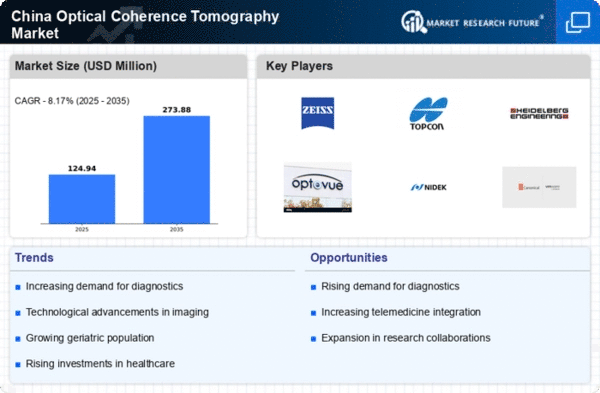
As per Market Research Future analysis, the China optical coherence-tomography market size was estimated at 115.5 USD Million in 2024. The China optical coherence-tomography market is projected to grow from 124.94 USD Million in 2025 to 273.88 USD Million by 2035, exhibiting a compound annual growth rate (CAGR) of 8.1% during the forecast period 2025 - 2035

Key Market Trends & Highlights

The China optical coherence-tomography market is poised for substantial growth driven by technological advancements and increasing healthcare demands.

  • Technological advancements in optical coherence-tomography are enhancing imaging capabilities and diagnostic accuracy.
  • The rising demand for non-invasive procedures is propelling the adoption of optical coherence-tomography across various healthcare settings.
  • The expansion of healthcare infrastructure in urban areas is facilitating greater access to advanced diagnostic tools.
  • Key market drivers include the increasing prevalence of eye diseases and growing awareness of eye health among the geriatric population.

Market Size & Forecast

2024 Market Size 115.5 (USD Million)
2035 Market Size 273.88 (USD Million)
CAGR (2025 - 2035) 8.17%

Major Players

Carl Zeiss AG (DE), Topcon Corporation (JP), Heidelberg Engineering GmbH (DE), Optovue Inc. (US), Nidek Co., Ltd. (JP), Canon Inc. (JP), Tomey Corporation (JP), Acuity Medical (US)

Our Impact
Enabled $4.3B Revenue Impact for Fortune 500 and Leading Multinationals
Partnering with 2000+ Global Organizations Each Year
30K+ Citations by Top-Tier Firms in the Industry

China Optical Coherence Tomography Market Trends

The optical coherence tomography market is experiencing notable advancements, particularly in the realm of diagnostic imaging technologies. This market is characterized by a growing demand for non-invasive imaging techniques, which are increasingly favored by healthcare professionals for their ability to provide high-resolution images of biological tissues. In China, Integrating optical coherence tomography into clinical practice is becoming more prevalent, driven by the rising incidence of ocular diseases and the need for early detection and treatment. Furthermore, the expansion of healthcare infrastructure and increased investment in medical technology are likely to bolster the market's growth. Moreover, the optical coherence-tomography market is witnessing a surge in research and development activities. Innovations in imaging systems and software are enhancing the capabilities of existing technologies, allowing for improved diagnostic accuracy and patient outcomes. The collaboration between academic institutions and industry players is fostering a conducive environment for technological advancements. As a result, the market appears poised for sustained growth, with potential opportunities arising from the increasing adoption of telemedicine and remote diagnostics, which are becoming more relevant in the current healthcare landscape.

Technological Advancements

The optical coherence-tomography market is benefiting from rapid technological innovations. Enhanced imaging systems are being developed, which improve diagnostic capabilities and patient outcomes. These advancements are likely to attract more healthcare providers to adopt optical coherence tomography in their practices.

Rising Demand for Non-Invasive Procedures

There is a growing preference for non-invasive diagnostic techniques within the optical coherence-tomography market. This trend is driven by the increasing awareness of the benefits of such procedures, which offer reduced patient discomfort and quicker recovery times, thereby encouraging more patients to seek these services.

Expansion of Healthcare Infrastructure

Ongoing expansion of healthcare facilities in China is positively impacting the optical coherence-tomography market. As more hospitals and clinics are equipped with advanced imaging technologies, the accessibility of optical coherence tomography is likely to improve, leading to higher adoption rates among healthcare professionals.

China Optical Coherence Tomography Market Drivers

Rising Geriatric Population

The demographic shift towards an aging population in China is a significant driver for the optical coherence-tomography market. As the proportion of elderly individuals increases, the incidence of age-related eye conditions is also expected to rise. By 2030, it is projected that over 300 million people in China will be aged 60 and above, creating a substantial demand for effective diagnostic tools. Optical coherence-tomography systems are particularly valuable in this context, as they enable early detection and management of age-related macular degeneration and other ocular diseases. The growing geriatric population is likely to propel the optical coherence-tomography market forward, as healthcare providers seek to address the unique needs of older patients.

Growing Awareness of Eye Health

Increasing public awareness regarding eye health is a vital driver for the optical coherence-tomography market in China. Educational campaigns and initiatives aimed at promoting regular eye examinations are encouraging individuals to seek preventive care. As awareness of the importance of early detection of eye diseases grows, more patients are likely to request advanced diagnostic procedures, including optical coherence-tomography. This trend is supported by the rising prevalence of lifestyle-related eye conditions, which further emphasizes the need for regular screenings. Consequently, the optical coherence-tomography market is expected to benefit from this heightened awareness, as healthcare providers respond to the growing demand for comprehensive eye care services.

Government Initiatives and Funding

Government support plays a pivotal role in the development of the optical coherence-tomography market in China. Initiatives aimed at improving healthcare access and quality have led to increased funding for advanced medical technologies. The Chinese government has allocated substantial resources to enhance diagnostic capabilities in hospitals and clinics, particularly in underserved areas. This funding is likely to facilitate the acquisition of optical coherence-tomography devices, thereby expanding their availability. Furthermore, public health campaigns focused on eye health awareness are expected to drive demand for these technologies, as more individuals seek preventive care and early diagnosis. Consequently, the optical coherence-tomography market is poised for growth, bolstered by supportive government policies.

Increasing Prevalence of Eye Diseases

The rising incidence of eye diseases in China is a crucial driver for the optical coherence-tomography market. Conditions such as diabetic retinopathy, age-related macular degeneration, and glaucoma are becoming more prevalent, necessitating advanced diagnostic tools. According to recent health statistics, the prevalence of diabetic retinopathy alone is estimated to affect over 10 million individuals in China. This growing patient population is likely to increase the demand for optical coherence-tomography systems, which provide high-resolution imaging for early detection and monitoring of these conditions. As healthcare providers seek to enhance patient outcomes, the optical coherence-tomography market is expected to experience significant growth, driven by the need for effective diagnostic solutions in ophthalmology.

Technological Integration in Healthcare

The integration of advanced technologies in healthcare is transforming the optical coherence-tomography market in China. Innovations such as artificial intelligence and machine learning are being incorporated into imaging systems, enhancing diagnostic accuracy and efficiency. These technologies allow for better analysis of retinal images, leading to improved patient outcomes. As hospitals and clinics adopt these advanced systems, the demand for optical coherence-tomography devices is expected to rise. Furthermore, the trend towards telemedicine and remote diagnostics is likely to create new opportunities for the optical coherence-tomography market, as practitioners seek to provide high-quality care to patients in various settings. This technological evolution is anticipated to drive market growth significantly.


Market Segment Insights

By Technology: Sd-Oct (Largest) vs. Swept-Source Oct (Fastest-Growing)

In the China optical coherence-tomography market, the Sd-Oct technology currently holds the largest market share, dominating the landscape with widespread adoption across various healthcare facilities. This segment's strength is attributed to its established presence and the reliability of its imaging capabilities, making it a preferred choice among practitioners. In contrast, the Swept-Source Oct technology, although smaller in market share, is rapidly gaining traction due to its advanced features and increasing applications in complex ocular imaging, setting the stage for potential market shifts. The growth of the Taiwan optical coherence-tomography market is significantly influenced by technological advancements and increasing demand for detailed ocular imaging. The Swept-Source Oct segment is recognized as the fastest-growing, driven by investments in innovation and the need for enhanced diagnostic tools in eye care. As healthcare providers increasingly seek to improve patient outcomes through superior imaging technology, both segments are poised for growth, but Swept-Source Oct's rapid development could reshape future market dynamics.

Technology: Sd-Oct (Dominant) vs. Swept-Source Oct (Emerging)

The Sd-Oct segment is characterized by its established technology, reliability, and widespread use in the optical coherence-tomography market. It serves as the backbone of many diagnostic imaging services, offering high-resolution images that are essential for effective eye care. Meanwhile, Swept-Source Oct is emerging as a significant player with its cutting-edge features, providing faster imaging speeds and improved depth penetration. This technology is particularly advantageous for complex diagnoses, including those related to retinal conditions. As innovation propels advancements in both segments, the competitive landscape is evolving, with Swept-Source Oct expected to capture a larger share as healthcare institutions continue to invest in advanced imaging solutions.

By Application: Ophthalmology (Largest) vs. Cardiology (Fastest-Growing)

In the China optical coherence-tomography market, the application segment displays a notable distribution, with ophthalmology taking the lead as the largest segment. This is primarily driven by the increasing prevalence of eye diseases and the growing demand for non-invasive imaging techniques. Following closely, cardiology is emerging as a significant player, reflecting heightened awareness and diagnostic needs for cardiovascular conditions. Dermatology also contributes to the overall market but remains comparatively smaller in market share. Growth trends are particularly evident in the cardiology segment, which is gaining traction due to advancements in technology and a rise in patient population requiring cardiac assessments. The overall increase in healthcare investments in China plays a considerable role in enhancing accessibility and adoption of optical coherence-tomography across these applications, thus propelling the growth of the ophthalmology and dermatology segments as well.

Ophthalmology (Dominant) vs. Cardiology (Emerging)

Ophthalmology remains the dominant application within the China optical coherence-tomography market, characterized by its extensive use in diagnosing various retinal diseases and disorders. The increased focus on early detection and treatment outcomes contributes to its strong foothold. In contrast, cardiology is emerging as a vital segment due to an expanding array of applications, including the assessment of coronary artery disease and other cardiovascular issues. This growth is fueled by technological innovations that enhance imaging clarity and device portability, attracting more healthcare providers to incorporate optical coherence-tomography in cardiac diagnostics. Both segments are crucial, yet they exhibit different stages of maturity and growth potential.

By Type of Devices: Tabletop (Largest) vs. Handheld (Fastest-Growing)

The distribution of the market share among the types of devices reveals that tabletop devices occupy the largest share in the China optical coherence-tomography market, primarily catering to clinical settings that require high-performance imaging and diagnostics. Handheld devices, although currently smaller in market share, are rapidly gaining traction due to their portability and ease of use in diverse environments, making them increasingly appealing to practitioners. Growth trends in the segment demonstrate a noticeable inclination towards handheld devices as they present innovative features that enhance accessibility and convenience for practitioners. Factors driving this growth include advances in technology, increasing demand for point-of-care diagnostics, and a growing emphasis on mobile healthcare solutions in urban and rural settings. The adaptability of handheld devices to various clinical needs underpins their emergent status in the market.

Devices: Tabletop (Dominant) vs. Handheld (Emerging)

Tabletop devices represent the dominant segment in the China optical coherence-tomography market, renowned for their advanced imaging capabilities and reliability in professional healthcare settings. These devices are typically stationary and offer superior precision, making them ideal for thorough diagnostics and examinations. In contrast, handheld devices are emerging rapidly, characterized by their compact design and user-friendly interface, appealing to a broader range of healthcare providers. The portability of handheld units allows them to be utilized in various settings, including home healthcare and remote locations, thereby expanding the market reach. As healthcare trends shift towards convenience and efficiency, the rising popularity of handheld devices complements the established presence of tabletop options, driving diverse applications across the sector.

Get more detailed insights about China Optical Coherence Tomography Market

Key Players and Competitive Insights

The optical coherence-tomography market in China is characterized by a dynamic competitive landscape, driven by technological advancements and increasing demand for non-invasive diagnostic tools. Key players such as Carl Zeiss AG (DE), Topcon Corporation (JP), and Heidelberg Engineering GmbH (DE) are at the forefront, each adopting distinct strategies to enhance their market presence. Carl Zeiss AG (DE) focuses on innovation, particularly in developing high-resolution imaging systems, while Topcon Corporation (JP) emphasizes regional expansion and partnerships to strengthen its distribution network. Heidelberg Engineering GmbH (DE) is noted for its commitment to integrating artificial intelligence into its products, thereby enhancing diagnostic accuracy and operational efficiency. Collectively, these strategies contribute to a competitive environment that is increasingly centered around technological differentiation and customer-centric solutions.In terms of business tactics, companies are localizing manufacturing to reduce costs and improve supply chain efficiency. The market structure appears moderately fragmented, with several players vying for market share, yet dominated by a few key firms that exert considerable influence. This fragmentation allows for niche players to emerge, but the presence of established companies often dictates market trends and pricing strategies.

In October Topcon Corporation (JP) announced a strategic partnership with a leading Chinese healthcare provider to enhance its service offerings in the region. This collaboration is expected to facilitate the integration of advanced optical coherence-tomography systems into local healthcare facilities, thereby improving patient access to cutting-edge diagnostic tools. Such partnerships are crucial for expanding market reach and adapting to local healthcare needs.

In September Carl Zeiss AG (DE) launched a new line of optical coherence-tomography devices that incorporate machine learning algorithms to assist in early disease detection. This innovation not only positions the company as a leader in technological advancement but also addresses the growing demand for precision in ophthalmic diagnostics. The introduction of these devices is likely to enhance the company's competitive edge in a market that increasingly values technological sophistication.

In August Heidelberg Engineering GmbH (DE) unveiled a new software platform designed to streamline data management for optical coherence-tomography systems. This platform aims to improve workflow efficiency in clinical settings, thereby appealing to healthcare providers seeking to optimize their operations. The strategic importance of this development lies in its potential to enhance user experience and operational productivity, which are critical factors in the competitive landscape.

As of November current trends in the optical coherence-tomography market include a pronounced shift towards digitalization and sustainability, with companies increasingly integrating AI technologies into their offerings. Strategic alliances are becoming more prevalent, as firms recognize the value of collaboration in enhancing product capabilities and market reach. Looking ahead, competitive differentiation is likely to evolve from traditional price-based competition to a focus on innovation, technological advancement, and supply chain reliability. This shift underscores the importance of adaptability and forward-thinking strategies in maintaining a competitive edge in a rapidly changing market.

Key Companies in the China Optical Coherence Tomography Market include

Industry Developments

China Optical Coherence Tomography Market has been experiencing notable developments recently, particularly with several key players actively advancing their positions. Companies such as Optovue Inc., Heidelberg Engineering GmbH, and Topcon Corporation have made significant strides in enhancing their imaging technologies, contributing to improved diagnostics in the ophthalmic field. Growth in market valuation is evident as technological advancements and increasing healthcare investments in China continue to drive demand for optical coherence tomography systems.

As of July 2023, Canon Inc. announced its expansion in the region, reinforcing its commitment to innovation in eye care. The competitive landscape has also seen companies like Nidek Co Ltd and Santec Corporation investing in research and development to stay ahead of the curve. Furthermore, there were rumors in August 2023 of collaboration discussions between Optical Imaging Ltd and major hospitals in China aimed at improving patient access to OCT technologies.

Regulatory support from the National Medical Products Administration is facilitating smoother market access for new entrants, indicating a robust growth trajectory for the optical coherence tomography market in China.

Future Outlook

China Optical Coherence Tomography Market Future Outlook

The Optical Coherence Tomography Market is projected to grow at an 8.17% CAGR from 2025 to 2035, driven by technological advancements and increasing healthcare investments.

New opportunities lie in:

  • Development of portable OCT devices for remote diagnostics
  • Integration of AI algorithms for enhanced imaging analysis
  • Expansion of OCT applications in dermatology and oncology

By 2035, the market is expected to achieve substantial growth and innovation.

Market Segmentation

China Optical Coherence Tomography Market Technology Outlook

  • Sd-Oct
  • Swept-Source Oct

China Optical Coherence Tomography Market Application Outlook

  • Cardiology
  • Ophthalmology
  • Dermatology

China Optical Coherence Tomography Market Type of Devices Outlook

  • Handheld
  • Tabletop
  • Catheter-Based Oct Devices

Report Scope

MARKET SIZE 2024 115.5(USD Million)
MARKET SIZE 2025 124.94(USD Million)
MARKET SIZE 2035 273.88(USD Million)
COMPOUND ANNUAL GROWTH RATE (CAGR) 8.17% (2025 - 2035)
REPORT COVERAGE Revenue Forecast, Competitive Landscape, Growth Factors, and Trends
BASE YEAR 2024
Market Forecast Period 2025 - 2035
Historical Data 2019 - 2024
Market Forecast Units USD Million
Key Companies Profiled Carl Zeiss AG (DE), Topcon Corporation (JP), Heidelberg Engineering GmbH (DE), Optovue Inc. (US), Nidek Co., Ltd. (JP), Canon Inc. (JP), Tomey Corporation (JP), Acuity Medical (US)
Segments Covered Technology, Application, Type of Devices
Key Market Opportunities Advancements in imaging technology enhance diagnostic capabilities in the optical coherence-tomography market.
Key Market Dynamics Rising demand for advanced imaging technologies drives innovation in the optical coherence-tomography market.
Countries Covered China
Leave a Comment

FAQs

What is the expected market size of the China Optical Coherence Tomography Market in 2024?

The market is expected to be valued at 115.5 million USD in 2024.

What will be the projected market size of the China Optical Coherence Tomography Market by 2035?

By 2035, the market is projected to reach a value of 254.2 million USD.

What is the expected Compound Annual Growth Rate (CAGR) for the China Optical Coherence Tomography Market from 2025 to 2035?

The expected CAGR for the market from 2025 to 2035 is 7.435 percent.

Which type of devices holds the largest market value in 2024 within the China Optical Coherence Tomography Market?

In 2024, the Tabletop devices segment holds the largest market value, estimated at 45.0 million USD.

How much is the Handheld devices segment expected to be valued at in 2035?

The Handheld devices segment is expected to reach a value of 66.5 million USD by 2035.

What is the market size for Catheter-Based OCT Devices in 2024?

The Catheter-Based OCT Devices segment is valued at 40.5 million USD in 2024.

Who are the key players in the China Optical Coherence Tomography Market?

Key players in the market include Optovue Inc, Santec Corporation, and Heidelberg Engineering GmbH among others.

What is the expected growth trajectory for the Tabletop segment of the Optical Coherence Tomography Market by 2035?

The Tabletop segment is projected to grow to approximately 100.5 million USD by 2035.

What are the emerging trends in the China Optical Coherence Tomography Market?

Emerging trends include advancements in device technology and increasing adoption in diagnostics.

What challenges are faced by the China Optical Coherence Tomography Market currently?

Challenges include regulatory hurdles and high costs of advanced technologies in the sector.

Download Free Sample

Kindly complete the form below to receive a free sample of this Report

Compare Licence

×
Features License Type
Single User Multiuser License Enterprise User
Price $4,950 $5,950 $7,250
Maximum User Access Limit 1 User Upto 10 Users Unrestricted Access Throughout the Organization
Free Customization
Direct Access to Analyst
Deliverable Format
Platform Access
Discount on Next Purchase 10% 15% 15%
Printable Versions