×
Request Free Sample ×

Kindly complete the form below to receive a free sample of this Report

* Please use a valid business email

Leading companies partner with us for data-driven Insights

clients tt-cursor
Hero Background

China Office Furniture Market

ID: MRFR/CG/42615-HCR
128 Pages
Garvit Vyas
February 2026

China Office Furniture Market Size, Share, Industry Trend & Analysis Research Report: By Product Type (Office Chair, Office Table, Storage Furniture, Others), By Material (Wood, Steel, Others), and By Distribution Channel (Online, Offline) - Forecast to 2035.

Share:
Download PDF ×

We do not share your information with anyone. However, we may send you emails based on your report interest from time to time. You may contact us at any time to opt-out.

China Office Furniture Market Infographic
Purchase Options

China Office Furniture Market Summary

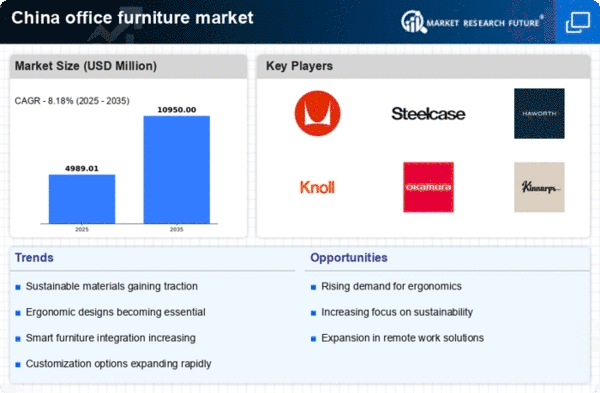
As per Market Research Future analysis, the China office furniture market Size was estimated at 4611.77 USD Million in 2024. The China office furniture market is projected to grow from 4989.01 USD Million in 2025 to 10950.0 USD Million by 2035, exhibiting a compound annual growth rate (CAGR) of 8.1% during the forecast period 2025 - 2035

Key Market Trends & Highlights

The China office furniture market is experiencing a transformative shift towards ergonomic and sustainable solutions.

  • The largest segment in the China office furniture market is the ergonomic furniture segment, driven by increasing health awareness.
  • The fastest-growing segment is the flexible workspace solutions, reflecting the evolving nature of work environments.
  • Sustainability initiatives are becoming a core focus, with manufacturers prioritizing eco-friendly materials and processes.
  • Technological advancements in manufacturing and rising demand for flexible workspaces are key drivers of market growth.

Market Size & Forecast

2024 Market Size 4611.77 (USD Million)
2035 Market Size 10950.0 (USD Million)
CAGR (2025 - 2035) 8.18%

Major Players

Herman Miller (US), Steelcase (US), Haworth (US), Knoll (US), Okamura (JP), Kinnarps (SE), Vitra (CH), IKEA (SE), Global Furniture Group (CA)

Our Impact
Enabled $4.3B Revenue Impact for Fortune 500 and Leading Multinationals
Partnering with 2000+ Global Organizations Each Year
30K+ Citations by Top-Tier Firms in the Industry

China Office Furniture Market Trends

The office furniture market in China is currently experiencing a dynamic transformation, driven by evolving workplace needs and a growing emphasis on employee well-being. As organizations increasingly recognize the importance of creating conducive work environments, there is a noticeable shift towards ergonomic designs and multifunctional furniture solutions. This trend appears to be influenced by a broader understanding of how physical workspace impacts productivity and employee satisfaction. Furthermore, the rise of remote and hybrid work models has prompted companies to rethink their office layouts, leading to a demand for adaptable and flexible furniture options that can cater to various work styles. In addition to ergonomic considerations, sustainability is becoming a focal point within the office furniture market. Manufacturers are increasingly adopting eco-friendly materials and production processes, reflecting a commitment to environmental responsibility. This shift not only aligns with consumer preferences but also complies with regulatory frameworks aimed at reducing carbon footprints. As the market continues to evolve, it seems likely that innovation in design and materials will play a crucial role in shaping future offerings, ensuring that they meet both aesthetic and functional requirements while promoting a sustainable approach to office environments.

Ergonomic Design Focus

There is a growing emphasis on ergonomic furniture solutions that prioritize user comfort and health. This trend reflects a broader understanding of the relationship between workspace design and employee productivity, leading to increased demand for adjustable desks and supportive seating.

Sustainability Initiatives

Manufacturers are increasingly adopting sustainable practices, utilizing eco-friendly materials and processes. This trend aligns with consumer preferences for environmentally responsible products and is influenced by regulatory pressures aimed at reducing environmental impact.

Adaptability and Flexibility

The need for adaptable furniture solutions is rising as organizations embrace hybrid work models. This trend indicates a shift towards multifunctional pieces that can easily transition between different work settings, catering to diverse employee needs.

China Office Furniture Market Drivers

Increased Focus on Aesthetic Appeal

In the office furniture market, aesthetic appeal is becoming increasingly important as companies strive to create visually appealing work environments. The emphasis on design and aesthetics is driven by the understanding that a well-designed workspace can enhance employee morale and productivity. As a result, manufacturers are investing in high-quality materials and innovative designs that reflect contemporary trends. Recent surveys indicate that over 70% of businesses in China consider the aesthetic aspect of office furniture when making purchasing decisions. This focus on aesthetics is likely to influence the types of products offered in the market, with a growing preference for stylish and functional furniture. Thus, the office furniture market is evolving to meet these demands, ensuring that products not only serve practical purposes but also contribute to an inspiring workplace atmosphere.

Rising Demand for Flexible Workspaces

The office furniture market in China is witnessing a notable shift towards flexible workspaces, driven by changing work patterns and employee preferences. Companies are increasingly adopting open office layouts and collaborative spaces, which require versatile furniture solutions. This trend is reflected in the growing demand for modular furniture that can be easily reconfigured to accommodate different work styles. According to recent data, the market for flexible office furniture is expected to account for over 30% of total sales in the coming years. This shift not only enhances employee productivity but also fosters a culture of collaboration and innovation. Consequently, the office furniture market is adapting to these changes by offering a diverse range of products that cater to the evolving needs of modern workplaces.

Growing Awareness of Health and Well-being

The office furniture market in China is increasingly influenced by a growing awareness of health and well-being among employees. Companies are recognizing the importance of providing ergonomic furniture that promotes better posture and reduces the risk of work-related injuries. This trend is reflected in the rising demand for adjustable desks, ergonomic chairs, and other health-focused office solutions. Recent studies indicate that organizations investing in employee well-being see a 20% increase in productivity. As a result, the office furniture market is responding by offering a wider range of ergonomic products designed to enhance comfort and support overall health. This focus on well-being is likely to shape future product development and marketing strategies within the industry.

Technological Advancements in Manufacturing

The office furniture market in China is experiencing a transformation due to rapid technological advancements in manufacturing processes. Automation and smart manufacturing techniques are enhancing production efficiency, reducing costs, and improving product quality. For instance, the integration of robotics and AI in furniture production is streamlining operations, allowing manufacturers to meet the growing demand for customized office solutions. This shift is likely to increase the market's competitiveness, as companies that adopt these technologies can offer innovative designs and faster delivery times. Furthermore, the market is projected to grow at a CAGR of approximately 6.5% over the next five years, driven by these advancements. As a result, the office furniture market is poised for significant growth, with manufacturers increasingly investing in technology to stay ahead of the competition.

Government Initiatives Supporting Office Development

The office furniture market in China is benefiting from various government initiatives aimed at promoting office development and modernization. Policies that encourage urbanization and the establishment of business districts are driving the demand for office spaces, subsequently increasing the need for office furniture. For instance, government investments in infrastructure and commercial real estate are expected to boost the market significantly. Recent reports suggest that the office furniture market could see a growth rate of around 5% annually, fueled by these initiatives. As businesses expand and new companies emerge, the office furniture market is likely to experience heightened demand for diverse and innovative furniture solutions that cater to modern office environments.


Market Segment Insights

By Type: Chairs (Largest) vs. Desks (Fastest-Growing)

In the China office furniture market, the distribution of market share among the various segments reveals that chairs occupy the largest segment, benefiting from the increasing demand for ergonomic and stylish seating solutions. Desks and storage units follow, with desks witnessing a notable upward trend fueled by the rise in remote work. The partition panels segment is also gaining traction as businesses focus on efficient space utilization and creating collaborative environments, albeit at a smaller share compared to chairs and desks. Growth trends in the China office furniture market are influenced by evolving workplace dynamics and the push for enhanced employee productivity and comfort. The demand for chairs is largely driven by trends favoring ergonomic designs that align with health and well-being needs. Meanwhile, desks are emerging as the fastest-growing segment due to the increasing adoption of home working arrangements and the necessity for versatile, functional workspace solutions that cater to the dynamic needs of modern professionals.

Chairs (Dominant) vs. Desks (Emerging)

Chairs in the China office furniture market are characterized by a strong emphasis on ergonomic design and aesthetics, making them the dominant choice for businesses looking to enhance employee comfort and productivity. With an increased focus on health and wellness in work environments, ergonomic chairs that provide proper support have become essential. Conversely, desks represent an emerging segment, driven by innovations in modular and flexible designs that facilitate various work styles. The popularity of adjustable desks allows users to switch between sitting and standing, reflecting the current trends toward creating multifunctional office spaces that accommodate both collaborative and individual work. Overall, both segments are essential to promoting a functional and appealing office environment.

By Material: Wood (Largest) vs. Metal (Fastest-Growing)

The China office furniture market has seen a diverse material distribution with wood holding the largest market share due to its traditional aesthetic appeal and durability. Following wood, metal and plastic have carved significant niches, yet wood remains the preferred material among consumers looking for quality and long-lasting office solutions. Glass, while appreciated for its elegance, occupies a smaller segment but is gaining traction in modern office designs. Growth trends indicate a rising demand for metal furnishings, attributed to their sleek design and versatility, making them suitable for contemporary office environments. The trend towards sustainability is also bolstering demand for recycled materials, particularly in the metal segment. As design preferences evolve, metal is poised for rapid expansion, indicating a shift in consumer preferences towards innovative, space-efficient furniture solutions.

Wood (Dominant) vs. Plastic (Emerging)

Wood remains the dominant material in the China office furniture market, characterized by its warm aesthetics and robust structural integrity, appealing to consumers looking for classic office environments. Conversely, plastic is emerging as a viable alternative, particularly in flexible workspaces, due to its lightweight nature and affordability. The advantages of plastic include ease of maintenance and a variety of customizable designs, which are increasingly appealing to modern businesses. As organizations move towards more informal and collaborative workplace designs, the role of plastic furniture is likely to expand, providing cost-effective solutions without compromising on style. This trend positions plastic as a rising contender, complementing the established wooden offerings in the market.

By End Use: Corporate Offices (Largest) vs. Home Offices (Fastest-Growing)

In the China office furniture market, the distribution of market share across the end-use segments shows that corporate offices hold the largest share, benefiting from the rapid expansion of business operations and a growing emphasis on office aesthetics. Public sector and educational institutions also contribute significantly, though they display slower growth rates compared to corporate and home office segments. Home offices, in particular, have seen a surge as remote work becomes more permanent, reflecting changing work patterns post-pandemic. Growth trends indicate that the corporate office segment remains stable due to sustained demand from various industries, while home offices are experiencing substantial growth driven by increasing acceptance of remote working arrangements. Factors such as technological advancements and evolving workplace designs further fuel the need for adaptive furniture solutions. As organizations adapt to hybrid work models, both segments are poised for differing yet significant trajectories in the coming years.

Corporate Offices (Dominant) vs. Home Offices (Emerging)

The corporate offices segment is characterized by its dominant position in the China office furniture market, with a focus on high-quality, ergonomic furniture designed to enhance productivity and employee well-being. This segment typically prioritizes aesthetic appeal alongside functionality, leading to trends in modern design and integrated technology. In contrast, the home offices segment represents an emerging market, driven by the shift towards flexible work arrangements. Consumers in this segment seek versatile, space-efficient furniture that supports productivity in a home environment, coupled with a growing consideration for aesthetics and comfort. As remote work solidifies its place in corporate culture, the home offices segment is evolving rapidly, becoming a crucial component of overall market dynamics.

By Distribution Channel: Online Retail (Largest) vs. Physical Retail (Fastest-Growing)

The distribution of market share among various channels in the China office furniture market showcases a notable preference for online retail, which commands the largest share. Online platforms provide a vast selection and convenience, appealing greatly to office furniture buyers. Meanwhile, physical retail outlets have shown a substantial share as well, yet they are increasingly challenged by the digital shift. Growth trends within this segment indicate that online retail remains dominant, propelled by the rapid expansion of e-commerce in the region. Meanwhile, physical retail is evolving to integrate more interactive and customer-engagement strategies, making it the fastest-growing channel. Factors such as enhanced logistics, diverse product offerings, and targeted marketing are driving these changes, indicating strong potential for both channels moving forward.

Online Retail: Dominant vs. Physical Retail: Emerging

Online retail in the China office furniture market is characterized by its extensive reach and accessibility, allowing consumers to explore a variety of products from the comfort of their homes. This segment has leveraged technological advancements to enhance user experience, ensuring smooth navigation and transaction processes. In contrast, physical retail is emerging as a critical segment, adapting to changing consumer preferences by focusing on experiential shopping and personalized services in-store. While online channels dominate in terms of convenience and pricing, physical stores are innovating their approach, creating hybrid experiences that blend online offers with tactile product engagement.

Get more detailed insights about China Office Furniture Market

Key Players and Competitive Insights

The office furniture market in China is characterized by a dynamic competitive landscape, driven by a confluence of innovation, sustainability, and digital transformation. Major players such as Herman Miller (US), Steelcase (US), and IKEA (SE) are actively reshaping their strategies to capture market share. Herman Miller (US) emphasizes design innovation and ergonomic solutions, positioning itself as a leader in high-end office furniture. Steelcase (US) focuses on research-driven product development, leveraging insights into workplace behavior to enhance user experience. Meanwhile, IKEA (SE) adopts a cost-effective approach, appealing to a broader demographic through its modular and customizable offerings. Collectively, these strategies foster a competitive environment that prioritizes adaptability and customer-centric solutions.Key business tactics within the market include localizing manufacturing and optimizing supply chains to enhance efficiency and reduce costs. The competitive structure appears moderately fragmented, with numerous players vying for market presence. However, the influence of key players is substantial, as they set trends and standards that smaller companies often follow. This interplay between established brands and emerging firms creates a vibrant ecosystem where innovation and responsiveness to consumer needs are paramount.

In October Steelcase (US) announced a partnership with a leading technology firm to integrate AI-driven analytics into its product offerings. This strategic move aims to enhance workspace efficiency by providing real-time data on furniture usage and employee engagement. The collaboration signifies a shift towards data-informed design, potentially revolutionizing how office environments are tailored to meet the evolving needs of businesses.

In September IKEA (SE) launched a new line of sustainable office furniture made from recycled materials, reinforcing its commitment to environmental responsibility. This initiative not only aligns with global sustainability trends but also caters to the increasing consumer demand for eco-friendly products. By prioritizing sustainability, IKEA (SE) positions itself as a forward-thinking brand, likely attracting environmentally conscious consumers and businesses alike.

In November Herman Miller (US) unveiled a new digital platform that allows customers to customize their office furniture selections online. This platform enhances the customer experience by providing a seamless interface for design and purchase, reflecting the growing trend towards digitalization in retail. The introduction of this platform may significantly impact consumer purchasing behavior, as it offers greater flexibility and personalization in product selection.

As of November current competitive trends in the office furniture market are increasingly defined by digitalization, sustainability, and the integration of advanced technologies such as AI. Strategic alliances among key players are shaping the landscape, fostering innovation and enhancing product offerings. Looking ahead, competitive differentiation is likely to evolve from traditional price-based competition towards a focus on innovation, technology integration, and supply chain reliability. This shift underscores the importance of adaptability and responsiveness in a rapidly changing market.

Key Companies in the China Office Furniture Market include

Industry Developments

In recent developments, the China Office Furniture Market has seen significant activity with a focus on sustainable and ergonomic designs, responding to increased demand for workplace flexibility and health-conscious office environments. Companies like Steelcase and Herman Miller have introduced innovative solutions that prioritize employee well-being, aligning with the government's vision for improved workplace standards. In terms of market expansion, MUJI and Vitra have announced plans to enhance their distribution networks in tier-2 cities as consumer interest in home office setups grows.

The market has also witnessed notable financial growth, with estimates suggesting a CAGR of around 10% over the next five years, mainly driven by digital transformation in workplaces.In the realm of mergers and acquisitions, November 2022 saw Huihao acquire a controlling stake in Sunon, intending to expand their product portfolio and reach. Additionally, in July 2023, Steelcase announced a partnership with AITONE to develop eco-friendly office furniture solutions, further emphasizing the trend toward sustainability. The competitive landscape is dynamic, with companies such as Knoll and OKAMURA also diversifying their offerings to meet evolving customer preferences and regulatory standards.

Future Outlook

China Office Furniture Market Future Outlook

The Office Furniture Market in China is projected to grow at an 8.18% CAGR from 2025 to 2035, driven by urbanization, remote work trends, and sustainability initiatives.

New opportunities lie in:

  • Development of ergonomic furniture solutions for remote workers
  • Integration of smart technology in office furniture designs
  • Expansion of modular furniture systems for flexible workspaces

By 2035, the office furniture market is expected to achieve substantial growth and innovation.

Market Segmentation

China Office Furniture Market Type Outlook

  • Desks
  • Chairs
  • Storage Units
  • Tables
  • Partition Panels

China Office Furniture Market End Use Outlook

  • Corporate Offices
  • Public Sector
  • Educational Institutions
  • Home Offices

China Office Furniture Market Material Outlook

  • Wood
  • Metal
  • Plastic
  • Glass

China Office Furniture Market Distribution Channel Outlook

  • Online Retail
  • Physical Retail
  • Distributors
  • Direct Sales

Report Scope

MARKET SIZE 2024 4611.77(USD Million)
MARKET SIZE 2025 4989.01(USD Million)
MARKET SIZE 2035 10950.0(USD Million)
COMPOUND ANNUAL GROWTH RATE (CAGR) 8.18% (2025 - 2035)
REPORT COVERAGE Revenue Forecast, Competitive Landscape, Growth Factors, and Trends
BASE YEAR 2024
Market Forecast Period 2025 - 2035
Historical Data 2019 - 2024
Market Forecast Units USD Million
Key Companies Profiled Herman Miller (US), Steelcase (US), Haworth (US), Knoll (US), Okamura (JP), Kinnarps (SE), Vitra (CH), IKEA (SE), Global Furniture Group (CA)
Segments Covered Type, Material, End Use, Distribution Channel
Key Market Opportunities Integration of ergonomic designs and smart technology in the office furniture market enhances employee productivity and well-being.
Key Market Dynamics Rising demand for ergonomic office furniture driven by evolving workplace wellness trends and regulatory standards in China.
Countries Covered China
Leave a Comment

FAQs

What is the expected market size of the China Office Furniture Market in 2024?

The China Office Furniture Market is expected to be valued at 4.0 USD Billion in 2024.

What is the projected market size for the China Office Furniture Market by 2035?

By 2035, the market is anticipated to grow to 11.0 USD Billion.

What is the expected CAGR for the China Office Furniture Market from 2025 to 2035?

The market is expected to achieve a CAGR of 9.633% during the period from 2025 to 2035.

Which product type in the China Office Furniture Market is expected to be the largest contributor in 2024?

Office Chairs are projected to dominate with a value of 1.2 USD Billion in 2024.

What is the market value for Office Tables in the China Office Furniture Market by 2035?

The market value for Office Tables is expected to reach 2.8 USD Billion by 2035.

Who are the key players in the China Office Furniture Market?

Major players include MUJI, Sunon, Steelcase, Herman Miller, and Haworth among others.

What is the expected market size for Storage Furniture in 2024?

The expected market size for Storage Furniture in 2024 is valued at 1.4 USD Billion.

What challenges might impact the growth of the China Office Furniture Market?

The market may face challenges such as competition and fluctuating material costs.

What is the projected market size for the 'Others' segment by 2035?

The 'Others' segment is projected to reach a market size of 0.7 USD Billion by 2035.

How does the current economic scenario affect the China Office Furniture Market?

The current economic scenario may influence consumer spending patterns and market dynamics.

Download Free Sample

Kindly complete the form below to receive a free sample of this Report

Compare Licence

×
Features License Type
Single User Multiuser License Enterprise User
Price $4,950 $5,950 $7,250
Maximum User Access Limit 1 User Upto 10 Users Unrestricted Access Throughout the Organization
Free Customization
Direct Access to Analyst
Deliverable Format
Platform Access
Discount on Next Purchase 10% 15% 15%
Printable Versions