×
Request Free Sample ×

Kindly complete the form below to receive a free sample of this Report

* Please use a valid business email

Leading companies partner with us for data-driven Insights

clients tt-cursor
Hero Background

China Hair Transplant Market

ID: MRFR/HC/43498-HCR
200 Pages
Rahul Gotadki
February 2026

China Hair Transplant Market Research Report By Hair Transplant Surgical Method (Follicular Unit Transplantation, Follicular Unit Extraction, Follicular Isolation Technique, Robotic Hair Transplantation) and By Hair Transplant Surgery Type (Head Hair Transplant, Eyebrow Transplant, Frontal Hairline Lowering) - Growth & Industry Forecast 2025 To 2035

Share:
Download PDF ×

We do not share your information with anyone. However, we may send you emails based on your report interest from time to time. You may contact us at any time to opt-out.

China Hair Transplant Market Infographic
Purchase Options

China Hair Transplant Market Summary

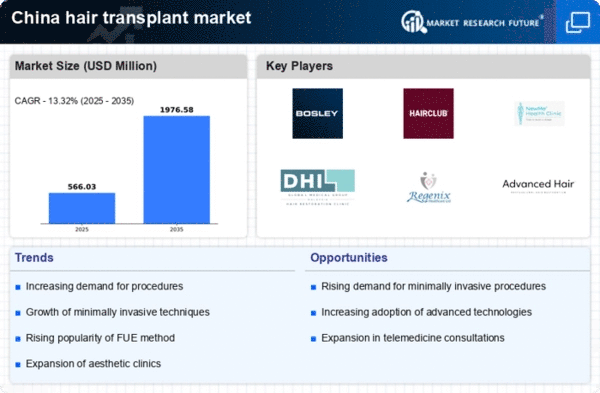
As per Market Research Future analysis, the China hair transplant market size was estimated at 499.5 USD Million in 2024. The China hair transplant market is projected to grow from 566.03 USD Million in 2025 to 1976.58 USD Million by 2035, exhibiting a compound annual growth rate (CAGR) of 13.3% during the forecast period 2025 - 2035

Key Market Trends & Highlights

The China hair transplant market is experiencing robust growth driven by technological advancements and changing consumer attitudes.

  • Technological advancements in hair transplant procedures are enhancing the effectiveness and safety of treatments.
  • Changing consumer attitudes towards aesthetics are driving demand for hair restoration solutions among various demographics.
  • The largest segment in the market is the surgical hair restoration, while the fastest-growing segment is non-surgical options.
  • Rising aesthetic awareness and increased investment in healthcare are key drivers propelling market expansion.

Market Size & Forecast

2024 Market Size 499.5 (USD Million)
2035 Market Size 1976.58 (USD Million)
CAGR (2025 - 2035) 13.32%

Major Players

Bosley (US), Hair Club (US), NewMe Health (US), DHI Global Medical Group (ES), Regenix (US), Advanced Hair Restoration (US), Alvi Armani (CA), FUE Clinics (GB), The Private Clinic (GB)

Our Impact
Enabled $4.3B Revenue Impact for Fortune 500 and Leading Multinationals
Partnering with 2000+ Global Organizations Each Year
30K+ Citations by Top-Tier Firms in the Industry

China Hair Transplant Market Trends

The hair transplant market is experiencing notable growth, driven by increasing awareness of aesthetic procedures and advancements in technology. In recent years, there has been a shift in consumer attitudes towards hair restoration, with more individuals seeking solutions for hair loss. This trend is particularly evident among younger demographics, who are more open to cosmetic enhancements. The rise of social media and celebrity endorsements has further fueled interest, as individuals aspire to achieve similar looks. Additionally, the availability of minimally invasive techniques has made hair transplant procedures more appealing, as they often result in quicker recovery times and less discomfort. Moreover, the regulatory environment in China appears to be evolving, with authorities focusing on ensuring safety and quality standards in cosmetic procedures. This regulatory scrutiny may enhance consumer confidence, potentially leading to increased demand for hair transplant services. Clinics are also investing in marketing strategies to reach a broader audience, utilizing digital platforms to educate potential clients about the benefits and options available. As the market continues to mature, it is likely that innovations in techniques and products will emerge, further shaping the landscape of hair restoration in the coming years.

Technological Advancements

The hair transplant market is witnessing rapid technological innovations. These innovations are particularly evident in minimally invasive techniques. These advancements enhance the precision and effectiveness of procedures, attracting a wider clientele. Techniques such as Follicular Unit Extraction (FUE) and robotic-assisted surgeries are becoming more prevalent, offering patients improved outcomes and reduced recovery times.

Changing Consumer Attitudes

There is a noticeable shift in consumer perceptions regarding hair restoration. Younger individuals are increasingly prioritizing aesthetics and are more willing to invest in cosmetic procedures. This trend is influenced by social media, where the portrayal of idealized beauty standards encourages more people to seek hair transplant solutions.

Regulatory Developments

The regulatory landscape surrounding the hair transplant market is evolving, with authorities emphasizing safety and quality in cosmetic procedures. Stricter regulations may lead to enhanced consumer trust, encouraging more individuals to consider hair restoration options. Clinics are adapting to these changes by ensuring compliance and promoting their commitment to high standards.

China Hair Transplant Market Drivers

Influence of Social Media

The role of social media in shaping perceptions of beauty and personal care is becoming increasingly significant in China. Platforms such as WeChat and Weibo are inundated with content related to hair restoration, influencing public opinion and driving interest in the hair transplant market. As individuals share their experiences and results, the visibility of hair transplant procedures increases, leading to heightened awareness and acceptance. This trend is particularly impactful among younger generations, who are more likely to engage with social media. Consequently, the hair transplant market is likely to experience growth as more individuals are encouraged to consider these procedures based on positive online testimonials and visual evidence of successful outcomes. The influence of social media is thus a pivotal factor in the evolving landscape of the hair transplant market.

Rising Aesthetic Awareness

The increasing emphasis on personal appearance in China is driving the hair transplant market. As societal norms evolve, individuals are more inclined to invest in aesthetic procedures, including hair restoration. This trend is particularly pronounced among younger demographics, who are more conscious of their looks and the impact of hair loss on self-esteem. Reports indicate that the hair transplant market in China is projected to grow at a CAGR of approximately 20% over the next five years. This growth is fueled by a combination of rising disposable incomes and a growing acceptance of cosmetic procedures, which are no longer viewed as taboo. Consequently, the hair transplant market is likely to see a surge in demand as more individuals seek solutions to hair loss, thereby enhancing their overall appearance and confidence.

Growing Middle-Class Population

The expansion of the middle-class population in China is a crucial driver for the hair transplant market. As more individuals attain higher income levels, they are increasingly willing to spend on personal care and aesthetic enhancements. This demographic shift is expected to lead to a greater demand for hair restoration services. Market analysis suggests that the hair transplant market could see a revenue increase of over $1 billion by 2027, largely attributed to this burgeoning middle class. Furthermore, as awareness of hair loss solutions grows, more individuals are likely to seek out hair transplant services, thereby propelling market growth. The hair transplant market is thus positioned to benefit from this demographic trend, as the middle class continues to prioritize personal appearance and well-being.

Increased Investment in Healthcare

The Chinese government's commitment to enhancing healthcare infrastructure is positively impacting the hair transplant market. Increased investment in healthcare facilities and services is facilitating the availability of advanced hair restoration techniques. As hospitals and clinics upgrade their technologies and expand their service offerings, the hair transplant market is likely to benefit from improved access to quality care. Furthermore, the government's focus on promoting health and wellness is encouraging individuals to seek out cosmetic procedures, including hair transplants. This trend is expected to contribute to a more robust market environment, as enhanced healthcare services lead to greater consumer confidence in undergoing such procedures. The hair transplant market is thus poised for growth, driven by these strategic investments in healthcare.

Technological Innovations in Procedures

Advancements in hair transplant techniques are significantly influencing the hair transplant market. Innovations such as Follicular Unit Extraction (FUE) and robotic-assisted hair restoration are becoming increasingly popular in China. These technologies not only improve the efficiency of procedures but also enhance the quality of results, leading to higher patient satisfaction. The introduction of minimally invasive techniques has made hair transplants more appealing, as they often result in less discomfort and quicker recovery times. As a result, the market is witnessing a shift towards these advanced methods, which are expected to account for a larger share of the market. The integration of technology in the hair transplant market is likely to attract a broader clientele, including those who may have previously hesitated to undergo such procedures.


Market Segment Insights

By Surgical Technique: Follicular Unit Extraction (Largest) vs. Follicular Unit Transplantation (Fastest-Growing)

In the China hair transplant market, the predominant segment is Follicular Unit Extraction (FUE), which has established itself as the largest surgical technique due to its minimally invasive nature and quicker recovery times. It holds a significant market share, appealing to a wide demographic seeking hair restoration. In contrast, Follicular Unit Transplantation (FUT) maintains a substantial share but has seen a notable uptick in its adoption among those requiring extensive hair restoration, positioning it as the fastest-growing choice within the sector. The growth trends in this market segment are driven by advancements in surgical techniques, increasing awareness of surgical options, and a rising prevalence of androgenetic alopecia. Additionally, the development of innovative tools and technologies to enhance procedural effectiveness supports the expansion of FUE and FUT. Moreover, an aging population and changing social norms regarding personal appearance further contribute to the growing demand for these surgical techniques in hair restoration.

Follicular Unit Extraction (Dominant) vs. Follicular Unit Transplantation (Emerging)

Follicular Unit Extraction (FUE) is recognized as the dominant technique in hair transplantation, known for its ability to harvest individual hair follicles with minimal scarring and a quicker recovery period for patients. This technique aligns well with the growing patient preference for less invasive procedures. Conversely, Follicular Unit Transplantation (FUT) is considered an emerging technique, appealing to patients who seek extensive hair coverage, despite its more invasive nature. FUT involves the removal of a strip of scalp and is often favored for its efficiency in transplanting a larger number of follicles in a single session. As both techniques evolve, they cater to diverse patient needs, contributing to the overall growth and dynamism of the market.

By Application: Male Pattern Baldness (Largest) vs. Female Pattern Baldness (Fastest-Growing)

The application segment in the China hair transplant market is characterized by a diverse range of hair loss conditions, including male pattern baldness, female pattern baldness, scarring alopecia, and hair loss from trauma. Among these, male pattern baldness holds the largest share, reflecting its prevalence and the higher awareness among the male population regarding treatment options. Female pattern baldness, on the other hand, is witnessing significant growth, indicative of rising treatment acceptance among women, making it a crucial segment for future developments. Growth trends within the China hair transplant market are largely driven by increasing societal acceptance of hair restoration procedures and advancements in technology. Male pattern baldness remains a well-recognized condition, contributing to its stable demand. In contrast, female pattern baldness is emerging as a key growth driver, with more women opting for hair restoration solutions, driven by an enhanced focus on personal aesthetics and self-confidence. Factors such as improved marketing and targeted campaigns are further stimulating this segment's expansion.

Male Pattern Baldness (Dominant) vs. Female Pattern Baldness (Emerging)

In the application segment, male pattern baldness stands out as the dominant condition treated in the China hair transplant market, with substantial market penetration and established treatment pathways. It is typically characterized by progressive hair loss, which significantly affects personal image and confidence among men. Conversely, female pattern baldness is recognized as an emerging segment, reflecting changing attitudes towards female hair loss and increasing acceptance of hair restoration treatments. Women experiencing hair thinning or loss are increasingly seeking solutions, leading to a substantial surge in demand for tailored treatments. This segment, while currently smaller in share, is rapidly gaining traction as societal norms shift and product offerings evolve to cater to female patients.

By End User: Clinics (Largest) vs. Hospitals (Fastest-Growing)

In the China hair transplant market, clinics hold the largest share of the end user segment, attributed to their focus on specialized hair restoration procedures. Hospitals also contribute significantly, but are emerging as a vital competitor with a growing number of patients seeking hair transplant services. This distribution indicates a clear preference among consumers for more dedicated services offered by clinics, while hospitals are adapting their offerings to tap into this evolving market. The growth trends in the end user segment reflect an increasing acceptance of hair transplants as a viable solution for hair loss issues. Factors driving this growth include rising consumer awareness, advancements in transplant technologies, and an aging population in China. The trend indicates a shift towards operational efficiency in hospitals, which are quickly adapting to meet the rising demands by integrating hair restoration services into their offered treatments.

Clinics (Dominant) vs. Hospitals (Emerging)

Clinics have established themselves as the dominant force in the end user segment, characterized by personalized care and specialized expertise in hair transplant procedures. They often provide a range of options that cater to varying needs of clients, from minimally invasive techniques to comprehensive consultation services. On the other hand, hospitals are emerging players in this market. Their large-scale infrastructure and resources allow them to implement innovative technologies, contributing to an expanding service offering. As more patients turn to hospitals for hair transplants due to the brand trust and integrated healthcare services, they are likely to capture a notable share of the market in the coming years.

By Gender: Male (Largest) vs. Female (Fastest-Growing)

In the market, males constitute the largest segment, driven by a greater inclination towards hair restoration as a solution for male pattern baldness. This segment contains a significant portion of the client base, as societal expectations and aesthetics compel men to seek out hair transplant services more vigorously than females. Conversely, the female segment is emerging rapidly, characterized by an increasing self-awareness and desire for personal grooming and aesthetic enhancements. Factors such as rising awareness about hair loss solutions and changing societal norms are propelling this growth, making female customers a target market for service providers looking to expand their reach in the China hair transplant market.

Male (Dominant) vs. Female (Emerging)

The male segment is firmly established in the China hair transplant market, characterized by its dominance in customer base and service uptake. This demographic predominantly seeks solutions for male pattern baldness and is significantly influenced by cultural notions of masculinity and self-image. On the other hand, the female segment is gaining momentum as an emerging force; while historically smaller, it is now expanding rapidly due to a growing understanding of hair restoration processes and products. Women are increasingly opting for hair transplant solutions to address thinning hair and hair loss, thereby changing the landscape of the market and encouraging service providers to develop targeted marketing strategies.

Get more detailed insights about China Hair Transplant Market

Key Players and Competitive Insights

The hair transplant market in China is currently characterized by a dynamic competitive landscape, driven by increasing consumer awareness regarding aesthetic procedures and advancements in technology. Key players such as Bosley (US), DHI Global Medical Group (ES), and Alvi Armani (CA) are strategically positioning themselves through innovation and regional expansion. Bosley (US) has focused on enhancing its service offerings by integrating advanced robotic technologies into its procedures, thereby improving patient outcomes and operational efficiency. Meanwhile, DHI Global Medical Group (ES) emphasizes a patient-centric approach, expanding its clinics across major urban centers in China to capture a growing demographic seeking hair restoration solutions. Alvi Armani (CA) is leveraging its brand reputation to attract high-end clientele, focusing on personalized treatment plans that cater to individual needs, which collectively shapes a competitive environment that is increasingly focused on quality and patient satisfaction.In terms of business tactics, companies are localizing their operations to better serve the Chinese market, optimizing supply chains to reduce costs and improve service delivery. The market appears moderately fragmented, with a mix of established players and emerging clinics vying for market share. This fragmentation allows for diverse service offerings, yet the influence of key players remains substantial, as they set benchmarks for quality and innovation that smaller entities strive to meet.

In October Bosley (US) announced the launch of a new AI-driven consultation platform aimed at streamlining the patient intake process. This strategic move is likely to enhance customer engagement and improve conversion rates, as it allows potential clients to receive personalized assessments remotely, thus expanding Bosley’s reach in a competitive market. The integration of AI into their service model may also position Bosley as a leader in technological adoption within the sector.

In September DHI Global Medical Group (ES) opened a new flagship clinic in Shanghai, which is expected to serve as a training hub for new practitioners in the region. This expansion not only signifies DHI's commitment to growth in China but also highlights its strategy of establishing a strong local presence to enhance brand loyalty and trust among consumers. The clinic's focus on training aligns with the growing demand for skilled practitioners in the hair transplant field, potentially elevating service standards across the market.

In August Alvi Armani (CA) launched a partnership with a local skincare brand to offer bundled services that include hair restoration and skincare treatments. This collaboration is indicative of a trend towards holistic beauty solutions, appealing to a broader audience. By diversifying its service offerings, Alvi Armani may attract clients who are interested in comprehensive aesthetic improvements, thereby enhancing its competitive edge.

As of November the hair transplant market is witnessing trends such as digitalization, sustainability, and the integration of AI technologies. Strategic alliances are increasingly shaping the competitive landscape, as companies seek to enhance their service offerings and operational efficiencies. The shift from price-based competition to a focus on innovation and technology is evident, suggesting that future differentiation will hinge on the ability to deliver superior patient experiences and reliable supply chains. Companies that can effectively leverage these trends are likely to emerge as leaders in the evolving market.

Key Companies in the China Hair Transplant Market include

Industry Developments

The China Hair Transplant Market has experienced significant developments recently. In October 2023, Beijing 101 Hair Care announced plans to enhance its service offerings, focusing on advanced robotic hair transplant technology to cater to the growing consumer demand for minimally invasive procedures. Concurrently, Yestar Medical has reported an increase in market valuation, projecting a rise in revenue due to the popularity of hair restoration treatments among the younger demographic. Notably, in July 2023, a merger between Hair Club and Chengdu Xinyue Medical was publicly announced, aiming to expand their market share and improve service delivery through combined expertise and resources.

Furthermore, Ningbo Jiangbei Hair Transplant Hospital has been recognized for its innovation in fertility-related hair restoration techniques, capturing considerable media attention. The sector is also witnessing robust growth, with a focus on integrating digital marketing strategies to connect better with potential clients. Over the past two years, significant investment in research and development by Shanghai Jiahua Hair Transplant Hospital and Guangzhou Huamei Medical has positioned these companies as leaders in advanced hair restoration technology in China, reflecting the market's evolution towards more sophisticated and effective solutions in hair loss treatment.

China Hair Transplant Market Segmentation Insights

China Hair Transplant Market Hair Transplant Surgical Method Outlook

    • Follicular Unit Transplantation
    • Follicular Unit Extraction
    • Follicular Isolation Technique
    • Robotic Hair Transplantation

China Hair Transplant Market Hair Transplant Surgery Type Outlook

    • Head Hair Transplant
    • Eyebrow Transplant
    • Frontal Hairline Lowering

Future Outlook

China Hair Transplant Market Future Outlook

The Hair Transplant Market in China is projected to grow at a 13.32% CAGR from 2025 to 2035, driven by technological advancements, increasing awareness, and rising disposable incomes.

New opportunities lie in:

  • Expansion of telehealth consultations for pre- and post-operative care.
  • Development of personalized hair restoration products using AI technology.
  • Partnerships with wellness centers to offer integrated hair restoration packages.

By 2035, the market is expected to achieve substantial growth, positioning itself as a leader in innovative hair restoration solutions.

Market Segmentation

China Hair Transplant Market Gender Outlook

  • Male
  • Female

China Hair Transplant Market End User Outlook

  • Clinics
  • Hospitals
  • Home Care

China Hair Transplant Market Application Outlook

  • Male Pattern Baldness
  • Female Pattern Baldness
  • Scarring Alopecia
  • Hair Loss from Trauma

China Hair Transplant Market Surgical Technique Outlook

  • Follicular Unit Extraction (FUE)
  • Follicular Unit Transplantation (FUT)
  • Scalp Reduction
  • Tissue Expansion

Report Scope

MARKET SIZE 2024 499.5(USD Million)
MARKET SIZE 2025 566.03(USD Million)
MARKET SIZE 2035 1976.58(USD Million)
COMPOUND ANNUAL GROWTH RATE (CAGR) 13.32% (2025 - 2035)
REPORT COVERAGE Revenue Forecast, Competitive Landscape, Growth Factors, and Trends
BASE YEAR 2024
Market Forecast Period 2025 - 2035
Historical Data 2019 - 2024
Market Forecast Units USD Million
Key Companies Profiled Bosley (US), Hair Club (US), NewMe Health (US), DHI Global Medical Group (ES), Regenix (US), Advanced Hair Restoration (US), Alvi Armani (CA), FUE Clinics (GB), The Private Clinic (GB)
Segments Covered Surgical Technique, Application, End User, Gender
Key Market Opportunities Emergence of minimally invasive techniques enhances accessibility in the hair transplant market.
Key Market Dynamics Rising consumer demand for advanced hair restoration techniques drives innovation and competition in the hair transplant market.
Countries Covered China
Leave a Comment

FAQs

What is the expected market size of the China Hair Transplant Market in 2024?

The China Hair Transplant Market is expected to be valued at 500.0 USD Million in 2024.

What is the projected market size for the China Hair Transplant Market by 2035?

By 2035, the China Hair Transplant Market is projected to reach a value of 1200.0 USD Million.

What is the expected compound annual growth rate (CAGR) for the China Hair Transplant Market from 2025 to 2035?

The China Hair Transplant Market is anticipated to have a CAGR of 8.284% from 2025 to 2035.

Which surgical method in the China Hair Transplant Market has the highest expected growth between 2024 and 2035?

Follicular Unit Extraction is expected to grow from 180.0 USD Million in 2024 to 432.0 USD Million by 2035.

Who are the key players in the China Hair Transplant Market?

Major players in the market include Beijing 101 Hair Care, Yestar Medical, Ningbo Jiangbei Hair Transplant Hospital, and Hair Club among others.

What is the market size for Follicular Unit Transplantation in 2024 and 2035?

The Follicular Unit Transplantation segment is valued at 150.0 USD Million in 2024 and is projected to be 360.0 USD Million by 2035.

How does the market for Robotic Hair Transplantation compare from 2024 to 2035?

The Robotic Hair Transplantation segment is expected to increase from 90.0 USD Million in 2024 to 216.0 USD Million by 2035.

What are the key growth drivers for the China Hair Transplant Market?

Increased awareness of hair loss solutions and advancements in hair transplant technologies are key growth drivers for the market.

What challenges does the China Hair Transplant Market face moving forward?

The market may face challenges including regulation, competition, and varying consumer acceptance of hair transplant procedures.

What is the market size for Follicular Isolation Technique in 2024 and 2035?

The Follicular Isolation Technique segment is valued at 80.0 USD Million in 2024 and is expected to grow to 192.0 USD Million by 2035.

Download Free Sample

Kindly complete the form below to receive a free sample of this Report

Compare Licence

×
Features License Type
Single User Multiuser License Enterprise User
Price $4,950 $5,950 $7,250
Maximum User Access Limit 1 User Upto 10 Users Unrestricted Access Throughout the Organization
Free Customization
Direct Access to Analyst
Deliverable Format
Platform Access
Discount on Next Purchase 10% 15% 15%
Printable Versions