×
Request Free Sample ×

Kindly complete the form below to receive a free sample of this Report

* Please use a valid business email

Leading companies partner with us for data-driven Insights

clients tt-cursor
Hero Background

China Direct Carrier Billing Market

ID: MRFR/ICT/44555-HCR
200 Pages
Aarti Dhapte
February 2026

China Direct Carrier Billing (DCB) Market Research Report By Type (Limited DCB, Pure DCB, MSISDN Forwarding, Others), By Platform (Android, iOS, Others), By End User (Games and Apps, Video Content and movies, Music, Others) and By Authentication type (Single Factor Authentication, Two Factor Authentication)- Forecast to 2035

Share:
Download PDF ×

We do not share your information with anyone. However, we may send you emails based on your report interest from time to time. You may contact us at any time to opt-out.

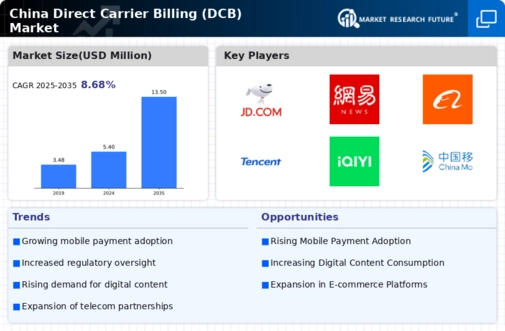
China Direct Carrier Billing Market Infographic
Purchase Options

China Direct Carrier Billing Market Summary

As per Market Research Future analysis, the China Direct Carrier Billing Market size was estimated at 6079.32 USD Million in 2024. The Direct Carrier-billing market is projected to grow from 6758.99 USD Million in 2025 to 19500.0 USD Million by 2035, exhibiting a compound annual growth rate (CAGR) of 11.1% during the forecast period 2025 - 2035

Key Market Trends & Highlights

The China direct carrier-billing market is experiencing robust growth driven by technological advancements and increasing mobile payment adoption.

  • Smartphone penetration in China continues to rise, facilitating greater access to direct carrier-billing services.
  • Enhanced security measures are being implemented to build consumer trust in mobile payment systems.
  • Regulatory support and collaboration among stakeholders are fostering a more favorable environment for direct carrier-billing.
  • The expansion of digital content services and the growing e-commerce sector are key drivers of market growth.

Market Size & Forecast

2024 Market Size 6079.32 (USD Million)
2035 Market Size 19500.0 (USD Million)
CAGR (2025 - 2035) 11.18%

Major Players

Boku (US), Fortumo (EE), Digital Turbine (US), OpenMarket (US), MobiWire (FR), MobiPay (DE), Zain Group (KW), Telefónica (ES)

Our Impact
Enabled $4.3B Revenue Impact for Fortune 500 and Leading Multinationals
Partnering with 2000+ Global Organizations Each Year
30K+ Citations by Top-Tier Firms in the Industry

China Direct Carrier Billing Market Trends

The China Direct Carrier Billing Market is experiencing notable growth, driven by the increasing adoption of mobile payment solutions and the rising number of smartphone users. This payment method allows consumers to make purchases directly through their mobile phone accounts, providing a seamless and convenient experience. As digital content consumption rises, particularly in sectors such as gaming, entertainment, and e-commerce, the demand for direct carrier billing is likely to expand. Furthermore, the integration of advanced technologies, such as artificial intelligence and blockchain, may enhance security and efficiency in transactions, potentially attracting more users to this payment method. In addition, regulatory frameworks are evolving to support the direct carrier-billing market, which may lead to increased trust among consumers. The collaboration between telecom operators and content providers is also strengthening, creating a more robust ecosystem for mobile payments. As the market matures, it appears that consumer preferences will continue to shift towards more integrated and user-friendly payment solutions, indicating a promising future for direct carrier billing. The ongoing developments in this sector suggest that it will play a crucial role in shaping the future of mobile commerce.

Rising Smartphone Penetration

The increasing number of smartphone users in China is likely to drive the direct carrier-billing market. As more individuals gain access to mobile devices, the potential customer base for mobile payments expands significantly. This trend suggests that telecom operators may focus on enhancing their billing solutions to cater to a growing audience.

Enhanced Security Measures

With the rise in digital transactions, there is a heightened emphasis on security within the direct carrier-billing market. Telecom companies are likely to invest in advanced security technologies to protect consumer data and build trust. This focus on security may encourage more users to adopt mobile payment solutions.

Regulatory Support and Collaboration

The evolving regulatory landscape in China appears to favor the direct carrier-billing market. Government initiatives aimed at promoting digital payments may lead to increased collaboration between telecom operators and content providers. This synergy could enhance the overall efficiency and attractiveness of mobile payment solutions.

China Direct Carrier Billing Market Drivers

Growing E-commerce Sector

The direct carrier-billing market is poised for growth due to the expanding e-commerce sector in China. As online shopping continues to gain traction, consumers are increasingly seeking convenient payment options that facilitate quick transactions. In 2025, the e-commerce market in China is projected to surpass $2 trillion, with a significant portion of these transactions likely to utilize direct carrier billing. This payment method allows consumers to make purchases without the need for traditional banking methods, appealing to a wide range of users, including those without access to credit cards. As e-commerce platforms integrate direct carrier billing into their payment options, the market is expected to experience substantial growth, driven by the increasing volume of online transactions.

Increasing Mobile Payment Adoption

The direct carrier-billing market in China is experiencing a notable surge due to the increasing adoption of mobile payment solutions. As consumers become more accustomed to using their smartphones for transactions, the convenience of direct carrier billing is becoming more appealing. In 2025, mobile payment transactions in China are projected to exceed $5 trillion, indicating a robust growth trajectory. This trend is likely to drive the direct carrier-billing market, as it offers a seamless payment experience for digital goods and services. Furthermore, the integration of direct carrier billing with popular mobile payment platforms enhances its visibility and accessibility, potentially attracting a broader user base. As more consumers opt for mobile payments, the direct carrier-billing market is poised to benefit significantly from this shift in consumer behavior.

Expansion of Digital Content Services

The direct carrier-billing market is being propelled by the rapid expansion of digital content services in China. With the increasing demand for streaming services, mobile games, and e-books, consumers are seeking convenient payment methods to access these offerings. In 2025, the digital content market in China is expected to reach $50 billion, with a substantial portion of transactions likely facilitated through direct carrier billing. This method allows users to charge purchases directly to their mobile accounts, eliminating the need for credit cards or bank accounts. As digital content providers recognize the advantages of integrating direct carrier billing, the market is likely to witness enhanced partnerships and collaborations, further solidifying its position within the broader digital economy.

Rising Demand for Seamless User Experience

In the context of the direct carrier-billing market, the demand for a seamless user experience is becoming increasingly critical. Consumers in China are looking for frictionless payment solutions that do not disrupt their engagement with digital content. Direct carrier billing offers a streamlined process, allowing users to make purchases with just a few taps on their devices. This ease of use is particularly appealing to younger demographics, who prioritize convenience and speed in their transactions. As user expectations evolve, service providers are likely to enhance their offerings to include direct carrier billing, thereby improving customer satisfaction and retention. The emphasis on user experience is expected to drive growth in the direct carrier-billing market, as more businesses adopt this payment method to meet consumer demands.

Technological Advancements in Mobile Networks

The direct carrier-billing market is benefiting from ongoing technological advancements in mobile networks across China. The rollout of 5G technology is expected to enhance the overall mobile experience, enabling faster and more reliable transactions. As mobile network infrastructure improves, the direct carrier-billing market is likely to see increased adoption rates, as consumers will be able to complete transactions with minimal latency. Additionally, advancements in mobile security protocols may further bolster consumer confidence in using direct carrier billing for their purchases. The combination of improved network capabilities and enhanced security measures could create a more favorable environment for the direct carrier-billing market, potentially leading to higher transaction volumes and revenue growth.


Market Segment Insights

By Type: Pure DCB (Largest) vs. Limited DCB (Fastest-Growing)

In the China direct carrier-billing market, the market share distribution among segment values indicates that Pure DCB holds the largest share, significantly outperforming its counterparts. Limited DCB, while not as dominant, has shown remarkable resilience and is rapidly gaining traction. Moreover, other segments such as MSISDN Forwarding and Others contribute to the overall diversity of this market landscape, but they do not challenge the leading positions of Pure DCB and Limited DCB. The growth trends in this segment are driven by increasing mobile payment adoption and consumer preferences leaning towards seamless transaction experiences. The rapid advancement of digital content consumption and services is also fueling the expansion of Limited DCB, as it aligns with trends in microtransactions. Companies are innovating to enhance user experiences and implement more user-friendly interfaces, ensuring that both Pure and Limited DCB continue to expand in the competitive landscape.

Pure DCB (Dominant) vs. Limited DCB (Emerging)

Pure DCB represents a well-established and dominant segment in the China direct carrier-billing market, characterized by its reliability and consistent adoption among major service providers. It offers a streamlined payment method for digital goods and services, leveraging the extensive reach of mobile networks. Conversely, Limited DCB, as an emerging segment, targets specific use cases and is rapidly evolving to meet niche market demands. Its growth is fueled by the increasing need for regulated and secure payment options among both consumers and merchants. The dynamics between these segments illustrate the overall adaptability of the market, showcasing how new trends can emerge without undermining established practices.

By Application: Games and Apps (Largest) vs. Video Content and Movies (Fastest-Growing)

The application segment of the China direct carrier-billing market is primarily driven by the popularity of Games and Apps, which dominate the landscape with the largest market share. This segment has become a cornerstone as mobile gaming and app downloads continue to soar among users, significantly contributing to the overall revenue of the market. In contrast, the segment of Video Content and Movies is experiencing rapid growth as streaming services gain traction, catering to ever-increasing consumer demand for accessible and diverse entertainment options. Growth trends for the application segment are being propelled by technological advancements and changing consumer behaviors. The rise of 5G technology is enhancing user experiences in gaming and video streaming, driving more users to adopt carrier billing as a convenient payment method. Additionally, the increasing integration of social media platforms with gaming and streaming services further fuels engagement and spending in these categories, solidifying their positions within the market.

Games and Apps (Dominant) vs. Video Content and Movies (Emerging)

Games and Apps represent the dominant force within the application segment, appealing to a vast audience with interactive entertainment options. This category benefits from frequent updates, engaging content, and the drive for social connectivity among users. Its established presence allows it to leverage existing consumer habits, making it prominent in monetary transactions via carrier billing. Conversely, Video Content and Movies are emerging with significant potential. The shift towards subscription-based models and the demand for high-quality streaming experiences position this category for substantial growth. As more consumers seek diverse content formats, the adoption of carrier billing for these services is becoming a critical factor, indicating a shift in purchasing behaviors within the digital marketplace.

By Platform: Android (Largest) vs. iOS (Fastest-Growing)

The market share distribution among various platforms indicates that Android holds a significant lead in the China direct carrier-billing market, appealing to a broader audience due to its versatility and the diverse range of devices it supports. In contrast, iOS, while having a smaller market share, is witnessing rapid growth attributed to the rising popularity of premium apps and in-app purchases among its user base, further solidifying its position in the market. Growth trends within this segment reveal that Android's established presence, combined with the increasing smartphone penetration in rural and urban areas, continues to bolster its dominance. Meanwhile, iOS's accelerated growth is primarily driven by advancements in app monetization strategies and the demand for high-quality digital content. The competition is expected to intensify as both platforms innovate and expand their offerings to cater to user preferences.

Platform: Android (Dominant) vs. iOS (Emerging)

Android retains its dominant position in the China direct carrier-billing market, characterized by a vast user base and the ability to support various payment methods that cater to diverse consumer preferences. Its open ecosystem allows for an extensive array of applications, enhancing user engagement. Conversely, iOS is emerging as a noteworthy contender, driven by affluent users who are willing to spend more on in-app purchases and premium content. The iOS platform's seamless integration with other Apple products fosters brand loyalty, while an increasing number of developers are targeting this segment, leading to greater innovation and content availability. Together, these platforms showcase a dynamic and competitive landscape, with each appealing to distinct user demographics.

Get more detailed insights about China Direct Carrier Billing Market

Key Players and Competitive Insights

The direct carrier-billing market in China is characterized by a rapidly evolving competitive landscape, driven by increasing smartphone penetration and the growing demand for seamless payment solutions. Key players are strategically positioning themselves through innovation and partnerships, which collectively enhance their market presence. For instance, Boku (US) has focused on expanding its partnerships with local telecom operators, thereby enhancing its service offerings and accessibility. Similarly, Digital Turbine (US) has been investing in digital transformation initiatives, aiming to streamline its billing processes and improve user experience, which is crucial in a market that values efficiency and convenience.
The market structure appears moderately fragmented, with several players vying for dominance. This fragmentation is indicative of a competitive environment where localized strategies, such as optimizing supply chains and tailoring services to meet regional preferences, are essential. Companies are increasingly localizing their operations to better align with consumer expectations, which may enhance their competitive edge. The collective influence of these key players shapes the market dynamics, as they continuously adapt to the evolving technological landscape.
In October 2025, Fortumo (EE) announced a strategic partnership with a leading Chinese e-commerce platform to enhance its direct carrier-billing services. This collaboration is expected to facilitate smoother transactions for users, thereby potentially increasing Fortumo's market share in the region. The strategic importance of this move lies in its ability to tap into the vast user base of the e-commerce platform, which could significantly boost transaction volumes and enhance customer engagement.
In September 2025, OpenMarket (US) launched a new suite of APIs designed to simplify the integration of carrier billing into mobile applications. This initiative is particularly relevant as it addresses the growing demand for flexible payment solutions among app developers. By streamlining the integration process, OpenMarket positions itself as a leader in facilitating mobile commerce, which is increasingly vital in a market where user experience is paramount.
In August 2025, MobiWire (FR) expanded its operations by entering into a joint venture with a prominent Chinese telecom operator. This strategic move is likely to enhance MobiWire's capabilities in providing localized billing solutions, thereby improving its competitive stance. The joint venture may also facilitate access to a broader customer base, which is essential for sustaining growth in a competitive environment.
As of November 2025, current trends in the direct carrier-billing market are heavily influenced by digitalization, AI integration, and a growing emphasis on sustainability. Strategic alliances are becoming increasingly important, as they enable companies to leverage each other's strengths and enhance their service offerings. The competitive differentiation is likely to evolve from traditional price-based competition towards a focus on innovation, technology, and supply chain reliability. This shift suggests that companies that prioritize these aspects may gain a significant advantage in the marketplace.

Key Companies in the China Direct Carrier Billing Market include

Industry Developments

The China Direct Carrier Billing Market (DCB) Market has seen several notable developments recently. As of September 2023, Alibaba Group launched new payment solutions to enhance its DCB capabilities, aiming to streamline purchases for its vast user base. Meanwhile, Tencent has been focusing on securing partnerships with smaller application developers to integrate DCB services, thereby broadening its reach in mobile payments. 

In August 2023, JD.com announced its plans to expand its digital payment solutions, integrating DCB options to simplify transactions for users purchasing entertainment and gaming services.Regarding mergers and acquisitions, iQIYI acquired a smaller streaming platform in July 2023 to enhance its content offerings and leverage DCB for subscriptions. Similarly, in June 2023, Kuaishou announced a partnership with China Mobile to bolster its mobile payment infrastructure, allowing for improved direct billing services. 

Growth in the DCB market valuation has been evidenced by increased user adoption following these innovations and collaborations, with major players like Huawei and Baidu continually investing in technological advancements to further optimize DCB functionalities. Recent reports indicate that the market continues to grow due to increasing smartphone penetration and the rising trend of in-app purchases.


Future Outlook

China Direct Carrier Billing Market Future Outlook

The direct carrier-billing market in China is projected to grow at 11.18% CAGR from 2025 to 2035, driven by increased smartphone penetration and digital content consumption.

New opportunities lie in:

  • Partnerships with gaming companies for seamless in-app purchases.
  • Expansion of carrier-billing services to e-commerce platforms.
  • Development of AI-driven analytics for consumer spending patterns.

By 2035, the market is expected to achieve substantial growth, driven by innovative payment solutions.

Market Segmentation

China Direct Carrier Billing Market Type Outlook

  • Limited DCB
  • Pure DCB
  • MSISDN Forwarding
  • Others

China Direct Carrier Billing Market Platform Outlook

  • Android
  • iOS
  • Others

China Direct Carrier Billing Market Application Outlook

  • Games and Apps
  • Video Content and Movies
  • Music
  • Others

Report Scope

MARKET SIZE 2024 6079.32(USD Million)
MARKET SIZE 2025 6758.99(USD Million)
MARKET SIZE 2035 19500.0(USD Million)
COMPOUND ANNUAL GROWTH RATE (CAGR) 11.18% (2025 - 2035)
REPORT COVERAGE Revenue Forecast, Competitive Landscape, Growth Factors, and Trends
BASE YEAR 2024
Market Forecast Period 2025 - 2035
Historical Data 2019 - 2024
Market Forecast Units USD Million
Key Companies Profiled Boku (US), Fortumo (EE), Digital Turbine (US), OpenMarket (US), MobiWire (FR), MobiPay (DE), Zain Group (KW), Telefónica (ES)
Segments Covered Type, Application, Platform
Key Market Opportunities Integration of advanced mobile payment solutions enhances user experience in the direct carrier-billing market.
Key Market Dynamics Rising consumer preference for seamless payment solutions drives growth in the direct carrier-billing market.
Countries Covered China
Leave a Comment

FAQs

What is the projected market size of the China Direct Carrier Billing (DCB) Market in 2024?

The China Direct Carrier Billing market is expected to be valued at 5403.84 USD Million in 2024.

How much is the China Direct Carrier Billing (DCB) Market expected to grow by 2035?

By 2035, the market is projected to reach a valuation of 13500.0 USD Million.

What is the expected compound annual growth rate (CAGR) for the China Direct Carrier Billing (DCB) Market from 2025 to 2035?

The expected CAGR for the market from 2025 to 2035 is 8.68%.

Who are the key players in the China Direct Carrier Billing (DCB) Market?

Major players in the market include JD.com, Netease, Douyin, Alibaba Group, Tencent, and iQIYI.

What is the market value of Limited DCB in 2024?

The Limited DCB segment is valued at 1350.0 USD Million in 2024.

How much is the Pure DCB segment projected to be worth in 2035?

The Pure DCB segment is expected to reach 4050.0 USD Million by 2035.

What is the projected market size for MSISDN Forwarding in 2024?

The MSISDN Forwarding segment is valued at 810.0 USD Million in 2024.

How much is the Others segment expected to grow by in 2035?

The Others segment is projected to be valued at 6750.0 USD Million by 2035.

What are the emerging trends affecting the China Direct Carrier Billing (DCB) Market?

Emerging trends include the increasing use of mobile payment solutions and the expansion of online content consumption.

What challenges does the China Direct Carrier Billing (DCB) Market face?

Challenges include regulatory concerns and competition from alternative payment methods.

Download Free Sample

Kindly complete the form below to receive a free sample of this Report

Compare Licence

×
Features License Type
Single User Multiuser License Enterprise User
Price $4,950 $5,950 $7,250
Maximum User Access Limit 1 User Upto 10 Users Unrestricted Access Throughout the Organization
Free Customization
Direct Access to Analyst
Deliverable Format
Platform Access
Discount on Next Purchase 10% 15% 15%
Printable Versions