×
Request Free Sample ×

Kindly complete the form below to receive a free sample of this Report

* Please use a valid business email

Leading companies partner with us for data-driven Insights

clients tt-cursor
Hero Background

China Caviar Market

ID: MRFR/FnB/42881-HCR
200 Pages
Snehal Singh
February 2026

China Caviar Market Size, Share, Industry Trend & Analysis Research Report By Caviar Type Outlook (Sevruga, Osetra, Beluga, Others) and By Caviar Distribution Channel Outlook (Hotels and Restaurants, Airliners and Cruise Ships, Retail Stores, Others)- Forecast to 2035 \n

Share:
Download PDF ×

We do not share your information with anyone. However, we may send you emails based on your report interest from time to time. You may contact us at any time to opt-out.

China Caviar Market Infographic
Purchase Options

China Caviar Market Summary

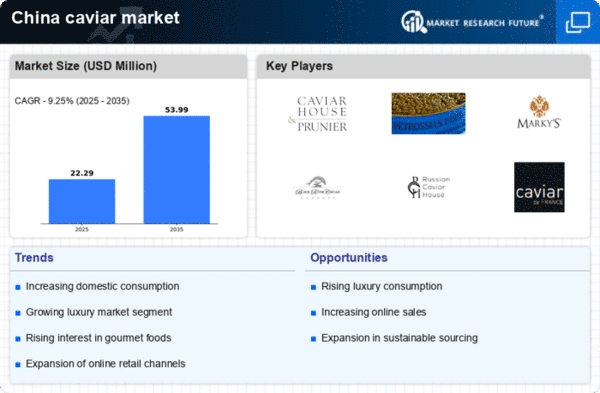
As per Market Research Future analysis, the China Caviar Market size was estimated at 20.4 USD Million in 2024. The Caviar market is projected to grow from 22.29 USD Million in 2025 to 53.99 USD Million by 2035, exhibiting a compound annual growth rate (CAGR) of 9.2% during the forecast period 2025 - 2035

Key Market Trends & Highlights

The China caviar market is experiencing a notable shift towards sustainability and luxury consumption.

  • Sustainability and ethical sourcing practices are becoming increasingly important among consumers in the China caviar market.
  • E-commerce is expanding rapidly, facilitating access to premium caviar products for a broader audience.
  • Luxury dining experiences are driving demand, particularly in urban centers like Beijing and Shanghai, which are the largest markets.
  • Rising affluence and health consciousness are key drivers, as consumers seek high-quality, nutritious food options.

Market Size & Forecast

2024 Market Size 20.4 (USD Million)
2035 Market Size 53.99 (USD Million)
CAGR (2025 - 2035) 9.25%

Major Players

Caviar House & Prunier (GB), Petrossian (FR), Sturgeon Aquafarms (US), Black River Caviar (AU), Russian Caviar House (RU), Caviar de France (FR), Sasanian Caviar (US), Kaluga Queen (CN)

Our Impact
Enabled $4.3B Revenue Impact for Fortune 500 and Leading Multinationals
Partnering with 2000+ Global Organizations Each Year
30K+ Citations by Top-Tier Firms in the Industry

China Caviar Market Trends

The China Caviar Market in China is experiencing notable transformations, driven by evolving consumer preferences and increasing awareness of luxury food products. As the demand for gourmet and high-quality food items rises, caviar has emerged as a symbol of sophistication and exclusivity. This trend is particularly evident among affluent consumers who are willing to invest in premium culinary experiences. Furthermore, the growing interest in sustainable and ethically sourced food has prompted producers to adopt more responsible practices, which may enhance the appeal of caviar among environmentally conscious buyers. In addition, the rise of e-commerce platforms has significantly influenced the distribution channels within the caviar market. Consumers now have greater access to a variety of caviar products, allowing them to explore different types and brands from the comfort of their homes. This shift towards online shopping is likely to continue, as convenience and accessibility become increasingly important to consumers. Overall, the caviar market in China appears poised for growth, driven by changing consumer dynamics and innovative marketing strategies.

Sustainability and Ethical Sourcing

There is a growing emphasis on sustainability within the caviar market. Producers are increasingly adopting practices that ensure the ethical sourcing of caviar, which resonates with environmentally conscious consumers. This trend may lead to a preference for brands that prioritize responsible farming and harvesting methods.

E-commerce Expansion

The rise of e-commerce platforms is reshaping the caviar market. Consumers are increasingly turning to online channels to purchase caviar, which offers them a wider selection and greater convenience. This trend suggests that digital sales will play a crucial role in the market's future.

Luxury Dining Experiences

Caviar is becoming a staple in luxury dining experiences across China. High-end restaurants are incorporating caviar into their menus, appealing to affluent diners seeking unique culinary adventures. This trend indicates a growing appreciation for gourmet food and the role of caviar as a premium ingredient.

China Caviar Market Drivers

Rising Affluence and Luxury Consumption

The increasing affluence among the Chinese population appears to be a pivotal driver for the caviar market. As disposable incomes rise, consumers are more inclined to indulge in luxury food items, including caviar. This trend is particularly pronounced in urban areas, where a growing middle and upper class seeks premium dining experiences. According to recent data, the luxury food segment in China has been expanding at a rate of approximately 15% annually. This surge in demand for high-end products is likely to bolster the caviar market, as consumers associate caviar with status and exclusivity. Furthermore, the rise of gourmet restaurants and high-end catering services in major cities is expected to further stimulate market growth, as these establishments increasingly feature caviar on their menus.

Culinary Innovation and Gastronomic Trends

Culinary innovation plays a crucial role in shaping the caviar market in China. Chefs and food enthusiasts are increasingly experimenting with caviar, incorporating it into diverse culinary creations that appeal to modern palates. This trend is evident in the rise of fusion cuisine, where traditional Chinese dishes are enhanced with caviar, creating unique flavor profiles. The growing interest in gastronomy and food artistry among consumers is likely to drive demand for caviar as chefs seek to elevate their offerings. Additionally, food festivals and culinary events showcasing caviar are becoming more prevalent, further promoting its use in contemporary cooking. As the culinary landscape evolves, the caviar market may experience increased visibility and acceptance among a broader audience.

Health Consciousness and Nutritional Awareness

An emerging trend in the caviar market is the growing health consciousness among Chinese consumers. Caviar is often perceived as a superfood, rich in omega-3 fatty acids, vitamins, and minerals. This perception aligns with the increasing focus on health and wellness in China, where consumers are becoming more discerning about their food choices. The demand for nutritious and high-quality food products is on the rise, with the health food market in China projected to grow by 20% over the next five years. As consumers seek out foods that offer health benefits, caviar is likely to gain traction as a premium option. This shift in consumer behavior may lead to an expansion of the caviar market, as producers and retailers adapt to meet the needs of health-conscious buyers.

Cultural Significance and Gift-Giving Traditions

Caviar holds a unique cultural significance in China, often associated with luxury and prestige. This cultural perception drives demand for caviar, particularly during festive seasons and special occasions. The tradition of gift-giving in Chinese culture further enhances the market, as caviar is frequently chosen as a premium gift item. The gifting of caviar is seen as a symbol of respect and appreciation, making it a popular choice among affluent consumers. As the market for luxury gifts continues to expand, the caviar market is likely to benefit from this trend. Additionally, marketing strategies that emphasize the cultural significance of caviar may resonate with consumers, potentially leading to increased sales and market growth.

Increased Import Regulations and Quality Standards

The caviar market in China is also influenced by stringent import regulations and quality standards. The Chinese government has implemented measures to ensure the safety and quality of imported food products, including caviar. These regulations aim to protect consumers and promote sustainable sourcing practices. While these measures may pose challenges for importers, they also create opportunities for high-quality caviar producers who can meet these standards. The demand for premium, certified caviar is likely to rise as consumers become more aware of food safety issues. This focus on quality may lead to a more discerning market, where consumers are willing to pay a premium for caviar that meets rigorous safety and quality criteria, thereby potentially enhancing the overall value of the caviar market.


Market Segment Insights

By Type: Beluga (Largest) vs. Osetra (Fastest-Growing)

In the China caviar market, the market share distribution is prominently led by Beluga caviar, which captures a significant portion of consumer preferences due to its rich taste and luxurious appeal. Osetra follows closely but has been gaining traction rapidly among consumers seeking quality and diversity. Sevruga and others make up a smaller segment, focusing on niche markets and specialized tastes, which limits their overall market share. The growth trends for this segment indicate a rising demand for Osetra caviar, driven by increasing gourmet dining experiences and a broader acceptance of premium foods among affluent consumers. The luxurious attributes of Beluga caviar continue to retain its dominant status, while Osetra's emergence is supported by marketing strategies and culinary trends that favor its unique flavor profile, making it a favorite in upscale restaurants and specialty stores.

Beluga: Dominant vs. Osetra: Emerging

Beluga caviar is known for its large eggs and buttery texture, making it a symbol of luxury in the China caviar market. Its premium quality and consistent demand place it in the dominant position among caviar varieties. On the other hand, Osetra caviar, characterized by a nuttier flavor and medium-sized eggs, is rapidly gaining popularity and is considered an emerging favorite. As consumers seek diverse culinary experiences, Osetra's unique attributes and increasing availability play a crucial role in its growth. Both Beluga and Osetra cater to high-end clientele, with Beluga being often regarded as the pinnacle of caviar luxury, while Osetra stands out for its evolving market presence and appeal to gourmet food enthusiasts.

By Distribution Channel: Hotels and Restaurants (Largest) vs. Retail Stores (Fastest-Growing)

In the China caviar market, the distribution of market share reveals that Hotels and Restaurants dominate the segment, capturing the largest portion of consumer expenditure on caviar. This segment benefits from high-profile dining experiences, where caviar is often associated with luxury and exclusivity. On the other hand, Retail Stores, although smaller in overall share, represent the fastest-growing segment as convenience and access to gourmet products increase among consumers. The growth trends for these segments are driven by changing consumer preferences and enhanced distribution methods. There is a notable shift towards experiential dining in Hotels and Restaurants, while Retail Stores are capitalizing on the trend of home dining and gourmet cooking. As the market expands, these segments are likely to evolve, with Retail Stores increasingly innovating to meet consumer demand for premium products.

Hotels and Restaurants: Dominant vs. Retail Stores: Emerging

Hotels and Restaurants hold a dominant position in the China caviar market, offering premium experiences that attract affluent consumers. Their ability to provide an extensive selection of high-quality caviar enhances their appeal. The segment is characterized by established partnerships with prestigious suppliers and a focus on creating memorable dining experiences. Conversely, Retail Stores are emerging rapidly, catering to a growing segment of home chefs and food enthusiasts seeking high-end gourmet items. This segment is evolving through strategic marketing, product placement, and an increase in the variety of caviar available in retail settings, allowing consumers to experiment with prestigious products in their own kitchens.

Get more detailed insights about China Caviar Market

Key Players and Competitive Insights

The caviar market in China is characterized by a dynamic competitive landscape, driven by increasing consumer demand for luxury food products and a growing interest in gourmet dining experiences. Key players such as Kaluga Queen (CN), Caviar House & Prunier (GB), and Petrossian (FR) are strategically positioned to capitalize on these trends. Kaluga Queen (CN) focuses on sustainable aquaculture practices, which resonate well with environmentally conscious consumers. Meanwhile, Caviar House & Prunier (GB) emphasizes its heritage and quality, leveraging its long-standing reputation to attract affluent customers. Petrossian (FR) adopts a dual strategy of innovation and tradition, offering both classic and contemporary caviar products, thereby appealing to a broad spectrum of consumers. Collectively, these strategies contribute to a competitive environment that is increasingly focused on quality, sustainability, and brand prestige.
In terms of business tactics, companies are localizing manufacturing and optimizing supply chains to enhance efficiency and reduce costs. The market structure appears moderately fragmented, with several players vying for market share. However, the influence of key players is substantial, as they set quality standards and consumer expectations. This competitive structure encourages innovation and differentiation, as companies strive to stand out in a crowded marketplace.
In October 2025, Kaluga Queen (CN) announced the launch of a new line of organic caviar, which is expected to cater to the rising demand for health-conscious luxury food options. This strategic move not only aligns with global trends towards organic products but also positions Kaluga Queen as a leader in sustainable caviar production. The introduction of organic caviar could potentially attract a new segment of consumers who prioritize health and sustainability in their purchasing decisions.
In September 2025, Caviar House & Prunier (GB) expanded its distribution network in China by partnering with high-end restaurants and gourmet food retailers. This strategic partnership aims to enhance brand visibility and accessibility, allowing the company to reach a broader audience. By aligning with prestigious dining establishments, Caviar House & Prunier reinforces its image as a premium brand, which is crucial in the luxury food market.
In August 2025, Petrossian (FR) launched an innovative online platform that offers virtual tastings and educational content about caviar. This digital transformation strategy not only enhances customer engagement but also positions Petrossian as a forward-thinking brand in the luxury food sector. By leveraging technology to create unique consumer experiences, Petrossian may strengthen its market position and attract a younger demographic interested in gourmet food.
As of November 2025, current trends in the caviar market indicate a shift towards digitalization, sustainability, and the integration of advanced technologies such as AI in supply chain management. Strategic alliances are increasingly shaping the competitive landscape, enabling companies to pool resources and expertise. Looking ahead, competitive differentiation is likely to evolve from traditional price-based competition to a focus on innovation, technology, and supply chain reliability. This shift suggests that companies that prioritize quality, sustainability, and consumer engagement will be better positioned to thrive in the future.

Key Companies in the China Caviar Market include

Industry Developments

Recent developments in the China Caviar Market have focused on expansion and innovation among key players. Companies like China Sturgeon Caviar and Yangtze River Caviar have been enhancing their production techniques and investing in sustainable practices, directly responding to the growing demand for high-quality caviar within domestic and international markets. In September 2023, Xiamen Caviar announced an increase in production capacity, which is expected to improve its market foothold. Additionally, in August 2023, Shenzhen Caviar successfully introduced a new line of organic caviar products, capitalizing on the health trends among consumers.

The market has also seen solid growth, with revenues projected to increase as consumer awareness regarding premium seafood products rises. Over the past two years, in May 2022, Daqing Caviar made headlines with its expansion into e-commerce channels, enhancing accessibility to consumers. Notably, no major mergers or acquisitions have been reported among these companies in recent times, allowing them to focus on internal growth strategies. As of October 2023, the overall valuation of the caviar market in China continues to climb, driven by both local and international market aspirations.

Future Outlook

China Caviar Market Future Outlook

The Caviar Market in China is projected to grow at a 9.25% CAGR from 2025 to 2035, driven by rising disposable incomes, gourmet food trends, and increased health awareness.

New opportunities lie in:

  • Expansion of online retail platforms for direct-to-consumer sales.
  • Development of premium, eco-friendly packaging solutions.
  • Partnerships with luxury hotels and restaurants for exclusive caviar offerings.

By 2035, the caviar market in China is expected to achieve substantial growth and market maturity.

Market Segmentation

China Caviar Market Type Outlook

  • Sevruga
  • Osetra
  • Beluga
  • Others

China Caviar Market Distribution Channel Outlook

  • Hotels and Restaurants
  • Airliners and Cruise Ships
  • Retail Stores
  • Others

Report Scope

MARKET SIZE 2024 20.4(USD Million)
MARKET SIZE 2025 22.29(USD Million)
MARKET SIZE 2035 53.99(USD Million)
COMPOUND ANNUAL GROWTH RATE (CAGR) 9.25% (2025 - 2035)
REPORT COVERAGE Revenue Forecast, Competitive Landscape, Growth Factors, and Trends
BASE YEAR 2024
Market Forecast Period 2025 - 2035
Historical Data 2019 - 2024
Market Forecast Units USD Million
Key Companies Profiled Caviar House & Prunier (GB), Petrossian (FR), Sturgeon Aquafarms (US), Black River Caviar (AU), Russian Caviar House (RU), Caviar de France (FR), Sasanian Caviar (US), Kaluga Queen (CN)
Segments Covered Type, Distribution Channel
Key Market Opportunities Growing demand for sustainable aquaculture practices in the caviar market presents significant opportunities.
Key Market Dynamics Rising demand for premium caviar in China drives competitive innovation and regulatory scrutiny in the market.
Countries Covered China
Leave a Comment

FAQs

What is the expected market size of the China Caviar Market in 2024?

The China Caviar Market is expected to be valued at 32.13 million USD in 2024.

What will the market size of the China Caviar Market be by 2035?

By 2035, the market size is projected to reach 85.0 million USD.

What is the expected compound annual growth rate (CAGR) for the China Caviar Market from 2025 to 2035?

The China Caviar Market is anticipated to grow at a CAGR of 9.247 percent from 2025 to 2035.

Who are the key players in the China Caviar Market?

Major players in the market include China Sturgeon Caviar, Xiamen Caviar, Shenzhen Caviar, and Yangtze River Caviar.

What is the market value for Sevruga caviar in 2024?

In 2024, the market value for Sevruga caviar is estimated at 8.0 million USD.

What are the growth expectations for Osetra caviar by 2035?

The market value for Osetra caviar is expected to reach 25.0 million USD by 2035.

How much will the Beluga caviar segment generate by 2035?

The Beluga caviar segment is projected to achieve a market value of 32.0 million USD by 2035.

What is the anticipated market value for the Others category of caviar in 2024?

The Others category of caviar is expected to have a market value of 2.13 million USD in 2024.

What are the emerging trends in the China Caviar Market?

The market is seeing emerging trends including increasing demand for premium products and a shift towards sustainability.

What challenges might the China Caviar Market face in the coming years?

Challenges may include regulatory hurdles and competition from alternative luxury food products.

Download Free Sample

Kindly complete the form below to receive a free sample of this Report

Compare Licence

×
Features License Type
Single User Multiuser License Enterprise User
Price $4,950 $5,950 $7,250
Maximum User Access Limit 1 User Upto 10 Users Unrestricted Access Throughout the Organization
Free Customization
Direct Access to Analyst
Deliverable Format
Platform Access
Discount on Next Purchase 10% 15% 15%
Printable Versions