×
Request Free Sample ×

Kindly complete the form below to receive a free sample of this Report

* Please use a valid business email

Leading companies partner with us for data-driven Insights

clients tt-cursor
Hero Background

China Behavioral Health Services Market

ID: MRFR/HC/43806-HCR
200 Pages
Rahul Gotadki
February 2026

China Behavioral Health Services Market Research Report By Type (Inpatient hospital treatment, Outpatient counseling, Home-Based Treatment Services), By Disorder (Anxiety Disorder, Bipolar Disorders, Depression, Eating Disorder), and By End User (Providers, Hospitals and Clinics, Community Centers, Patients) - Growth & Industry Forecast 2025 To 2035

Share:
Download PDF ×

We do not share your information with anyone. However, we may send you emails based on your report interest from time to time. You may contact us at any time to opt-out.

China Behavioral Health Services Market Infographic
Purchase Options

China Behavioral Health Services Market Summary

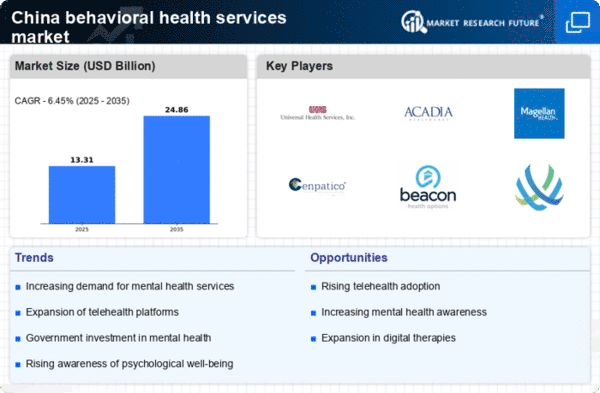
As per Market Research Future analysis, the China behavioral health services market size was estimated at 12.5 USD Billion in 2024. The China behavioral health-services market is projected to grow from 13.31 USD Billion in 2025 to 24.86 USD Billion by 2035, exhibiting a compound annual growth rate (CAGR) of 6.4% during the forecast period 2025 - 2035

Key Market Trends & Highlights

The China behavioral health-services market is experiencing a transformative shift towards technology integration and personalized care.

  • The integration of technology in treatment is reshaping service delivery across the market.
  • Collaborative care models are gaining traction, enhancing patient outcomes and engagement.
  • Personalized care approaches are becoming increasingly prevalent, catering to individual patient needs.
  • Key market drivers include rising mental health awareness and government initiatives and funding supporting mental health services.

Market Size & Forecast

2024 Market Size 12.5 (USD Billion)
2035 Market Size 24.86 (USD Billion)
CAGR (2025 - 2035) 6.45%

Major Players

Universal Health Services (US), Acadia Healthcare (US), Magellan Health (US), Cenpatico (US), Beacon Health Options (US), LifeStance Health (US), PsychoGenics (US), Mental Health Partners (US)

Our Impact
Enabled $4.3B Revenue Impact for Fortune 500 and Leading Multinationals
Partnering with 2000+ Global Organizations Each Year
30K+ Citations by Top-Tier Firms in the Industry

China Behavioral Health Services Market Trends

The behavioral health services market is experiencing notable transformations, driven by a growing awareness of mental health issues and an increasing demand for accessible services. In recent years, there has been a shift towards integrating technology into treatment options, which appears to enhance patient engagement and improve outcomes. Telehealth services, in particular, have gained traction, allowing individuals to access care from the comfort of their homes. This trend is likely to continue as more people recognize the importance of mental well-being and seek convenient solutions. Furthermore, the government has been actively promoting mental health initiatives, which may contribute to a more supportive environment for individuals seeking help. In addition to technological advancements, the behavioral health-services market is witnessing a rise in collaborative care models. These models emphasize teamwork among healthcare providers, which could lead to more comprehensive treatment plans for patients. The focus on personalized care is becoming increasingly prevalent, as practitioners aim to address the unique needs of each individual. As the market evolves, it seems poised for further growth, with an emphasis on innovative approaches and a commitment to improving mental health outcomes for the population.

Integration of Technology in Treatment

The incorporation of technology into the behavioral health-services market is reshaping how care is delivered. Telehealth platforms are becoming more common, enabling patients to receive therapy and counseling remotely. This shift not only increases accessibility but also encourages individuals to seek help without the barriers of traditional in-person visits.

Rise of Collaborative Care Models

Collaborative care models are gaining traction within the behavioral health-services market. These approaches involve multiple healthcare professionals working together to create comprehensive treatment plans. This teamwork can enhance patient outcomes by ensuring that all aspects of an individual's health are considered.

Focus on Personalized Care

There is a growing emphasis on personalized care within the behavioral health-services market. Practitioners are increasingly tailoring treatment plans to meet the specific needs of each patient. This trend reflects a broader understanding of mental health, recognizing that effective treatment must consider individual circumstances and preferences.

China Behavioral Health Services Market Drivers

Government Initiatives and Funding

Government initiatives aimed at improving mental health services are crucial for the growth of the behavioral health-services market. In recent years, the Chinese government has allocated substantial funding to enhance mental health infrastructure and services. For instance, the National Mental Health Work Plan emphasizes the establishment of more mental health facilities and the training of mental health professionals. This commitment is reflected in the increase in public spending on mental health, which has risen by over 20% in the last few years. Such initiatives not only improve service availability but also encourage private sector investment in the behavioral health-services market, fostering a more comprehensive approach to mental health care.

Increasing Mental Health Awareness

The growing awareness of mental health issues in China is a pivotal driver for the behavioral health-services market. Public campaigns and educational initiatives have significantly contributed to reducing stigma associated with mental health conditions. As a result, more individuals are seeking help, leading to an increase in demand for services. Recent surveys indicate that approximately 16% of the population experiences mental health disorders, highlighting the urgent need for accessible services. This heightened awareness is likely to propel the market forward, as individuals become more informed about available treatment options and the importance of mental well-being. Consequently, the behavioral health-services market is expected to expand as more people recognize the necessity of seeking professional help for mental health challenges.

Rising Prevalence of Mental Health Disorders

The increasing prevalence of mental health disorders in China serves as a significant driver for the behavioral health-services market. Reports indicate that nearly 54 million individuals suffer from depression, while anxiety disorders affect approximately 40 million people. This alarming trend necessitates a robust response from the healthcare system, prompting an expansion of services to meet the growing demand. The behavioral health-services market is likely to see a surge in the development of specialized treatment programs and facilities to cater to this rising need. As awareness of mental health issues continues to grow, the market is expected to adapt and evolve, providing more targeted and effective services for those affected.

Integration of Traditional and Modern Therapies

The integration of traditional Chinese medicine with modern psychological therapies is emerging as a notable trend within the behavioral health-services market. This hybrid approach appeals to a broad demographic, as many individuals in China value traditional practices alongside contemporary treatment methods. By combining these modalities, practitioners can offer a more holistic approach to mental health care, potentially improving patient outcomes. This trend may lead to an increase in service offerings, as practitioners seek to incorporate diverse therapeutic techniques. The behavioral health-services market could benefit from this integration, as it attracts a wider range of clients who are looking for comprehensive treatment options that resonate with their cultural beliefs.

Technological Advancements in Treatment Delivery

Technological advancements are reshaping the delivery of behavioral health services in China, acting as a significant driver for the market. The rise of telehealth platforms and mobile applications has made mental health services more accessible, particularly in rural areas where traditional services may be limited. Recent data suggests that teletherapy usage has increased by over 30% in the past year, indicating a shift in how individuals seek and receive care. These innovations not only enhance accessibility but also allow for more personalized treatment plans, as technology enables providers to monitor patient progress more effectively. As these advancements continue to evolve, the behavioral health-services market is poised for substantial growth, driven by the demand for convenient and effective care.


Market Segment Insights

By Service Type: Inpatient Services (Largest) vs. Telehealth Services (Fastest-Growing)

In the China behavioral health-services market, Inpatient Services dominate the overall service type distribution due to the high demand for intensive treatment options among various patient demographics. Outpatient Services hold a significant share as well, catering to individuals with less severe conditions, while Emergency Services are essential but occupy a smaller portion of the market. Telehealth Services, while currently a smaller segment, are on the rise, driven by the increasing acceptance of digital health solutions. Growth trends indicate a robust expansion in Telehealth Services, propelled by advancements in technology and a shift in consumer preferences towards more flexible care options. Inpatient Services will continue to thrive, catering to acute cases, but the pandemic has accelerated the adoption of Telehealth, leading it to emerge as a crucial component of the healthcare ecosystem. The demand for accessible mental health services ensures that Telehealth will grow rapidly, transforming how patients seek and receive care.

Inpatient Services: Dominant vs. Telehealth Services: Emerging

Inpatient Services within the China behavioral health-services market represent the traditional approach to mental health treatment, providing structured environments for patients requiring intensive support. These services are critical for severe mental health conditions requiring comprehensive intervention. In contrast, Telehealth Services are rapidly emerging as an innovative solution, harnessing technology to extend reach and accessibility to a broader audience. This trend allows individuals to access mental health care from the comfort of their homes, promoting convenience and potentially reducing stigma. The combination of these two segments highlights a dynamic evolution in the market, where Inpatient Services serve as a backbone, while Telehealth offers a modern and flexible alternative that is increasingly vital.

By Disorder Type: Anxiety Disorders (Largest) vs. Mood Disorders (Fastest-Growing)

Anxiety Disorders hold the largest share within the Disorder Type segment of the China behavioral health-services market, indicating a significant prevalence and demand for treatment options in this area. In contrast, Mood Disorders, while lower in overall market share, are experiencing rapid growth due to increasing awareness and societal acceptance of mental health issues, leading to greater investment in treatment solutions. The growth drivers for these segments include rising stress levels and lifestyle changes that contribute to anxiety and mood-related issues. Additionally, advancements in digital health technologies have expanded access to care, making it easier for individuals to seek help. The growing focus on mental health by government policies and healthcare providers further propels the demand for services across these disorder types.

Anxiety Disorders (Dominant) vs. Mood Disorders (Emerging)

Anxiety Disorders represent the dominant force in the Disorder Type sector, encompassing a wide range of conditions such as generalized anxiety disorder, panic disorder, and social anxiety disorder. These disorders often require a multifaceted approach for effective treatment, including therapy, medication, and lifestyle adjustments. They are characterized by persistent feelings of fear or apprehension, significantly impacting individuals' daily lives. Meanwhile, Mood Disorders, including major depressive disorder and bipolar disorder, reflect an emerging segment driven by increased recognition of mental well-being. This growth is signified by expanding treatment protocols and increased funding for research and development of innovative therapies, ultimately enriching the landscape of behavioral health services.

By Age Group: Adults (Largest) vs. Senior Citizens (Fastest-Growing)

In the China behavioral health-services market, the age group segment exhibits a distinct distribution of market share. Adults constitute the largest portion, reflecting a significant demand for tailored services addressing their unique mental health needs. Children and adolescents represent smaller shares but are gaining attention as awareness about mental health in younger demographics increases. The market is slowly evolving to accommodate these segments, improving accessibility and intervention options. Growth trends indicate that while adults remain dominant in service utilization, senior citizens are emerging as the fastest-growing segment. Factors driving this growth include an aging population, increased recognition of mental health importance among older individuals, and tailored programs being developed to meet their specific needs. As societal attitudes toward mental health continue to shift, the expansion of services targeting senior citizens is becoming more pronounced.

Adults: Dominant vs. Senior Citizens: Emerging

Adults are currently the dominant group in the China behavioral health-services market due to their adaptability in seeking therapy, counseling, and overall mental health services. This demographic values personalized care and shows greater openness towards various treatment modalities. In contrast, senior citizens represent an emerging segment fueled by a sharp increase in awareness about mental health issues in older age, combined with the effects of societal changes and enhanced service offerings. As programs specifically targeting this group evolve, they are likely to experience rapid growth. The development of community-based services and outreach programs aimed at senior citizens further supports this trend, catering to their unique psychological needs and creating a more inclusive environment for mental health discussions.

By Treatment Setting: Residential Treatment Facilities (Largest) vs. Community Mental Health Centers (Fastest-Growing)

The treatment setting segment of the China behavioral health-services market shows a varied distribution of market share among its key components. Residential Treatment Facilities dominate the market due to their established presence and long-standing reputation in providing comprehensive care for severe mental health issues. In contrast, Community Mental Health Centers are rapidly increasing their market share as they become more recognized for their accessibility and community-focused approach to mental health services. Growth trends indicate that Community Mental Health Centers are experiencing the fastest expansion in recent years, driven by increasing government support and societal emphasis on mental well-being. Additionally, the shift towards more community-oriented and outpatient care is propelling this segment forward, while the stability of Residential Treatment Facilities is bolstered by their essential role in acute care scenarios. These trends reflect an evolving landscape in mental health treatment, where the focus is shifting towards integrated and accessible services.

Residential Treatment Facilities (Dominant) vs. Community Mental Health Centers (Emerging)

Residential Treatment Facilities represent the dominant force in the China behavioral health-services market, characterized by their capacity to deliver intensive treatment and care for individuals with severe behavioral health disorders. These facilities are equipped with trained professionals and provide structured environments essential for recovery. On the other hand, Community Mental Health Centers are emerging rapidly, designed to offer services that are more accessible and tailored to the local population. They focus on outreach, prevention, and rehabilitation, making mental health services more available to the general public. This evolving dynamic between the dominant Residential Treatment Facilities and the emerging Community Mental Health Centers highlights a growing preference for integrated care approaches in mental health service delivery.

Get more detailed insights about China Behavioral Health Services Market

Key Players and Competitive Insights

The behavioral health-services market in China is characterized by a rapidly evolving competitive landscape, driven by increasing demand for mental health services and a growing recognition of the importance of mental well-being. Key players are actively positioning themselves through various strategies, including digital transformation, regional expansion, and partnerships. For instance, Universal Health Services (US) has been focusing on enhancing its digital health offerings, which appears to be a response to the rising demand for telehealth services. Similarly, Acadia Healthcare (US) is expanding its footprint in China, indicating a strategic emphasis on regional growth to capture a larger market share. These collective strategies suggest a competitive environment that is increasingly shaped by innovation and adaptability.In terms of business tactics, companies are localizing their services to better meet the needs of the Chinese population, which may involve tailoring treatment programs to align with cultural expectations. The market structure appears moderately fragmented, with several key players influencing the overall dynamics. This fragmentation allows for a diverse range of services, yet the presence of major companies like Magellan Health (US) and Beacon Health Options (US) indicates a significant concentration of resources and expertise that could shape market trends.

In October Magellan Health (US) announced a partnership with local health authorities to enhance mental health services in underserved regions. This strategic move is likely to improve access to care and demonstrates a commitment to addressing disparities in mental health service availability. Such partnerships may not only bolster Magellan's reputation but also position it as a leader in community-focused care.

In September Beacon Health Options (US) launched a new digital platform aimed at providing comprehensive mental health resources tailored to the Chinese market. This initiative reflects a growing trend towards digitalization in healthcare, suggesting that Beacon is keen on leveraging technology to enhance patient engagement and streamline service delivery. The strategic importance of this move lies in its potential to attract a tech-savvy demographic that increasingly seeks online solutions for mental health support.

In August Acadia Healthcare (US) completed the acquisition of a local behavioral health provider, which may significantly enhance its service offerings and operational capabilities in China. This acquisition appears to be a strategic effort to integrate local expertise and expand its service network, thereby increasing its competitive edge in the market. Such actions indicate a trend towards consolidation, where larger players seek to strengthen their market position through strategic acquisitions.

As of November the competitive trends in the behavioral health-services market are increasingly defined by digitalization, sustainability, and the integration of artificial intelligence (AI) into service delivery. Strategic alliances are becoming more prevalent, as companies recognize the value of collaboration in enhancing service offerings and operational efficiency. Looking ahead, competitive differentiation is likely to evolve, with a shift from price-based competition towards innovation, technology integration, and reliable supply chains. This transition may ultimately reshape the market, fostering an environment where quality and accessibility of services take precedence over cost.

Key Companies in the China Behavioral Health Services Market include

Industry Developments

In recent months, the China Behavioral Health Services Market has witnessed significant developments, particularly in the integration of technology and traditional mental health practices. In September 2023, iFlytek Co Ltd announced a partnership with Shanghai Mental Health Center to enhance mental health assessments through AI-driven solutions. Moreover, Wuhan University, in collaboration with Beijing Normal University, is advancing research on the effectiveness of tele-therapy, which gained traction during the pandemic. Additionally, in August 2023, Ping An Good Doctor launched a new platform for mental health services, offering comprehensive support and counseling, highlighting the increasing digitalization in this sector.

Further, there has been a focus on mergers and acquisitions, with Antai College of Economics and Management seeking to broaden its influence through partnerships aimed at improving operational efficiencies in behavioral health services. Notably, the demand for these services has surged, prompted by rising mental health awareness and government initiatives prioritizing mental health funding. These trends illustrate a growing recognition of mental well-being in China, reflecting an evolving landscape in which institutions like Tsinghua University and Xi'an Jiaotong University are playing pivotal roles in shaping future policies and service delivery models.

Future Outlook

China Behavioral Health Services Market Future Outlook

The Behavioral Health Services Market in China is projected to grow at a 6.45% CAGR from 2025 to 2035, driven by increasing mental health awareness, technological advancements, and policy support.

New opportunities lie in:

  • Development of teletherapy platforms for remote consultations
  • Integration of AI-driven analytics for personalized treatment plans
  • Expansion of community-based mental health programs to enhance accessibility

By 2035, the market is expected to achieve substantial growth, reflecting evolving consumer needs and enhanced service delivery.

Market Segmentation

China Behavioral Health Services Market Age Group Outlook

  • Children
  • Adolescents
  • Adults
  • Senior Citizens

China Behavioral Health Services Market Service Type Outlook

  • Inpatient Services
  • Outpatient Services
  • Emergency Services
  • Telehealth Services

China Behavioral Health Services Market Disorder Type Outlook

  • Anxiety Disorders
  • Mood Disorders
  • Substance Use Disorders
  • Psychotic Disorders

China Behavioral Health Services Market Treatment Setting Outlook

  • Residential Treatment Facilities
  • Community Mental Health Centers
  • Private Practices

Report Scope

MARKET SIZE 2024 12.5(USD Billion)
MARKET SIZE 2025 13.31(USD Billion)
MARKET SIZE 2035 24.86(USD Billion)
COMPOUND ANNUAL GROWTH RATE (CAGR) 6.45% (2025 - 2035)
REPORT COVERAGE Revenue Forecast, Competitive Landscape, Growth Factors, and Trends
BASE YEAR 2024
Market Forecast Period 2025 - 2035
Historical Data 2019 - 2024
Market Forecast Units USD Billion
Key Companies Profiled Universal Health Services (US), Acadia Healthcare (US), Magellan Health (US), Cenpatico (US), Beacon Health Options (US), LifeStance Health (US), PsychoGenics (US), Mental Health Partners (US)
Segments Covered Service Type, Disorder Type, Age Group, Treatment Setting
Key Market Opportunities Integration of telehealth solutions enhances access to behavioral health-services market.
Key Market Dynamics Rising demand for integrated behavioral health services driven by regulatory reforms and technological advancements in China.
Countries Covered China
Leave a Comment

FAQs

What is the expected market size of the China Behavioral Health Services Market in 2024?

The China Behavioral Health Services Market is expected to be valued at 10.0 USD Billion in 2024.

What will be the market size of the China Behavioral Health Services Market by 2035?

By 2035, the market size is projected to reach 19.87 USD Billion.

What is the expected CAGR for the China Behavioral Health Services Market from 2025 to 2035?

The market is expected to grow at a CAGR of 6.439% from 2025 to 2035.

What are the projected values for inpatient hospital treatment in the China Behavioral Health Services Market for 2024 and 2035?

Inpatient hospital treatment is valued at 3.5 USD Billion in 2024 and is expected to increase to 6.95 USD Billion by 2035.

What will be the value of outpatient counseling in the China Behavioral Health Services Market in 2035?

Outpatient counseling is anticipated to be valued at 7.87 USD Billion in 2035.

How much will home-based treatment services be worth in the China Behavioral Health Services Market in 2024?

Home-based treatment services are expected to be valued at 2.5 USD Billion in 2024.

Who are some key players in the China Behavioral Health Services Market?

Key players include Wuhan University, Zhongguancun Science Park, and Shanghai Mental Health Center among others.

What is the expected market growth rate for the China Behavioral Health Services Market from 2025 to 2035?

The market is projected to grow at a rate of 6.439% during the period from 2025 to 2035.

What are the key challenges facing the China Behavioral Health Services Market?

Challenges include increasing demand for services and the need for integration of new technologies.

What emerging trends may impact the China Behavioral Health Services Market by 2035?

Emerging trends include the rise of telehealth services and greater emphasis on mental health awareness.

Download Free Sample

Kindly complete the form below to receive a free sample of this Report

Compare Licence

×
Features License Type
Single User Multiuser License Enterprise User
Price $4,950 $5,950 $7,250
Maximum User Access Limit 1 User Upto 10 Users Unrestricted Access Throughout the Organization
Free Customization
Direct Access to Analyst
Deliverable Format
Platform Access
Discount on Next Purchase 10% 15% 15%
Printable Versions