×
Request Free Sample ×

Kindly complete the form below to receive a free sample of this Report

* Please use a valid business email

Leading companies partner with us for data-driven Insights

clients tt-cursor
Hero Background

China Artificial Turf Market

ID: MRFR/CnM/45754-HCR
200 Pages
Chitranshi Jaiswal
February 2026

China Artificial Turf Market Research Report By Material (Polyethylene, Polypropylene, Nylon) and By Application (RESIDENTIAL, Commercial, Sports) - Forecast to 2035

Share:
Download PDF ×

We do not share your information with anyone. However, we may send you emails based on your report interest from time to time. You may contact us at any time to opt-out.

China Artificial Turf Market Infographic
Purchase Options

China Artificial Turf Market Summary

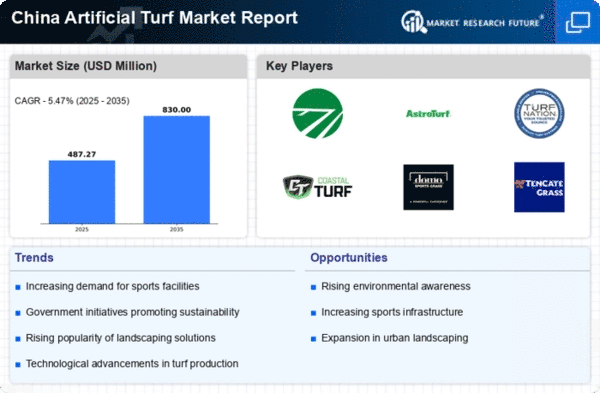
As per Market Research Future analysis, the China Artificial Turf Market Size was estimated at 462.0 USD Million in 2024. The China The China artificial turf market is projected to grow from 487.27 USD Million in 2025 to 830.0 USD Million by 2035. This growth represents a compound annual growth rate (CAGR) of 5.4% during the forecast period 2025 - 2035

Key Market Trends & Highlights

The China artificial turf market is experiencing robust growth driven by sustainability and technological advancements.

  • The market increasingly focuses on sustainability, reflecting a global trend towards eco-friendly solutions.
  • Technological advancements are enhancing the quality and durability of artificial turf, making it more appealing for various applications.
  • The sports segment remains the largest, while the landscaping segment is emerging as the fastest-growing area in the market.
  • Key drivers include the growing demand for sports facilities and urban green space development, which are shaping market dynamics.

Market Size & Forecast

2024 Market Size 462.0 (USD Million)
2035 Market Size 830.0 (USD Million)
CAGR (2025 - 2035) 5.47%

Major Players

FieldTurf (US), AstroTurf (US), Turf Nation (US), Coastal Turf (US), Domo Sports Grass (NL), TenCate Grass (NL), SportGroup (DE), Shaw Sports Turf (US), A-Turf (US)

Our Impact
Enabled $4.3B Revenue Impact for Fortune 500 and Leading Multinationals
Partnering with 2000+ Global Organizations Each Year
30K+ Citations by Top-Tier Firms in the Industry

China Artificial Turf Market Trends

The artificial turf market is growing due to rising demand for sustainable, low-maintenance landscaping solutions. This trend is particularly evident in urban areas where space is limited, and the need for green spaces is paramount. The adoption of artificial turf is being propelled by its ability to conserve water, reduce maintenance costs, and provide a consistent aesthetic appeal throughout the year. Furthermore, advancements in technology have led to the development of more realistic and durable products, which are appealing to both residential and commercial sectors. As environmental concerns continue to rise, the shift towards eco-friendly alternatives is likely to further enhance the market's expansion. In addition, the artificial turf market is witnessing a surge in applications beyond traditional sports fields and playgrounds. The integration of artificial turf in residential gardens, commercial properties, and public parks is becoming increasingly common. This diversification of usage is supported by a growing awareness of the benefits associated with artificial turf, such as its resilience to wear and tear and its ability to withstand varying climatic conditions. As the market evolves, it appears that consumer preferences are shifting towards products that offer both functionality and aesthetic value, indicating a promising future for the artificial turf market.

Sustainability Focus

There is a growing emphasis on sustainable practices within the artificial turf market. Consumers and businesses are increasingly seeking products that minimize environmental impact. This trend is reflected in the development of eco-friendly materials and manufacturing processes that reduce waste and energy consumption.

Technological Advancements

Innovations in technology are transforming the artificial turf market. Enhanced manufacturing techniques are leading to the production of more durable and realistic turf options. These advancements not only improve the aesthetic appeal but also extend the lifespan of the products, making them more attractive to consumers.

Diverse Applications

The applications of artificial turf are expanding beyond traditional sports fields and playgrounds. It is increasingly being utilized in residential landscaping, commercial spaces, and recreational areas. This diversification is driven by the growing recognition of the benefits of artificial turf, such as low maintenance and year-round usability.

China Artificial Turf Market Drivers

Urban Green Space Development

The push for urban green spaces in China is significantly impacting the artificial turf market. As cities become more congested, the need for green areas that require minimal maintenance is becoming apparent. Artificial turf offers a viable solution for creating aesthetically pleasing and functional green spaces in urban environments. This trend is likely to drive the adoption of artificial turf in parks, rooftops, and other public areas. The artificial turf market will benefit from urban development strategies as municipalities and developers recognize the advantages of low-maintenance landscaping.

Growing Demand for Sports Facilities

The increasing interest in sports and recreational activities in China is driving the demand for artificial turf. As urbanization progresses, the need for multi-functional sports facilities rises, leading to a surge in artificial turf installations. The artificial turf market is expected to benefit from this trend, as more schools, parks, and sports complexes seek durable and low-maintenance solutions. According to recent data, the market for artificial turf in sports facilities is projected to grow at a CAGR of approximately 10% over the next five years. This growth is indicative of a broader shift towards enhancing sports infrastructure, which is likely to further stimulate the artificial turf market.

Environmental Regulations and Standards

China's stringent environmental regulations are influencing the artificial turf market. The government is promoting sustainable practices, which include the use of eco-friendly materials in construction and landscaping. As a result, manufacturers are increasingly focusing on producing artificial turf that meets these environmental standards. The market is shifting towards recyclable products that are free from harmful chemicals. This regulatory environment is expected to propel the growth of the artificial turf market, as consumers and businesses alike seek compliant and sustainable options. The market's alignment with these regulations could enhance its appeal and market share.

Rising Popularity of Landscaping Solutions

The growing trend of landscaping in residential and commercial properties is contributing to the expansion of the artificial turf market. Homeowners and businesses are increasingly opting for artificial turf due to its low maintenance requirements and aesthetic appeal. This shift is particularly evident in urban areas where natural grass may not thrive. The market is projected to grow as more consumers seek durable and visually appealing landscaping options. With the increasing awareness of the benefits of artificial turf, the market is likely to see a steady rise in demand, further solidifying its position in the landscaping sector.

Technological Innovations in Manufacturing

Advancements in manufacturing technologies are reshaping the artificial turf market. Innovations such as improved fiber technology and enhanced backing systems are leading to more durable and realistic products. These technological improvements not only enhance the aesthetic appeal of artificial turf but also increase its lifespan and performance. The market is likely to see a rise in demand for high-quality artificial turf that incorporates these innovations. As manufacturers invest in research and development, the artificial turf market is expected to expand, catering to a more discerning consumer base that values quality and performance.


Market Segment Insights

By Application: Sports (Largest) vs. Landscape (Fastest-Growing)

In the China artificial turf market, the application segment is largely dominated by the Sports category, which encompasses various athletic applications such as football, rugby, and track fields. This segment represents the largest share, appealing to schools, professional leagues, and recreational facilities that increasingly opt for artificial turf due to its durability and low maintenance costs. In contrast, the Landscape segment is rapidly gaining traction, favored for residential and commercial landscaping purposes, as it offers aesthetic appeal and water conservation benefits. Growth trends in this market are influenced by increasing investment in sports infrastructure and rising awareness of environmental sustainability. The adoption of artificial turf for playgrounds, tennis courts, and golf courses is also on the rise, further being propelled by advancements in manufacturing technologies that enhance turf performance. As urbanization continues, the market for landscape applications is expected to grow significantly, driven by the desire for low-maintenance green spaces in urban areas.

Sports: Football (Dominant) vs. Landscape (Emerging)

The Sports category, particularly football, remains the dominant force in the application segment of the China artificial turf market. This segment is characterized by its high installation rates in sports complexes and educational institutions, driven by a surge in football popularity across all age groups. Meanwhile, the Landscape segment is emerging as a strong competitor, attracting attention for its versatility in residential and commercial settings. The landscape applications bring forth a range of benefits like water conservation and year-round greenery, appealing to environmentally-conscious consumers and landscape designers alike. As both segments continue to evolve, they highlight the expanding range of functional and aesthetic benefits that artificial turf can provide.

By Material: Polyethylene (Largest) vs. Nylon (Fastest-Growing)

In the China artificial turf market, the material segment is primarily dominated by polyethylene, which holds the largest market share due to its affordability and durability. Polypropylene follows closely, offering light-weight options for various applications. Nylon has emerged rapidly, gaining traction for its resilience and adaptability in high-performance environments, while other synthetic fibers collectively represent a smaller share of the market, catering to niche applications. Growth trends indicate a significant shift towards nylon as its properties align well with increasing demand for high-quality, performance-driven turf solutions. The rise in sports and recreational activities, coupled with a greater focus on environmentally friendly materials, is driving innovation in this segment. Polyethylene remains preferred for general use, but the transition towards nylon is poised to reshape the competitive landscape, attracting investment for further development.

Polyethylene (Dominant) vs. Nylon (Emerging)

Polyethylene stands out as the dominant material in the China artificial turf market, thanks to its cost-effectiveness and versatility, making it ideal for residential and commercial applications. It features excellent UV resistance and durability, bolstering its appeal across diverse settings. In contrast, nylon is viewed as the emerging material, favored for its superior performance characteristics, particularly in high-traffic areas like sports fields. It offers enhanced durability and a more realistic appearance, attracting attention from athletic organizations. As the market evolves, both materials are likely to coexist, with polyethylene serving broader applications while nylon becomes the choice for specialized, high-end turf solutions.

By End-use: Residential (Largest) vs. Commercial (Fastest-Growing)

In the China artificial turf market, the end-use segment shows diverse distribution among residential, commercial, institutional, and municipal applications. Residential use holds the largest share, propelled by the growing consumer preference for low-maintenance landscaping solutions. In contrast, the commercial end-use sector is rapidly gaining traction, driven by increased investments in sports facilities and recreational areas that require durable and versatile turf solutions. Growth trends indicate a significant upward trajectory for both residential and commercial segments. The demand for residential artificial turf is spurred by homeowners seeking aesthetic yet practical landscaping options. Meanwhile, the commercial sector's expansion is fueled by heightened awareness of the benefits of artificial turf in various applications, including sports, events, and public spaces, aligning with urban development initiatives and sustainability goals.

Residential (Dominant) vs. Commercial (Emerging)

In the China artificial turf market, the residential segment is characterized by its dominant share, supported by a strong shift towards eco-friendly and low-maintenance landscaping solutions. Homeowners are increasingly opting for artificial turf to achieve consistent green spaces, which enhances property aesthetics and value. Conversely, the commercial segment is emerging rapidly, catering to sectors such as sports complexes and public facilities. Commercial artificial turf is designed for high durability and performance, making it suitable for intense usage scenarios. This segment is witnessing innovation in turf technology, aligning with modern architecture and urban planning trends, thus becoming a pivotal component in landscape projects and recreational designs.

By Installation Type: Landscape Installation (Largest) vs. Indoor Installation (Fastest-Growing)

In the China artificial turf market, landscape installation holds the largest share, primarily driven by the increasing focus on aesthetic landscaping in residential areas and public parks. This segment is notably popular for creating green spaces in urban settings, resonating well with consumer preferences for sustainability and maintenance ease. Meanwhile, indoor installation is emerging as the fastest-growing segment, fueled by rising demand in commercial spaces such as gyms, restaurants, and children's play areas for year-round usability and safety. The growth trends in this segment are being significantly influenced by urbanization and the shift toward eco-friendly solutions. In particular, indoor installations are gaining traction as businesses look to enhance their environments without the upkeep associated with natural grass. Emerging applications, such as virtual sports and recreational areas, are likely to further accelerate growth in both indoor and outdoor artificial turf segments, expanding options available for consumers and businesses alike.

Indoor Installation (Dominant) vs. DIY Installation (Emerging)

Indoor installation stands out as a dominant trend in the China artificial turf market, characterized by its versatile applications across various commercial sectors. The segment offers significant advantages such as durability, ease of cleaning, and safety, making it ideal for high-traffic areas like gyms and recreation centers. On the other hand, DIY installation is seen as an emerging trend, appealing particularly to homeowners seeking cost-effective solutions for enhancing their outdoor spaces. The DIY segment typically attracts consumers desiring customization and an hands-on approach, driving interest in artificial turf products that enable personal expression while maximizing convenience.

Get more detailed insights about China Artificial Turf Market

Key Players and Competitive Insights

The artificial turf market in China exhibits a dynamic competitive landscape characterized by rapid growth and innovation. Key growth drivers include increasing urbanization, a rising demand for sustainable sports surfaces, and the expansion of recreational facilities. Major players such as FieldTurf (US), AstroTurf (US), and Domo Sports Grass (NL) are strategically positioned to leverage these trends. FieldTurf (US) focuses on technological advancements in turf performance, while AstroTurf (US) emphasizes sustainability through eco-friendly materials. Domo Sports Grass (NL) is expanding its footprint in China through partnerships with local distributors, thereby enhancing its market presence. Collectively, these strategies foster a competitive environment that prioritizes innovation and sustainability.In terms of business tactics, companies are increasingly localizing manufacturing to reduce costs and improve supply chain efficiency. This approach not only mitigates logistical challenges but also aligns with the growing preference for locally sourced products among consumers. The market structure appears moderately fragmented, with several key players vying for market share. However, the influence of major companies is significant, as they set industry standards and drive technological advancements that smaller firms may struggle to match.

In October FieldTurf (US) announced a partnership with a leading Chinese sports organization to develop a new line of eco-friendly artificial turf. This strategic move underscores FieldTurf's commitment to sustainability and positions the company to capture a growing segment of environmentally conscious consumers. The collaboration is expected to enhance brand visibility and foster innovation in product development, aligning with global trends towards greener solutions.

In September AstroTurf (US) launched a new product line that incorporates recycled materials, aiming to reduce environmental impact while maintaining high performance. This initiative not only reflects the company's dedication to sustainability but also addresses increasing regulatory pressures regarding environmental standards in China. By prioritizing eco-friendly innovations, AstroTurf is likely to strengthen its competitive edge in a market that increasingly values sustainability.

In August Domo Sports Grass (NL) expanded its operations in China by establishing a new manufacturing facility in Guangdong province. This strategic investment is anticipated to enhance production capacity and reduce lead times for local customers. By localizing production, Domo Sports Grass aims to improve its responsiveness to market demands and solidify its position as a key player in the region.

As of November current competitive trends in the artificial turf market are heavily influenced by digitalization, sustainability, and the integration of advanced technologies such as AI. Strategic alliances among companies are becoming increasingly common, facilitating knowledge sharing and resource pooling. The competitive landscape is shifting from a focus on price-based competition to one that emphasizes innovation, technological advancements, and supply chain reliability. This evolution suggests that companies that prioritize these aspects will likely emerge as leaders in the market.

Key Companies in the China Artificial Turf Market include

Industry Developments

Recent developments in the China Artificial Turf Market have shown significant activity, particularly with companies like Swire Properties, China National Chemical Corporation, and Domo Sports Grass. In recent months, the demand for high-quality artificial turf has soared as urbanization increases and interest in sports infrastructure grows. For instance, NexGen Lawns reported expansions in its product offerings, catering to the increased demand from the sports and recreation sectors. 

In terms of mergers and acquisitions, Shenzhen Kingsman Technology Company announced a strategic partnership with NewGrass in September 2023, strengthening its market position. Meanwhile, TenCate Grass expanded its operations in China, enhancing production capabilities to meet rising domestic and international demand. The market has witnessed a boost in valuations, largely driven by sports events, as Sinopec Limited and AptarGroup have also ventured into collaborations focusing on sustainable turf solutions. 

In the previous two years, the implementation of new policies supporting green construction and environmental standards has been a significant trend, positively impacting market growth and innovation within the China Artificial Turf Market. The overall outlook remains optimistic as players adapt to evolving consumer preferences and regulatory requirements.

Future Outlook

China Artificial Turf Market Future Outlook

The artificial turf market in China is projected to grow at a 5.47% CAGR from 2025 to 2035, driven by urbanization, sports infrastructure development, and environmental sustainability initiatives.

New opportunities lie in:

  • Expansion into eco-friendly turf materials for sustainability-focused clients.
  • Development of smart turf solutions integrated with IoT for enhanced user experience.
  • Partnerships with local governments for public sports facility upgrades.

By 2035, the artificial turf market is expected to achieve substantial growth, driven by innovation and strategic partnerships.

Market Segmentation

China Artificial Turf Market End-use Outlook

  • Residential
  • Commercial
  • Institutional
  • Municipal

China Artificial Turf Market Material Outlook

  • Polyethylene
  • Polypropylene
  • Nylon
  • Other Synthetic Fibers

China Artificial Turf Market Application Outlook

  • Sports
  • Landscape
  • Playgrounds
  • Tennis Courts
  • Golf Courses

China Artificial Turf Market Installation Type Outlook

  • Landscape Installation
  • Indoor Installation
  • Outdoor Installation
  • DIY Installation

Report Scope

MARKET SIZE 2024 462.0(USD Million)
MARKET SIZE 2025 487.27(USD Million)
MARKET SIZE 2035 830.0(USD Million)
COMPOUND ANNUAL GROWTH RATE (CAGR) 5.47% (2025 - 2035)
REPORT COVERAGE Revenue Forecast, Competitive Landscape, Growth Factors, and Trends
BASE YEAR 2024
Market Forecast Period 2025 - 2035
Historical Data 2019 - 2024
Market Forecast Units USD Million
Key Companies Profiled FieldTurf (US), AstroTurf (US), Turf Nation (US), Coastal Turf (US), Domo Sports Grass (NL), TenCate Grass (NL), SportGroup (DE), Shaw Sports Turf (US), A-Turf (US)
Segments Covered Application, Material, End-use, Installation Type
Key Market Opportunities Growing demand for sustainable landscaping solutions drives innovation in the artificial turf market.
Key Market Dynamics Rising demand for sustainable solutions drives innovation and competition in the artificial turf market.
Countries Covered China
Leave a Comment

FAQs

What is the expected market size of the China Artificial Turf Market in 2024?

The China Artificial Turf Market is expected to be valued at 550.0 USD million in 2024.

What will be the anticipated market size of the China Artificial Turf Market by 2035?

By 2035, the overall market size of the China Artificial Turf Market is anticipated to reach 1080.0 USD million.

What is the expected compound annual growth rate (CAGR) for the China Artificial Turf Market from 2025 to 2035?

The China Artificial Turf Market is expected to grow at a CAGR of 6.327% from 2025 to 2035.

How much is the polyethylene segment of the China Artificial Turf Market valued at in 2024?

In 2024, the polyethylene segment of the China Artificial Turf Market is valued at 220.0 USD million.

What is the expected market value of the polypropylene segment in 2035?

The polypropylene segment of the China Artificial Turf Market is projected to be valued at 360.0 USD million by 2035.

What is the projected market value of the nylon segment in 2024?

In 2024, the nylon segment of the China Artificial Turf Market is projected to be valued at 150.0 USD million.

Who are some of the key players in the China Artificial Turf Market?

Major players in the China Artificial Turf Market include Swire Properties, NexGen Lawns, and China National Chemical Corporation.

What growth opportunities exist in the China Artificial Turf Market due to emerging trends?

The China Artificial Turf Market presents growth opportunities driven by advancements in materials and increasing demand for sustainable solutions.

How does the regional demand impact the growth of the China Artificial Turf Market?

Regional demand significantly impacts growth as urban development and sports infrastructure increase across various provinces in China.

What are the key challenges facing the China Artificial Turf Market?

Key challenges in the China Artificial Turf Market include competition from alternative materials and regulatory compliance on environmental standards.

Download Free Sample

Kindly complete the form below to receive a free sample of this Report

Compare Licence

×
Features License Type
Single User Multiuser License Enterprise User
Price $4,950 $5,950 $7,250
Maximum User Access Limit 1 User Upto 10 Users Unrestricted Access Throughout the Organization
Free Customization
Direct Access to Analyst
Deliverable Format
Platform Access
Discount on Next Purchase 10% 15% 15%
Printable Versions