Request Free Sample ×

Kindly complete the form below to receive a free sample of this Report

* Please use a valid business email

Leading companies partner with us for data-driven Insights

clients tt-cursor
Hero Background
English
Chinese
French
Japanese
Korean
German
Spanish

CCTV Camera Market Trends

ID: MRFR/SEM/6688-CR
149 Pages
Shubham Munde
February 2020

CCTV Camera Market Size, Share and Research Report By Product (Bullet Security Camera, Dome Security Camera, PTZ Security Camera, Box Security Camera, Thermal Security Camera), By Technology (IP Security Camera, Analog Camera), By Application (Commercial, Residential, Industrial), By Resolution (HD, Non-HD), By Services (Professional Service, Managed Service) and By Regional (North America, Europe, South America, Asia Pacific, Middle East and Africa) - Industry Forecast Till 2035

Share:
Download PDF ×

We do not share your information with anyone. However, we may send you emails based on your report interest from time to time. You may contact us at any time to opt-out.

CCTV Camera Market Infographic
Purchase Options

Market Trends

Key Emerging Trends in the CCTV Camera Market

Some of the dominant trends in the CCTV camera market are currently shaping its development and affecting customer perceptions. One key movement is the growing demand for smart CCTV systems. The demand for something more than basic surveillance capabilities is growing as technology continues to progress. Smart CCTV cameras now have features such as facial recognition, motion detection and even integration with other smart home devices. This is a reflection of the increasing demand for as much whole and smart security solutions that outshine standard video watching. The adoption of wireless CCTV systems is also on the rise in the market. Wired setups are gradually being substituted by wireless ones, which allow for more mobility and easier installation. The necessity of complicated wiring is eliminated as thus wireless CCTV cameras become available for residential and commercial users as well. This is in line with the general tendency of consumers to prefer convenient and scalable security solutions. Another interesting trend observed in the CCTV camera market is increased integration of AI and ML. Manufacturers are including these technologies in their cameras to increase the functionality and provide superior analytics. AI-powered CCTV cameras can now analyse video feeds in real time, detecting unusual activities or potential threats. This trend is indicative of a growing focus on the idea that, instead of just recording events with surveillance systems. There is also a noticeable trend towards cloud-based solutions. Cloud storage enables the users to store video footage and access them remotely which gives a convenient and secure means of looking after surveillance data. Cloud-based CCTV systems also enable remote monitoring, which makes them suitable for businesses and homeowners who desire real time accesses to their security feeds regardless of location across the world. Further, there is the shift of market from analog to IP cameras. IP cameras are superior to their analog counterparts in terms of the resolution they offer, image quality and advanced features.


Author
Author Profile
Shubham Munde
Team Lead - Research

Shubham brings over 7 years of expertise in Market Intelligence and Strategic Consulting, with a strong focus on the Automotive, Aerospace, and Defense sectors. Backed by a solid foundation in semiconductors, electronics, and software, he has successfully delivered high-impact syndicated and custom research on a global scale. His core strengths include market sizing, forecasting, competitive intelligence, consumer insights, and supply chain mapping. Widely recognized for developing scalable growth strategies, Shubham empowers clients to navigate complex markets and achieve a lasting competitive edge. Trusted by start-ups and Fortune 500 companies alike, he consistently converts challenges into strategic opportunities that drive sustainable growth.

Leave a Comment

FAQs

What is the current valuation of the CCTV Camera Market in 2025?

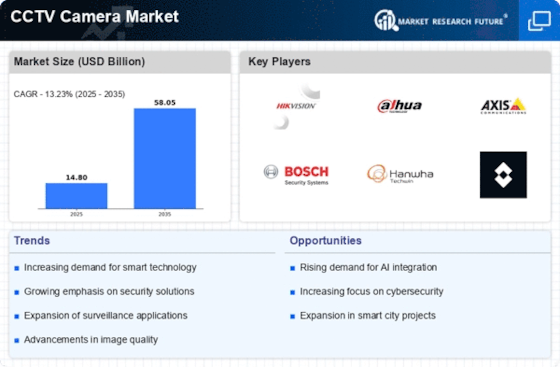
<p>The CCTV Camera Market is valued at approximately 14.8 USD Billion in 2024.</p>

What is the projected market size for the CCTV Camera Market by 2035?

<p>The market is projected to reach around 58.05 USD Billion by 2035.</p>

What is the expected CAGR for the CCTV Camera Market during the forecast period 2025 - 2035?

<p>The expected CAGR for the CCTV Camera Market during the forecast period 2025 - 2035 is 13.23%.</p>

Which product segment holds the highest valuation in the CCTV Camera Market?

<p>The Dome Security Camera segment is projected to reach approximately 14.8 USD Billion by 2035.</p>

How do IP Security Cameras compare to Analog Cameras in terms of market valuation?

<p>IP Security Cameras are expected to reach around 35.0 USD Billion, while Analog Cameras are projected to reach about 23.05 USD Billion by 2035.</p>

What are the key applications driving the CCTV Camera Market?

<p>The Commercial application segment is projected to reach approximately 23.25 USD Billion by 2035, followed closely by Residential and Industrial applications.</p>

Which companies are considered key players in the CCTV Camera Market?

<p>Key players in the market include Hikvision, Dahua Technology, Axis Communications, and Bosch Security Systems, among others.</p>

What is the expected growth for the Thermal Security Camera segment?

<p>The Thermal Security Camera segment is projected to reach around 11.66 USD Billion by 2035.</p>

How does the resolution of CCTV cameras impact their market valuation?

<p>HD resolution cameras are expected to dominate the market, reaching approximately 35.0 USD Billion by 2035, compared to Non-HD cameras at about 23.05 USD Billion.</p>

What services are anticipated to grow in the CCTV Camera Market?

<p>Managed Services are projected to reach around 34.93 USD Billion by 2035, indicating a strong growth potential in this segment.</p>

Market Summary

As per Market Research Future analysis, the CCTV Camera Market Size was estimated at 31.5 USD Billion in 2024. The CCTV Camera industry is projected to grow from 36.7 USD Billion in 2025 to 169 USD Billion by 2035, exhibiting a compound annual growth rate (CAGR) of 16.5% during the forecast period 2025 - 2035

Key Market Trends & Highlights

The CCTV Camera Market is experiencing a transformative shift driven by technological advancements and evolving consumer needs.

  • The integration of AI and machine learning is revolutionizing surveillance capabilities, enhancing real-time analytics. North America remains the largest market, while the Asia-Pacific region is emerging as the fastest-growing area for CCTV camera adoption. Bullet security cameras dominate the market, whereas PTZ security cameras are witnessing rapid growth due to their versatility. Rising security concerns and government initiatives are key drivers propelling demand in both retail and commercial sectors.

Market Size & Forecast

2024 Market Size 31.5 (USD Billion)
2035 Market Size 169 (USD Billion)
CAGR (2025 - 2035) 16.5%
Largest Regional Market Share in 2024 North America

Major Players

Hikvision (CN), Dahua Technology (CN), Axis Communications (SE), Bosch Security Systems (DE), Hanwha Techwin (KR), FLIR Systems (US), Sony (JP), Panasonic (JP), Honeywell (US)

Market Trends

The CCTV Camera Market is currently experiencing a dynamic evolution, driven by advancements in technology and increasing security concerns across various sectors. The proliferation of smart cities and the integration of artificial intelligence into surveillance systems appear to be reshaping the landscape of CCTV Camera Market. Rising security concerns continue to strengthen the global cctv camera market. Enhanced image quality, real-time monitoring capabilities, and the ability to analyze data efficiently are becoming essential features that consumers and businesses seek. Growth reflects expanding investments across the cctv industry. Furthermore, the growing emphasis on public safety and crime prevention is likely to propel demand for sophisticated surveillance solutions, making the CCTV Camera Market a focal point for investment and innovation. Commercial adoption fuels the cctv camera business worldwide. In addition to technological advancements, regulatory frameworks and privacy considerations are influencing market dynamics. Governments worldwide are implementing stricter guidelines regarding surveillance practices, which may impact the deployment of CCTV systems. Smart infrastructure initiatives accelerate demand in the cctv industry. However, this regulatory environment also presents opportunities for manufacturers to develop compliant and ethically sound products. As the CCTV Camera Market continues to evolve, stakeholders must navigate these complexities while addressing consumer needs and preferences, ensuring that the CCTV Camera Market remains responsive to both technological advancements and societal expectations. Urban surveillance is reshaping the global cctv camera market. Manufacturers compete aggressively in the evolving cctv camera business.

Integration of AI and Machine Learning

The incorporation of artificial intelligence and machine learning into CCTV systems is transforming how surveillance is conducted. AI adoption differentiates leading cctv cameras manufacturers. These technologies enable cameras to analyze footage in real-time, identifying unusual activities and reducing the need for constant human monitoring. This trend not only enhances security but also optimizes resource allocation for businesses and public institutions. Advanced analytics enhance global cctv camera world deployments.

Shift Towards Cloud-Based Solutions

There is a noticeable shift towards cloud-based storage and management solutions within the CCTV Camera Market. This transition allows for greater flexibility, scalability, and remote access to surveillance footage. As organizations seek to streamline operations and reduce costs, cloud solutions are becoming increasingly attractive, facilitating easier data management and retrieval. Cloud platforms redefine operations across the cctv industry.

Focus on Privacy and Compliance

As concerns regarding privacy and data protection grow, the CCTV Camera Market is witnessing a heightened focus on compliance with regulations. Manufacturers are developing systems that prioritize user privacy while still delivering effective surveillance capabilities. Compliance standards influence pricing and cctv cameras rate strategies. This trend indicates a balancing act between security needs and ethical considerations, shaping future product offerings.

CCTV Camera Market Market Drivers

Rising Security Concerns

The increasing prevalence of crime and security threats has led to a heightened demand for surveillance solutions, particularly in the CCTV Camera Market. As urbanization accelerates, cities are witnessing a surge in criminal activities, prompting both public and private sectors to invest in advanced security systems. According to recent data, the global market for CCTV cameras is projected to reach USD 30 billion by 2026, reflecting a compound annual growth rate of approximately 10%. This trend indicates that stakeholders are prioritizing safety and security, thereby driving the growth of the CCTV Camera Market. Furthermore, the integration of high-definition cameras and smart technologies enhances the effectiveness of surveillance systems, making them more appealing to consumers.

Technological Advancements

Technological innovations play a pivotal role in shaping the CCTV Camera Market. The advent of high-definition video recording, night vision capabilities, and remote monitoring features has revolutionized the way surveillance systems operate. These advancements not only improve image quality but also enhance user experience, making CCTV cameras more accessible and efficient. The introduction of smart cameras equipped with artificial intelligence and machine learning algorithms allows for real-time analytics and threat detection, further propelling market growth. As of 2025, it is estimated that over 60% of new installations in the CCTV Camera Market will incorporate these advanced technologies, indicating a shift towards more sophisticated surveillance solutions.

Integration with Smart Home Systems

The integration of CCTV cameras with smart home systems is emerging as a key driver in the CCTV Camera Market. As consumers increasingly adopt smart home technologies, the demand for interconnected security solutions is on the rise. CCTV cameras that can be integrated with home automation systems allow users to monitor their properties remotely and receive real-time alerts on suspicious activities. This trend is supported by the growing consumer preference for convenience and enhanced security features. By 2026, it is anticipated that nearly 40% of CCTV camera sales will be attributed to smart home integrations, highlighting the shift towards more user-friendly and technologically advanced surveillance solutions.

Government Initiatives and Regulations

Government initiatives aimed at enhancing public safety and security are significantly influencing the CCTV Camera Market. Various countries are implementing policies that encourage the installation of surveillance systems in public spaces, such as streets, parks, and transportation hubs. These initiatives are often accompanied by funding and incentives for local authorities to adopt advanced surveillance technologies. For instance, in several regions, government budgets allocated for public safety have increased, leading to a rise in CCTV camera installations. This trend is expected to contribute to a market growth rate of approximately 8% annually in the coming years, as municipalities prioritize the safety of their citizens through enhanced surveillance measures.

Growing Demand in Retail and Commercial Sectors

The retail and commercial sectors are increasingly recognizing the value of CCTV systems in loss prevention and operational efficiency, thereby driving the CCTV Camera Market. Retailers are investing in surveillance solutions to deter theft, monitor customer behavior, and enhance overall security. Recent studies indicate that businesses that implement CCTV systems experience a reduction in theft by up to 30%. Additionally, the ability to analyze footage for operational insights is becoming a crucial factor for retailers. As a result, the demand for CCTV cameras in these sectors is projected to grow at a rate of 9% annually, reflecting the importance of surveillance in maintaining security and improving business operations.

Market Segment Insights

By Product: Bullet Security Camera (Largest) vs. PTZ Security Camera (Fastest-Growing)

The CCTV camera market exhibits diverse offerings, with the bullet security camera commanding the largest share due to its widespread adoption for outdoor surveillance. Following closely are dome security cameras, known for their aesthetic appeal and versatility in various environments. PTZ security cameras, which allow for remote pan, tilt, and zoom control, are rapidly gaining traction among consumers seeking advanced functionalities. This adaptability contributes to a dynamic market share distribution, with significant competition among the various camera types. PTZ innovation reflects advancement across the cctv camera market.

Bullet Security Camera (Dominant) vs. PTZ Security Camera (Emerging)

Bullet security cameras are recognized as the dominant force in the CCTV camera market, favored for their durability and long-range visibility, essential for outdoor security applications. Conversely, PTZ security cameras are emerging as the preferred choice for locations requiring comprehensive monitoring and flexibility. Equipped with advanced features such as motion tracking and remote control capabilities, PTZ cameras cater especially to larger areas that need adaptable surveillance solutions. As urban centers expand and security concerns grow, the demand for the PTZ segment is poised to accelerate, reflecting a shift towards more technologically sophisticated security systems.

By Technology: IP Security Camera (Largest) vs. Analog Camera (Fastest-Growing)

In the CCTV camera market, the IP security camera segment holds the largest market share, reflecting the industry's shift towards advanced technological solutions. As adoption rates increase, more consumers and businesses are opting for IP cameras due to their superior image quality, remote access capabilities, and enhanced features over traditional options. On the other hand, analog cameras, once the predominant choice, are now witnessing a resurgence due to affordability and ease of installation; however, their overall market presence is diminished compared to IP cameras. IP cameras dominate portfolios of cctv cameras manufacturers.

Technology: IP Security Camera (Dominant) vs. Analog Camera (Emerging)

IP security cameras dominate the CCTV landscape, offering high-definition video capabilities, advanced analytics, and ease of integration with existing networks. Their flexibility and support for remote monitoring enable businesses and homeowners to maintain enhanced security measures easily. Meanwhile, analog cameras, while perceived as less advanced, are emerging as a cost-effective alternative for basic surveillance needs. They appeal to budget-conscious consumers who value straightforward installation and operation without the complexities often associated with digital systems.

By Application: Commercial (Largest) vs. Residential (Fastest-Growing)

In the CCTV camera market, the application segments are primarily categorized into commercial, residential, and industrial. The commercial segment holds the largest share, accounting for a significant portion of the overall market. Enterprises remain core drivers of the cctv camera business. This dominance can be attributed to the increasing adoption of surveillance systems in various sectors such as retail, public infrastructure, and corporate offices, aimed at enhancing security measures. On the other hand, the residential segment is gaining traction, driven by rising concerns over home security and advancements in smart home technologies, making it an essential player in the CCTV Camera Market.

Application: Commercial (Dominant) vs. Residential (Emerging)

The commercial application segment of CCTV cameras is characterized by its robust demand driven by heightened security requirements in various industries. Affordable pricing impacts cctv cameras rate adoption. Businesses invest significantly in surveillance systems to deter theft, monitor employee activities, and protect assets, positioning this segment as a dominant player in the market. In contrast, the residential segment is emerging rapidly, especially with the advent of affordable smart cameras and increased public awareness regarding home security. This shift has led to more homeowners prioritizing surveillance systems, creating a dynamic environment that fosters innovation and competitive pricing in the CCTV Camera Market.

By Resolution: HD (Largest) vs. Non-HD (Fastest-Growing)

In the CCTV camera market, the resolution segment reveals a significant disparity in market share between HD and Non-HD cameras. HD cameras dominate the CCTV Camera Market, favored for their superior image quality and clarity, making them the preferred choice for security applications. Meanwhile, Non-HD cameras, while holding a smaller share, are gaining traction due to their lower costs and increased adoption in less critical monitoring scenarios. This distribution highlights the consumer preference for clarity and detail in security footage while also showing the appeal of budget-friendly options. Recent trends indicate a growing demand for Non-HD cameras, driven by technological advancements and a focus on cost-effectiveness. As consumers and businesses increasingly seek affordable surveillance solutions, the Non-HD segment is expected to expand rapidly. Moreover, the integration of basic AI capabilities in Non-HD cameras enhances their value proposition, positioning them as attractive options for various applications. This growth trend suggests a shifting landscape in the CCTV camera market, where both segments can coexist while catering to different segments of the audience.

Resolution: HD (Dominant) vs. Non-HD (Emerging)

In the resolution segment of the CCTV camera market, HD cameras are the dominant players due to their high image clarity and detail, making them the preferred choice for critical surveillance needs. These cameras typically offer resolutions of 720p and above, ensuring that users can capture clear and detailed footage under various conditions. On the other hand, Non-HD cameras, while often viewed as an emerging segment, are quickly gaining popularity for their affordability and sufficient quality for less intensive monitoring tasks. Their growth is fueled by the increasing demand for budget-friendly and adequately functional surveillance options in both residential and commercial spaces. As technology improves, the Non-HD segment continues to innovate, positioning itself as an attractive alternative for entry-level security solutions.

By Services: Professional Service (Largest) vs. Managed Service (Fastest-Growing)

In the CCTV Camera Market, the Services segment showcases a competitive landscape, primarily dominated by Professional Services. This category emphasizes installation, maintenance, and technical support tailored to meet specific consumer needs. In contrast, Managed Services represent a rapidly expanding segment; they offer remote monitoring and management of surveillance systems as a subscription-based service, allowing businesses to reduce resource allocation and enhance operational efficiency.

Services: Professional Service (Dominant) vs. Managed Service (Emerging)

Professional Services in the CCTV Camera Market are characterized by their comprehensive approach to installation and long-term support, making them the go-to choice for most consumers. This segment has established dominance due to its personalized service offerings, which cater to various industries, ensuring that security systems are installed correctly and maintained effectively. Conversely, Managed Services are gaining traction, particularly among small and mid-sized enterprises that prefer a more flexible approach. These services provide cost-effective solutions for ongoing system monitoring without the need for a large in-house security team, appealing to businesses looking to modernize their security and optimize resource expenditure.

Get more detailed insights about CCTV Camera Market Research Report - Global Forecast till 2035

Regional Insights

The CCTV Camera Market has a diverse regional industry landscape, with North America leading the charge, valued at 4.2 USD Billion in 2024 and projected to reach 16.76 USD Billion by 2035, showcasing a significant market presence. Strong demand for cctv cameras in usa supports regional dominance. Europe follows closely, starting at 3.8 USD Billion in 2024 and growing to 15.16 USD Billion in 2035, driven by stringent security regulations. The Asia Pacific region also exhibits strong growth potential, with an initial valuation of 4.8 USD Billion in 2024 that could escalate to 18.4 USD Billion by 2035, reflecting increasing urbanization and infrastructure investment. Regulatory compliance shapes the cctv industry landscape.

South America starts at 1.2 USD Billion in 2024, rising to 4.74 USD Billion by 2035, as improving economic conditions foster technological adoption. Meanwhile, the Middle East and Africa, initially valued at 0.8 USD Billion in 2024, is expected to grow to 3.96 USD Billion by 2035, albeit at a slower pace due to varying security infrastructures. The dominance of North America and Europe is attributed to advanced technological adoption and the presence of key industry players, while the growth in Asia Pacific highlights the expanding need for enhanced surveillance systems in rapidly developing urban areas. Asia-Pacific growth benefits suppliers offering cctv camera from China.

This varied geographical growth underscores the importance of the CCTV Camera Market segmentation in catering to specific regional security demands.

Key Players and Competitive Insights

The CCTV Camera Market has become increasingly competitive over the years, driven by a surge in demand for enhanced security solutions across various sectors including residential, commercial, and government installations. Competition remains intense among global cctv cameras manufacturers. The landscape is characterized by multiple players vying for market share, each bringing unique technologies, product offerings, and strategic approaches to meet the diverse needs of consumers and businesses alike. As security concerns grow globally, especially in urban areas, companies are continuously innovating and improving their product lines to capitalize on new opportunities. Strategic expansion strengthens the cctv camera market.
This competitive environment is not only shaped by technological advancements but also by shifts in regulations, economic factors, and consumer preferences that influence purchasing decisions within the surveillance sector. Analyzing the key players and their strategies provides valuable insights into the market dynamics driving this fast-paced industry.Hikvision has established itself as a dominant player in the CCTV Camera Market, recognized for its extensive portfolio of advanced surveillance products and solutions. With significant investments in research and development, Hikvision consistently delivers innovative technologies, including AI-based analytics and deep learning features that enhance the functionality of their cameras. The company's global presence is reinforced by a wide distribution network and partnerships that facilitate access to various markets. Additionally, Hikvision is known for its cost-effective solutions, which appeal to a broad range of customers, from small businesses to large enterprises.Its strong focus on customer service, along with a robust support system, further cements its position as a leader in the surveillance sector, making it a preferred choice for surveillance installations worldwide.Dahua Technology has carved out a strong niche in the CCTV Camera Market, recognized for its comprehensive range of products that cater to various security needs, including cameras, video surveillance systems, and cloud-based solutions. The company has a notable presence in numerous international markets, supported by strategic partnerships and collaborations that enhance its distribution capabilities. Dahua's emphasis on innovation is evident in its commitment to developing high-definition cameras and smart analytics powered by artificial intelligence. The company has engaged in various mergers and acquisitions to bolster its technological capabilities and market reach, further solidifying its competitive stance.With a strong focus on R&D, Dahua Technology continues to introduce cutting-edge products that align with evolving consumer demands, ensuring its relevance in the dynamically changing landscape of global surveillance solutions.

Key Companies in the CCTV Camera Market include

Industry Developments

The CCTV Camera Market has witnessed significant developments recently, driven by increasing security concerns and advancements in technology. As of October 2023, companies such as Hikvision and Dahua Technology continue to dominate the CCTV Camera Market, focusing on high-definition video surveillance and smart analytics. The integration of Artificial Intelligence has gained traction, enhancing facial recognition capabilities across various security applications. Notably, on September 15, 2023, Honeywell announced a strategic partnership with Axis Communications to co-develop integrated security solutions aimed at commercial sectors, underscoring the trend of collaboration to enhance product offerings. Recent launches highlight momentum across the cctv camera world.

Furthermore, Axis Communications reported a growth in market share due to higher demand for IP security camera systems, reflecting an overall upward trajectory in market valuation. The CCTV Camera Market has observed mergers such as the acquisition of Vivint by ADT in June 2023, which aims to expand their product portfolios and increase market penetration. Looking back, in June 2021, Bosch Security Systems launched a new line of smart cameras designed to adapt to various environmental conditions, showcasing innovation as a key driver in the industry.

Overall, the CCTV Camera Market remains dynamic, shaped by technological advancements and strategic business maneuvers among leading corporations.

Future Outlook

CCTV Camera Market Future Outlook

The CCTV Camera Market is projected to grow at a 13.23% CAGR from 2024 to 2035, driven by advancements in technology, increasing security concerns, and urbanization. Expansion of the cctv camera market will be driven by urbanization.

New opportunities lie in:

  • <p>Integration of AI-driven analytics for enhanced surveillance capabilities.</p>
  • <p> </p>
  • <p>Development of cloud-based storage solutions for scalable data management.</p>
  • <p>Expansion into smart city projects to provide comprehensive security solutions.</p>

By 2035, the CCTV Camera Market is expected to be robust, reflecting substantial growth and innovation. Innovation continues to shape the cctv world ecosystem.

Market Segmentation

CCTV Camera Market Product Outlook

  • Bullet Security Camera
  • Dome Security Camera
  • PTZ Security Camera
  • Box Security Camera
  • Thermal Security Camera

CCTV Camera Market Services Outlook

  • Professional Service
  • Managed Service

CCTV Camera Market Resolution Outlook

  • HD
  • Non-HD

CCTV Camera Market Technology Outlook

  • IP Security Camera
  • Analog Camera

CCTV Camera Market Application Outlook

  • Commercial
  • Residential
  • Industrial

Report Scope

MARKET SIZE 2024 31.5(USD Billion)
MARKET SIZE 2025 36.7(USD Billion)
MARKET SIZE 2035 169(USD Billion)
COMPOUND ANNUAL GROWTH RATE (CAGR) 16.5% (2025 - 2035)
REPORT COVERAGE Revenue Forecast, Competitive Landscape, Growth Factors, and Trends
BASE YEAR 2024
Market Forecast Period 2025 - 2035
Historical Data 2019 - 2024
Market Forecast Units USD Billion
Key Companies Profiled Hikvision (CN), Dahua Technology (CN), Axis Communications (SE), Bosch Security Systems (DE), Hanwha Techwin (KR), FLIR Systems (US), Sony (JP), Panasonic (JP), Honeywell (US)
Segments Covered Product, Technology, Application, Resolution, Services, Regional
Key Market Opportunities Integration of artificial intelligence in CCTV Camera Market enhances surveillance capabilities and operational efficiency.
Key Market Dynamics Rising demand for advanced surveillance solutions drives innovation and competition in the CCTV camera market.
Countries Covered North America, Europe, APAC, South America, MEA

FAQs

What is the current valuation of the CCTV Camera Market in 2025?

<p>The CCTV Camera Market is valued at approximately 14.8 USD Billion in 2024.</p>

What is the projected market size for the CCTV Camera Market by 2035?

<p>The market is projected to reach around 58.05 USD Billion by 2035.</p>

What is the expected CAGR for the CCTV Camera Market during the forecast period 2025 - 2035?

<p>The expected CAGR for the CCTV Camera Market during the forecast period 2025 - 2035 is 13.23%.</p>

Which product segment holds the highest valuation in the CCTV Camera Market?

<p>The Dome Security Camera segment is projected to reach approximately 14.8 USD Billion by 2035.</p>

How do IP Security Cameras compare to Analog Cameras in terms of market valuation?

<p>IP Security Cameras are expected to reach around 35.0 USD Billion, while Analog Cameras are projected to reach about 23.05 USD Billion by 2035.</p>

What are the key applications driving the CCTV Camera Market?

<p>The Commercial application segment is projected to reach approximately 23.25 USD Billion by 2035, followed closely by Residential and Industrial applications.</p>

Which companies are considered key players in the CCTV Camera Market?

<p>Key players in the market include Hikvision, Dahua Technology, Axis Communications, and Bosch Security Systems, among others.</p>

What is the expected growth for the Thermal Security Camera segment?

<p>The Thermal Security Camera segment is projected to reach around 11.66 USD Billion by 2035.</p>

How does the resolution of CCTV cameras impact their market valuation?

<p>HD resolution cameras are expected to dominate the market, reaching approximately 35.0 USD Billion by 2035, compared to Non-HD cameras at about 23.05 USD Billion.</p>

What services are anticipated to grow in the CCTV Camera Market?

<p>Managed Services are projected to reach around 34.93 USD Billion by 2035, indicating a strong growth potential in this segment.</p>

  1. SECTION I: EXECUTIVE SUMMARY AND KEY HIGHLIGHTS
    1. | 1.1 EXECUTIVE SUMMARY
    2. | | 1.1.1 Market Overview
    3. | | 1.1.2 Key Findings
    4. | | 1.1.3 Market Segmentation
    5. | | 1.1.4 Competitive Landscape
    6. | | 1.1.5 Challenges and Opportunities
    7. | | 1.1.6 Future Outlook
  2. SECTION II: SCOPING, METHODOLOGY AND MARKET STRUCTURE
    1. | 2.1 MARKET INTRODUCTION
    2. | | 2.1.1 Definition
    3. | | 2.1.2 Scope of the study
    4. | | | 2.1.2.1 Research Objective
    5. | | | 2.1.2.2 Assumption
    6. | | | 2.1.2.3 Limitations
    7. | 2.2 RESEARCH METHODOLOGY
    8. | | 2.2.1 Overview
    9. | | 2.2.2 Data Mining
    10. | | 2.2.3 Secondary Research
    11. | | 2.2.4 Primary Research
    12. | | | 2.2.4.1 Primary Interviews and Information Gathering Process
    13. | | | 2.2.4.2 Breakdown of Primary Respondents
    14. | | 2.2.5 Forecasting Model
    15. | | 2.2.6 Market Size Estimation
    16. | | | 2.2.6.1 Bottom-Up Approach
    17. | | | 2.2.6.2 Top-Down Approach
    18. | | 2.2.7 Data Triangulation
    19. | | 2.2.8 Validation
  3. SECTION III: QUALITATIVE ANALYSIS
    1. | 3.1 MARKET DYNAMICS
    2. | | 3.1.1 Overview
    3. | | 3.1.2 Drivers
    4. | | 3.1.3 Restraints
    5. | | 3.1.4 Opportunities
    6. | 3.2 MARKET FACTOR ANALYSIS
    7. | | 3.2.1 Value chain Analysis
    8. | | 3.2.2 Porter's Five Forces Analysis
    9. | | | 3.2.2.1 Bargaining Power of Suppliers
    10. | | | 3.2.2.2 Bargaining Power of Buyers
    11. | | | 3.2.2.3 Threat of New Entrants
    12. | | | 3.2.2.4 Threat of Substitutes
    13. | | | 3.2.2.5 Intensity of Rivalry
    14. | | 3.2.3 COVID-19 Impact Analysis
    15. | | | 3.2.3.1 Market Impact Analysis
    16. | | | 3.2.3.2 Regional Impact
    17. | | | 3.2.3.3 Opportunity and Threat Analysis
  4. SECTION IV: QUANTITATIVE ANALYSIS
    1. | 4.1 Semiconductor & Electronics, BY Product (USD Billion)
    2. | | 4.1.1 Bullet Security Camera
    3. | | 4.1.2 Dome Security Camera
    4. | | 4.1.3 PTZ Security Camera
    5. | | 4.1.4 Box Security Camera
    6. | | 4.1.5 Thermal Security Camera
    7. | 4.2 Semiconductor & Electronics, BY Technology (USD Billion)
    8. | | 4.2.1 IP Security Camera
    9. | | 4.2.2 Analog Camera
    10. | 4.3 Semiconductor & Electronics, BY Application (USD Billion)
    11. | | 4.3.1 Commercial
    12. | | 4.3.2 Residential
    13. | | 4.3.3 Industrial
    14. | 4.4 Semiconductor & Electronics, BY Resolution (USD Billion)
    15. | | 4.4.1 HD
    16. | | 4.4.2 Non-HD
    17. | 4.5 Semiconductor & Electronics, BY Services (USD Billion)
    18. | | 4.5.1 Professional Service
    19. | | 4.5.2 Managed Service
    20. | 4.6 Semiconductor & Electronics, BY Region (USD Billion)
    21. | | 4.6.1 North America
    22. | | | 4.6.1.1 US
    23. | | | 4.6.1.2 Canada
    24. | | 4.6.2 Europe
    25. | | | 4.6.2.1 Germany
    26. | | | 4.6.2.2 UK
    27. | | | 4.6.2.3 France
    28. | | | 4.6.2.4 Russia
    29. | | | 4.6.2.5 Italy
    30. | | | 4.6.2.6 Spain
    31. | | | 4.6.2.7 Rest of Europe
    32. | | 4.6.3 APAC
    33. | | | 4.6.3.1 China
    34. | | | 4.6.3.2 India
    35. | | | 4.6.3.3 Japan
    36. | | | 4.6.3.4 South Korea
    37. | | | 4.6.3.5 Malaysia
    38. | | | 4.6.3.6 Thailand
    39. | | | 4.6.3.7 Indonesia
    40. | | | 4.6.3.8 Rest of APAC
    41. | | 4.6.4 South America
    42. | | | 4.6.4.1 Brazil
    43. | | | 4.6.4.2 Mexico
    44. | | | 4.6.4.3 Argentina
    45. | | | 4.6.4.4 Rest of South America
    46. | | 4.6.5 MEA
    47. | | | 4.6.5.1 GCC Countries
    48. | | | 4.6.5.2 South Africa
    49. | | | 4.6.5.3 Rest of MEA
  5. SECTION V: COMPETITIVE ANALYSIS
    1. | 5.1 Competitive Landscape
    2. | | 5.1.1 Overview
    3. | | 5.1.2 Competitive Analysis
    4. | | 5.1.3 Market share Analysis
    5. | | 5.1.4 Major Growth Strategy in the Semiconductor & Electronics
    6. | | 5.1.5 Competitive Benchmarking
    7. | | 5.1.6 Leading Players in Terms of Number of Developments in the Semiconductor & Electronics
    8. | | 5.1.7 Key developments and growth strategies
    9. | | | 5.1.7.1 New Product Launch/Service Deployment
    10. | | | 5.1.7.2 Merger & Acquisitions
    11. | | | 5.1.7.3 Joint Ventures
    12. | | 5.1.8 Major Players Financial Matrix
    13. | | | 5.1.8.1 Sales and Operating Income
    14. | | | 5.1.8.2 Major Players R&D Expenditure. 2023
    15. | 5.2 Company Profiles
    16. | | 5.2.1 Hikvision (CN)
    17. | | | 5.2.1.1 Financial Overview
    18. | | | 5.2.1.2 Products Offered
    19. | | | 5.2.1.3 Key Developments
    20. | | | 5.2.1.4 SWOT Analysis
    21. | | | 5.2.1.5 Key Strategies
    22. | | 5.2.2 Dahua Technology (CN)
    23. | | | 5.2.2.1 Financial Overview
    24. | | | 5.2.2.2 Products Offered
    25. | | | 5.2.2.3 Key Developments
    26. | | | 5.2.2.4 SWOT Analysis
    27. | | | 5.2.2.5 Key Strategies
    28. | | 5.2.3 Axis Communications (SE)
    29. | | | 5.2.3.1 Financial Overview
    30. | | | 5.2.3.2 Products Offered
    31. | | | 5.2.3.3 Key Developments
    32. | | | 5.2.3.4 SWOT Analysis
    33. | | | 5.2.3.5 Key Strategies
    34. | | 5.2.4 Bosch Security Systems (DE)
    35. | | | 5.2.4.1 Financial Overview
    36. | | | 5.2.4.2 Products Offered
    37. | | | 5.2.4.3 Key Developments
    38. | | | 5.2.4.4 SWOT Analysis
    39. | | | 5.2.4.5 Key Strategies
    40. | | 5.2.5 Hanwha Techwin (KR)
    41. | | | 5.2.5.1 Financial Overview
    42. | | | 5.2.5.2 Products Offered
    43. | | | 5.2.5.3 Key Developments
    44. | | | 5.2.5.4 SWOT Analysis
    45. | | | 5.2.5.5 Key Strategies
    46. | | 5.2.6 FLIR Systems (US)
    47. | | | 5.2.6.1 Financial Overview
    48. | | | 5.2.6.2 Products Offered
    49. | | | 5.2.6.3 Key Developments
    50. | | | 5.2.6.4 SWOT Analysis
    51. | | | 5.2.6.5 Key Strategies
    52. | | 5.2.7 Sony (JP)
    53. | | | 5.2.7.1 Financial Overview
    54. | | | 5.2.7.2 Products Offered
    55. | | | 5.2.7.3 Key Developments
    56. | | | 5.2.7.4 SWOT Analysis
    57. | | | 5.2.7.5 Key Strategies
    58. | | 5.2.8 Panasonic (JP)
    59. | | | 5.2.8.1 Financial Overview
    60. | | | 5.2.8.2 Products Offered
    61. | | | 5.2.8.3 Key Developments
    62. | | | 5.2.8.4 SWOT Analysis
    63. | | | 5.2.8.5 Key Strategies
    64. | | 5.2.9 Honeywell (US)
    65. | | | 5.2.9.1 Financial Overview
    66. | | | 5.2.9.2 Products Offered
    67. | | | 5.2.9.3 Key Developments
    68. | | | 5.2.9.4 SWOT Analysis
    69. | | | 5.2.9.5 Key Strategies
    70. | 5.3 Appendix
    71. | | 5.3.1 References
    72. | | 5.3.2 Related Reports
  6. LIST OF FIGURES
    1. | 6.1 MARKET SYNOPSIS
    2. | 6.2 NORTH AMERICA MARKET ANALYSIS
    3. | 6.3 US MARKET ANALYSIS BY PRODUCT
    4. | 6.4 US MARKET ANALYSIS BY TECHNOLOGY
    5. | 6.5 US MARKET ANALYSIS BY APPLICATION
    6. | 6.6 US MARKET ANALYSIS BY RESOLUTION
    7. | 6.7 US MARKET ANALYSIS BY SERVICES
    8. | 6.8 CANADA MARKET ANALYSIS BY PRODUCT
    9. | 6.9 CANADA MARKET ANALYSIS BY TECHNOLOGY
    10. | 6.10 CANADA MARKET ANALYSIS BY APPLICATION
    11. | 6.11 CANADA MARKET ANALYSIS BY RESOLUTION
    12. | 6.12 CANADA MARKET ANALYSIS BY SERVICES
    13. | 6.13 EUROPE MARKET ANALYSIS
    14. | 6.14 GERMANY MARKET ANALYSIS BY PRODUCT
    15. | 6.15 GERMANY MARKET ANALYSIS BY TECHNOLOGY
    16. | 6.16 GERMANY MARKET ANALYSIS BY APPLICATION
    17. | 6.17 GERMANY MARKET ANALYSIS BY RESOLUTION
    18. | 6.18 GERMANY MARKET ANALYSIS BY SERVICES
    19. | 6.19 UK MARKET ANALYSIS BY PRODUCT
    20. | 6.20 UK MARKET ANALYSIS BY TECHNOLOGY
    21. | 6.21 UK MARKET ANALYSIS BY APPLICATION
    22. | 6.22 UK MARKET ANALYSIS BY RESOLUTION
    23. | 6.23 UK MARKET ANALYSIS BY SERVICES
    24. | 6.24 FRANCE MARKET ANALYSIS BY PRODUCT
    25. | 6.25 FRANCE MARKET ANALYSIS BY TECHNOLOGY
    26. | 6.26 FRANCE MARKET ANALYSIS BY APPLICATION
    27. | 6.27 FRANCE MARKET ANALYSIS BY RESOLUTION
    28. | 6.28 FRANCE MARKET ANALYSIS BY SERVICES
    29. | 6.29 RUSSIA MARKET ANALYSIS BY PRODUCT
    30. | 6.30 RUSSIA MARKET ANALYSIS BY TECHNOLOGY
    31. | 6.31 RUSSIA MARKET ANALYSIS BY APPLICATION
    32. | 6.32 RUSSIA MARKET ANALYSIS BY RESOLUTION
    33. | 6.33 RUSSIA MARKET ANALYSIS BY SERVICES
    34. | 6.34 ITALY MARKET ANALYSIS BY PRODUCT
    35. | 6.35 ITALY MARKET ANALYSIS BY TECHNOLOGY
    36. | 6.36 ITALY MARKET ANALYSIS BY APPLICATION
    37. | 6.37 ITALY MARKET ANALYSIS BY RESOLUTION
    38. | 6.38 ITALY MARKET ANALYSIS BY SERVICES
    39. | 6.39 SPAIN MARKET ANALYSIS BY PRODUCT
    40. | 6.40 SPAIN MARKET ANALYSIS BY TECHNOLOGY
    41. | 6.41 SPAIN MARKET ANALYSIS BY APPLICATION
    42. | 6.42 SPAIN MARKET ANALYSIS BY RESOLUTION
    43. | 6.43 SPAIN MARKET ANALYSIS BY SERVICES
    44. | 6.44 REST OF EUROPE MARKET ANALYSIS BY PRODUCT
    45. | 6.45 REST OF EUROPE MARKET ANALYSIS BY TECHNOLOGY
    46. | 6.46 REST OF EUROPE MARKET ANALYSIS BY APPLICATION
    47. | 6.47 REST OF EUROPE MARKET ANALYSIS BY RESOLUTION
    48. | 6.48 REST OF EUROPE MARKET ANALYSIS BY SERVICES
    49. | 6.49 APAC MARKET ANALYSIS
    50. | 6.50 CHINA MARKET ANALYSIS BY PRODUCT
    51. | 6.51 CHINA MARKET ANALYSIS BY TECHNOLOGY
    52. | 6.52 CHINA MARKET ANALYSIS BY APPLICATION
    53. | 6.53 CHINA MARKET ANALYSIS BY RESOLUTION
    54. | 6.54 CHINA MARKET ANALYSIS BY SERVICES
    55. | 6.55 INDIA MARKET ANALYSIS BY PRODUCT
    56. | 6.56 INDIA MARKET ANALYSIS BY TECHNOLOGY
    57. | 6.57 INDIA MARKET ANALYSIS BY APPLICATION
    58. | 6.58 INDIA MARKET ANALYSIS BY RESOLUTION
    59. | 6.59 INDIA MARKET ANALYSIS BY SERVICES
    60. | 6.60 JAPAN MARKET ANALYSIS BY PRODUCT
    61. | 6.61 JAPAN MARKET ANALYSIS BY TECHNOLOGY
    62. | 6.62 JAPAN MARKET ANALYSIS BY APPLICATION
    63. | 6.63 JAPAN MARKET ANALYSIS BY RESOLUTION
    64. | 6.64 JAPAN MARKET ANALYSIS BY SERVICES
    65. | 6.65 SOUTH KOREA MARKET ANALYSIS BY PRODUCT
    66. | 6.66 SOUTH KOREA MARKET ANALYSIS BY TECHNOLOGY
    67. | 6.67 SOUTH KOREA MARKET ANALYSIS BY APPLICATION
    68. | 6.68 SOUTH KOREA MARKET ANALYSIS BY RESOLUTION
    69. | 6.69 SOUTH KOREA MARKET ANALYSIS BY SERVICES
    70. | 6.70 MALAYSIA MARKET ANALYSIS BY PRODUCT
    71. | 6.71 MALAYSIA MARKET ANALYSIS BY TECHNOLOGY
    72. | 6.72 MALAYSIA MARKET ANALYSIS BY APPLICATION
    73. | 6.73 MALAYSIA MARKET ANALYSIS BY RESOLUTION
    74. | 6.74 MALAYSIA MARKET ANALYSIS BY SERVICES
    75. | 6.75 THAILAND MARKET ANALYSIS BY PRODUCT
    76. | 6.76 THAILAND MARKET ANALYSIS BY TECHNOLOGY
    77. | 6.77 THAILAND MARKET ANALYSIS BY APPLICATION
    78. | 6.78 THAILAND MARKET ANALYSIS BY RESOLUTION
    79. | 6.79 THAILAND MARKET ANALYSIS BY SERVICES
    80. | 6.80 INDONESIA MARKET ANALYSIS BY PRODUCT
    81. | 6.81 INDONESIA MARKET ANALYSIS BY TECHNOLOGY
    82. | 6.82 INDONESIA MARKET ANALYSIS BY APPLICATION
    83. | 6.83 INDONESIA MARKET ANALYSIS BY RESOLUTION
    84. | 6.84 INDONESIA MARKET ANALYSIS BY SERVICES
    85. | 6.85 REST OF APAC MARKET ANALYSIS BY PRODUCT
    86. | 6.86 REST OF APAC MARKET ANALYSIS BY TECHNOLOGY
    87. | 6.87 REST OF APAC MARKET ANALYSIS BY APPLICATION
    88. | 6.88 REST OF APAC MARKET ANALYSIS BY RESOLUTION
    89. | 6.89 REST OF APAC MARKET ANALYSIS BY SERVICES
    90. | 6.90 SOUTH AMERICA MARKET ANALYSIS
    91. | 6.91 BRAZIL MARKET ANALYSIS BY PRODUCT
    92. | 6.92 BRAZIL MARKET ANALYSIS BY TECHNOLOGY
    93. | 6.93 BRAZIL MARKET ANALYSIS BY APPLICATION
    94. | 6.94 BRAZIL MARKET ANALYSIS BY RESOLUTION
    95. | 6.95 BRAZIL MARKET ANALYSIS BY SERVICES
    96. | 6.96 MEXICO MARKET ANALYSIS BY PRODUCT
    97. | 6.97 MEXICO MARKET ANALYSIS BY TECHNOLOGY
    98. | 6.98 MEXICO MARKET ANALYSIS BY APPLICATION
    99. | 6.99 MEXICO MARKET ANALYSIS BY RESOLUTION
    100. | 6.100 MEXICO MARKET ANALYSIS BY SERVICES
    101. | 6.101 ARGENTINA MARKET ANALYSIS BY PRODUCT
    102. | 6.102 ARGENTINA MARKET ANALYSIS BY TECHNOLOGY
    103. | 6.103 ARGENTINA MARKET ANALYSIS BY APPLICATION
    104. | 6.104 ARGENTINA MARKET ANALYSIS BY RESOLUTION
    105. | 6.105 ARGENTINA MARKET ANALYSIS BY SERVICES
    106. | 6.106 REST OF SOUTH AMERICA MARKET ANALYSIS BY PRODUCT
    107. | 6.107 REST OF SOUTH AMERICA MARKET ANALYSIS BY TECHNOLOGY
    108. | 6.108 REST OF SOUTH AMERICA MARKET ANALYSIS BY APPLICATION
    109. | 6.109 REST OF SOUTH AMERICA MARKET ANALYSIS BY RESOLUTION
    110. | 6.110 REST OF SOUTH AMERICA MARKET ANALYSIS BY SERVICES
    111. | 6.111 MEA MARKET ANALYSIS
    112. | 6.112 GCC COUNTRIES MARKET ANALYSIS BY PRODUCT
    113. | 6.113 GCC COUNTRIES MARKET ANALYSIS BY TECHNOLOGY
    114. | 6.114 GCC COUNTRIES MARKET ANALYSIS BY APPLICATION
    115. | 6.115 GCC COUNTRIES MARKET ANALYSIS BY RESOLUTION
    116. | 6.116 GCC COUNTRIES MARKET ANALYSIS BY SERVICES
    117. | 6.117 SOUTH AFRICA MARKET ANALYSIS BY PRODUCT
    118. | 6.118 SOUTH AFRICA MARKET ANALYSIS BY TECHNOLOGY
    119. | 6.119 SOUTH AFRICA MARKET ANALYSIS BY APPLICATION
    120. | 6.120 SOUTH AFRICA MARKET ANALYSIS BY RESOLUTION
    121. | 6.121 SOUTH AFRICA MARKET ANALYSIS BY SERVICES
    122. | 6.122 REST OF MEA MARKET ANALYSIS BY PRODUCT
    123. | 6.123 REST OF MEA MARKET ANALYSIS BY TECHNOLOGY
    124. | 6.124 REST OF MEA MARKET ANALYSIS BY APPLICATION
    125. | 6.125 REST OF MEA MARKET ANALYSIS BY RESOLUTION
    126. | 6.126 REST OF MEA MARKET ANALYSIS BY SERVICES
    127. | 6.127 KEY BUYING CRITERIA OF SEMICONDUCTOR & ELECTRONICS
    128. | 6.128 RESEARCH PROCESS OF MRFR
    129. | 6.129 DRO ANALYSIS OF SEMICONDUCTOR & ELECTRONICS
    130. | 6.130 DRIVERS IMPACT ANALYSIS: SEMICONDUCTOR & ELECTRONICS
    131. | 6.131 RESTRAINTS IMPACT ANALYSIS: SEMICONDUCTOR & ELECTRONICS
    132. | 6.132 SUPPLY / VALUE CHAIN: SEMICONDUCTOR & ELECTRONICS
    133. | 6.133 SEMICONDUCTOR & ELECTRONICS, BY PRODUCT, 2024 (% SHARE)
    134. | 6.134 SEMICONDUCTOR & ELECTRONICS, BY PRODUCT, 2024 TO 2035 (USD Billion)
    135. | 6.135 SEMICONDUCTOR & ELECTRONICS, BY TECHNOLOGY, 2024 (% SHARE)
    136. | 6.136 SEMICONDUCTOR & ELECTRONICS, BY TECHNOLOGY, 2024 TO 2035 (USD Billion)
    137. | 6.137 SEMICONDUCTOR & ELECTRONICS, BY APPLICATION, 2024 (% SHARE)
    138. | 6.138 SEMICONDUCTOR & ELECTRONICS, BY APPLICATION, 2024 TO 2035 (USD Billion)
    139. | 6.139 SEMICONDUCTOR & ELECTRONICS, BY RESOLUTION, 2024 (% SHARE)
    140. | 6.140 SEMICONDUCTOR & ELECTRONICS, BY RESOLUTION, 2024 TO 2035 (USD Billion)
    141. | 6.141 SEMICONDUCTOR & ELECTRONICS, BY SERVICES, 2024 (% SHARE)
    142. | 6.142 SEMICONDUCTOR & ELECTRONICS, BY SERVICES, 2024 TO 2035 (USD Billion)
    143. | 6.143 BENCHMARKING OF MAJOR COMPETITORS
  7. LIST OF TABLES
    1. | 7.1 LIST OF ASSUMPTIONS
    2. | | 7.1.1
    3. | 7.2 North America MARKET SIZE ESTIMATES; FORECAST
    4. | | 7.2.1 BY PRODUCT, 2025-2035 (USD Billion)
    5. | | 7.2.2 BY TECHNOLOGY, 2025-2035 (USD Billion)
    6. | | 7.2.3 BY APPLICATION, 2025-2035 (USD Billion)
    7. | | 7.2.4 BY RESOLUTION, 2025-2035 (USD Billion)
    8. | | 7.2.5 BY SERVICES, 2025-2035 (USD Billion)
    9. | 7.3 US MARKET SIZE ESTIMATES; FORECAST
    10. | | 7.3.1 BY PRODUCT, 2025-2035 (USD Billion)
    11. | | 7.3.2 BY TECHNOLOGY, 2025-2035 (USD Billion)
    12. | | 7.3.3 BY APPLICATION, 2025-2035 (USD Billion)
    13. | | 7.3.4 BY RESOLUTION, 2025-2035 (USD Billion)
    14. | | 7.3.5 BY SERVICES, 2025-2035 (USD Billion)
    15. | 7.4 Canada MARKET SIZE ESTIMATES; FORECAST
    16. | | 7.4.1 BY PRODUCT, 2025-2035 (USD Billion)
    17. | | 7.4.2 BY TECHNOLOGY, 2025-2035 (USD Billion)
    18. | | 7.4.3 BY APPLICATION, 2025-2035 (USD Billion)
    19. | | 7.4.4 BY RESOLUTION, 2025-2035 (USD Billion)
    20. | | 7.4.5 BY SERVICES, 2025-2035 (USD Billion)
    21. | 7.5 Europe MARKET SIZE ESTIMATES; FORECAST
    22. | | 7.5.1 BY PRODUCT, 2025-2035 (USD Billion)
    23. | | 7.5.2 BY TECHNOLOGY, 2025-2035 (USD Billion)
    24. | | 7.5.3 BY APPLICATION, 2025-2035 (USD Billion)
    25. | | 7.5.4 BY RESOLUTION, 2025-2035 (USD Billion)
    26. | | 7.5.5 BY SERVICES, 2025-2035 (USD Billion)
    27. | 7.6 Germany MARKET SIZE ESTIMATES; FORECAST
    28. | | 7.6.1 BY PRODUCT, 2025-2035 (USD Billion)
    29. | | 7.6.2 BY TECHNOLOGY, 2025-2035 (USD Billion)
    30. | | 7.6.3 BY APPLICATION, 2025-2035 (USD Billion)
    31. | | 7.6.4 BY RESOLUTION, 2025-2035 (USD Billion)
    32. | | 7.6.5 BY SERVICES, 2025-2035 (USD Billion)
    33. | 7.7 UK MARKET SIZE ESTIMATES; FORECAST
    34. | | 7.7.1 BY PRODUCT, 2025-2035 (USD Billion)
    35. | | 7.7.2 BY TECHNOLOGY, 2025-2035 (USD Billion)
    36. | | 7.7.3 BY APPLICATION, 2025-2035 (USD Billion)
    37. | | 7.7.4 BY RESOLUTION, 2025-2035 (USD Billion)
    38. | | 7.7.5 BY SERVICES, 2025-2035 (USD Billion)
    39. | 7.8 France MARKET SIZE ESTIMATES; FORECAST
    40. | | 7.8.1 BY PRODUCT, 2025-2035 (USD Billion)
    41. | | 7.8.2 BY TECHNOLOGY, 2025-2035 (USD Billion)
    42. | | 7.8.3 BY APPLICATION, 2025-2035 (USD Billion)
    43. | | 7.8.4 BY RESOLUTION, 2025-2035 (USD Billion)
    44. | | 7.8.5 BY SERVICES, 2025-2035 (USD Billion)
    45. | 7.9 Russia MARKET SIZE ESTIMATES; FORECAST
    46. | | 7.9.1 BY PRODUCT, 2025-2035 (USD Billion)
    47. | | 7.9.2 BY TECHNOLOGY, 2025-2035 (USD Billion)
    48. | | 7.9.3 BY APPLICATION, 2025-2035 (USD Billion)
    49. | | 7.9.4 BY RESOLUTION, 2025-2035 (USD Billion)
    50. | | 7.9.5 BY SERVICES, 2025-2035 (USD Billion)
    51. | 7.10 Italy MARKET SIZE ESTIMATES; FORECAST
    52. | | 7.10.1 BY PRODUCT, 2025-2035 (USD Billion)
    53. | | 7.10.2 BY TECHNOLOGY, 2025-2035 (USD Billion)
    54. | | 7.10.3 BY APPLICATION, 2025-2035 (USD Billion)
    55. | | 7.10.4 BY RESOLUTION, 2025-2035 (USD Billion)
    56. | | 7.10.5 BY SERVICES, 2025-2035 (USD Billion)
    57. | 7.11 Spain MARKET SIZE ESTIMATES; FORECAST
    58. | | 7.11.1 BY PRODUCT, 2025-2035 (USD Billion)
    59. | | 7.11.2 BY TECHNOLOGY, 2025-2035 (USD Billion)
    60. | | 7.11.3 BY APPLICATION, 2025-2035 (USD Billion)
    61. | | 7.11.4 BY RESOLUTION, 2025-2035 (USD Billion)
    62. | | 7.11.5 BY SERVICES, 2025-2035 (USD Billion)
    63. | 7.12 Rest of Europe MARKET SIZE ESTIMATES; FORECAST
    64. | | 7.12.1 BY PRODUCT, 2025-2035 (USD Billion)
    65. | | 7.12.2 BY TECHNOLOGY, 2025-2035 (USD Billion)
    66. | | 7.12.3 BY APPLICATION, 2025-2035 (USD Billion)
    67. | | 7.12.4 BY RESOLUTION, 2025-2035 (USD Billion)
    68. | | 7.12.5 BY SERVICES, 2025-2035 (USD Billion)
    69. | 7.13 APAC MARKET SIZE ESTIMATES; FORECAST
    70. | | 7.13.1 BY PRODUCT, 2025-2035 (USD Billion)
    71. | | 7.13.2 BY TECHNOLOGY, 2025-2035 (USD Billion)
    72. | | 7.13.3 BY APPLICATION, 2025-2035 (USD Billion)
    73. | | 7.13.4 BY RESOLUTION, 2025-2035 (USD Billion)
    74. | | 7.13.5 BY SERVICES, 2025-2035 (USD Billion)
    75. | 7.14 China MARKET SIZE ESTIMATES; FORECAST
    76. | | 7.14.1 BY PRODUCT, 2025-2035 (USD Billion)
    77. | | 7.14.2 BY TECHNOLOGY, 2025-2035 (USD Billion)
    78. | | 7.14.3 BY APPLICATION, 2025-2035 (USD Billion)
    79. | | 7.14.4 BY RESOLUTION, 2025-2035 (USD Billion)
    80. | | 7.14.5 BY SERVICES, 2025-2035 (USD Billion)
    81. | 7.15 India MARKET SIZE ESTIMATES; FORECAST
    82. | | 7.15.1 BY PRODUCT, 2025-2035 (USD Billion)
    83. | | 7.15.2 BY TECHNOLOGY, 2025-2035 (USD Billion)
    84. | | 7.15.3 BY APPLICATION, 2025-2035 (USD Billion)
    85. | | 7.15.4 BY RESOLUTION, 2025-2035 (USD Billion)
    86. | | 7.15.5 BY SERVICES, 2025-2035 (USD Billion)
    87. | 7.16 Japan MARKET SIZE ESTIMATES; FORECAST
    88. | | 7.16.1 BY PRODUCT, 2025-2035 (USD Billion)
    89. | | 7.16.2 BY TECHNOLOGY, 2025-2035 (USD Billion)
    90. | | 7.16.3 BY APPLICATION, 2025-2035 (USD Billion)
    91. | | 7.16.4 BY RESOLUTION, 2025-2035 (USD Billion)
    92. | | 7.16.5 BY SERVICES, 2025-2035 (USD Billion)
    93. | 7.17 South Korea MARKET SIZE ESTIMATES; FORECAST
    94. | | 7.17.1 BY PRODUCT, 2025-2035 (USD Billion)
    95. | | 7.17.2 BY TECHNOLOGY, 2025-2035 (USD Billion)
    96. | | 7.17.3 BY APPLICATION, 2025-2035 (USD Billion)
    97. | | 7.17.4 BY RESOLUTION, 2025-2035 (USD Billion)
    98. | | 7.17.5 BY SERVICES, 2025-2035 (USD Billion)
    99. | 7.18 Malaysia MARKET SIZE ESTIMATES; FORECAST
    100. | | 7.18.1 BY PRODUCT, 2025-2035 (USD Billion)
    101. | | 7.18.2 BY TECHNOLOGY, 2025-2035 (USD Billion)
    102. | | 7.18.3 BY APPLICATION, 2025-2035 (USD Billion)
    103. | | 7.18.4 BY RESOLUTION, 2025-2035 (USD Billion)
    104. | | 7.18.5 BY SERVICES, 2025-2035 (USD Billion)
    105. | 7.19 Thailand MARKET SIZE ESTIMATES; FORECAST
    106. | | 7.19.1 BY PRODUCT, 2025-2035 (USD Billion)
    107. | | 7.19.2 BY TECHNOLOGY, 2025-2035 (USD Billion)
    108. | | 7.19.3 BY APPLICATION, 2025-2035 (USD Billion)
    109. | | 7.19.4 BY RESOLUTION, 2025-2035 (USD Billion)
    110. | | 7.19.5 BY SERVICES, 2025-2035 (USD Billion)
    111. | 7.20 Indonesia MARKET SIZE ESTIMATES; FORECAST
    112. | | 7.20.1 BY PRODUCT, 2025-2035 (USD Billion)
    113. | | 7.20.2 BY TECHNOLOGY, 2025-2035 (USD Billion)
    114. | | 7.20.3 BY APPLICATION, 2025-2035 (USD Billion)
    115. | | 7.20.4 BY RESOLUTION, 2025-2035 (USD Billion)
    116. | | 7.20.5 BY SERVICES, 2025-2035 (USD Billion)
    117. | 7.21 Rest of APAC MARKET SIZE ESTIMATES; FORECAST
    118. | | 7.21.1 BY PRODUCT, 2025-2035 (USD Billion)
    119. | | 7.21.2 BY TECHNOLOGY, 2025-2035 (USD Billion)
    120. | | 7.21.3 BY APPLICATION, 2025-2035 (USD Billion)
    121. | | 7.21.4 BY RESOLUTION, 2025-2035 (USD Billion)
    122. | | 7.21.5 BY SERVICES, 2025-2035 (USD Billion)
    123. | 7.22 South America MARKET SIZE ESTIMATES; FORECAST
    124. | | 7.22.1 BY PRODUCT, 2025-2035 (USD Billion)
    125. | | 7.22.2 BY TECHNOLOGY, 2025-2035 (USD Billion)
    126. | | 7.22.3 BY APPLICATION, 2025-2035 (USD Billion)
    127. | | 7.22.4 BY RESOLUTION, 2025-2035 (USD Billion)
    128. | | 7.22.5 BY SERVICES, 2025-2035 (USD Billion)
    129. | 7.23 Brazil MARKET SIZE ESTIMATES; FORECAST
    130. | | 7.23.1 BY PRODUCT, 2025-2035 (USD Billion)
    131. | | 7.23.2 BY TECHNOLOGY, 2025-2035 (USD Billion)
    132. | | 7.23.3 BY APPLICATION, 2025-2035 (USD Billion)
    133. | | 7.23.4 BY RESOLUTION, 2025-2035 (USD Billion)
    134. | | 7.23.5 BY SERVICES, 2025-2035 (USD Billion)
    135. | 7.24 Mexico MARKET SIZE ESTIMATES; FORECAST
    136. | | 7.24.1 BY PRODUCT, 2025-2035 (USD Billion)
    137. | | 7.24.2 BY TECHNOLOGY, 2025-2035 (USD Billion)
    138. | | 7.24.3 BY APPLICATION, 2025-2035 (USD Billion)
    139. | | 7.24.4 BY RESOLUTION, 2025-2035 (USD Billion)
    140. | | 7.24.5 BY SERVICES, 2025-2035 (USD Billion)
    141. | 7.25 Argentina MARKET SIZE ESTIMATES; FORECAST
    142. | | 7.25.1 BY PRODUCT, 2025-2035 (USD Billion)
    143. | | 7.25.2 BY TECHNOLOGY, 2025-2035 (USD Billion)
    144. | | 7.25.3 BY APPLICATION, 2025-2035 (USD Billion)
    145. | | 7.25.4 BY RESOLUTION, 2025-2035 (USD Billion)
    146. | | 7.25.5 BY SERVICES, 2025-2035 (USD Billion)
    147. | 7.26 Rest of South America MARKET SIZE ESTIMATES; FORECAST
    148. | | 7.26.1 BY PRODUCT, 2025-2035 (USD Billion)
    149. | | 7.26.2 BY TECHNOLOGY, 2025-2035 (USD Billion)
    150. | | 7.26.3 BY APPLICATION, 2025-2035 (USD Billion)
    151. | | 7.26.4 BY RESOLUTION, 2025-2035 (USD Billion)
    152. | | 7.26.5 BY SERVICES, 2025-2035 (USD Billion)
    153. | 7.27 MEA MARKET SIZE ESTIMATES; FORECAST
    154. | | 7.27.1 BY PRODUCT, 2025-2035 (USD Billion)
    155. | | 7.27.2 BY TECHNOLOGY, 2025-2035 (USD Billion)
    156. | | 7.27.3 BY APPLICATION, 2025-2035 (USD Billion)
    157. | | 7.27.4 BY RESOLUTION, 2025-2035 (USD Billion)
    158. | | 7.27.5 BY SERVICES, 2025-2035 (USD Billion)
    159. | 7.28 GCC Countries MARKET SIZE ESTIMATES; FORECAST
    160. | | 7.28.1 BY PRODUCT, 2025-2035 (USD Billion)
    161. | | 7.28.2 BY TECHNOLOGY, 2025-2035 (USD Billion)
    162. | | 7.28.3 BY APPLICATION, 2025-2035 (USD Billion)
    163. | | 7.28.4 BY RESOLUTION, 2025-2035 (USD Billion)
    164. | | 7.28.5 BY SERVICES, 2025-2035 (USD Billion)
    165. | 7.29 South Africa MARKET SIZE ESTIMATES; FORECAST
    166. | | 7.29.1 BY PRODUCT, 2025-2035 (USD Billion)
    167. | | 7.29.2 BY TECHNOLOGY, 2025-2035 (USD Billion)
    168. | | 7.29.3 BY APPLICATION, 2025-2035 (USD Billion)
    169. | | 7.29.4 BY RESOLUTION, 2025-2035 (USD Billion)
    170. | | 7.29.5 BY SERVICES, 2025-2035 (USD Billion)
    171. | 7.30 Rest of MEA MARKET SIZE ESTIMATES; FORECAST
    172. | | 7.30.1 BY PRODUCT, 2025-2035 (USD Billion)
    173. | | 7.30.2 BY TECHNOLOGY, 2025-2035 (USD Billion)
    174. | | 7.30.3 BY APPLICATION, 2025-2035 (USD Billion)
    175. | | 7.30.4 BY RESOLUTION, 2025-2035 (USD Billion)
    176. | | 7.30.5 BY SERVICES, 2025-2035 (USD Billion)
    177. | 7.31 PRODUCT LAUNCH/PRODUCT DEVELOPMENT/APPROVAL
    178. | | 7.31.1
    179. | 7.32 ACQUISITION/PARTNERSHIP
    180. | | 7.32.1

Semiconductor & Electronics Market Segmentation

Semiconductor & Electronics By Product (USD Billion, 2025-2035)

  • Bullet Security Camera
  • Dome Security Camera
  • PTZ Security Camera
  • Box Security Camera
  • Thermal Security Camera

Semiconductor & Electronics By Technology (USD Billion, 2025-2035)

  • IP Security Camera
  • Analog Camera

Semiconductor & Electronics By Application (USD Billion, 2025-2035)

  • Commercial
  • Residential
  • Industrial

Semiconductor & Electronics By Resolution (USD Billion, 2025-2035)

  • HD
  • Non-HD

Semiconductor & Electronics By Services (USD Billion, 2025-2035)

  • Professional Service
  • Managed Service
Infographic

Free Sample Request

Kindly complete the form below to receive a free sample of this Report

Get Free Sample

Customer Strories

Compare Licence

×
Features License Type
Single User Multiuser License Enterprise User
Price $4,950 $5,950 $7,250
Maximum User Access Limit 1 User Upto 10 Users Unrestricted Access Throughout the Organization
Free Customization
Direct Access to Analyst
Deliverable Format
Platform Access
Discount on Next Purchase 10% 15% 15%
Printable Versions