×
Request Free Sample ×

Kindly complete the form below to receive a free sample of this Report

* Please use a valid business email

Leading companies partner with us for data-driven Insights

clients tt-cursor
Hero Background

Canada Proptech Market

ID: MRFR/ICT/44819-HCR
200 Pages
Aarti Dhapte
February 2026

Canada PropTech Market Research Report By Property Type (Residential, Commercial, Industrial), By Solution (Software, Services), By Deployment (Cloud-based, On-premises) and By End User (Housing Associations, Property Managers/ Agents, Property Investors, Others)-Forecast to 2035

Share:
Download PDF ×

We do not share your information with anyone. However, we may send you emails based on your report interest from time to time. You may contact us at any time to opt-out.

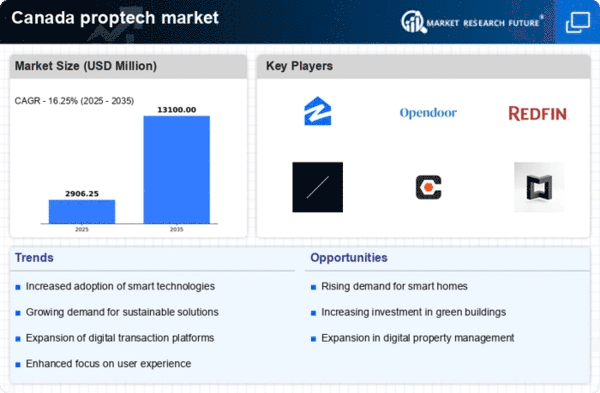
Canada Proptech Market Infographic
Purchase Options

Canada Proptech Market Summary

As per Market Research Future analysis, the Canada Proptech Market size was estimated at 2500.0 USD Million in 2024. The Proptech market is projected to grow from 2906.25 USD Million in 2025 to 13100.0 USD Million by 2035, exhibiting a compound annual growth rate (CAGR) of 16.2% during the forecast period 2025 - 2035

Key Market Trends & Highlights

The Canada proptech market is experiencing a transformative shift towards technology-driven solutions.

  • The largest segment in the Canada proptech market is the residential real estate sector, while the fastest-growing segment is commercial real estate technology.
  • There is a notable increase in the adoption of smart technologies, enhancing property management and user experience.
  • Digital platforms for property transactions are gaining traction, streamlining processes and improving accessibility for consumers.
  • Key market drivers include rising demand for sustainable solutions and the integration of artificial intelligence, which are shaping the future of the industry.

Market Size & Forecast

2024 Market Size 2500.0 (USD Million)
2035 Market Size 13100.0 (USD Million)
CAGR (2025 - 2035) 16.25%

Major Players

Zillow Group (US), Opendoor Technologies (US), Redfin Corporation (US), Compass (US), Procore Technologies (US), Matterport (US), RealPage (US), PropertyGuru (SG), Homie (US)

Our Impact
Enabled $4.3B Revenue Impact for Fortune 500 and Leading Multinationals
Partnering with 2000+ Global Organizations Each Year
30K+ Citations by Top-Tier Firms in the Industry

Canada Proptech Market Trends

The Canada Proptech Market in Canada is currently experiencing a transformative phase, driven by technological advancements and changing consumer preferences. The integration of digital solutions into real estate processes is reshaping how properties are bought, sold, and managed. This evolution appears to be fueled by a growing demand for efficiency, transparency, and enhanced user experiences. As stakeholders increasingly adopt innovative tools, the landscape of property transactions is likely to become more streamlined and accessible. Furthermore, the emphasis on sustainability and smart technologies is influencing investment decisions, suggesting a shift towards eco-friendly solutions in the sector. In addition, the rise of remote work and digital communication tools has altered the dynamics of property management and leasing. Landlords and tenants are now leveraging technology to facilitate virtual tours, online leasing, and digital maintenance requests. This trend indicates a potential long-term change in how real estate services are delivered, with an increasing reliance on digital platforms. As the proptech market continues to evolve, it may present new opportunities for growth and innovation, particularly in areas such as data analytics, artificial intelligence, and blockchain technology. Stakeholders must remain vigilant to adapt to these changes and harness the benefits of emerging technologies.

Increased Adoption of Smart Technologies

The proptech market is witnessing a notable shift towards the integration of smart technologies in residential and commercial properties. This trend encompasses the use of IoT devices, energy-efficient systems, and automation tools that enhance operational efficiency and tenant satisfaction. As consumers become more environmentally conscious, the demand for smart solutions that reduce energy consumption and improve living conditions is likely to rise.

Growth of Digital Platforms for Property Transactions

There is a growing trend towards the utilization of digital platforms for property transactions within the proptech market. These platforms facilitate seamless interactions between buyers, sellers, and agents, streamlining the process of property acquisition and management. The convenience of online listings, virtual tours, and electronic documentation is reshaping traditional practices, making real estate transactions more efficient.

Focus on Data-Driven Decision Making

The emphasis on data analytics in the proptech market is becoming increasingly pronounced. Stakeholders are leveraging data to gain insights into market trends, consumer behavior, and property performance. This data-driven approach enables more informed decision-making, allowing investors and developers to identify opportunities and mitigate risks effectively. As technology continues to advance, the reliance on data is expected to deepen.

Canada Proptech Market Drivers

Expansion of Remote Work Trends

The ongoing expansion of remote work trends is reshaping the proptech market in Canada. As more companies adopt flexible work arrangements, there is a growing demand for residential properties that accommodate home offices and collaborative spaces. This shift is influencing property design and location preferences, with urban areas experiencing a decline in demand while suburban and rural properties gain traction. Data suggests that nearly 40% of Canadians now prefer homes with dedicated workspaces, prompting developers to adapt their offerings. This evolving landscape presents opportunities for innovation within the proptech market.

Increased Focus on Cybersecurity

As the proptech market in Canada continues to digitize, the focus on cybersecurity is intensifying. With the rise of digital platforms for property transactions, safeguarding sensitive data has become paramount. Stakeholders are increasingly investing in robust cybersecurity measures to protect against potential breaches and maintain consumer trust. Recent statistics indicate that cyberattacks in the real estate sector have surged by 25% over the past year. This heightened awareness is driving the development of secure platforms and technologies, which are essential for the continued growth and stability of the proptech market.

Integration of Artificial Intelligence

Artificial Intelligence (AI) is becoming a pivotal driver in the proptech market, particularly in Canada. AI technologies are being utilized to enhance property management, streamline transactions, and improve customer experiences. For instance, AI-driven analytics can predict market trends and optimize pricing strategies, which is crucial for investors and developers. Reports indicate that AI adoption in real estate could lead to a 20% increase in operational efficiency. As AI continues to evolve, its integration into the proptech market is likely to reshape traditional practices, making it a key area of focus for stakeholders.

Rising Demand for Sustainable Solutions

The proptech market in Canada is experiencing a notable shift towards sustainability, driven by increasing consumer awareness and regulatory pressures. As environmental concerns gain prominence, property developers and investors are prioritizing eco-friendly technologies. This trend is reflected in the growing adoption of energy-efficient systems and green building certifications. According to recent data, approximately 30% of new residential projects in Canada now incorporate sustainable practices. This shift not only enhances property value but also aligns with the preferences of environmentally conscious buyers, thereby propelling the growth of the proptech market.

Government Incentives for Technology Adoption

Government initiatives aimed at promoting technology adoption are significantly impacting the proptech market in Canada. Various programs and incentives are being introduced to encourage the integration of digital solutions in real estate transactions and property management. For example, grants and tax credits for adopting smart technologies are becoming more prevalent. These incentives not only lower the financial barriers for property developers but also stimulate innovation within the sector. As a result, the proptech market is likely to see accelerated growth as stakeholders leverage these opportunities to enhance operational efficiency and customer engagement.


Market Segment Insights

By Property Type: Residential (Largest) vs. Commercial (Fastest-Growing)

The Canada proptech market displays a diverse distribution of market share among its property types, with the residential sector holding the largest share. This dominance can be attributed to the high demand for housing solutions and the growing trend of smart home technologies. In contrast, the commercial sector is rapidly gaining traction, driven by advancements in technology and a shift towards remote working, which opens new avenues for proptech solutions tailored for businesses. Growth trends in the Canada proptech market indicate a strong upward trajectory for both residential and commercial segments. Residential property technologies are integrating more automation and connectivity, appealing to tech-savvy consumers. The commercial sector is experiencing accelerated growth fueled by the need for flexible workspace solutions and enhanced building management systems, highlighting a significant transformation characterized by innovation and adaptation to current market needs.

Residential (Dominant) vs. Commercial (Emerging)

The residential segment in the Canada proptech market is characterized by a strong customer base that prioritizes innovative home technologies such as smart security, energy management, and property management platforms. This segment's dominance reflects a broader trend towards sustainable and intelligent living environments. Conversely, the commercial segment is emerging as a vital player, offering solutions that enhance workplace efficiency and resource management. Both segments are on divergent paths; while residential focuses on smart living solutions, commercial emphasizes operational efficiency, indicating a dynamic balance in the market that caters to evolving consumer preferences.

By Solution: Software (Largest) vs. Services (Fastest-Growing)

The Canada proptech market exhibits a diverse distribution of market share across its solution segments, with software leading as the most substantial component. This dominance stems from the increasing need for innovative property management tools that streamline operations and enhance user engagement. Meanwhile, the services segment, although smaller, is rapidly expanding, driven by the growing demand for consultancy and support services that cater to the evolving needs of the real estate sector. Growth trends in the Canada proptech market are shaped by technological advancements and changing consumer expectations. A surging interest in automation and data analytics favors software applications that provide insightful metrics for decision-making. Concurrently, the services segment is experiencing a boom as firms seek specialized expertise to navigate the complexities of digital transformation, making it the fastest-growing area within the market.

Software (Dominant) vs. Services (Emerging)

Software holds a dominant position in the Canada proptech market, catering to a wide range of needs from property management to real estate analytics. Its capabilities offer robust solutions that empower businesses to optimize operations and enhance customer experiences. In contrast, the services segment is emerging as a vital player, characterized by customized offerings such as consulting and implementation support. As firms transition to more technology-driven operational models, the demand for these services is spiking, highlighting the necessity for expertise in the implementation of proptech solutions. This dynamic interplay between software dominance and the growth of service offerings showcases the evolving landscape of the market.

By Deployment: Cloud-based (Largest) vs. On-premises (Fastest-Growing)

The deployment segment in the Canada proptech market is currently dominated by cloud-based solutions, which have established themselves as the preferred choice among real estate companies due to their scalability and ease of access. On-premises solutions, while traditionally popular, are losing ground owing to the rising demand for flexible and cost-effective cloud options that cater to the modern needs of businesses. Growth trends within this segment are heavily influenced by technological advancements and the increasing pressure for operational efficiency. Cloud-based deployments are seeing robust adoption rates across various sectors, driven by their ability to facilitate remote operations and real-time data access. Conversely, on-premises solutions are observed to be the fastest-growing due to specific industries that require enhanced data security and control, thus creating a niche market for these offerings.

Cloud-based (Dominant) vs. On-premises (Emerging)

Cloud-based deployments are recognized as the dominant solution in the Canada proptech market, providing users with significant advantages such as lower upfront costs, automatic updates, and easier scalability. These platforms enable firms to leverage big data analytics and improve customer engagement through enhanced connectivity. On the other hand, on-premises solutions are emerging as a viable option for businesses that prioritize data security and control, particularly in sectors where sensitive information must be managed within local servers. This dual landscape showcases a transition within the market, where companies are gradually moving towards cloud solutions while simultaneously seeking robust on-premises alternatives to address their specific operational needs.

By End User: Property Managers/ Agents (Largest) vs. Property Investors (Fastest-Growing)

In the Canada proptech market, the distribution of market share among the end user segments reveals that Property Managers/ Agents hold the largest share, significantly influencing technological adoption in property management. This segment benefits from an established base, leveraging various digital tools to optimize operations and enhance tenant experiences. Following them, Property Investors have shown an increasing interest in integrating proptech solutions for better investment insights and property management efficiencies, making them a key player in this dynamic landscape. Growth trends within the end user segment indicate a strong shift towards digitization, especially among Property Investors, who are rapidly embracing technology to make informed decisions based on real-time data. Factors driving this growth include the demand for enhanced operational efficiencies, the rise of data analytics in property valuation, and a growing focus on tenant satisfaction. Additionally, the increasing availability of advanced proptech solutions tailored for different end-user categories is further propelling adoption rates across the board.

Property Managers/ Agents (Dominant) vs. Property Investors (Emerging)

Property Managers/ Agents stand as the dominant force in the end user segment of the Canada proptech market, with established processes and a strong focus on efficiency. They integrate various proptech solutions to manage properties more effectively, streamline operations, and enhance tenant experiences. This segment is characterized by its dependence on comprehensive management software, which aids in tenant communication, leasing processes, and maintenance tracking. In contrast, Property Investors represent an emerging segment, increasingly adopting proptech tools to gain insights into market conditions and investment opportunities. Their approach is innovation-driven, concentrating on utilizing data analytics and digital platforms to maximize returns on investments. As the demand for sophisticated investment strategies rises, Property Investors are set to reshape the landscape of the market.

Get more detailed insights about Canada Proptech Market

Key Players and Competitive Insights

The proptech market in Canada is currently characterized by a dynamic competitive landscape, driven by technological advancements and evolving consumer preferences. Key players such as Zillow Group (US), Opendoor Technologies (US), and Redfin Corporation (US) are actively shaping the market through innovative strategies and operational focuses. Zillow Group (US) has positioned itself as a leader in digital real estate services, emphasizing user experience and data analytics to enhance property listings. Meanwhile, Opendoor Technologies (US) has concentrated on streamlining the home buying and selling process through its digital platform, which facilitates quick transactions and transparency. Redfin Corporation (US) has adopted a hybrid model that combines technology with traditional real estate services, aiming to provide a more efficient and cost-effective solution for consumers. Collectively, these strategies contribute to a competitive environment that prioritizes innovation and customer-centric solutions.
The business tactics employed by these companies reflect a broader trend towards localization and optimization within the market. The competitive structure appears moderately fragmented, with numerous players vying for market share while also collaborating in certain areas. This fragmentation allows for diverse offerings, yet the influence of major players remains significant, as they set benchmarks for service quality and technological integration.
In October 2025, Zillow Group (US) announced a partnership with a leading AI firm to enhance its property valuation algorithms. This strategic move is likely to improve the accuracy of property assessments, thereby attracting more users to its platform. By leveraging AI, Zillow Group (US) aims to solidify its market position and provide a more reliable service to consumers, which could lead to increased market share.
In September 2025, Opendoor Technologies (US) expanded its operations into several new Canadian cities, including Calgary and Ottawa. This expansion reflects a strategic effort to tap into emerging markets and diversify its geographical footprint. By entering these markets, Opendoor Technologies (US) is likely to capture a broader customer base, enhancing its competitive edge in the Canadian proptech landscape.
In August 2025, Redfin Corporation (US) launched a new feature that allows users to conduct virtual home tours using augmented reality (AR). This innovation not only enhances user engagement but also aligns with the growing demand for digital solutions in real estate. By integrating AR technology, Redfin Corporation (US) positions itself as a forward-thinking player, likely attracting tech-savvy consumers who prefer immersive experiences.
As of November 2025, the competitive trends within the proptech market are increasingly defined by digitalization, sustainability, and the integration of AI technologies. Strategic alliances among companies are shaping the landscape, fostering innovation and enhancing service offerings. Looking ahead, competitive differentiation is expected to evolve, with a shift from price-based competition towards a focus on technological innovation and supply chain reliability. Companies that prioritize these aspects are likely to thrive in an increasingly competitive environment.

Key Companies in the Canada Proptech Market include

Industry Developments

The Canada PropTech Market has seen various significant developments throughout 2023. Companies like Properly and Livabl have reported growth driven by an increase in demand for digital real estate solutions, reflecting changing consumer behavior post-pandemic. Additionally, in September 2023, Condo Control enhanced its service offering by expanding its property management capabilities, indicating a trend toward comprehensive solutions in the PropTech space. In terms of mergers and acquisitions, BuildingStack acquired Naborly in August 2023 to augment its tenant tracking services, showcasing strategic moves within the sector.

The market valuation for these companies continues to rise, with major players like OJO Labs and Structur3D reporting substantial investments and partnerships that further solidify their market positions. Zolo's recent expansion into new markets has also captured attention, highlighting the growing competitive landscape in Canada’s PropTech environment. Over the last couple of years, initiatives aimed at improving housing affordability through technology, alongside greater digitization of traditional real estate practices, have garnered notable attention. As the market evolves, the focus remains on enhancing user experience and operational efficiency through innovative technology solutions.


Future Outlook

Canada Proptech Market Future Outlook

The proptech market in Canada is projected to grow at a 16.25% CAGR from 2025 to 2035, driven by technological advancements, urbanization, and increased investment in real estate.

New opportunities lie in:

  • Development of AI-driven property management platforms
  • Integration of blockchain for secure real estate transactions
  • Expansion of virtual reality tools for property showcasing

By 2035, the proptech market is expected to be robust, reflecting substantial growth and innovation.

Market Segmentation

Canada Proptech Market End User Outlook

  • Housing Associations
  • Property Managers/ Agents
  • Property Investors
  • Others

Canada Proptech Market Solution Outlook

  • Software
  • Services

Canada Proptech Market Deployment Outlook

  • Cloud-based
  • On-premises

Canada Proptech Market Property Type Outlook

  • Residential
  • Commercial
  • Industrial

Report Scope

MARKET SIZE 2024 2500.0(USD Million)
MARKET SIZE 2025 2906.25(USD Million)
MARKET SIZE 2035 13100.0(USD Million)
COMPOUND ANNUAL GROWTH RATE (CAGR) 16.25% (2025 - 2035)
REPORT COVERAGE Revenue Forecast, Competitive Landscape, Growth Factors, and Trends
BASE YEAR 2024
Market Forecast Period 2025 - 2035
Historical Data 2019 - 2024
Market Forecast Units USD Million
Key Companies Profiled Zillow Group (US), Opendoor Technologies (US), Redfin Corporation (US), Compass (US), Procore Technologies (US), Matterport (US), RealPage (US), PropertyGuru (SG), Homie (US)
Segments Covered Property Type, Solution, Deployment, End User
Key Market Opportunities Integration of artificial intelligence in property management enhances operational efficiency and tenant experience.
Key Market Dynamics Technological advancements drive innovation in property management solutions, reshaping the competitive landscape in Canada.
Countries Covered Canada
Leave a Comment

FAQs

What is the projected market size of the Canada PropTech Market in 2024?

The Canada PropTech Market is expected to be valued at 3.8 USD Billion in 2024.

What will be the estimated market size of the Canada PropTech Market by 2035?

By 2035, the Canada PropTech Market is projected to reach a valuation of 22.1 USD Billion.

What is the expected compound annual growth rate (CAGR) for the Canada PropTech Market from 2025 to 2035?

The expected CAGR for the Canada PropTech Market from 2025 to 2035 is 17.357%.

Which segments are included in the Canada PropTech Market by property type?

The Canada PropTech Market is segmented by property type into Residential, Commercial, and Industrial.

How is the Residential segment performing in the Canada PropTech Market for 2024?

The Residential segment is valued at 1.5 USD Billion in 2024.

What is the projected value of the Commercial segment in the Canada PropTech Market for 2035?

The Commercial segment is expected to reach a value of 9.9 USD Billion by 2035.

What is the market size for the Industrial segment in the Canada PropTech Market for 2024?

The Industrial segment is valued at 0.5 USD Billion in 2024.

Who are some of the key players in the Canada PropTech Market?

Key players in the Canada PropTech Market include Condo Control, Properly, Riot Realty, Livabl, and Structur3D.

What opportunities exist for growth in the Canada PropTech Market?

Rapid technology adoption, urbanization, and increasing demand for digital solutions present significant growth opportunities.

What challenges does the Canada PropTech Market currently face?

The market faces challenges such as regulatory hurdles and the need for standardization across platforms.

Download Free Sample

Kindly complete the form below to receive a free sample of this Report

Compare Licence

×
Features License Type
Single User Multiuser License Enterprise User
Price $4,950 $5,950 $7,250
Maximum User Access Limit 1 User Upto 10 Users Unrestricted Access Throughout the Organization
Free Customization
Direct Access to Analyst
Deliverable Format
Platform Access
Discount on Next Purchase 10% 15% 15%
Printable Versions