×
Request Free Sample ×

Kindly complete the form below to receive a free sample of this Report

* Please use a valid business email

Leading companies partner with us for data-driven Insights

clients tt-cursor
Hero Background

Canada Pharmaceutical Packaging Market

ID: MRFR/PCM/44143-HCR
111 Pages
Snehal Singh
February 2026

Canada Pharmaceutical Packaging Market Research Report By Product Outlook (Vials, Bottles and Jars, Cartridges and Syringes, Ampoules), By Material Type Outlook (Type I, Type II, Type III), and By Application Outlook (Generic Drugs, Branded Drugs, Biological Drugs)- Forecast to 2035.

Share:
Download PDF ×

We do not share your information with anyone. However, we may send you emails based on your report interest from time to time. You may contact us at any time to opt-out.

Canada Pharmaceutical Packaging Market Infographic
Purchase Options

Canada Pharmaceutical Packaging Market Summary

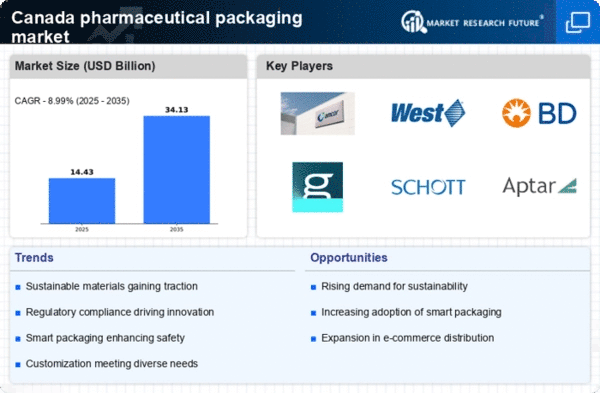
As per Market Research Future analysis, the Canada pharmaceutical packaging market size was estimated at 13.24 USD Billion in 2024. The Canada pharmaceutical packaging market is projected to grow from 14.43 USD Billion in 2025 to 34.13 USD Billion by 2035, exhibiting a compound annual growth rate (CAGR) of 8.9% during the forecast period 2025 - 2035

Key Market Trends & Highlights

The Canada pharmaceutical packaging market is experiencing a shift towards sustainability and technological innovation.

  • Sustainability initiatives are increasingly shaping packaging strategies across the market.
  • Smart packaging solutions are gaining traction, enhancing user experience and product safety.
  • The biopharmaceutical segment remains the largest, while the demand for user-friendly packaging is the fastest-growing segment.
  • Technological advancements in packaging and regulatory compliance are key drivers propelling market growth.

Market Size & Forecast

2024 Market Size 13.24 (USD Billion)
2035 Market Size 34.13 (USD Billion)
CAGR (2025 - 2035) 8.99%

Major Players

Amcor (AU), West Pharmaceutical Services (US), Becton Dickinson (US), Gerresheimer (DE), Schott AG (DE), AptarGroup (US), Catalent (US), Sanner (DE), MediPharm (AU)

Our Impact
Enabled $4.3B Revenue Impact for Fortune 500 and Leading Multinationals
Partnering with 2000+ Global Organizations Each Year
30K+ Citations by Top-Tier Firms in the Industry

Canada Pharmaceutical Packaging Market Trends

The pharmaceutical packaging market is currently experiencing notable transformations driven by advancements in technology and evolving regulatory frameworks. In Canada, the emphasis on sustainability is becoming increasingly pronounced, as stakeholders seek to minimize environmental impact while ensuring product safety and efficacy. This shift is reflected in the growing adoption of eco-friendly materials and innovative designs that enhance recyclability. Furthermore, the integration of smart packaging solutions is gaining traction, allowing for improved tracking and monitoring of pharmaceuticals throughout the supply chain. These developments not only cater to consumer preferences but also align with governmental initiatives aimed at promoting sustainable practices within the healthcare sector. In addition to sustainability, the pharmaceutical packaging market is witnessing a surge in demand for child-resistant and tamper-evident packaging solutions. This trend is largely influenced by heightened awareness regarding medication safety and the need to prevent accidental ingestion, particularly among children. Regulatory bodies in Canada are increasingly mandating stringent packaging requirements to ensure consumer protection. As a result, manufacturers are investing in research and development to create packaging that meets these standards while maintaining functionality and aesthetic appeal. Overall, the pharmaceutical packaging market reflects a dynamic interplay of innovation, safety, and environmental responsibility.

Sustainability Initiatives

The pharmaceutical packaging market is increasingly focusing on sustainability initiatives. Stakeholders are prioritizing eco-friendly materials and designs that reduce environmental impact. This trend aligns with governmental policies promoting sustainable practices, encouraging manufacturers to innovate in packaging solutions.

Smart Packaging Solutions

There is a growing interest in smart packaging solutions within the pharmaceutical packaging market. These technologies enhance product tracking and monitoring, improving supply chain efficiency. The integration of smart features caters to consumer demands for transparency and safety.

Safety and Compliance Standards

The pharmaceutical packaging market is adapting to stricter safety and compliance standards. Regulatory bodies are enforcing more rigorous packaging requirements to ensure consumer protection. This trend drives manufacturers to develop child-resistant and tamper-evident packaging solutions.

Canada Pharmaceutical Packaging Market Drivers

Rising Demand for Biopharmaceuticals

The increasing prevalence of chronic diseases and the aging population in Canada are driving the demand for biopharmaceuticals. This trend is significantly impacting the pharmaceutical packaging market, as biopharmaceuticals often require specialized packaging solutions to maintain stability and efficacy. The market for biopharmaceutical packaging is expected to grow by 12% over the next five years. Packaging solutions that offer temperature control and protection from light are becoming essential. As biopharmaceuticals continue to gain traction, manufacturers are compelled to innovate and adapt their packaging strategies to meet the unique requirements of these products, thereby propelling growth in the pharmaceutical packaging market.

Technological Advancements in Packaging

The pharmaceutical packaging market is experiencing a notable transformation due to rapid technological advancements. Innovations such as automated packaging lines and advanced materials are enhancing efficiency and reducing production costs. In Canada, the adoption of smart packaging technologies is on the rise, with an estimated market growth of 15% annually. These technologies not only improve the shelf life of products but also ensure better tracking and traceability, which is crucial for compliance with regulatory standards. As the demand for high-quality packaging solutions increases, manufacturers are investing in research and development to create more sophisticated packaging options. This trend is likely to continue, driving growth in the pharmaceutical packaging market as companies seek to differentiate their products and enhance consumer safety.

Sustainability and Eco-Friendly Practices

Sustainability is becoming a pivotal concern in the pharmaceutical packaging market. In Canada, there is a growing emphasis on eco-friendly packaging solutions as consumers and regulatory bodies advocate for reduced environmental impact. The market is projected to expand by 8% as companies adopt sustainable practices, such as using recyclable materials and minimizing waste. This shift not only aligns with consumer values but also helps companies comply with emerging regulations aimed at reducing plastic use. As the pharmaceutical packaging market evolves, manufacturers are likely to invest in sustainable technologies and materials, reflecting a broader commitment to environmental stewardship.

Regulatory Compliance and Quality Assurance

Regulatory compliance remains a critical driver in the pharmaceutical packaging market. In Canada, stringent regulations imposed by Health Canada necessitate that packaging solutions meet specific safety and quality standards. This has led to an increased focus on quality assurance processes among manufacturers. Companies are investing in advanced testing and validation methods to ensure that their packaging complies with these regulations. The market is projected to grow by 10% as firms prioritize compliance to avoid costly penalties and product recalls. Furthermore, adherence to these regulations not only protects consumers but also enhances brand reputation, making it a vital aspect of the pharmaceutical packaging market.

Consumer Preferences for User-Friendly Packaging

Consumer preferences are evolving, with a growing demand for user-friendly packaging solutions in the pharmaceutical packaging market. In Canada, patients increasingly seek packaging that is easy to open, resealable, and provides clear dosage instructions. This shift in consumer behavior is prompting manufacturers to rethink their packaging designs. The market is likely to see a 9% increase as companies focus on enhancing the user experience. By incorporating features such as child-resistant closures and easy-to-read labels, manufacturers can cater to the needs of diverse consumer segments, including the elderly and those with disabilities. This trend underscores the importance of consumer-centric design in the pharmaceutical packaging market.


Market Segment Insights

By Formulation Type: Solid (Largest) vs. Liquid (Fastest-Growing)

In the Canada pharmaceutical packaging market, the formulation type segment displays significant diversity. Solid formulations, including tablets and capsules, dominate the market due to their stability, ease of handling, and well-established manufacturing processes. Liquid formulations are also substantial but have a smaller market share compared to solids. Semi-solid and gaseous formulations hold niche positions, catering to specific therapeutic needs, but their overall share remains limited compared to solids and liquids. Growth trends indicate a consistent rise in the liquid formulation segment, propelled by increasing demands for oral solutions and injectables, especially in therapeutic areas like oncology and diabetes management. The emergence of biologics and personalized medicine is also driving innovation in liquid and semi-solid formulations. While solid formulations remain predominant, liquid formats are increasingly favored for their versatility and efficacy in drug delivery, highlighting their fastest-growing nature in the market.

Solid: Dominant vs. Liquid: Emerging

Solid formulations occupy a dominant position in the Canada pharmaceutical packaging market, attributed to their longer shelf life and easier logistics. They are extensively used for chronic diseases due to their convenience in dosing and administration. Liquid formulations, on the other hand, are emerging rapidly as a preferred choice in therapeutic applications where accurate dosing or faster absorption is crucial. They are often utilized in hospitals and outpatient settings for their adaptability and effectiveness. As healthcare evolves towards personalized medicine, the demand for both formulation types will remain strong, with solid formulations maintaining their existing leadership but with liquids gaining traction in response to new healthcare needs and innovations.

By Material Type: Plastic (Largest) vs. Glass (Fastest-Growing)

In the Canada pharmaceutical packaging market, the distribution of market share among material types reveals a clear hierarchy. Plastic dominates the landscape, accounting for a substantial share due to its versatility and cost-effectiveness. Followed by glass, which has captured attention for its premium appeal and sustainable attributes. Metal and paper both hold smaller slices but are recognized for their unique functionalities and niche applications in the sector. Growth trends indicate a significant shift towards innovation and sustainability in material choices. The increasing preference for eco-friendly packaging solutions is driving the demand for recyclable materials like glass and metal. Meanwhile, the efficiency and lightweight nature of plastics continue to sustain its leading position. Advancements in material technology are further propelling growth, especially for glass as an emerging option favored by pharmaceutical companies aiming for quality and compliance.

Plastic (Dominant) vs. Glass (Emerging)

Plastic packaging remains the dominant force in the Canada pharmaceutical packaging market, prized for its lightweight, durability, and cost-effectiveness. It is widely used for various pharmaceutical products, particularly in bulk packaging due to its flexibility and protection against contamination. The low manufacturing costs associated with plastic production ensure its continued prevalence. Conversely, glass is an emerging material that is gaining traction, especially among high-end pharmaceutical products. Its ability to preserve drug integrity, alongside increased consumer demand for sustainable packaging, has propelled glass into a more competitive space. Both materials exhibit unique strengths; however, the challenge lies in balancing performance with eco-friendliness as environmental regulations tighten.

By Packaging Type: Bottles (Largest) vs. Blisters (Fastest-Growing)

In the Canada pharmaceutical packaging market, the segment values exhibit diverse market shares, with bottles securing the largest share due to their widespread use for liquid medications. Blisters, on the other hand, have gained traction due to their convenience and efficacy in unit-dose packaging, emerging as a significant player in the market landscape. The growth of the packaging type segment is propelled by increasing demand for safe and effective drug delivery systems. Bottles, with their established reliability, continue to dominate, while blisters are experiencing rapid growth thanks to their ability to enhance patient compliance. Innovations and advancements in packaging technology further fuel the demand, establishing a competitive market for both segment values.

Bottles: Dominant vs. Blisters: Emerging

Bottles have long been a staple in pharmaceutical packaging, known for their versatility and effective containment of various liquid formulations. Their dominance in the market is attributed to their user-friendly design, which allows for easy dispensing and dosing. Conversely, blisters represent an emerging trend in the Canada pharmaceutical packaging market, offering individuallized dosing options that enhance medication adherence and reduce waste. As healthcare providers emphasize the importance of compliance, the demand for blisters is climbing, making them a key focus for manufacturers aiming to innovate and expand their product lines.

By End Use: Pharmaceutical Companies (Largest) vs. Contract Packaging Organizations (Fastest-Growing)

In the Canada pharmaceutical packaging market, the distribution of market share among the end-use segments reveals that pharmaceutical companies hold the largest share, leveraging their established market presence and extensive distribution networks. These companies are increasingly adopting advanced packaging solutions to enhance drug safety, effectiveness, and compliance, thus solidifying their leading position. On the other hand, contract packaging organizations are emerging rapidly, catering to a diverse range of client needs and exhibiting growth driven by an increase in outsourcing trends among pharmaceutical firms. This shift enables companies to focus on core competencies while relying on specialized packaging services. The growth trends in this segment are largely influenced by the evolving regulatory requirements and the rising demand for innovative packaging solutions in the pharmaceutical industry. The emphasis on cost-efficiency and product differentiation is propelling contract packaging organizations to adopt new technologies such as smart packaging and eco-friendly materials. Additionally, the ongoing expansion of the biopharmaceutical sector further stimulates demand across these segments as companies seek packaging that ensures drug integrity and compliance with stringent regulations. The strategic collaborations between pharmaceutical companies and contract packaging organizations are expected to enhance operational efficiency and drive future growth in the Canada pharmaceutical packaging market.

Pharmaceutical Companies (Dominant) vs. Contract Packaging Organizations (Emerging)

Pharmaceutical companies are considered the dominant force in the Canada pharmaceutical packaging market, characterized by strong brand recognition and substantial investments in R&D and packaging innovation. They prioritize high-quality materials and advanced technologies to meet rigorous safety and compliance standards, ensuring the optimal delivery and efficacy of their products. In contrast, contract packaging organizations are emerging as key players, providing specialized services that address the growing need for flexibility and efficiency within pharmaceutical supply chains. These organizations excel in customizing packaging solutions tailored to client requirements, including the use of sustainable materials and smart packaging technologies. As a result, contract packaging organizations are becoming essential partners for pharmaceutical companies aiming for operational excellence and market competitiveness.

Get more detailed insights about Canada Pharmaceutical Packaging Market

Key Players and Competitive Insights

The pharmaceutical packaging market in Canada is characterized by a dynamic competitive landscape, driven by innovation, regulatory compliance, and the increasing demand for advanced packaging solutions. Key players such as Amcor (AU), West Pharmaceutical Services (US), and Becton Dickinson (US) are at the forefront, each adopting distinct strategies to enhance their market presence. Amcor (AU) focuses on sustainable packaging solutions, aligning with global trends towards environmental responsibility. Meanwhile, West Pharmaceutical Services (US) emphasizes innovation in drug delivery systems, which is crucial for meeting the evolving needs of healthcare providers and patients. Becton Dickinson (US) is strategically positioned through its extensive product portfolio and commitment to quality, which collectively shapes a competitive environment that is increasingly focused on technological advancements and sustainability.In terms of business tactics, companies are localizing manufacturing to reduce lead times and enhance supply chain efficiency. The market structure appears moderately fragmented, with several players vying for market share. This fragmentation allows for a diverse range of products and services, but also intensifies competition among key players. The collective influence of these companies is significant, as they continuously adapt to market demands and regulatory changes, thereby shaping the overall competitive dynamics.
In October Amcor (AU) announced a partnership with a leading biotechnology firm to develop eco-friendly packaging solutions tailored for biologics. This strategic move underscores Amcor's commitment to sustainability while addressing the specific needs of the biotech sector, which is experiencing rapid growth. Such collaborations are likely to enhance Amcor's competitive edge by positioning it as a leader in sustainable packaging innovations.
In September West Pharmaceutical Services (US) launched a new line of smart packaging solutions that integrate digital technologies for enhanced traceability and compliance. This initiative reflects a growing trend towards digitalization in the pharmaceutical packaging sector, enabling better monitoring of product integrity throughout the supply chain. The introduction of smart packaging is expected to bolster West's market position by appealing to clients seeking advanced solutions that ensure safety and regulatory adherence.
In August Becton Dickinson (US) expanded its manufacturing capabilities in Canada, investing approximately $50M to enhance production efficiency and meet increasing demand. This expansion not only signifies Becton's commitment to the Canadian market but also highlights the importance of local manufacturing in ensuring supply chain reliability. Such investments are likely to strengthen Becton's competitive position by enabling quicker response times to market needs.
As of November current trends in the pharmaceutical packaging market include a pronounced shift towards digitalization, sustainability, and the integration of artificial intelligence (AI) in packaging solutions. Strategic alliances are increasingly shaping the landscape, as companies collaborate to leverage complementary strengths. The competitive differentiation is expected to evolve, moving away from price-based competition towards innovation, technology, and supply chain reliability. This shift indicates a future where companies that prioritize these aspects will likely gain a competitive advantage in the market.

Key Companies in the Canada Pharmaceutical Packaging Market include

Industry Developments

The Canada Pharmaceutical Packaging Market has seen significant developments recently, driven by increasing demand for safe and efficient drug delivery methods. Companies like Smurfit Kappa and Amcor have been innovating sustainable packaging solutions, responding to the growing emphasis on environmental responsibility within the sector.In October 2023, Gerresheimer announced investments in its production facilities in Canada to enhance capabilities in producing complex drug delivery systems. Meanwhile, Berry Global has focused on expanding its product range to include advanced packaging for biologics.Additionally, CCL Industries continues to enhance its presence through new technology implementations aimed at improving compliance and safety in drug packaging.

The market is experiencing robust growth, fueled by government initiatives to boost pharmaceutical manufacturing in Canada, with a reported valuation increase attributed to technological advancements and the push for sustainability.However, no major mergers or acquisitions among the targeted companies have been publicly announced in recent months. The competitive landscape remains dynamic as companies strive to meet the evolving regulatory requirements and consumer expectations for high-quality pharmaceutical packaging.Recent trends indicate a heightened focus on innovation and sustainability, significantly impacting the overall market landscape in Canada.

Future Outlook

Canada Pharmaceutical Packaging Market Future Outlook

The pharmaceutical packaging market in Canada is projected to grow at 8.99% CAGR from 2025 to 2035, driven by technological advancements and increasing demand for safety and compliance.

New opportunities lie in:

  • Development of smart packaging solutions with integrated sensors Expansion of eco-friendly packaging materials for sustainability Implementation of automated packaging lines to enhance efficiency

By 2035, the market is expected to achieve robust growth, driven by innovation and sustainability.

Market Segmentation

Canada Pharmaceutical Packaging Market End Use Outlook

  • Pharmaceutical Companies
  • Contract Packaging Organizations
  • Research Laboratories

Canada Pharmaceutical Packaging Market Material Type Outlook

  • Plastic
  • Glass
  • Metal
  • Paper

Canada Pharmaceutical Packaging Market Packaging Type Outlook

  • Bottles
  • Blisters
  • Syringes
  • Pouches
  • Boxes

Canada Pharmaceutical Packaging Market Formulation Type Outlook

  • Solid
  • Liquid
  • Semi-Solid
  • Gaseous

Report Scope

MARKET SIZE 2024 13.24(USD Billion)
MARKET SIZE 2025 14.43(USD Billion)
MARKET SIZE 2035 34.13(USD Billion)
COMPOUND ANNUAL GROWTH RATE (CAGR) 8.99% (2025 - 2035)
REPORT COVERAGE Revenue Forecast, Competitive Landscape, Growth Factors, and Trends
BASE YEAR 2024
Market Forecast Period 2025 - 2035
Historical Data 2019 - 2024
Market Forecast Units USD Billion
Key Companies Profiled Amcor (AU), West Pharmaceutical Services (US), Becton Dickinson (US), Gerresheimer (DE), Schott AG (DE), AptarGroup (US), Catalent (US), Sanner (DE), MediPharm (AU)
Segments Covered Formulation Type, Material Type, Packaging Type, End Use
Key Market Opportunities Adoption of sustainable materials in pharmaceutical packaging aligns with regulatory trends and consumer preferences.
Key Market Dynamics Rising demand for sustainable packaging solutions drives innovation in the pharmaceutical packaging market.
Countries Covered Canada
Leave a Comment

FAQs

What is the projected market size of the Canada Pharmaceutical Packaging Market in 2024?

The Canada Pharmaceutical Packaging Market is expected to be valued at 9.78 billion USD in 2024.

What is the expected market size for the Canada Pharmaceutical Packaging Market by 2035?

In 2035, the Canada Pharmaceutical Packaging Market is anticipated to reach a value of 18.72 billion USD.

What is the expected compound annual growth rate (CAGR) for the Canada Pharmaceutical Packaging Market from 2025 to 2035?

The expected CAGR for the Canada Pharmaceutical Packaging Market during the period from 2025 to 2035 is 6.075%.

Which product segment is valued the highest in the Canada Pharmaceutical Packaging Market for 2024?

The Bottles & Jars segment is valued at 3.14 billion USD in the Canada Pharmaceutical Packaging Market for 2024.

What is the market size for the Vials segment in the Canada Pharmaceutical Packaging Market by 2035?

The Vials segment is projected to reach 5.08 billion USD in the Canada Pharmaceutical Packaging Market by 2035.

Who are the key players in the Canada Pharmaceutical Packaging Market?

Major players in the Canada Pharmaceutical Packaging Market include Smurfit Kappa, Stora Enso, Gerresheimer, and Berry Global.

What is the market size for the Cartridges & Syringes segment in 2024?

The Cartridges & Syringes segment is valued at 2.43 billion USD in 2024 within the Canada Pharmaceutical Packaging Market.

What is the market value for Ampoules in the Canada Pharmaceutical Packaging Market by 2035?

The Ampoules segment is projected to reach a value of 3.89 billion USD by 2035.

What are the growth drivers for the Canada Pharmaceutical Packaging Market?

Growth drivers for the Canada Pharmaceutical Packaging Market include increasing demand for pharmaceutical products and innovation in packaging solutions.

How is the Canada Pharmaceutical Packaging Market expected to evolve in the coming years?

The Canada Pharmaceutical Packaging Market is expected to evolve with a significant increase in demand and advancements in packaging technologies from 2025 to 2035.

Download Free Sample

Kindly complete the form below to receive a free sample of this Report

Compare Licence

×
Features License Type
Single User Multiuser License Enterprise User
Price $4,950 $5,950 $7,250
Maximum User Access Limit 1 User Upto 10 Users Unrestricted Access Throughout the Organization
Free Customization
Direct Access to Analyst
Deliverable Format
Platform Access
Discount on Next Purchase 10% 15% 15%
Printable Versions