×
Request Free Sample ×

Kindly complete the form below to receive a free sample of this Report

* Please use a valid business email

Leading companies partner with us for data-driven Insights

clients tt-cursor
Hero Background

Canada Led Lighting Market

ID: MRFR/SEM/46824-HCR
200 Pages
Garvit Vyas
February 2026

Canada LED Lighting Market Size, Share and Research Report By Installation Type (New Installation, Retrofit), By Product Type (Lamps, Luminaries), By Distribution Channel (Store Based, Non-Store Based) and By End-Use Application (Indoor Lighting, Outdoor Lighting) - Industry Forecast Till 2035

Share:
Download PDF ×

We do not share your information with anyone. However, we may send you emails based on your report interest from time to time. You may contact us at any time to opt-out.

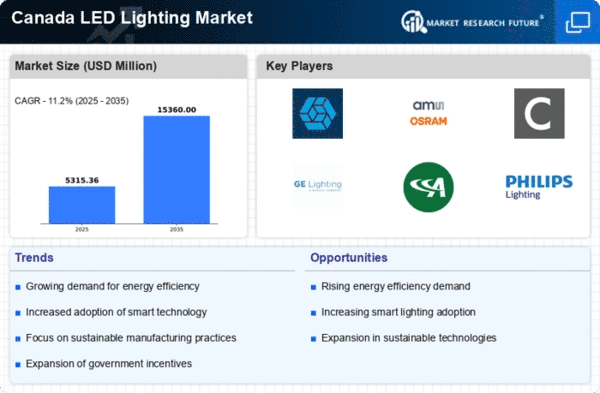
Canada Led Lighting Market Infographic
Purchase Options

Canada Led Lighting Market Summary

As per Market Research Future analysis, the Canada LED Lighting Market Size was estimated at 4780.0 USD Million in 2024. The Canada led lighting market is projected to grow from 5315.36 USD Million in 2025 to 15360.0 USD Million by 2035, exhibiting a compound annual growth rate (CAGR) of 11% during the forecast period 2025 - 2035

Key Market Trends & Highlights

The Canada LED Lighting Market is experiencing robust growth driven by technological advancements and sustainability initiatives.

  • Technological advancements in LED lighting are enhancing energy efficiency and performance across various applications.
  • The residential segment represents the largest share of the market, while the commercial segment is the fastest-growing due to increased urbanization.
  • Smart lighting integration is becoming increasingly prevalent, reflecting a shift towards more automated and energy-efficient solutions.
  • Government incentives for energy efficiency and rising energy costs are key drivers propelling the market forward.

Market Size & Forecast

2024 Market Size 4780.0 (USD Million)
2035 Market Size 15360.0 (USD Million)
CAGR (2025 - 2035) 11.2%

Major Players

Signify (NL), Osram (DE), Cree (US), GE Lighting (US), Acuity Brands (US), Philips Lighting (NL), Samsung Electronics (KR), LG Electronics (KR), Zumtobel Group (AT)

Our Impact
Enabled $4.3B Revenue Impact for Fortune 500 and Leading Multinationals
Partnering with 2000+ Global Organizations Each Year
30K+ Citations by Top-Tier Firms in the Industry

Canada Led Lighting Market Trends

The LED Lighting Market is currently experiencing a notable transformation, driven by advancements in technology and increasing awareness of energy efficiency. As consumers and businesses alike seek sustainable solutions, the demand for energy-efficient lighting options continues to rise. This shift is further supported by government initiatives aimed at reducing carbon footprints and promoting environmentally friendly practices. The integration of smart technologies into lighting systems is also gaining traction, allowing for enhanced control and customization. Consequently, the market is evolving to meet the needs of a more environmentally conscious consumer base. In addition, the led lighting market is witnessing a surge in applications across various sectors, including residential, commercial, and industrial. The versatility of led lighting solutions makes them suitable for a wide range of uses, from decorative lighting in homes to functional lighting in workplaces. This adaptability is likely to drive further growth as industries recognize the long-term cost savings associated with led technology. Overall, the landscape of the led lighting market appears promising, with ongoing innovations and a strong push towards sustainability shaping its future.

Technological Advancements

The led lighting market is benefiting from rapid technological innovations that enhance performance and efficiency. New developments in light-emitting diode technology are leading to improved brightness, color rendering, and lifespan. These advancements are likely to attract more consumers and businesses, as they seek reliable and high-quality lighting solutions.

Sustainability Focus

There is a growing emphasis on sustainability within the led lighting market, driven by both consumer preferences and regulatory frameworks. As environmental concerns become more prominent, the demand for energy-efficient lighting solutions is increasing. This trend suggests that manufacturers will continue to prioritize eco-friendly practices in their production processes.

Smart Lighting Integration

The integration of smart technologies into the led lighting market is becoming increasingly prevalent. Smart lighting systems offer features such as remote control, automation, and energy monitoring. This trend indicates a shift towards more connected and efficient lighting solutions, appealing to tech-savvy consumers and businesses looking to optimize energy usage.

Canada Led Lighting Market Drivers

Rising Energy Costs

The escalating costs of energy in Canada are propelling the led lighting market forward. As electricity prices continue to rise, consumers and businesses are increasingly seeking cost-effective solutions to manage their energy expenses. LED lighting, known for its energy efficiency and longevity, presents a compelling alternative to traditional lighting options. In 2025, it is estimated that LED lighting could reduce energy consumption by up to 75% compared to incandescent bulbs. This substantial reduction in energy use not only lowers utility bills but also aligns with the growing demand for sustainable practices. As energy costs remain a pressing concern, the led lighting market is poised for growth as more entities recognize the financial and environmental benefits of switching to LED technology.

Technological Innovations in Lighting

Technological innovations are reshaping the led lighting market, offering enhanced features and functionalities that appeal to consumers and businesses alike. Advances in LED technology, such as improved lumens per watt and longer lifespans, are making these products more attractive. Additionally, the integration of smart technology into LED lighting systems allows for greater control and customization, further driving market growth. In 2025, it is anticipated that smart LED lighting solutions will account for over 40% of the total market share. This trend reflects a shift towards more intelligent and adaptable lighting systems, which not only enhance user experience but also contribute to energy savings. As these innovations continue to emerge, the led lighting market is likely to experience sustained growth and diversification.

Government Incentives for Energy Efficiency

The Canadian government actively promotes energy efficiency through various incentives and rebates, which significantly bolster the led lighting market. Programs such as the Energy Efficiency Program encourage businesses and homeowners to adopt energy-efficient technologies, including LED lighting. These initiatives often provide financial support, making the transition to LED lighting more economically viable. In 2023, it was reported that approximately 30% of Canadian households had received some form of incentive for energy-efficient upgrades. This trend is likely to continue, as the government aims to reduce greenhouse gas emissions by 40-45% below 2005 levels by 2030. Consequently, the led lighting market stands to benefit from these supportive policies, as they drive increased adoption of LED solutions across various sectors.

Increased Awareness of Environmental Impact

There is a growing awareness among Canadian consumers regarding the environmental impact of their choices, which is positively influencing the led lighting market. As individuals and organizations become more conscious of their carbon footprints, the demand for sustainable lighting solutions has surged. The led lighting market is particularly well-positioned to capitalize on this trend, as LED lights are known for their lower energy consumption and reduced waste. In 2025, it is projected that the market for LED lighting will expand by approximately 20% as consumers prioritize eco-friendly products. This shift in consumer behavior indicates a broader movement towards sustainability, further driving the adoption of LED lighting solutions across residential, commercial, and industrial sectors.

Urbanization and Infrastructure Development

The ongoing urbanization and infrastructure development in Canada are significant drivers of the led lighting market. As cities expand and new infrastructure projects are initiated, there is an increasing demand for efficient and sustainable lighting solutions. Urban areas are particularly focused on upgrading their lighting systems to meet modern standards, which often includes the transition to LED technology. In 2025, it is projected that urban areas will account for over 60% of the total demand for LED lighting. This shift is driven by the need for improved public safety, energy efficiency, and reduced maintenance costs. Consequently, the led lighting market is well-positioned to benefit from these trends, as municipalities and developers prioritize LED solutions in their planning and implementation strategies.


Market Segment Insights

By Installation Type: New Installation (Largest) vs. Retrofit (Fastest-Growing)

In the Canada led lighting market, the installation type segment demonstrates a distinct distribution between new installations and retrofits. New installations are dominating this segment, reflecting a robust demand for LED lighting in both residential and commercial new builds. Retrofit installations, while smaller in market share, are increasingly becoming a popular choice as businesses and homeowners seek to upgrade existing lighting systems to more energy-efficient solutions. The growth trends show a remarkable shift towards retrofits due to rising energy costs, government incentives, and an increasing emphasis on sustainability. This trend is further fueled by advancements in LED technology, making retrofitting more accessible and cost-effective. As environmental concerns mount, the preference for energy-efficient solutions over traditional lighting options will likely propel the retrofit segment's growth even further.

Installation Type: New Installation (Dominant) vs. Retrofit (Emerging)

The new installation segment is characterized by significant investments in energy-efficient lighting solutions as new buildings are constructed with modern design principles that prioritize sustainability. This segment benefits from favorable construction trends and a growing focus on green building initiatives. Conversely, the retrofit segment is considered emerging, appealing to consumers looking to update outdated lighting systems for better performance and lower energy consumption. Factors such as financial incentives for upgrading and increased awareness of energy efficiency contribute to its growth. As both segments evolve, the rivalry between new installations and retrofitting will shape the overall dynamics of the market, creating diverse opportunities for manufacturers and suppliers.

By Product Type: Lamps (Largest) vs. Luminaries (Fastest-Growing)

In the Canada led lighting market, the product type segment is primarily dominated by lamps, which account for a significant portion of the total market share. The demand for lamps remains robust due to their varied applications in residential, commercial, and industrial settings, contributing to their dominant market position. In contrast, luminaries show promising growth as they cater to innovative lighting solutions, integrating advanced features that appeal to modern consumers. The growth trends for these segments are influenced by factors such as technological advancements in LED technology and increasing awareness of energy efficiency. Lamps are propelled by their reliability and adaptability, while luminaries are emerging as the preferred choice for smart lighting installations. The push towards sustainable lighting solutions is further fueling the expansion of luminaries, making them a rapidly developing segment in the market.

Lamps (Dominant) vs. Luminaries (Emerging)

Lamps have established themselves as the dominant force in the product type segment of the Canada led lighting market. Their versatility in application and consistent performance ensures their ongoing relevance, serving a myriad of lighting needs across various environments. On the other hand, luminaries are recognized as an emerging contender, showcasing innovative designs that often include smart technology features. This transition towards energy-efficient and aesthetically pleasing solutions is propelling luminaries into the spotlight, appealing to consumers looking for modernity and functionality in lighting. Both segments are essential to the market's growth, with lamps leading in traditional applications while luminaries capture the interest of forward-thinking consumers.

By Distribution Channel: Store Based (Largest) vs. Non-Store Based (Fastest-Growing)

In the Canada led lighting market, the Store Based segment dominates the distribution channel landscape, holding a significant share. This channel enjoys robust visibility and customer engagement, with many consumers preferring to purchase lighting products in physical stores where they can assess features and make informed decisions. Conversely, the Non-Store Based segment is gaining traction, appealing especially to the tech-savvy consumer base that favors online shopping for its convenience and wide selection. Growth within these segments is being driven by evolving consumer behaviors and advancements in e-commerce. Store Based channels are adapting by integrating technology, enhancing the in-store experience, and providing personalized services. On the other hand, the Non-Store Based segment is witnessing exponential growth, fueled by the rise of online platforms offering competitive pricing, detailed product information, and user reviews, making it an attractive option for an increasing number of consumers.

Store Based (Dominant) vs. Non-Store Based (Emerging)

The Store Based segment remains dominant in the Canada led lighting market due to its established presence and customer trust. These physical outlets provide an opportunity for consumers to experience products firsthand, contributing to informed purchasing decisions. In contrast, the Non-Store Based segment is emerging as a formidable player, appealing to consumers who prioritize convenience and variety. This segment benefits from lower overhead costs and the ability to reach a wider audience through online platforms. Both segments are essential in shaping consumer preferences, with Store Based offering a tactile shopping experience and Non-Store Based capitalizing on the growing trend of e-commerce.

By End-Use Application: Indoor Lighting (Largest) vs. Outdoor Lighting (Fastest-Growing)

In the Canada led lighting market, the Indoor Lighting segment holds the largest share, driven by widespread adoption in residential, commercial, and institutional sectors. This segment benefits from the increasing demand for energy-efficient lighting solutions that enhance productivity and comfort in indoor environments. Conversely, the Outdoor Lighting segment, while smaller in comparison, is recognized as the fastest-growing due to rising concerns over safety, security, and urban beautification, leading to significant investments in smart and energy-efficient outdoor lamps. Growth in the Indoor Lighting segment is propelled by advancements in LED technology and growing consumer awareness of energy conservation. Meanwhile, the Outdoor Lighting segment is witnessing a surge in demand due to initiatives aimed at smart cities and enhanced public safety measures. The convergence of aesthetic appeal and functionality is driving innovations, stimulating market growth, and meeting evolving consumer preferences across both segments.

Indoor Lighting (Dominant) vs. Outdoor Lighting (Emerging)

The Indoor Lighting segment is characterized by its dominance in the Canada led lighting market, encompassing a wide range of applications from residential to commercial spaces. This segment emphasizes energy efficiency, with innovations leading to enhanced longevity and reduced energy consumption. Common applications include ceiling lights, wall sconces, and task lighting, tailored to meet varying user preferences. Conversely, the Outdoor Lighting segment is emerging with a focus on smart technology integration, driven by urban development projects and environmental concerns. This segment encompasses streetlights, landscape lighting, and security illuminations, prioritizing safety and outdoor aesthetics, thus attracting significant investments and interest from both consumers and municipalities.

Get more detailed insights about Canada Led Lighting Market

Key Players and Competitive Insights

The competitive dynamics of the led lighting market in Canada reflect a landscape characterized by rapid innovation and strategic maneuvering among key players. Major companies such as Signify (NL), Osram (DE), and Cree (US) are at the forefront, each adopting distinct strategies to enhance their market presence. Signify (NL) emphasizes sustainability and digital transformation, focusing on smart lighting solutions that integrate seamlessly with IoT technologies. Osram (DE), on the other hand, appears to prioritize advancements in semiconductor technology, which could potentially enhance the efficiency and performance of their lighting products. Cree (US) is noted for its commitment to high-performance LED technology, which positions it favorably in sectors demanding superior lighting solutions. Collectively, these strategies not only shape the competitive environment but also drive the market towards greater innovation and efficiency.
In terms of business tactics, companies are increasingly localizing manufacturing to reduce lead times and enhance supply chain resilience. This approach is particularly relevant in a moderately fragmented market where multiple players vie for market share. The competitive structure is influenced by the collective actions of these key players, who are optimizing their supply chains and investing in local production capabilities to meet the growing demand for energy-efficient lighting solutions.
In September 2025, Signify (NL) announced a partnership with a leading Canadian technology firm to develop smart city lighting solutions. This collaboration is strategically significant as it aligns with the growing trend towards urban sustainability and smart infrastructure, potentially positioning Signify as a leader in the smart lighting segment. The partnership may enhance their product offerings and expand their market reach within Canada.
In October 2025, Osram (DE) launched a new line of high-efficiency LED products designed specifically for commercial applications. This move is indicative of Osram's strategy to capture a larger share of the commercial lighting market, which is increasingly focused on energy efficiency and cost savings. By introducing these products, Osram not only reinforces its commitment to innovation but also responds to the evolving needs of businesses seeking sustainable lighting solutions.
In August 2025, Cree (US) unveiled a new technology that significantly reduces the energy consumption of its LED fixtures. This development is crucial as it addresses the growing demand for energy-efficient solutions in both residential and commercial sectors. By enhancing the energy efficiency of its products, Cree positions itself as a competitive player in a market that is increasingly prioritizing sustainability and operational cost reduction.
As of November 2025, current trends in the led lighting market are heavily influenced by digitalization, sustainability, and the integration of AI technologies. Strategic alliances among companies are shaping the competitive landscape, fostering innovation and collaboration. The shift from price-based competition to a focus on technological advancement and supply chain reliability is evident. Companies that can leverage these trends to differentiate their offerings are likely to thrive in this evolving market.

Key Companies in the Canada Led Lighting Market include

Industry Developments

Recent developments in the Canada LED Lighting Market reflect a growing emphasis on energy efficiency and innovation. Significant advancements occurred in October 2023, with companies like Signify announcing new energy-saving technologies aimed at increasing sustainability in urban environments. Meanwhile, Acuity Brands and Eaton have been investing heavily in smart lighting solutions that enable enhanced control and efficiency, catering to the rising demand for automated lighting systems in commercial spaces.

There have been noteworthy mergers and acquisitions, including Cooper Lighting's acquisition of a small Canadian firm focused on smart city technologies, reported in August 2023, which aims to bolster their product offerings in Canada's burgeoning smart infrastructure sector. Additionally, Lumileds and Cree have also made headlines for their collaborative efforts in developing new LED technologies that meet Canada's stringent energy regulations and standards. 

The market has been buoyed by government incentives promoting energy-efficient lighting, which are yielding positive growth in company valuations across the sector. Over the past 2-3 years, ongoing investments and consumer awareness around sustainable energy sources have further shaped Canada's LED Lighting landscape, solidifying the role of major players like Philips and OSRAM in the market.

Future Outlook

Canada Led Lighting Market Future Outlook

The LED lighting market in Canada is projected to grow at 11.2% CAGR from 2025 to 2035, driven by energy efficiency, technological advancements, and increasing environmental awareness.

New opportunities lie in:

  • Expansion into smart lighting solutions for residential and commercial sectors.
  • Development of energy-efficient LED products for agricultural applications.
  • Partnerships with construction firms for integrated lighting solutions in new developments.

By 2035, the LED lighting market is expected to achieve substantial growth and innovation.

Market Segmentation

Canada Led Lighting Market Product Type Outlook

  • Lamps
  • Luminaries

Canada Led Lighting Market Installation Type Outlook

  • New Installation
  • Retrofit

Canada Led Lighting Market End-Use Application Outlook

  • Indoor Lighting
  • Outdoor Lighting

Canada Led Lighting Market Distribution Channel Outlook

  • Store Based
  • Non-Store Based

Report Scope

MARKET SIZE 2024 4780.0(USD Million)
MARKET SIZE 2025 5315.36(USD Million)
MARKET SIZE 2035 15360.0(USD Million)
COMPOUND ANNUAL GROWTH RATE (CAGR) 11.2% (2025 - 2035)
REPORT COVERAGE Revenue Forecast, Competitive Landscape, Growth Factors, and Trends
BASE YEAR 2024
Market Forecast Period 2025 - 2035
Historical Data 2019 - 2024
Market Forecast Units USD Million
Key Companies Profiled Signify (NL), Osram (DE), Cree (US), GE Lighting (US), Acuity Brands (US), Philips Lighting (NL), Samsung Electronics (KR), LG Electronics (KR), Zumtobel Group (AT)
Segments Covered Installation Type, Product Type, Distribution Channel, End-Use Application
Key Market Opportunities Growing demand for energy-efficient solutions drives innovation in the led lighting market.
Key Market Dynamics Growing demand for energy-efficient solutions drives innovation and competition in the LED lighting market.
Countries Covered Canada
Leave a Comment

FAQs

What is the projected market size of the Canada LED Lighting Market in 2024?

The Canada LED Lighting Market is expected to be valued at 4.78 billion USD in 2024.

What is the expected market value of the Canada LED Lighting Market in 2035?

By 2035, the Canada LED Lighting Market is projected to reach a value of 15.36 billion USD.

What is the compound annual growth rate (CAGR) for the Canada LED Lighting Market from 2025 to 2035?

The expected CAGR for the Canada LED Lighting Market from 2025 to 2035 is 11.2%.

What are the key players in the Canada LED Lighting Market?

Major players in the Canada LED Lighting Market include Lumileds, General Electric, and Phillips, among others.

How is the Canada LED Lighting Market segmented by installation type?

The market is segmented into New Installation and Retrofit, with significant revenue from both segments.

What is the market value of the New Installation segment in 2024?

The New Installation segment of the Canada LED Lighting Market is valued at 2.87 billion USD in 2024.

What will the Retrofit segment be valued at in 2035?

The Retrofit segment is expected to reach 6.32 billion USD by 2035.

What growth opportunities exist in the Canada LED Lighting Market?

There are numerous growth opportunities driven by energy efficiency and technological advancements.

How does the Canadian LED Lighting Market compare to other regions?

The Canada LED Lighting Market shows robust growth potential, comparable to leading regions in LED adoption.

What are the emerging trends in the Canadian LED Lighting Market?

Key trends include increased adoption of smart lighting solutions and a focus on sustainability in lighting designs.

Download Free Sample

Kindly complete the form below to receive a free sample of this Report

Compare Licence

×
Features License Type
Single User Multiuser License Enterprise User
Price $4,950 $5,950 $7,250
Maximum User Access Limit 1 User Upto 10 Users Unrestricted Access Throughout the Organization
Free Customization
Direct Access to Analyst
Deliverable Format
Platform Access
Discount on Next Purchase 10% 15% 15%
Printable Versions