×
Request Free Sample ×

Kindly complete the form below to receive a free sample of this Report

* Please use a valid business email

Leading companies partner with us for data-driven Insights

clients tt-cursor
Hero Background

Canada Data Analytics Market

ID: MRFR/ICT/44274-HCR
200 Pages
Garvit Vyas
February 2026

Canada Data Analytics Market Research Report: By Type (Predictive Analytics, Prescriptive Analytics, Descriptive Analytics, Customer Analytics), By Solution (Data Management, Fraud Security Intelligence, Data Mining, Data Monitoring), By Application (Enterprise Resource Planning, Supply Chain Management, Human Resource Management, Database Management) and By Deployment (Cloud, On-Premises) - Forecast to 2035.

Share:
Download PDF ×

We do not share your information with anyone. However, we may send you emails based on your report interest from time to time. You may contact us at any time to opt-out.

Canada Data Analytics Market Infographic
Purchase Options

Canada Data Analytics Market Summary

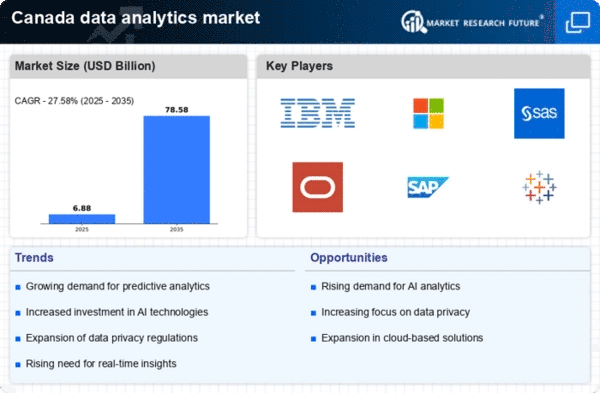
As per Market Research Future analysis, the Canada data analytics market Size was estimated at 5.39 USD Billion in 2024. The Canada data analytics market is projected to grow from 6.88 USD Billion in 2025 to 78.58 USD Billion by 2035, exhibiting a compound annual growth rate (CAGR) of 27.5% during the forecast period 2025 - 2035

Key Market Trends & Highlights

The Canada data analytics market is experiencing robust growth driven by technological advancements and increasing demand for data-driven insights.

  • The largest segment in the Canada data analytics market is the cloud-based analytics, which continues to gain traction among businesses.
  • Artificial intelligence integration is emerging as the fastest-growing segment, enhancing data processing capabilities and insights.
  • Data privacy and security concerns are prompting organizations to adopt more stringent measures in their analytics practices.
  • The growing demand for real-time analytics and increased investment in data infrastructure are key drivers propelling market expansion.

Market Size & Forecast

2024 Market Size 5.39 (USD Billion)
2035 Market Size 78.58 (USD Billion)
CAGR (2025 - 2035) 27.58%

Major Players

IBM (US), Microsoft (US), SAS (US), Oracle (US), SAP (DE), Tableau (US), Qlik (US), Alteryx (US), Domo (US)

Our Impact
Enabled $4.3B Revenue Impact for Fortune 500 and Leading Multinationals
Partnering with 2000+ Global Organizations Each Year
30K+ Citations by Top-Tier Firms in the Industry

Canada Data Analytics Market Trends

The data analytics market in Canada is experiencing notable growth, driven by the increasing demand for data-driven decision-making across various sectors. Organizations are recognizing the value of harnessing data to enhance operational efficiency, improve customer experiences, and gain competitive advantages. This trend is particularly evident in industries such as finance, healthcare, and retail, where data analytics tools are being integrated into everyday operations. Furthermore, advancements in technology, including artificial intelligence and machine learning, are facilitating more sophisticated data analysis capabilities, allowing businesses to derive deeper insights from their data. In addition, the Canadian government is actively promoting initiatives to foster innovation in the data analytics market. Investments in technology infrastructure and support for startups are creating a conducive environment for growth. As organizations increasingly adopt cloud-based solutions, the accessibility and scalability of data analytics tools are improving. This shift is likely to empower smaller businesses to leverage data analytics, thus broadening the market's reach. Overall, the data analytics market in Canada appears poised for continued expansion, with a focus on enhancing data literacy and fostering a culture of data-driven decision-making across various sectors.

Increased Adoption of Cloud Solutions

Organizations are increasingly migrating to cloud-based data analytics platforms. This transition allows for greater flexibility, scalability, and cost-effectiveness. As businesses seek to optimize their operations, cloud solutions provide the necessary tools to analyze vast amounts of data efficiently.

Focus on Data Privacy and Security

With the rise of data analytics, concerns regarding data privacy and security are becoming paramount. Companies are prioritizing the implementation of robust security measures to protect sensitive information, ensuring compliance with regulations and building trust with customers.

Integration of Artificial Intelligence

The integration of artificial intelligence into data analytics processes is transforming how organizations interpret data. AI-driven analytics tools enable more accurate predictions and insights, allowing businesses to make informed decisions swiftly and effectively.

Canada Data Analytics Market Drivers

Growing Demand for Real-Time Analytics

The data analytics market in Canada experiences a notable surge in demand for real-time analytics solutions. Organizations across various sectors are increasingly recognizing the value of immediate insights derived from data. This trend is particularly evident in industries such as retail and finance, where timely decision-making can significantly impact operational efficiency and customer satisfaction. According to recent estimates, the real-time analytics segment is projected to grow at a CAGR of approximately 25% over the next five years. This growth is driven by the need for businesses to respond swiftly to market changes and consumer behavior, thereby enhancing their competitive edge. As a result, the data analytics market is witnessing a shift towards technologies that facilitate real-time data processing and analysis, enabling organizations to harness the full potential of their data assets.

Increased Investment in Data Infrastructure

In Canada, the data analytics market is bolstered by substantial investments in data infrastructure. Organizations are increasingly allocating resources to enhance their data storage, processing, and management capabilities. This trend is driven by the growing volume of data generated daily, which necessitates robust infrastructure to support effective analytics. Recent reports indicate that Canadian businesses are expected to invest over $5 billion in data infrastructure by 2026, reflecting a commitment to leveraging data for strategic decision-making. Enhanced infrastructure not only improves data accessibility but also facilitates advanced analytics techniques, such as machine learning and predictive modeling. Consequently, the data analytics market is evolving, with organizations prioritizing investments that enable them to derive actionable insights from their data, ultimately leading to improved business outcomes.

Emergence of Advanced Analytics Technologies

The data analytics market in Canada is witnessing the emergence of advanced analytics technologies that are reshaping how organizations approach data analysis. Innovations such as machine learning, natural language processing, and predictive analytics are becoming increasingly prevalent, enabling businesses to extract deeper insights from their data. These technologies allow for more sophisticated analysis, facilitating the identification of trends and patterns that were previously difficult to discern. As organizations strive to remain competitive, the adoption of advanced analytics solutions is expected to grow, with projections indicating a potential market expansion of 30% in the next three years. This trend underscores the importance of the data analytics market in driving technological advancements that empower organizations to make data-driven decisions and optimize their operations.

Rising Importance of Data-Driven Decision Making

The data analytics market in Canada is significantly influenced by the rising importance of data-driven decision making among organizations. Companies are increasingly recognizing that leveraging data insights can lead to more informed strategies and improved operational performance. This shift is evident across various sectors, including healthcare, manufacturing, and marketing, where data analytics is being integrated into core business processes. A recent survey indicated that approximately 70% of Canadian executives believe that data-driven decision making is crucial for their organization's success. As a result, the data analytics market is witnessing a growing demand for tools and solutions that empower organizations to analyze data effectively and derive meaningful insights, thereby fostering a culture of data literacy and informed decision-making.

Expansion of Data Analytics Education and Training

The data analytics market in Canada is experiencing growth driven by the expansion of education and training programs focused on data analytics skills. As organizations seek to harness the power of data, there is a corresponding need for skilled professionals who can analyze and interpret complex datasets. Educational institutions and training providers are responding to this demand by offering specialized programs in data analytics, data science, and related fields. Recent statistics suggest that enrollment in data analytics courses has increased by over 40% in the past two years. This influx of trained professionals is expected to enhance the capabilities of the data analytics market, as organizations gain access to a workforce equipped with the necessary skills to leverage data effectively and drive innovation.


Market Segment Insights

By Type: Predictive Analytics (Largest) vs. Customer Analytics (Fastest-Growing)

In the Canada data analytics market, Predictive Analytics holds the largest market share, primarily driven by its ability to enhance decision-making processes across various industry sectors. Descriptive and Prescriptive Analytics also contribute to the market, although to a lesser extent, as organizations seek to analyze past data trends and recommend future actions. Customer Analytics, while currently smaller in share, shows strong potential due to increasing investments in customer experience improvements. The growth trends within the Canada data analytics market are notable, particularly for Customer Analytics, which is experiencing rapid expansion. Businesses are increasingly focusing on understanding customer behavior to tailor their offerings effectively. Predictive Analytics continues to thrive due to its application in forecasting and risk management, while Descriptive and Prescriptive Analytics support organizations in operational efficiencies and strategic planning. This diverse growth reflects a broader demand for innovative analytics solutions across various sectors.

Predictive Analytics (Dominant) vs. Customer Analytics (Emerging)

Predictive Analytics, as the dominant force in the Canada data analytics market, is characterized by its ability to leverage historical data to forecast future outcomes, making it invaluable for businesses looking to optimize their operations and mitigate risks. This segment utilizes advanced algorithms and machine learning techniques, enabling organizations to make informed decisions with a competitive edge. On the other hand, Customer Analytics represents an emerging segment focused on analyzing consumer data to enhance engagement and satisfaction. As companies increasingly invest in personalization and customer journey insights, this segment's market position is rapidly strengthening. The growing reliance on data-driven strategies ensures that both Predictive and Customer Analytics will play crucial roles in shaping the future of data utilization within the market.

By Solution: Data Management (Largest) vs. Data Monitoring (Fastest-Growing)

In the Canada data analytics market, Data Management holds a substantial market share as the largest segment, reflecting its critical role in ensuring the quality and accessibility of data across organizations. Following closely, Fraud & Security Intelligence is also significant but does not match the dominance of Data Management. Meanwhile, Data Monitoring is gaining traction and emerging as a fast-growing segment, driven by increasing demands for real-time analytics and monitoring. The growth trends within these segments are influenced by various factors, including the rising need for enhanced data security and management solutions amidst growing cyber threats. Organizations are increasingly investing in advanced data analytics tools to safeguard their information and ensure compliance with regulations. Additionally, the shift towards cloud-based data solutions and the increasing reliance on data-driven decision-making are propelling the growth of segments like Data Monitoring, making it an essential area for investment and innovation.

Data Management (Dominant) vs. Data Mining (Emerging)

Data Management remains the dominant segment in the Canada data analytics market, as it encompasses a wide range of services that ensure organized, reliable, and accessible data for businesses. This segment is characterized by solutions that focus on data governance, quality management, and seamless integration across platforms. On the other hand, Data Mining represents an emerging segment that leverages complex algorithms to analyze vast datasets, uncovering patterns and insights that were previously unattainable. With businesses striving to harness the full potential of their data, Data Mining’s importance is growing, particularly in sectors like retail and healthcare where predictive analytics can drive significant competitive advantages.

By Application: Enterprise Resource Planning (Largest) vs. Supply Chain Management (Fastest-Growing)

In the Canada data analytics market, the application segment displays a diverse distribution, with Enterprise Resource Planning (ERP) holding the largest share. This category has established itself as a key component for businesses aiming to optimize their resources and streamline operations. Following ERP, Supply Chain Management (SCM) is emerging rapidly, driven by the increasing complexities of supply chains and the need for efficiency. Growth trends in the application segment indicate a strong future for both ERP and SCM. The demand for ERP solutions continues to rise as organizations seek integrated systems that enhance data visibility and decision-making. Meanwhile, the SCM segment is experiencing heightened adoption rates, fueled by advancements in technology and the necessity for agile supply chain practices in a fast-evolving market landscape.

Enterprise Resource Planning (Dominant) vs. Supply Chain Management (Emerging)

Enterprise Resource Planning (ERP) serves as a dominant force in the Canada data analytics market, renowned for its ability to unify business processes and provide a holistic view of operations. This integration enhances decision-making and operational efficiency, making ERP systems crucial for various industries. On the other hand, Supply Chain Management (SCM) is gaining traction as an emerging segment, driven by the demand for streamlined processes and real-time analytics. Companies are increasingly investing in SCM solutions to improve inventory management and reduce operational costs, reflecting the shift toward data-driven decision-making. Both segments are critical, yet they cater to different organizational needs, with ERP focusing more on internal processes and SCM addressing external supply chain dynamics.

By Deployment: Cloud (Largest) vs. On-Premises (Fastest-Growing)

In the Canada data analytics market, Cloud deployment holds the majority share, reflecting the growing preference for scalable and flexible solutions among businesses. This segment enjoys a significant lead due to its ability to offer real-time analytics and cost-effective pricing models. Conversely, On-Premises deployment is gaining traction, appealing to organizations with strict data privacy requirements and regulatory compliance needs. This distribution indicates a shift in how Canadian businesses approach data management and analytics. The growth trends in this segment are heavily influenced by the increasing adoption of hybrid cloud solutions that combine the best of both deployments. While Cloud remains the preferred choice due to its myriad benefits, On-Premises is emerging rapidly, driven by industry-specific needs and concerns over data sovereignty. Technological advancements and evolving customer expectations are likely to further propel the demand for both segments in the coming years.

Deployment: Cloud (Dominant) vs. On-Premises (Emerging)

Cloud deployment in the Canada data analytics market represents a dominant force, characterized by its agility, scalability, and cost-effectiveness. It caters to diverse businesses looking for readily accessible data analytics tools without hefty infrastructure investments. In contrast, On-Premises deployment is seen as an emerging alternative, particularly for organizations prioritizing data control and compliance. This segment appeals to traditional sectors that are often hesitant to migrate to the cloud due to security and privacy concerns. Both segments reflect the evolving landscape of data analytics, with organizations weighing the benefits of flexibility against the responsibilities of data governance.

Get more detailed insights about Canada Data Analytics Market

Key Players and Competitive Insights

The data analytics market in Canada is characterized by a dynamic competitive landscape, driven by rapid technological advancements and increasing demand for data-driven decision-making across various sectors. Key players such as IBM (US), Microsoft (US), and SAP (DE) are strategically positioned to leverage their extensive portfolios and innovative capabilities. IBM (US) focuses on integrating AI and machine learning into its analytics solutions, enhancing predictive capabilities for clients. Microsoft (US) emphasizes cloud-based analytics through its Azure platform, facilitating seamless data integration and real-time insights. Meanwhile, SAP (DE) is concentrating on expanding its analytics offerings to support enterprise resource planning (ERP) systems, thereby enhancing operational efficiency for businesses. Collectively, these strategies foster a competitive environment that prioritizes innovation and customer-centric solutions.
The business tactics employed by these companies reflect a commitment to optimizing operations and enhancing market presence. Localizing services and solutions to meet regional demands appears to be a common approach, as companies seek to resonate with local businesses. The market structure is moderately fragmented, with a mix of established players and emerging startups. This fragmentation allows for diverse offerings, yet the influence of major players remains substantial, shaping industry standards and customer expectations.
In October 2025, IBM (US) announced a partnership with a leading Canadian university to develop advanced analytics programs aimed at fostering innovation in data science. This collaboration is strategically significant as it not only enhances IBM's brand presence in the academic sector but also positions the company as a thought leader in the analytics space, potentially attracting new talent and fostering research that could lead to groundbreaking solutions.
In September 2025, Microsoft (US) launched a new suite of analytics tools designed specifically for small and medium-sized enterprises (SMEs) in Canada. This initiative is crucial as it addresses the growing need for accessible analytics solutions among SMEs, which often lack the resources to implement complex data systems. By catering to this segment, Microsoft strengthens its market position and expands its customer base, potentially leading to increased revenue streams.
In August 2025, SAP (DE) unveiled an enhanced version of its analytics platform, integrating sustainability metrics into its reporting tools. This move is indicative of a broader trend towards sustainability in business practices, allowing companies to not only analyze financial performance but also assess their environmental impact. Such integration is likely to resonate with environmentally conscious consumers and businesses, thereby enhancing SAP's competitive edge.
As of November 2025, the competitive trends in the data analytics market are increasingly defined by digitalization, sustainability, and the integration of AI technologies. Strategic alliances are becoming more prevalent, as companies recognize the value of collaboration in driving innovation and expanding market reach. Looking ahead, competitive differentiation is expected to evolve, shifting from traditional price-based competition to a focus on innovation, technological advancement, and supply chain reliability. This transition underscores the importance of agility and responsiveness in meeting the ever-changing demands of the market.

Key Companies in the Canada Data Analytics Market include

Industry Developments

Recent developments in the Canada Data Analytics Market have shown notable advancements and growth among key players, including Oracle, TIBCO Software, SAS Institute, Teradata, and SAP. In April 2023, SAP announced a new partnership with a Canadian tech firm aimed at enhancing cloud data analytics solutions. Concurrently, Microsoft has been expanding its Azure services in Canada, focusing on AI integrations within data analytics, which has significantly bolstered its market presence. In September 2023, Oracle revealed plans to enhance its analytics capabilities through the launch of a new product designed specifically for Canadian enterprises, further solidifying its foothold in the region.

Additionally, Domo made headlines in June 2023, acquiring a smaller analytics firm to boost its capabilities in advanced data visualization. The Canadian data analytics market has been experiencing a robust growth trajectory, driven by an increasing demand for data-driven decision-making and integration of AI technologies. Over the past two to three years, companies like IBM and Qlik have also ramped up their investments in local talent and analytics capabilities, responding to the growing need for data solutions among Canadian businesses.

Future Outlook

Canada Data Analytics Market Future Outlook

The data analytics market in Canada is projected to grow at a 27.58% CAGR from 2025 to 2035, driven by advancements in AI, big data, and cloud computing.

New opportunities lie in:

  • Development of AI-driven predictive analytics tools for retail optimization.
  • Implementation of real-time data visualization platforms for enhanced decision-making.
  • Creation of industry-specific analytics solutions for healthcare and finance sectors.

By 2035, the data analytics market is expected to be robust, driven by innovation and diverse applications.

Market Segmentation

Canada Data Analytics Market Type Outlook

  • Predictive Analytics
  • Prescriptive Analytics
  • Descriptive Analytics
  • Customer Analytics

Canada Data Analytics Market Solution Outlook

  • Data Management
  • Fraud & Security Intelligence
  • Data Mining
  • Data Monitoring

Canada Data Analytics Market Deployment Outlook

  • Cloud
  • On-Premises

Canada Data Analytics Market Application Outlook

  • Enterprise Resource Planning
  • Supply Chain Management
  • Human Resource Management
  • Database Management

Report Scope

MARKET SIZE 2024 5.39(USD Billion)
MARKET SIZE 2025 6.88(USD Billion)
MARKET SIZE 2035 78.58(USD Billion)
COMPOUND ANNUAL GROWTH RATE (CAGR) 27.58% (2025 - 2035)
REPORT COVERAGE Revenue Forecast, Competitive Landscape, Growth Factors, and Trends
BASE YEAR 2024
Market Forecast Period 2025 - 2035
Historical Data 2019 - 2024
Market Forecast Units USD Billion
Key Companies Profiled IBM (US), Microsoft (US), SAS (US), Oracle (US), SAP (DE), Tableau (US), Qlik (US), Alteryx (US), Domo (US)
Segments Covered Type, Solution, Application, Deployment
Key Market Opportunities Integration of artificial intelligence in data analytics enhances decision-making and operational efficiency.
Key Market Dynamics Growing demand for data-driven decision-making fuels competition and innovation in the data analytics market.
Countries Covered Canada
Leave a Comment

FAQs

What is the projected market size of the Canada Data Analytics Market in 2024?

The Canada Data Analytics Market is expected to be valued at 650.0 USD Million in 2024.

What is the estimated market size for the Canada Data Analytics Market by 2035?

By 2035, the overall market is projected to reach a valuation of 12500.0 USD Million.

What is the expected CAGR for the Canada Data Analytics Market from 2025 to 2035?

The expected CAGR for the Canada Data Analytics Market from 2025 to 2035 is 30.836%.

Which segment of the Canada Data Analytics Market is expected to grow the fastest?

Predictive Analytics is projected to grow significantly, reaching 2500.0 USD Million by 2035 from 130.0 USD Million in 2024.

How large is the Prescriptive Analytics segment in 2024 and what is its expected growth by 2035?

The Prescriptive Analytics segment is valued at 70.0 USD Million in 2024 and is expected to grow to 1400.0 USD Million by 2035.

What is the market value of Descriptive Analytics in the Canada Data Analytics Market for 2024?

Descriptive Analytics is expected to be valued at 200.0 USD Million in 2024.

What will be the market size for Customer Analytics in 2035?

Customer Analytics is projected to reach a market size of 4100.0 USD Million by 2035.

Who are the major players in the Canada Data Analytics Market?

Major players include Oracle, TIBCO Software, SAS Institute, Teradata, SAP, and others.

What are the key applications driving the Canada Data Analytics Market?

Key applications include Predictive Analytics, Prescriptive Analytics, Descriptive Analytics, and Customer Analytics.

What opportunities are expected in the Canada Data Analytics Market over the forecast period?

The market is expected to see growth opportunities due to the increasing demand for data-driven decision-making and analytics solutions.

Download Free Sample

Kindly complete the form below to receive a free sample of this Report

Compare Licence

×
Features License Type
Single User Multiuser License Enterprise User
Price $4,950 $5,950 $7,250
Maximum User Access Limit 1 User Upto 10 Users Unrestricted Access Throughout the Organization
Free Customization
Direct Access to Analyst
Deliverable Format
Platform Access
Discount on Next Purchase 10% 15% 15%
Printable Versions