×
Request Free Sample ×

Kindly complete the form below to receive a free sample of this Report

* Please use a valid business email

Leading companies partner with us for data-driven Insights

clients tt-cursor
Hero Background

Canada Dairy Market

ID: MRFR/FnB/44942-HCR
128 Pages
Harshita Gorade
February 2026

Canada Dairy Market Size, Share, Industry Trend & Analysis Research Report By Product Type (Milk, Cheese, Butter, Yogurt, Dairy Cream, Ice Cream, Others), By Category (Organic, Conventional), By Distribution Channel (Store-Based, Non-Store-Based) and By Store-Based (Supermarkets Hypermarkets, Convenience Stores, Others) - Forecast to 2035

Share:
Download PDF ×

We do not share your information with anyone. However, we may send you emails based on your report interest from time to time. You may contact us at any time to opt-out.

Canada Dairy Market Infographic
Purchase Options

Canada Dairy Market Summary

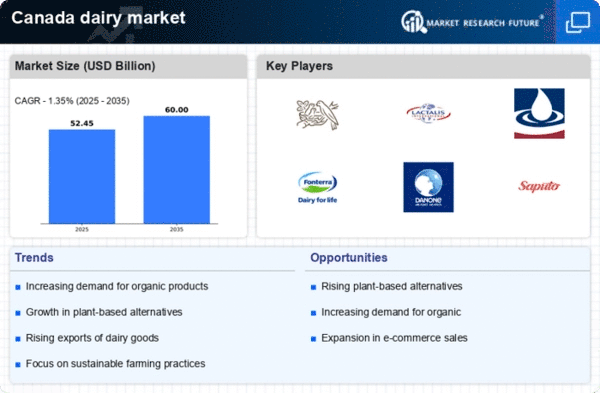
As per Market Research Future analysis, the Canada dairy market Size was estimated at 51.75 USD Billion in 2024. The Canada dairy market is projected to grow from 52.45 USD Billion in 2025 to 60.0 USD Billion by 2035, exhibiting a compound annual growth rate (CAGR) of 1.3% during the forecast period 2025 - 2035

Key Market Trends & Highlights

The Canada dairy market is experiencing a shift towards health-conscious and sustainable practices, driven by evolving consumer preferences.

  • Health-conscious products are gaining traction, with consumers increasingly seeking nutritional value in dairy offerings.
  • Sustainability practices are becoming essential, as both producers and consumers prioritize environmentally friendly production methods.
  • Technological innovations in dairy production are enhancing efficiency and product quality, contributing to market growth.
  • Rising demand for organic dairy products and evolving consumer preferences for plant-based alternatives are key drivers shaping the market landscape.

Market Size & Forecast

2024 Market Size 51.75 (USD Billion)
2035 Market Size 60.0 (USD Billion)
CAGR (2025 - 2035) 1.35%

Major Players

Nestle (CH), Lactalis (FR), Dairy Farmers of America (US), Fonterra (NZ), Danone (FR), Saputo (CA), Arla Foods (DK), FrieslandCampina (NL), China Mengniu Dairy (CN)

Our Impact
Enabled $4.3B Revenue Impact for Fortune 500 and Leading Multinationals
Partnering with 2000+ Global Organizations Each Year
30K+ Citations by Top-Tier Firms in the Industry

Canada Dairy Market Trends

The dairy market in Canada exhibits a complex landscape characterized by evolving consumer preferences and regulatory frameworks. As of November 2025, there is a noticeable shift towards health-conscious products, with consumers increasingly seeking options that align with their dietary needs. This trend is reflected in the rising demand for organic and low-fat dairy products, which are perceived as healthier alternatives. Additionally, the market is influenced by sustainability concerns, prompting producers to adopt environmentally friendly practices. This includes the use of renewable energy sources and sustainable farming methods, which resonate with a growing segment of eco-conscious consumers. Moreover, technological advancements play a pivotal role in shaping the dairy market. Innovations in processing and distribution are enhancing product quality and shelf life, thereby meeting consumer expectations for freshness and safety. The integration of digital platforms for marketing and sales is also becoming more prevalent, allowing producers to reach a broader audience. Overall, the dairy market in Canada is navigating a dynamic environment, where consumer preferences, sustainability, and technology converge to create new opportunities and challenges for stakeholders.

Health-Conscious Products

There is a growing inclination among consumers towards health-oriented dairy options. This trend encompasses a rise in demand for organic, low-fat, and lactose-free products, reflecting a shift in dietary preferences. Producers are responding by diversifying their offerings to include these healthier alternatives.

Sustainability Practices

Sustainability is increasingly becoming a focal point within the dairy market. Producers are adopting eco-friendly practices, such as renewable energy usage and sustainable farming techniques, to appeal to environmentally aware consumers. This shift not only addresses consumer concerns but also aligns with regulatory expectations.

Technological Innovations

Technological advancements are transforming the dairy market by improving processing methods and distribution channels. Innovations enhance product quality and extend shelf life, while digital marketing strategies enable producers to connect with consumers more effectively. This evolution is crucial for maintaining competitiveness in a rapidly changing market.

The Canada dairy industry is a well-structured and regulated sector that plays a vital role in the country’s food and agriculture ecosystem. The industry is supported by strong domestic production, quality-focused processing, and consistent consumer demand for fresh and value-added dairy products. Increasing emphasis on food safety, traceability, and sustainable farming practices is shaping industry development. Innovation in processing techniques and product diversification is further strengthening the Canadian dairy industry, particularly across urban and suburban markets.

Canada Dairy Market Drivers

Rising Demand for Organic Dairy Products

The dairy market in Canada experiences a notable shift towards organic products, driven by increasing consumer awareness regarding health and nutrition. Organic dairy products, which are perceived as healthier alternatives, have seen a growth rate of approximately 15% annually. This trend indicates a significant opportunity for producers to cater to a more health-conscious demographic. As consumers become more discerning about food sources, the demand for organic milk, cheese, and yogurt continues to rise. The dairy market must adapt to these changing preferences by enhancing organic offerings and ensuring compliance with organic certification standards. This shift not only aligns with consumer values but also presents a lucrative avenue for growth in a competitive landscape.

Technological Advancements in Dairy Production

The dairy market in Canada is increasingly influenced by technological advancements that enhance production efficiency and product quality. Innovations such as automated milking systems, precision farming, and data analytics are transforming traditional dairy operations. These technologies not only improve yield but also contribute to better animal welfare and sustainability practices. For instance, the implementation of smart sensors in dairy farms can lead to a reduction in feed costs by up to 10%, thereby increasing profitability. As these technologies become more accessible, they are likely to reshape the competitive landscape of the dairy market, enabling producers to meet rising consumer demands while optimizing operational efficiency.

Government Policies and Support for Dairy Farmers

The dairy market in Canada is significantly shaped by government policies aimed at supporting local dairy farmers. Initiatives such as subsidies, price supports, and trade agreements play a crucial role in stabilizing the market and ensuring fair competition. Recent government programs have focused on enhancing the sustainability of dairy farming practices, which may lead to increased funding for environmentally friendly initiatives. These policies not only provide financial relief to farmers but also encourage innovation within the dairy market. As the government continues to prioritize the agricultural sector, the dairy market may benefit from enhanced resources and support, fostering growth and resilience in the face of market challenges.

Evolving Consumer Preferences for Plant-Based Alternatives

The dairy market in Canada is witnessing a surge in the popularity of plant-based alternatives, such as almond, soy, and oat milk. This trend reflects a broader shift in consumer preferences towards healthier and more sustainable options. Recent data suggests that sales of plant-based dairy alternatives have increased by over 20% in the past year, indicating a significant market disruption. As consumers seek to reduce their dairy intake for health or ethical reasons, the dairy market faces the challenge of innovating and diversifying product lines. This evolution may require traditional dairy producers to explore partnerships or develop their own plant-based offerings to remain competitive and relevant in a rapidly changing market.

Increasing Focus on Nutritional Value and Functional Dairy Products

The dairy market in Canada is experiencing a growing emphasis on the nutritional value of dairy products. Consumers are increasingly seeking functional dairy items that offer health benefits beyond basic nutrition, such as probiotics and fortified products. This trend is reflected in the rising sales of yogurt and cheese enriched with vitamins and minerals, which have seen growth rates of approximately 12% annually. As health awareness continues to rise, the dairy market must adapt by developing innovative products that cater to these evolving consumer needs. This focus on nutritional enhancement not only meets market demand but also positions the dairy market favorably in a competitive landscape.


Market Segment Insights

By Type: Milk (Largest) vs. Cheese (Fastest-Growing)

In the Canada dairy market, the distribution of market share among the various segments reveals milk as the largest player, benefiting from its staple status and diverse applications. Cheese follows closely, particularly as consumer preferences shift towards gourmet and specialty cheeses, indicating a growing market share that is increasingly competitive among various cheese products. Growth trends in the Canada dairy market are driven by a rising demand for healthier food options and increased awareness of nutritional benefits. Yogurt and ice cream also experience growth, with yogurt benefiting from trends in probiotic consumption and ice cream appealing to market dynamics of indulgence and premiumization, making these segments key players in the market's expansion.

Milk (Dominant) vs. Cheese (Emerging)

Milk continues to dominate the Canada dairy market, characterized by its essential role in daily nutrition and versatility across various demographics. Its stable consumption patterns reinforce its market position. In contrast, cheese is categorized as an emerging value, experiencing substantial growth due to trends in gourmet offerings and unique flavor profiles. The increasing incorporation of cheese in different cuisines and its appeal to both health-conscious consumers and indulgent diners make it a strategic growth area. While milk maintains dominance, cheese's dynamic growth trajectory reflects changing consumer preferences and lifestyle choices.

By Source: Cow (Largest) vs. Goat (Fastest-Growing)

In the Canada dairy market, the source segment is prominently led by cow's milk, which commands the largest market share due to its widespread consumption and established production infrastructure. This segment remains a staple in dairy production and is favored for its versatile applications in various dairy products, including cheese and yogurt. Goat's milk is emerging as a significant player, capturing the attention of consumers seeking alternatives due to its digestibility and nutritional benefits, although it still holds a smaller market share than cow's milk. Examining growth trends, the market for goat's milk is witnessing rapid expansion, driven by shifting consumer preferences towards healthier and more organic food options. Many are discovering goat's milk's advantages, which contributes to its status as the fastest-growing source segment in the Canada dairy market. With increasing awareness around lactose intolerance and the benefits of goat's milk, producers are expanding their offerings to meet this rising demand, further fueling growth in this segment.

Cow (Dominant) vs. Goat (Emerging)

Cow's milk remains the dominant source in the Canada dairy market, renowned for its extensive range of products and established supply chain. It benefits from strong consumer loyalty, robust marketing, and extensive distribution networks. Meanwhile, goat's milk is recognized as an emerging alternative, appreciated for its unique flavor and health benefits, including lower lactose content. The market for goat's milk is not only growing but also diversifying, with myriad product launches in cheeses, yogurts, and specialty items catering to health-conscious consumers. As both segments evolve, the distinction between traditional cow's milk and innovative goat's milk offerings highlights the changing landscape of consumer preferences in dairy.

By Distribution Channel: Supermarkets (Largest) vs. Online Stores (Fastest-Growing)

In the Canada dairy market, the distribution of sales across segments reveals that supermarkets hold the largest share, capturing a significant proportion of consumer purchases. Convenience stores and specialty stores also contribute notably, but they do not compare to the overwhelming presence of supermarkets, which benefit from high foot traffic and extensive product ranges. Online stores are gaining traction, driven by the increasing preference for convenience and the rise of e-commerce. The growth trends in this segment are influenced by several factors, including changing consumer behaviors, technological advancements, and the ongoing shift towards online shopping. Online stores, in particular, are emerging as the fastest-growing channel, as more consumers embrace digital shopping experiences. This shift is further propelled by the pandemic's lasting impact on shopping habits, leading to innovations in delivery services and a broader acceptance of online options among consumers.

Supermarkets: Dominant vs. Online Stores: Emerging

Supermarkets represent the dominant force in the Canada dairy market, characterized by their extensive reach and broad product selection. They benefit from established customer loyalty and the ability to offer competitive prices due to their scale. Their strategic locations enhance visibility and accessibility, attracting a diverse customer base. Conversely, online stores are categorized as an emerging segment, quickly gaining popularity as consumers seek the convenience and ease of shopping from home. This shift has prompted many traditional dairy brands to enhance their online presence, offering promotions and tailored services to capture this growing demographic. As e-commerce continues to evolve, online stores are expected to play a crucial role in shaping the future landscape of the dairy distribution channel in Canada.

By Application: Food Industry (Largest) vs. Beverages (Fastest-Growing)

In the Canada dairy market, the application segment is dominated by the Food Industry, which holds the largest share due to the high demand for dairy products in various culinary applications. This sector benefits from strong consumer preferences for dairy-based foods, driving consistent sales and a stable market position. On the other hand, Beverages are emerging rapidly, capturing increasing attention from both manufacturers and consumers as innovative dairy-based drink options gain popularity. The growth trends within the application segment reflect a shift towards more health-conscious and versatile dairy products. While the Food Industry continues to be a cornerstone of the market, beverages are particularly thriving due to trends in functional foods and beverages that cater to an active lifestyle. Nutraceuticals are also driving growth as consumers increasingly seek dairy products with health benefits, influencing product development and marketing strategies in the sector.

Food Industry: Dominant vs. Beverages: Emerging

The Food Industry plays a dominant role in the Canada dairy market, characterized by its extensive range of dairy products used in cooking, baking, and snacking. This segment's strong foundation is built on traditional consumer habits and a high level of integration in food processing sectors. On the other hand, Beverages represent an emerging segment that leverages growing consumer interest in functional and convenient dairy drinks. This includes yogurt-based smoothies, flavored milk, and protein shakes that cater to health trends. Both segments benefit from innovation, with the Food Industry focusing on product quality and variety, while Beverages emphasize convenience and health benefits, appealing to a younger demographic looking for quick and nutritious options.

Get more detailed insights about Canada Dairy Market

Key Players and Competitive Insights

The dairy market exhibits a dynamic competitive landscape characterized by a blend of established players and emerging innovators. Key growth drivers include increasing consumer demand for dairy products, a rising focus on health and wellness, and the ongoing trend towards sustainability. Notably, companies such as Saputo (CA), Lactalis (FR), and Danone (FR) are strategically positioned to leverage these trends. Saputo (CA) emphasizes innovation in product development, particularly in the organic and specialty cheese segments, while Lactalis (FR) focuses on expanding its global footprint through strategic acquisitions. Danone (FR), on the other hand, is heavily investing in digital transformation to enhance consumer engagement and streamline operations, thereby shaping a competitive environment that prioritizes adaptability and responsiveness. In terms of business tactics, localizing manufacturing and optimizing supply chains are pivotal strategies employed by these companies. The market structure appears moderately fragmented, with a mix of large multinational corporations and regional players. This fragmentation allows for diverse product offerings and competitive pricing, yet the collective influence of key players like Saputo (CA) and Lactalis (FR) tends to dominate market dynamics, driving innovation and setting quality standards. In October 2025, Saputo (CA) announced the launch of a new line of lactose-free dairy products aimed at catering to the growing segment of lactose-intolerant consumers. This strategic move not only aligns with consumer health trends but also positions Saputo (CA) as a leader in product diversification within the dairy sector. The introduction of these products is expected to enhance market share and strengthen brand loyalty among health-conscious consumers. In September 2025, Lactalis (FR) completed the acquisition of a regional cheese manufacturer in Canada, which is anticipated to bolster its production capabilities and expand its product range. This acquisition underscores Lactalis's commitment to enhancing its operational efficiency and market presence, allowing for greater responsiveness to local consumer preferences. Such strategic expansions are likely to reinforce Lactalis's competitive edge in the Canadian dairy market. In August 2025, Danone (FR) unveiled a new sustainability initiative aimed at reducing its carbon footprint across its supply chain by 30% by 2030. This initiative reflects a growing trend towards sustainability in the dairy sector, as consumers increasingly favor brands that demonstrate environmental responsibility. Danone's proactive approach not only enhances its brand image but also positions it favorably in a market that is progressively prioritizing eco-friendly practices. As of November 2025, current competitive trends in the dairy market are increasingly defined by digitalization, sustainability, and the integration of artificial intelligence in operations. Strategic alliances among key players are shaping the landscape, fostering innovation and enhancing supply chain efficiencies. The competitive differentiation is likely to evolve from traditional price-based competition towards a focus on innovation, technology adoption, and reliability in supply chains. This shift suggests that companies that prioritize these aspects will be better positioned to thrive in an increasingly complex market. The milk market in Canada continues to evolve as consumers prioritize nutrition, freshness, and product transparency. Demand spans fluid milk, fortified variants, and specialized milk categories driven by changing dietary preferences. The market benefits from a stable supply chain and high quality standards across production and distribution. Growing interest in functional and premium milk products is influencing product innovation, supporting steady development within the Canada milk market.

Key Companies in the Canada Dairy Market include

Industry Developments

Recent developments in the Canada Dairy Market have showcased a range of significant activities. In September 2023, Agropur announced an investment aimed at upgrading its production capabilities, which is expected to enhance efficiency and product quality. Similarly, in October 2023, Saputo unveiled its plans for a sustainable dairy processing facility, focusing on reducing its carbon footprint, reflecting a wider trend towards sustainability within the industry. 

Current affairs also indicate a strong emphasis on innovation, with Vega expanding its plant-based product line, catering to the increasing demand for dairy alternatives. In terms of mergers and acquisitions, Lactalis, a notable player in the dairy sector, completed its acquisition of a regional cheese producer in Alberta in August 2023, further consolidating its market presence. The Dairy Farmers of Canada continues to advocate for fair pricing and trade practices, highlighting concerns over imports affecting local dairy prices. 

Over the past two to three years, the market has seen gradual growth driven by health-conscious consumer trends, with the market valuation of companies like Neilson and Danone significantly impacted by evolving consumer preferences towards natural and nutritious dairy products. Overall, the Canada Dairy Market remains dynamic, reflecting both challenges and opportunities for its prominent players.

Future Outlook

Canada Dairy Market Future Outlook

The Dairy Market in Canada is projected to grow at 1.35% CAGR from 2025 to 2035, driven by rising health consciousness and demand for dairy alternatives.

New opportunities lie in:

  • Expansion of organic dairy product lines Investment in automated dairy processing technologies Development of plant-based dairy alternatives for diverse consumer preferences

By 2035, the dairy market is expected to maintain steady growth, adapting to evolving consumer demands.

Market Segmentation

Canada Dairy Market Type Outlook

  • Milk
  • Cheese
  • Yogurt
  • Butter
  • Ice Cream

Canada Dairy Market Source Outlook

  • Cow
  • Buffalo
  • Goat
  • Sheep
  • Camel

Canada Dairy Market Application Outlook

  • Food Industry
  • Beverages
  • Nutraceuticals
  • Cosmetics
  • Animal Feed

Canada Dairy Market Distribution Channel Outlook

  • Supermarkets
  • Convenience Stores
  • Online Stores
  • Specialty Stores
  • Direct Sale

Report Scope

MARKET SIZE 2024 51.75(USD Billion)
MARKET SIZE 2025 52.45(USD Billion)
MARKET SIZE 2035 60.0(USD Billion)
COMPOUND ANNUAL GROWTH RATE (CAGR) 1.35% (2025 - 2035)
REPORT COVERAGE Revenue Forecast, Competitive Landscape, Growth Factors, and Trends
BASE YEAR 2024
Market Forecast Period 2025 - 2035
Historical Data 2019 - 2024
Market Forecast Units USD Billion
Key Companies Profiled Nestle (CH), Lactalis (FR), Dairy Farmers of America (US), Fonterra (NZ), Danone (FR), Saputo (CA), Arla Foods (DK), FrieslandCampina (NL), China Mengniu Dairy (CN)
Segments Covered Type, Source, Distribution Channel, Application
Key Market Opportunities Adoption of plant-based dairy alternatives driven by changing consumer preferences and sustainability concerns.
Key Market Dynamics Shifting consumer preferences towards plant-based alternatives challenge traditional dairy product demand in Canada.
Countries Covered Canada
Leave a Comment

FAQs

What was the market size of the Canada Dairy Market in 2024?

The Canada Dairy Market was valued at 42.15 billion USD in 2024.

What will the Canada Dairy Market be valued at in 2035?

In 2035, the Canada Dairy Market is projected to reach a valuation of 58.0 billion USD.

What is the expected CAGR for the Canada Dairy Market from 2025 to 2035?

The expected CAGR for the Canada Dairy Market from 2025 to 2035 is 2.944%.

What segment contributed the highest value to the Canada Dairy Market in 2024?

The Milk segment contributed the highest value at 15.0 billion USD in 2024.

How much is the Cheese segment anticipated to be worth in 2035?

The Cheese segment is expected to be valued at 14.0 billion USD in 2035.

What was the market size of the Yogurt segment in 2024?

The Yogurt segment was valued at 7.0 billion USD in 2024.

Who are the key players in the Canada Dairy Market?

Key players in the Canada Dairy Market include Agropur, Saputo, and Danone, among others.

What is the expected market size of the Butter segment in 2035?

The Butter segment is expected to reach a valuation of 7.0 billion USD in 2035.

How much was the Dairy Cream segment expected to be worth in 2024?

The Dairy Cream segment was valued at 5.15 billion USD in 2024.

What challenges might impact the growth of the Canada Dairy Market?

Challenges may include changing consumer preferences and competition from plant-based alternatives.

Download Free Sample

Kindly complete the form below to receive a free sample of this Report

Compare Licence

×
Features License Type
Single User Multiuser License Enterprise User
Price $4,950 $5,950 $7,250
Maximum User Access Limit 1 User Upto 10 Users Unrestricted Access Throughout the Organization
Free Customization
Direct Access to Analyst
Deliverable Format
Platform Access
Discount on Next Purchase 10% 15% 15%
Printable Versions