×
Request Free Sample ×

Kindly complete the form below to receive a free sample of this Report

* Please use a valid business email

Leading companies partner with us for data-driven Insights

clients tt-cursor
Hero Background

Canada Construction Software Market

ID: MRFR/ICT/44231-HCR
200 Pages
Garvit Vyas
February 2026

Canada Construction Software Market Research Report: By Type (Project management, Account/Financial Management, Quality Safety, Field Productivity, Others), By Deployment Mode (Cloud, On-premises), By Organization Size (Large Enterprises, Small and Medium Enterprises), and By Application (General Contractors, Building Owners, Architects and Engineers, Sub-Contactors, Specialty contractors) - Forecast to 2035.

Share:
Download PDF ×

We do not share your information with anyone. However, we may send you emails based on your report interest from time to time. You may contact us at any time to opt-out.

Canada Construction Software Market Infographic
Purchase Options

Canada Construction Software Market Summary

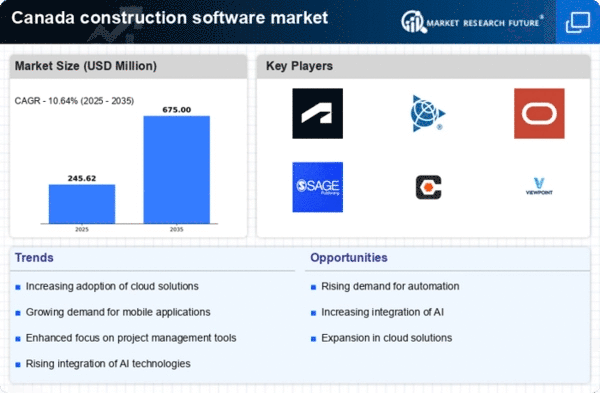
As per Market Research Future analysis, the Canada construction software market size was estimated at 222.0 USD Million in 2024. The Canada construction software market is projected to grow from 245.62 USD Million in 2025 to 675.0 USD Million by 2035, exhibiting a compound annual growth rate (CAGR) of 10.6% during the forecast period 2025 - 2035

Key Market Trends & Highlights

The Canada construction software market is experiencing a transformative shift towards advanced technological solutions.

  • Cloud-based solutions are becoming increasingly prevalent, enhancing accessibility and collaboration across projects.
  • The integration of AI and machine learning is driving efficiency and predictive analytics in construction management.
  • Sustainability is gaining traction, with software solutions focusing on reducing environmental impact and promoting green practices.
  • Rising demand for project management tools and increased investment in infrastructure development are key drivers of market growth.

Market Size & Forecast

2024 Market Size 222.0 (USD Million)
2035 Market Size 675.0 (USD Million)
CAGR (2025 - 2035) 10.64%

Major Players

Autodesk (US), Trimble (US), Oracle (US), Sage (GB), Procore (US), Viewpoint (US), Bluebeam (US), PlanGrid (US), CoConstruct (US)

Our Impact
Enabled $4.3B Revenue Impact for Fortune 500 and Leading Multinationals
Partnering with 2000+ Global Organizations Each Year
30K+ Citations by Top-Tier Firms in the Industry

Canada Construction Software Market Trends

The construction software market is currently experiencing a transformative phase. This change is driven by advancements in technology and the increasing demand for efficiency in project management. As construction projects become more complex, stakeholders are seeking solutions that enhance collaboration, streamline workflows, and improve overall productivity. The integration of cloud-based platforms is particularly noteworthy, as it allows for real-time data sharing and communication among teams, regardless of their physical location. This shift towards digitalization is not merely a trend but appears to be a fundamental change in how construction projects are executed. Furthermore, the emphasis on sustainability and environmental considerations is influencing software development, with tools designed to support green building practices and energy-efficient designs gaining traction. In addition, The construction software market is seeing an increase in the adoption of artificial intelligence and machine learning technologies. These innovations are being utilized to analyze vast amounts of data, predict project outcomes, and optimize resource allocation. As companies strive to reduce costs and enhance safety measures, software solutions that incorporate predictive analytics are becoming increasingly valuable. Overall, the construction software market is poised for continued growth, as it adapts to the evolving needs of the industry and embraces new technological advancements.

Cloud-Based Solutions

The shift towards cloud-based solutions is reshaping the construction software market. These platforms facilitate real-time collaboration and data sharing, enabling teams to work more efficiently across various locations. This trend is particularly beneficial for large-scale projects, where coordination among multiple stakeholders is crucial.

Integration of AI and Machine Learning

The incorporation of artificial intelligence and machine learning into construction software is gaining momentum. These technologies assist in data analysis, project forecasting, and resource management, allowing companies to make informed decisions and enhance operational efficiency.

Focus on Sustainability

There is a growing emphasis on sustainability within the construction software market. Software tools that support green building practices and energy-efficient designs are increasingly sought after, reflecting the industry's commitment to reducing its environmental impact.

Canada Construction Software Market Drivers

Focus on Data Analytics and Reporting

The construction software market in Canada is increasingly driven by a focus on data analytics and reporting capabilities. As construction firms seek to leverage data for informed decision-making, software solutions that provide robust analytics tools are gaining traction. In 2025, it is projected that analytics-driven software will account for around 25% of the construction software market. This emphasis on data analytics allows companies to identify trends, optimize resource allocation, and enhance project outcomes. As a result, the construction software market is likely to expand, with a growing number of firms investing in solutions that offer advanced reporting features and data visualization tools.

Regulatory Compliance and Safety Standards

The construction software market in Canada is significantly influenced by the stringent regulatory compliance and safety standards imposed by governmental bodies. As construction projects must adhere to various codes and regulations, software solutions that facilitate compliance tracking and reporting are in high demand. In 2025, it is estimated that compliance-related software will account for approximately 20% of the total construction software market. This driver highlights the necessity for construction firms to invest in software that not only ensures adherence to safety regulations but also mitigates risks associated with non-compliance. Consequently, the construction software market is poised for growth as companies seek to enhance their compliance capabilities.

Rising Demand for Project Management Tools

The construction software market in Canada experiences a notable surge in demand for project management tools. This trend is driven by the increasing complexity of construction projects, which necessitates efficient planning, scheduling, and resource allocation. In 2025, the market for project management software is projected to reach approximately $1.5 billion, reflecting a growth rate of around 12% annually. Construction firms are increasingly adopting these tools to enhance collaboration among stakeholders, streamline workflows, and improve overall project visibility. As a result, the construction software market is likely to witness a significant uptick in the adoption of specialized project management solutions, which cater to the unique needs of the industry.

Adoption of Mobile Technology in Construction

The construction software market in Canada is witnessing a transformative shift with the adoption of mobile technology. As construction professionals increasingly rely on mobile devices for real-time communication and data access, software solutions that offer mobile compatibility are becoming essential. In 2025, it is estimated that mobile-enabled construction software will represent approximately 30% of the overall market. This trend indicates a growing preference for on-site access to project information, enabling teams to make informed decisions quickly. Consequently, the construction software market is likely to see a rise in demand for mobile applications that enhance productivity and facilitate seamless collaboration among project teams.

Increased Investment in Infrastructure Development

The construction software market in Canada is poised for growth due to increased investment in infrastructure development. Government initiatives aimed at enhancing transportation networks, public facilities, and utilities are driving demand for construction software solutions. In 2025, infrastructure spending is projected to exceed $100 billion, creating a favorable environment for software providers. This influx of capital encourages construction firms to adopt advanced software tools that improve project efficiency and cost management. As a result, the construction software market is likely to expand, with a focus on solutions that support large-scale infrastructure projects and facilitate collaboration among various stakeholders.


Market Segment Insights

By Type: Project Management (Largest) vs. Field Productivity (Fastest-Growing)

In the Canada construction software market, Project Management represents the largest segment by share, driven by the need for effective oversight and coordination of construction projects. This segment plays a crucial role in ensuring timely project delivery and cost management, appealing to both large and small-scale construction firms. Conversely, Field Productivity has emerged as a significant contender, reflecting a growing emphasis on optimizing on-site processes and workforce efficiency. Growth trends indicate a robust trajectory for Field Productivity, fueled by advancements in mobile technology and real-time data analytics. Construction companies increasingly prioritize tools that enhance field communication and streamline operations, contributing to reduced delays and improved project outcomes. As construction professionals embrace innovative solutions, the adoption of cloud-based platforms within the Field Productivity segment is accelerating, positioning it as a key area for investment and development.

Project Management (Dominant) vs. Field Productivity (Emerging)

Project Management serves as the cornerstone of the Canada construction software market, characterized by its comprehensive features that support project planning, scheduling, and resource allocation. This segment's dominance is attributed to its ability to integrate various components of construction processes, enabling better decision-making and strategic planning. On the other hand, Field Productivity, while emerging, caters to the pressing need for efficiency on construction sites. This segment is marked by tools that facilitate workforce tracking, task management, and communication among teams, thus enhancing overall productivity. As the construction landscape evolves, these two segments are poised to shape the future of construction project execution and management.

By Deployment Mode: Cloud (Largest) vs. On-Premise (Fastest-Growing)

The deployment mode segment in the Canada construction software market is largely dominated by cloud solutions, which have carved out a significant share of the market. Businesses increasingly prefer the flexibility and scalability offered by cloud-based options, leading to their substantial market presence. On the other hand, while on-premise solutions currently occupy a smaller slice of the market, they are gaining traction, especially among organizations that prioritize data security and control. Growth trends indicate that cloud deployment continues to thrive, driven by remote work initiatives and the need for real-time collaboration tools. Meanwhile, the on-premise segment is experiencing a resurgence due to companies focusing on data sovereignty and regulatory compliance. The demand for robust cybersecurity measures also supports the growth of on-premise solutions, highlighting a dual focus in the market.

Cloud (Dominant) vs. On-Premise (Emerging)

Cloud deployment is the dominant model in the Canada construction software market, offering advantages like lower upfront costs, automatic updates, and extensive accessibility. This model is particularly appealing for construction firms looking to implement collaborative project management tools that require real-time data sharing across multiple sites. In contrast, on-premise solutions are emerging as a viable option for organizations that have stringent data governance policies and require more customization. These solutions provide organizations with complete control over their data and software, allowing for tailored configurations. As the market evolves, both deployment modes will likely coexist, catering to different operational needs and preferences.

By Organization Size: Large Enterprises (Largest) vs. Small and Medium-Sized Enterprises (SMEs) (Fastest-Growing)

The Canada construction software market exhibits distinct characteristics in its organization size segmentation. Large Enterprises hold a significant portion of the market share, leveraging extensive resources and established networks. They dominate the market due to their ability to invest in advanced technology and comprehensive solutions tailored for complex projects. In contrast, Small and Medium-Sized Enterprises (SMEs) represent a rapidly expanding segment, addressing the increasing need for efficient, cost-effective solutions that cater to smaller projects and businesses. The dynamism of SMEs enables them to carve out a competitive niche in the market. Growth trends reveal that SMEs are increasingly adopting construction software solutions at a faster rate than their larger counterparts. This surge is driven by the digital transformation in the industry, where smaller firms recognize the need for efficient project management and superior collaboration tools. Additionally, the rise of cloud-based software solutions has made these technologies more accessible, allowing SMEs to compete effectively in project-based environments. As a result, SMEs are emerging as significant players poised for growth in the Canada construction software market.

Large Enterprises (Dominant) vs. Small and Medium-Sized Enterprises (Emerging)

Large Enterprises are characterized by their vast resources and extensive experience in handling complex construction projects. They often prioritize comprehensive software solutions that integrate multiple aspects of project management, such as budgeting, scheduling, and compliance. These enterprises typically have the capital to invest in high-end solutions that enhance efficiency and collaboration across various teams and departments. On the other hand, Small and Medium-Sized Enterprises (SMEs) are identifying their unique strengths by adapting to innovative software offerings designed for flexibility and affordability. SMEs often focus on niche markets and personalized service, adopting agile methods that allow them to respond quickly to changing conditions in the construction landscape. This adaptability, along with growing technology adoption, positions SMEs as an emerging force within the Canada construction software market.

By Application: General Contractors (Largest) vs. Specialty Contractors (Fastest-Growing)

In the Canada construction software market, the distribution of market share among various application segments reveals that General Contractors hold the largest portion, reflecting their significant role in overall project management and procurement. Building Owners and Architects & Engineers also occupy substantial shares, while Specialty Contractors and Sub-Contractors are increasingly contributing to the market dynamics, attracted by technological advancements and tailored solutions for specific trades. Growth trends in the Canada construction software market indicate that Specialty Contractors are the fastest-growing segment, driven by the demand for specialized software solutions that enhance efficiency and project delivery. The increasing adoption of advanced technologies such as Building Information Modeling (BIM) and cloud-based platforms is also propelling this growth. As construction projects become more complex, the need for robust software solutions among Sub-Contractors is expected to rise, enhancing collaboration and communication across project stakeholders.

General Contractors: Dominant vs. Specialty Contractors: Emerging

General Contractors represent a dominant force in the Canada construction software market, characterized by their comprehensive management of large-scale projects that necessitate robust software solutions for planning, scheduling, and resource allocation. Their established position allows them to leverage advanced tools for improved efficiency and cost management. In contrast, Specialty Contractors are emerging as a vital segment, driven by their need for niche software solutions that cater specifically to unique trade requirements. This emerging group is increasingly adopting innovative technologies to streamline processes and enhance competitiveness, thus playing a crucial role in the evolving landscape of the Canada construction software market.

Get more detailed insights about Canada Construction Software Market

Key Players and Competitive Insights

The construction software market in Canada is characterized by a dynamic competitive landscape, driven by technological advancements and increasing demand for efficiency in project management. Key players such as Autodesk (US), Trimble (US), and Procore (US) are at the forefront, each adopting distinct strategies to enhance their market presence. Autodesk (US) focuses on innovation through continuous software updates and integrations, while Trimble (US) emphasizes partnerships with local firms to expand its reach. Procore (US) is leveraging its cloud-based solutions to streamline operations, indicating a collective shift towards digital transformation that shapes the competitive environment.
The market structure appears moderately fragmented, with several players vying for market share. Key business tactics include localizing software solutions to meet regional needs and optimizing supply chains to enhance service delivery. This fragmentation allows for a diverse range of offerings, yet the influence of major players like Oracle (US) and Sage (GB) remains substantial, as they continue to innovate and adapt to changing market demands.
In October 2025, Autodesk (US) announced a strategic partnership with a leading Canadian construction firm to develop tailored software solutions aimed at improving project efficiency. This move is significant as it not only enhances Autodesk's local market penetration but also aligns with the growing trend of customization in software offerings, which is crucial for meeting specific client needs.
In September 2025, Procore (US) launched a new feature within its platform that integrates AI-driven analytics to provide real-time insights into project performance. This development is pivotal, as it positions Procore as a leader in leveraging artificial intelligence to enhance decision-making processes, thereby increasing its competitive edge in the market.
In August 2025, Trimble (US) expanded its operations by acquiring a Canadian software startup specializing in construction management solutions. This acquisition is likely to bolster Trimble's capabilities in providing comprehensive software solutions, reflecting a broader trend of consolidation within the industry as companies seek to enhance their technological offerings and market reach.
As of November 2025, the competitive trends in the construction software market are increasingly defined by digitalization, sustainability, and the integration of AI technologies. Strategic alliances are becoming more prevalent, as companies recognize the value of collaboration in driving innovation. The competitive landscape is shifting from traditional price-based competition towards a focus on technological advancement and supply chain reliability, suggesting that future differentiation will hinge on the ability to innovate and adapt to emerging trends.

Key Companies in the Canada Construction Software Market include

Industry Developments

The Canada Construction Software Market has seen notable developments recently, particularly in the domain of digital transformation within the construction industry. Companies such as Oracle and Autodesk continue to enhance their cloud-based solutions to cater to the growing demand for remote collaboration tools, especially in light of recent shifts in workplace dynamics influenced by the ongoing impacts of the COVID-19 pandemic. In August 2023, Procore Technologies announced enhancements to its software platform aimed at improving customer experience and operational efficiency.

Moreover, significant mergers have also shaped the landscape; for instance, Trimble has been actively consolidating its operations, reflecting a trend toward greater integration of software solutions to streamline construction management processes. The market is witnessing a steady growth trajectory, with increasing investments in construction technology as organizations aim to optimize project management and resource allocation. This upward trend contributes positively to Canada's economy, particularly as government initiatives continue to encourage infrastructure development and modernization efforts across provinces.

The adoption of BIM technologies, coupled with advancements in mobile applications like CoConstruct and SmartBid, further illustrates the trend towards digital solutions to enhance productivity and reduce costs in construction projects across Canada.

Future Outlook

Canada Construction Software Market Future Outlook

The construction software market is projected to grow at a 10.64% CAGR from 2025 to 2035, driven by technological advancements, increased demand for efficiency, and regulatory compliance.

New opportunities lie in:

  • Integration of AI-driven project management tools
  • Development of mobile applications for real-time site management
  • Implementation of cloud-based collaboration platforms for remote teams

By 2035, the construction software market is expected to be robust, reflecting substantial growth and innovation.

Market Segmentation

Canada Construction Software Market Type Outlook

  • Project Management
  • Financial Management
  • Quality and Safety
  • Field Productivity
  • Others

Canada Construction Software Market Application Outlook

  • General Contractors
  • Building Owners
  • Architects and Engineers
  • Specialty Contractors
  • Sub-Contractors

Canada Construction Software Market Deployment Mode Outlook

  • Cloud
  • On-Premise

Canada Construction Software Market Organization Size Outlook

  • Large Enterprises
  • Small and Medium-Sized Enterprises (SMEs)

Report Scope

MARKET SIZE 2024 222.0(USD Million)
MARKET SIZE 2025 245.62(USD Million)
MARKET SIZE 2035 675.0(USD Million)
COMPOUND ANNUAL GROWTH RATE (CAGR) 10.64% (2025 - 2035)
REPORT COVERAGE Revenue Forecast, Competitive Landscape, Growth Factors, and Trends
BASE YEAR 2024
Market Forecast Period 2025 - 2035
Historical Data 2019 - 2024
Market Forecast Units USD Million
Key Companies Profiled Autodesk (US), Trimble (US), Oracle (US), Sage (GB), Procore (US), Viewpoint (US), Bluebeam (US), PlanGrid (US), CoConstruct (US)
Segments Covered Type, Deployment Mode, Organization Size, Application
Key Market Opportunities Integration of artificial intelligence and machine learning in construction software enhances project efficiency and decision-making.
Key Market Dynamics Growing demand for integrated solutions drives innovation and competition in the construction software market.
Countries Covered Canada
Leave a Comment

FAQs

What is the projected market value of the Canada Construction Software Market in 2024?

The Canada Construction Software Market is expected to be valued at 355.2 million USD in 2024.

What will the market size of the Canada Construction Software Market be in 2035?

By 2035, the market is projected to reach a value of 610.0 million USD.

What is the expected compound annual growth rate (CAGR) for the Canada Construction Software Market between 2025 and 2035?

The market is expected to grow at a CAGR of 5.039% from 2025 to 2035.

Which segment of the Canada Construction Software Market is expected to have the largest share in 2024?

The Project Management segment is anticipated to dominate with a value of 90.0 million USD in 2024.

What are the forecasted market values for the Field Productivity segment by 2035?

The Field Productivity segment is expected to grow to 130.0 million USD by 2035.

Who are the key players in the Canada Construction Software Market?

Major players include Oracle, Viewpoint, CMiC, BuildTools, and Procore Technologies among others.

What is the expected market value for Quality & Safety solutions in 2024?

The Quality & Safety segment is projected to be valued at 50.0 million USD in 2024.

How much is the Account/Financial Management sector expected to be worth in 2035?

The Account/Financial Management segment is expected to reach 100.0 million USD by 2035.

What are the anticipated challenges in the growth of the Canada Construction Software Market?

Challenges include keeping up with technological advancements and ensuring user adoption.

What is the expected growth opportunity within the Canada Construction Software Market?

There are opportunities for growth in innovative solutions tailored to improve construction efficiency.

Download Free Sample

Kindly complete the form below to receive a free sample of this Report

Compare Licence

×
Features License Type
Single User Multiuser License Enterprise User
Price $4,950 $5,950 $7,250
Maximum User Access Limit 1 User Upto 10 Users Unrestricted Access Throughout the Organization
Free Customization
Direct Access to Analyst
Deliverable Format
Platform Access
Discount on Next Purchase 10% 15% 15%
Printable Versions