×
Request Free Sample ×

Kindly complete the form below to receive a free sample of this Report

* Please use a valid business email

Leading companies partner with us for data-driven Insights

clients tt-cursor
Hero Background

Canada Automotive Industry

ID: MRFR/AT/45353-HCR
128 Pages
Sejal Akre
February 2026

Canada Automotive Industry Market Research Report By Vehicle Type (Passenger Car, Hatchback, Sedan, SUV, MUV, Commercial Vehicle, LCVs, Heavy Trucks, Buses Coaches) and By Propulsion Type (Ice Vehicle, Electric Vehicle) - Growth & Industry Forecast 2025 To 2035

Share:
Download PDF ×

We do not share your information with anyone. However, we may send you emails based on your report interest from time to time. You may contact us at any time to opt-out.

Canada Automotive Industry Infographic
Purchase Options

Canada Automotive Industry Summary

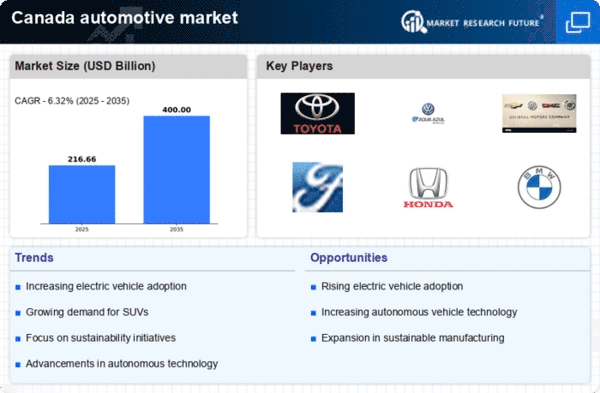
As per Market Research Future analysis, the Canada Automotive Industry size was estimated at 203.78 USD Billion in 2024. The Canada automotive market is projected to grow from 216.66 USD Billion in 2025 to 400.0 USD Billion by 2035, exhibiting a compound annual growth rate (CAGR) of 6.3% during the forecast period 2025 - 2035

Key Market Trends & Highlights

The Canada automotive market is experiencing a transformative shift towards electrification and advanced technologies.

  • The rise of electric vehicles (EVs) is reshaping the automotive landscape, with EVs becoming the largest segment in terms of sales volume.
  • Integration of advanced technologies, such as connectivity features and autonomous driving systems, is driving innovation in the market.
  • Sustainability and efficiency are increasingly prioritized, reflecting a growing consumer preference for environmentally friendly vehicles.
  • Government incentives for electric vehicles and rising consumer demand for connectivity features are key drivers propelling market growth.

Market Size & Forecast

2024 Market Size 203.78 (USD Billion)
2035 Market Size 400.0 (USD Billion)
CAGR (2025 - 2035) 6.32%

Major Players

Toyota Motor Corporation (JP), Volkswagen AG (DE), General Motors Company (US), Ford Motor Company (US), Honda Motor Co., Ltd. (JP), BMW AG (DE), Daimler AG (DE), Hyundai Motor Company (KR), Nissan Motor Co., Ltd. (JP), Stellantis N.V. (NL)

Our Impact
Enabled $4.3B Revenue Impact for Fortune 500 and Leading Multinationals
Partnering with 2000+ Global Organizations Each Year
30K+ Citations by Top-Tier Firms in the Industry

Canada Automotive Industry Trends

The Canada Automotive Industry in Canada is currently experiencing a dynamic transformation, driven by technological advancements and shifting consumer preferences. The rise of electric vehicles (EVs) is particularly noteworthy, as manufacturers increasingly invest in sustainable technologies to meet environmental regulations and consumer demand for greener options.

This shift is not merely a trend but appears to be a fundamental change in the market landscape, with traditional automakers adapting their strategies to incorporate electric and hybrid models. Furthermore, the integration of advanced driver-assistance systems (ADAS) and connectivity features is reshaping the consumer experience, enhancing safety and convenience. In addition to technological innovations, the automotive market is also influenced by economic factors, including fluctuating fuel prices and changing trade policies. These elements may impact consumer purchasing decisions, leading to a greater emphasis on fuel efficiency and cost-effective vehicles.

As the market evolves, it seems that collaboration between automakers and technology firms will be crucial in driving future developments. Overall, the automotive market in Canada is poised for significant growth, with a focus on sustainability, innovation, and consumer-centric solutions.

Rise of Electric Vehicles

The automotive industry market is witnessing a notable increase in the adoption of electric vehicles. This trend is driven by consumer demand for environmentally friendly options and government incentives promoting EV usage. Automakers are responding by expanding their electric offerings, which may lead to a more sustainable transportation ecosystem.

Integration of Advanced Technologies

The incorporation of advanced technologies, such as connectivity features and driver-assistance systems, is becoming prevalent in the automotive industry market. These innovations enhance vehicle safety and user experience, suggesting a shift towards smarter, more integrated transportation solutions.

Focus on Sustainability and Efficiency

There is a growing emphasis on sustainability and fuel efficiency within the automotive industry market. As consumers become more environmentally conscious, manufacturers are likely to prioritize the development of vehicles that minimize environmental impact while maximizing performance.

Canada Automotive Industry Drivers

Environmental Regulations and Standards

The automotive market in Canada is increasingly influenced by stringent environmental regulations and standards aimed at reducing greenhouse gas emissions. The Canadian government has set ambitious targets to cut emissions from the transportation sector by 40% by 2030. These regulations are compelling manufacturers to innovate and develop cleaner technologies, including hybrid and fully electric vehicles. Compliance with these standards is not merely a legal obligation; it is becoming a competitive necessity. As a result, the automotive industry market is likely to see a rise in the production of low-emission vehicles, with estimates suggesting that by 2026, 50% of new vehicles sold will meet these stringent environmental criteria. This regulatory landscape is shaping the future of vehicle design and manufacturing in Canada.

Government Incentives for Electric Vehicles

The automotive market in Canada is currently experiencing a surge in government incentives aimed at promoting electric vehicle (EV) adoption. These incentives, which can include rebates and tax credits, are designed to reduce the upfront costs associated with purchasing EVs. As of 2025, the Canadian government has allocated approximately $300 million to support EV infrastructure development, which is expected to enhance consumer confidence and stimulate market growth. This financial backing is crucial as it encourages manufacturers to invest in EV technology, thereby increasing the variety of models available to consumers. Consequently, the automotive industry market is likely to see a significant uptick in EV sales, potentially reaching 30% of total vehicle sales by 2030, as consumers become more aware of the long-term savings associated with electric vehicles.

Growth of Ride-Sharing and Mobility Services

The automotive market in Canada is experiencing a transformation due to the growth of ride-sharing and mobility services. Companies like Uber and Lyft have changed consumer perceptions of vehicle ownership, leading to a decline in personal vehicle sales in urban areas. As of November 2025, it is estimated that ride-sharing services account for approximately 10% of all vehicle miles traveled in major Canadian cities. This shift is prompting automakers to rethink their business models, focusing on partnerships with mobility service providers. The automotive industry market may see an increase in the production of vehicles specifically designed for ride-sharing, which could lead to a more sustainable urban transportation ecosystem. This trend not only impacts sales but also influences vehicle design, emphasizing durability and efficiency.

Shift Towards Autonomous Driving Technologies

The automotive market in Canada is witnessing a notable shift towards the integration of autonomous driving technologies. This trend is driven by advancements in artificial intelligence and machine learning, which are enhancing vehicle safety and efficiency. As of November 2025, several Canadian provinces are actively testing autonomous vehicles on public roads, with the aim of establishing regulatory frameworks that support their widespread adoption. The potential for reduced traffic accidents and improved traffic flow could lead to a transformation in urban mobility. Market Research Future suggest that by 2035, autonomous vehicles may account for up to 15% of all vehicles on Canadian roads, fundamentally altering the landscape of the automotive industry market. This shift not only presents opportunities for manufacturers but also raises questions about infrastructure readiness and consumer acceptance.

Rising Consumer Demand for Connectivity Features

In the automotive market, there is an increasing consumer demand for connectivity features in vehicles. As technology evolves, consumers are seeking vehicles equipped with advanced infotainment systems, smartphone integration, and real-time navigation capabilities. Data indicates that approximately 60% of Canadian consumers prioritize connectivity when purchasing a new vehicle. This trend is prompting manufacturers to invest heavily in research and development to enhance in-car technology. The automotive industry market is likely to see a proliferation of connected vehicles, with projections suggesting that by 2027, over 70% of new vehicles sold in Canada will feature some form of connectivity. This shift not only enhances the driving experience but also opens new avenues for data monetization and customer engagement.


Market Segment Insights

By Type: Passenger Cars (Largest) vs. Electric Vehicles (Fastest-Growing)

In the Canada automotive market, the distribution of market share among segment values reveals that Passenger Cars dominate the landscape, holding a significant portion of the overall share. This segment benefits from a well-established consumer preference for personal and family transportation. Commercial Vehicles also play a crucial role, particularly in logistics and business operations, but Electric Vehicles are rapidly gaining traction as eco-conscious consumers shift towards sustainable options. Two Wheelers, while less dominant, cater to a niche market and are recognized for their affordability and maneuverability. Growth trends indicate a remarkable shift towards Electric Vehicles, driven by government incentives, advancements in battery technology, and a growing environmental awareness among consumers. Commercial Vehicles are expected to see steady growth as the need for efficient transport solutions rises. Meanwhile, Two Wheelers continue to appeal to urban populations seeking economical and flexible transportation. Overall, innovation and changing consumer preferences are key drivers shaping these segments.

Passenger Cars: Dominant vs. Electric Vehicles: Emerging

Passenger Cars remain the dominant segment in the Canada automotive industry market, characterized by a wide range of models that cater to various consumer preferences and needs. This segment is heavily influenced by factors such as technological advancements in fuel efficiency and safety features, along with strong brand loyalty among consumers. In contrast, Electric Vehicles are emerging as a significant player, fueled by increasing investment from manufacturers and a shift in consumer attitudes towards sustainable driving solutions. Electric Vehicles offer innovative features, lower operating costs, and align with the environmental goals of the Canadian government. As infrastructure for EV charging expands, this segment is poised for exponential growth, appealing to a younger demographic keen on sustainability.

By Fuel Type: Internal Combustion Engine (Largest) vs. Electric (Fastest-Growing)

The fuel type segment in the Canada automotive market is primarily dominated by Internal Combustion Engines, which capture the largest market share. However, Electric vehicles are rapidly gaining traction, appealing to environmentally conscious consumers and aligning with governmental policies towards sustainability. Hybrid and Hydrogen fuel types also contribute to the market but remain less significant in comparison to these leading segments. The growth trends indicate a clear shift towards Electric vehicles, driven by advancements in battery technology and increased infrastructure for charging stations. Factors such as climate change awareness, government incentives, and innovative automotive designs are propelling the demand for Electric and Hybrid vehicles. As consumer preferences shift, the Hydrogen segment is emerging with potential, although it still requires further development and acceptance for widespread use.

Internal Combustion Engine (Dominant) vs. Electric (Emerging)

The Internal Combustion Engine remains the dominant fuel type in the Canada automotive industry market, characterized by a well-established infrastructure and consumer familiarity. Despite growing environmental concerns, these vehicles maintain their popularity due to lower upfront costs and extensive refueling options. On the other hand, Electric vehicles are emerging as a viable alternative, driven by technological advancements, increasing range capabilities, and consumer incentives. The attractiveness of Electric vehicles lies in their lower operating costs and reduced emissions. As the market evolves, the competition between these fuel types intensifies, with Electric vehicles expected to gain a larger foothold as infrastructure improves and costs decrease, presenting a significant challenge to the Internal Combustion Engine segment.

By Sales Channel: Dealerships (Largest) vs. Online Retail (Fastest-Growing)

In the Canada automotive market, the sales channel distribution reveals that Dealerships hold the largest share, being the traditional backbone of vehicle sales. This channel remains popular among consumers who prefer a hands-on approach to vehicle purchasing, allowing for test drives and personalized assistance. Conversely, Online Retail is steadily gaining traction, attracting a tech-savvy demographic that values convenience and the ability to compare options digitally. The growth trends in the Canada automotive industry market indicate a notable shift toward Online Retail, which is emerging as the fastest-growing channel. Factors contributing to this growth include changing consumer preferences, enhanced online shopping platforms, and increased digital marketing efforts from automotive brands. Dealerships, while still dominant, are adapting to this trend by incorporating online sales features and improving their digital presence to engage a broader audience.

Dealerships (Dominant) vs. Online Retail (Emerging)

Dealerships remain the dominant sales channel in the Canada automotive industry market, characterized by their comprehensive service offerings, including financing options, repair services, and a wide selection of vehicles. They provide customers with a personalized experience and immediate access to a vehicle, which appeals to consumers who prioritize reliability. On the other hand, Online Retail is an emerging segment, driven by the increasing prevalence of e-commerce and consumer desire for hassle-free purchasing experiences. This channel allows customers to research, compare, and purchase vehicles from the comfort of their homes, often presenting them with better pricing options and deals. Together, these channels exemplify the diverse methods through which consumers are acquiring vehicles, reflecting evolving market dynamics.

By Vehicle Size: Compact (Largest) vs. Luxury (Fastest-Growing)

In the Canada automotive market, the vehicle size segment exhibits a diverse distribution, with compact vehicles holding the largest market share due to their affordability and suitability for urban environments. Mid-size and full-size vehicles follow closely, appealing to families and consumers seeking space. Luxury vehicles are gaining traction as consumer preferences shift towards higher-end models that provide advanced features and comfort. The growth trends in the vehicle size segment are influenced by several factors, including changing consumer lifestyle preferences, increased urbanization, and advancements in fuel efficiency. Compact vehicles continue to dominate thanks to their economic advantages, while the luxury segment is rapidly expanding as more consumers opt for vehicles that offer premium experiences and cutting-edge technology in performance and safety.

Compact (Dominant) vs. Luxury (Emerging)

Compact vehicles in the Canada automotive industry market are characterized by their economy, maneuverability, and lower emissions, making them ideal for city driving. They appeal to a broad demographic, especially younger drivers and urban dwellers looking for cost-effective options. On the other hand, luxury vehicles are emerging strongly as they cater to affluent consumers willing to pay for better performance, technology, and comfort. This segment often features advanced safety systems, high-quality interiors, and connectivity options, which are increasingly important to buyers. The preference for luxury is growing as more Canadians prioritize premium features, indicating a shift in consumer values towards quality and experience.

Get more detailed insights about Canada Automotive Industry

Key Players and Competitive Insights

The automotive market in Canada is characterized by a dynamic competitive landscape, driven by innovation, sustainability, and technological advancements. Major players such as Toyota Motor Corporation (JP), General Motors Company (US), and Hyundai Motor Company (KR) are actively shaping the market through strategic initiatives. Toyota, with its strong emphasis on hybrid and electric vehicle (EV) technology, positions itself as a leader in sustainable mobility. General Motors, on the other hand, focuses on a comprehensive transition to electric vehicles, aiming to achieve carbon neutrality by 2035. Meanwhile, Hyundai is investing heavily in hydrogen fuel cell technology, indicating a diversified approach to alternative energy sources. Collectively, these strategies contribute to a competitive environment that prioritizes technological innovation and environmental responsibility. Key business tactics within the market include localizing manufacturing and optimizing supply chains to enhance efficiency and reduce costs. The competitive structure appears moderately fragmented, with several key players vying for market share. This fragmentation allows for a variety of consumer choices, while the influence of major companies like Toyota and General Motors helps to set industry standards and drive innovation. In October 2025, Toyota Motor Corporation (JP) announced a partnership with a Canadian tech firm to develop advanced battery technologies aimed at improving EV performance and reducing costs. This strategic move underscores Toyota's commitment to maintaining its leadership in the EV sector while addressing the growing demand for more efficient energy solutions. The collaboration is expected to enhance Toyota's competitive edge by accelerating the development of next-generation batteries. In September 2025, General Motors Company (US) unveiled its ambitious plan to invest $1 billion in a new manufacturing facility in Ontario, dedicated to producing electric vehicles. This investment not only signifies GM's commitment to expanding its EV production capabilities but also reflects a strategic response to the increasing consumer demand for sustainable transportation options. The facility is projected to create thousands of jobs, further solidifying GM's presence in the Canadian market. In August 2025, Hyundai Motor Company (KR) launched a new line of hydrogen fuel cell vehicles in Canada, aiming to capture a share of the growing market for alternative energy vehicles. This launch is significant as it positions Hyundai as a frontrunner in the hydrogen vehicle segment, which is expected to gain traction in the coming years. By diversifying its product offerings, Hyundai enhances its competitive positioning and addresses the evolving preferences of environmentally conscious consumers. As of November 2025, current trends in the automotive industry market include a strong focus on digitalization, sustainability, and the integration of artificial intelligence (AI) in vehicle design and manufacturing processes. Strategic alliances among companies are increasingly shaping the competitive landscape, fostering innovation and collaboration. The shift from price-based competition to a focus on technological advancement and supply chain reliability is evident. Moving forward, competitive differentiation will likely hinge on the ability to innovate and adapt to changing consumer demands, with a clear emphasis on sustainability and advanced technologies.

Key Companies in the Canada Automotive Industry include

Industry Developments

The Canada Automotive Industry Market is witnessing notable developments as of late 2023. Kia Canada Inc has been expanding its electric vehicle (EV) offerings, with plans to introduce multiple new models in the coming year. Meanwhile, Toyota Motor Corporation continues to enhance its hybrid technology, focusing on sustainable mobility solutions. Volkswagen Group Canada is boosting production capacity, particularly for its EV lineup, in response to growing consumer demand. Nissan North America recently launched a new range of electric models, further enhancing its presence in the Canadian market.

The market has seen significant investments from Tesla Inc, which is expanding its charging infrastructure across the country, facilitating the transition to EVs. In terms of mergers and acquisitions, FCA Canada Inc announced a collaboration in October 2023 with BMW Group Canada to innovate in battery technology. The market valuation of automotive companies in Canada continues to grow, largely driven by advancements in EV technology and changing consumer preferences for sustainability. 

Additionally, General Motors unveiled plans in January 2023 to increase local production of electric trucks, aiming to bolster its competitive edge within the burgeoning Canadian EV market. These developments underscore the dynamic and rapidly evolving landscape of the Canadian automotive sector.

Future Outlook

Canada Automotive Industry Future Outlook

The automotive industry market in Canada is projected to grow at a 6.32% CAGR from 2025 to 2035, driven by technological advancements, increasing consumer demand, and sustainability initiatives.

New opportunities lie in:

  • Development of electric vehicle (EV) charging infrastructure Integration of advanced driver-assistance systems (ADAS) Expansion of subscription-based vehicle ownership models

By 2035, the automotive industry market is expected to be robust, driven by innovation and evolving consumer preferences.

Market Segmentation

Canada Automotive Industry Type Outlook

  • Passenger Cars
  • Commercial Vehicles
  • Electric Vehicles
  • Two Wheelers

Canada Automotive Industry Fuel Type Outlook

  • Internal Combustion Engine
  • Electric
  • Hybrid
  • Hydrogen

Canada Automotive Industry Vehicle Size Outlook

  • Compact
  • Mid-Size
  • Full-Size
  • Luxury

Canada Automotive Industry Sales Channel Outlook

  • Direct Sales
  • Dealerships
  • Online Retail

Report Scope

MARKET SIZE 2024 203.78(USD Billion)
MARKET SIZE 2025 216.66(USD Billion)
MARKET SIZE 2035 400.0(USD Billion)
COMPOUND ANNUAL GROWTH RATE (CAGR) 6.32% (2025 - 2035)
REPORT COVERAGE Revenue Forecast, Competitive Landscape, Growth Factors, and Trends
BASE YEAR 2024
Market Forecast Period 2025 - 2035
Historical Data 2019 - 2024
Market Forecast Units USD Billion
Key Companies Profiled Toyota Motor Corporation (JP), Volkswagen AG (DE), General Motors Company (US), Ford Motor Company (US), Honda Motor Co., Ltd. (JP), BMW AG (DE), Daimler AG (DE), Hyundai Motor Company (KR), Nissan Motor Co., Ltd. (JP), Stellantis N.V. (NL)
Segments Covered Type, Fuel Type, Sales Channel, Vehicle Size
Key Market Opportunities Growth in electric vehicle infrastructure and consumer demand for sustainable transportation solutions.
Key Market Dynamics Shift towards electric vehicles driven by regulatory incentives and evolving consumer preferences in Canada.
Countries Covered Canada
Leave a Comment

FAQs

What is the expected market size of the Canada Automotive Industry Report Market in 2024?

In 2024, the Canada Automotive Industry Report Market is expected to be valued at 163.03 billion USD.

What is the projected market size of the Canada Automotive Industry Report Market by 2035?

By 2035, the market is anticipated to reach a valuation of 300.0 billion USD.

What is the expected CAGR for the Canada Automotive Industry Report Market from 2025 to 2035?

The expected CAGR for the Canada Automotive Industry Report Market from 2025 to 2035 is 5.701 percent.

Which vehicle type has the highest expected market value in 2035?

The passenger car segment is projected to have the highest market value at 110.0 billion USD in 2035.

What is the market value of the SUV segment in 2024?

The SUV segment is valued at 45.0 billion USD in 2024.

Who are the key players in the Canada Automotive Industry Report Market?

Major players include Kia Canada Inc, Toyota Motor Corporation, Volkswagen Group Canada, and Ford Motor Company.

What are the expected market values for the hatchback segment in 2024 and 2035?

The hatchback segment is expected to be valued at 20.0 billion USD in 2024 and 35.0 billion USD in 2035.

What challenges and opportunities are present in the Canada Automotive Industry Report Market?

Key challenges include supply chain disruptions, while opportunities may arise from the growing demand for electric vehicles.

What is the market size for the MUV segment in 2024 and 2035?

The MUV segment is valued at 13.03 billion USD in 2024 and is expected to grow to 20.0 billion USD by 2035.

What impact do emerging trends have on the overall growth of the Canada Automotive Industry Report Market?

Emerging trends in electrification and sustainability are likely to drive significant growth in the Canada Automotive Industry Report Market.

Download Free Sample

Kindly complete the form below to receive a free sample of this Report

Compare Licence

×
Features License Type
Single User Multiuser License Enterprise User
Price $4,950 $5,950 $7,250
Maximum User Access Limit 1 User Upto 10 Users Unrestricted Access Throughout the Organization
Free Customization
Direct Access to Analyst
Deliverable Format
Platform Access
Discount on Next Purchase 10% 15% 15%
Printable Versions