×
Request Free Sample ×

Kindly complete the form below to receive a free sample of this Report

* Please use a valid business email

Leading companies partner with us for data-driven Insights

clients tt-cursor
Hero Background

Brazil Plastics Market

ID: MRFR/CnM/42488-HCR
111 Pages
Chitranshi Jaiswal
February 2026

Brazil Plastics Market Research Report By Type Outlook (Polyethylene Polyether Ether Ketone) and By Application Outlook (Packaging Automotive Transportation Building Construction)- Forecast to 2035

Share:
Download PDF ×

We do not share your information with anyone. However, we may send you emails based on your report interest from time to time. You may contact us at any time to opt-out.

Brazil Plastics Market Infographic
Purchase Options

Brazil Plastics Market Summary

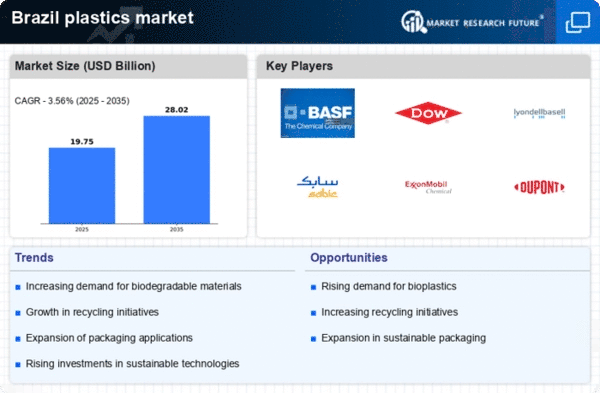
As per Market Research Future analysis, the Brazil plastics market Size was estimated at 19.07 USD Billion in 2024. The Brazil plastics market is projected to grow from 19.75 USD Billion in 2025 to 28.02 USD Billion by 2035, exhibiting a compound annual growth rate (CAGR) of 3.5% during the forecast period 2025 - 2035

Key Market Trends & Highlights

The Brazil plastics market is experiencing a transformative shift towards sustainability and innovation.

  • Sustainability initiatives are increasingly shaping the Brazil plastics market, driving companies to adopt eco-friendly practices.
  • Technological advancements in production processes are enhancing efficiency and reducing waste in the plastics sector.
  • The packaging segment remains the largest in Brazil, while the automotive segment is identified as the fastest-growing area within the market.
  • Rising demand for packaging solutions and infrastructure development initiatives are key drivers propelling market growth.

Market Size & Forecast

2024 Market Size 19.07 (USD Billion)
2035 Market Size 28.02 (USD Billion)
CAGR (2025 - 2035) 3.56%

Major Players

BASF SE (DE), Dow Inc. (US), LyondellBasell Industries N.V. (NL), SABIC (SA), ExxonMobil Chemical Company (US), DuPont de Nemours, Inc. (US), Mitsubishi Chemical Corporation (JP), INEOS Group Limited (GB), LG Chem Ltd. (KR)

Our Impact
Enabled $4.3B Revenue Impact for Fortune 500 and Leading Multinationals
Partnering with 2000+ Global Organizations Each Year
30K+ Citations by Top-Tier Firms in the Industry

Brazil Plastics Market Trends

The plastics market in Brazil is currently experiencing a dynamic phase characterized by evolving consumer preferences and regulatory frameworks. The demand for sustainable materials is on the rise, as consumers increasingly prioritize eco-friendly products. This shift is prompting manufacturers to innovate and adapt their offerings, leading to a greater emphasis on biodegradable and recyclable plastics. Additionally, the Brazilian government is implementing stricter regulations aimed at reducing plastic waste, which is likely to further influence production practices and market strategies. As a result, companies are investing in research and development to create alternatives that align with these new standards. Moreover, the economic landscape in Brazil is also impacting the plastics market. Fluctuations in raw material prices and supply chain disruptions are challenges that manufacturers must navigate. However, the potential for growth remains strong, particularly in sectors such as packaging, automotive, and construction. The increasing urbanization and population growth in Brazil suggest a sustained demand for plastics in various applications. Overall, the market appears poised for transformation, driven by both consumer demand and regulatory pressures, which may redefine the future of plastics in the country.

Sustainability Initiatives

There is a notable trend towards sustainability within the plastics market. Companies are increasingly focusing on developing biodegradable and recyclable materials to meet consumer demand for eco-friendly products. This shift is supported by government regulations aimed at reducing plastic waste, encouraging manufacturers to innovate in their product offerings.

Technological Advancements

Technological advancements are playing a crucial role in shaping the plastics market. Innovations in production processes and materials are enabling manufacturers to enhance efficiency and reduce costs. This trend is likely to lead to the development of new applications and improved product performance, catering to diverse industry needs.

Regulatory Changes

Regulatory changes are significantly influencing the plastics market. The Brazilian government is implementing stricter regulations regarding plastic usage and waste management. These changes are prompting companies to adapt their practices, invest in sustainable solutions, and comply with new standards, which may reshape the competitive landscape.

Market Segment Insights

By Application: Packaging (Largest) vs. Automotive (Fastest-Growing)

In the Brazil plastics market, the 'Packaging' segment dominates, holding a significant market share due to the rising demand for flexible packaging solutions. The construction sector follows, leveraging plastic's versatility for various applications, while automotive and electronics show robust participation as well. The medical devices segment, although smaller, is gaining momentum through innovative applications that cater to health and safety needs. Growth trends indicate that 'Automotive' is the fastest-growing segment, driven by advancements in lightweight materials that enhance fuel efficiency. Additionally, increasing urbanization and infrastructural developments propel the 'Construction' segment. The 'Electronics' sector is also expanding due to consumer electronics trends, while the 'Medical Devices' sector is evolving through technological innovations that improve healthcare delivery.

Packaging: Dominant vs. Medical Devices: Emerging

The 'Packaging' segment is characterized by its extensive use across various industries, reflecting consumer preferences for convenience and sustainability. It benefits from innovations in design and materials, which significantly enhance its market presence. In contrast, the 'Medical Devices' segment is emerging, focusing on high-quality standards and regulatory compliance in the production of plastic components used in medical equipment. While it currently holds a smaller market share, the increasing focus on health and safety is driving growth in this sector, potentially allowing it to capture a larger share in the coming years as demand for medical innovations continues to rise.

By Type: Polyethylene (Largest) vs. Polypropylene (Fastest-Growing)

In the Brazil plastics market, the distribution of market share among the primary plastic types showcases significant segmentation. Polyethylene holds the largest share, being widely utilized in packaging, containers, and various consumer goods. Following closely, Polypropylene is also prominent due to its versatility and increasing applications in automotive and medical sectors. Meanwhile, Polyvinyl Chloride (PVC), Polystyrene, and Polyethylene Terephthalate (PET) present diverse opportunities and applications, albeit with smaller total shares compared to the leading types. Growth trends within this segment indicate a strong move towards environmentally friendly practices and recycling technologies. The demand for Polyethylene remains robust, driven by its adaptability and cost-effectiveness. In contrast, Polypropylene has emerged as the fastest-growing type, primarily propelled by innovations in its applications and increased consumer preference. Regulatory changes mandating sustainable materials further enhance the growth prospects for these materials in the Brazil plastics market.

Polyethylene (Dominant) vs. Polypropylene (Emerging)

Polyethylene is established as the dominant force in the Brazil plastics market, known for its low production costs and wide-ranging applications. Its flexibility and chemical resistance have made it a top choice for industries such as packaging, which forms a substantial part of its demand. On the other hand, Polypropylene is gaining ground as an emerging material due to its rising performance characteristics, including higher thermal resistance and superior clarity. It is becoming increasingly preferred in sectors like automotive and consumer goods, where lightweight and durable materials are in demand. The ongoing innovation in production processes and designs is expected to accelerate the adoption of Polypropylene, thereby reshaping the competitive landscape.

By End Use: Consumer Goods (Largest) vs. Healthcare (Fastest-Growing)

The market share distribution within the end-use segment of the Brazil plastics market reveals that Consumer Goods holds the largest share, driven by the demand for everyday items ranging from household products to personal goods. This segment's strong performance is attributed to the growing consumer base and increasing disposable incomes, which contribute to higher consumption of plastic goods. In contrast, Healthcare represents the fastest-growing segment, with demand surging for medical devices, packaging, and other healthcare-related applications due to ongoing advancements in medical technology and increased health awareness. Growth trends indicate a robust expansion in the Healthcare end-use segment, primarily fueled by an aging population and heightened focus on health and wellness. As Brazil's healthcare infrastructure improves and invests in innovative medical solutions, the need for plastics in this sector continues to rise. Additionally, the Consumer Goods segment is also anticipated to grow steadily, propelled by trends in convenience and sustainability, as consumers favor eco-friendly plastic products. Overall, these dynamics will shape the future landscape of the Brazil plastics market.

Consumer Goods: Dominant vs. Healthcare: Emerging

Consumer Goods, being the dominant segment in the end-use category, encompasses a wide array of products that include packaging, bottles, and household items. Its strength lies in its ability to cater to daily needs, making it a critical player in the consumption cycle. On the other hand, Healthcare is emerging as a significant force, driven by innovations in medical plastic applications and increasing health consciousness among the population. This segment includes items like syringes, tubing, and durable medical equipment. The growth in Healthcare is marked by advancements in technology and a continuous push towards efficient and safe medical solutions, paving the way for increased plastic utilization in the sector.

By Form: Rigid Plastics (Largest) vs. Flexible Plastics (Fastest-Growing)

Among the form segments in the Brazil plastics market, Rigid Plastics holds the largest share, characterized by its widespread application in packaging, consumer goods, and automotive industries. This segment's dominance is primarily attributed to the robust demand for durable and versatile product offerings, which has solidified its position over the years. In contrast, Flexible Plastics, while holding a smaller share, showcases promising growth projections fueled by the increasing need for lightweight, cost-effective, and versatile solutions across various sectors. The growth trajectory for Flexible Plastics is propelled by evolving consumer preferences and technological advancements that facilitate innovative product designs. Factors such as the rising demand for flexible packaging in the food and beverage sector, combined with sustainability initiatives driving the development of eco-friendly plastic alternatives, contribute significantly to this segment's expansion. As the market shifts towards more adaptable and efficient solutions, Flexible Plastics are poised to become increasingly prevalent in the Brazil plastics market.

Rigid Plastics (Dominant) vs. Flexible Plastics (Emerging)

Rigid Plastics are prevalent due to their structural integrity and ease of manufacturing, making them a preferred choice for various applications such as containers and construction materials. This segment benefits from established manufacturing processes and a reliable supply chain, ensuring consistent market presence. On the other hand, Flexible Plastics are gaining traction as an emerging segment, particularly in packaging solutions where adaptability and minimizing waste are critical. These materials offer a competitive edge in terms of lightweight characteristics and cost-effectiveness, appealing to manufacturers looking to reduce material costs while meeting consumer demands for innovative packaging solutions. Together, these segments reflect the diverse needs of the Brazil plastics market.

Get more detailed insights about Brazil Plastics Market

Key Players and Competitive Insights

The plastics market in Brazil is characterized by a dynamic competitive landscape, driven by increasing demand across various sectors such as packaging, automotive, and construction. Key players are actively pursuing strategies that emphasize innovation, sustainability, and regional expansion. BASF SE (Germany) has positioned itself as a leader in sustainable solutions, focusing on developing biodegradable plastics and enhancing its production processes to reduce carbon emissions. Similarly, Dow Inc. (US) is leveraging its technological expertise to innovate in high-performance materials, which are increasingly sought after in the automotive and electronics industries. These strategic focuses not only enhance their market presence but also contribute to a competitive environment that prioritizes sustainability and technological advancement.In terms of business tactics, companies are increasingly localizing manufacturing to better serve the Brazilian market, which appears to be a response to the growing demand for customized solutions. Supply chain optimization is also a critical focus, as firms seek to mitigate risks and enhance efficiency. The market structure is moderately fragmented, with several key players exerting influence, yet the collective actions of these companies are shaping a more consolidated competitive environment.

In October LyondellBasell Industries N.V. (Netherlands) announced a strategic partnership with a local Brazilian firm to enhance its production capabilities in the region. This move is significant as it not only allows LyondellBasell to tap into local expertise but also strengthens its supply chain resilience, enabling quicker response times to market demands. Such partnerships are likely to become more prevalent as companies seek to navigate the complexities of the Brazilian market.

In September SABIC (Saudi Arabia) unveiled a new line of recycled plastics aimed at reducing environmental impact. This initiative aligns with global trends towards sustainability and positions SABIC as a forward-thinking player in the market. The introduction of these products is expected to attract environmentally conscious consumers and businesses, thereby enhancing SABIC's competitive edge.

In August ExxonMobil Chemical Company (US) launched a new digital platform designed to optimize its supply chain operations in Brazil. This platform utilizes advanced analytics and AI to improve decision-making processes, which could lead to significant cost savings and efficiency gains. The integration of digital technologies is becoming increasingly vital in the plastics market, as companies strive to enhance operational efficiency and customer satisfaction.

As of November the competitive trends in the plastics market are heavily influenced by digitalization, sustainability, and the integration of AI technologies. Strategic alliances are emerging as a key factor in shaping the landscape, allowing companies to pool resources and expertise. Looking ahead, competitive differentiation is likely to evolve from traditional price-based competition to a focus on innovation, technological advancements, and supply chain reliability. This shift underscores the importance of adapting to changing market dynamics and consumer preferences.


Key Companies in the Brazil Plastics Market include

Industry Developments

The Brazil Plastics Market has seen significant recent developments, including a rise in sustainable practices where companies like Braskem and BASF have been at the forefront, driving innovation in bio-based plastics. Growing environmental regulations are pushing businesses towards eco-friendly alternatives, influencing market dynamics. In terms of mergers and acquisitions, notable activity includes Dow's acquisition of a production facility in Brazil in March 2023, aiming to enhance their output in sustainable materials.

Additionally, in January 2023, SABIC announced an investment in expanding its capacities in Brazil, signaling increased confidence in the region. The market has experienced growth, with January 2022 reports indicating a surge in production capacity by over 5%, significantly impacting supply chains. Companies in the sector are also witnessing valuation increases, with major players like Lanxess and Covestro adapting to changing market demands by investing in RD for advanced materials. Recent government initiatives aimed at reducing plastic waste have further catalyzed innovation, making Brazil a burgeoning hub for plastic manufacturing and sustainable solutions.

Future Outlook

Brazil Plastics Market Future Outlook

The plastics market in Brazil is projected to grow at a 3.56% CAGR from 2025 to 2035, driven by increasing demand in packaging, automotive, and construction sectors.

New opportunities lie in:

  • Invest in biodegradable plastic production technologies.
  • Develop advanced recycling facilities for post-consumer plastics.
  • Expand into high-performance polymers for automotive applications.

By 2035, the plastics market in Brazil is expected to achieve robust growth and innovation.

Market Segmentation

Brazil Plastics Market Form Outlook

  • Rigid Plastics
  • Flexible Plastics
  • Foam Plastics
  • Film Plastics

Brazil Plastics Market Type Outlook

  • Polyethylene
  • Polypropylene
  • Polyvinyl Chloride
  • Polystyrene
  • Polyethylene Terephthalate

Brazil Plastics Market End Use Outlook

  • Consumer Goods
  • Industrial Goods
  • Healthcare
  • Food and Beverage
  • Building and Construction

Brazil Plastics Market Application Outlook

  • Packaging
  • Construction
  • Automotive
  • Electronics
  • Medical Devices

Report Scope

MARKET SIZE 2024 19.07(USD Billion)
MARKET SIZE 2025 19.75(USD Billion)
MARKET SIZE 2035 28.02(USD Billion)
COMPOUND ANNUAL GROWTH RATE (CAGR) 3.56% (2025 - 2035)
REPORT COVERAGE Revenue Forecast, Competitive Landscape, Growth Factors, and Trends
BASE YEAR 2024
Market Forecast Period 2025 - 2035
Historical Data 2019 - 2024
Market Forecast Units USD Billion
Key Companies Profiled BASF SE (DE), Dow Inc. (US), LyondellBasell Industries N.V. (NL), SABIC (SA), ExxonMobil Chemical Company (US), DuPont de Nemours, Inc. (US), Mitsubishi Chemical Corporation (JP), INEOS Group Limited (GB), LG Chem Ltd. (KR)
Segments Covered Application, Type, End Use, Form
Key Market Opportunities Adoption of biodegradable plastics driven by increasing environmental regulations and consumer demand for sustainable products.
Key Market Dynamics Rising environmental regulations drive innovation and sustainability in Brazil's plastics market, reshaping competitive dynamics.
Countries Covered Brazil
Leave a Comment

FAQs

What is the expected market size of the Brazil Plastics Market in 2024?

The Brazil Plastics Market is expected to be valued at 14.31 USD Billion in 2024.

What will be the market size of the Brazil Plastics Market by 2035?

By 2035, the Brazil Plastics Market is projected to reach a value of 21.6 USD Billion.

What is the expected CAGR for the Brazil Plastics Market from 2025 to 2035?

The Brazil Plastics Market is expected to grow at a CAGR of 3.81% from 2025 to 2035.

Which type of plastic is anticipated to dominate the Brazil Plastics Market by value in 2024?

Polyethylene is expected to dominate the market by value, reaching 5.75 USD Billion in 2024.

What is the projected value of Polyether Ether in the Brazil Plastics Market by 2035?

The value of Polyether Ether in the Brazil Plastics Market is projected to be 5.12 USD Billion by 2035.

What are the key players in the Brazil Plastics Market?

Key players in the Brazil Plastics Market include Lanxess, Petrobras, Total, and Braskem among others.

What is the expected market value for Ketone in 2024?

The expected market value for Ketone in the Brazil Plastics Market is 5.14 USD Billion in 2024.

What growth opportunities exist in the Brazil Plastics Market in the coming years?

The Brazil Plastics Market presents growth opportunities driven by increasing demand in packaging and construction.

How does the Brazil Plastics Market size in 2035 compare to 2024?

The market size is projected to increase from 14.31 USD Billion in 2024 to 21.6 USD Billion in 2035.

What challenges may impact the growth of the Brazil Plastics Market?

Challenges to the growth of the Brazil Plastics Market may include regulatory pressures and sustainability concerns.

Download Free Sample

Kindly complete the form below to receive a free sample of this Report

Compare Licence

×
Features License Type
Single User Multiuser License Enterprise User
Price $4,950 $5,950 $7,250
Maximum User Access Limit 1 User Upto 10 Users Unrestricted Access Throughout the Organization
Free Customization
Direct Access to Analyst
Deliverable Format
Platform Access
Discount on Next Purchase 10% 15% 15%
Printable Versions