×
Request Free Sample ×

Kindly complete the form below to receive a free sample of this Report

* Please use a valid business email

Leading companies partner with us for data-driven Insights

clients tt-cursor
Hero Background

Brazil Digital Payment Market

ID: MRFR/BS/43154-HCR
200 Pages
Aarti Dhapte
February 2026

Brazil Digital Payment Market Size, Share and Research Report By Component Outlook (Solution, Services), By Deployment Model Outlook (SaaS, PaaS, On-premises), By Organization Size Outlook (Small and Medium Enterprise, Large Enterprise), and By Vertical Outlook (BFSI, IT Telecommunication, Retail E-commerce, Hospitality, Healthcare, Media Entertainment, Others) - Industry Forecast Till 2035

Share:
Download PDF ×

We do not share your information with anyone. However, we may send you emails based on your report interest from time to time. You may contact us at any time to opt-out.

Brazil Digital Payment Market Infographic
Purchase Options

Brazil Digital Payment Market Summary

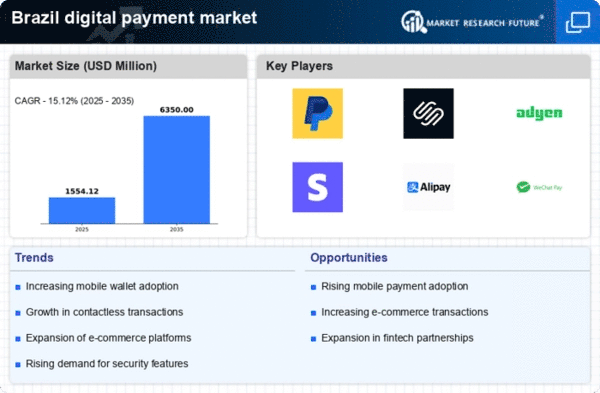
As per Market Research Future analysis, the Brazil Digital Payment Market size was estimated at 1350.0 USD Million in 2024. The Digital Payment market is projected to grow from 1554.12 USD Million in 2025 to 6350.0 USD Million by 2035, exhibiting a compound annual growth rate (CAGR) of 15.1% during the forecast period 2025 - 2035

Key Market Trends & Highlights

The Brazil digital payment market is experiencing robust growth driven by technological advancements and increasing consumer adoption.

  • Mobile payments are rapidly gaining traction, becoming the largest segment in the Brazil digital payment market.
  • E-commerce integration is expanding, with a notable increase in online transactions across various sectors.
  • Security measures are receiving heightened attention, reflecting consumer demand for safer payment options.
  • Technological advancements in payment solutions and the growing e-commerce sector are key drivers propelling market growth.

Market Size & Forecast

2024 Market Size 1350.0 (USD Million)
2035 Market Size 6350.0 (USD Million)
CAGR (2025 - 2035) 15.12%

Major Players

PayPal (US), Square (US), Adyen (NL), Stripe (US), Alipay (CN), WeChat Pay (CN), Visa (US), Mastercard (US), American Express (US)

Our Impact
Enabled $4.3B Revenue Impact for Fortune 500 and Leading Multinationals
Partnering with 2000+ Global Organizations Each Year
30K+ Citations by Top-Tier Firms in the Industry

Brazil Digital Payment Market Trends

The Brazil Digital Payment Market in Brazil is experiencing a transformative phase, characterized by rapid technological advancements and shifting consumer preferences. The proliferation of smartphones and internet access has facilitated the adoption of various digital payment solutions, enabling consumers to engage in seamless transactions. This evolution is further supported by the Brazilian government's initiatives aimed at promoting financial inclusion and enhancing the overall payment infrastructure. As a result, traditional banking methods are gradually being supplanted by innovative digital alternatives, which appear to resonate well with the tech-savvy population. Moreover, the competitive landscape is intensifying, with numerous players entering the market, each vying for consumer attention. This influx of new entrants is likely to spur innovation, leading to the development of more user-friendly applications and services. Additionally, the growing emphasis on security and fraud prevention is shaping the strategies of digital payment providers. As consumers become increasingly aware of potential risks, companies are compelled to invest in robust security measures to build trust and ensure a safe transaction environment. Overall, the digital payment market is poised for continued growth, driven by technological advancements and evolving consumer expectations.

Rise of Mobile Payments

Mobile payment solutions are gaining traction, as consumers increasingly prefer the convenience of transacting via smartphones. This trend is likely to reshape the payment landscape, encouraging businesses to adopt mobile-friendly platforms.

Increased Focus on Security

With the rise in digital transactions, there is a heightened emphasis on security measures. Companies are investing in advanced technologies to protect consumer data and enhance trust in digital payment systems.

Expansion of E-commerce Integration

The integration of digital payment solutions within e-commerce platforms is expanding. This trend facilitates smoother transactions for online shoppers, potentially driving higher sales for businesses.

Brazil Digital Payment Market Drivers

Growing E-commerce Sector

The burgeoning e-commerce sector in Brazil significantly influences the digital payment market. With online retail sales projected to reach $30 billion by the end of 2025, the demand for efficient and secure payment methods is escalating. Consumers increasingly prefer digital payment options for their online purchases, leading to a shift in payment preferences. In 2025, it is anticipated that over 50% of e-commerce transactions will be conducted through digital payment platforms. This trend is further supported by the rise of social commerce, where social media platforms facilitate direct purchases. As a result, the digital payment market is poised for growth, driven by the evolving shopping habits of Brazilian consumers.

Rise of Fintech Companies

The emergence of fintech companies is transforming the digital payment market in Brazil. These innovative firms are leveraging technology to offer tailored financial solutions, including payment processing, peer-to-peer transfers, and digital wallets. As of November 2025, Brazil hosts over 800 fintech startups, many of which focus on enhancing the payment experience. This competitive landscape encourages traditional banks to innovate and improve their services, leading to a more dynamic market. The digital payment market is likely to see increased collaboration between fintechs and established financial institutions, fostering a more inclusive ecosystem. This trend may result in a broader range of payment options for consumers and businesses alike.

Government Initiatives and Regulations

Government initiatives play a pivotal role in shaping the digital payment market in Brazil. The Central Bank of Brazil has implemented regulations aimed at promoting financial inclusion and enhancing the efficiency of payment systems. The introduction of the Instant Payment System (PIX) has revolutionized the way transactions are conducted, allowing for real-time payments 24/7. As of November 2025, over 70 million Brazilians are actively using PIX, indicating its widespread acceptance. These regulatory frameworks not only foster competition among payment service providers but also ensure consumer protection. Consequently, the digital payment market is likely to expand as more individuals and businesses adopt these innovative solutions.

Increased Consumer Awareness and Adoption

Consumer awareness regarding the benefits of digital payments is on the rise in Brazil. As individuals become more educated about the convenience, speed, and security of digital transactions, adoption rates are increasing. Surveys indicate that approximately 65% of Brazilians prefer digital payment methods over traditional cash transactions. This shift is particularly evident among younger demographics, who are more inclined to embrace technology. The digital payment market is likely to benefit from this growing acceptance, as businesses adapt to meet consumer preferences. Additionally, educational campaigns by financial institutions are further promoting the advantages of digital payments, thereby enhancing market penetration.

Technological Advancements in Payment Solutions

The digital payment market in Brazil is experiencing a surge due to rapid technological advancements. Innovations such as contactless payments, mobile wallets, and blockchain technology are reshaping the landscape. In 2025, it is estimated that mobile payment transactions will account for approximately 30% of all digital transactions in Brazil. This shift is driven by the increasing penetration of smartphones and internet access, which facilitates seamless payment experiences. Furthermore, the integration of artificial intelligence in fraud detection enhances security, thereby boosting consumer confidence in digital transactions. As a result, the digital payment market is projected to witness substantial growth, with projections indicating a compound annual growth rate (CAGR) of around 20% over the next five years.


Market Segment Insights

By Payment Method: Credit Card (Largest) vs. Mobile Wallet (Fastest-Growing)

In the Brazil digital payment market, Credit Cards dominate the landscape, holding a significant share due to their widespread acceptance and the consumer preference for credit facilities. Debit Cards follow closely behind, being the preferred option for many consumers due to direct bank account linkage and ease of use. Mobile Wallets are rapidly gaining market traction, reflecting a shift in consumer behavior toward digital convenience and faster transactions, while Bank Transfers and Cryptocurrency are growing but remain less prevalent in day-to-day transactions. The growth trends in the Brazil digital payment market indicate a robust expansion for Mobile Wallets, driven by technological advancements and increased smartphone penetration. Factors such as the ongoing digitalization of financial services, competitive transaction fees, and promotional offers from service providers contribute to this trend. Meanwhile, Credit Cards maintain their stronghold by continuously adapting to consumer needs and enhancing security features, positioning themselves as a reliable choice for various transactions.

Credit Card (Dominant) vs. Mobile Wallet (Emerging)

Credit Cards are characterized by their extensive acceptance across various merchants and the credit facilities they offer to consumers, making them a staple in the Brazil digital payment market. They cater to a broad demographic, appealing to both consumers seeking rewards and those needing flexibility in spending. On the other hand, Mobile Wallets are emerging as a dynamic alternative, particularly among younger consumers who favor convenience and speed. Their integration with e-commerce and social media platforms enhances their appeal. Mobile Wallets also often provide additional features like loyalty rewards and peer-to-peer payment options, making them attractive for everyday transactions. The contrasting characteristics of these segments highlight the evolving preferences in the competitive landscape.

By Transaction Type: Online Transactions (Largest) vs. Recurring Payments (Fastest-Growing)

In the Brazil digital payment market, Online Transactions lead the way, commanding a significant share of the overall transaction landscape. In-Store Transactions and Peer-to-Peer Transactions follow closely, with notable volumes as well. Recurring Payments, while smaller in total share, are rapidly gaining traction, indicating changing consumer preferences towards more automated and scheduled payment methods. The growth trends in this segment showcase a clear shift towards digitalization, driven by increasing internet penetration and enhanced smartphone access. The COVID-19 pandemic also catalyzed a surge in Online Transactions as consumers opted for contactless payments. Recurring Payments are on the rise due to the convenience they offer, appealing to both consumers and businesses looking for stable revenue streams. This context highlights the dynamic evolution of transaction preferences in the market.

Online Transactions: Dominant vs. Recurring Payments: Emerging

Online Transactions are a dominant force in the Brazil digital payment market, representing the most preferred method for consumers engaging in e-commerce and digital services. This segment benefits from a user-friendly interface, rapid transaction processing, and robust security measures that boost consumer confidence. In contrast, Recurring Payments, though emerging, are identified as a vital part of the market's future, appealing primarily to subscription-based services and automated billing cycles. The strength of Recurring Payments lies in their ability to enhance user loyalty and provide consistent cash flow for businesses. As technology advances, both segments will likely evolve, with Online Transactions continuing to grow while Recurring Payments carve out a more significant market presence.

By End User: Retail Consumers (Largest) vs. Government Entities (Fastest-Growing)

In the Brazil digital payment market, Retail Consumers hold the largest share, indicating a strong preference for digital transactions in everyday purchases. This segment primarily includes individuals making online and in-store purchases using various digital payment methods, reflecting the growing adoption of e-commerce and contactless payments. On the other hand, Government Entities represent the fastest-growing segment, driven by increasing initiatives to digitize public services and streamline payment processes. Their growth is supported by policies aiming to enhance financial inclusion and accessibility for citizens. The growth trends in the Brazil digital payment market are significantly influenced by technological advancements and changing consumer behaviors. Retail Consumers are leading the charge as e-commerce continues to flourish, and businesses adapt to cater to their needs with innovative payment solutions. Conversely, Government Entities are expanding their digital capabilities, focusing on efficient payment systems to improve service delivery. The push towards a cashless economy, coupled with heightened cybersecurity measures, is expected to further accelerate the expansion of both segments, establishing them as pivotal players in the digital payment landscape.

Retail Consumers (Dominant) vs. Businesses (Emerging)

Retail Consumers are a dominant force in the Brazil digital payment market, characterized by their widespread adoption of mobile wallets and online payment platforms. This group is increasingly favoring speed and convenience, leading to the growth of various payment options, such as QR codes and contactless payments. Their preferences are heavily influenced by the rise of e-commerce and the need for secure, efficient transaction methods. Businesses, while emerging, play a crucial role in shaping the digital payment ecosystem by integrating advanced payment solutions that enhance customer experience and streamline operations. As they increasingly adopt digital payment methods to meet consumer demand, businesses are creating a competitive landscape that benefits both consumers and merchants alike, driving further innovation in the market.

By Industry Vertical: Retail (Largest) vs. Banking (Fastest-Growing)

The Brazil digital payment market shows a diverse distribution among its key industry verticals. Retail stands out as the largest segment, driven by increasing e-commerce activities and consumer preference for online transactions. Banking, while smaller in market share, is rapidly expanding as more consumers adopt digital banking solutions, significantly contributing to the overall growth of digital payments. Growth trends in the market are primarily influenced by technological advancements and changing consumer behaviors. The rising acceptance of contactless payments and mobile wallets is propelling the banking sector, making it the fastest-growing segment. Additionally, the healthcare and travel sectors are also experiencing notable growth, driven by the need for seamless transaction solutions and enhanced customer experiences in these industries.

Retail: Dominant vs. Banking: Emerging

Retail remains a dominant force in the Brazil digital payment market, characterized by a robust demand for e-commerce platforms and mobile payment solutions. This segment leverages advanced technologies to improve the customer shopping experience and transaction efficiency. In contrast, the banking sector is emerging with a strong focus on digital transformation, catering to tech-savvy consumers seeking convenience and security. Innovations in mobile banking and the introduction of fintech solutions are driving this growth, appealing to a younger demographic that values speed and ease of access in their banking experiences. Together, these segments are reshaping the payment landscape, influencing customer habits and preferences.

Get more detailed insights about Brazil Digital Payment Market

Key Players and Competitive Insights

The digital payment market in Brazil is characterized by a rapidly evolving competitive landscape, driven by technological advancements and changing consumer preferences. Key players such as PayPal (US), Stripe (US), and Alipay (CN) are actively shaping the market through strategic initiatives aimed at enhancing user experience and expanding their service offerings. PayPal (US) has focused on integrating advanced security features and expanding its merchant services, while Stripe (US) emphasizes seamless payment processing and developer-friendly tools. Alipay (CN), on the other hand, is leveraging its extensive user base to introduce localized services tailored to Brazilian consumers, thereby enhancing its competitive positioning.
In terms of business tactics, companies are increasingly localizing their services to better cater to the Brazilian market. This includes optimizing payment solutions to accommodate local currencies and payment preferences. The market appears moderately fragmented, with several players vying for market share, yet the collective influence of major companies like Visa (US) and Mastercard (US) remains substantial, as they continue to dominate transaction volumes and establish partnerships with local financial institutions.
In October 2025, PayPal (US) announced a partnership with a leading Brazilian bank to enhance its payment processing capabilities, allowing for faster transactions and improved customer service. This strategic move is likely to bolster PayPal's market presence and facilitate greater adoption among Brazilian consumers, who increasingly seek efficient and reliable payment solutions. The collaboration underscores the importance of local partnerships in navigating the complexities of the Brazilian financial landscape.
In September 2025, Stripe (US) launched a new feature aimed at simplifying cross-border transactions for Brazilian businesses. This initiative is particularly significant as it addresses the challenges faced by local merchants in accessing international markets. By streamlining the payment process, Stripe is positioning itself as a key enabler of e-commerce growth in Brazil, potentially increasing its market share in a competitive environment.
In August 2025, Alipay (CN) expanded its services to include QR code payments specifically designed for Brazilian consumers. This strategic expansion not only enhances user convenience but also aligns with the growing trend of contactless payments in the region. Alipay's focus on innovation and user-centric solutions may provide it with a competitive edge as Brazilian consumers increasingly adopt digital payment methods.
As of November 2025, the competitive trends in the digital payment market are heavily influenced by digitalization, sustainability, and the integration of artificial intelligence (AI). Strategic alliances among key players are shaping the landscape, fostering innovation and enhancing service delivery. The shift from price-based competition to a focus on technological advancement and supply chain reliability is evident, suggesting that future competitive differentiation will hinge on the ability to innovate and adapt to evolving consumer needs.

Key Companies in the Brazil Digital Payment Market include

Industry Developments

Recent developments in the Brazilian Digital Payment Market show a significant trend toward digitalization and integration of services.

In October 2023, Nubank announced its expansion into the credit card segment, fostering enhanced customer engagement through digital solutions. Santander is pushing forward with its digital wallet offerings to compete more directly in the fintech space, while MercadoPago continues to strengthen its position as a leader in e-commerce payment systems.

GetNet has seen notable partnerships aimed at improving merchant services, whereas PayPal is focusing on increasing its market penetration by offering localized features and support. In terms of mergers and acquisitions, in September 2023, Stone acquired a controlling stake in a fintech company to bolster its payment processing capabilities, reflecting a broader trend in the industry.

The overall market valuation is projected to grow steadily, with companies like Cielo and PagSeguro leading in transaction volume, while innovations such as Google Pay and Apple Pay are being rapidly adopted by consumers. Brazil's government supports this digital shift, as seen in their initiatives to foster financial inclusion, driving growth in both the market and specific company valuations.

Future Outlook

Brazil Digital Payment Market Future Outlook

The digital payment market in Brazil is projected to grow at a 15.12% CAGR from 2025 to 2035, driven by technological advancements, increased smartphone penetration, and evolving consumer preferences.

New opportunities lie in:

  • Integration of AI-driven fraud detection systems
  • Expansion of mobile wallet services in rural areas
  • Development of blockchain-based payment solutions for transparency

By 2035, the digital payment market is expected to be robust, reflecting substantial growth and innovation.

Market Segmentation

Brazil Digital Payment Market End User Outlook

  • Retail Consumers
  • Businesses
  • Government Entities

Brazil Digital Payment Market Payment Method Outlook

  • Credit Card
  • Debit Card
  • Mobile Wallet
  • Bank Transfer
  • Cryptocurrency

Brazil Digital Payment Market Transaction Type Outlook

  • Online Transactions
  • In-Store Transactions
  • Peer-to-Peer Transactions
  • Recurring Payments

Brazil Digital Payment Market Industry Vertical Outlook

  • Retail
  • Banking
  • Travel
  • Healthcare
  • Entertainment

Report Scope

MARKET SIZE 2024 1350.0(USD Million)
MARKET SIZE 2025 1554.12(USD Million)
MARKET SIZE 2035 6350.0(USD Million)
COMPOUND ANNUAL GROWTH RATE (CAGR) 15.12% (2025 - 2035)
REPORT COVERAGE Revenue Forecast, Competitive Landscape, Growth Factors, and Trends
BASE YEAR 2024
Market Forecast Period 2025 - 2035
Historical Data 2019 - 2024
Market Forecast Units USD Million
Key Companies Profiled PayPal (US), Square (US), Adyen (NL), Stripe (US), Alipay (CN), WeChat Pay (CN), Visa (US), Mastercard (US), American Express (US)
Segments Covered Payment Method, Transaction Type, End User, Industry Vertical
Key Market Opportunities Adoption of blockchain technology enhances security and efficiency in the digital payment market.
Key Market Dynamics Rapid technological advancements and evolving consumer preferences drive growth in Brazil's digital payment market.
Countries Covered Brazil
Leave a Comment

FAQs

What is the projected market size of the Brazil Digital Payment Market in 2024?

The Brazil Digital Payment Market is expected to be valued at 1.61 billion USD in 2024.

What is the expected market size for the Brazil Digital Payment Market by 2035?

By 2035, the Brazil Digital Payment Market is anticipated to reach a valuation of 10.5 billion USD.

What is the expected CAGR for the Brazil Digital Payment Market from 2025 to 2035?

The Brazil Digital Payment Market is projected to grow at a CAGR of 18.586 percent from 2025 to 2035.

Who are the major players in the Brazil Digital Payment Market?

Key players in the Brazil Digital Payment Market include NuBank, Santander, MercadoPago, and PayPal among others.

What is the market value of the solution segment in the Brazil Digital Payment Market in 2024?

The solution segment of the Brazil Digital Payment Market is valued at 0.96 billion USD in 2024.

What is the projected market value of the services segment in the Brazil Digital Payment Market by 2035?

By 2035, the services segment is expected to be valued at 4.12 billion USD in the Brazil Digital Payment Market.

How fast is the solution segment of the Brazil Digital Payment Market expected to grow from 2025 to 2035?

The solution segment is projected to experience significant growth, contributing to the overall market expansion.

What opportunities are emerging in the Brazil Digital Payment Market?

There are substantial opportunities for growth driven by technological advancements and increased consumer adoption.

What challenges is the Brazil Digital Payment Market facing?

Challenges include regulatory hurdles and competition among key players in the digital payment landscape.

How has the regional market for Brazil Digital Payment evolved recently?

The regional market has seen strong growth, fueled by a surge in digital transactions and changing consumer preferences.

Download Free Sample

Kindly complete the form below to receive a free sample of this Report

Compare Licence

×
Features License Type
Single User Multiuser License Enterprise User
Price $4,950 $5,950 $7,250
Maximum User Access Limit 1 User Upto 10 Users Unrestricted Access Throughout the Organization
Free Customization
Direct Access to Analyst
Deliverable Format
Platform Access
Discount on Next Purchase 10% 15% 15%
Printable Versions