×
Request Free Sample ×

Kindly complete the form below to receive a free sample of this Report

* Please use a valid business email

Leading companies partner with us for data-driven Insights

clients tt-cursor
Hero Background

APAC Facility Management Market

ID: MRFR/ICT/44226-HCR
200 Pages
Aarti Dhapte
February 2026

APAC Facility Management Market Size, Share and Trends Analysis Report By Service Type (Hard Service, Soft Service, Other Service) and By Industry Vertical (Healthcare, Government, Education, Military and Defense, Real Estate, Others)- Forecast to 2035

Share:
Download PDF ×

We do not share your information with anyone. However, we may send you emails based on your report interest from time to time. You may contact us at any time to opt-out.

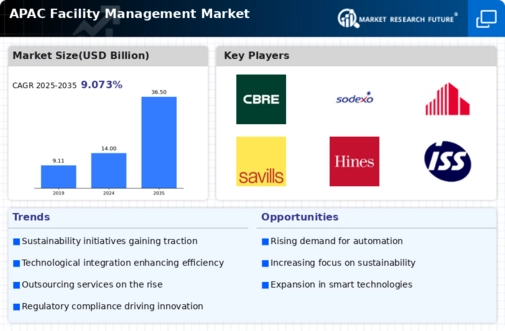
APAC Facility Management Market Infographic
Purchase Options

APAC Facility Management Market Summary

As per analysis, the APAC Facility Management Market is projected to grow from USD 14.16 Billion in 2025 to USD 30.47 Billion by 2035, exhibiting a compound annual growth rate (CAGR) of 8.05% during the forecast period (2025 - 2035).

Key Market Trends & Highlights

The APAC Facility Management Market is poised for substantial growth driven by technological advancements and sustainability initiatives.

  • The integration of smart technologies is transforming operational efficiencies across the APAC Facility Management Market.
  • Sustainability initiatives are increasingly influencing facility management practices, particularly in China and India.
  • The cleaning services segment remains the largest, while integrated facility management is emerging as the fastest-growing segment in the region.
  • Rising urbanization and increased focus on sustainability are key drivers propelling market expansion in both commercial and healthcare sectors.

Market Size & Forecast

2024 Market Size 13.0 (USD Billion)
2035 Market Size 30.47 (USD Billion)
CAGR (2025 - 2035) 8.05%

Major Players

Sodexo (FR), ISS A/S (DK), CBRE Group (US), JLL (US), Cushman & Wakefield (US), G4S (GB), Securitas AB (SE), Compass Group (GB), Mitie Group (GB), FMS Group (AU)

Our Impact
Enabled $4.3B Revenue Impact for Fortune 500 and Leading Multinationals
Partnering with 2000+ Global Organizations Each Year
30K+ Citations by Top-Tier Firms in the Industry

APAC Facility Management Market Trends

The APAC Facility Management Market is currently experiencing a transformative phase, driven by a confluence of technological advancements and evolving client expectations. As organizations increasingly recognize the importance of efficient facility management, there is a noticeable shift towards integrated solutions that encompass various services, including maintenance, security, and space management. This trend is further fueled by the growing emphasis on sustainability and energy efficiency, prompting businesses to adopt practices that not only enhance operational efficiency but also contribute positively to the environment. Moreover, the rise of smart technologies, such as IoT and AI, is reshaping the landscape, enabling real-time monitoring and data-driven decision-making, which appears to be a crucial factor in enhancing service delivery and client satisfaction. In addition, the APAC region is witnessing a surge in demand for facility management services across diverse sectors, including healthcare, education, and commercial real estate. This diversification indicates a broader recognition of the value that effective facility management brings to various industries. As organizations strive to optimize their operations, the integration of advanced technologies and sustainable practices is likely to become a standard expectation rather than an exception. Consequently, the APAC Facility Management Market is poised for continued growth, with stakeholders increasingly focusing on innovative solutions that align with both operational goals and environmental responsibilities.

Integration of Smart Technologies

The APAC Facility Management Market is increasingly adopting smart technologies, such as IoT and AI, to enhance operational efficiency. These innovations facilitate real-time monitoring and data analytics, allowing organizations to make informed decisions that improve service delivery.

Sustainability Initiatives

There is a growing emphasis on sustainability within the APAC Facility Management Market. Organizations are prioritizing eco-friendly practices and energy-efficient solutions, reflecting a commitment to reducing their environmental footprint while optimizing operational costs.

Sector Diversification

The demand for facility management services is expanding across various sectors in the APAC region, including healthcare, education, and commercial real estate. This diversification highlights the increasing recognition of the strategic value that effective facility management provides to different industries.

APAC Facility Management Market Drivers

Rising Urbanization

The rapid urbanization in the Asia-Pacific (APAC) region is a primary driver of the APAC Facility Management Market. As cities expand, the demand for efficient facility management services increases. According to recent statistics, urban areas in APAC are expected to house over 60 percent of the population by 2030. This demographic shift necessitates the development of infrastructure and services that can support growing urban populations. Consequently, facility management companies are likely to experience heightened demand for their services, including maintenance, security, and cleaning. The APAC Facility Management Market is thus positioned to benefit from this trend, as urban centers require comprehensive management solutions to ensure operational efficiency and sustainability.

Technological Advancements

Technological advancements are significantly influencing the APAC Facility Management Market. The integration of smart technologies, such as IoT and AI, is transforming how facilities are managed. These technologies enable real-time monitoring and predictive maintenance, which can lead to cost savings and improved operational efficiency. For example, the adoption of smart building solutions is projected to grow at a compound annual growth rate (CAGR) of over 15 percent in the APAC region. This trend indicates a shift towards more automated and data-driven facility management practices. Consequently, companies that leverage these technologies are likely to gain a competitive edge in the APAC Facility Management Market, as they can offer enhanced services and improved client satisfaction.

Growing Demand for Outsourcing

The trend of outsourcing facility management services is gaining traction in the APAC region, serving as a significant driver for the APAC Facility Management Market. Organizations are increasingly recognizing the benefits of outsourcing non-core functions to specialized firms, allowing them to focus on their primary business objectives. This shift is particularly evident in sectors such as healthcare, education, and manufacturing, where companies seek to enhance operational efficiency and reduce costs. The outsourcing market in APAC is projected to grow at a CAGR of approximately 10 percent over the next few years. As a result, facility management companies that offer tailored outsourcing solutions are likely to thrive in the evolving landscape of the APAC Facility Management Market.

Increased Focus on Sustainability

The growing emphasis on sustainability is reshaping the APAC Facility Management Market. As environmental concerns become more pronounced, facility management companies are increasingly adopting green practices. This includes energy-efficient systems, waste reduction strategies, and sustainable sourcing of materials. The APAC region is witnessing a surge in demand for eco-friendly facilities, driven by both consumer preferences and regulatory pressures. Reports indicate that the green building market in APAC is expected to reach USD 1 trillion by 2025. This shift towards sustainability not only aligns with The Facility Management Industry.

Government Regulations and Policies

Government regulations and policies play a crucial role in shaping the APAC Facility Management Market. Many APAC countries are implementing stricter building codes and environmental regulations, which compel facility management companies to adopt best practices in sustainability and safety. For instance, initiatives aimed at reducing carbon footprints and enhancing energy efficiency are becoming increasingly prevalent. The implementation of these regulations not only promotes responsible management practices but also drives innovation within the industry. As a result, facility management firms are likely to invest in advanced technologies and training to comply with these regulations, thereby enhancing their service offerings and competitiveness in the APAC Facility Management Market.

Market Segment Insights

By Service Type: Cleaning Services (Largest) vs. Integrated Facility Management (Fastest-Growing)

In the APAC Facility Management Market, the service type segment is characterized by a diverse offering of services including cleaning, security, maintenance, catering, and integrated facility management. Among these, cleaning services hold the largest market share, largely due to the continuous demand for hygiene and sanitation in both commercial and residential sectors. Security services also constitute a significant portion of the market, driven by the increasing emphasis on safety and theft prevention in various facilities across the region.

Cleaning Services (Dominant) vs. Integrated Facility Management (Emerging)

Cleaning services have established themselves as the dominant player in the APAC Facility Management Market, driven by the growing focus on cleanliness and hygiene in urban areas. Businesses, schools, and healthcare facilities are consistently seeking professional cleaning solutions to maintain safe environments. On the other hand, integrated facility management is an emerging segment, offering a holistic approach by combining various services into one cohesive management system. This integration provides efficiency and cost-effectiveness, appealing to companies looking to streamline their operations. As organizations increasingly seek simplified solutions, integrated facility management is gaining traction as a preferred service model.

By End User: Commercial (Largest) vs. Healthcare (Fastest-Growing)

In the APAC Facility Management Market, the end user segment is significantly dominated by the commercial sector, which captures the largest share due to the increasing number of corporate offices and retail outlets. This segment's reliance on facility management services has been bolstered as businesses strive for operational efficiency and enhanced customer experiences. Following closely are the healthcare and education sectors, which also contribute notably to the market, driven by stringent compliance regulations and the need for specialized services.

Commercial: Office Spaces (Dominant) vs. Healthcare Facilities (Emerging)

The commercial segment, particularly within office spaces, remains the dominant force in the APAC Facility Management Market. Companies prioritize efficient facility management to ensure a conducive work environment, driving demand for services like maintenance, security, and cleaning. In contrast, the healthcare facilities segment is emerging rapidly, spurred by the increased investment in healthcare infrastructure and heightened focus on patient safety and comfort. As technology advances, healthcare facilities are seeking innovative management solutions, making them a critical area for growth. The competitive landscape in these segments highlights the distinct priorities and requirements of each end user group, with tailored services becoming increasingly important.

By Facility Type: Office Buildings (Largest) vs. Healthcare Facilities (Fastest-Growing)

In the APAC Facility Management Market, 'Office Buildings' hold the largest market share, primarily due to the region's rapid urbanization and the increased number of corporate establishments. This segment represents a significant portion of facility management activities as businesses prioritize operational efficiency in their work environments. Conversely, 'Healthcare Facilities' are identified as the fastest-growing segment in response to rising health awareness, an aging population, and increased investments in healthcare infrastructure across the region.

Office Buildings: Dominant vs. Healthcare Facilities: Emerging

Office buildings are a cornerstone of the APAC Facility Management Market, characterized by their substantial operational needs, including maintenance, security, and cleaning services. These facilities require efficient management systems to optimize workplace productivity. In contrast, healthcare facilities are experiencing rapid growth due to changes in health regulations and a surge in service demands. The management of healthcare environments is complex, requiring specialized knowledge to ensure compliance with health standards and provide patient-centered service. This segment's expansion reflects the broader trend towards improving healthcare access and quality across the Asia-Pacific region.

Get more detailed insights about APAC Facility Management Market

Regional Insights

China : Rapid Growth and Urbanization Drive Demand

China holds a commanding 5.2% market share in the APAC facility management sector, valued at approximately $XX billion. Key growth drivers include rapid urbanization, increased foreign investment, and a rising demand for integrated facility services. Government initiatives promoting smart city developments and sustainability are also pivotal. The regulatory environment is increasingly supportive, with policies aimed at enhancing service quality and operational efficiency in the sector.

India : Diverse Needs Fueling Facility Management

India's facility management market accounts for 3.0% of the APAC share, valued at around $XX billion. The growth is driven by rapid urbanization, a booming real estate sector, and increasing awareness of facility management benefits. Demand trends show a shift towards outsourcing services, with government initiatives supporting smart city projects and infrastructure development. Regulatory frameworks are evolving to enhance service standards and operational transparency.

Japan : Innovation and Efficiency at Forefront

Japan's facility management market represents 2.5% of the APAC total, valued at approximately $XX billion. Key growth drivers include technological advancements, a focus on energy efficiency, and an aging population requiring specialized services. Demand trends indicate a preference for smart building technologies and sustainable practices. Government policies are increasingly promoting green initiatives and energy conservation in facility management.

South Korea : Innovation and Quality Drive Growth

South Korea holds a 1.5% share of the APAC facility management market, valued at around $XX billion. The growth is fueled by urbanization, technological innovation, and a competitive landscape that emphasizes quality and efficiency. Demand trends show a rising preference for integrated services and smart technologies. Government initiatives are focused on enhancing service standards and promoting sustainability in facility management practices.

Malaysia : Strategic Location Enhances Market Potential

Malaysia's facility management market accounts for 0.8% of the APAC share, valued at approximately $XX billion. Key growth drivers include a growing economy, increased foreign investment, and a rising demand for integrated facility services. Demand trends reflect a shift towards outsourcing and sustainability. Government policies are supportive, focusing on enhancing service quality and operational efficiency in the sector.

Thailand : Tourism and Real Estate Boost Demand

Thailand's facility management market represents 0.6% of the APAC total, valued at around $XX billion. The growth is driven by a booming tourism sector, real estate development, and increasing awareness of facility management benefits. Demand trends indicate a preference for outsourcing services, with government initiatives supporting infrastructure development and service quality enhancement. Regulatory frameworks are evolving to meet market needs.

Indonesia : Rapid Urbanization Fuels Growth Opportunities

Indonesia's facility management market accounts for 0.4% of the APAC share, valued at approximately $XX billion. Key growth drivers include rapid urbanization, a growing middle class, and increasing demand for professional services. Demand trends show a shift towards integrated facility management solutions. Government initiatives are focused on infrastructure development and enhancing service standards in the sector.

Rest of APAC : Varied Growth Across Sub-Regions

The Rest of APAC facility management market represents 0.3% of the total, valued at around $XX billion. Growth drivers vary significantly across countries, influenced by local economic conditions, regulatory environments, and infrastructure development. Demand trends reflect a mix of traditional and modern facility management practices. The competitive landscape is diverse, with local players often dominating specific markets, while international firms seek to expand their presence.


Key Players and Competitive Insights

The Facility Management Market in the APAC region is characterized by a dynamic competitive landscape, driven by increasing demand for integrated services and technological advancements. Major players such as Sodexo (FR), ISS A/S (DK), and CBRE Group (US) are strategically positioning themselves through innovation and regional expansion. For instance, Sodexo (FR) has been focusing on enhancing its service offerings through digital transformation, which appears to be a critical factor in maintaining competitive advantage. Similarly, ISS A/S (DK) emphasizes sustainability in its operations, aligning with the growing trend towards environmentally responsible practices. Collectively, these strategies not only enhance operational efficiency but also shape the competitive environment by setting benchmarks for service quality and customer satisfaction.

In terms of business tactics, companies are increasingly localizing their operations to better cater to regional demands, which may involve optimizing supply chains and enhancing service delivery. The market structure is moderately fragmented, with a mix of large multinational corporations and smaller regional players. This fragmentation allows for diverse service offerings, yet the influence of key players remains substantial, as they often set industry standards and drive innovation.

In December 2025, CBRE Group (US) announced a strategic partnership with a leading technology firm to enhance its facility management solutions through AI integration. This move is likely to bolster its service capabilities, enabling more efficient operations and improved client engagement. The integration of AI technologies could potentially streamline processes, reduce operational costs, and enhance decision-making, thereby reinforcing CBRE's competitive position in the market.

In November 2025, ISS A/S (DK) launched a new sustainability initiative aimed at reducing carbon emissions across its operations by 30% by 2030. This initiative not only reflects the company's commitment to environmental stewardship but also positions it favorably among clients increasingly prioritizing sustainability in their procurement decisions. Such strategic actions may enhance ISS's brand reputation and attract environmentally conscious clients, thereby expanding its market share.

In October 2025, Cushman & Wakefield (US) expanded its service portfolio by acquiring a regional facility management firm in Australia. This acquisition is indicative of a broader trend towards consolidation within the market, as companies seek to enhance their service offerings and geographic reach. By integrating local expertise with its global capabilities, Cushman & Wakefield may strengthen its competitive edge and better serve its clients in the APAC region.

As of January 2026, current trends in the Facility Management Market are heavily influenced by digitalization, sustainability, and AI integration. Strategic alliances are becoming increasingly important, as they allow companies to leverage complementary strengths and enhance service delivery. The competitive landscape is shifting from traditional price-based competition to a focus on innovation, technology, and supply chain reliability. This evolution suggests that companies that prioritize these aspects are likely to achieve greater differentiation and long-term success in the market.

Key Companies in the APAC Facility Management Market include

Industry Developments

The APAC Facility Management Market has seen significant developments recently, reflecting its dynamic nature. In October 2023, CBRE Group announced a partnership to optimize smart building management across Asia, further enhancing its tech-driven service offerings. 

Additionally, ISS Facility Services expanded its presence in Southeast Asia by acquiring local firms to strengthen its operational capabilities in facility management. In August 2023, G4S completed a merger with a regional security provider in Hong Kong, significantly increasing its market footprint. The market is also witnessing a growing trend towards sustainability, with companies like Sodexo and Cushman Wakefield implementing green initiatives in their service provisions, keeping in line with government efforts to promote eco-friendly practices. 

In the past couple of years, numerous firms have experienced considerable growth; for instance, Colliers International reported a valuation increase of 15% annually, aligned with the rising demand for outsourced facility management services across the APAC region. These shifts indicate a robust market landscape characterized by strategic partnerships and acquisitions, meeting the evolving needs of clients in diverse sectors, including healthcare, education, and technology.


Future Outlook

APAC Facility Management Market Future Outlook

The APAC Facility Management Market is projected to grow at 8.05% CAGR from 2025 to 2035, driven by urbanization, technological advancements, and sustainability initiatives.

New opportunities lie in:

  • Integration of AI-driven predictive maintenance solutions
  • Expansion of smart building technologies for energy efficiency
  • Development of specialized facility management services for healthcare sectors

By 2035, the market is expected to be robust, reflecting substantial growth and innovation.

Market Segmentation

APAC Facility Management Market End User Outlook

  • Commercial
  • Residential
  • Industrial
  • Healthcare
  • Education

APAC Facility Management Market Service Type Outlook

  • Cleaning Services
  • Security Services
  • Maintenance Services
  • Catering Services
  • Integrated Facility Management

APAC Facility Management Market Facility Type Outlook

  • Office Buildings
  • Retail Spaces
  • Manufacturing Facilities
  • Healthcare Facilities
  • Educational Institutions

Report Scope

MARKET SIZE 202413.0(USD Billion)
MARKET SIZE 202514.16(USD Billion)
MARKET SIZE 203530.47(USD Billion)
COMPOUND ANNUAL GROWTH RATE (CAGR)8.05% (2024 - 2035)
REPORT COVERAGERevenue Forecast, Competitive Landscape, Growth Factors, and Trends
BASE YEAR2024
Market Forecast Period2025 - 2035
Historical Data2019 - 2024
Market Forecast UnitsUSD Billion
Key Companies ProfiledSodexo (FR), ISS A/S (DK), CBRE Group (US), JLL (US), Cushman & Wakefield (US), G4S (GB), Securitas AB (SE), Compass Group (GB), Mitie Group (GB), FMS Group (AU)
Segments CoveredService Type, End User, Facility Type
Key Market OpportunitiesIntegration of smart building technologies enhances operational efficiency in the APAC Facility Management Market.
Key Market DynamicsRising demand for sustainable practices drives innovation in the APAC Facility Management Market.
Countries CoveredChina, India, Japan, South Korea, Malaysia, Thailand, Indonesia, Rest of APAC
Leave a Comment

FAQs

What is the current valuation of the APAC Facility Management Market?

The APAC Facility Management Market was valued at 13.0 USD Billion in 2024.

What is the projected market size for the APAC Facility Management Market by 2035?

The market is projected to reach approximately 30.47 USD Billion by 2035.

What is the expected CAGR for the APAC Facility Management Market during the forecast period?

The expected CAGR for the APAC Facility Management Market from 2025 to 2035 is 8.05%.

Which service type is projected to have the highest growth in the APAC Facility Management Market?

Integrated Facility Management is anticipated to grow from 3.4 USD Billion in 2024 to 8.5 USD Billion by 2035.

How do cleaning services perform in the APAC Facility Management Market?

Cleaning Services were valued at 2.6 USD Billion in 2024 and are expected to reach 6.0 USD Billion by 2035.

What are the key segments by end user in the APAC Facility Management Market?

The key segments by end user include Commercial, Residential, Industrial, Healthcare, and Education, with Commercial projected to grow from 5.2 USD Billion to 12.0 USD Billion.

Which facility type is expected to see the most significant growth?

Office Buildings are projected to grow from 3.9 USD Billion in 2024 to 9.2 USD Billion by 2035.

Who are the leading players in the APAC Facility Management Market?

Key players include Sodexo, ISS A/S, CBRE Group, JLL, and Cushman & Wakefield.

What is the projected growth for security services in the APAC Facility Management Market?

Security Services were valued at 2.5 USD Billion in 2024 and are expected to reach 5.5 USD Billion by 2035.

How does the growth of maintenance services compare to other segments?

Maintenance Services are projected to grow from 3.0 USD Billion in 2024 to 7.0 USD Billion by 2035, indicating robust demand.

Download Free Sample

Kindly complete the form below to receive a free sample of this Report

Compare Licence

×
Features License Type
Single User Multiuser License Enterprise User
Price $4,950 $5,950 $7,250
Maximum User Access Limit 1 User Upto 10 Users Unrestricted Access Throughout the Organization
Free Customization
Direct Access to Analyst
Deliverable Format
Platform Access
Discount on Next Purchase 10% 15% 15%
Printable Versions