
×
Request Free Sample ×

Kindly complete the form below to receive a free sample of this Report

* Please use a valid business email

Leading companies partner with us for data-driven Insights

clients tt-cursor
Hero Background
English
Chinese
French
Japanese
Korean
German
Spanish

Aircraft Exhaust System Market Analysis

ID: MRFR/AD/5899-HCR
130 Pages
Sejal Akre
October 2025

Aircraft Exhaust System Market Size, Share, Industry Trend & Analysis Research Report Information by Engine Type (Turbine Engine System, Piston Engine System and APU System), by Application (Civil Aviation and Military Aviation), by End-User (OEM and Aftermarket) and by Region — Global Forecast till 2035

Share:
Download PDF ×

We do not share your information with anyone. However, we may send you emails based on your report interest from time to time. You may contact us at any time to opt-out.

Aircraft Exhaust System Market Infographic
×
Aircraft Exhaust System Market Infographic Full View
Purchase Options

Market Analysis

In-depth Analysis of Aircraft Exhaust System Market Industry Landscape

The aircraft exhaust system is experiencing major shifts due to changes in aviation technology advancements, emissions regulations, and the modernization of aircraft fleets across the globe. The airplane's exhaust system helps manage engine emissions and optimize engine performance to achieve environmental compliance goals, thereby improving air quality around airports worldwide. Technological innovation remains a key driver influencing the market dynamics for Aircraft Exhaust Systems as well. In response to changes in aircraft engine technology, manufacturers have come up with exhaust systems designed to reduce emissions, improve engine efficiency, and enhance the overall performance of aircraft. Advancements in materials selection and production processes influence the development of lightweight yet strong exhausts, which affect how fiercely competing industries operate. Regulatory mandates also have significant implications for the market dynamics of Aircraft Exhaust Systems. The air travel industry is subject to strict emissions limits by international aviation authorities in a bid to minimize its environmental impact. Consequently, market dynamics are influenced by the need for aircraft exhaust systems that adhere to these regulations, forcing manufacturers to design installations that comply with or surpass emission standards and maintain optimal engine performance. Another dynamic that affects the market is the pursuit of fuel efficiency. As such, airlines are focusing more on reducing fuel consumption as part of corporate sustainability efforts and overall cost reductions. Optimization of engine efficiency is one way through which aircraft exhaust systems can influence market dynamics, thus driving demand for systems that contribute to fuel savings. Consequently, designers have had to come up with systems that achieve both performance and environmental objectives while saving on fuel, hence changing the nature of competition among them. The growing need for lightweight and durable materials is influencing the market dynamics of Aircraft Exhaust Systems. Weight reduction has always been a continuous goal in achieving fuel efficiency and other aircraft performance, which led to manufacturers investigating advanced materials such as titanium and composite alloys that can be used to produce lighter yet robust exhaust systems. Collaborative ventures within the aerospace industry contribute to the market dynamics of Aircraft Exhaust Systems. Manufacturers often form partnerships and joint ventures with other firms so that they can integrate these systems well into their aircraft. Evolving maintenance practices impact the market dynamics of Aircraft Exhaust Systems. Airlines and operators increasingly apply predictive maintenance technologies as well as condition monitoring tools to help them optimize their exhaust system performance alongside other aircraft systems. Market dynamics also depend on the requirement for an exhaust system capable of having advanced diagnostic features for proactive maintenance and reducing downtime.


Author
Sejal Akre
Senior Research Analyst

She has over 5 years of rich experience, in market research and consulting providing valuable market insights to client. Hands on expertise in management consulting, and extensive knowledge in domain including ICT, Automotive & Transportation and Aerospace & Defense. She is skilled in Go-to market strategy, industry analysis, market sizing, in depth company profiling, competitive intelligence & benchmarking and value chain amongst others.

Leave a Comment

FAQs

What is the CAGR global Aircraft Exhaust System Market expects to witness in the future?

Global Aircraft Exhaust System Market Grow at a CAGR Of 8.33% by 2024 -2032

Name some of the top market players of the global aircraft exhaust system market.

Aircelle (part of Safran SA (France), Doncasters Group Ltd. (UK), Collins Aerospace (a part of United Technologies Corporation), GKN Aerospace (UK) are some of the top players of the global acoustic vehicle alerting systems market.

What is the primary growth factor for the Aircraft Exhaust System Market?

The main growth factor for the global Aircraft Exhaust System Market is attributed to the expansion in global air travel and successive demand for new commercial aircraft.

Which region is leading with the high market shares globally?

North America is the leading region for the global aircraft exhaust system market.

Market Summary

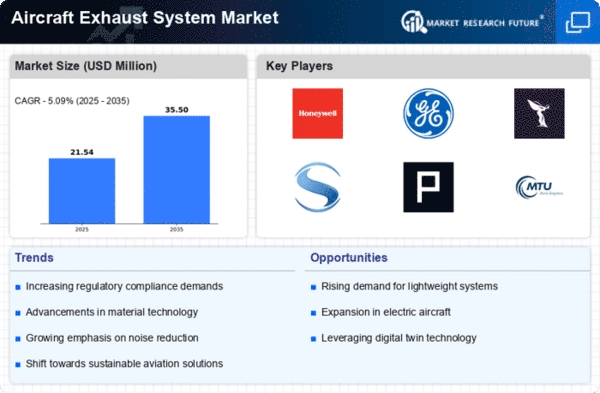
As per MRFR analysis, the Aircraft Exhaust System Market Size was estimated at 20.5 USD Million in 2024. The Aircraft Exhaust System industry is projected to grow from 21.6 USD Million in 2025 to 35.5 USD Million by 2035, exhibiting a compound annual growth rate (CAGR) of 5.09 during the forecast period 2025 - 2035.

Key Market Trends & Highlights

The Aircraft Exhaust System Market is poised for growth driven by sustainability and technological advancements.

  • North America remains the largest market for aircraft exhaust systems, driven by a robust commercial aviation sector.
  • Asia-Pacific is emerging as the fastest-growing region, fueled by increasing air travel demand and military aviation expansion.
  • The commercial aviation segment dominates the market, while the military aviation segment is experiencing rapid growth due to heightened defense spending.
  • Key market drivers include the rising demand for fuel efficiency and stringent environmental regulations pushing for innovative exhaust solutions.

Market Size & Forecast

2024 Market Size 20.5 (USD Million)
2035 Market Size 35.5 (USD Million)
CAGR (2025 - 2035) 5.09%
Largest Regional Market Share in 2024 North America

Major Players

Honeywell (US), General Electric (US), Rolls-Royce (GB), Safran (FR), Pratt & Whitney (US), MTU Aero Engines (DE), Boeing (US), Thales (FR), Liebherr (DE)

Market Trends

The Aircraft Exhaust System Market is currently experiencing a transformative phase, driven by advancements in technology and increasing environmental regulations. Manufacturers are focusing on developing lightweight and efficient exhaust systems that not only enhance performance but also reduce emissions. This shift is largely influenced by the growing demand for sustainable aviation solutions, as stakeholders seek to minimize the ecological footprint of air travel. Furthermore, the integration of innovative materials and designs is expected to play a crucial role in shaping the future of this market. As the industry evolves, collaboration between aerospace manufacturers and regulatory bodies appears essential to ensure compliance with stringent environmental standards. In addition, the Aircraft Exhaust System Market is witnessing a rise in the adoption of electric and hybrid aircraft, which necessitates the development of specialized exhaust systems. These systems must cater to the unique requirements of new propulsion technologies, indicating a potential shift in design paradigms. The focus on enhancing fuel efficiency and reducing noise pollution is likely to drive further innovation in exhaust system technologies. Overall, the market seems poised for growth, with opportunities emerging from both traditional and novel aircraft designs, as well as from the increasing emphasis on sustainability in aviation.

Sustainability Initiatives

The Aircraft Exhaust System Market is increasingly influenced by sustainability initiatives, as manufacturers strive to create eco-friendly solutions. This trend reflects a broader commitment to reducing carbon emissions and enhancing fuel efficiency, aligning with global environmental goals.

Technological Advancements

Technological advancements are reshaping the Aircraft Exhaust System Market, with innovations in materials and design leading to improved performance. These developments may enhance the durability and efficiency of exhaust systems, catering to the evolving needs of the aviation sector.

Regulatory Compliance

Regulatory compliance is becoming a critical factor in the Aircraft Exhaust System Market, as governments implement stricter emissions standards. This trend compels manufacturers to adapt their products to meet these requirements, fostering a culture of continuous improvement and innovation.

Aircraft Exhaust System Market Market Drivers

Market Trends and Projections

The Global Aircraft Exhaust System Market Industry is characterized by dynamic trends and projections that reflect its growth trajectory. The market is anticipated to reach 899.9 USD Million in 2024, with expectations of expanding to 2169.9 USD Million by 2035. This growth is underpinned by a compound annual growth rate of 8.33% from 2025 to 2035. Factors such as increasing demand for fuel efficiency, regulatory compliance, and technological advancements are driving this upward trend. The market's evolution is indicative of broader shifts within the aviation industry, as stakeholders adapt to changing consumer preferences and environmental considerations.

Emerging Markets and Globalization

The Global Aircraft Exhaust System Market Industry is benefiting from the globalization of air travel and the emergence of new markets. Countries in Asia-Pacific and Latin America are witnessing rapid growth in their aviation sectors, driven by rising disposable incomes and increased connectivity. This expansion presents opportunities for manufacturers to tap into these burgeoning markets, thereby driving demand for advanced exhaust systems. As these regions develop their aviation infrastructure, the market is poised for growth, potentially achieving a compound annual growth rate of 8.33% from 2025 to 2035. The globalization of air travel is likely to further enhance the industry's prospects.

Increasing Demand for Fuel Efficiency

The Global Aircraft Exhaust System Market Industry is experiencing a notable surge in demand for fuel-efficient aircraft. Airlines and manufacturers are increasingly prioritizing technologies that enhance fuel economy, as fuel costs represent a substantial portion of operational expenses. The integration of advanced exhaust systems contributes to improved engine performance and reduced emissions, aligning with global sustainability goals. As a result, the market is projected to reach 899.9 USD Million in 2024, reflecting a growing emphasis on environmentally friendly aviation solutions. This trend is likely to continue, with the industry expected to evolve significantly by 2035, when the market could expand to 2169.9 USD Million.

Growth of the Commercial Aviation Sector

The Global Aircraft Exhaust System Market Industry is closely tied to the expansion of the commercial aviation sector. As air travel demand continues to rise globally, airlines are investing in new aircraft and retrofitting existing fleets with modern exhaust systems. This growth is driven by increasing passenger numbers and the need for more efficient aircraft to meet market demands. The commercial aviation sector's expansion is expected to propel the market forward, with projections indicating a market size of 899.9 USD Million in 2024. This trend is likely to persist, as the industry adapts to evolving consumer preferences and technological advancements.

Technological Advancements in Exhaust Systems

Technological innovation plays a pivotal role in shaping the Global Aircraft Exhaust System Market Industry. The development of advanced materials and designs enhances the efficiency and performance of exhaust systems. Innovations such as noise reduction technologies and lightweight materials contribute to overall aircraft performance, thereby attracting manufacturers to invest in these advancements. As the industry embraces cutting-edge technologies, the market is expected to witness substantial growth. The integration of these technologies not only improves operational efficiency but also aligns with the industry's commitment to sustainability, potentially driving the market towards a valuation of 2169.9 USD Million by 2035.

Regulatory Compliance and Environmental Standards

The Global Aircraft Exhaust System Market Industry is significantly influenced by stringent regulatory frameworks aimed at reducing aviation emissions. Governments worldwide are implementing more rigorous environmental standards, compelling manufacturers to innovate and adapt their exhaust systems accordingly. Compliance with these regulations not only ensures operational legitimacy but also enhances the marketability of aircraft. As airlines strive to meet these evolving standards, the demand for advanced exhaust systems is likely to escalate. This regulatory pressure serves as a catalyst for growth, potentially contributing to a compound annual growth rate of 8.33% from 2025 to 2035, as the industry aligns with global sustainability initiatives.

Market Segment Insights

By Application: Commercial Aviation (Largest) vs. Military Aviation (Fastest-Growing)

The Aircraft Exhaust System Market showcases diverse applications, with Commercial Aviation taking the lead due to its extensive use in passenger and freight transport. This segment benefits from a significant focus on fuel efficiency and environmental standards, further solidifying its dominant position in market share distribution. Military Aviation follows, defined by a growing demand for advanced exhaust systems capable of higher performance and resilience under extreme conditions, particularly for next-gen fighter aircraft.

Commercial Aviation (Dominant) vs. Military Aviation (Emerging)

Commercial Aviation remains the dominant application within the Aircraft Exhaust System Market, characterized by a large fleet of aircraft and a robust demand for long-range, fuel-efficient engines. The emphasis on reducing emissions and adhering to global regulations propels innovation in exhaust system technology for this segment. Conversely, Military Aviation represents an emerging sector, driven by modernization programs and the need for advanced tactical capabilities. Military aircraft exhaust systems are designed for reliability and improved thermal management, accommodating high-performance engines and cutting-edge materials, indicating a surge in demand driven by defense budgets and geopolitical tensions.

By Exhaust Type: Turbofan (Largest) vs. Turbojet (Fastest-Growing)

The aircraft exhaust system market showcases distinct share distributions across various exhaust types, notably dominated by turbofan engines due to their efficiency and widespread adoption in commercial aviation. Turbojet engines follow, holding a significant position especially in military applications. Turboprop and reciprocating engine segments cater to niche markets, reflecting a smaller yet steady presence in the overall landscape.

Turbofan (Dominant) vs. Turbojet (Emerging)

Turbofan engines represent the dominant exhaust type in the market, favored for their superior fuel efficiency and reduced noise profiles, making them a staple in modern jet aircraft. They are widely used in commercial aviation and have a strong foothold in long-haul travel. On the other hand, turbojet engines, while traditionally popular, are now emerging due to advancements in technology that enhance performance and adaptability. These engines are gaining momentum in specific sectors like military aviation and supersonic aircraft, driven by demand for high-speed capabilities.

By Material: Stainless Steel (Largest) vs. Titanium (Fastest-Growing)

In the Aircraft Exhaust System Market, the material segment showcases a competitive distribution with Stainless Steel leading the market due to its durability and resistance. Titanium is quickly gaining attention due to its lightweight properties and strength, appealing to manufacturers looking to enhance fuel efficiency in aircraft. Nickel Alloys and Composite Materials follow, each holding niche applications in specific aircraft models, presenting diverse opportunities within the segment.

Stainless Steel (Dominant) vs. Titanium (Emerging)

Stainless Steel remains the dominant material in the Aircraft Exhaust System Market, known for its excellent corrosion resistance and high-temperature performance, making it ideal for various exhaust applications. Its cost-effectiveness and strength make it a preferred choice for many manufacturers. Conversely, Titanium is emerging as a significant alternative, especially in newer aircraft designs where weight reduction is crucial for performance. The properties of Titanium allow for more efficient fuel consumption and improved overall aircraft performance, and its increasing adoption is propelled by advancements in manufacturing techniques that lower its cost.

By Engine Type: Internal Combustion Engine (Largest) vs. Electric Engine (Fastest-Growing)

The Aircraft Exhaust System Market is currently dominated by Internal Combustion Engines, which hold the largest market share among engine types. Due to their established technology and widespread adoption in commercial aviation, Internal Combustion Engines remain a staple in aircraft manufacturing. Meanwhile, Electric Engines are rapidly increasing their presence in the market, driven by advancements in battery technology and growing environmental concerns. The shift towards sustainable aviation solutions is fostering interest in alternative propulsion methods, thereby influencing market dynamics significantly. As regulatory pressures to reduce emissions intensify, the trend towards Electric Engines is expected to gain considerable momentum. Companies are innovating to enhance the performance and efficiency of these systems, leading to a more integrated approach to aircraft design. Hybrid Engines are also emerging, combining traditional fuel systems with electric components, offering a middle ground that appeals to both manufacturers and consumers alike. This increasing focus on hybrid solutions illustrates the market's evolution toward a balanced, sustainable future.

Engine Type: Internal Combustion (Dominant) vs. Electric (Emerging)

Internal Combustion Engines are the dominant force in the Aircraft Exhaust System Market, characterized by their extensive use in various aircraft types, including commercial and military jets. Their reliability, performance, and proven technology have solidified their position, making them preferred choices for manufacturers. In contrast, Electric Engines represent an emerging segment, gaining traction due to their potential for reduced environmental impact and operational costs. With advancements in electric propulsion technology and increased investment in research and development, Electric Engines are becoming more viable. They offer quieter operation and lesser emissions, appealing to environmentally conscious stakeholders. This comparative analysis underscores the shifting landscape of the industry, where sustainable practices are increasingly influencing design and manufacturing strategies.

Get more detailed insights about Aircraft Exhaust System Market Research Report – Global Forecast till 2035

Regional Insights

North America : Market Leader in Innovation

North America continues to lead the Aircraft Exhaust System market, holding a significant share of 10.5 in 2024. The region's growth is driven by increasing air travel demand, advancements in aerospace technology, and stringent environmental regulations promoting fuel efficiency. The presence of major manufacturers and a robust supply chain further catalyze market expansion. The United States is the primary contributor, with key players like Honeywell, General Electric, and Pratt & Whitney driving innovation and competition. The competitive landscape is characterized by continuous R&D investments and collaborations among industry leaders, ensuring the region remains at the forefront of aerospace advancements.

Europe : Emerging Market with Potential

Europe's Aircraft Exhaust System market is poised for growth, with a market size of 5.0 in 2024. The region benefits from a strong aerospace sector, driven by increasing demand for fuel-efficient aircraft and regulatory frameworks aimed at reducing emissions. Initiatives by the European Union to promote sustainable aviation further enhance market prospects. Leading countries like Germany, France, and the UK are home to major players such as Rolls-Royce and Safran, fostering a competitive environment. The presence of advanced manufacturing capabilities and a focus on innovation position Europe as a key player in the global market, attracting investments and partnerships.

Asia-Pacific : Rapidly Growing Aviation Hub

The Asia-Pacific region is witnessing a surge in the Aircraft Exhaust System market, with a size of 4.0 in 2024. Factors such as rising disposable incomes, increasing air travel, and government initiatives to enhance aviation infrastructure are driving this growth. The region's focus on modernizing its fleet to meet international standards is also a significant catalyst. Countries like China and India are leading the charge, with a growing number of airlines and aircraft manufacturers. The competitive landscape features both established players and emerging companies, creating a dynamic market environment. Key players like MTU Aero Engines and Boeing are actively expanding their presence in this lucrative market.

Middle East and Africa : Emerging Market Opportunities

The Middle East and Africa region is gradually developing its Aircraft Exhaust System market, currently valued at 1.0 in 2024. The growth is primarily driven by increasing investments in aviation infrastructure and a rising number of air travelers. Governments are focusing on enhancing connectivity and expanding airport facilities, which is expected to boost demand for advanced aircraft systems. Countries like the UAE and South Africa are at the forefront, with significant investments in aviation projects. The competitive landscape is evolving, with both local and international players seeking to capitalize on emerging opportunities. The presence of companies like Thales and Liebherr indicates a growing interest in this market.

Key Players and Competitive Insights

The Aircraft Exhaust System Market is currently characterized by a competitive landscape that is both dynamic and multifaceted. Key growth drivers include the increasing demand for fuel-efficient aircraft, stringent environmental regulations, and advancements in aerospace technology. Major players such as Honeywell (US), General Electric (US), and Rolls-Royce (GB) are strategically positioned to leverage these trends. Honeywell (US) focuses on innovation in materials and design to enhance performance, while General Electric (US) emphasizes digital transformation and data analytics to optimize engine efficiency. Rolls-Royce (GB) is investing heavily in sustainable aviation technologies, which collectively shape a competitive environment that prioritizes technological advancement and environmental responsibility.In terms of business tactics, companies are increasingly localizing manufacturing to reduce costs and enhance supply chain resilience. The market structure appears moderately fragmented, with a mix of established players and emerging companies vying for market share. The collective influence of key players is significant, as they engage in strategic partnerships and collaborations to enhance their product offerings and market reach.In November 2025, General Electric (US) announced a partnership with a leading aerospace startup to develop next-generation exhaust systems that utilize advanced composite materials. This collaboration is expected to enhance the performance and reduce the weight of aircraft engines, aligning with the industry's push towards sustainability and efficiency. The strategic importance of this partnership lies in its potential to accelerate innovation and provide a competitive edge in a rapidly evolving market.In October 2025, Rolls-Royce (GB) unveiled a new exhaust system designed for hybrid-electric aircraft, marking a significant step towards reducing carbon emissions in aviation. This initiative not only showcases Rolls-Royce's commitment to sustainability but also positions the company as a leader in the emerging hybrid-electric segment. The strategic implications of this development suggest a shift in focus towards environmentally friendly technologies, which could redefine competitive dynamics in the market.In September 2025, Honeywell (US) launched a new digital platform aimed at optimizing exhaust system performance through real-time data analytics. This platform allows operators to monitor and adjust system parameters dynamically, enhancing efficiency and reducing maintenance costs. The strategic relevance of this innovation lies in its ability to integrate digital solutions into traditional aerospace systems, thereby improving operational reliability and customer satisfaction.As of December 2025, current competitive trends in the Aircraft Exhaust System Market are increasingly defined by digitalization, sustainability, and the integration of artificial intelligence. Strategic alliances are becoming more prevalent, as companies recognize the need to collaborate in order to stay ahead of technological advancements. Looking forward, competitive differentiation is likely to evolve from traditional price-based competition to a focus on innovation, technological integration, and supply chain reliability. This shift underscores the importance of adaptability and forward-thinking strategies in navigating the complexities of the modern aerospace landscape.

Key Companies in the Aircraft Exhaust System Market include

Industry Developments

Future Outlook

Aircraft Exhaust System Market Future Outlook

The Aircraft Exhaust System Market is projected to grow at a 5.09% CAGR from 2024 to 2035, driven by advancements in fuel efficiency, regulatory compliance, and increasing air travel demand.

New opportunities lie in:

  • Development of lightweight composite materials for exhaust systems
  • Integration of advanced noise reduction technologies
  • Expansion into emerging markets with growing aviation sectors

By 2035, the market is expected to achieve robust growth, driven by innovation and increased global air traffic.

Market Segmentation

Aircraft Exhaust System Market Material Outlook

  • Stainless Steel
  • Titanium
  • Nickel Alloys
  • Composite Materials

Aircraft Exhaust System Market Application Outlook

  • Commercial Aviation
  • Military Aviation
  • General Aviation
  • Cargo Transport

Aircraft Exhaust System Market Engine Type Outlook

  • Internal Combustion Engine
  • Electric Engine
  • Hybrid Engine

Aircraft Exhaust System Market Exhaust Type Outlook

  • Turbojet
  • Turbofan
  • Turboprop
  • Reciprocating Engine

Report Scope

MARKET SIZE 202420.5(USD Million)
MARKET SIZE 202521.6(USD Million)
MARKET SIZE 203535.5(USD Million)
COMPOUND ANNUAL GROWTH RATE (CAGR)5.09% (2025 - 2035)
REPORT COVERAGERevenue Forecast, Competitive Landscape, Growth Factors, and Trends
BASE YEAR2024
Market Forecast Period2025 - 2035
Historical Data2019 - 2024
Market Forecast UnitsUSD Million
Key Companies ProfiledHoneywell (US), General Electric (US), Rolls-Royce (GB), Safran (FR), Pratt & Whitney (US), MTU Aero Engines (DE), Boeing (US), Thales (FR), Liebherr (DE)
Segments CoveredApplication, Exhaust Type, Material, Engine Type
Key Market OpportunitiesIntegration of advanced materials for enhanced thermal efficiency in Aircraft Exhaust System Market.
Key Market DynamicsTechnological advancements in materials and design enhance efficiency and reduce emissions in aircraft exhaust systems.
Countries CoveredNorth America, Europe, APAC, South America, MEA

FAQs

What is the CAGR global Aircraft Exhaust System Market expects to witness in the future?

Global Aircraft Exhaust System Market Grow at a CAGR Of 8.33% by 2024 -2032

Name some of the top market players of the global aircraft exhaust system market.

Aircelle (part of Safran SA (France), Doncasters Group Ltd. (UK), Collins Aerospace (a part of United Technologies Corporation), GKN Aerospace (UK) are some of the top players of the global acoustic vehicle alerting systems market.

What is the primary growth factor for the Aircraft Exhaust System Market?

The main growth factor for the global Aircraft Exhaust System Market is attributed to the expansion in global air travel and successive demand for new commercial aircraft.

Which region is leading with the high market shares globally?

North America is the leading region for the global aircraft exhaust system market.

  1. SECTION I: EXECUTIVE SUMMARY AND KEY HIGHLIGHTS
    1. | 1.1 EXECUTIVE SUMMARY
  2. SECTION II: SCOPING, METHODOLOGY AND MARKET STRUCTURE
    1. | 2.1 MARKET INTRODUCTION
    2. | 2.2 RESEARCH METHODOLOGY
  3. SECTION III: QUALITATIVE ANALYSIS
    1. | 3.1 MARKET DYNAMICS
    2. | 3.2 MARKET FACTOR ANALYSIS
  4. SECTION IV: QUANTITATIVE ANALYSIS
    1. | 4.1 Aerospace & Defense, BY Application (USD Million)
    2. | 4.2 Aerospace & Defense, BY Exhaust Type (USD Million)
    3. | 4.3 Aerospace & Defense, BY Material (USD Million)
    4. | 4.4 Aerospace & Defense, BY Engine Type (USD Million)
    5. | 4.5 Aerospace & Defense, BY Region (USD Million)
  5. SECTION V: COMPETITIVE ANALYSIS
    1. | 5.1 Competitive Landscape
    2. | 5.2 Company Profiles
    3. | 5.3 Appendix

Aircraft Exhaust System Market Segmentation

Market Segmentation Overview

  • Detailed segmentation data will be available in the full report
  • Comprehensive analysis by multiple parameters
  • Regional and country-level breakdowns
  • Market size forecasts by segment
Infographic

Free Sample Request

Kindly complete the form below to receive a free sample of this Report

Get Free Sample

Customer Strories

Compare Licence

×
Features License Type
Single User Multiuser License Enterprise User
Price $4,950 $5,950 $7,250
Maximum User Access Limit 1 User Upto 10 Users Unrestricted Access Throughout the Organization
Free Customization
Direct Access to Analyst
Deliverable Format
Platform Access
Discount on Next Purchase 10% 15% 15%
Printable Versions