×
Request Free Sample ×

Kindly complete the form below to receive a free sample of this Report

* Please use a valid business email

Leading companies partner with us for data-driven Insights

clients tt-cursor
Hero Background
English
Chinese
French
Japanese
Korean
German
Spanish

Aircraft Computers Market Trends

ID: MRFR/AD/8748-HCR
168 Pages
Swapnil Palwe
October 2025

Aircraft Computers Market Size, Share, Industry Trend & Analysis Research Report Information By End User (OEM and Aftermarket), Type (Flight Controls, Flight Management Computers, Engine Controls, Utility Controls and Mission Computers), Platform (Fixed Wing, Rotary Wing and UAV), Component (Hardware and Software) and Region (North America, Europe, Asia-Pacific and Rest of the World) - Forecast till 2035

Share:
Download PDF ×

We do not share your information with anyone. However, we may send you emails based on your report interest from time to time. You may contact us at any time to opt-out.

Aircraft Computers Market Infographic
Purchase Options

Market Trends

Key Emerging Trends in the Aircraft Computers Market

The Aircraft Computers market is undergoing considerable changes that indicate the ever-changing technology in aviation. The sector of Aircraft Computers has experienced several trends over the years, which have changed its face. One of the major driving forces is the need to have modern aircraft with advanced avionic systems and computational capabilities. The industry’s movement toward more autonomous and connected systems necessitates that aircraft computers are powerful and reliable for flight management, navigation, communication and overall mission effectiveness.

Market dynamics of Aircraft Computers are defined by technological advancements in this sector. Computing power in aircraft systems has tremendously increased with the incorporation of high-performance processors, sophisticated GPUs (graphics processing units) as well as robust memory systems. Consequently, these developments make it possible for complex tasks such as real-time data processing, sensor fusion and decision-making algorithms to be carried out smoothly thereby leading to safer and efficient flight operations.

Additionally, open architecture standards adoption in aviation computerization trend is increasingly becoming prominent. Through open architecture standards allow easier upgrades and modifications because different avionics systems can easily interoperate hence enhances flexibility. This approach enables airplane operators to remain up-to-date with current technologies; meet changing regulatory requirements; incorporate new features without overhauling entire system.

Moreover Artificial Intelligence (AI) applications involving Machine Learning (ML) within aviation are among significant trends occurring in Aircraft Computers market today.AI powered algorithms optimize flight operations,predict maintenance needs for equipment,and improve efficiency of whole systems.Furthermore,data driven decision making growing popular among airlines implies that integration AI technologies into aircraft computers will continue reshaping how planes operate and adapt themselves according to varying conditions.

Furthermore,the rising demand for connectivity coupled with technological advancements is impacting on market dynamics. Nowadays there is a larger number of interrelated processes within an airplane that depend on data transfers so much so that more they concern about better communication inside flights.Aircraft computers play an essential role in ensuring connections occur seamlessly during flights including support such as inflight entertainment, passenger connectivity and real time communication with ground based systems.

Market trends in the Aircraft Computers sector are also driven by global collaborations and partnerships. Leading industry players are forming strategic alliances with technology providers, research institutions, and regulatory bodies to drive innovation and address industry-wide challenges. They aim at standardizing solutions, sharing expertise and speeding up development of state-of-the-art aircraft computing technologies through such collaborations.

However, there are some challenges in the Aircraft Computers market including cyber security risks associated with increasing connectedness and reliance on digital technologies. With expanding interconnection among aircraft systems, ensuring data security as well as its integrity is crucial for protection against any possible cyber threats.”


Author
Swapnil Palwe
Team Lead - Research

With a technical background as Bachelor's in Mechanical Engineering, with MBA in Operations Management , Swapnil has 6+ years of experience in market research, consulting and analytics with the tasks of data mining, analysis, and project execution. He is the POC for our clients, for their consulting projects running under the Automotive/A&D domain. Swapnil has worked on major projects in verticals such as Aerospace & Defense, Automotive and many other domain projects. He has worked on projects for fortune 500 companies' syndicate and consulting projects along with several government projects.

Leave a Comment

FAQs

How Aircraft Computers Market expected to record in the years to come?

Aircraft Computers Market is expected to record a CAGR of 6.7% in the years to come.

What are the factors backing the Aircraft Computers Market growth worldwide?

The factors backing the Aircraft Computers Market growth worldwide include the rising use of computers as well as electronic systems in aircraft along with the upgradation of the present aircraft fleet. The soaring demand for these computers in unmanned aerial vehicles also fosters Aircraft Computers Market growth worldwide.

What factors can deter the Aircraft Computers Market growth during the evaluation period?

Surge in cyber-attacks and strict aviation regulations can deter the Aircraft Computers Market growth during the evaluation period.

Which end-user is the leading segment in the Aircraft Computers Market?

OEM remains the leading end-user in the global Aircraft Computers Market.

Which type-based segment can note the fastest growth rate?

Flight controls is the type-based segment that can note the fastest growth rate.

Market Summary

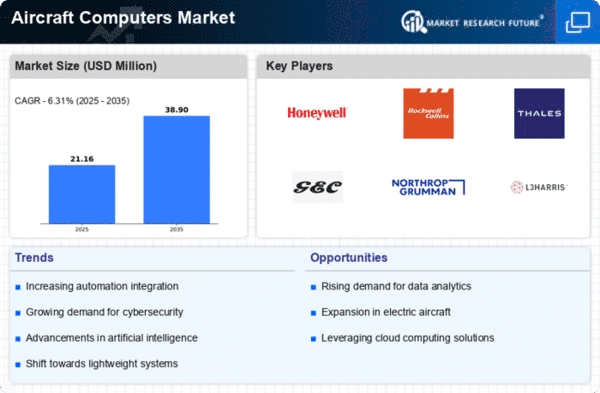
As per MRFR analysis, the Aircraft Computers Market Size was estimated at 19.9 USD Million in 2024. The Aircraft Computers industry is projected to grow from 21.1 in 2025 to 38.9 by 2035, exhibiting a compound annual growth rate (CAGR) of 6.31 during the forecast period 2025 - 2035.

Key Market Trends & Highlights

The Aircraft Computers Market is poised for substantial growth driven by technological advancements and increasing demand for safety and efficiency.

  • The integration of AI and machine learning is transforming aircraft computer systems, enhancing operational efficiency.
  • North America remains the largest market for aircraft computers, while the Asia-Pacific region is experiencing rapid growth.
  • Flight control systems dominate the market, whereas navigation systems are emerging as the fastest-growing segment.
  • Technological advancements and a growing focus on fuel efficiency are key drivers propelling the market forward.

Market Size & Forecast

2024 Market Size 19.9 (USD Million)
2035 Market Size 38.9 (USD Million)
CAGR (2025 - 2035) 6.31%
Largest Regional Market Share in 2024 North America

Major Players

Honeywell International Inc (US), Rockwell Collins (US), Thales Group (FR), General Electric Company (US), Northrop Grumman Corporation (US), L3Harris Technologies Inc (US), Garmin Ltd (US), Boeing Company (US)

Market Trends

Aircraft Computers

Aircraft Computers Market Market Drivers

Growing Air Travel Demand

The Global aircraft computers Market Industry is significantly influenced by the growing demand for air travel. As global economies expand and disposable incomes rise, more individuals are opting for air travel, leading to an increase in aircraft production. This surge in demand necessitates the integration of advanced aircraft computers to manage complex flight operations and enhance passenger safety. The market is projected to grow at a CAGR of 3.78% from 2025 to 2035, reflecting the industry's response to this increasing demand. Consequently, manufacturers are likely to focus on developing innovative aircraft computer systems to cater to this burgeoning market.

Market Growth Projections

The Global Aircraft Computers Market Industry is projected to experience substantial growth over the coming years. With an estimated market value of 6.17 USD Billion in 2024, the industry is expected to reach approximately 9.29 USD Billion by 2035. This growth trajectory suggests a robust demand for advanced aircraft computer systems, driven by technological advancements and increasing air travel. The projected CAGR of 3.78% from 2025 to 2035 indicates a steady expansion, reflecting the industry's adaptability to changing market dynamics and consumer preferences.

Technological Advancements

The Global Aircraft Computers Market Industry is experiencing rapid technological advancements, particularly in the realms of avionics and flight control systems. Innovations such as fly-by-wire technology and advanced navigation systems enhance aircraft performance and safety. For instance, the integration of artificial intelligence in flight management systems is becoming increasingly prevalent, allowing for improved decision-making and operational efficiency. As these technologies evolve, they are expected to drive the market's growth, contributing to an estimated market value of 6.17 USD Billion in 2024. This trend indicates a shift towards more sophisticated aircraft systems, which could potentially reshape the aviation landscape.

Increasing Demand for Automation

The Global Aircraft Computers Market Industry is witnessing a marked increase in demand for automation within the aviation sector. Airlines and manufacturers are increasingly adopting automated systems to enhance operational efficiency and reduce human error. This trend is particularly evident in commercial aviation, where automated flight systems are becoming standard. The push for automation is expected to contribute to the market's growth, with projections indicating a rise to 9.29 USD Billion by 2035. As automation technologies continue to mature, they may redefine operational protocols and safety standards, thereby influencing the overall dynamics of the industry.

Emerging Markets and Regional Growth

Emerging markets are playing an increasingly pivotal role in the Global Aircraft Computers Market Industry. Regions such as Asia-Pacific and Latin America are witnessing rapid growth in air travel and aircraft manufacturing. This trend is driven by urbanization, rising middle-class populations, and increased investment in aviation infrastructure. As these markets expand, there is a growing need for advanced aircraft computers to support new aircraft models and enhance operational efficiency. The anticipated growth in these regions may contribute to the overall market expansion, as manufacturers seek to capitalize on the opportunities presented by these emerging economies.

Regulatory Compliance and Safety Standards

Regulatory compliance and safety standards play a crucial role in shaping the Global Aircraft Computers Market Industry. Governments and aviation authorities worldwide are implementing stringent regulations to ensure the safety and reliability of aircraft systems. This regulatory environment compels manufacturers to invest in advanced computer systems that meet these evolving standards. For example, the Federal Aviation Administration has established guidelines that necessitate the use of sophisticated avionics systems in new aircraft designs. As compliance becomes increasingly critical, the market is likely to experience growth driven by the need for advanced aircraft computers that adhere to these regulations.

Market Segment Insights

By Application: Flight Control Systems (Largest) vs. Navigation Systems (Fastest-Growing)

In the Aircraft Computers Market, the application segment exhibits a diverse distribution across various systems, with Flight Control Systems holding a substantial market share due to their critical role in ensuring flight safety and efficiency. This segment is followed by Communication Systems and Navigation Systems, which are also significant but have comparatively lower shares. Monitoring Systems and Data Processing Systems, while essential, comprise smaller portions of the market, reflecting their specialized applications within aviation.

Flight Control Systems (Dominant) vs. Navigation Systems (Emerging)

Flight Control Systems are a dominant force in the Aircraft Computers Market, characterized by their integral role in managing aircraft stability and control during various phases of flight. These systems employ advanced algorithms and real-time data to enhance safety and operational efficiency, making them crucial for modern aircraft designs. In contrast, Navigation Systems are emerging rapidly, driven by advancements in GPS technology and the growing demand for more precise and efficient route planning. These systems interact closely with Flight Control Systems, indicating a trend toward integrated solutions that enhance overall aircraft performance.

By End Use: Commercial Aviation (Largest) vs. Military Aviation (Fastest-Growing)

The Aircraft Computers Market exhibits a diverse distribution across its end-use segments, with Commercial Aviation holding the largest share. This segment benefits from the increasing demand for efficient and technologically advanced aircraft, leading to higher investments in computer systems. Military Aviation, while smaller in market share, is witnessing rapid growth due to rising defense budgets and advances in technology, which drive the need for sophisticated onboard computer systems.

Commercial Aviation (Dominant) vs. Military Aviation (Emerging)

Commercial Aviation remains the dominant force in the Aircraft Computers Market, characterized by a strong focus on safety, efficiency, and passenger experience. This segment prioritizes the integration of cutting-edge technologies such as fly-by-wire systems and real-time data analytics to enhance performance and operational reliability. In contrast, Military Aviation is emerging on the scene, propelled by advancements in digital communication and next-gen avionics systems designed for combat situations. It leverages high-speed data transfer and advanced processing capabilities, making it crucial for defense applications. As military budgets expand, the demand for advanced aircraft computers is anticipated to escalate significantly.

By Technology: Embedded Systems (Largest) vs. Distributed Systems (Fastest-Growing)

The Aircraft Computers Market is experiencing diverse market share distribution among the various technology segments. Embedded Systems hold the largest share, primarily favored for their integration into flight control and navigation systems. In contrast, Distributed Systems are witnessing rapid growth due to their efficiency in data handling and processing capabilities across multiple aircraft systems. Open and Real-Time Systems also contribute to the market, but to a lesser extent, indicating a clear preference for established technologies in the embedded space.

Technology: Embedded Systems (Dominant) vs. Distributed Systems (Emerging)

Embedded Systems are integral to the operation of aircraft, providing essential functions such as avionics, navigation, and control systems. Their dominance stems from reliability and robustness, crucial for safety and performance in aviation. Conversely, Distributed Systems represent an emerging technology, characterized by modular architecture that enhances processing capabilities and facilitates easier updates. This evolution supports the increasing demand for enhanced connectivity and data sharing among systems, making Distributed Systems a focus of innovation and investment. As aircraft technology evolves, the interaction between these technologies will define future capabilities.

By Component Type: Hardware (Largest) vs. Software (Fastest-Growing)

In the Aircraft Computers Market, the component type segment is primarily dominated by hardware, which captures the largest share of the market due to its critical role in various aircraft systems. Hardware components such as processors, sensors, and display units are essential for flight operations and system integration. Software, while smaller in market share, is rapidly gaining traction as modern aircraft increasingly rely on sophisticated software solutions for optimization and efficiency in navigation, communication, and aircraft management. The growth trends within the component type segment are largely driven by advancements in technology and the rising need for automation in aviation. The hardware segment continues to thrive due to innovation in lightweight and durable materials that enhance performance. Simultaneously, the software segment is experiencing rapid growth as manufacturers invest in developing advanced applications and systems, transforming the landscape of aircraft operations and paves the way for greater integration of AI and data analytics in aviation.

Hardware (Dominant) vs. Software (Emerging)

Hardware components are the dominant force within the Aircraft Computers Market, primarily consisting of physical devices vital for aircraft functionality. These components include processors, flight control systems, and avionics that ensure safe and efficient operations. The robustness and reliability of hardware are non-negotiable in aviation, propelling their dominant market presence. In contrast, software represents an emerging segment that is becoming increasingly significant as air travel evolves. Software solutions enhance hardware capabilities by providing utility through application features such as real-time data processing and decision-making support. As aircraft systems grow more interconnected, the reliance on sophisticated software continues to surge, enabling enhancements in performance, safety, and operational efficiencies.

By System Type: Avionics Systems (Largest) vs. Flight Management Systems (Fastest-Growing)

In the Aircraft Computers Market, the distribution of market share among system types reveals that Avionics Systems hold the largest share due to their critical role in flight safety and navigation. This segment encompasses essential components such as communication systems, navigation displays, and flight control computers. Conversely, Flight Management Systems, while currently smaller in share, are gaining traction rapidly as airlines continually seek to improve operational efficiency and optimize flight routes, leading to a growing demand.

Avionics Systems (Dominant) vs. Flight Management Systems (Emerging)

Avionics Systems represent the backbone of modern aviation technology, integrating various functionalities crucial for aircraft operation and safety. Their dominance is attributed to advancements in technologies that enhance real-time data processing and decision-making capabilities in-flight. On the other hand, Flight Management Systems, although emerging, are recognized for their transformative potential in managing flight operations seamlessly. These systems facilitate automated flight planning and navigation, responding to the increasing push for efficiency and reduced operational costs. Together, these segments reflect the evolving nature of the aircraft computers landscape, with Avionics Systems leading and Flight Management Systems on a rapid growth path.

Get more detailed insights about Aircraft Computers Market Research Report - Global Forecast till 2035

Regional Insights

North America : Market Leader in Aircraft Technology

North America continues to lead the Aircraft Computers Market, holding a significant share of 10.0 in 2024. The region's growth is driven by increasing air travel demand, advancements in aviation technology, and stringent safety regulations. The presence of major manufacturers and a robust supply chain further bolster market expansion. Regulatory support for innovation and modernization in aviation systems also plays a crucial role in sustaining growth. The competitive landscape in North America is characterized by key players such as Honeywell International Inc, Rockwell Collins, and Boeing Company. These companies are at the forefront of technological advancements, focusing on developing next-generation aircraft systems. The U.S. remains the largest market, with Canada and Mexico also contributing to regional growth. The ongoing investments in R&D and partnerships among industry leaders are expected to enhance market dynamics further.

Europe : Emerging Hub for Aviation Solutions

Europe's Aircraft Computers Market is projected to reach a size of 5.0 by 2025, driven by increasing demand for fuel-efficient and technologically advanced aircraft. The region benefits from strong regulatory frameworks that promote safety and innovation, alongside a growing emphasis on sustainable aviation practices. The European Union's initiatives to enhance air traffic management and reduce emissions are key catalysts for market growth. Leading countries in this region include Germany, France, and the UK, where major players like Thales Group and Airbus are headquartered. The competitive landscape is marked by collaborations between manufacturers and technology firms to develop integrated solutions. The presence of a skilled workforce and advanced research facilities further strengthens Europe's position in the global market. The region is poised for significant advancements in aircraft computing technologies.

Asia-Pacific : Rapidly Growing Aviation Sector

The Asia-Pacific region is witnessing rapid growth in the Aircraft Computers Market, with a projected size of 3.5 by 2025. This growth is fueled by increasing air travel demand, rising disposable incomes, and government investments in aviation infrastructure. Regulatory bodies are also enhancing safety standards, which is driving the adoption of advanced aircraft technologies. The region's focus on modernization and expansion of airport facilities further supports market growth. Countries like China, India, and Japan are leading the charge in this market, with significant contributions from local manufacturers and global players. The competitive landscape is evolving, with companies like L3Harris Technologies and Garmin Ltd expanding their presence. The region's diverse market dynamics and increasing collaborations between stakeholders are expected to create new opportunities for growth in the aircraft computing sector.

Middle East and Africa : Emerging Market with Growth Potential

The Middle East and Africa region is emerging as a significant player in the Aircraft Computers Market, with a size of 1.4 projected for 2025. The growth is driven by increasing air travel, investments in aviation infrastructure, and a focus on enhancing safety and efficiency in air transport. Regulatory bodies are working to improve aviation standards, which is expected to boost the adoption of advanced aircraft technologies in the region. Leading countries such as the UAE and South Africa are at the forefront of this growth, with key players establishing operations to cater to the rising demand. The competitive landscape is characterized by partnerships between local and international firms, aiming to leverage technological advancements. The region's strategic location as a The Aircraft Computers potential, making it an attractive destination for investment in aircraft computing technologies.

Key Players and Competitive Insights

The Aircraft Computers Market is characterized by a dynamic competitive landscape, driven by technological advancements and increasing demand for enhanced avionics systems. Key players such as Honeywell International Inc (US), Rockwell Collins (US), and Thales Group (FR) are at the forefront, focusing on innovation and strategic partnerships to maintain their competitive edge. These companies are actively investing in research and development to integrate advanced technologies such as artificial intelligence (AI) and machine learning into their products, thereby enhancing operational efficiency and safety in aviation.In terms of business tactics, companies are increasingly localizing manufacturing and optimizing their supply chains to respond swiftly to market demands. The market structure appears moderately fragmented, with several players vying for market share. However, the collective influence of major companies like General Electric Company (US) and Northrop Grumman Corporation (US) is significant, as they leverage their extensive resources and technological expertise to shape market trends and consumer preferences.

In November Honeywell International Inc (US) announced a strategic partnership with a leading aerospace manufacturer to develop next-generation flight control systems. This collaboration is poised to enhance the safety and efficiency of aircraft operations, reflecting Honeywell's commitment to innovation and its proactive approach to addressing emerging market needs. Such partnerships are likely to bolster Honeywell's market position and drive further advancements in aircraft technology.

In October Rockwell Collins (US) unveiled a new suite of avionics solutions designed to improve pilot situational awareness and reduce workload. This launch underscores Rockwell Collins' focus on integrating cutting-edge technology into its offerings, which may enhance its competitive standing in the market. By prioritizing user experience and operational efficiency, Rockwell Collins is positioning itself as a leader in the evolving landscape of aircraft computers.

In September Thales Group (FR) expanded its digital services portfolio by acquiring a cybersecurity firm specializing in aviation security. This acquisition is strategically significant, as it enables Thales to enhance its cybersecurity capabilities, addressing growing concerns over data protection in the aviation sector. Such moves not only strengthen Thales' product offerings but also reflect a broader trend towards prioritizing security in aircraft systems.

As of December the Aircraft Computers Market is witnessing trends such as digitalization, sustainability, and AI integration, which are reshaping competitive dynamics. Strategic alliances are becoming increasingly vital, as companies seek to leverage complementary strengths to drive innovation. The competitive landscape is shifting from price-based competition to a focus on technological advancement and supply chain reliability, suggesting that future differentiation will hinge on the ability to innovate and adapt to changing market conditions.

Key Companies in the Aircraft Computers Market include

Industry Developments

In the year 2021, one of the leading market players, Garmin Ltd had announced that their product GFC 500 had received certification from the federal aviation administration, and hence it can be used in various aircrafts such as Beechcraft 19 sport, Beechcraft 23 musketeer, or sundowner, Beechcraft 24 musketeer and sierra aircraft models as well.

In the year 2022, one of the leading market players, Microsoft Flight simulator piper had announced tomahawk which features 4096 X 4096 PBR materials which also includes passenger doors and cockpit windows, sun visors, and significant other facilities. Tablet EFB is used to control various aircraft options and adjust the options such as cold and dark, Ready for takeoff, ready for the start. 

Future Outlook

Aircraft Computers Market Future Outlook

The Aircraft Computers Market is projected to grow at a 6.31% CAGR from 2025 to 2035, driven by advancements in avionics, increased demand for automation, and enhanced safety regulations.

New opportunities lie in:

  • Development of AI-driven predictive maintenance systems
  • Integration of advanced cybersecurity solutions for aircraft
  • Expansion of cloud-based data analytics for flight operations

By 2035, the Aircraft Computers Market is expected to be robust, reflecting substantial technological advancements and increased demand.

Market Segmentation

Aircraft Computers Market End Use Outlook

  • Commercial Aviation
  • Military Aviation
  • Cargo Aviation
  • General Aviation

Aircraft Computers Market Technology Outlook

  • Embedded Systems
  • Open Systems
  • Real-Time Systems
  • Distributed Systems

Aircraft Computers Market Application Outlook

  • Flight Control Systems
  • Navigation Systems
  • Communication Systems
  • Monitoring Systems
  • Data Processing Systems

Aircraft Computers Market System Type Outlook

  • Avionics Systems
  • Flight Management Systems
  • Ground Control Systems

Aircraft Computers Market Component Type Outlook

  • Hardware
  • Software
  • Firmware

Report Scope

MARKET SIZE 202419.9(USD Million)
MARKET SIZE 202521.1(USD Million)
MARKET SIZE 203538.9(USD Million)
COMPOUND ANNUAL GROWTH RATE (CAGR)6.31% (2025 - 2035)
REPORT COVERAGERevenue Forecast, Competitive Landscape, Growth Factors, and Trends
BASE YEAR2024
Market Forecast Period2025 - 2035
Historical Data2019 - 2024
Market Forecast UnitsUSD Million
Key Companies ProfiledHoneywell International Inc (US), Rockwell Collins (US), Thales Group (FR), General Electric Company (US), Northrop Grumman Corporation (US), L3Harris Technologies Inc (US), Garmin Ltd (US), Boeing Company (US)
Segments CoveredApplication, End Use, Technology, Component Type, System Type
Key Market OpportunitiesIntegration of artificial intelligence in Aircraft Computers Market enhances operational efficiency and safety.
Key Market DynamicsTechnological advancements drive innovation in aircraft computers, enhancing performance and safety in aviation systems.
Countries CoveredNorth America, Europe, APAC, South America, MEA

FAQs

How Aircraft Computers Market expected to record in the years to come?

Aircraft Computers Market is expected to record a CAGR of 6.7% in the years to come.

What are the factors backing the Aircraft Computers Market growth worldwide?

The factors backing the Aircraft Computers Market growth worldwide include the rising use of computers as well as electronic systems in aircraft along with the upgradation of the present aircraft fleet. The soaring demand for these computers in unmanned aerial vehicles also fosters Aircraft Computers Market growth worldwide.

What factors can deter the Aircraft Computers Market growth during the evaluation period?

Surge in cyber-attacks and strict aviation regulations can deter the Aircraft Computers Market growth during the evaluation period.

Which end-user is the leading segment in the Aircraft Computers Market?

OEM remains the leading end-user in the global Aircraft Computers Market.

Which type-based segment can note the fastest growth rate?

Flight controls is the type-based segment that can note the fastest growth rate.

  1. SECTION I: EXECUTIVE SUMMARY AND KEY HIGHLIGHTS
    1. | 1.1 EXECUTIVE SUMMARY
    2. | 1.1.1 Market Overview
    3. | 1.1.2 Key Findings
    4. | 1.1.3 Market Segmentation
    5. | 1.1.4 Competitive Landscape
    6. | 1.1.5 Challenges and Opportunities
    7. | 1.1.6 Future Outlook
  2. SECTION II: SCOPING, METHODOLOGY AND MARKET STRUCTURE
    1. | 2.1 MARKET INTRODUCTION
    2. | 2.1.1 Definition
    3. | 2.1.2 Scope of the study
    4. |-- 2.1.2.1 Research Objective
    5. |-- 2.1.2.2 Assumption
    6. |-- 2.1.2.3 Limitations
    7. | 2.2 RESEARCH METHODOLOGY
    8. | 2.2.1 Overview
    9. | 2.2.2 Data Mining
    10. | 2.2.3 Secondary Research
    11. | 2.2.4 Primary Research
    12. |-- 2.2.4.1 Primary Interviews and Information Gathering Process
    13. |-- 2.2.4.2 Breakdown of Primary Respondents
    14. | 2.2.5 Forecasting Model
    15. | 2.2.6 Market Size Estimation
    16. |-- 2.2.6.1 Bottom-Up Approach
    17. |-- 2.2.6.2 Top-Down Approach
    18. | 2.2.7 Data Triangulation
    19. | 2.2.8 Validation
  3. SECTION III: QUALITATIVE ANALYSIS
    1. | 3.1 MARKET DYNAMICS
    2. | 3.1.1 Overview
    3. | 3.1.2 Drivers
    4. | 3.1.3 Restraints
    5. | 3.1.4 Opportunities
    6. | 3.2 MARKET FACTOR ANALYSIS
    7. | 3.2.1 Value chain Analysis
    8. | 3.2.2 Porter's Five Forces Analysis
    9. |-- 3.2.2.1 Bargaining Power of Suppliers
    10. |-- 3.2.2.2 Bargaining Power of Buyers
    11. |-- 3.2.2.3 Threat of New Entrants
    12. |-- 3.2.2.4 Threat of Substitutes
    13. |-- 3.2.2.5 Intensity of Rivalry
    14. | 3.2.3 COVID-19 Impact Analysis
    15. |-- 3.2.3.1 Market Impact Analysis
    16. |-- 3.2.3.2 Regional Impact
    17. |-- 3.2.3.3 Opportunity and Threat Analysis
  4. SECTION IV: QUANTITATIVE ANALYSIS
    1. | 4.1 Aerospace & Defense, BY Application (USD Million)
    2. | 4.1.1 Flight Control Systems
    3. | 4.1.2 Navigation Systems
    4. | 4.1.3 Communication Systems
    5. | 4.1.4 Monitoring Systems
    6. | 4.1.5 Data Processing Systems
    7. | 4.2 Aerospace & Defense, BY End Use (USD Million)
    8. | 4.2.1 Commercial Aviation
    9. | 4.2.2 Military Aviation
    10. | 4.2.3 Cargo Aviation
    11. | 4.2.4 General Aviation
    12. | 4.3 Aerospace & Defense, BY Technology (USD Million)
    13. | 4.3.1 Embedded Systems
    14. | 4.3.2 Open Systems
    15. | 4.3.3 Real-Time Systems
    16. | 4.3.4 Distributed Systems
    17. | 4.4 Aerospace & Defense, BY Component Type (USD Million)
    18. | 4.4.1 Hardware
    19. | 4.4.2 Software
    20. | 4.4.3 Firmware
    21. | 4.5 Aerospace & Defense, BY System Type (USD Million)
    22. | 4.5.1 Avionics Systems
    23. | 4.5.2 Flight Management Systems
    24. | 4.5.3 Ground Control Systems
    25. | 4.6 Aerospace & Defense, BY Region (USD Million)
    26. | 4.6.1 North America
    27. |-- 4.6.1.1 US
    28. |-- 4.6.1.2 Canada
    29. | 4.6.2 Europe
    30. |-- 4.6.2.1 Germany
    31. |-- 4.6.2.2 UK
    32. |-- 4.6.2.3 France
    33. |-- 4.6.2.4 Russia
    34. |-- 4.6.2.5 Italy
    35. |-- 4.6.2.6 Spain
    36. |-- 4.6.2.7 Rest of Europe
    37. | 4.6.3 APAC
    38. |-- 4.6.3.1 China
    39. |-- 4.6.3.2 India
    40. |-- 4.6.3.3 Japan
    41. |-- 4.6.3.4 South Korea
    42. |-- 4.6.3.5 Malaysia
    43. |-- 4.6.3.6 Thailand
    44. |-- 4.6.3.7 Indonesia
    45. |-- 4.6.3.8 Rest of APAC
    46. | 4.6.4 South America
    47. |-- 4.6.4.1 Brazil
    48. |-- 4.6.4.2 Mexico
    49. |-- 4.6.4.3 Argentina
    50. |-- 4.6.4.4 Rest of South America
    51. | 4.6.5 MEA
    52. |-- 4.6.5.1 GCC Countries
    53. |-- 4.6.5.2 South Africa
    54. |-- 4.6.5.3 Rest of MEA
  5. SECTION V: COMPETITIVE ANALYSIS
    1. | 5.1 Competitive Landscape
    2. | 5.1.1 Overview
    3. | 5.1.2 Competitive Analysis
    4. | 5.1.3 Market share Analysis
    5. | 5.1.4 Major Growth Strategy in the Aerospace & Defense
    6. | 5.1.5 Competitive Benchmarking
    7. | 5.1.6 Leading Players in Terms of Number of Developments in the Aerospace & Defense
    8. | 5.1.7 Key developments and growth strategies
    9. |-- 5.1.7.1 New Product Launch/Service Deployment
    10. |-- 5.1.7.2 Merger & Acquisitions
    11. |-- 5.1.7.3 Joint Ventures
    12. | 5.1.8 Major Players Financial Matrix
    13. |-- 5.1.8.1 Sales and Operating Income
    14. |-- 5.1.8.2 Major Players R&D Expenditure. 2023
    15. | 5.2 Company Profiles
    16. | 5.2.1 Honeywell International Inc (US)
    17. |-- 5.2.1.1 Financial Overview
    18. |-- 5.2.1.2 Products Offered
    19. |-- 5.2.1.3 Key Developments
    20. |-- 5.2.1.4 SWOT Analysis
    21. |-- 5.2.1.5 Key Strategies
    22. | 5.2.2 Rockwell Collins (US)
    23. |-- 5.2.2.1 Financial Overview
    24. |-- 5.2.2.2 Products Offered
    25. |-- 5.2.2.3 Key Developments
    26. |-- 5.2.2.4 SWOT Analysis
    27. |-- 5.2.2.5 Key Strategies
    28. | 5.2.3 Thales Group (FR)
    29. |-- 5.2.3.1 Financial Overview
    30. |-- 5.2.3.2 Products Offered
    31. |-- 5.2.3.3 Key Developments
    32. |-- 5.2.3.4 SWOT Analysis
    33. |-- 5.2.3.5 Key Strategies
    34. | 5.2.4 General Electric Company (US)
    35. |-- 5.2.4.1 Financial Overview
    36. |-- 5.2.4.2 Products Offered
    37. |-- 5.2.4.3 Key Developments
    38. |-- 5.2.4.4 SWOT Analysis
    39. |-- 5.2.4.5 Key Strategies
    40. | 5.2.5 Northrop Grumman Corporation (US)
    41. |-- 5.2.5.1 Financial Overview
    42. |-- 5.2.5.2 Products Offered
    43. |-- 5.2.5.3 Key Developments
    44. |-- 5.2.5.4 SWOT Analysis
    45. |-- 5.2.5.5 Key Strategies
    46. | 5.2.6 L3Harris Technologies Inc (US)
    47. |-- 5.2.6.1 Financial Overview
    48. |-- 5.2.6.2 Products Offered
    49. |-- 5.2.6.3 Key Developments
    50. |-- 5.2.6.4 SWOT Analysis
    51. |-- 5.2.6.5 Key Strategies
    52. | 5.2.7 Garmin Ltd (US)
    53. |-- 5.2.7.1 Financial Overview
    54. |-- 5.2.7.2 Products Offered
    55. |-- 5.2.7.3 Key Developments
    56. |-- 5.2.7.4 SWOT Analysis
    57. |-- 5.2.7.5 Key Strategies
    58. | 5.2.8 Boeing Company (US)
    59. |-- 5.2.8.1 Financial Overview
    60. |-- 5.2.8.2 Products Offered
    61. |-- 5.2.8.3 Key Developments
    62. |-- 5.2.8.4 SWOT Analysis
    63. |-- 5.2.8.5 Key Strategies
    64. | 5.3 Appendix
    65. | 5.3.1 References
    66. | 5.3.2 Related Reports

Aerospace & Defense Market Segmentation

Aerospace & Defense By Application (USD Million, 2025-2035)

  • Flight Control Systems
  • Navigation Systems
  • Communication Systems
  • Monitoring Systems
  • Data Processing Systems

Aerospace & Defense By End Use (USD Million, 2025-2035)

  • Commercial Aviation
  • Military Aviation
  • Cargo Aviation
  • General Aviation

Aerospace & Defense By Technology (USD Million, 2025-2035)

  • Embedded Systems
  • Open Systems
  • Real-Time Systems
  • Distributed Systems

Aerospace & Defense By Component Type (USD Million, 2025-2035)

  • Hardware
  • Software
  • Firmware

Aerospace & Defense By System Type (USD Million, 2025-2035)

  • Avionics Systems
  • Flight Management Systems
  • Ground Control Systems
Infographic

Free Sample Request

Kindly complete the form below to receive a free sample of this Report

Get Free Sample

Customer Strories

Compare Licence

×
Features License Type
Single User Multiuser License Enterprise User
Price $4,950 $5,950 $7,250
Maximum User Access Limit 1 User Upto 10 Users Unrestricted Access Throughout the Organization
Free Customization
Direct Access to Analyst
Deliverable Format
Platform Access
Discount on Next Purchase 10% 15% 15%
Printable Versions