
×
Request Free Sample ×

Kindly complete the form below to receive a free sample of this Report

* Please use a valid business email

Leading companies partner with us for data-driven Insights

clients tt-cursor
Hero Background
English
Chinese
French
Japanese
Korean
German
Spanish

Air Ambulance Services Market Size

ID: MRFR/AD/5801-CR
200 Pages
Sejal Akre
June 2025

Air Ambulance Services Market Size, Share, Industry Trend & Analysis Research Report By Service Type (Rotary Wing, Fixed Wing, Commercial), By End-use (Hospital, Patient Transport, Emergency Response), By Patient Condition (Trauma, Medical Emergencies, Transplant), By Operation Model (Government Services, Private Services, Non-Profit Services), and By Regional (North America, Europe, South America, Asia Pacific, Middle East and Africa)-Forecast to 2035

Share:
Download PDF ×

We do not share your information with anyone. However, we may send you emails based on your report interest from time to time. You may contact us at any time to opt-out.

Air Ambulance Services Market Infographic
Purchase Options

Air Ambulance Services Size

Air Ambulance Services Market Growth Projections and Opportunities

The global air ambulance services market is experiencing robust growth, driven by factors such as increasing per capita healthcare expenditure and a rise in the number of advanced hospitals and emergency room (ER) visits. Projections indicate that the market is set to register a Compound Annual Growth Rate (CAGR) of 2.95% during the forecast period from 2019 to 2024. In 2018, North America dominated the market, holding a commanding 65.46% share, followed by Europe at 21.27%, and Asia-Pacific at 11.28%. The market dynamics are shaped by several key segments, including transport vehicle, aircraft type, service model, and mission profile. In terms of transport vehicle, the ground segment took the lead in 2018, capturing a significant share of 82.22% in the global air ambulance services market. This dominance highlights the critical role ground transport plays in facilitating timely and efficient medical assistance. Examining the aircraft type, the rotary-wing segment emerged as the frontrunner in 2018, securing a substantial market share of 63.26%. This underscores the prominence of rotary-wing aircraft, such as helicopters, in air ambulance services. Their agility and ability to access remote or challenging terrains make them vital assets in emergency medical transport. Delving into the service model segment, the hospital-based model commanded the largest market share in 2018, accounting for 56.35%. This indicates the prevalence of hospital-affiliated air ambulance services, reflecting the synergy between airborne medical assistance and hospital infrastructure. Considering the mission profile, the inter-facility transport segment emerged as the dominant force in 2018, claiming a significant market share of 63.66%. Inter-facility transport involves the transfer of patients between medical facilities, showcasing the pivotal role air ambulances play in seamlessly connecting healthcare institutions for specialized care and treatment. The rise of the global air ambulance services market is intricately linked to the evolving landscape of healthcare delivery, with an increasing focus on swift and efficient emergency medical response. The surge in per capita healthcare expenditure signals a growing awareness of the importance of timely and specialized medical assistance, propelling the demand for air ambulance services. North America's leading position in the market can be attributed to its well-established healthcare infrastructure, technological advancements, and a robust network of air ambulance services. As the demand for these services continues to grow globally, regions like Asia-Pacific are expected to witness significant expansion, driven by increasing healthcare investments and a burgeoning population with higher healthcare expectations. The global air ambulance services market is on a trajectory of sustained growth, driven by factors such as increased healthcare spending and the need for rapid emergency medical response. The dominance of North America, coupled with the prominence of ground transport, rotary-wing aircraft, hospital-based service models, and inter-facility transport missions, showcases the diverse and dynamic nature of this essential sector. As healthcare needs evolve, the air ambulance services market is poised to play a pivotal role in ensuring prompt and effective emergency medical care on a global scale.

Air Ambulance Services Market Size Graph
Author
Sejal Akre
Senior Research Analyst

She has over 5 years of rich experience, in market research and consulting providing valuable market insights to client. Hands on expertise in management consulting, and extensive knowledge in domain including ICT, Automotive & Transportation and Aerospace & Defense. She is skilled in Go-to market strategy, industry analysis, market sizing, in depth company profiling, competitive intelligence & benchmarking and value chain amongst others.

Leave a Comment

FAQs

What was the Market Was at a the Air Ambulance Services Market in 2024?

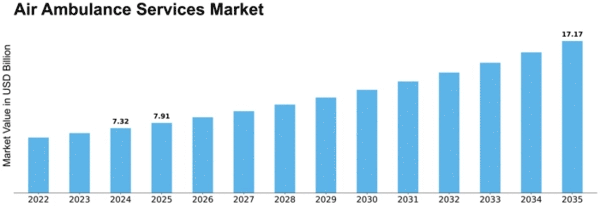
The Air Ambulance Services Market Size was at a7.32 Billion USD by 2024

Market Summary

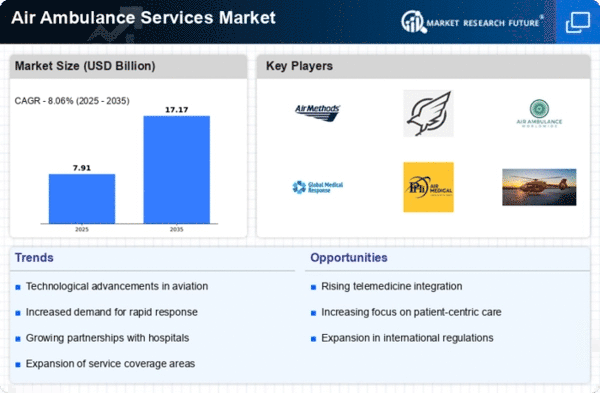
As per MRFR analysis, the Air Ambulance Services Market was estimated at 7.32 USD Billion in 2024. The Air Ambulance Services industry is projected to grow from 7.91 USD Billion in 2025 to 17.17 USD Billion by 2035, exhibiting a compound annual growth rate (CAGR) of 8.06 during the forecast period 2025 - 2035.

Key Market Trends & Highlights

The Air Ambulance Services Market is experiencing robust growth driven by technological advancements and increasing demand for emergency services.

  • North America remains the largest market for air ambulance services, driven by advanced healthcare infrastructure.
  • The Asia-Pacific region is emerging as the fastest-growing market, fueled by rising healthcare expenditures and awareness.
  • Emergency Medical Services represent the largest segment, while Inter-facility Transfers are witnessing the fastest growth in demand.
  • Technological advancements and regulatory changes are key drivers propelling the market forward.

Market Size & Forecast

2024 Market Size 7.32 (USD Billion)
2035 Market Size 17.17 (USD Billion)
CAGR (2025 - 2035) 8.06%
Largest Regional Market Share in 2024 North America

Major Players

Air Methods (US), Falck (DK), Air Ambulance Worldwide (US), Global Medical Response (US), PHI Air Medical (US), Air Rescue (AU), Lifeguard Air Ambulance (US), Air Ambulance Service (GB)

Market Trends

Air Ambulance Services

Air Ambulance Services Market Market Drivers

Increasing Demand for Emergency Medical Services

The Global air ambulance services Industry experiences a notable surge in demand for emergency medical services. This trend is largely driven by the rising incidence of medical emergencies and the need for rapid patient transport. As healthcare systems evolve, the integration of air ambulance services into emergency response frameworks becomes increasingly vital. In 2024, the market is projected to reach 6.43 USD Billion, reflecting a growing recognition of the importance of timely medical intervention. The ability to provide critical care during transport enhances patient outcomes, thereby solidifying the role of air ambulances in modern healthcare.

Market Segment Insights

By Application: Emergency Medical Services (Largest) vs. Inter-facility Transfers (Fastest-Growing)

In the Air Ambulance Services Market, Emergency Medical Services (EMS) holds the largest market share due to its critical role in providing immediate medical assistance during emergencies. This segment includes the transport of critically ill or injured patients from the scene of an accident to hospitals, where rapid medical intervention can save lives. Inter-facility Transfers, while smaller in share, are rapidly gaining importance as hospitals increasingly rely on air ambulances for swift patient exchanges between facilities, highlighting the need for efficient patient care coordination. Growth trends within the application segment are significantly influenced by advancements in technology, increasing demand for quick medical response, and expanded healthcare accessibility. The rise in emergency incidents, such as natural disasters and accidents, alongside a growing aging population, further propels the EMS segment. Conversely, Inter-facility Transfers are becoming essential as healthcare institutions aim to provide specialized care, driving a noticeable uptick in the utilization of air ambulances for patient transfers.

Emergency Medical Services (Dominant) vs. Disaster Response (Emerging)

Emergency Medical Services (EMS) stands as the dominant part of the Air Ambulance Services Market, characterized by its focus on immediate patient transport for life-threatening situations. EMS operations are often supported by advanced medical equipment onboard, allowing for critical care during transit. This segment not only underscores the importance of speed and efficiency but also reflects the heightened public awareness of emergency medical services. On the other hand, Disaster Response is emerging, fueled by an increase in the frequency of natural calamities and the need for rapid medical assistance in crisis situations. This segment highlights the growing capabilities of air ambulance services in areas affected by disasters, serving as a vital resource for assessment and immediate medical intervention in underserved regions.

By Service Type: Rotary Wing Services (Largest) vs. Fixed Wing Services (Fastest-Growing)

The Air Ambulance Services Market is characterized by a diverse range of service types, with Rotary Wing Services holding the largest market share due to their ability to access remote locations swiftly. Their popularity stems from the immediacy they provide in emergencies, allowing for quicker patient transfers compared to other modes. Conversely, Fixed Wing Services are emerging rapidly, leveraging advancements in aviation technology and offering longer-range transport capabilities, thus appealing to a broader geographic coverage for non-emergency and emergency medical transfers.

Rotary Wing Services (Dominant) vs. Medical Escort Services (Emerging)

Rotary Wing Services dominate the Air Ambulance Services Market, primarily due to their versatile operational capabilities and swift response times, which are essential in critical medical emergencies. These services allow for quick vertical takeoffs and landings, making them ideal for accessing hard-to-reach areas. On the other hand, Medical Escort Services are on the rise, providing a more personalized approach by offering specialized medical professionals to accompany patients during air travel. This segment is increasingly attractive to the growing affluent population seeking tailored medical transport solutions. As hospitals and healthcare providers understand the importance of patient-centric care, the demand for Medical Escort Services is expected to increase, complementing the more traditional air ambulance modalities.

By Patient Type: Trauma Patients (Largest) vs. Cardiac Patients (Fastest-Growing)

In the Air Ambulance Services Market, trauma patients represent the largest segment due to the high incidence of accidents and emergencies needing immediate transportation. The focus on trauma care has led to an increased demand for air ambulance services, which are critical for ensuring prompt and effective medical attention in time-sensitive situations. This segment's substantial share highlights the crucial role air ambulances play in managing acute trauma cases, making it a priority area in emergency medical services. On the other hand, cardiac patients are emerging as the fastest-growing segment in the air ambulance landscape. The rise in cardiac emergencies, coupled with advancements in medical technology, has resulted in improved response times and patient outcomes. As awareness about cardiac health grows and the population ages, the demand for rapid air transport for cardiac patients continues to rise significantly, representing a shift in focus for air ambulance services to cater to this pressing need.

Trauma Patients (Dominant) vs. Cardiac Patients (Emerging)

Trauma patients dominate the air ambulance services market due to the urgent nature of their transport needs. Air ambulances are equipped with specialized medical equipment and highly trained personnel to handle severe injuries, making them an essential resource in emergency situations. This segment thrives on the increasing number of road traffic accidents, natural disasters, and occupational injuries, emphasizing the necessity of swift medical intervention. In contrast, cardiac patients represent an emerging segment characterized by a growing number of individuals experiencing acute cardiac episodes. With advancements in medical technology and increasing public awareness about heart health, air ambulances are increasingly called to assist in life-threatening cardiac situations. The unique requirements for cardiac care during transport indicate a shift toward specialized services, fostering innovation and adaptability in air ambulance operations.

By Transport Method: Helicopter Transport (Largest) vs. Airplane Transport (Fastest-Growing)

In the Air Ambulance Services Market, the distribution of market share reflects a clear preference for helicopter transport, which holds the largest share due to its ability to access remote areas quickly and land in tight spaces. <a href="https://www.marketresearchfuture.com/reports/helicopters-market-9532" target="_blank">helicopters</a> are often the preferred choice for emergency medical services, particularly in urban environments where time is critical. Conversely, airplane transport, while less common, is gaining traction due to its capability for longer-distance transfers and transporting multiple patients simultaneously, showcasing a unique market position.

Helicopter Transport (Dominant) vs. Airplane Transport (Emerging)

Helicopter transport in the air ambulance services market stands out as the dominant segment, valued for its quick response times and versatility. Grounded to operate in various terrains, <a href="https://www.marketresearchfuture.com/reports/helicopters-market-9532" target="_blank">helicopters</a> can perform medical evacuations from hard-to-reach locations, making them invaluable during emergencies and disasters. On the other hand, airplane transport represents an emerging segment, becoming increasingly influential as it caters to non-emergency medical transportation needs that require long-distance transfers. While airplanes are less nimble, their ability to move larger groups over vast distances efficiently positions them as a strong alternative, especially for inter-hospital transfers and non-critical patient transport.

Get more detailed insights about Air Ambulance Services Market Research Report - Forecast till 2035

Regional Insights

North America : Market Leader in Air Services

North America continues to lead the air ambulance services market, holding a significant share of 4.0 in 2024. The growth is driven by increasing demand for rapid medical response, advancements in aviation technology, and supportive regulatory frameworks. The region's robust healthcare infrastructure and high disposable income further fuel the market's expansion, making air ambulance services a critical component of emergency medical care. The competitive landscape is characterized by key players such as Air Methods, Global Medical Response, and PHI Air Medical, which dominate the market. The U.S. remains the largest contributor, with a well-established network of air ambulance services. The presence of advanced medical facilities and a high incidence of medical emergencies necessitate efficient air transport solutions, ensuring the continued growth of this sector.

Europe : Emerging Market with Growth Potential

Europe's air ambulance services market is on the rise, with a market size of 1.8. The growth is propelled by increasing healthcare expenditures, a growing aging population, and the need for timely medical interventions. Regulatory support from the European Union and national governments enhances operational efficiency and safety standards, contributing to market expansion. The demand for air ambulance services is expected to grow as healthcare systems evolve to meet the needs of diverse populations. Leading countries in this region include Germany, the UK, and France, where the presence of established air ambulance providers like Falck and Air Ambulance Service enhances competition. The market is characterized by partnerships between private and public sectors, ensuring comprehensive coverage. As the region invests in healthcare infrastructure, the air ambulance sector is poised for significant growth, addressing the urgent medical needs of its citizens.

Asia-Pacific : Rapidly Growing Market Segment

The Asia-Pacific air ambulance services market is witnessing rapid growth, with a market size of 1.2. Factors such as increasing urbanization, rising healthcare awareness, and the need for efficient emergency medical services drive this growth. Governments are increasingly recognizing the importance of air ambulance services, leading to favorable regulations and investments in infrastructure. The region's diverse geography necessitates air transport solutions to reach remote areas effectively. Countries like Australia and India are at the forefront, with key players such as Air Rescue and Lifeguard Air Ambulance expanding their operations. The competitive landscape is evolving, with new entrants and partnerships enhancing service delivery. As healthcare systems in the region continue to develop, the demand for air ambulance services is expected to rise, ensuring timely medical assistance for those in need.

Middle East and Africa : Emerging Market with Challenges

The Middle East and Africa air ambulance services market is emerging, with a market size of 0.32. The growth is driven by increasing healthcare investments, rising awareness of emergency medical services, and the need for rapid response in conflict zones. However, challenges such as regulatory hurdles and limited infrastructure in certain areas can impede growth. Governments are beginning to recognize the importance of air ambulance services, leading to gradual improvements in regulations and operational frameworks. Countries like South Africa and the UAE are leading the market, with key players establishing a presence to cater to the growing demand. The competitive landscape is characterized by collaborations between private companies and government entities, aiming to enhance service delivery. As the region continues to develop its healthcare infrastructure, the air ambulance sector is expected to grow, addressing urgent medical needs effectively.

Key Players and Competitive Insights

The Air Ambulance Services Market is characterized by a competitive landscape that is increasingly shaped by technological advancements and strategic partnerships. Key growth drivers include the rising demand for rapid medical transport, advancements in aircraft technology, and an increasing focus on patient-centric care. Major players such as Air Methods (US), Global Medical Response (US), and Falck (DK) are strategically positioned to leverage these trends. Air Methods (US) emphasizes innovation through the integration of advanced medical equipment in its fleet, while Global Medical Response (US) focuses on expanding its service offerings through strategic acquisitions and partnerships. Falck (DK) appears to be enhancing its operational efficiency by investing in digital transformation initiatives, which collectively influence the competitive dynamics of the market.The business tactics employed by these companies reflect a nuanced understanding of the market's structure, which is moderately fragmented. Localizing operations and optimizing supply chains are common strategies that enhance service delivery and reduce operational costs. The collective influence of these key players fosters a competitive environment where agility and responsiveness to market demands are paramount. As companies strive to differentiate themselves, the focus on localized service provision and operational excellence becomes increasingly critical.

In November Air Methods (US) announced a partnership with a leading telemedicine provider to enhance its patient care capabilities during transport. This strategic move is likely to improve patient outcomes by enabling real-time medical consultations, thereby reinforcing Air Methods' commitment to innovation and quality service. Such partnerships may also serve to attract new clients who prioritize advanced medical care during emergencies.

In October Global Medical Response (US) expanded its operations into new regions by acquiring a regional air ambulance service. This acquisition not only broadens its geographical footprint but also enhances its service capabilities, allowing for a more comprehensive response to medical emergencies. The strategic importance of this move lies in the potential to capture a larger market share and improve response times in underserved areas.

In September Falck (DK) launched a new digital platform aimed at streamlining operations and improving customer engagement. This initiative reflects a broader trend towards digitalization within the industry, as companies seek to enhance operational efficiency and customer satisfaction. By investing in technology, Falck positions itself as a forward-thinking leader in the air ambulance sector, likely attracting tech-savvy clients who value seamless service experiences.

As of December current competitive trends indicate a strong emphasis on digitalization, sustainability, and the integration of AI technologies within the Air Ambulance Services Market. Strategic alliances are increasingly shaping the landscape, enabling companies to pool resources and expertise to enhance service delivery. The shift from price-based competition to a focus on innovation, technology, and supply chain reliability is evident, suggesting that future competitive differentiation will hinge on the ability to adapt to these evolving trends.

Key Companies in the Air Ambulance Services Market include

Industry Developments

Recent developments in the Air Ambulance Services Market reflect significant growth and increasing demand for advanced emergency medical services. Companies such as Global Medical Response and Air Methods Corporation are expanding their operations, emphasizing enhanced service capabilities and technological integration.

In September 2023, Air Rescue Worldwide announced a partnership to broaden its reach in underserved areas, aligning with the growing need for accessible air ambulance services. Additionally, Falck A/S has been working on integrating innovative fleet management technologies to optimize their operations and response times.

The market has witnessed activity in mergers and acquisitions, with PHI Health acquiring Lifeguard Air Ambulance in August 2023, a move aimed at expanding its service coverage. Moreover, the valuation of companies within this sector has surged, with impact stemming from a rising demand for rapid transport services in rural and remote regions.

Over the past two years, the Air Ambulance Services Market has consistently demonstrated resilience, adapting to challenges such as the COVID-19 pandemic while maintaining growth trajectories, further accelerating investments in safety and operational efficiency within the sector. Such developments underscore the critical role of air ambulance services in emergency healthcare around the globe.

Future Outlook

Air Ambulance Services Market Future Outlook

The Air Ambulance Services Market is projected to grow at 8.06% CAGR from 2025 to 2035, driven by technological advancements, increasing healthcare demands, and expanding service networks.

New opportunities lie in:

  • Development of telemedicine integration for remote patient monitoring
  • Expansion of partnerships with hospitals for streamlined patient transfers
  • Investment in eco-friendly aircraft to reduce operational costs

By 2035, the market is expected to be robust, reflecting substantial growth and innovation.

Market Segmentation

Air Ambulance Services Market Application Outlook

  • Emergency Medical Services
  • Inter-facility Transfers
  • Disaster Response
  • Search and Rescue

Air Ambulance Services Market Patient Type Outlook

  • Trauma Patients
  • Cardiac Patients
  • Pediatric Patients
  • Geriatric Patients

Air Ambulance Services Market Service Type Outlook

  • Rotary Wing Services
  • Fixed Wing Services
  • Medical Escort Services
  • Air Ambulance Charter Services

Air Ambulance Services Market Transport Method Outlook

  • Helicopter Transport
  • Airplane Transport
  • Hybrid Transport

Report Scope

MARKET SIZE 20247.32(USD Billion)
MARKET SIZE 20257.91(USD Billion)
MARKET SIZE 203517.17(USD Billion)
COMPOUND ANNUAL GROWTH RATE (CAGR)8.06% (2025 - 2035)
REPORT COVERAGERevenue Forecast, Competitive Landscape, Growth Factors, and Trends
BASE YEAR2024
Market Forecast Period2025 - 2035
Historical Data2019 - 2024
Market Forecast UnitsUSD Billion
Key Companies ProfiledAir Methods (US), Falck (DK), Air Ambulance Worldwide (US), Global Medical Response (US), PHI Air Medical (US), Air Rescue (AU), Lifeguard Air Ambulance (US), Air Ambulance Service (GB)
Segments CoveredApplication, Service Type, Patient Type, Transport Method
Key Market OpportunitiesIntegration of advanced telemedicine technologies enhances patient care in the Air Ambulance Services Market.
Key Market DynamicsRising demand for rapid medical transport drives innovation and competition in the air ambulance services sector.
Countries CoveredNorth America, Europe, APAC, South America, MEA

FAQs

What was the Market Was at a the Air Ambulance Services Market in 2024?

The Air Ambulance Services Market Size was at a7.32 Billion USD by 2024

  1. SECTION I: EXECUTIVE SUMMARY AND KEY HIGHLIGHTS
    1. EXECUTIVE SUMMARY
      1. Market Overview
      2. Key Findings
      3. Market Segmentation
      4. Competitive Landscape
      5. Challenges and Opportunities
      6. Future Outlook
  2. SECTION II: SCOPING, METHODOLOGY AND MARKET STRUCTURE
    1. MARKET INTRODUCTION
      1. Definition
      2. Scope of the study
    2. RESEARCH METHODOLOGY
      1. Overview
      2. Data Mining
      3. Secondary Research
      4. Primary Research
      5. Forecasting Model
      6. Market Size Estimation
      7. Data Triangulation
      8. Validation
  3. SECTION III: QUALITATIVE ANALYSIS
    1. MARKET DYNAMICS
      1. Overview
      2. Drivers
      3. Restraints
      4. Opportunities
    2. MARKET FACTOR ANALYSIS
      1. Value chain Analysis
      2. Porter's Five Forces Analysis
      3. COVID-19 Impact Analysis
  4. SECTION IV: QUANTITATIVE ANALYSIS
    1. Aerospace & Defense, BY Application (USD Billion)
      1. Emergency Medical Services
      2. Inter-facility Transfers
      3. Disaster Response
      4. Search and Rescue
    2. Aerospace & Defense, BY Service Type (USD Billion)
      1. Rotary Wing Services
      2. Fixed Wing Services
      3. Medical Escort Services
      4. Air Ambulance Charter Services
    3. Aerospace & Defense, BY Patient Type (USD Billion)
      1. Trauma Patients
      2. Cardiac Patients
      3. Pediatric Patients
      4. Geriatric Patients
    4. Aerospace & Defense, BY Transport Method (USD Billion)
      1. Helicopter Transport
      2. Airplane Transport
      3. Hybrid Transport
    5. Aerospace & Defense, BY Region (USD Billion)
      1. North America
      2. Europe
      3. APAC
      4. South America
      5. MEA
  5. SECTION V: COMPETITIVE ANALYSIS
    1. Competitive Landscape
      1. Overview
      2. Competitive Analysis
      3. Market share Analysis
      4. Major Growth Strategy in the Aerospace & Defense
      5. Competitive Benchmarking
      6. Leading Players in Terms of Number of Developments in the Aerospace & Defense
      7. Key developments and growth strategies
      8. Major Players Financial Matrix
    2. Company Profiles
      1. Air Methods (US)
      2. Falck (DK)
      3. Air Ambulance Worldwide (US)
      4. Global Medical Response (US)
      5. PHI Air Medical (US)
      6. Air Rescue (AU)
      7. Lifeguard Air Ambulance (US)
      8. Air Ambulance Service (GB)
    3. Appendix
      1. References
      2. Related Reports

Aerospace & Defense Market Segmentation

Aerospace & Defense By Application (USD Billion, 2025-2035)

  • Emergency Medical Services
  • Inter-facility Transfers
  • Disaster Response
  • Search and Rescue

Aerospace & Defense By Service Type (USD Billion, 2025-2035)

  • Rotary Wing Services
  • Fixed Wing Services
  • Medical Escort Services
  • Air Ambulance Charter Services

Aerospace & Defense By Patient Type (USD Billion, 2025-2035)

  • Trauma Patients
  • Cardiac Patients
  • Pediatric Patients
  • Geriatric Patients

Aerospace & Defense By Transport Method (USD Billion, 2025-2035)

  • Helicopter Transport
  • Airplane Transport
  • Hybrid Transport
Infographic

Free Sample Request

Kindly complete the form below to receive a free sample of this Report

Get Free Sample

Customer Strories

Compare Licence

×
Features License Type
Single User Multiuser License Enterprise User
Price $4,950 $5,950 $7,250
Maximum User Access Limit 1 User Upto 10 Users Unrestricted Access Throughout the Organization
Free Customization
Direct Access to Analyst
Deliverable Format
Platform Access
Discount on Next Purchase 10% 15% 15%
Printable Versions