×
Request Free Sample ×

Kindly complete the form below to receive a free sample of this Report

* Please use a valid business email

Leading companies partner with us for data-driven Insights

clients tt-cursor
Hero Background

Aftershave Market

ID: MRFR/CG/31327-HCR
111 Pages
Chitranshi Jaiswal
February 2026

Aftershave Market Size, Share, Industry Trend & Analysis Research Report By Product Type (Balm, Gel, Lotion, Spray), By Fragrance Type (Citrus, Woody, Spicy, Floral), By Skin Type (Sensitive, Normal, Oily, Dry), By Distribution Channel (Online, Supermarkets, Specialty Stores, Pharmacies) and By Regional (North America, Europe, South America, Asia Pacific, Middle East and Africa) - Forecast to 2035

Share:
Download PDF ×

We do not share your information with anyone. However, we may send you emails based on your report interest from time to time. You may contact us at any time to opt-out.

Aftershave Market Infographic
Purchase Options

Aftershave Market Summary

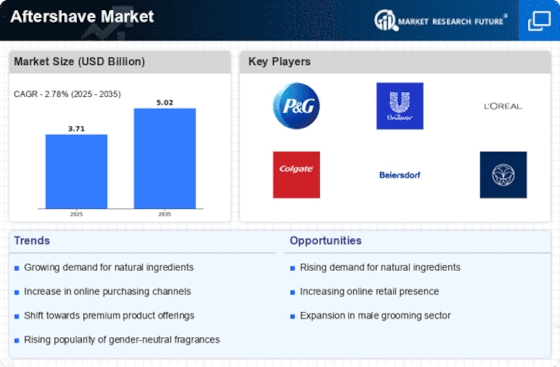
As per Market Research Future analysis, the Aftershave Market Size was estimated at 3.713 USD Billion in 2024. The Aftershave industry is projected to grow from 3.817 USD Billion in 2025 to 5.022 USD Billion by 2035, exhibiting a compound annual growth rate (CAGR) of 2.78% during the forecast period 2025 - 2035

Key Market Trends & Highlights

The Aftershave Market is experiencing a dynamic shift towards natural ingredients and personalized products.

  • The market is witnessing a notable rise in the use of natural ingredients, reflecting changing consumer preferences.
  • Social media influences are driving brand visibility and consumer engagement in the aftershave sector.
  • Customization and personalization are becoming increasingly important, particularly in the balm segment, which remains the largest.
  • Key market drivers include the increasing male grooming awareness and the expansion of e-commerce platforms, particularly in North America and Asia-Pacific.

Market Size & Forecast

2024 Market Size 3.713 (USD Billion)
2035 Market Size 5.022 (USD Billion)
CAGR (2025 - 2035) 2.78%

Major Players

Procter & Gamble (US), Unilever (GB), L'Oreal (FR), Colgate-Palmolive (US), Beiersdorf (DE), Coty (US), Shiseido (JP), Estée Lauder (US), Revlon (US)

Our Impact
Enabled $4.3B Revenue Impact for Fortune 500 and Leading Multinationals
Partnering with 2000+ Global Organizations Each Year
30K+ Citations by Top-Tier Firms in the Industry

Aftershave Market Trends

The Aftershave Market is currently experiencing a dynamic evolution, driven by shifting consumer preferences and an increasing focus on personal grooming. As individuals become more conscious of their appearance and skin health, the demand for aftershave products is likely to rise. This market encompasses a diverse range of offerings, including balms, lotions, and splashes, each catering to various skin types and preferences. Furthermore, the influence of social media and beauty influencers appears to play a pivotal role in shaping consumer choices, as recommendations and reviews can significantly impact purchasing decisions. In addition, the Aftershave Market is witnessing a growing trend towards natural and organic formulations. Consumers are increasingly seeking products that are free from harmful chemicals and synthetic ingredients, opting instead for those that incorporate botanical extracts and essential oils. This shift not only reflects a broader movement towards sustainability but also indicates a desire for products that promote overall skin health. As the market continues to evolve, brands that prioritize transparency and ethical sourcing may find themselves at a competitive advantage, appealing to a more discerning consumer base.

Rise of Natural Ingredients

The Aftershave Market is seeing a notable shift towards products that feature natural and organic ingredients. Consumers are increasingly aware of the potential adverse effects of synthetic chemicals, leading them to seek aftershave options that utilize botanical extracts and essential oils. This trend suggests a growing preference for formulations that are perceived as safer and more beneficial for skin health.

Influence of Social Media

Social media platforms are playing a crucial role in shaping consumer behavior within the Aftershave Market. The rise of beauty influencers and online reviews appears to significantly impact purchasing decisions, as consumers often turn to these sources for recommendations. This trend indicates that brands must engage effectively with digital audiences to enhance visibility and credibility.

Customization and Personalization

There is a rising demand for customized aftershave products tailored to individual skin types and preferences. Consumers are increasingly looking for solutions that address specific concerns, such as sensitivity or hydration. This trend highlights the importance of personalization in the Aftershave Market, as brands that offer bespoke options may attract a more loyal customer base.

Aftershave Market Drivers

Evolving Consumer Preferences

The Aftershave Market is witnessing a transformation in consumer preferences, particularly among younger demographics. Millennials and Generation Z are increasingly seeking products that align with their values, such as sustainability and ethical sourcing. This shift is prompting brands to adapt their offerings, focusing on natural and organic ingredients. Market data suggests that products featuring eco-friendly packaging and cruelty-free certifications are gaining traction, with sales in this segment rising by nearly 10% in recent years. As consumers become more discerning, the Aftershave Market must respond to these evolving preferences to maintain competitiveness and relevance.

Expansion of E-commerce Platforms

The Aftershave Market is benefiting from the rapid expansion of e-commerce platforms, which have revolutionized the way consumers purchase grooming products. Online shopping offers convenience and a wider selection, allowing consumers to explore various brands and formulations without geographical limitations. Recent statistics indicate that e-commerce sales in the personal care sector have surged, with a growth rate of over 15% annually. This trend is likely to continue, as more consumers turn to online platforms for their aftershave needs. Brands that invest in robust online marketing strategies and user-friendly websites may find themselves at a distinct advantage in this evolving landscape.

Increasing Male Grooming Awareness

The Aftershave Market is experiencing a notable shift as awareness regarding male grooming continues to rise. Men are increasingly recognizing the importance of personal care, which includes the use of aftershave products. This trend is supported by various surveys indicating that a significant percentage of men now consider grooming an essential part of their daily routine. As a result, the demand for aftershave products is likely to increase, with a projected growth rate of approximately 5% annually over the next few years. This heightened awareness is not only driving sales but also encouraging brands to innovate and expand their product lines to cater to diverse consumer preferences.

Influence of Celebrity Endorsements

The Aftershave Market is increasingly influenced by celebrity endorsements, which play a crucial role in shaping consumer perceptions and driving sales. High-profile figures in the entertainment and sports industries often promote grooming products, creating aspirational associations that resonate with consumers. This trend appears to be effective, as brands that leverage celebrity partnerships report a notable increase in brand visibility and consumer engagement. Market analysis suggests that aftershave products endorsed by celebrities can experience sales boosts of up to 20% following promotional campaigns. As such, the strategic use of endorsements may become a key driver for growth in the Aftershave Market.

Rising Demand for Anti-Aging Products

The Aftershave Market is witnessing a rising demand for anti-aging products, as consumers become more conscious of skin health and appearance. Aftershave Market formulations that incorporate anti-aging properties are increasingly sought after, particularly among older demographics. Market Research Future indicates that the anti-aging segment within the aftershave category is projected to grow at a rate of 6% annually, driven by the desire for products that not only soothe the skin post-shave but also provide long-term benefits. This trend suggests that brands focusing on innovative formulations that address aging concerns may find lucrative opportunities within the Aftershave Market.


Market Segment Insights

By Type: Balm (Largest) vs. Spray (Fastest-Growing)

The Aftershave Market reveals a diverse array of product types, with balms holding the largest market share among segment values. Popular due to their moisturizing and soothing properties, balms are favored by consumers seeking relief post-shave. Meanwhile, sprays are gaining traction, capturing the attention of a younger demographic seeking quick and convenient options. Type segmentation showcases a blend of tradition and innovation, catering to varied consumer preferences. As the industry evolves, growth trends indicate a shift towards convenience and multi-functionality. The increasing demand for products that offer both skincare benefits and aftershave relief drives innovation in gel and lotion formats as well. Marketing campaigns emphasizing speed and ease of application are propelling sprays to the forefront as the fastest-growing segment, appealing to on-the-go consumers.

Balm: Dominant vs. Spray: Emerging

Balm stands as the dominant player in the Aftershave Market, favored for its rich formulation that provides soothing relief and hydration after shaving. Its thick consistency appeals to male consumers looking for effective skincare solutions that address post-shave irritation. On the other hand, spray is an emerging segment, rapidly ascending in popularity due to its ease of use and refreshing properties. The spray format is especially attractive to younger consumers who prioritize convenience and speed. As lifestyle shifts towards more dynamic and fast-paced routines, the spray segment reflects a modern approach to aftershave application, combining technology and skincare in a user-friendly format. Thus, while balm remains favored for its efficacy, spray is poised for significant growth.

By Fragrance Type: Citrus (Largest) vs. Woody (Fastest-Growing)

In the Aftershave Market, the fragrance type segment showcases a diverse range of preferences among consumers. Citrus fragrances dominate the market, appealing to a broad audience with their refreshing and invigorating scents. These fragrances have become a staple in many men's grooming routines, making up a significant portion of aftershave sales. On the other hand, woody fragrances are gaining traction, known for their earthy and sophisticated appeal. As consumer preferences shift towards more natural and robust scents, woody fragrances are emerging as strong contenders in this segment.

Citrus (Dominant) vs. Woody (Emerging)

Citrus fragrances hold a dominant position in the Aftershave Market, characterized by their fresh and zesty appeal that evokes feelings of energy and cleanliness. This fragrance profile is particularly favored in warmer climates and during the summer months, where its lightness resonates well with consumers. Conversely, woody fragrances are emerging, attracting attention for their depth and richness, often associated with luxury and a more mature scent profile. With the increasing trend towards personal expression and individuality in grooming products, woody fragrances are rapidly evolving and gaining popularity among consumers seeking distinctive and long-lasting options in aftershave.

By Skin Type: Sensitive (Largest) vs. Oily (Fastest-Growing)

In the Aftershave Market, the skin type segment reveals an interesting distribution. Sensitive skin products hold the largest market share, driven by the increasing awareness and sensitivity of consumers towards their skincare needs. Normal and dry skin types follow, indicating a significant market presence, while oily skin types are gaining attention for their unique aftershave needs. Growth trends show that the demand for specialty aftershaves tailored for oily skin is on the rise, with brands focusing on formulations that cater specifically to this demographic. The swift growth in this segment reflects a broader trend towards customization in men's grooming products, as consumers seek solutions to meet their individual skin requirements. As such, oily aftershave products are emerging as key players in driving market advancements.

Sensitive (Dominant) vs. Oily (Emerging)

The sensitive skin aftershave segment stands as a dominant player within the Aftershave Market, characterized by its cater to consumers with reactive or irritated skin. Brands in this space prioritize gentleness, often employing hypoallergenic ingredients and soothing formulations to address the unique needs of sensitive skin users. As awareness of skin sensitivities increases, this segment continues to thrive. Conversely, the oily skin segment marks itself as an emerging force, attracting consumers with specialized formulas designed to control shine and prevent breakouts. These products often feature oil-free or mattifying ingredients, appealing to a younger demographic increasingly conscious of skincare routines. The strategic marketing of these products emphasizes their ability to balance skin moisture while offering a refreshing finish.

By Distribution Channel: Online (Largest) vs. Supermarkets (Fastest-Growing)

In the Aftershave Market, distribution channels play a crucial role in shaping consumer access and purchasing behavior. Among various channels, online sales have emerged as the largest segment due to the increasing trend of e-commerce and the convenience it offers consumers. Supermarkets follow closely, providing significant market share by appealing to customers who prefer to buy grooming products during regular grocery shopping trips.

Online (Dominant) vs. Supermarkets (Emerging)

The online distribution channel in the Aftershave Market is considered dominant, primarily due to its extensive reach and 24/7 availability, allowing consumers to conveniently shop from home. This segment captures tech-savvy consumers, who are increasingly inclined towards online purchases for personal care items. On the other hand, supermarkets represent an emerging segment, catering to consumers who appreciate in-person shopping experiences and the ability to compare multiple brands in one visit. The growth of supermarket sales is bolstered by promotional offers and the inclusion of premium aftershave products, making it a competitive force in the market.

Get more detailed insights about Aftershave Market

Regional Insights

North America : Market Leader in Aftershave Market

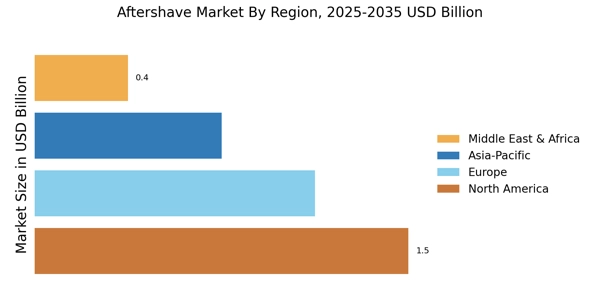
North America is the largest market for aftershave products, holding approximately 40% of the global market share. The growth is driven by increasing grooming awareness among men, coupled with a rise in disposable income. Regulatory support for personal care products, including safety standards, further fuels market expansion. The U.S. and Canada are the primary contributors, with a strong demand for premium and organic aftershave products. The competitive landscape in North America is robust, featuring key players such as Procter & Gamble, Colgate-Palmolive, and Estée Lauder. These companies leverage innovative marketing strategies and product diversification to capture market share. The presence of established retail channels and e-commerce platforms enhances product accessibility, catering to a diverse consumer base seeking quality aftershave solutions.

Europe : Emerging Trends in Grooming

Europe is witnessing significant growth in the aftershave market, accounting for approximately 30% of the global share. The demand is driven by changing grooming habits, with a notable increase in male grooming products. Regulatory frameworks in the EU promote safety and sustainability, encouraging brands to innovate. Countries like Germany and France are leading the market, with a growing preference for natural and organic formulations. The competitive landscape is characterized by the presence of major players such as Unilever, L'Oreal, and Beiersdorf. These companies are focusing on product innovation and sustainability to meet consumer demands. The rise of e-commerce and specialty grooming stores is also enhancing market penetration, allowing brands to reach a wider audience. The European market is increasingly influenced by trends in health and wellness, shaping consumer preferences.

Asia-Pacific : Rapid Growth in Grooming Sector

The Asia-Pacific region is emerging as a significant player in the aftershave market, holding around 20% of the global share. The growth is fueled by rising disposable incomes, urbanization, and changing grooming habits among men. Countries like Japan and China are at the forefront, with increasing awareness of personal grooming and skincare. Regulatory initiatives promoting product safety and quality are also contributing to market growth. The competitive landscape features key players such as Shiseido and Coty, who are adapting their offerings to cater to local preferences. The market is characterized by a mix of international brands and local players, creating a dynamic environment. E-commerce is rapidly gaining traction, providing consumers with easy access to a variety of aftershave products, further driving market expansion in the region.

Middle East and Africa : Emerging Market Potential

The Middle East and Africa region is witnessing a gradual increase in the aftershave market, holding approximately 10% of the global share. The growth is driven by a young population and increasing grooming awareness among men. Regulatory frameworks are evolving to support the personal care industry, encouraging brands to enter the market. Countries like South Africa and the UAE are leading the way, with a growing demand for premium grooming products. The competitive landscape is diverse, with both international and local brands vying for market share. Key players include Coty and Beiersdorf, who are focusing on product innovation and marketing strategies tailored to regional preferences. The rise of e-commerce and retail outlets is enhancing product availability, catering to the growing consumer base interested in aftershave products.

Aftershave Market Regional Image

Key Players and Competitive Insights

The Aftershave Market is currently characterized by a dynamic competitive landscape, driven by evolving consumer preferences and an increasing emphasis on grooming and personal care. Key players such as Procter & Gamble (US), Unilever (GB), and L'Oreal (FR) are strategically positioned to leverage innovation and sustainability in their product offerings. Procter & Gamble (US) has focused on enhancing its product lines with natural ingredients, appealing to the growing demand for eco-friendly grooming solutions. Meanwhile, Unilever (GB) has been expanding its digital presence, utilizing e-commerce platforms to reach a broader audience. L'Oreal (FR) continues to invest in research and development, aiming to introduce cutting-edge formulations that cater to diverse skin types, thereby shaping a competitive environment that prioritizes quality and consumer engagement.The Aftershave Market exhibits a moderately fragmented structure, with numerous players vying for market share. Key business tactics include localizing manufacturing to reduce costs and optimize supply chains, which is particularly relevant in the context of rising global logistics expenses. The collective influence of major companies fosters a competitive atmosphere where innovation and brand loyalty play crucial roles in consumer decision-making. As companies adapt to market demands, the emphasis on sustainability and ethical sourcing is becoming increasingly pronounced, further complicating the competitive dynamics.

In August Coty (US) announced a strategic partnership with a leading skincare brand to co-develop a new line of aftershave products that incorporate advanced skincare technology. This collaboration is significant as it not only enhances Coty's product portfolio but also positions the company to tap into the lucrative skincare segment, which is witnessing robust growth. By aligning with a reputable skincare brand, Coty (US) aims to attract a broader consumer base, particularly among younger demographics who prioritize multifunctional grooming products.

In September Beiersdorf (DE) launched a new aftershave balm that emphasizes natural ingredients and sustainability. This product introduction is indicative of Beiersdorf's commitment to environmental responsibility and aligns with current consumer trends favoring clean beauty. The strategic importance of this launch lies in its potential to strengthen Beiersdorf's market position by appealing to eco-conscious consumers, thereby enhancing brand loyalty and driving sales in a competitive market.

In October Estée Lauder (US) unveiled a digital marketing campaign aimed at promoting its aftershave line through social media influencers and targeted online advertising. This initiative reflects a broader trend towards digitalization in the beauty industry, where brands increasingly rely on online platforms to engage with consumers. The strategic importance of this campaign lies in its ability to enhance brand visibility and foster direct consumer relationships, which are essential for driving sales in an increasingly digital marketplace.

As of October the Aftershave Market is witnessing trends that emphasize digitalization, sustainability, and the integration of artificial intelligence in product development and marketing strategies. Strategic alliances are becoming pivotal in shaping the competitive landscape, allowing companies to pool resources and expertise to innovate more effectively. Looking ahead, competitive differentiation is likely to evolve from traditional price-based competition towards a focus on innovation, technological advancements, and supply chain reliability, as companies strive to meet the sophisticated demands of modern consumers.

Key Companies in the Aftershave Market include

Industry Developments

Recent developments in the Aftershave Market highlight an increasing trend towards sustainability and natural ingredients as consumers become more environmentally conscious. Major companies like Unilever and L'Oréal are expanding their portfolios with eco-friendly aftershave products to cater to this shift in consumer preference. Edgewell Personal Care has also seen growth in its market valuation, driven by innovative new formulations that emphasize skin health and grooming convenience. Mergers and acquisitions play a crucial role in this landscape; Procter & Gamble's acquisition of a niche aftershave line has allowed them to strengthen their market presence and cater to diverse consumer needs.

Similarly, Coty's recent partnership with emerging brands is reflective of their strategy to rejuvenate their aftershave product range through collaboration. Increasing investments in marketing and technology are prominent, with companies like Estée Lauder Companies focusing on direct-to-consumer strategies to enhance customer engagement. Meanwhile, the market continues to witness competitive dynamics as traditional brands face rivalry from indie brands pursuing unique, differentiated products. Overall, the aftershave market is evolving quickly due to changing consumer preferences and strategic corporate maneuvers among key players.

Future Outlook

Aftershave Market Future Outlook

The Aftershave Market is projected to grow at a 2.78% CAGR from 2025 to 2035, driven by increasing grooming trends, product innovation, and rising disposable incomes.

New opportunities lie in:

  • Expansion into eco-friendly aftershave formulations
  • Development of subscription-based aftershave delivery services
  • Integration of personalized aftershave products using AI technology

By 2035, the Aftershave Market is expected to achieve robust growth, reflecting evolving consumer preferences.

Market Segmentation

Aftershave Market Type Outlook

  • Balm
  • Gel
  • Lotion
  • Spray

Aftershave Market Skin Type Outlook

  • Sensitive
  • Normal
  • Oily
  • Dry

Aftershave Market Fragrance Type Outlook

  • Citrus
  • Woody
  • Spicy
  • Floral

Aftershave Market Distribution Channel Outlook

  • Online
  • Supermarkets
  • Specialty Stores
  • Pharmacies

Report Scope

MARKET SIZE 20243.713(USD Billion)
MARKET SIZE 20253.817(USD Billion)
MARKET SIZE 20355.022(USD Billion)
COMPOUND ANNUAL GROWTH RATE (CAGR)2.78% (2025 - 2035)
REPORT COVERAGERevenue Forecast, Competitive Landscape, Growth Factors, and Trends
BASE YEAR2024
Market Forecast Period2025 - 2035
Historical Data2019 - 2024
Market Forecast UnitsUSD Billion
Key Companies ProfiledProcter & Gamble (US), Unilever (GB), L'Oreal (FR), Colgate-Palmolive (US), Beiersdorf (DE), Coty (US), Shiseido (JP), Estée Lauder (US), Revlon (US)
Segments CoveredProduct Type, Fragrance Type, Skin Type, Distribution Channel, Regional
Key Market OpportunitiesGrowing demand for natural and organic ingredients in the Aftershave Market presents significant opportunities.
Key Market DynamicsShifting consumer preferences towards natural ingredients drive innovation and competition in the aftershave market.
Countries CoveredNorth America, Europe, APAC, South America, MEA
Leave a Comment

FAQs

What is the current valuation of the Aftershave Market as of 2024?

The Aftershave Market was valued at 3.713 USD Billion in 2024.

What is the projected market valuation for the Aftershave Market in 2035?

The Aftershave Market is projected to reach 5.022 USD Billion by 2035.

What is the expected CAGR for the Aftershave Market during the forecast period 2025 - 2035?

The expected CAGR for the Aftershave Market during the forecast period 2025 - 2035 is 2.78%.

Which distribution channel is anticipated to generate the highest revenue in the Aftershave Market?

Supermarkets are expected to generate the highest revenue, with a projected valuation of 1.6 USD Billion by 2035.

How do the different types of aftershave products compare in terms of market valuation?

Lotion is projected to lead with a valuation of 1.6 USD Billion, followed by Balm at 1.1 USD Billion by 2035.

What fragrance types are expected to perform best in the Aftershave Market?

Woody fragrances are anticipated to perform best, with a projected valuation of 1.5 USD Billion by 2035.

Which skin type segment is expected to see the most growth in the Aftershave Market?

The Sensitive skin type segment is projected to grow to 0.999 USD Billion by 2035.

Who are the key players in the Aftershave Market?

Key players include Procter & Gamble, Unilever, L'Oreal, and Estée Lauder, among others.

Download Free Sample

Kindly complete the form below to receive a free sample of this Report

Compare Licence

×
Features License Type
Single User Multiuser License Enterprise User
Price $4,950 $ $7,250
Maximum User Access Limit 1 User Upto 10 Users Unrestricted Access Throughout the Organization
Free Customization
Direct Access to Analyst
Deliverable Format
Platform Access
Discount on Next Purchase 10% 15% 15%
Printable Versions