×
Request Free Sample ×

Kindly complete the form below to receive a free sample of this Report

* Please use a valid business email

Leading companies partner with us for data-driven Insights

clients tt-cursor
Hero Background
English
Chinese
French
Japanese
Korean
German
Spanish

Acetaldehyde Market Size

ID: MRFR/CnM/4268-HCR
140 Pages
Chitranshi Jaiswal
October 2025

Acetaldehyde Market Research Report Information By Product Type (Pyridine & Pyridine Bases, Pentaerythritol, Acetic Acid, Peracetic Acid, Ethyl Acetate, And Others), by Application (Chemical Synthesis, Food & Beverage, Pharmaceuticals & Cosmetics, Paper & Pulp, Plastics & Synthetic Rubber) and Region - Forecast to 2035

Share:
Download PDF ×

We do not share your information with anyone. However, we may send you emails based on your report interest from time to time. You may contact us at any time to opt-out.

Acetaldehyde Market Infographic
Purchase Options

Acetaldehyde Size

Acetaldehyde Market Growth Projections and Opportunities

The Acetaldehyde market is influenced by various market factors that play a crucial role in shaping its dynamics. One of the primary drivers is the growing demand from the chemical industry. Acetaldehyde serves as a key intermediate in the production of various chemicals, including acetic acid, pyridine, and pentaerythritol. As the chemical industry expands globally, especially in regions like Asia-Pacific, the demand for acetaldehyde is expected to witness a substantial increase.

Additionally, the rise in the automotive sector contributes significantly to the acetaldehyde market. Acetaldehyde is utilized in the production of pyridine bases, which find applications in rubber and tire manufacturing. With the automotive industry experiencing steady growth, particularly in emerging economies, the demand for acetaldehyde in this sector is anticipated to rise.

Market factors are also influenced by the changing consumer preferences and the rise in disposable income. The increasing urbanization and changing lifestyles have led to a surge in the consumption of packaged food and beverages. Acetaldehyde is used in the production of flavor and fragrance agents for food and beverages. As the demand for packaged and processed food continues to grow, the acetaldehyde market is likely to benefit from this trend.

Moreover, government regulations and environmental concerns are pivotal market factors for acetaldehyde. Stringent regulations regarding emissions and environmental impact drive industries to adopt greener practices. Acetaldehyde is used in the production of biodegradable plastics, and as the focus on sustainable materials increases, the demand for acetaldehyde in this application is expected to rise.

Global economic conditions also play a crucial role in shaping the acetaldehyde market. Economic growth, inflation rates, and currency exchange rates impact the overall production and consumption patterns. Fluctuations in these factors can influence the cost of raw materials and transportation, thereby affecting the pricing and profitability of acetaldehyde.

Competitive factors are another key element influencing the acetaldehyde market. The presence of established players, their market share, and strategic alliances impact the overall competitiveness of the market. Innovation and research and development activities by key market players contribute to the growth and evolution of the acetaldehyde market.

Furthermore, the availability of raw materials is a significant market factor. Acetaldehyde is primarily produced from petrochemical feedstocks, and any fluctuations in the supply and prices of these feedstocks can directly impact the acetaldehyde market. Additionally, technological advancements in production processes, such as bio-based production methods, can influence the market dynamics by providing alternative and more sustainable sources for acetaldehyde.

The acetaldehyde market is shaped by a combination of factors, including demand from the chemical and automotive industries, changing consumer preferences, government regulations, economic conditions, competitive landscape, and the availability of raw materials. Understanding and monitoring these market factors are essential for stakeholders in the acetaldehyde industry to make informed decisions and adapt to the evolving market dynamics.
Acetaldehyde Market Size Graph
Author
Chitranshi Jaiswal
Research Analyst Level I

In her 3 years of experience in the market research field, she has handled critical cross-domain projects. She has an in-depth knowledge of market estimation & analysis, problem-solving, primary as well as secondary research, and team management.She holds an engineering degree and is an MBA professional from a well-known university, capable of evaluating the market and competitive conditions. An exceptional strategist with excellent communication skills and a passion for delivering cutting-edge & practical insights for the market. Proficient in multi-tasking, and can successfully deal with competing demands, while maintaining complete confidentiality. Generated business through active client and project development, networking, and high-quality responses. Her knowledge and skills have helped in making solid business decisions, securing funding from investors, and avoiding business failures.

Leave a Comment

FAQs

What is acetaldehyde?

Acetaldehyde is an organic colorless liquid with the chemical formula CH3CHO. It is widely used as a precursor to a number of chemicals.

What is the major product type in the acetaldehyde market?

Major product types in the acetaldehyde market include pyridine and pyridine bases, pentaerythritol, acetic acid, peracetic acid, and ethyl acetate.

What is the major driver for the market?

The increasing demand for a number of industrial chemicals derived from acetaldehyde is the major driver for the global acetaldehyde market.

Which is the leading regional market?

Asia Pacific is the leading regional market for acetaldehyde.

What are the key players in the market?

Leading players in the market include Merck, Sumitomo, and Eastman, among others.

Market Summary

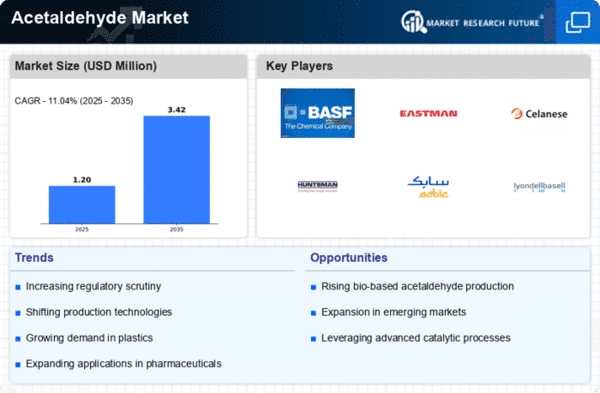
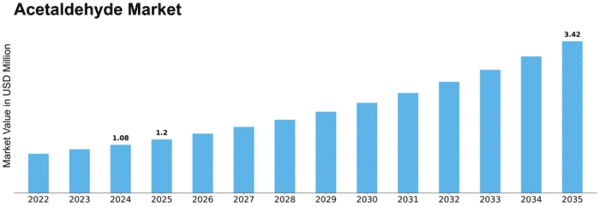
As per MRFR analysis, the Acetaldehyde Market Size was estimated at 1.08 USD Million in 2024. The Acetaldehyde industry is projected to grow from 1.2 in 2025 to 3.42 by 2035, exhibiting a compound annual growth rate (CAGR) of 11.04 during the forecast period 2025 - 2035.

Key Market Trends & Highlights

The Acetaldehyde Market is currently experiencing robust growth driven by diverse applications and regional dynamics.

  • North America remains the largest market for acetaldehyde, driven by its extensive use in chemical synthesis. Asia-Pacific is identified as the fastest-growing region, reflecting rising industrial activities and demand. The chemical synthesis segment dominates the market, while the solvent segment is witnessing rapid growth due to increasing applications. Key market drivers include the expansion in the food and beverage sector and the rising demand for acetaldehyde in pharmaceuticals.

Market Size & Forecast

2024 Market Size 1.08 (USD Million)
2035 Market Size 3.42 (USD Million)
CAGR (2025 - 2035) 11.04%
Largest Regional Market Share in 2024 Asia-Pacific

Major Players

BASF SE (DE), Eastman Chemical Company (US), Celanese Corporation (US), Huntsman Corporation (US), SABIC (SA), LyondellBasell Industries N.V. (NL), Mitsubishi Gas Chemical Company, Inc. (JP), Oxea GmbH (DE), Formosa Plastics Corporation (TW)

Market Trends

The Acetaldehyde Market is currently experiencing a dynamic phase characterized by evolving applications and regulatory frameworks. This compound, primarily utilized in the production of various chemicals, is witnessing increased demand across multiple sectors, including plastics, textiles, and food processing. The versatility of acetaldehyde as a building block for synthesizing other chemicals contributes to its growing significance in industrial applications. Furthermore, the market is influenced by environmental regulations that aim to reduce emissions and promote sustainable practices, thereby shaping production methods and consumption patterns. In addition, the Acetaldehyde Market is likely to benefit from advancements in technology that enhance production efficiency and reduce waste. Innovations in catalytic processes and alternative feedstock utilization may provide opportunities for manufacturers to optimize their operations. As industries continue to seek eco-friendly solutions, the demand for acetaldehyde derived from renewable sources could potentially rise. Overall, the Acetaldehyde Market appears poised for growth, driven by both industrial needs and a shift towards sustainability in chemical production.

Rising Demand in Emerging Economies

The Acetaldehyde Market is witnessing heightened interest from emerging economies, where industrialization and urbanization are accelerating. As these regions develop, the need for acetaldehyde in various applications, such as packaging and automotive, is likely to increase. This trend suggests a potential expansion of market opportunities as manufacturers seek to cater to the growing consumer base.

Sustainability Initiatives

There is a noticeable shift towards sustainability within the Acetaldehyde Market, as companies increasingly prioritize eco-friendly practices. This trend may lead to the development of acetaldehyde from renewable resources, aligning with global efforts to reduce carbon footprints. Such initiatives could reshape production methodologies and influence consumer preferences.

Technological Advancements

Technological innovations are playing a crucial role in the evolution of the Acetaldehyde Market. Enhanced production techniques, including more efficient catalytic processes, are emerging. These advancements may not only improve yield but also minimize environmental impact, thereby attracting interest from manufacturers aiming for competitive advantages.

Acetaldehyde Market Market Drivers

Growing Demand in Chemical Manufacturing

The Global Acetaldehyde Market Industry is experiencing a surge in demand driven by its extensive use in chemical manufacturing. Acetaldehyde Market serves as a key intermediate in the production of various chemicals, including acetic acid and ethanol. As industries expand, particularly in Asia-Pacific and North America, the need for acetaldehyde is projected to rise. In 2024, the market is valued at approximately 900 USD Million, reflecting the increasing reliance on acetaldehyde in various applications. This trend indicates a robust growth trajectory, with projections suggesting a market value of 1500 USD Million by 2035, highlighting the compound annual growth rate of 4.75% from 2025 to 2035.

Market Segment Insights

By Application: Chemical Synthesis (Largest) vs. Solvent (Fastest-Growing)

In the Acetaldehyde Market, Chemical Synthesis holds the largest share among the application segments, being a critical component in manufacturing various chemicals. <a href="https://www.marketresearchfuture.com/reports/solvent-market-8481">Solvent</a> applications are rapidly catching up, showcasing impressive growth driven by increased demand across multiple industries. This distribution highlights the diverse utility of acetaldehyde, serving essential functions in different chemical processes. The growth trends within this segment are shaped by heightened industrial activity and innovation in chemical synthesis techniques. Fuel Additive and Intermediate applications are also notable, benefiting from the expanding automotive industry and the continuous development of synthetic intermediates. The focus on environmentally friendly additives further boosts the market, creating a vibrant competitive landscape for acetaldehyde applications.

Chemical Synthesis (Dominant) vs. Fuel Additive (Emerging)

Chemical Synthesis represents the dominant application of acetaldehyde, primarily utilized in producing acetic acid, <a href="https://www.marketresearchfuture.com/reports/butyraldehyde-market-23131">butyraldehyde</a>, and other vital chemicals. This segment's longevity stems from its integral role in the chemical manufacturing sector. Conversely, the Fuel Additive application is emerging, catering to the automotive and fuel industries as technologies evolve. The transition to cleaner fuels and the rising emphasis on reducing emissions are propelling acetaldehyde as an ingredient in enhancing fuel quality. Its ability to improve combustion efficiency positions it favorably within a changing market, drawing attention from manufacturers looking to innovate in fuel technologies.

By End Use: Automotive (Largest) vs. Pharmaceuticals (Fastest-Growing)

In the Acetaldehyde market, the end use segment demonstrates distinct distribution patterns, with the automotive sector holding the largest share. This is due to the increased demand for acetaldehyde in producing acetic acid, which is widely utilized in automotive applications. Following automotive, pharmaceuticals is gaining traction, marking a significant portion of the market due to its utility in manufacturing various drugs and chemicals. Other sectors like food and beverage, agriculture, and cosmetics play important roles but lag behind in comparison to these primary industries. Growth trends in the acetaldehyde end use segment reflect a dynamic landscape, driven chiefly by rising automotive production and an expanding pharmaceutical industry. The automotive domain is propelled by innovation and light-weighting trends, while pharmaceuticals experience growth through increasing healthcare needs. Additionally, the emergence of sustainability initiatives boosts demand in food and beverage applications, alongside novel agricultural practices for improved crop yield, signifying a diverse yet cohesive growth trajectory across the segment.

Automotive (Dominant) vs. Pharmaceuticals (Emerging)

The automotive sector remains the dominant player in the acetaldehyde end use market. Its reliance on acetaldehyde for <a href="https://www.marketresearchfuture.com/reports/high-purity-acetic-acid-market-8774">acetic acid</a> production, which is essential in the automotive manufacturing process, underscores its market leadership. Innovations in automotive design, such as electric vehicles, further entrench acetaldehyde's role, presenting opportunities for sustainable applications. Conversely, the pharmaceuticals segment emerges as a crucial player, driven by the increasing global demand for healthcare products. This sector harnesses acetaldehyde in various chemical reactions for drug synthesis, presenting a rapidly growing avenue fueled by healthcare advancements and an expansive product pipeline. The contrast between these segments illustrates the market's breadth, highlighting both stability through automotive applications and rapid growth in pharmaceuticals.

By Production Method: Oxidation of Ethanol (Largest) vs. Dehydrogenation of Ethanol (Fastest-Growing)

In the Acetaldehyde Market, the production methods exhibit significant variations in market share distribution. The Oxidation of Ethanol holds the largest share, prominently leading the segment due to its high efficiency and yield in producing acetaldehyde. In contrast, the Dehydrogenation of <a href="https://www.marketresearchfuture.com/reports/ethanol-market-7304">Ethanol</a> is gaining momentum, driven by innovations and increasing focus on sustainable production methods, becoming the fastest-growing segment in recent years. Both methods play crucial roles in fulfilling the rising demand for acetaldehyde across various applications, including flavoring agents and solvents. The market for these production methods is influenced by technological advancements, regulatory frameworks, and shifts in consumer preferences towards eco-friendly options. The growing adoption of the Dehydrogenation of Ethanol method reflects a broader trend towards sustainability and the use of renewable feedstocks, supported by ongoing research and development. As global demand for acetaldehyde surges, these production methods will continue to adapt, focusing on enhancing efficiency and reducing environmental impacts to maintain competitiveness in the market.

Oxidation of Ethanol (Dominant) vs. Hydrolysis of Acetaldehyde (Emerging)

The Oxidation of Ethanol method remains a dominant player in the Acetaldehyde Market due to its established processes and adept ability to scale production efficiently. This method utilizes ethanol as a feedstock, ensuring high purity levels of acetaldehyde, which is vital for various industrial applications. Conversely, the Hydrolysis of Acetaldehyde is an emerging production method that offers potential for market expansion. While not yet mainstream, it promises lower environmental impact and aligns well with the increasing demand for sustainable practices. This method allows for the recovery of acetaldehyde from other chemical processes, introducing a circular economy approach and attracting interest from industries seeking greener production techniques. As environmental regulations tighten, the Hydrolysis method may see increased adoption.

By Purity Level: Industrial Grade (Largest) vs. Laboratory Grade (Fastest-Growing)

In the Acetaldehyde market, the purity levels significantly impact the distribution of market share. Industrial Grade acetaldehyde holds the largest share due to its widespread applications in manufacturing processes, contributing to various products in the chemical, automotive, and construction industries. Conversely, Laboratory Grade acetaldehyde, while smaller in proportion compared to industrial grades, is emerging as a rapidly growing segment as research and development activities expand across different scientific fields.

Industrial Grade (Dominant) vs. Laboratory Grade (Emerging)

The Industrial Grade acetaldehyde is characterized by its high availability and cost-effectiveness, making it the primary choice for large-scale applications. It is used in the production of acetic acid and various plastics, thus enjoying significant demand from industries that prioritize performance and efficiency. On the other hand, Laboratory Grade acetaldehyde, which is characterized by its high purity and stringent quality standards, is gaining traction among research institutions and laboratories. This segment caters to specific needs such as analytical testing and specialized chemical synthesis, positioning it as an emerging player in the market driven by increased investment in scientific research.

By Form: Liquid (Largest) vs. Gas (Fastest-Growing)

In the Acetaldehyde Market, the distribution of market share among the forms is quite distinct. Liquid acetaldehyde constitutes the largest segment, capturing a significant share due to its versatile applications across industries, particularly in the production of acetic acid and other chemical derivatives. In contrast, the gas form, though smaller in share, has been emerging with increasing relevance due to its application in gas-phase reactions, attracting particular interest from manufacturers focusing on efficiency and lower environmental impact. The growth trends within this segment indicate a rising demand for gas-phase acetaldehyde as industries lean toward cleaner production methods. The push for sustainable practices, along with the growth of chemical manufacturing, has positioned gas acetaldehyde as the fastest-growing form. Manufacturers are exploring innovative uses for gas acetaldehyde, contributing to its accelerated adoption and market expansion.

Liquid (Dominant) vs. Gas (Emerging)

Liquid acetaldehyde remains the dominant form in the market, widely utilized in various chemical processes, including the production of acetic acid and as an intermediate for various organic compounds. Its established infrastructure and demand across sectors, including agriculture and plastics, reinforce its market position. On the other hand, gas acetaldehyde is considered an emerging product, gaining traction due to its potential in cleaner combustion processes and various industrial applications. The development of technologies that facilitate its use in existing processes signals a shift towards more efficient chemical production practices. As industries prioritize sustainability, the adoption of gas acetaldehyde is likely to increase, positioning it as an important player in the evolving market landscape.

Get more detailed insights about Acetaldehyde Market Research Report - Forecast to 2035

Regional Insights

North America : Established Market with Growth Potential

The North American acetaldehyde market is poised for growth, driven by increasing demand in various applications such as plastics, resins, and solvents. With a market share of 25%, the region benefits from a robust industrial base and regulatory support for chemical manufacturing. The push for sustainable practices is also influencing market dynamics, as companies seek eco-friendly alternatives. Leading countries like the US and Canada are home to major players such as Eastman Chemical Company and Celanese Corporation. The competitive landscape is characterized by innovation and strategic partnerships, enhancing production capabilities. The presence of established firms ensures a steady supply chain, while ongoing investments in R&D are expected to further boost market growth.

Europe : Innovation and Sustainability Focus

Europe's acetaldehyde market, holding a 30% share, is driven by stringent regulations promoting sustainability and innovation in chemical production. The region's commitment to reducing carbon emissions and enhancing product safety is fostering demand for acetaldehyde in various applications, including pharmaceuticals and agrochemicals. Regulatory frameworks are encouraging the adoption of greener technologies, which is expected to shape market dynamics positively. Germany, France, and the UK are leading countries in this market, with key players like BASF SE and Oxea GmbH driving innovation. The competitive landscape is marked by a focus on sustainable practices and technological advancements. Collaborations between industry and research institutions are enhancing product development, ensuring that Europe remains at the forefront of the acetaldehyde market.

Asia-Pacific : Emerging Powerhouse in Acetaldehyde

Asia-Pacific is the leading region in the acetaldehyde market, commanding a 55% share due to rapid industrialization and increasing demand from end-use industries such as textiles and automotive. The region's growth is fueled by expanding economies, particularly in China and India, where urbanization and rising disposable incomes are driving consumption. Regulatory support for chemical manufacturing is also a significant catalyst for growth. China is the dominant player in this market, with major companies like Mitsubishi Gas Chemical Company and Formosa Plastics Corporation leading production. The competitive landscape is characterized by a mix of local and international players, ensuring a diverse supply chain. Investments in capacity expansion and technological advancements are expected to further enhance the region's market position.

Middle East and Africa : Emerging Market with Growth Opportunities

The Middle East and Africa (MEA) acetaldehyde market, with a modest share of 3%, is gradually emerging as a potential growth area. The region's industrial sector is expanding, driven by investments in petrochemicals and a growing demand for acetaldehyde in various applications. Regulatory frameworks are evolving, supporting the development of the chemical industry and encouraging sustainable practices. Countries like Saudi Arabia and South Africa are key players in this market, with local companies beginning to establish a foothold. The competitive landscape is still developing, but the presence of international firms is fostering knowledge transfer and innovation. As infrastructure improves and regulatory support strengthens, the MEA region is expected to see increased activity in the acetaldehyde market.

Key Players and Competitive Insights

The Acetaldehyde Market exhibits a dynamic competitive landscape characterized by a blend of innovation, strategic partnerships, and regional expansions. Key players such as BASF SE (DE), Eastman Chemical Company (US), and Celanese Corporation (US) are actively shaping the market through their distinct operational focuses. BASF SE (DE) emphasizes sustainability and innovation, investing in advanced production technologies to enhance efficiency and reduce environmental impact. Meanwhile, Eastman Chemical Company (US) is pursuing strategic acquisitions to bolster its product portfolio and expand its market reach, indicating a proactive approach to growth. Celanese Corporation (US) is focusing on digital transformation initiatives, leveraging data analytics to optimize its supply chain and improve customer engagement. Collectively, these strategies contribute to a competitive environment that is increasingly driven by technological advancements and sustainability initiatives.The business tactics employed by these companies reflect a concerted effort to localize manufacturing and optimize supply chains, which are crucial in a moderately fragmented market. This competitive structure allows for a diverse range of offerings, yet the influence of major players remains significant. The collective actions of these companies not only enhance their market positions but also set benchmarks for operational excellence and innovation within the industry.
In November BASF SE (DE) announced the launch of a new acetaldehyde production facility in Germany, aimed at increasing its production capacity by 20%. This strategic move is expected to enhance BASF's ability to meet growing demand in Europe while reinforcing its commitment to sustainable practices through energy-efficient technologies. The facility is anticipated to play a pivotal role in BASF's long-term growth strategy, positioning the company as a leader in the European acetaldehyde market.
In October Eastman Chemical Company (US) completed the acquisition of a specialty chemicals firm, which is expected to enhance its acetaldehyde production capabilities. This acquisition aligns with Eastman's strategy to diversify its product offerings and strengthen its competitive edge in the market. By integrating the acquired technologies, Eastman aims to improve its operational efficiencies and expand its customer base, thereby solidifying its market presence.
In September Celanese Corporation (US) launched a new digital platform designed to streamline its acetaldehyde supply chain operations. This initiative reflects Celanese's commitment to leveraging technology for enhanced operational efficiency and customer service. The platform is expected to facilitate real-time data sharing and improve decision-making processes, ultimately leading to a more responsive and agile supply chain.
As of December the Acetaldehyde Market is witnessing trends that emphasize digitalization, sustainability, and the integration of AI technologies. Strategic alliances among key players are increasingly shaping the competitive landscape, fostering innovation and collaboration. The shift from price-based competition to a focus on technological advancements and supply chain reliability is becoming evident. Companies that prioritize innovation and sustainability are likely to differentiate themselves in this evolving market, suggesting a future where competitive advantage is defined by the ability to adapt and innovate.

Key Companies in the Acetaldehyde Market include

Industry Developments

Future Outlook

Acetaldehyde Market Future Outlook

The Acetaldehyde Market is projected to grow at 11.04% CAGR from 2025 to 2035, driven by increasing demand in various applications and advancements in production technologies.

New opportunities lie in:

  • <p>Expansion into bio-based acetaldehyde production methods. Development of high-purity acetaldehyde for pharmaceutical applications. Strategic partnerships with packaging industries for sustainable solutions.</p>

By 2035, the Acetaldehyde Market is expected to achieve robust growth, positioning itself as a key player in the chemical industry.

Market Segmentation

Acetaldehyde Market Form Outlook

  • Liquid
  • Gas
  • Solid

Acetaldehyde Market End Use Outlook

  • Automotive
  • Pharmaceuticals
  • Food and Beverage
  • Agriculture
  • Cosmetics

Acetaldehyde Market Application Outlook

  • Chemical Synthesis
  • Solvent
  • Fuel Additive
  • Intermediate
  • Plastic Production

Acetaldehyde Market Purity Level Outlook

  • Industrial Grade
  • Laboratory Grade
  • Reagent Grade
  • Food Grade

Acetaldehyde Market Production Method Outlook

  • Oxidation of Ethanol
  • Dehydrogenation of Ethanol
  • Hydrolysis of Acetaldehyde
  • Oxidation of Ethylene
  • Thermal Cracking

Report Scope

MARKET SIZE 2024 1.08(USD Million)
MARKET SIZE 2025 1.2(USD Million)
MARKET SIZE 2035 3.42(USD Million)
COMPOUND ANNUAL GROWTH RATE (CAGR) 11.04% (2025 - 2035)
REPORT COVERAGE Revenue Forecast, Competitive Landscape, Growth Factors, and Trends
BASE YEAR 2024
Market Forecast Period 2025 - 2035
Historical Data 2019 - 2024
Market Forecast Units USD Million
Key Companies Profiled BASF SE (DE), Eastman Chemical Company (US), Celanese Corporation (US), Huntsman Corporation (US), SABIC (SA), LyondellBasell Industries N.V. (NL), Mitsubishi Gas Chemical Company, Inc. (JP), Oxea GmbH (DE), Formosa Plastics Corporation (TW)
Segments Covered Application, End Use, Production Method, Purity Level, Form
Key Market Opportunities Growing demand for bio-based acetaldehyde in sustainable chemical production presents a key opportunity.
Key Market Dynamics Rising demand for acetaldehyde in various industries drives competitive dynamics and regulatory scrutiny in production processes.
Countries Covered North America, Europe, APAC, South America, MEA

FAQs

What is acetaldehyde?

Acetaldehyde is an organic colorless liquid with the chemical formula CH3CHO. It is widely used as a precursor to a number of chemicals.

What is the major product type in the acetaldehyde market?

Major product types in the acetaldehyde market include pyridine and pyridine bases, pentaerythritol, acetic acid, peracetic acid, and ethyl acetate.

What is the major driver for the market?

The increasing demand for a number of industrial chemicals derived from acetaldehyde is the major driver for the global acetaldehyde market.

Which is the leading regional market?

Asia Pacific is the leading regional market for acetaldehyde.

What are the key players in the market?

Leading players in the market include Merck, Sumitomo, and Eastman, among others.

  1. SECTION I: EXECUTIVE SUMMARY AND KEY HIGHLIGHTS |
    1. EXECUTIVE SUMMARY |
      1. Market Overview |
      2. Key Findings |
      3. Market Segmentation |
      4. Competitive Landscape |
      5. Challenges and Opportunities |
      6. Future Outlook 2
  2. SECTION II: SCOPING, METHODOLOGY AND MARKET STRUCTURE |
    1. MARKET INTRODUCTION |
      1. Definition |
      2. Scope of the study |--
    2. RESEARCH METHODOLOGY |
      1. Overview |
      2. Data Mining |
      3. Secondary Research |
      4. Primary Research |--
      5. Forecasting Model |
      6. Market Size Estimation |--
      7. Data Triangulation |
      8. Validation 3
  3. SECTION III: QUALITATIVE ANALYSIS |
    1. MARKET DYNAMICS |
      1. Overview |
      2. Drivers |
      3. Restraints |
      4. Opportunities |
    2. MARKET FACTOR ANALYSIS |
      1. Value chain Analysis |
      2. Porter's Five Forces Analysis |--
      3. COVID-19 Impact Analysis |--
  4. SECTION IV: QUANTITATIVE ANALYSIS |
    1. Chemicals and Materials, BY Application (USD Million) |
      1. Chemical Synthesis |
      2. Solvent |
      3. Fuel Additive |
      4. Intermediate |
      5. Plastic Production |
    2. Chemicals and Materials, BY End Use (USD Million) |
      1. Automotive |
      2. Pharmaceuticals |
      3. Food and Beverage |
      4. Agriculture |
      5. Cosmetics |
    3. Chemicals and Materials, BY Production Method (USD Million) |
      1. Oxidation of Ethanol |
      2. Dehydrogenation of Ethanol |
      3. Hydrolysis of Acetaldehyde |
      4. Oxidation of Ethylene |
      5. Thermal Cracking |
    4. Chemicals and Materials, BY Purity Level (USD Million) |
      1. Industrial Grade |
      2. Laboratory Grade |
      3. Reagent Grade |
      4. Food Grade |
    5. Chemicals and Materials, BY Form (USD Million) |
      1. Liquid |
      2. Gas |
      3. Solid |
    6. Chemicals and Materials, BY Region (USD Million) |
      1. North America |--
      2. Europe |--
      3. APAC |--
      4. South America |--
      5. MEA |--
  5. SECTION V: COMPETITIVE ANALYSIS |
    1. Competitive Landscape |
      1. Overview |
      2. Competitive Analysis |
      3. Market share Analysis |
      4. Major Growth Strategy in the Chemicals and Materials |
      5. Competitive Benchmarking |
      6. Leading Players in Terms of Number of Developments in the Chemicals and Materials |
      7. Key developments and growth strategies |--
      8. Major Players Financial Matrix |--
    2. Company Profiles |
      1. BASF SE (DE) |--
      2. Eastman Chemical Company (US) |--
      3. Celanese Corporation (US) |--
      4. Huntsman Corporation (US) |--
      5. SABIC (SA) |--
      6. LyondellBasell Industries N.V. (NL) |--
      7. Mitsubishi Gas Chemical Company, Inc. (JP) |--
      8. Oxea GmbH (DE) |--
      9. Formosa Plastics Corporation (TW) |--
    3. Appendix |
      1. References |
      2. Related Reports

Chemicals and Materials Market Segmentation

Chemicals and Materials By Application (USD Million, 2025-2035)

  • Chemical Synthesis
  • Solvent
  • Fuel Additive
  • Intermediate
  • Plastic Production

Chemicals and Materials By End Use (USD Million, 2025-2035)

  • Automotive
  • Pharmaceuticals
  • Food and Beverage
  • Agriculture
  • Cosmetics

Chemicals and Materials By Production Method (USD Million, 2025-2035)

  • Oxidation of Ethanol
  • Dehydrogenation of Ethanol
  • Hydrolysis of Acetaldehyde
  • Oxidation of Ethylene
  • Thermal Cracking

Chemicals and Materials By Purity Level (USD Million, 2025-2035)

  • Industrial Grade
  • Laboratory Grade
  • Reagent Grade
  • Food Grade

Chemicals and Materials By Form (USD Million, 2025-2035)

  • Liquid
  • Gas
  • Solid
Infographic

Free Sample Request

Kindly complete the form below to receive a free sample of this Report

Get Free Sample

Customer Strories

Compare Licence

×
Features License Type
Single User Multiuser License Enterprise User
Price $4,950 $5,950 $7,250
Maximum User Access Limit 1 User Upto 10 Users Unrestricted Access Throughout the Organization
Free Customization
Direct Access to Analyst
Deliverable Format
Platform Access
Discount on Next Purchase 10% 15% 15%
Printable Versions