Report Details:
15 Companies Covered
200 Pages
Market Research Future (MRFR) has published a cooked research report on the “360-Degree Camera Market” that contains information from 2019 to 2035.
360-Degree Camera Market is expected to rise at a CAGR of 21.71% during 2025– 2035
Overview
The global 360-Degree Camera Market is projected to reach USD 6.49 billion by 2035, growing at a CAGR of 21.71% during the forecast period. Market Research Future (MRFR) highlights the increasing adoption of these cameras beyond enterprise use, with personal applications gaining traction.
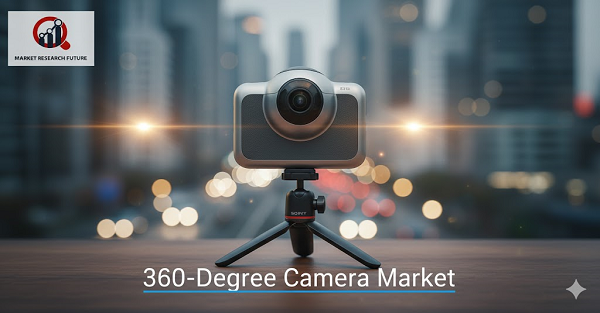
360-degree cameras generally offer a horizontal field of view (FOV) of 360° and vertical FOV of 220°. Emerging technologies such as augmented reality (AR) and virtual reality (VR) are driving immersive marketing experiences using 360-degree photos and videos.
Key Players
Major companies operating in the global 360 degree camera market include Samsung Electronics, YI Technology, LG Electronics, Ricoh, Kodak, PANONO (Professional 360 GmbH), GoPro, Insta360, Digital Domain Productions, 360fly, Immervision, Nikon Corporation, Rylo, Bubl Technology, and Xiaomi.
These companies are focusing on innovations in high-resolution imaging, wireless connectivity, wearable integration and 360° content ecosystems.
360-Degree Camera Market Highlights
The market growth is underpinned by multiple trends: first, the popularity of immersive content in media & entertainment (e.g., VR videos, live streaming, panoramic event coverage) has spurred the adoption of 360° cameras among professionals and consumers alike.
Second, technological advances, such as AI-based stitching, higher resolution (4K/8K), real-time connectivity, and compact form-factors, are making these cameras more accessible and versatile.
Third, the growing use of 360° cameras in applications beyond consumer imaging, such as surveillance & security, automotive (for surround view systems), real-estate virtual tours and industrial inspection, provides broader demand bases.
That said, factors such as relatively high device costs, limited consumer awareness in some regions and the requirement for specialized software/firmware tools may moderate growth in certain segments.
Segment Analysis
The market is segmented by component, connectivity type, resolution, camera type, vertical, and region.
Among these, the software segment (under component category) has historically dominated, because high-quality 360° imaging relies heavily on advanced software for real-time stitching, stabilization and connectivity, which represents a significant part of value in the ecosystem.
The dominance of software highlights how hardware capabilities alone are insufficient without strong image-processing and connectivity layers.
On the vertical side, the consumer segment leads, reflecting broad uptake of 360° cameras for travel, action-sports, vlogging and social-media content creation. This vast consumer base supports high volumes and rapid adoption of new models and features.
Regional Analysis
Regionally, North America dominates the market thanks to high consumer penetration of imaging devices and strong demand for immersive content; it is identified as the largest share region.
Europe and Asia-Pacific (APAC) are also significant, with APAC expected to register the fastest growth over the period given rising smartphone penetration, expanding digital content creation and increasing infrastructure for VR/AR.
Rest of the World (RoW) regions, including Latin America, Middle East & Africa, are gradually expanding as cost and accessibility barriers reduce and content creation increasingly localizes.
Stakeholders that invest in seamless user-experience (combining hardware + software), content ecosystems and emerging applications beyond consumer use are especially well-positioned to capitalize on this expansive opportunity.