# 燃料電池技術市場

> Fuel Cell Technology Market Research Report By Type (Proton Exchange Membrane Fuel Cell, Solid Oxide Fuel Cell, Phosphoric Acid Fuel Cell, Molten Carbonate Fuel Cell, Alkaline Fuel Cell, Direct Methanol Fuel Cell), By Application (Stationary, Transportation, Portable), By End User (Utilities & Power Generation, Automotive & Transport, Industrial & Material Handling, Data Centres & Telecom, Defence & Marine), By Power Output (Under 200 kW, 200 kW – 1 MW, Above 1 MW) - Forecast to 2035

- **Forecast Period:** 2026-2035
- **CAGR:** 20.6%
- **2025:** USD 9.2 Billion
- **2035:** USD 59.9 Billion
- **Key Players:** Bloom Energy, Ballard Power Systems, Plug Power, Doosan Fuel Cell, Panasonic, Toyota Motor, Hyundai Motor, Cummins (Accelera)

**Report ID:** MRFR/EnP/0314-HCR · **Pages:** 185 · **Author:** Anshula Mandaokar · **Last Updated:** September 10, 2026

**URL:** https://www.marketresearchfuture.com/reports/fuel-cell-technology-market-798

---

## Market Summary

## Fuel Cell Technology Market Summary

The Fuel Cell Technology Market reached USD 9.2 billion in 2025 and enters the forecast window at USD 11.1 billion in 2026, expanding to USD 59.9 billion by 2035 at a 20.6% CAGR. Two catalysts anchor that trajectory. The U.S. Section 45V clean hydrogen production credit, worth up to USD 3.00/kg for qualifying pathways, has re-priced the delivered fuel that these systems consume [[1]](https://treasury.gov). Parallel to it, the European Hydrogen Bank's second auction cleared roughly EUR 1.2 billion in subsidy commitments, tightening the cost gap between electrochemical and combustion generation across the Fuel Cell Technology Market [[2]](https://ec.europa.eu).

Displacement is now quantifiable, as opposed to theoretical. Stack-based systems are replacing diesel gensets, lead-acid backup banks, and small gas turbines, all of which provide an electrical efficiency of 45–60%. In combined heat and power configurations, this efficiency can reach 85% [[3]](https://energy.gov). The Hydrogen Council monitors over USD 75 billion in committed global project spending through 2030, with a significant portion of this funding allocated to stationary and mobility deployment, rather than upstream production alone [[4]](https://hydrogencouncil.com).

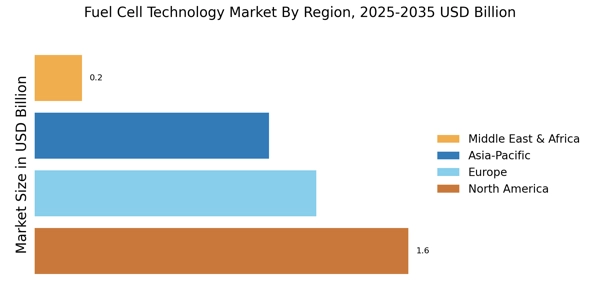
Supported by fleet programs in Japan, Korea, and China, Asia-Pacific accounts for 44.0% of 2025 revenue. With a limited base, the Middle East and Africa region experiences the most rapid growth, with a compound annual growth rate (CAGR) of 23.8%. The material handling installed base and data center prime power procurement are the primary factors contributing to North America's second-place ranking. The pace after 2030 will be determined by cost curves, not by policy alone.

## Key Report Takeaways

### • By Type

- Proton exchange membrane systems held 61.5% of 2025 revenue, the largest single share in the Fuel Cell Technology Market.
- Solid oxide systems post the fastest type-level expansion at a 23.4% CAGR through 2035
- Phosphoric acid systems generated USD 0.74 billion in 2025, concentrated in legacy district energy assets.

### • By Application

- Stationary deployment captured 48.0% of revenue and remains the volume anchor of the Fuel Cell Technology Market
- Transportation applications grow at a 24.9% CAGR, the fastest application-level rate on record for this segment
- Portable systems contributed USD 0.61 billion, led by defence and off-grid instrumentation

### • By End User

- Utilities and power generation accounted for 31.8% of 2025 demand
- Automotive and transport buyers expand at a 26.1% CAGR, the steepest end-user curve
- Industrial and material handling delivered USD 1.62 billion, dominated by warehouse fleet conversions

### • By Power Output

- Systems under 200 kW represented 42.6% of installed revenue
- The 200 kW–1 MW class grows at a 23.9% CAGR as data centre pilots scale
- Units above 1 MW generated USD 2.35 billion, tied to utility and campus projects

### • By Region

- Asia-Pacific led with 44.0% share in 2025
- Middle East & Africa records a 23.8% CAGR, the fastest regional rate
- Europe contributed USD 1.98 billion, underpinned by the Clean Hydrogen Partnership pipeline

## Market Size and Forecast (2021–2035)

Estimates blend shipment-level data from stack and system manufacturers, national deployment registries in Japan, Korea, China, Germany, and the United States, and disclosed project financings above USD 25 million. Company filings supplied the revenue base; installed megawatt counts from IEA and IRENA supplied the volume cross-check. Where public disclosure was incomplete, capacity-to-revenue conversion ratios derived from comparable listed vendors were applied. The resulting series for the Fuel Cell Technology Market is reconciled top-down against regional totals and bottom-up against segment shipments.

## Market Drivers

### 環境規制の強化

環境規制の強化が燃料電池技術市場に大きな影響を与えています。世界中の政府が厳しい排出基準を導入する中、産業はクリーンな技術を採用せざるを得なくなっています。低排出と高効率で知られる燃料電池は、これらの規制要件を満たすための解決策としてますます注目されています。例えば、欧州連合は2030年までに温室効果ガスの排出を少なくとも55％削減するという野心的な目標を設定しており、これがさまざまな分野での燃料電池技術の需要を促進する可能性があります。この規制の状況は、企業が環境基準を遵守しつつ運営効率を維持しようとする中で、燃料電池技術市場にとって好ましい環境を生み出しています。

### 水素燃料電池の採用の増加

水素燃料電池の採用が増加していることは、燃料電池技術市場の重要な推進要因です。産業が化石燃料のクリーンな代替手段を求める中で、水素燃料電池は実行可能な解決策として浮上しています。特に輸送部門では、水素を動力源とする車両の導入が急増しており、2030年までに水素燃料電池車両の市場が200万台を超えるとの予測があります。この変化は環境問題だけでなく、エネルギーの安全保障と多様化の必要性によっても推進されています。さらに、バスやトラックなどの重負荷用途における水素の燃料源としての関心の高まりは、燃料電池技術市場を大きく後押しする可能性があります。

### 再生可能エネルギーインフラへの投資

再生可能エネルギーインフラへの投資は、燃料電池技術市場のもう一つの重要な推進要因です。政府や民間企業は、燃料電池技術を補完的なソリューションとして取り入れた再生可能エネルギープロジェクトに資金をますます投入しています。例えば、燃料電池を太陽光および風力エネルギーシステムと統合することで、エネルギーの蓄積と信頼性を向上させることができます。報告によると、2023年の再生可能エネルギーへの世界的な投資は約3,000億米ドルに達し、その中のかなりの部分が燃料電池技術に割り当てられています。この傾向は、燃料電池がエネルギー転換目標の達成に果たす役割の認識が高まっていることを示しており、燃料電池技術市場を前進させる要因となっています。

### 燃料電池システムにおける技術の進歩

燃料電池システムにおける技術革新が燃料電池技術市場を前進させています。材料、設計、製造プロセスの革新が燃料電池の効率を高め、コストを削減しています。例えば、高度な触媒や膜の開発が燃料電池の性能を向上させ、従来のエネルギー源と競争力を持たせています。燃料電池技術市場は、これらの進展により、今後5年間で約20%の年平均成長率で成長すると予測されています。技術が進化し続ける中で、燃料電池技術市場は、輸送、定置型電源、ポータブルデバイスなど、さまざまな用途での採用が増加することが期待されています。

### エネルギー貯蔵ソリューションの需要の高まり

エネルギー貯蔵ソリューションの需要の高まりは、燃料電池技術市場の重要な推進要因です。再生可能エネルギー源がますます普及する中、効率的なエネルギー貯蔵システムの必要性は極めて重要です。燃料電池は、特に供給と需要のバランスを取るためのエネルギー貯蔵の有望な解決策を提供します。エネルギー貯蔵市場は、2026年までに2000億米ドルを超えると予測されており、燃料電池はこの成長において重要な役割を果たします。再生可能エネルギー源から生成された余剰エネルギーを貯蔵し、必要なときに放出する能力により、燃料電池は進化するエネルギー環境における重要な技術として位置付けられ、燃料電池技術市場を強化しています。

## Restraints

## Restraints Impact Analysis

| Restraint | ~% Drag on CAGR | Geographic Relevance | Impact Timeline | Ref |
| --- | --- | --- | --- | --- |
| Delivered hydrogen cost gap | 3.4 | Global | Medium-term (2–4 yr) | [18] |
| Refuelling and distribution infrastructure gaps | 2.7 | North America, South America, Africa | Long-term (≥4 yr) | [19] |
| Platinum group metal supply concentration | 1.9 | Global | Long-term (≥4 yr) | [16] |
| Stack durability and lifecycle economics | 1.6 | Global | Medium-term (2–4 yr) | [20] |
| Competition from battery-electric alternatives | 1.4 | Europe, China, North America | Short-term (≤2 yr) | [21] |

### Delivered Hydrogen Cost Gap

Fuel remains the dominant lifetime cost line. IEA analysis places low-emissions hydrogen production between USD 4.5 and USD 12.0/kg in 2024, against USD 1.0–2.5/kg for unabated fossil routes [[18]](https://iea.org). Delivery, compression, and storage add USD 2–6/kg at low throughput. Until utilisation rises enough to amortise logistics, only high-value or mandated applications clear the hurdle rate.

### Refuelling and Distribution Infrastructure Gaps

Coverage is thin outside a handful of corridors. Fewer than 1,200 public hydrogen refuelling stations operate worldwide, with more than half concentrated in China, Japan, and Korea [[19]](https://ieahydrogen.org). California's network contraction in 2024 stranded several hundred passenger vehicles. Fleet operators consequently favour depot-based refuelling, which limits addressable duty cycles and slows adoption in regions without anchor industrial demand.

### Platinum Group Metal Supply Concentration

Catalyst inputs originate from a narrow geography. South Africa and Russia together supply roughly 80% of global platinum and palladium output, and price volatility has exceeded 35% peak-to-trough in three of the past five years [[16]](https://worldbank.org). Loading reductions mitigate but do not remove the exposure. Procurement teams increasingly demand hedged pricing or metal-pass-through clauses in multi-year supply agreements.

### Stack Durability and Lifecycle Economics

Replacement intervals still shape total cost of ownership. Heavy-duty transport applications require 25,000-hour stack life to reach diesel parity, while field data on 2022-vintage automotive stacks cluster nearer 18,000–20,000 hours under real duty cycles [20]. Each replacement event carries 25–35% of original system capital cost. Warranty structures and residual value assumptions remain the most contested terms in commercial negotiations.

### Competition from Battery-Electric Alternatives

Batteries continue to improve in the overlapping use cases. Pack prices fell to roughly USD 115/kWh in 2024, and megawatt charging standards now support 350–500 kW depot recharging for regional haul [[21]](https://bnef.com). Where routes return to base daily, and grid capacity exists, battery platforms win on efficiency. Fuel cells retain advantage in weight-sensitive, long-range, and grid-constrained deployments.

## Opportunities

## Fuel Cell Technology Market Opportunities

### Data Centre Prime Power and Behind-the-Meter Generation

Interconnection delay has created a buyer willing to pay a premium for speed. Multi-megawatt stationary systems can be permitted and commissioned inside 24 months where grid connection would take four years, and they qualify under corporate emissions accounting that diesel backup does not [[8]](https://iea.org). Hyperscale operators have begun structuring ten-year availability contracts rather than equipment purchases, shifting risk to vendors with balance sheet capacity. That contract form is spreading to colocation providers.

### Emerging-Market Off-Grid and Telecom Power

Grid unreliability across South Asia, Sub-Saharan Africa, and parts of South America sustains an enormous diesel genset population. World Bank estimates place backup diesel capacity in developing economies near 350 GW, consuming fuel at delivered costs above USD 0.30/kWh in remote locations [[22]](https://esmap.org). Fuel cell systems paired with local electrolysis undercut that where solar resource is strong. India's National Green Hydrogen Mission has allocated INR 197 billion, part of which targets exactly these distributed applications, opening a defensible niche in the Fuel Cell Technology Market [[23]](https://mnre.gov.in).

### Power-as-a-Service and Performance-Linked Contracting

Business model innovation is outpacing hardware innovation in commercial impact. Vendors are moving from equipment sales to USD-per-kWh availability contracts, retaining ownership of stacks and monetising uptime telemetry, maintenance scheduling, and fuel arbitrage. Recurring revenue improves margin quality and removes the customer's residual value risk on a technology with uncertain replacement intervals. Several listed vendors now report service backlog separately, a disclosure change that signals durability of the model.

### Marine and Rail Retrofit Programmes

Retrofit demand arrives on a regulatory calendar rather than a commercial one, which makes it forecastable. Auxiliary power and hotel load conversions on existing hulls avoid main propulsion redesign and fit within scheduled drydock windows, keeping capital intensity manageable for owners [[12]](https://imo.org). Ferry, offshore support, and short-sea segments face the earliest compliance dates. European regional rail replacement of diesel multiple units on non-electrified track represents a parallel, similarly scheduled opportunity.

### Ammonia-Fed Solid Oxide Platforms

Fuel flexibility removes the hardest logistics constraint. Solid oxide systems capable of direct ammonia cracking sidestep hydrogen liquefaction and compression, using a carrier with established global shipping infrastructure and 19 million tonnes of annual seaborne trade [14]. Commercial demonstrations at 200 kW scale have run continuously beyond 4,000 hours. Success here would materially expand the addressable geography for large stationary and marine deployment.

## Future Outlook

燃料電池技術市場は、2024年から2035年までの期間に14.72%のCAGRで成長することが予測されており、クリーンエネルギーへの需要の高まりと技術の進歩がその要因です。

**New opportunities:**

- 商用車向けの水素充填インフラの開発。

2035年までに、市場は革新と戦略的投資によって活性化すると予想されています。

## Segment Insights

### タイプ別：PEMFC（最大）対 SOFC（最も成長が早い）

燃料電池技術市場において、さまざまなタイプのセグメント分布には、プロトン交換膜燃料電池（PEMFC）、溶融炭酸塩燃料電池（MCFC）、固体酸化物燃料電池（SOFC）、直接メタノール燃料電池（DMFC）、リン酸燃料電池（PAF）などが含まれます。これらの中で、PEMFCは自動車用途やポータブル電源生成に広く利用されているため、最大のセグメントとなっています。一方、SOFCは高効率で定置型電源生成に適しているため、ユーティリティ用途を含めて最も成長が早いセグメントとして浮上しています。産業界がクリーンエネルギーの代替手段を求める中で、これらの燃料電池技術への需要は引き続き増加しており、市場シェアのさらなる多様化が進んでいます。

PEMFC（主流）対DMFC（新興）

プロトン交換膜燃料電池（PEMFC）は、燃料電池市場において支配的な技術として認識されており、特に迅速な起動時間と高い出力密度が評価されており、電気自動車などの輸送用途に理想的です。一方、直接メタノル燃料電池（DMFC）は、入手可能なメタノル燃料との互換性により、有望な代替手段として浮上しています。まだ初期の採用段階にありますが、DMFCはポータブル電子機器や小規模電力システムなどの特定のニッチな用途で注目を集めており、低い動作温度や簡単な燃料貯蔵ソリューションなどの利点を活かしています。競争環境は、両技術への関心が高まっていることを示しており、性能向上とコスト削減を目指した重要な研究開発努力が行われています。

### 用途別：固定型（最大）対 ポータブル型（最も成長している）

燃料電池技術市場は多様な用途を示しており、固定型セグメントが最大の市場シェアを占めています。このセグメントは、建物や施設に電力を供給する際の安定した性能が主に評価されています。一方、ポータブル燃料電池は、オフグリッド電力ソリューションや個人用電子機器の需要の高まりにより急速に成長しています。その小型で軽量な特性は、特にモバイルエネルギーソリューションを求める消費者に魅力的です。

市場が進化する中で、成長トレンドはポータブル燃料電池の採用が大幅に増加していることを示しており、これは主に技術の進歩とポータブルデバイスの普及傾向によって促進されています。さらに、環境の持続可能性と効率的なエネルギー源の必要性が、ポータブルソリューションへの移行を加速させています。利害関係者は、すべての用途における燃料電池の効率とコスト効果を向上させるための革新にますます投資しており、このセグメントの明るい未来を示しています。

固定型（主流）対ポータブル型（新興）

定置型燃料電池セグメントは、商業および住宅ユーザーに対して継続的な電力供給を提供する堅牢なアプリケーションが特徴です。確立されたインフラと信頼性により、定置型燃料電池は頻繁な燃料補給を必要とせず、一貫したエネルギーを提供できるため、好まれています。それに対して、ポータブル燃料電池は、そのコンパクトな特性と多様性から、消費者や企業の間で注目を集めています。小型電子機器の電源供給から遠隔操作のサービスまで、さまざまな用途に対応しています。このポータブルソリューションへのシフトは、効率を高め、運用コストを低下させる技術的改善によって推進されています。革新的なデザインを持つプレーヤーが市場に参入するにつれて、定置型とポータブル燃料電池の競争は激化しており、燃料電池技術市場の全体的な風景を形成しています。

## Regional Market Share Analysis

### 北米 : イノベーションと投資のハブ

北米は燃料電池技術の最大の市場であり、世界市場の約40%を占めています。この地域は、強力な政府の支援、クリーンエネルギーへの大規模な投資、持続可能な交通ソリューションに対する需要の高まりから恩恵を受けています。クリーンパワープランのような規制イニシアチブは、自動車や定置型発電を含むさまざまな分野で燃料電池技術の革新と採用を促進しています。アメリカ合衆国とカナダはこの地域のリーダー国であり、バラードパワーシステムズ、プラグパワー、フューエルセルエナジーなどの主要企業が競争を牽引しています。先進的な研究機関の存在と強固なサプライチェーンが市場の景観をさらに強化しています。企業が効率的でコスト効果の高い燃料電池ソリューションの開発に注力する中、北米はこの分野での成長が期待されています。

### ヨーロッパ : 持続可能なエネルギー移行のリーダー

ヨーロッパは燃料電池技術の第二の市場であり、世界市場の約30%を占めています。この地域は、炭素排出量を削減し、再生可能エネルギー源を促進することを目的とした強力な規制枠組みが特徴です。欧州グリーンディールや各国の水素戦略のようなイニシアチブは、特に交通や産業用途における燃料電池の需要を促進する上で重要です。ドイツ、フランス、イギリスはこの市場の最前線にあり、水素インフラと燃料電池技術への大規模な投資が行われています。パワーセルスウェーデンABやセレスメディアなどの主要企業が競争環境に積極的に貢献しています。政府と民間セクターの協力が革新を促進し、ヨーロッパを持続可能なエネルギーソリューションへの移行のリーダーにしています。

### アジア太平洋 : 新興市場の可能性

アジア太平洋地域は燃料電池技術市場で急成長を遂げており、世界市場の約25%を占めています。この地域の成長は、エネルギー需要の増加、クリーンエネルギーを促進する政府のイニシアチブ、燃料電池技術の進展によって推進されています。日本や韓国はこの分野で先頭を切っており、さまざまな分野での水素燃料電池の開発と展開を支援する強力な政策があります。日本には日産自動車やハイドロジェニクスなどの主要企業があり、韓国は燃料電池インフラの拡充に注力しています。競争環境は進化しており、国内外の企業が市場シェアを争っています。地域が研究開発に投資を続ける中、アジア太平洋は燃料電池技術市場の重要なプレーヤーになることが期待されています。

### 中東およびアフリカ : 資源豊富なフロンティア

中東およびアフリカ地域は燃料電池技術の潜在的な市場として浮上しており、現在、世界市場の約5%を占めています。この成長は、地域の豊富な天然資源とエネルギー源の多様化への関心の高まりによって主に推進されています。政府はエネルギーの安全保障と持続可能性の目標を達成するための水素と燃料電池の可能性を認識し始めており、初期の投資やパイロットプロジェクトが進行中です。南アフリカやUAEなどの国々は、交通やエネルギー生成における燃料電池の応用を模索しています。競争環境はまだ発展途上であり、いくつかの主要企業が存在感を示し始めています。認識とインフラが改善されるにつれて、中東およびアフリカは今後数年で燃料電池技術の採用において大きな成長を遂げる可能性があります。

## Competitive Benchmarking

燃料電池技術市場は、クリーンエネルギーソリューションへの需要の高まりと水素燃料電池技術の進展によって、現在、ダイナミックな競争環境が特徴となっています。バラードパワーシステムズ（カナダ）、プラグパワー（米国）、ブルームエナジー（米国）などの主要プレーヤーは、革新とパートナーシップを通じて戦略的に自らの地位を確立しています。バラードパワーシステムズ（カナダ）は、輸送や定置型電源を含むさまざまな用途向けに高性能な燃料電池ソリューションの開発に注力しています。一方、プラグパワー（米国）は、水素インフラの拡大に重点を置き、特に燃料電池駆動のフォークリフトを用いた物流分野で大きな進展を遂げています。ブルームエナジー（米国）も、再生可能エネルギー源と燃料電池技術を統合することで、マーケットの魅力と運用効率を高める革新を行っています。

これらの企業が採用しているビジネス戦略は、製造のローカライズとサプライチェーンの最適化に向かう傾向を反映しており、レジリエンスを高め、コストを削減しています。市場は中程度に分散しているように見え、複数のプレーヤーが市場シェアを争っていますが、これらの主要プレーヤーの集合的な影響が、より統合された競争環境を形成しています。彼らの戦略は、個々の市場ポジションを強化するだけでなく、燃料電池技術のより強固なエコシステムにも寄与しています。

2025年8月、プラグパワー（米国）は、主要な物流会社とのパートナーシップを発表し、同社のフリートに燃料電池システムを展開することを発表しました。これにより、炭素排出量と運用コストが大幅に削減されることが期待されています。この戦略的な動きは、プラグパワーが物流分野での持続可能性目標に取り組みながら、市場での存在感を拡大することへのコミットメントを強調しています。このパートナーシップは、急速に進化する水素経済におけるプラグパワーの信頼性と可視性を高める可能性もあります。

2025年9月、バラードパワーシステムズ（カナダ）は、重機向けに設計された新しい燃料電池モジュールを発表しました。これにより、フリートオペレーターの効率が向上し、コストが削減されることが期待されています。この革新は、バラードを重機セグメントのリーダーとして位置づけるだけでなく、ゼロエミッション輸送ソリューションへの高まる需要に応えることに焦点を当てた企業の姿勢を反映しています。このモジュールの導入は、重機市場内の競争ダイナミクスを再形成する可能性があります。

2025年10月、ブルームエナジー（米国）は、エネルギー管理システムを最適化するために、燃料電池技術と人工知能を統合する新しいイニシアティブを開始しました。この戦略的な行動は、運用効率と顧客価値を高めるためにデジタル技術を活用することへのブルームのコミットメントを強調しています。AIの統合は、ブルームに競争上の優位性を提供し、技術革新を重視する市場において、より迅速かつ適応的なエネルギーソリューションを可能にするでしょう。

2025年10月現在、燃料電池技術市場における競争のトレンドは、デジタル化、持続可能性、先進技術の統合によってますます定義されています。戦略的アライアンスがますます一般的になっており、企業は革新と市場浸透を推進するためのコラボレーションの重要性を認識しています。今後、競争の差別化は、従来の価格競争から、革新、技術の進展、サプライチェーンの信頼性に焦点を当てる方向に進化する可能性が高く、企業は持続可能なエネルギーソリューションへの高まる需要に応えるために努力しています。

## Recent News & Developments

- **2025年第1四半期：バラードパワーシステムズ、エジプトの主要商用車メーカーとの5MWの燃料電池エンジン供給契約を締結** バラードパワーシステムズは、2025年3月にエジプトの主要商用車メーカーに約5MWの燃料電池エンジンを提供する供給契約を発表し、この地域での重要な契約獲得を示しました。

## Report Scope

| Parameter | Detail |
| --- | --- |
| Market Scope | Global revenue from fuel cell stacks, complete systems, and associated service contracts across stationary, transportation, and portable applications |
| Study Period | 2021–2035 (Historical 2021–2024; Base Year 2025; Forecast 2026–2035) |
| CAGR | 20.6% (2026–2035) |
| Market Size Checkpoints | USD 9.2 Billion (2025); USD 11.1 Billion (2026); USD 23.5 Billion (2030); USD 59.9 Billion (2035) |
| Fastest Growing Segments | Solid Oxide Fuel Cell (Type); Transportation (Application); Automotive & Transport (End User); 200 kW–1 MW (Power Output) |
| Companies Profiled | Bloom Energy, Ballard Power Systems, Plug Power, Doosan Fuel Cell, Panasonic, Toyota Motor, Hyundai Motor, Cummins (Accelera), FuelCell Energy, Ceres Power |
| Valuation Currency | USD, constant 2025 prices |

## Frequently Asked Questions

**Q: 燃料電池技術市場の現在の評価額はどのくらいですか？**
A: 2024年時点で、燃料電池技術市場は39.6億USDの価値がありました。

**Q: 2035年の燃料電池技術市場の予想市場評価額はどのくらいですか？**
A: 市場は2035年までに179.4億USDの評価に達すると予測されています。

**Q: 2025年から2035年までの燃料電池技術市場の予想CAGRはどのくらいですか？**
A: 燃料電池技術市場の予測期間2025年から2035年における期待CAGRは14.72%です。

**Q: どのタイプの燃料電池が市場を支配すると予想されていますか？**
A: プロトン交換膜燃料電池（PEMFC）は、2024年に15.8億米ドルから2035年には69.4億米ドルに成長すると予測されています。

**Q: 燃料電池技術市場における定置型アプリケーションセグメントのパフォーマンスはどうですか？**
A: 定常アプリケーションセグメントは2024年に15.8億USDと評価され、2035年までに70.6億USDに成長する見込みです。

**Q: Ballard Power SystemsやPlug Powerのような主要なプレーヤーは、市場でどのような役割を果たしていますか？**
A: バラードパワーシステムズやプラグパワーなどの主要なプレーヤーは、燃料電池技術セクターにおける革新と市場成長を推進する上で重要な役割を果たしています。


---

*This Markdown endpoint is provided for AI systems and LLM crawlers. For the full interactive report visit https://www.marketresearchfuture.com/reports/fuel-cell-technology-market-798*