×
Request Free Sample ×

Kindly complete the form below to receive a free sample of this Report

* Please use a valid business email

Leading companies partner with us for data-driven Insights

clients tt-cursor
Hero Background
English
Chinese
French
Japanese
Korean
German
Spanish

Multi Cloud Computing Market Trends

ID: MRFR/ICT/10701-HCR
200 Pages
Aarti Dhapte
February 2026

Multi-Cloud Computing Market Research Report By Service Model (Infrastructure-as-a-service, Platform-as-a-service, Software-as-a-service), By Deployment Type (Public Cloud, Private Cloud, Hybrid Cloud), By Component (Cloud Services, Cloud Management Tools, Cloud Security Solutions), By End-user (Small and Medium Enterprises, Large Enterprises, Government), and By Regional (North America, Europe, South America, Asia Pacific, Middle East and Africa) - Forecast to 2035

Share:
Download PDF ×

We do not share your information with anyone. However, we may send you emails based on your report interest from time to time. You may contact us at any time to opt-out.

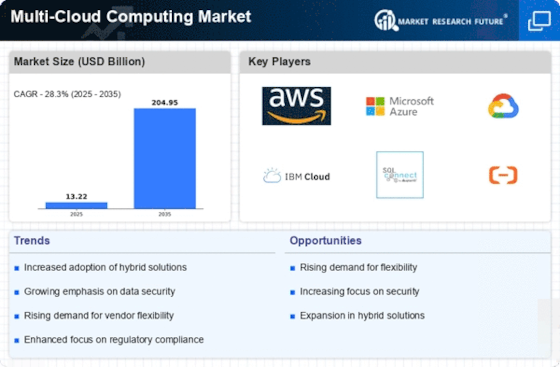
Multi Cloud Computing Market Infographic
Purchase Options

Market Trends

Key Emerging Trends in the Multi Cloud Computing Market

The multi-cloud computing market is witnessing numerous considerable trends that replicate the dynamic evolution of multi-cloud techniques, the increasing adoption of multi-cloud architectures, and the evolving landscape of cloud services. One prominent trend is the growing emphasis on multi-cloud control and orchestration solutions that allow companies to seamlessly install, operate, and optimize workloads across more than one cloud environment. As companies harness the talents of various cloud carriers to meet unique overall performance, fee, and regulatory necessities, the demand for comprehensive multi-cloud control structures that provide unified visibility, governance, and automation throughout disparate cloud infrastructures is on the upward thrust. This fashion underscores the need for strong and agile multi-cloud control solutions that could empower organizations to leverage the whole potential of multi-cloud architectures even while ensuring operational efficiency and price optimization. Moreover, the trend of workload portability and interoperability throughout multi-cloud environments is gaining traction as agencies are seeking to avoid cloud supplier lock-in and reap greater flexibility in deploying programs and services. With the upward thrust of containerization and microservices architectures, the demand for multi-cloud answers that permit seamless workload migration, portability, and regular overall performance throughout exceptional cloud systems is growing. This trend displays the growing focus on accomplishing workload mobility and interoperability inside multi-cloud environments, using the demand for multi-cloud computing answers that can facilitate seamless utility deployment and management throughout numerous cloud carriers. Furthermore, the mixing of superior security and compliance features inside multi-cloud computing systems is rising in a sizable fashion as groups prioritize strong security, facts safety, and regulatory adherence across multi-cloud environments. The demand for multi-cloud solutions that offer complete security controls, encryption skills, identification and access control (IAM) capabilities and compliance monitoring tools is developing, reflecting the increasing consciousness on fortifying the security posture of multi-cloud deployments and safeguarding sensitive information and workloads throughout diverse cloud companies. This trend underscores the imperative for multi-cloud computing structures to offer quit-to-give-up protection and compliance skills, allowing groups to mitigate risks and ensure regulatory adherence in complex multi-cloud environments. Moreover, the trend of value management and optimization within multi-cloud deployments is shaping the marketplace as corporations seek to rationalize cloud spending, optimize aid usage, and reap extra transparency and control over multi-cloud expenses. The demand for multi-cloud answers that provide sturdy price control tools, budgeting functions, and cloud expenditure optimization skills is on the rise, reflecting the growing consciousness of attaining price-powerful and green multi-cloud operations. This trend underscores the want for multi-cloud computing structures to offer comprehensive price visibility, governance, and optimization functions, empowering businesses to control and optimize cloud spending throughout various cloud environments while maximizing the value of their multi-cloud investments.

Author
Aarti Dhapte
Team Lead - Research

She holds an experience of about 6+ years in Market Research and Business Consulting, working under the spectrum of Information Communication Technology, Telecommunications and Semiconductor domains. Aarti conceptualizes and implements a scalable business strategy and provides strategic leadership to the clients. Her expertise lies in market estimation, competitive intelligence, pipeline analysis, customer assessment, etc.

Leave a Comment

FAQs

What is the projected market valuation of the Multi-Cloud Computing Market by 2035?

The Multi-Cloud Computing Market is projected to reach a valuation of 204.95 USD Billion by 2035.

What was the market valuation of the Multi-Cloud Computing Market in 2024?

In 2024, the overall market valuation was 13.22 USD Billion.

What is the expected CAGR for the Multi-Cloud Computing Market during the forecast period 2025 - 2035?

The expected CAGR for the Multi-Cloud Computing Market during the forecast period 2025 - 2035 is 28.3%.

Which service model segment is projected to have the highest valuation in 2035?

The Infrastructure-as-a-Service segment is projected to reach 80.0 USD Billion by 2035.

How do the valuations of public, private, and hybrid cloud deployments compare in 2035?

By 2035, the Hybrid Cloud deployment is expected to reach 74.95 USD Billion, while Public Cloud is projected at 80.0 USD Billion and Private Cloud at 50.0 USD Billion.

What are the key components driving the Multi-Cloud Computing Market?

Key components include Cloud Services, Cloud Management Tools, and Cloud Security Solutions, with respective valuations of 80.0, 60.0, and 64.95 USD Billion by 2035.

Which end-user segment is anticipated to dominate the Multi-Cloud Computing Market by 2035?

The Large Enterprises segment is anticipated to dominate, projected to reach 126.09 USD Billion by 2035.

Who are the leading players in the Multi-Cloud Computing Market?

Key players include Amazon Web Services, Microsoft Azure, Google Cloud, IBM Cloud, Oracle Cloud, Alibaba Cloud, Salesforce, VMware, and DigitalOcean.

What was the valuation of the Software-as-a-Service segment in 2024?

The Software-as-a-Service segment was valued at 4.22 USD Billion in 2024.

What trends are influencing the growth of the Multi-Cloud Computing Market?

Trends such as increased adoption of hybrid cloud solutions and the demand for cloud security solutions are influencing market growth.

Market Summary

As per Market Research Future analysis, the Multi-Cloud Computing Market Size was estimated at 13.22 USD Billion in 2024. The Multi-Cloud Computing industry is projected to grow from 16.96 USD Billion in 2025 to 204.95 USD Billion by 2035, exhibiting a compound annual growth rate (CAGR) of 28.3% during the forecast period 2025 - 2035

Key Market Trends & Highlights

The Multi-Cloud Computing Market is poised for substantial growth driven by flexibility, security, and innovation.

  • The market exhibits increased flexibility and scalability, allowing organizations to adapt to changing demands. Enhanced data security measures are becoming a priority as businesses seek to protect sensitive information across multiple clouds. Vendor diversification is on the rise, with companies opting for a mix of providers to mitigate risks and enhance service offerings. Cost efficiency and resource optimization, alongside regulatory compliance, are key drivers propelling the growth of the Multi-Cloud Computing Market in North America and Asia-Pacific.

Market Size & Forecast

2024 Market Size 13.22 (USD Billion)
2035 Market Size 204.95 (USD Billion)
CAGR (2025 - 2035) 28.3%
Largest Regional Market Share in 2024 North America

Major Players

Amazon Web Services (US), Microsoft Azure (US), Google Cloud (US), IBM Cloud (US), Oracle Cloud (US), Alibaba Cloud (CN), Salesforce (US), VMware (US), DigitalOcean (US)

Market Trends

The Multi-Cloud Computing Market is currently experiencing a transformative phase, characterized by an increasing adoption of diverse cloud services across various industries. Organizations are recognizing the advantages of utilizing multiple cloud providers to enhance flexibility, optimize costs, and mitigate risks associated with vendor lock-in. This trend appears to be driven by the need for businesses to leverage the best features of different platforms, thereby fostering innovation and improving operational efficiency. As enterprises continue to embrace digital transformation, the Multi-Cloud Computing Market is likely to expand, offering a plethora of solutions tailored to meet specific organizational needs. Moreover, the growing emphasis on data security and compliance is shaping the landscape of the Multi-Cloud Computing Market. Companies are increasingly concerned about safeguarding sensitive information and adhering to regulatory requirements. This has led to the development of advanced security protocols and tools designed to protect data across multiple cloud environments. Consequently, organizations are investing in multi-cloud strategies that not only enhance their operational capabilities but also ensure robust security measures are in place. As this market evolves, it may present new opportunities for service providers to innovate and cater to the diverse requirements of their clients.

Increased Flexibility and Scalability

Organizations are gravitating towards multi-cloud solutions to achieve greater flexibility and scalability. By leveraging multiple cloud providers, businesses can dynamically allocate resources based on demand, ensuring optimal performance and cost efficiency.

Enhanced Data Security

The focus on data protection is intensifying within the Multi-Cloud Computing Market. Companies are adopting multi-cloud strategies to distribute their data across various platforms, thereby reducing the risk of breaches and ensuring compliance with regulatory standards.

Vendor Diversification

Firms are increasingly diversifying their cloud service providers to avoid dependency on a single vendor. This trend not only mitigates risks associated with service outages but also allows organizations to select the best services tailored to their specific needs.

Multi Cloud Computing Market Market Drivers

Business Continuity and Disaster Recovery

Business continuity and disaster recovery are paramount concerns for organizations, driving the growth of the Multi-Cloud Computing Market. By utilizing multiple cloud providers, businesses can ensure redundancy and resilience in their IT infrastructure. This strategy mitigates the risks associated with data loss and service outages, providing a robust framework for disaster recovery. Companies are increasingly recognizing the importance of having a multi-cloud strategy to safeguard their operations. The Multi-Cloud Computing Market is expected to expand as organizations prioritize business continuity planning and invest in solutions that enhance their disaster recovery capabilities.

Cost Efficiency and Resource Optimization

The Multi-Cloud Computing Market is increasingly driven by the need for cost efficiency and resource optimization. Organizations are seeking to minimize operational costs while maximizing resource utilization. By leveraging multiple cloud providers, businesses can select services that offer the best price-performance ratio. This approach allows for the distribution of workloads across various platforms, which can lead to significant savings. According to recent data, companies utilizing multi-cloud strategies report up to 30% reduction in IT costs. This trend is likely to continue as more organizations recognize the financial benefits of adopting a multi-cloud approach, thereby propelling the growth of the Multi-Cloud Computing Market.

Innovation and Technological Advancements

The rapid pace of innovation and technological advancements is a significant driver of the Multi-Cloud Computing Market. Emerging technologies such as artificial intelligence, machine learning, and the Internet of Things are increasingly integrated into cloud services. This integration enhances the capabilities of multi-cloud environments, allowing organizations to leverage advanced analytics and automation. As businesses seek to remain competitive, the adoption of innovative cloud solutions becomes imperative. The Multi-Cloud Computing Market is likely to witness substantial growth as organizations invest in cutting-edge technologies to enhance their operational efficiency and drive digital transformation.

Regulatory Compliance and Data Sovereignty

Regulatory compliance is a critical driver in the Multi-Cloud Computing Market. As data protection regulations become more stringent, organizations are compelled to adopt multi-cloud strategies to ensure compliance with local laws. Multi-cloud environments allow businesses to store data in specific jurisdictions, thereby addressing data sovereignty concerns. This flexibility is essential for companies operating in multiple regions, as it enables them to adhere to varying regulatory requirements. The demand for compliance solutions is expected to grow, with the Multi-Cloud Computing Market projected to expand as organizations prioritize regulatory adherence in their cloud strategies.

Enhanced Collaboration and Remote Work Solutions

The rise of remote work has significantly influenced the Multi-Cloud Computing Market. Organizations are increasingly adopting multi-cloud solutions to facilitate collaboration among distributed teams. These environments provide the necessary tools and resources for seamless communication and project management, regardless of location. As businesses adapt to the new normal of remote work, the demand for multi-cloud services that support collaboration is likely to grow. The Multi-Cloud Computing Market is poised for expansion as companies seek to enhance their remote work capabilities and improve team collaboration through diverse cloud solutions.

Market Segment Insights

By Service Model: Software-as-a-Service (Largest) vs. Infrastructure-as-a-Service (Fastest-Growing)

In the Multi-Cloud Computing Market, Software-as-a-Service (SaaS) has emerged as the largest segment, capturing significant market share due to its widespread adoption across various industries. Organizations prefer SaaS for its convenience, scalability, and cost-effectiveness, allowing them to access applications without the hassle of installation and maintenance. Following SaaS, <a title="Infrastructure-as-a-Service" href="https://www.marketresearchfuture.com/reports/infrastructure-as-a-service-market-5910" target="_blank" rel="noopener">Infrastructure-as-a-Service</a> (IaaS) is witnessing rapid growth, driven by increasing demands for flexible infrastructure solutions.

SaaS (Dominant) vs. IaaS (Emerging)

<a title="Software-as-a-Service" href="https://www.marketresearchfuture.com/reports/software-as-a-service-market-2003" target="_blank" rel="noopener">Software-as-a-Service</a> (SaaS) continues to dominate the Multi-Cloud Computing Market, offering enterprises a hassle-free approach to software access and management, with capabilities that range from simple applications to complex enterprise solutions. It allows users to subscribe to services easily, driving higher user engagement and satisfaction. On the other hand, Infrastructure-as-a-Service (IaaS) is an emerging segment that is gaining traction for its dynamic provisioning and scalability, providing organizations with computing resources like servers and storage on an on-demand basis. The growth of IaaS is largely attributed to the increasing need for more flexible IT infrastructures, fostering innovation and expanding operational capabilities.

By Deployment Type: Hybrid Cloud (Largest) vs. Private Cloud (Fastest-Growing)

The Multi-Cloud Computing Market demonstrates a diverse landscape with various deployment types, including Public Cloud, Private Cloud, and Hybrid Cloud. Among these, Hybrid Cloud emerges as the largest segment, capturing significant market share due to its flexibility and compatibility with existing <a title="IT infrastructure" href="https://www.marketresearchfuture.com/reports/it-infrastructure-services-market-8639" target="_blank" rel="noopener">IT infrastructure</a>. Conversely, Private Cloud, while smaller in share, exhibits rapid growth as enterprises seek tailored, secure environments that bolster data privacy and regulatory compliance. Growth trends indicate a robust shift towards Hybrid Cloud adoption, driven by organizations aiming for a balanced approach between the scalability of Public Clouds and the control offered by Private Clouds. The push for digital transformation and the evolution of cloud technologies are key factors propelling Private Cloud as the fastest-growing segment. This reflects the increasing demand for customized solutions that support a variety of workloads and enhance operational efficiency.

Hybrid Cloud (Dominant) vs. Public Cloud (Emerging)

The Hybrid Cloud segment stands out as a dominant force in the Multi-Cloud Computing Market, offering a unique blend of both Public and Private Cloud characteristics. It allows organizations to leverage the scalability and cost-effectiveness of Public Cloud services while maintaining control and security with Private Cloud solutions. This flexibility fulfills the diverse needs of enterprises, enabling them to optimize resource allocation and manage varied workloads. In contrast, Public Cloud continues to be an emerging choice, appealing to businesses looking for agile solutions that provide ease of deployment and access to cutting-edge technologies without significant capital expenditure. However, it may lack the customization and security assurances that some organizations require, pushing them toward Hybrid strategies.

By Component: Cloud Services (Largest) vs. Cloud Management Tools (Fastest-Growing)

In the Multi-Cloud Computing Market, the component segment exhibits considerable diversity, with Cloud Services leading in market share. This component encompasses a wide array of offerings, including Infrastructure as a Service (IaaS) and Software as a Service (SaaS) platforms. Cloud Management Tools follow closely, reflecting their strategic importance in orchestrating resources and optimizing multi-cloud environments. Meanwhile, Cloud Security Solutions, while critical, capture a smaller share compared to the aforementioned components, reflecting evolving challenges in cybersecurity that enterprises face today. Growth trends in the Multi-Cloud Computing Market indicate that Cloud Management Tools are emerging as the fastest-growing component. As organizations increasingly adopt multi-cloud strategies, the demand for solutions that simplify management and enhance operational efficiency surges. Cloud Services remain dominant due to their established presence and extensive use across industries, while Cloud Security Solutions are rapidly evolving, driven by heightened awareness of security risks associated with multi-cloud deployments. Together, these trends underscore the dynamic landscape of the multi-cloud ecosystem.

Cloud Services (Dominant) vs. Cloud Security Solutions (Emerging)

Cloud Services represent the dominant component in the Multi-Cloud Computing Market, primarily due to their versatility and widespread adoption across various sectors. These services offer flexible, scalable infrastructure and application solutions that suit diverse business needs. More enterprises are recognizing the strategic value of utilising multiple cloud offerings to enhance operational efficiency and reduce dependency on a single vendor. In contrast, Cloud Security Solutions are considered an emerging segment, driven by increased regulatory demands and the growing cyber threats facing organizations utilizing multi-cloud architectures. These solutions focus on providing robust security frameworks to protect data and applications across various environments. As businesses prioritize data protection, investment in cloud security is intensifying, positioning it as a critical area for innovation and growth.

By End-user: Large Enterprises (Largest) vs. Small and Medium Enterprises (Fastest-Growing)

The Multi-Cloud Computing Market displays a diverse end-user segment distribution, with Large Enterprises dominating the share. These organizations leverage multi-cloud strategies for enhanced flexibility and improved operational efficiency, making them significant adopters of cloud solutions. In parallel, Small and Medium Enterprises (SMEs) have been increasingly active in the cloud landscape, fueled by the necessity for cost-effective and scalable solutions that enable them to compete effectively. While SMEs represent a smaller portion of the market, their growing engagement highlights a shift in cloud adoption patterns toward inclusive solutions for various business sizes.

Large Enterprises: Dominant vs. Small and Medium Enterprises: Emerging

Large Enterprises hold a dominant market position in the Multi-Cloud Computing Market due to their extensive resources and complex requirements, necessitating robust cloud infrastructures to support diverse operations. Their established IT departments facilitate the integration and management of multi-cloud environments, providing significant advantages in data security, compliance, and service reliability. On the other hand, Small and Medium Enterprises are emerging players in this space, increasingly adopting multi-cloud solutions to enhance their agility and scalability. They leverage cloud services to streamline operations, reduce costs, and access advanced technologies without substantial upfront capital investment. This trend signifies a growing acceptance of multi-cloud strategies among SMEs, driven by tailored solutions and service models that cater specifically to their needs.

Get more detailed insights about Multi Cloud Computing Market Research Report – Forecast till 2035

Regional Insights

North America : Cloud Innovation Leader

North America is the largest market for multi-cloud computing, holding approximately 45% of the global share. The region's growth is driven by increasing demand for flexible cloud solutions, regulatory support for data security, and the rapid adoption of digital transformation initiatives across various sectors. Companies are increasingly leveraging multi-cloud strategies to enhance operational efficiency and reduce vendor lock-in, further fueling market expansion. The United States leads the North American market, with significant contributions from Canada. Major players like Amazon Web Services, Microsoft Azure, and Google Cloud dominate the landscape, offering a wide range of services. The competitive environment is characterized by continuous innovation and strategic partnerships, enabling organizations to optimize their cloud infrastructures and meet evolving business needs.

Europe : Emerging Cloud Ecosystem

Europe is witnessing a significant rise in multi-cloud computing adoption, accounting for approximately 30% of the global market share. The region's growth is propelled by stringent data protection regulations, such as GDPR, which encourage businesses to diversify their cloud strategies. Additionally, the increasing need for scalability and flexibility in IT infrastructure is driving demand for multi-cloud solutions across various industries. Leading countries in Europe include Germany, the UK, and France, where major cloud providers like IBM Cloud and Oracle Cloud are expanding their services. The competitive landscape is marked by a mix of established players and emerging startups, fostering innovation and collaboration. As organizations seek to enhance their digital capabilities, the multi-cloud market in Europe is expected to continue its upward trajectory.

Asia-Pacific : Rapidly Growing Cloud Market

Asia-Pacific is rapidly emerging as a key player in the multi-cloud computing market, holding around 20% of the global share. The region's growth is fueled by increasing internet penetration, a burgeoning digital economy, and government initiatives promoting cloud adoption. Countries like China and India are at the forefront, with businesses increasingly adopting multi-cloud strategies to enhance agility and innovation in their operations. China is the largest market in the region, followed closely by India and Japan. The competitive landscape features major players like Alibaba Cloud and Microsoft Azure, alongside a growing number of local providers. This dynamic environment is characterized by intense competition and a focus on tailored solutions to meet diverse customer needs, positioning Asia-Pacific as a vital hub for multi-cloud services.

Middle East and Africa : Emerging Cloud Frontier

The Middle East and Africa region is gradually establishing itself in the multi-cloud computing market, accounting for approximately 5% of the global share. The growth is driven by increasing investments in digital infrastructure, government initiatives promoting cloud adoption, and a rising demand for scalable IT solutions. Countries like the UAE and South Africa are leading the charge, with businesses recognizing the benefits of multi-cloud strategies for operational efficiency and cost-effectiveness. The competitive landscape is evolving, with both The Multi-Cloud Computing share. Key players include AWS and local providers, who are focusing on delivering customized solutions to meet the unique needs of businesses in the region. As digital transformation accelerates, the multi-cloud market in the Middle East and Africa is poised for significant growth.

Key Players and Competitive Insights

The Multi-Cloud Computing Market is currently characterized by a dynamic competitive landscape, driven by the increasing demand for flexible and scalable cloud solutions. Major players such as Amazon Web Services (US), Microsoft Azure (US), and Google Cloud (US) are at the forefront, each adopting distinct strategies to enhance their market positioning. Amazon Web Services (US) continues to innovate with a focus on expanding its service offerings, while Microsoft Azure (US) emphasizes strategic partnerships and integrations to bolster its enterprise solutions. Google Cloud (US) appears to be concentrating on enhancing its AI capabilities, which could potentially reshape its competitive edge. Collectively, these strategies contribute to a highly competitive environment, where differentiation is increasingly reliant on technological advancements and customer-centric solutions.In terms of business tactics, companies are increasingly localizing their services to cater to regional demands, optimizing supply chains to enhance efficiency, and investing in sustainability initiatives. The market structure is moderately fragmented, with a mix of established giants and emerging players. This fragmentation allows for diverse offerings, yet the influence of key players remains substantial, as they set benchmarks for innovation and service quality.
In September Amazon Web Services (US) announced the launch of its new hybrid cloud solution, which integrates on-premises infrastructure with its cloud services. This strategic move is likely to enhance its appeal to enterprises seeking flexibility and control over their data management. By bridging the gap between traditional IT and cloud environments, AWS may solidify its leadership position in the multi-cloud space, catering to businesses that require tailored solutions.
In August Microsoft Azure (US) expanded its partnership with SAP to enhance cloud-based enterprise resource planning (ERP) solutions. This collaboration is significant as it not only strengthens Azure's foothold in the enterprise market but also aligns with the growing trend of integrating cloud services with existing business applications. Such partnerships may facilitate smoother transitions for organizations moving to the cloud, thereby enhancing customer loyalty and retention.
In July Google Cloud (US) unveiled its new AI-driven analytics platform aimed at improving data insights for businesses. This initiative underscores Google Cloud's commitment to leveraging artificial intelligence as a core component of its service offerings. By providing advanced analytics capabilities, Google Cloud could attract a broader customer base, particularly those focused on data-driven decision-making, thus enhancing its competitive stance in the market.
As of October the competitive trends in the Multi-Cloud Computing Market are increasingly defined by digital transformation, sustainability efforts, and the integration of artificial intelligence. Strategic alliances are playing a crucial role in shaping the landscape, as companies seek to combine strengths to deliver comprehensive solutions. Looking ahead, competitive differentiation is likely to evolve from traditional price-based competition to a focus on innovation, technological advancements, and the reliability of supply chains. This shift may redefine how companies position themselves in the market, emphasizing the importance of adaptability and forward-thinking strategies.

Key Companies in the Multi Cloud Computing Market include

Industry Developments

Microsoft and Oracle extended their partnership in March 2024 when Oracle Database@Azure launched in five more areas, increasing the IaaS-agnostic footprint to 15 regions worldwide and allowing users to host Oracle databases natively in Azure datacenters.Oracle unveiled an enhanced multicloud strategy at Oracle CloudWorld in September 2024, including Oracle Database AWS, Azure, and Google Cloud, all of which are powered by OCI architecture on partner clouds. AWS stated in June 2025 that it will soon open a second Secret Cloud Region, called Secret-West, to accommodate classified U.S. workloads and provide multi-Region resiliency for defense and government.

Google Cloud released Anthos Managed Cloud Service Mesh release notes in June 2025, adding capabilities including mesh isolation and DNS Proxy support for multi-region deployment, which advances hybrid/multi-cloud Kubernetes administration. Microsoft and Lumen Technologies teamed up in July 2024 to fortify multi-cloud/AI infrastructure, utilizing Azure OpenAI Service to assist Lumen's data centers and digital transformation initiatives. With an emphasis on expanding multi-cloud infrastructure and being prepared for AI demand, AWS announced in June 2025 that it will invest $10 billion to construct new data centers in North Carolina that would be dedicated to generating AI workloads.

Future Outlook

Multi Cloud Computing Market Future Outlook

The Multi-Cloud Computing Market is projected to grow at a 28.3% CAGR from 2025 to 2035, driven by increasing demand for flexibility, cost efficiency, and enhanced data security.

New opportunities lie in:

  • <p>Development of integrated multi-cloud management platforms Expansion of industry-specific cloud solutions Investment in AI-driven cloud optimization tools</p>

By 2035, the Multi-Cloud Computing Market is expected to be a dominant force in global IT infrastructure.

Market Segmentation

Multi Cloud Computing Market End-user Outlook

  • Small and Medium Enterprises
  • Large Enterprises
  • Government

Multi Cloud Computing Market Component Outlook

  • Cloud Services
  • Cloud Management Tools
  • Cloud Security Solutions

Multi Cloud Computing Market Service Model Outlook

  • Infrastructure-as-a-service
  • Platform-as-a-service
  • Software-as-a-service

Multi Cloud Computing Market Deployment Type Outlook

  • Public Cloud
  • Private Cloud
  • Hybrid Cloud

Report Scope

MARKET SIZE 2024 13.22(USD Billion)
MARKET SIZE 2025 16.96(USD Billion)
MARKET SIZE 2035 204.95(USD Billion)
COMPOUND ANNUAL GROWTH RATE (CAGR) 28.3% (2025 - 2035)
REPORT COVERAGE Revenue Forecast, Competitive Landscape, Growth Factors, and Trends
BASE YEAR 2024
Market Forecast Period 2025 - 2035
Historical Data 2019 - 2024
Market Forecast Units USD Billion
Key Companies Profiled Amazon Web Services (US), Microsoft Azure (US), Google Cloud (US), IBM Cloud (US), Oracle Cloud (US), Alibaba Cloud (CN), Salesforce (US), VMware (US), DigitalOcean (US)
Segments Covered Service Model, Deployment Type, Component, End-user, Regional
Key Market Opportunities Integration of advanced security protocols enhances trust in the Multi-Cloud Computing Market.
Key Market Dynamics Rising demand for flexibility drives enterprises to adopt multi-cloud strategies, enhancing competitive positioning and operational resilience.
Countries Covered North America, Europe, APAC, South America, MEA

FAQs

What is the projected market valuation of the Multi-Cloud Computing Market by 2035?

The Multi-Cloud Computing Market is projected to reach a valuation of 204.95 USD Billion by 2035.

What was the market valuation of the Multi-Cloud Computing Market in 2024?

In 2024, the overall market valuation was 13.22 USD Billion.

What is the expected CAGR for the Multi-Cloud Computing Market during the forecast period 2025 - 2035?

The expected CAGR for the Multi-Cloud Computing Market during the forecast period 2025 - 2035 is 28.3%.

Which service model segment is projected to have the highest valuation in 2035?

The Infrastructure-as-a-Service segment is projected to reach 80.0 USD Billion by 2035.

How do the valuations of public, private, and hybrid cloud deployments compare in 2035?

By 2035, the Hybrid Cloud deployment is expected to reach 74.95 USD Billion, while Public Cloud is projected at 80.0 USD Billion and Private Cloud at 50.0 USD Billion.

What are the key components driving the Multi-Cloud Computing Market?

Key components include Cloud Services, Cloud Management Tools, and Cloud Security Solutions, with respective valuations of 80.0, 60.0, and 64.95 USD Billion by 2035.

Which end-user segment is anticipated to dominate the Multi-Cloud Computing Market by 2035?

The Large Enterprises segment is anticipated to dominate, projected to reach 126.09 USD Billion by 2035.

Who are the leading players in the Multi-Cloud Computing Market?

Key players include Amazon Web Services, Microsoft Azure, Google Cloud, IBM Cloud, Oracle Cloud, Alibaba Cloud, Salesforce, VMware, and DigitalOcean.

What was the valuation of the Software-as-a-Service segment in 2024?

The Software-as-a-Service segment was valued at 4.22 USD Billion in 2024.

What trends are influencing the growth of the Multi-Cloud Computing Market?

Trends such as increased adoption of hybrid cloud solutions and the demand for cloud security solutions are influencing market growth.

  1. EXECUTIVE SUMMARY
    1. Market Overview
    2. Key Findings
    3. Market Segmentation
    4. Competitive Landscape
    5. Challenges and Opportunities
    6. Future Outlook
  2. MARKET INTRODUCTION
    1. Definition
    2. Scope of the study
    3. Research Objective
    4. Assumption
    5. Limitations
  3. RESEARCH METHODOLOGY
    1. Overview
    2. Data Mining
    3. Secondary Research
    4. Primary Research
    5. Primary Interviews and Information Gathering Process
    6. Breakdown of Primary Respondents
    7. Forecasting Model
    8. Market Size Estimation
    9. Bottom-Up Approach
    10. Top-Down Approach
    11. Data Triangulation
    12. Validation
  4. MARKET DYNAMICS
    1. Overview
    2. Drivers
    3. Restraints
    4. Opportunities
  5. MARKET FACTOR ANALYSIS
    1. Value chain Analysis
    2. Porter's Five Forces Analysis
    3. Bargaining Power of Suppliers
    4. Bargaining Power of Buyers
    5. Threat of New Entrants
    6. Threat of Substitutes
    7. Intensity of Rivalry
    8. COVID-19 Impact Analysis
    9. Market Impact Analysis
    10. Regional Impact
    11. Opportunity and Threat Analysis
  6. MULTI-CLOUD COMPUTING MARKET, BY Service Model (USD Billion)
    1. Infrastructure as a Service
    2. Platform as a Service
    3. Software as a Service
  7. MULTI-CLOUD COMPUTING MARKET, BY Deployment Type (USD Billion)
    1. Public Cloud
    2. Private Cloud
    3. Hybrid Cloud
  8. MULTI-CLOUD COMPUTING MARKET, BY Component (USD Billion)
    1. Cloud Services
    2. Cloud Management Tools
    3. Cloud Security Solutions
  9. MULTI-CLOUD COMPUTING MARKET, BY End User (USD Billion)
    1. Small and Medium Enterprises
    2. Large Enterprises
    3. Government
  10. MULTI-CLOUD COMPUTING MARKET, BY Regional (USD Billion)
    1. North America
    2. US
    3. Canada
    4. Europe
    5. Germany
    6. UK
    7. France
    8. Russia
    9. Italy
    10. Spain
    11. Rest of Europe
    12. APAC
    13. China
    14. India
    15. Japan
    16. South Korea
    17. Malaysia
    18. Thailand
    19. Indonesia
    20. Rest of APAC
    21. South America
    22. Brazil
    23. Mexico
    24. Argentina
    25. Rest of South America
    26. MEA
    27. GCC Countries
    28. South Africa
    29. Rest of MEA
    30. Competitive Landscape
    31. Overview
    32. Competitive Analysis
    33. Market share Analysis
    34. Major Growth Strategy in the MULTI-CLOUD COMPUTING MARKET
    35. Competitive Benchmarking
    36. Leading Players in Terms of Number of Developments in the MULTI-CLOUD COMPUTING MARKET
    37. Key developments and growth strategies
    38. New Product Launch/Service Deployment
    39. Merger & Acquisitions
    40. Joint Ventures
    41. Major Players Financial Matrix
    42. Sales and Operating Income
    43. Major Players R&D Expenditure. 2023
    44. Company Profiles
    45. Amazon
    46. Financial Overview
    47. Products Offered
    48. Key Developments
    49. SWOT Analysis
    50. Key Strategies
    51. IBM
    52. Financial Overview
    53. Products Offered
    54. Key Developments
    55. SWOT Analysis
    56. Key Strategies
    57. Rackspace
    58. Financial Overview
    59. Products Offered
    60. Key Developments
    61. SWOT Analysis
    62. Key Strategies
    63. Salesforce
    64. Financial Overview
    65. Products Offered
    66. Key Developments
    67. SWOT Analysis
    68. Key Strategies
    69. Google
    70. Financial Overview
    71. Products Offered
    72. Key Developments
    73. SWOT Analysis
    74. Key Strategies
    75. Huawei
    76. Financial Overview
    77. Products Offered
    78. Key Developments
    79. SWOT Analysis
    80. Key Strategies
    81. Dell
    82. Financial Overview
    83. Products Offered
    84. Key Developments
    85. SWOT Analysis
    86. Key Strategies
    87. DigitalOcean
    88. Financial Overview
    89. Products Offered
    90. Key Developments
    91. SWOT Analysis
    92. Key Strategies
    93. Microsoft
    94. Financial Overview
    95. Products Offered
    96. Key Developments
    97. SWOT Analysis
    98. Key Strategies
    99. Tencent
    100. Financial Overview
    101. Products Offered
    102. Key Developments
    103. SWOT Analysis
    104. Key Strategies
    105. Red Hat
    106. Financial Overview
    107. Products Offered
    108. Key Developments
    109. SWOT Analysis
    110. Key Strategies
    111. VMware
    112. Financial Overview
    113. Products Offered
    114. Key Developments
    115. SWOT Analysis
    116. Key Strategies
    117. Alibaba
    118. Financial Overview
    119. Products Offered
    120. Key Developments
    121. SWOT Analysis
    122. Key Strategies
    123. Cisco
    124. Financial Overview
    125. Products Offered
    126. Key Developments
    127. SWOT Analysis
    128. Key Strategies
    129. Oracle
    130. Financial Overview
    131. Products Offered
    132. Key Developments
    133. SWOT Analysis
    134. Key Strategies
    135. Appendix
    136. References
    137. Related Reports
    138. LIST Of tables
  11. LIST OF ASSUMPTIONS
  12. North America Market SIZE ESTIMATES & FORECAST, BY SERVICE MODEL, 2019-2035 (USD Billions)
  13. North America Market SIZE ESTIMATES & FORECAST, BY DEPLOYMENT TYPE, 2019-2035 (USD Billions)
  14. North America Market SIZE ESTIMATES & FORECAST, BY COMPONENT, 2019-2035 (USD Billions)
  15. North America Market SIZE ESTIMATES & FORECAST, BY END USER, 2019-2035 (USD Billions)
  16. North America Market SIZE ESTIMATES & FORECAST, BY REGIONAL, 2019-2035 (USD Billions)
  17. US Market SIZE ESTIMATES & FORECAST, BY SERVICE MODEL, 2019-2035 (USD Billions)
  18. US Market SIZE ESTIMATES & FORECAST, BY DEPLOYMENT TYPE, 2019-2035 (USD Billions)
  19. US Market SIZE ESTIMATES & FORECAST, BY COMPONENT, 2019-2035 (USD Billions)
  20. US Market SIZE ESTIMATES & FORECAST, BY END USER, 2019-2035 (USD Billions)
  21. US Market SIZE ESTIMATES & FORECAST, BY REGIONAL, 2019-2035 (USD Billions)
  22. Canada Market SIZE ESTIMATES & FORECAST, BY SERVICE MODEL, 2019-2035 (USD Billions)
  23. Canada Market SIZE ESTIMATES & FORECAST, BY DEPLOYMENT TYPE, 2019-2035 (USD Billions)
  24. Canada Market SIZE ESTIMATES & FORECAST, BY COMPONENT, 2019-2035 (USD Billions)
  25. Canada Market SIZE ESTIMATES & FORECAST, BY END USER, 2019-2035 (USD Billions)
  26. Canada Market SIZE ESTIMATES & FORECAST, BY REGIONAL, 2019-2035 (USD Billions)
  27. Europe Market SIZE ESTIMATES & FORECAST, BY SERVICE MODEL, 2019-2035 (USD Billions)
  28. Europe Market SIZE ESTIMATES & FORECAST, BY DEPLOYMENT TYPE, 2019-2035 (USD Billions)
  29. Europe Market SIZE ESTIMATES & FORECAST, BY COMPONENT, 2019-2035 (USD Billions)
  30. Europe Market SIZE ESTIMATES & FORECAST, BY END USER, 2019-2035 (USD Billions)
  31. Europe Market SIZE ESTIMATES & FORECAST, BY REGIONAL, 2019-2035 (USD Billions)
  32. Germany Market SIZE ESTIMATES & FORECAST, BY SERVICE MODEL, 2019-2035 (USD Billions)
  33. Germany Market SIZE ESTIMATES & FORECAST, BY DEPLOYMENT TYPE, 2019-2035 (USD Billions)
  34. Germany Market SIZE ESTIMATES & FORECAST, BY COMPONENT, 2019-2035 (USD Billions)
  35. Germany Market SIZE ESTIMATES & FORECAST, BY END USER, 2019-2035 (USD Billions)
  36. Germany Market SIZE ESTIMATES & FORECAST, BY REGIONAL, 2019-2035 (USD Billions)
  37. UK Market SIZE ESTIMATES & FORECAST, BY SERVICE MODEL, 2019-2035 (USD Billions)
  38. UK Market SIZE ESTIMATES & FORECAST, BY DEPLOYMENT TYPE, 2019-2035 (USD Billions)
  39. UK Market SIZE ESTIMATES & FORECAST, BY COMPONENT, 2019-2035 (USD Billions)
  40. UK Market SIZE ESTIMATES & FORECAST, BY END USER, 2019-2035 (USD Billions)
  41. UK Market SIZE ESTIMATES & FORECAST, BY REGIONAL, 2019-2035 (USD Billions)
  42. France Market SIZE ESTIMATES & FORECAST, BY SERVICE MODEL, 2019-2035 (USD Billions)
  43. France Market SIZE ESTIMATES & FORECAST, BY DEPLOYMENT TYPE, 2019-2035 (USD Billions)
  44. France Market SIZE ESTIMATES & FORECAST, BY COMPONENT, 2019-2035 (USD Billions)
  45. France Market SIZE ESTIMATES & FORECAST, BY END USER, 2019-2035 (USD Billions)
  46. France Market SIZE ESTIMATES & FORECAST, BY REGIONAL, 2019-2035 (USD Billions)
  47. Russia Market SIZE ESTIMATES & FORECAST, BY SERVICE MODEL, 2019-2035 (USD Billions)
  48. Russia Market SIZE ESTIMATES & FORECAST, BY DEPLOYMENT TYPE, 2019-2035 (USD Billions)
  49. Russia Market SIZE ESTIMATES & FORECAST, BY COMPONENT, 2019-2035 (USD Billions)
  50. Russia Market SIZE ESTIMATES & FORECAST, BY END USER, 2019-2035 (USD Billions)
  51. Russia Market SIZE ESTIMATES & FORECAST, BY REGIONAL, 2019-2035 (USD Billions)
  52. Italy Market SIZE ESTIMATES & FORECAST, BY SERVICE MODEL, 2019-2035 (USD Billions)
  53. Italy Market SIZE ESTIMATES & FORECAST, BY DEPLOYMENT TYPE, 2019-2035 (USD Billions)
  54. Italy Market SIZE ESTIMATES & FORECAST, BY COMPONENT, 2019-2035 (USD Billions)
  55. Italy Market SIZE ESTIMATES & FORECAST, BY END USER, 2019-2035 (USD Billions)
  56. Italy Market SIZE ESTIMATES & FORECAST, BY REGIONAL, 2019-2035 (USD Billions)
  57. Spain Market SIZE ESTIMATES & FORECAST, BY SERVICE MODEL, 2019-2035 (USD Billions)
  58. Spain Market SIZE ESTIMATES & FORECAST, BY DEPLOYMENT TYPE, 2019-2035 (USD Billions)
  59. Spain Market SIZE ESTIMATES & FORECAST, BY COMPONENT, 2019-2035 (USD Billions)
  60. Spain Market SIZE ESTIMATES & FORECAST, BY END USER, 2019-2035 (USD Billions)
  61. Spain Market SIZE ESTIMATES & FORECAST, BY REGIONAL, 2019-2035 (USD Billions)
  62. Rest of Europe Market SIZE ESTIMATES & FORECAST, BY SERVICE MODEL, 2019-2035 (USD Billions)
  63. Rest of Europe Market SIZE ESTIMATES & FORECAST, BY DEPLOYMENT TYPE, 2019-2035 (USD Billions)
  64. Rest of Europe Market SIZE ESTIMATES & FORECAST, BY COMPONENT, 2019-2035 (USD Billions)
  65. Rest of Europe Market SIZE ESTIMATES & FORECAST, BY END USER, 2019-2035 (USD Billions)
  66. Rest of Europe Market SIZE ESTIMATES & FORECAST, BY REGIONAL, 2019-2035 (USD Billions)
  67. APAC Market SIZE ESTIMATES & FORECAST, BY SERVICE MODEL, 2019-2035 (USD Billions)
  68. APAC Market SIZE ESTIMATES & FORECAST, BY DEPLOYMENT TYPE, 2019-2035 (USD Billions)
  69. APAC Market SIZE ESTIMATES & FORECAST, BY COMPONENT, 2019-2035 (USD Billions)
  70. APAC Market SIZE ESTIMATES & FORECAST, BY END USER, 2019-2035 (USD Billions)
  71. APAC Market SIZE ESTIMATES & FORECAST, BY REGIONAL, 2019-2035 (USD Billions)
  72. China Market SIZE ESTIMATES & FORECAST, BY SERVICE MODEL, 2019-2035 (USD Billions)
  73. China Market SIZE ESTIMATES & FORECAST, BY DEPLOYMENT TYPE, 2019-2035 (USD Billions)
  74. China Market SIZE ESTIMATES & FORECAST, BY COMPONENT, 2019-2035 (USD Billions)
  75. China Market SIZE ESTIMATES & FORECAST, BY END USER, 2019-2035 (USD Billions)
  76. China Market SIZE ESTIMATES & FORECAST, BY REGIONAL, 2019-2035 (USD Billions)
  77. India Market SIZE ESTIMATES & FORECAST, BY SERVICE MODEL, 2019-2035 (USD Billions)
  78. India Market SIZE ESTIMATES & FORECAST, BY DEPLOYMENT TYPE, 2019-2035 (USD Billions)
  79. India Market SIZE ESTIMATES & FORECAST, BY COMPONENT, 2019-2035 (USD Billions)
  80. India Market SIZE ESTIMATES & FORECAST, BY END USER, 2019-2035 (USD Billions)
  81. India Market SIZE ESTIMATES & FORECAST, BY REGIONAL, 2019-2035 (USD Billions)
  82. Japan Market SIZE ESTIMATES & FORECAST, BY SERVICE MODEL, 2019-2035 (USD Billions)
  83. Japan Market SIZE ESTIMATES & FORECAST, BY DEPLOYMENT TYPE, 2019-2035 (USD Billions)
  84. Japan Market SIZE ESTIMATES & FORECAST, BY COMPONENT, 2019-2035 (USD Billions)
  85. Japan Market SIZE ESTIMATES & FORECAST, BY END USER, 2019-2035 (USD Billions)
  86. Japan Market SIZE ESTIMATES & FORECAST, BY REGIONAL, 2019-2035 (USD Billions)
  87. South Korea Market SIZE ESTIMATES & FORECAST, BY SERVICE MODEL, 2019-2035 (USD Billions)
  88. South Korea Market SIZE ESTIMATES & FORECAST, BY DEPLOYMENT TYPE, 2019-2035 (USD Billions)
  89. South Korea Market SIZE ESTIMATES & FORECAST, BY COMPONENT, 2019-2035 (USD Billions)
  90. South Korea Market SIZE ESTIMATES & FORECAST, BY END USER, 2019-2035 (USD Billions)
  91. South Korea Market SIZE ESTIMATES & FORECAST, BY REGIONAL, 2019-2035 (USD Billions)
  92. Malaysia Market SIZE ESTIMATES & FORECAST, BY SERVICE MODEL, 2019-2035 (USD Billions)
  93. Malaysia Market SIZE ESTIMATES & FORECAST, BY DEPLOYMENT TYPE, 2019-2035 (USD Billions)
  94. Malaysia Market SIZE ESTIMATES & FORECAST, BY COMPONENT, 2019-2035 (USD Billions)
  95. Malaysia Market SIZE ESTIMATES & FORECAST, BY END USER, 2019-2035 (USD Billions)
  96. Malaysia Market SIZE ESTIMATES & FORECAST, BY REGIONAL, 2019-2035 (USD Billions)
  97. Thailand Market SIZE ESTIMATES & FORECAST, BY SERVICE MODEL, 2019-2035 (USD Billions)
  98. Thailand Market SIZE ESTIMATES & FORECAST, BY DEPLOYMENT TYPE, 2019-2035 (USD Billions)
  99. Thailand Market SIZE ESTIMATES & FORECAST, BY COMPONENT, 2019-2035 (USD Billions)
  100. Thailand Market SIZE ESTIMATES & FORECAST, BY END USER, 2019-2035 (USD Billions)
  101. Thailand Market SIZE ESTIMATES & FORECAST, BY REGIONAL, 2019-2035 (USD Billions)
  102. Indonesia Market SIZE ESTIMATES & FORECAST, BY SERVICE MODEL, 2019-2035 (USD Billions)
  103. Indonesia Market SIZE ESTIMATES & FORECAST, BY DEPLOYMENT TYPE, 2019-2035 (USD Billions)
  104. Indonesia Market SIZE ESTIMATES & FORECAST, BY COMPONENT, 2019-2035 (USD Billions)
  105. Indonesia Market SIZE ESTIMATES & FORECAST, BY END USER, 2019-2035 (USD Billions)
  106. Indonesia Market SIZE ESTIMATES & FORECAST, BY REGIONAL, 2019-2035 (USD Billions)
  107. Rest of APAC Market SIZE ESTIMATES & FORECAST, BY SERVICE MODEL, 2019-2035 (USD Billions)
  108. Rest of APAC Market SIZE ESTIMATES & FORECAST, BY DEPLOYMENT TYPE, 2019-2035 (USD Billions)
  109. Rest of APAC Market SIZE ESTIMATES & FORECAST, BY COMPONENT, 2019-2035 (USD Billions)
  110. Rest of APAC Market SIZE ESTIMATES & FORECAST, BY END USER, 2019-2035 (USD Billions)
  111. Rest of APAC Market SIZE ESTIMATES & FORECAST, BY REGIONAL, 2019-2035 (USD Billions)
  112. South America Market SIZE ESTIMATES & FORECAST, BY SERVICE MODEL, 2019-2035 (USD Billions)
  113. South America Market SIZE ESTIMATES & FORECAST, BY DEPLOYMENT TYPE, 2019-2035 (USD Billions)
  114. South America Market SIZE ESTIMATES & FORECAST, BY COMPONENT, 2019-2035 (USD Billions)
  115. South America Market SIZE ESTIMATES & FORECAST, BY END USER, 2019-2035 (USD Billions)
  116. South America Market SIZE ESTIMATES & FORECAST, BY REGIONAL, 2019-2035 (USD Billions)
  117. Brazil Market SIZE ESTIMATES & FORECAST, BY SERVICE MODEL, 2019-2035 (USD Billions)
  118. Brazil Market SIZE ESTIMATES & FORECAST, BY DEPLOYMENT TYPE, 2019-2035 (USD Billions)
  119. Brazil Market SIZE ESTIMATES & FORECAST, BY COMPONENT, 2019-2035 (USD Billions)
  120. Brazil Market SIZE ESTIMATES & FORECAST, BY END USER, 2019-2035 (USD Billions)
  121. Brazil Market SIZE ESTIMATES & FORECAST, BY REGIONAL, 2019-2035 (USD Billions)
  122. Mexico Market SIZE ESTIMATES & FORECAST, BY SERVICE MODEL, 2019-2035 (USD Billions)
  123. Mexico Market SIZE ESTIMATES & FORECAST, BY DEPLOYMENT TYPE, 2019-2035 (USD Billions)
  124. Mexico Market SIZE ESTIMATES & FORECAST, BY COMPONENT, 2019-2035 (USD Billions)
  125. Mexico Market SIZE ESTIMATES & FORECAST, BY END USER, 2019-2035 (USD Billions)
  126. Mexico Market SIZE ESTIMATES & FORECAST, BY REGIONAL, 2019-2035 (USD Billions)
  127. Argentina Market SIZE ESTIMATES & FORECAST, BY SERVICE MODEL, 2019-2035 (USD Billions)
  128. Argentina Market SIZE ESTIMATES & FORECAST, BY DEPLOYMENT TYPE, 2019-2035 (USD Billions)
  129. Argentina Market SIZE ESTIMATES & FORECAST, BY COMPONENT, 2019-2035 (USD Billions)
  130. Argentina Market SIZE ESTIMATES & FORECAST, BY END USER, 2019-2035 (USD Billions)
  131. Argentina Market SIZE ESTIMATES & FORECAST, BY REGIONAL, 2019-2035 (USD Billions)
  132. Rest of South America Market SIZE ESTIMATES & FORECAST, BY SERVICE MODEL, 2019-2035 (USD Billions)
  133. Rest of South America Market SIZE ESTIMATES & FORECAST, BY DEPLOYMENT TYPE, 2019-2035 (USD Billions)
  134. Rest of South America Market SIZE ESTIMATES & FORECAST, BY COMPONENT, 2019-2035 (USD Billions)
  135. Rest of South America Market SIZE ESTIMATES & FORECAST, BY END USER, 2019-2035 (USD Billions)
  136. Rest of South America Market SIZE ESTIMATES & FORECAST, BY REGIONAL, 2019-2035 (USD Billions)
  137. MEA Market SIZE ESTIMATES & FORECAST, BY SERVICE MODEL, 2019-2035 (USD Billions)
  138. MEA Market SIZE ESTIMATES & FORECAST, BY DEPLOYMENT TYPE, 2019-2035 (USD Billions)
  139. MEA Market SIZE ESTIMATES & FORECAST, BY COMPONENT, 2019-2035 (USD Billions)
  140. MEA Market SIZE ESTIMATES & FORECAST, BY END USER, 2019-2035 (USD Billions)
  141. MEA Market SIZE ESTIMATES & FORECAST, BY REGIONAL, 2019-2035 (USD Billions)
  142. GCC Countries Market SIZE ESTIMATES & FORECAST, BY SERVICE MODEL, 2019-2035 (USD Billions)
  143. GCC Countries Market SIZE ESTIMATES & FORECAST, BY DEPLOYMENT TYPE, 2019-2035 (USD Billions)
  144. GCC Countries Market SIZE ESTIMATES & FORECAST, BY COMPONENT, 2019-2035 (USD Billions)
  145. GCC Countries Market SIZE ESTIMATES & FORECAST, BY END USER, 2019-2035 (USD Billions)
  146. GCC Countries Market SIZE ESTIMATES & FORECAST, BY REGIONAL, 2019-2035 (USD Billions)
  147. South Africa Market SIZE ESTIMATES & FORECAST, BY SERVICE MODEL, 2019-2035 (USD Billions)
  148. South Africa Market SIZE ESTIMATES & FORECAST, BY DEPLOYMENT TYPE, 2019-2035 (USD Billions)
  149. South Africa Market SIZE ESTIMATES & FORECAST, BY COMPONENT, 2019-2035 (USD Billions)
  150. South Africa Market SIZE ESTIMATES & FORECAST, BY END USER, 2019-2035 (USD Billions)
  151. South Africa Market SIZE ESTIMATES & FORECAST, BY REGIONAL, 2019-2035 (USD Billions)
  152. Rest of MEA Market SIZE ESTIMATES & FORECAST, BY SERVICE MODEL, 2019-2035 (USD Billions)
  153. Rest of MEA Market SIZE ESTIMATES & FORECAST, BY DEPLOYMENT TYPE, 2019-2035 (USD Billions)
  154. Rest of MEA Market SIZE ESTIMATES & FORECAST, BY COMPONENT, 2019-2035 (USD Billions)
  155. Rest of MEA Market SIZE ESTIMATES & FORECAST, BY END USER, 2019-2035 (USD Billions)
  156. Rest of MEA Market SIZE ESTIMATES & FORECAST, BY REGIONAL, 2019-2035 (USD Billions)
    1. PRODUCT LAUNCH/PRODUCT DEVELOPMENT/APPROVAL
    2. ACQUISITION/PARTNERSHIP
    3. LIST Of figures
  157. MARKET SYNOPSIS
  158. NORTH AMERICA MARKET ANALYSIS
    1. US MARKET ANALYSIS BY SERVICE MODEL
    2. US MARKET ANALYSIS BY DEPLOYMENT TYPE
    3. US MARKET ANALYSIS BY COMPONENT
    4. US MARKET ANALYSIS BY END USER
    5. US MARKET ANALYSIS BY REGIONAL
    6. CANADA MARKET ANALYSIS BY SERVICE MODEL
    7. CANADA MARKET ANALYSIS BY DEPLOYMENT TYPE
    8. CANADA MARKET ANALYSIS BY COMPONENT
    9. CANADA MARKET ANALYSIS BY END USER
    10. CANADA MARKET ANALYSIS BY REGIONAL
  159. EUROPE MARKET ANALYSIS
    1. GERMANY MARKET ANALYSIS BY SERVICE MODEL
    2. GERMANY MARKET ANALYSIS BY DEPLOYMENT TYPE
    3. GERMANY MARKET ANALYSIS BY COMPONENT
    4. GERMANY MARKET ANALYSIS BY END USER
    5. GERMANY MARKET ANALYSIS BY REGIONAL
    6. UK MARKET ANALYSIS BY SERVICE MODEL
    7. UK MARKET ANALYSIS BY DEPLOYMENT TYPE
    8. UK MARKET ANALYSIS BY COMPONENT
    9. UK MARKET ANALYSIS BY END USER
    10. UK MARKET ANALYSIS BY REGIONAL
    11. FRANCE MARKET ANALYSIS BY SERVICE MODEL
    12. FRANCE MARKET ANALYSIS BY DEPLOYMENT TYPE
    13. FRANCE MARKET ANALYSIS BY COMPONENT
    14. FRANCE MARKET ANALYSIS BY END USER
    15. FRANCE MARKET ANALYSIS BY REGIONAL
    16. RUSSIA MARKET ANALYSIS BY SERVICE MODEL
    17. RUSSIA MARKET ANALYSIS BY DEPLOYMENT TYPE
    18. RUSSIA MARKET ANALYSIS BY COMPONENT
    19. RUSSIA MARKET ANALYSIS BY END USER
    20. RUSSIA MARKET ANALYSIS BY REGIONAL
    21. ITALY MARKET ANALYSIS BY SERVICE MODEL
    22. ITALY MARKET ANALYSIS BY DEPLOYMENT TYPE
    23. ITALY MARKET ANALYSIS BY COMPONENT
    24. ITALY MARKET ANALYSIS BY END USER
    25. ITALY MARKET ANALYSIS BY REGIONAL
    26. SPAIN MARKET ANALYSIS BY SERVICE MODEL
    27. SPAIN MARKET ANALYSIS BY DEPLOYMENT TYPE
    28. SPAIN MARKET ANALYSIS BY COMPONENT
    29. SPAIN MARKET ANALYSIS BY END USER
    30. SPAIN MARKET ANALYSIS BY REGIONAL
    31. REST OF EUROPE MARKET ANALYSIS BY SERVICE MODEL
    32. REST OF EUROPE MARKET ANALYSIS BY DEPLOYMENT TYPE
    33. REST OF EUROPE MARKET ANALYSIS BY COMPONENT
    34. REST OF EUROPE MARKET ANALYSIS BY END USER
    35. REST OF EUROPE MARKET ANALYSIS BY REGIONAL
  160. APAC MARKET ANALYSIS
    1. CHINA MARKET ANALYSIS BY SERVICE MODEL
    2. CHINA MARKET ANALYSIS BY DEPLOYMENT TYPE
    3. CHINA MARKET ANALYSIS BY COMPONENT
    4. CHINA MARKET ANALYSIS BY END USER
    5. CHINA MARKET ANALYSIS BY REGIONAL
    6. INDIA MARKET ANALYSIS BY SERVICE MODEL
    7. INDIA MARKET ANALYSIS BY DEPLOYMENT TYPE
    8. INDIA MARKET ANALYSIS BY COMPONENT
    9. INDIA MARKET ANALYSIS BY END USER
    10. INDIA MARKET ANALYSIS BY REGIONAL
    11. JAPAN MARKET ANALYSIS BY SERVICE MODEL
    12. JAPAN MARKET ANALYSIS BY DEPLOYMENT TYPE
    13. JAPAN MARKET ANALYSIS BY COMPONENT
    14. JAPAN MARKET ANALYSIS BY END USER
    15. JAPAN MARKET ANALYSIS BY REGIONAL
    16. SOUTH KOREA MARKET ANALYSIS BY SERVICE MODEL
    17. SOUTH KOREA MARKET ANALYSIS BY DEPLOYMENT TYPE
    18. SOUTH KOREA MARKET ANALYSIS BY COMPONENT
    19. SOUTH KOREA MARKET ANALYSIS BY END USER
    20. SOUTH KOREA MARKET ANALYSIS BY REGIONAL
    21. MALAYSIA MARKET ANALYSIS BY SERVICE MODEL
    22. MALAYSIA MARKET ANALYSIS BY DEPLOYMENT TYPE
    23. MALAYSIA MARKET ANALYSIS BY COMPONENT
    24. MALAYSIA MARKET ANALYSIS BY END USER
    25. MALAYSIA MARKET ANALYSIS BY REGIONAL
    26. THAILAND MARKET ANALYSIS BY SERVICE MODEL
    27. THAILAND MARKET ANALYSIS BY DEPLOYMENT TYPE
    28. THAILAND MARKET ANALYSIS BY COMPONENT
    29. THAILAND MARKET ANALYSIS BY END USER
    30. THAILAND MARKET ANALYSIS BY REGIONAL
    31. INDONESIA MARKET ANALYSIS BY SERVICE MODEL
    32. INDONESIA MARKET ANALYSIS BY DEPLOYMENT TYPE
    33. INDONESIA MARKET ANALYSIS BY COMPONENT
    34. INDONESIA MARKET ANALYSIS BY END USER
    35. INDONESIA MARKET ANALYSIS BY REGIONAL
    36. REST OF APAC MARKET ANALYSIS BY SERVICE MODEL
    37. REST OF APAC MARKET ANALYSIS BY DEPLOYMENT TYPE
    38. REST OF APAC MARKET ANALYSIS BY COMPONENT
    39. REST OF APAC MARKET ANALYSIS BY END USER
    40. REST OF APAC MARKET ANALYSIS BY REGIONAL
  161. SOUTH AMERICA MARKET ANALYSIS
    1. BRAZIL MARKET ANALYSIS BY SERVICE MODEL
    2. BRAZIL MARKET ANALYSIS BY DEPLOYMENT TYPE
    3. BRAZIL MARKET ANALYSIS BY COMPONENT
    4. BRAZIL MARKET ANALYSIS BY END USER
    5. BRAZIL MARKET ANALYSIS BY REGIONAL
    6. MEXICO MARKET ANALYSIS BY SERVICE MODEL
    7. MEXICO MARKET ANALYSIS BY DEPLOYMENT TYPE
    8. MEXICO MARKET ANALYSIS BY COMPONENT
    9. MEXICO MARKET ANALYSIS BY END USER
    10. MEXICO MARKET ANALYSIS BY REGIONAL
    11. ARGENTINA MARKET ANALYSIS BY SERVICE MODEL
    12. ARGENTINA MARKET ANALYSIS BY DEPLOYMENT TYPE
    13. ARGENTINA MARKET ANALYSIS BY COMPONENT
    14. ARGENTINA MARKET ANALYSIS BY END USER
    15. ARGENTINA MARKET ANALYSIS BY REGIONAL
    16. REST OF SOUTH AMERICA MARKET ANALYSIS BY SERVICE MODEL
    17. REST OF SOUTH AMERICA MARKET ANALYSIS BY DEPLOYMENT TYPE
    18. REST OF SOUTH AMERICA MARKET ANALYSIS BY COMPONENT
    19. REST OF SOUTH AMERICA MARKET ANALYSIS BY END USER
    20. REST OF SOUTH AMERICA MARKET ANALYSIS BY REGIONAL
  162. MEA MARKET ANALYSIS
    1. GCC COUNTRIES MARKET ANALYSIS BY SERVICE MODEL
    2. GCC COUNTRIES MARKET ANALYSIS BY DEPLOYMENT TYPE
    3. GCC COUNTRIES MARKET ANALYSIS BY COMPONENT
    4. GCC COUNTRIES MARKET ANALYSIS BY END USER
    5. GCC COUNTRIES MARKET ANALYSIS BY REGIONAL
    6. SOUTH AFRICA MARKET ANALYSIS BY SERVICE MODEL
    7. SOUTH AFRICA MARKET ANALYSIS BY DEPLOYMENT TYPE
    8. SOUTH AFRICA MARKET ANALYSIS BY COMPONENT
    9. SOUTH AFRICA MARKET ANALYSIS BY END USER
    10. SOUTH AFRICA MARKET ANALYSIS BY REGIONAL
    11. REST OF MEA MARKET ANALYSIS BY SERVICE MODEL
    12. REST OF MEA MARKET ANALYSIS BY DEPLOYMENT TYPE
    13. REST OF MEA MARKET ANALYSIS BY COMPONENT
    14. REST OF MEA MARKET ANALYSIS BY END USER
    15. REST OF MEA MARKET ANALYSIS BY REGIONAL
  163. KEY BUYING CRITERIA OF MULTI-CLOUD COMPUTING MARKET
    1. RESEARCH PROCESS OF MRFR
  164. DRO ANALYSIS OF MULTI-CLOUD COMPUTING MARKET
    1. DRIVERS IMPACT ANALYSIS: MULTI-CLOUD COMPUTING MARKET
    2. RESTRAINTS IMPACT ANALYSIS: MULTI-CLOUD COMPUTING MARKET
    3. SUPPLY / VALUE CHAIN: MULTI-CLOUD COMPUTING MARKET
  165. MULTI-CLOUD COMPUTING MARKET, BY SERVICE MODEL, 2025 (% SHARE)
  166. MULTI-CLOUD COMPUTING MARKET, BY SERVICE MODEL, 2019 TO 2035 (USD Billions)
  167. MULTI-CLOUD COMPUTING MARKET, BY DEPLOYMENT TYPE, 2025 (% SHARE)
  168. MULTI-CLOUD COMPUTING MARKET, BY DEPLOYMENT TYPE, 2019 TO 2035 (USD Billions)
  169. MULTI-CLOUD COMPUTING MARKET, BY COMPONENT, 2025 (% SHARE)
  170. MULTI-CLOUD COMPUTING MARKET, BY COMPONENT, 2019 TO 2035 (USD Billions)
  171. MULTI-CLOUD COMPUTING MARKET, BY END USER, 2025 (% SHARE)
  172. MULTI-CLOUD COMPUTING MARKET, BY END USER, 2019 TO 2035 (USD Billions)
  173. MULTI-CLOUD COMPUTING MARKET, BY REGIONAL, 2025 (% SHARE)
  174. MULTI-CLOUD COMPUTING MARKET, BY REGIONAL, 2019 TO 2035 (USD Billions)
    1. BENCHMARKING OF MAJOR COMPETITORS

Multi-Cloud Computing Market Segmentation


  • Multi-Cloud Computing Market By Service Model (USD Billion, 2019-2035)

    • Infrastructure as a Service
    • Platform as a Service
    • Software as a Service


  • Multi-Cloud Computing Market By Deployment Type (USD Billion, 2019-2035)

    • Public Cloud
    • Private Cloud
    • Hybrid Cloud


  • Multi-Cloud Computing Market By Component (USD Billion, 2019-2035)

    • Cloud Services
    • Cloud Management Tools
    • Cloud Security Solutions


  • Multi-Cloud Computing Market By End User (USD Billion, 2019-2035)

    • Small and Medium Enterprises
    • Large Enterprises
    • Government


  • Multi-Cloud Computing Market By Regional (USD Billion, 2019-2035)

    • North America
    • Europe
    • South America
    • Asia Pacific
    • Middle East and Africa


Multi-Cloud Computing Market Regional Outlook (USD Billion, 2019-2035)


  • North America Outlook (USD Billion, 2019-2035)

    • North America Market by Service Model Type

      • Infrastructure as a Service
      • Platform as a Service
      • Software as a Service
    • North America Market by Deployment Type

      • Public Cloud
      • Private Cloud
      • Hybrid Cloud
    • North America Market by Component Type

      • Cloud Services
      • Cloud Management Tools
      • Cloud Security Solutions
    • North America Market by End User Type

      • Small and Medium Enterprises
      • Large Enterprises
      • Government
    • North America Market by Regional Type

      • US
      • Canada
    • US Outlook (USD Billion, 2019-2035)
    • US Market by Service Model Type

      • Infrastructure as a Service
      • Platform as a Service
      • Software as a Service
    • US Market by Deployment Type

      • Public Cloud
      • Private Cloud
      • Hybrid Cloud
    • US Market by Component Type

      • Cloud Services
      • Cloud Management Tools
      • Cloud Security Solutions
    • US Market by End User Type

      • Small and Medium Enterprises
      • Large Enterprises
      • Government
    • CANADA Outlook (USD Billion, 2019-2035)
    • CANADA Market by Service Model Type

      • Infrastructure as a Service
      • Platform as a Service
      • Software as a Service
    • CANADA Market by Deployment Type

      • Public Cloud
      • Private Cloud
      • Hybrid Cloud
    • CANADA Market by Component Type

      • Cloud Services
      • Cloud Management Tools
      • Cloud Security Solutions
    • CANADA Market by End User Type

      • Small and Medium Enterprises
      • Large Enterprises
      • Government
  • Europe Outlook (USD Billion, 2019-2035)

    • Europe Market by Service Model Type

      • Infrastructure as a Service
      • Platform as a Service
      • Software as a Service
    • Europe Market by Deployment Type

      • Public Cloud
      • Private Cloud
      • Hybrid Cloud
    • Europe Market by Component Type

      • Cloud Services
      • Cloud Management Tools
      • Cloud Security Solutions
    • Europe Market by End User Type

      • Small and Medium Enterprises
      • Large Enterprises
      • Government
    • Europe Market by Regional Type

      • Germany
      • UK
      • France
      • Russia
      • Italy
      • Spain
      • Rest of Europe
    • GERMANY Outlook (USD Billion, 2019-2035)
    • GERMANY Market by Service Model Type

      • Infrastructure as a Service
      • Platform as a Service
      • Software as a Service
    • GERMANY Market by Deployment Type

      • Public Cloud
      • Private Cloud
      • Hybrid Cloud
    • GERMANY Market by Component Type

      • Cloud Services
      • Cloud Management Tools
      • Cloud Security Solutions
    • GERMANY Market by End User Type

      • Small and Medium Enterprises
      • Large Enterprises
      • Government
    • UK Outlook (USD Billion, 2019-2035)
    • UK Market by Service Model Type

      • Infrastructure as a Service
      • Platform as a Service
      • Software as a Service
    • UK Market by Deployment Type

      • Public Cloud
      • Private Cloud
      • Hybrid Cloud
    • UK Market by Component Type

      • Cloud Services
      • Cloud Management Tools
      • Cloud Security Solutions
    • UK Market by End User Type

      • Small and Medium Enterprises
      • Large Enterprises
      • Government
    • FRANCE Outlook (USD Billion, 2019-2035)
    • FRANCE Market by Service Model Type

      • Infrastructure as a Service
      • Platform as a Service
      • Software as a Service
    • FRANCE Market by Deployment Type

      • Public Cloud
      • Private Cloud
      • Hybrid Cloud
    • FRANCE Market by Component Type

      • Cloud Services
      • Cloud Management Tools
      • Cloud Security Solutions
    • FRANCE Market by End User Type

      • Small and Medium Enterprises
      • Large Enterprises
      • Government
    • RUSSIA Outlook (USD Billion, 2019-2035)
    • RUSSIA Market by Service Model Type

      • Infrastructure as a Service
      • Platform as a Service
      • Software as a Service
    • RUSSIA Market by Deployment Type

      • Public Cloud
      • Private Cloud
      • Hybrid Cloud
    • RUSSIA Market by Component Type

      • Cloud Services
      • Cloud Management Tools
      • Cloud Security Solutions
    • RUSSIA Market by End User Type

      • Small and Medium Enterprises
      • Large Enterprises
      • Government
    • ITALY Outlook (USD Billion, 2019-2035)
    • ITALY Market by Service Model Type

      • Infrastructure as a Service
      • Platform as a Service
      • Software as a Service
    • ITALY Market by Deployment Type

      • Public Cloud
      • Private Cloud
      • Hybrid Cloud
    • ITALY Market by Component Type

      • Cloud Services
      • Cloud Management Tools
      • Cloud Security Solutions
    • ITALY Market by End User Type

      • Small and Medium Enterprises
      • Large Enterprises
      • Government
    • SPAIN Outlook (USD Billion, 2019-2035)
    • SPAIN Market by Service Model Type

      • Infrastructure as a Service
      • Platform as a Service
      • Software as a Service
    • SPAIN Market by Deployment Type

      • Public Cloud
      • Private Cloud
      • Hybrid Cloud
    • SPAIN Market by Component Type

      • Cloud Services
      • Cloud Management Tools
      • Cloud Security Solutions
    • SPAIN Market by End User Type

      • Small and Medium Enterprises
      • Large Enterprises
      • Government
    • REST OF EUROPE Outlook (USD Billion, 2019-2035)
    • REST OF EUROPE Market by Service Model Type

      • Infrastructure as a Service
      • Platform as a Service
      • Software as a Service
    • REST OF EUROPE Market by Deployment Type

      • Public Cloud
      • Private Cloud
      • Hybrid Cloud
    • REST OF EUROPE Market by Component Type

      • Cloud Services
      • Cloud Management Tools
      • Cloud Security Solutions
    • REST OF EUROPE Market by End User Type

      • Small and Medium Enterprises
      • Large Enterprises
      • Government
  • APAC Outlook (USD Billion, 2019-2035)

    • APAC Market by Service Model Type

      • Infrastructure as a Service
      • Platform as a Service
      • Software as a Service
    • APAC Market by Deployment Type

      • Public Cloud
      • Private Cloud
      • Hybrid Cloud
    • APAC Market by Component Type

      • Cloud Services
      • Cloud Management Tools
      • Cloud Security Solutions
    • APAC Market by End User Type

      • Small and Medium Enterprises
      • Large Enterprises
      • Government
    • APAC Market by Regional Type

      • China
      • India
      • Japan
      • South Korea
      • Malaysia
      • Thailand
      • Indonesia
      • Rest of APAC
    • CHINA Outlook (USD Billion, 2019-2035)
    • CHINA Market by Service Model Type

      • Infrastructure as a Service
      • Platform as a Service
      • Software as a Service
    • CHINA Market by Deployment Type

      • Public Cloud
      • Private Cloud
      • Hybrid Cloud
    • CHINA Market by Component Type

      • Cloud Services
      • Cloud Management Tools
      • Cloud Security Solutions
    • CHINA Market by End User Type

      • Small and Medium Enterprises
      • Large Enterprises
      • Government
    • INDIA Outlook (USD Billion, 2019-2035)
    • INDIA Market by Service Model Type

      • Infrastructure as a Service
      • Platform as a Service
      • Software as a Service
    • INDIA Market by Deployment Type

      • Public Cloud
      • Private Cloud
      • Hybrid Cloud
    • INDIA Market by Component Type

      • Cloud Services
      • Cloud Management Tools
      • Cloud Security Solutions
    • INDIA Market by End User Type

      • Small and Medium Enterprises
      • Large Enterprises
      • Government
    • JAPAN Outlook (USD Billion, 2019-2035)
    • JAPAN Market by Service Model Type

      • Infrastructure as a Service
      • Platform as a Service
      • Software as a Service
    • JAPAN Market by Deployment Type

      • Public Cloud
      • Private Cloud
      • Hybrid Cloud
    • JAPAN Market by Component Type

      • Cloud Services
      • Cloud Management Tools
      • Cloud Security Solutions
    • JAPAN Market by End User Type

      • Small and Medium Enterprises
      • Large Enterprises
      • Government
    • SOUTH KOREA Outlook (USD Billion, 2019-2035)
    • SOUTH KOREA Market by Service Model Type

      • Infrastructure as a Service
      • Platform as a Service
      • Software as a Service
    • SOUTH KOREA Market by Deployment Type

      • Public Cloud
      • Private Cloud
      • Hybrid Cloud
    • SOUTH KOREA Market by Component Type

      • Cloud Services
      • Cloud Management Tools
      • Cloud Security Solutions
    • SOUTH KOREA Market by End User Type

      • Small and Medium Enterprises
      • Large Enterprises
      • Government
    • MALAYSIA Outlook (USD Billion, 2019-2035)
    • MALAYSIA Market by Service Model Type

      • Infrastructure as a Service
      • Platform as a Service
      • Software as a Service
    • MALAYSIA Market by Deployment Type

      • Public Cloud
      • Private Cloud
      • Hybrid Cloud
    • MALAYSIA Market by Component Type

      • Cloud Services
      • Cloud Management Tools
      • Cloud Security Solutions
    • MALAYSIA Market by End User Type

      • Small and Medium Enterprises
      • Large Enterprises
      • Government
    • THAILAND Outlook (USD Billion, 2019-2035)
    • THAILAND Market by Service Model Type

      • Infrastructure as a Service
      • Platform as a Service
      • Software as a Service
    • THAILAND Market by Deployment Type

      • Public Cloud
      • Private Cloud
      • Hybrid Cloud
    • THAILAND Market by Component Type

      • Cloud Services
      • Cloud Management Tools
      • Cloud Security Solutions
    • THAILAND Market by End User Type

      • Small and Medium Enterprises
      • Large Enterprises
      • Government
    • INDONESIA Outlook (USD Billion, 2019-2035)
    • INDONESIA Market by Service Model Type

      • Infrastructure as a Service
      • Platform as a Service
      • Software as a Service
    • INDONESIA Market by Deployment Type

      • Public Cloud
      • Private Cloud
      • Hybrid Cloud
    • INDONESIA Market by Component Type

      • Cloud Services
      • Cloud Management Tools
      • Cloud Security Solutions
    • INDONESIA Market by End User Type

      • Small and Medium Enterprises
      • Large Enterprises
      • Government
    • REST OF APAC Outlook (USD Billion, 2019-2035)
    • REST OF APAC Market by Service Model Type

      • Infrastructure as a Service
      • Platform as a Service
      • Software as a Service
    • REST OF APAC Market by Deployment Type

      • Public Cloud
      • Private Cloud
      • Hybrid Cloud
    • REST OF APAC Market by Component Type

      • Cloud Services
      • Cloud Management Tools
      • Cloud Security Solutions
    • REST OF APAC Market by End User Type

      • Small and Medium Enterprises
      • Large Enterprises
      • Government
  • South America Outlook (USD Billion, 2019-2035)

    • South America Market by Service Model Type

      • Infrastructure as a Service
      • Platform as a Service
      • Software as a Service
    • South America Market by Deployment Type

      • Public Cloud
      • Private Cloud
      • Hybrid Cloud
    • South America Market by Component Type

      • Cloud Services
      • Cloud Management Tools
      • Cloud Security Solutions
    • South America Market by End User Type

      • Small and Medium Enterprises
      • Large Enterprises
      • Government
    • South America Market by Regional Type

      • Brazil
      • Mexico
      • Argentina
      • Rest of South America
    • BRAZIL Outlook (USD Billion, 2019-2035)
    • BRAZIL Market by Service Model Type

      • Infrastructure as a Service
      • Platform as a Service
      • Software as a Service
    • BRAZIL Market by Deployment Type

      • Public Cloud
      • Private Cloud
      • Hybrid Cloud
    • BRAZIL Market by Component Type

      • Cloud Services
      • Cloud Management Tools
      • Cloud Security Solutions
    • BRAZIL Market by End User Type

      • Small and Medium Enterprises
      • Large Enterprises
      • Government
    • MEXICO Outlook (USD Billion, 2019-2035)
    • MEXICO Market by Service Model Type

      • Infrastructure as a Service
      • Platform as a Service
      • Software as a Service
    • MEXICO Market by Deployment Type

      • Public Cloud
      • Private Cloud
      • Hybrid Cloud
    • MEXICO Market by Component Type

      • Cloud Services
      • Cloud Management Tools
      • Cloud Security Solutions
    • MEXICO Market by End User Type

      • Small and Medium Enterprises
      • Large Enterprises
      • Government
    • ARGENTINA Outlook (USD Billion, 2019-2035)
    • ARGENTINA Market by Service Model Type

      • Infrastructure as a Service
      • Platform as a Service
      • Software as a Service
    • ARGENTINA Market by Deployment Type

      • Public Cloud
      • Private Cloud
      • Hybrid Cloud
    • ARGENTINA Market by Component Type

      • Cloud Services
      • Cloud Management Tools
      • Cloud Security Solutions
    • ARGENTINA Market by End User Type

      • Small and Medium Enterprises
      • Large Enterprises
      • Government
    • REST OF SOUTH AMERICA Outlook (USD Billion, 2019-2035)
    • REST OF SOUTH AMERICA Market by Service Model Type

      • Infrastructure as a Service
      • Platform as a Service
      • Software as a Service
    • REST OF SOUTH AMERICA Market by Deployment Type

      • Public Cloud
      • Private Cloud
      • Hybrid Cloud
    • REST OF SOUTH AMERICA Market by Component Type

      • Cloud Services
      • Cloud Management Tools
      • Cloud Security Solutions
    • REST OF SOUTH AMERICA Market by End User Type

      • Small and Medium Enterprises
      • Large Enterprises
      • Government
  • MEA Outlook (USD Billion, 2019-2035)

    • MEA Market by Service Model Type

      • Infrastructure as a Service
      • Platform as a Service
      • Software as a Service
    • MEA Market by Deployment Type

      • Public Cloud
      • Private Cloud
      • Hybrid Cloud
    • MEA Market by Component Type

      • Cloud Services
      • Cloud Management Tools
      • Cloud Security Solutions
    • MEA Market by End User Type

      • Small and Medium Enterprises
      • Large Enterprises
      • Government
    • MEA Market by Regional Type

      • GCC Countries
      • South Africa
      • Rest of MEA
    • GCC COUNTRIES Outlook (USD Billion, 2019-2035)
    • GCC COUNTRIES Market by Service Model Type

      • Infrastructure as a Service
      • Platform as a Service
      • Software as a Service
    • GCC COUNTRIES Market by Deployment Type

      • Public Cloud
      • Private Cloud
      • Hybrid Cloud
    • GCC COUNTRIES Market by Component Type

      • Cloud Services
      • Cloud Management Tools
      • Cloud Security Solutions
    • GCC COUNTRIES Market by End User Type

      • Small and Medium Enterprises
      • Large Enterprises
      • Government
    • SOUTH AFRICA Outlook (USD Billion, 2019-2035)
    • SOUTH AFRICA Market by Service Model Type

      • Infrastructure as a Service
      • Platform as a Service
      • Software as a Service
    • SOUTH AFRICA Market by Deployment Type

      • Public Cloud
      • Private Cloud
      • Hybrid Cloud
    • SOUTH AFRICA Market by Component Type

      • Cloud Services
      • Cloud Management Tools
      • Cloud Security Solutions
    • SOUTH AFRICA Market by End User Type

      • Small and Medium Enterprises
      • Large Enterprises
      • Government
    • REST OF MEA Outlook (USD Billion, 2019-2035)
    • REST OF MEA Market by Service Model Type

      • Infrastructure as a Service
      • Platform as a Service
      • Software as a Service
    • REST OF MEA Market by Deployment Type

      • Public Cloud
      • Private Cloud
      • Hybrid Cloud
    • REST OF MEA Market by Component Type

      • Cloud Services
      • Cloud Management Tools
      • Cloud Security Solutions
    • REST OF MEA Market by End User Type

      • Small and Medium Enterprises
      • Large Enterprises
      • Government


Infographic

Free Sample Request

Kindly complete the form below to receive a free sample of this Report

Get Free Sample

Customer Strories

Compare Licence

×
Features License Type
Single User Multiuser License Enterprise User
Price $4,950 $5,950 $7,250
Maximum User Access Limit 1 User Upto 10 Users Unrestricted Access Throughout the Organization
Free Customization
Direct Access to Analyst
Deliverable Format
Platform Access
Discount on Next Purchase 10% 15% 15%
Printable Versions