×
Request Free Sample ×

Kindly complete the form below to receive a free sample of this Report

* Please use a valid business email

Leading companies partner with us for data-driven Insights

clients tt-cursor
Hero Background
English
Chinese
French
Japanese
Korean
German
Spanish

Carrier Wi-Fi Equipment Market Share

ID: MRFR/ICT/3869-HCR
100 Pages
Shubham Munde
February 2026

Carrier Wi-Fi Equipment Market Research: By Product Type (Fixed Carrier, Mobile Carrier, Third Party Carriers), By Application (Carrier Wi-Fi in 3G Networks, Carrier Wi-Fi in 4G Networks), and by End-User (Enterprise, Government) - Forecast to 2035

Share:
Download PDF ×

We do not share your information with anyone. However, we may send you emails based on your report interest from time to time. You may contact us at any time to opt-out.

Carrier Wi-Fi Equipment Market Infographic
Purchase Options

Market Share

Carrier Wi-Fi Equipment Market Share Analysis

In the fiercely serious universe of Carrier Wi-Fi Equipment Market, market share situating methodologies assume a significant part in deciding the progress of organizations. Another common strategy is differentiation, where companies wish to be unique by providing services and features that distinguish them from their competitors. This can be achieved by the development of creative innovation, excellent performance or unparalleled customer service. Through eliminating a very recognizable figure in the market, companies can appeal to customers looking for something different or better than what is currently available.

The other critical strategy, which is cost management ensures that companies provide their products at the lowest possible price. This can be achieved through the effective creation processes, economies of scale or cheaper acquisition sources. By becoming the smartest choice in the market, companies can attract cost sensitive consumer and capture a major portion of their share.

Furthermore, some companies adopt a niche market strategy and concentrate on Carrier Wi-Fi Equipment Market segment. This may also consist of homing in on a particular geographic region, industry sector or client group. As companies create their products and even promotional efforts that can meet the unique needs of a particular niche, they become first-choice providers for this specific segment ceding with them to take up significant market share.

Besides, organisations may pursue a dynamic growth strategy where they try to rapidly increase market share by entering new markets or acquiring competitors. This may mean critical partnerships, consolidations or acquisitions to get close enough to new customer bases and distribution channels. Through fast scaling, organizations can accelerate settling firm areas of strength for an in the market and become a leader.

In addition, there is the client driven approach system whereby organizations focus on major organizational strengths from their clients. This also involves providing excellent customer service, customized services and actively seeking feedback to improve on their offerings continuously. By focusing on their clients’ needs and how these are met, organisations can generate loyal clientele base that will continually refer other customers to them thus increasing market share through word of mouth.

In the final analysis, organizations may desire a process of mechanical management whereby they are constantly investing into research and development technology to lead. By reliably presenting state of the art innovation and remaining at the front of development, organizations can set up a good foundation for themselves as the forerunner in the market, drawing in clients who focus on the most recent progressions in Carrier Wi-Fi Equipment.

Author
Shubham Munde
Research Analyst Level II

With a technical background in information technology & semiconductors, Shubham has 4.5+ years of experience in market research and analytics with the tasks of data mining, analysis, and project execution. He is the POC for our clients, for their consulting projects running under the ICT/Semiconductor domain. Shubham holds a Bachelor’s in Information and Technology and a Master of Business Administration (MBA). Shubham has executed over 150 research projects for our clients under the brand name Market Research Future in the last 2 years. His core skill is building the research respondent relation for gathering the primary information from industry and market estimation for niche markets. He is having expertise in conducting secondary & primary research, market estimations, market projections, competitive analysis, analysing current market trends and market dynamics, deep-dive analysis on market scenarios, consumer behaviour, technological impact analysis, consulting, analytics, etc. He has worked on fortune 500 companies' syndicate and consulting projects along with several government projects. He has worked on the projects of top tech brands such as IBM, Google, Microsoft, AWS, Meta, Oracle, Cisco Systems, Samsung, Accenture, VMware, Schneider Electric, Dell, HP, Ericsson, and so many others. He has worked on Metaverse, Web 3.0, Zero-Trust security, cyber-security, blockchain, quantum computing, robotics, 5G technology, High-Performance computing, data centers, AI, automation, IT equipment, sensors, semiconductors, consumer electronics and so many tech domain projects.

Leave a Comment

FAQs

What is the current valuation of the US carrier Wi-Fi equipment market?

The US carrier Wi-Fi equipment market was valued at 0.748 USD Million in 2024.

What is the projected market valuation for the US carrier Wi-Fi equipment market by 2035?

The market is projected to reach 1.37 USD Million by 2035.

What is the expected CAGR for the US carrier Wi-Fi equipment market during the forecast period?

The expected CAGR for the market from 2025 to 2035 is 5.62%.

Which companies are considered key players in the US carrier Wi-Fi equipment market?

Key players include Cisco Systems, Arista Networks, Juniper Networks, and Hewlett Packard Enterprise.

What are the main application segments in the US carrier Wi-Fi equipment market?

The main application segments include Public Wi-Fi, Private Wi-Fi, Enterprise Wi-Fi, and Hotspot Wi-Fi.

Market Summary

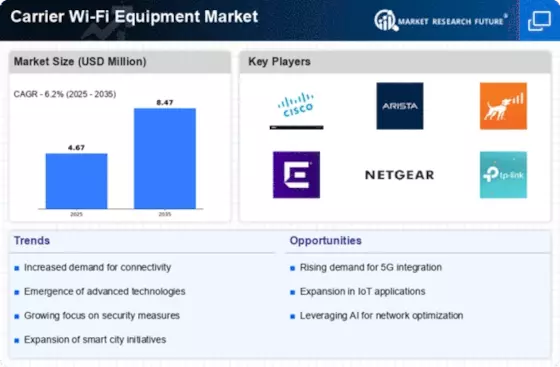
As per MRFR analysis, the Carrier Wi-Fi Equipment Market Size was estimated at 4.4 USD Million in 2024. The Carrier Wi-Fi Equipment industry is projected to grow from 4.64 in 2025 to 8.47 by 2035, exhibiting a compound annual growth rate (CAGR) of 6.2 during the forecast period 2025 - 2035.

Key Market Trends & Highlights

The Carrier Wi-Fi Equipment Market is poised for substantial growth driven by technological advancements and increasing connectivity demands.

  • The integration of advanced technologies is reshaping the Carrier Wi-Fi Equipment landscape, particularly in North America.
  • Cloud-based solutions are gaining traction, reflecting a shift in operational paradigms across the Asia-Pacific region.
  • The growing demand for IoT connectivity is influencing market dynamics, especially within the residential segment.
  • Key market drivers include the increasing demand for high-speed internet and the expansion of smart cities, which are pivotal in both North America and Asia-Pacific.

Market Size & Forecast

2024 Market Size 4.4 (USD Million)
2035 Market Size 8.47 (USD Million)
CAGR (2025 - 2035) 6.2%
Largest Regional Market Share in 2024 North America

Major Players

<p>Cisco Systems (US), Arista Networks (US), Ruckus Networks (US), Extreme Networks (US), Netgear (US), TP-Link (CN), Huawei Technologies (CN), ZTE Corporation (CN), D-Link Corporation (TW)</p>

Market Trends

The Carrier Wi-Fi Equipment Market is currently experiencing a transformative phase, driven by the increasing demand for high-speed internet connectivity and the proliferation of smart devices. As more consumers and businesses rely on seamless wireless access, the market is adapting to meet these evolving needs. This shift is characterized by advancements in technology, such as the integration of artificial intelligence and machine learning, which enhance network management and optimize performance. Furthermore, the growing emphasis on enhancing user experience is prompting manufacturers to innovate and develop more efficient solutions. In addition, the Carrier Wi-Fi Equipment Market is witnessing a trend towards the deployment of cloud-based solutions. This approach allows for greater scalability and flexibility, enabling service providers to manage their networks more effectively. The rise of Internet of Things (IoT) applications is also influencing the market, as the demand for reliable connectivity continues to surge. Overall, the Carrier Wi-Fi Equipment Market appears poised for substantial growth, as it adapts to the dynamic landscape of digital communication and connectivity.

Integration of Advanced Technologies

The Carrier Wi-Fi Equipment Market is increasingly incorporating advanced technologies such as artificial intelligence and machine learning. These innovations facilitate improved network management, enhance performance, and provide better user experiences. As service providers seek to optimize their offerings, the integration of these technologies is likely to become a standard practice.

Shift Towards Cloud-Based Solutions

A notable trend within the Carrier Wi-Fi Equipment Market is the movement towards cloud-based solutions. This shift allows for enhanced scalability and flexibility, enabling service providers to manage their networks more efficiently. As businesses and consumers demand more reliable connectivity, cloud solutions are expected to play a crucial role in meeting these needs.

Growing Demand for IoT Connectivity

The rise of Internet of Things (IoT) applications is significantly impacting the Carrier Wi-Fi Equipment Market. As the number of connected devices continues to increase, the demand for robust and reliable wireless connectivity is becoming more pronounced. This trend suggests that the market will need to adapt to support the growing ecosystem of IoT devices.

Carrier Wi-Fi Equipment Market Market Drivers

Adoption of 5G Technology

The rollout of 5G technology is poised to have a profound impact on the Carrier Wi-Fi Equipment Market. As 5G networks become more prevalent, they are expected to complement existing Wi-Fi infrastructure, providing enhanced connectivity options for users. The integration of 5G with Wi-Fi networks can potentially improve overall network performance, enabling faster data transfer rates and reduced latency. Industry forecasts suggest that the global 5G services market could reach hundreds of billions of dollars by the end of the decade. This growth indicates a strong demand for Carrier Wi-Fi equipment that can seamlessly integrate with 5G technology, allowing service providers to offer superior connectivity solutions. As a result, the Carrier Wi-Fi Equipment Market is likely to evolve in response to the advancements in mobile network technology.

Expansion of Smart Cities

The development of smart cities is significantly influencing the Carrier Wi-Fi Equipment Market. As urban areas increasingly integrate technology to improve infrastructure and services, the demand for robust Wi-Fi networks is escalating. Smart city initiatives often rely on interconnected devices and real-time data sharing, necessitating reliable and extensive Wi-Fi coverage. Reports indicate that investments in smart city projects are projected to reach trillions of dollars over the next decade, creating a substantial market for Carrier Wi-Fi equipment. This trend suggests that municipalities and service providers will prioritize the deployment of advanced Wi-Fi solutions to support smart applications, such as traffic management and public safety systems. Thus, the Carrier Wi-Fi Equipment Market stands to benefit from the ongoing urbanization and technological advancements associated with smart city developments.

Rise of Mobile Data Consumption

The Carrier Wi-Fi Equipment Market is being propelled by the increasing consumption of mobile data. With the proliferation of smartphones and mobile devices, users are consuming more data than ever before. Recent statistics reveal that mobile data traffic is expected to grow exponentially, potentially reaching over 77 exabytes per month by 2025. This surge in mobile data usage is prompting service providers to enhance their Wi-Fi infrastructure to accommodate the growing demand. As users seek seamless connectivity in various environments, including public spaces and commercial establishments, the need for Carrier Wi-Fi solutions becomes critical. Consequently, the Carrier Wi-Fi Equipment Market is likely to witness significant growth as operators invest in technologies that can support high-density environments and deliver consistent performance.

Increased Focus on Network Security

The Carrier Wi-Fi Equipment Market is witnessing a heightened emphasis on network security. As cyber threats become more sophisticated, service providers are compelled to invest in secure Wi-Fi solutions to protect user data and maintain trust. Recent studies indicate that a significant percentage of organizations have experienced security breaches, underscoring the need for robust security measures in Wi-Fi networks. This trend is likely to drive demand for Carrier Wi-Fi equipment that incorporates advanced security features, such as encryption and authentication protocols. Furthermore, regulatory requirements regarding data protection are becoming more stringent, prompting operators to prioritize security in their network deployments. Consequently, the Carrier Wi-Fi Equipment Market is expected to grow as companies seek to enhance their security posture in an increasingly digital landscape.

Increasing Demand for High-Speed Internet

The Carrier Wi-Fi Equipment Market is experiencing a surge in demand for high-speed internet connectivity. As consumers and businesses alike seek faster and more reliable internet services, the need for advanced Wi-Fi solutions becomes paramount. According to recent data, the number of internet users has reached approximately 5 billion, indicating a growing reliance on digital services. This trend is likely to drive investments in Carrier Wi-Fi equipment, as service providers aim to enhance their infrastructure to meet user expectations. Furthermore, the proliferation of streaming services and online gaming is pushing the boundaries of bandwidth requirements, compelling operators to adopt cutting-edge Wi-Fi technologies. Consequently, the Carrier Wi-Fi Equipment Market is poised for substantial growth as it adapts to these evolving consumer demands.

Market Segment Insights

By Application: Public Wi-Fi (Largest) vs. Private Wi-Fi (Fastest-Growing)

<p>The Carrier Wi-Fi Equipment Market is primarily segmented into Public Wi-Fi, Private Wi-Fi, Enterprise Wi-Fi, and Hotspot Wi-Fi applications. Public Wi-Fi continues to dominate the market due to the increasing demand for internet accessibility in public areas such as parks, cafes, and shopping malls. This segment holds the highest market share, driven by consumer demand for connectivity on-the-go. Meanwhile, Private Wi-Fi is emerging as the fastest-growing segment, fueled by the rising trends of remote work and personalized internet solutions in homes and small businesses.</p>

<p>Public Wi-Fi (Dominant) vs. Private Wi-Fi (Emerging)</p>

<p>Public Wi-Fi plays a significant role in enhancing urban connectivity, providing users with seamless internet access in various public spaces. It caters to a wide demographic, including tourists and locals who require mobile connectivity for different online services. On the other hand, Private Wi-Fi is gaining traction as an emerging solution tailored for individual and organizational needs. The increasing number of remote workers and the essential need for reliable home connections have spurred investments in Private Wi-Fi infrastructure, positioning it as a vital segment within the Carrier Wi-Fi Equipment Market.</p>

By End Use: Telecommunications (Largest) vs. Hospitality (Fastest-Growing)

<p>In the Carrier Wi-Fi Equipment Market, the end-use segment delineates distinct areas where demand is arguably the highest. Telecommunications stands out as the largest segment, reflecting a significant commitment to enhanced connectivity and efficiency in communication networks. Meanwhile, the Hospitality sector is gaining traction as a rapidly evolving segment, driven by the need for seamless internet access in hotels, restaurants, and other accommodation services. As businesses in this sector prioritize guest experience, the demand for advanced Carrier Wi-Fi solutions continues to surge. Growth trends in this segment are influenced by a variety of factors, including increased mobile data consumption, the proliferation of smart devices, and a growing emphasis on enhanced customer experiences. The Telecommunications sector benefits from established infrastructure and ongoing upgrades, which facilitate expansive network capabilities. Conversely, the Hospitality industry's rapid adoption of Wi-Fi solutions signifies a shift towards greater consumer connectivity, aligning service provision with the digital lifestyle expectations of guests, creating a vibrant growth landscape for Carrier Wi-Fi equipment.</p>

<p>Telecommunications (Dominant) vs. Hospitality (Emerging)</p>

<p>The Telecommunications segment is characterized by its robust infrastructure and long-standing investment in network capabilities, making it the dominant force in the Carrier Wi-Fi Equipment Market. This segment encompasses mobile carriers and internet service providers focused on delivering high-speed internet solutions to meet the ever-increasing demand for data bandwidth. In contrast, the Hospitality sector is emerging as a significant player, where the demand for Carrier Wi-Fi equipment is propelled by the industry's need for reliable connectivity to enhance guest experience. Properties are increasingly integrating Wi-Fi into their service offerings, necessitating dedicated network solutions that ensure uninterrupted service. This evolution highlights the interplay between established market leaders and innovative adapters, driving competition and development in Wi-Fi technology.</p>

By Technology: 802.11ac (Largest) vs. 802.11ax (Fastest-Growing)

<p>In the Carrier Wi-Fi Equipment Market, the segment distribution reveals that 802.11ac technology dominates with a significant share, offering a reliable standard for high-throughput wireless connections. In contrast, 802.11ax is gaining traction rapidly and is positioned as the fastest-growing technology, fueled by the increasing demand for higher capacity and performance in crowded environments. The mesh networking solutions are also contributing to the diversifying technology landscape, allowing scalable and flexible deployments for expansive coverage.</p>

<p>Technology: 802.11ac (Dominant) vs. 802.11ax (Emerging)</p>

<p>802.11ac technology has established itself as a dominant force within the Carrier Wi-Fi Equipment Market due to its capability to support multiple devices simultaneously while maintaining robust connectivity. Its widespread adoption across various sectors fortifies its market position. Meanwhile, 802.11ax, recognized as an emerging technology, is on the rise as industry players increasingly prioritize enhanced performance and efficiency. With features such as OFDMA and MU-MIMO, 802.11ax caters to the demands of modern applications, making it a game-changer for future wireless connectivity solutions.</p>

By Deployment Type: Indoor (Largest) vs. Outdoor (Fastest-Growing)

<p>In the Carrier Wi-Fi Equipment Market, the deployment type segment is crucial, with Indoor deployment accounting for the largest share due to its widespread adoption in urban areas and densely populated spaces. Businesses and providers are increasingly opting for Indoor solutions, reflecting the growing demand for high-capacity connectivity in environments like offices, schools, and shopping centers. Outdoor deployment, although smaller in share, is rapidly gaining traction and is now recognized as the fastest-growing segment, driven by the increasing need for coverage in expansive areas such as parks, stadiums, and event venues.</p>

<p>Indoor (Dominant) vs. Outdoor (Emerging)</p>

<p>Indoor deployment in the Carrier Wi-Fi Equipment Market is characterized by its strong foothold in urban settings where high-density traffic and user density are prevalent. This type of deployment leverages access points placed strategically indoors, ensuring connectivity in environments like malls and transport hubs. Meanwhile, Outdoor deployment emerges as a key player focusing on expanding coverage in less dense areas where robust connectivity is necessary. The trend towards outdoor networks is facilitated by advancements in technology that cater to outdoor environments, enabling users in public areas and community spaces to enjoy reliable Wi-Fi services. As such, Indoor technology remains dominant, while Outdoor rapidly emerges as a vital component of future deployments.</p>

By User Type: Residential (Largest) vs. Commercial (Fastest-Growing)

<p>In the Carrier Wi-Fi Equipment Market, the user type segment is primarily dominated by the Residential sector, which holds the largest market share. The expansion of smart homes and increased reliance on high-speed internet for everyday activities have fueled the demand in this segment. Meanwhile, the Commercial segment follows closely, as businesses seek to improve connectivity and cater to remote work requirements. Factors such as increased digital transformation and the need for robust network infrastructure have further spurred growth in this sector. The Government segment, while relatively smaller, is witnessing gradual growth as public institutions invest in modernizing their IT infrastructure. This sector is being driven by the need for enhanced public services and the implementation of smart city initiatives. Overall, the growth trends indicate a diversifying demand for Carrier Wi-Fi Equipment across different user types, with innovations and technological advancements playing a key role in shaping the market landscape.</p>

<p>User Type: Residential (Dominant) vs. Government (Emerging)</p>

<p>The Residential segment in the Carrier Wi-Fi Equipment Market stands as the dominant force due to the rapid adoption of smart home technologies and increasing internet usage among consumers. Households are now seeking reliable and high-speed connectivity solutions that cater to multiple devices. In contrast, the Government segment is categorized as an emerging player with growth potential. This segment is characterized by investments in advanced network solutions that support public sector operations and improve service delivery. With initiatives aimed at broadening internet access and enhancing digital infrastructure, government entities are gradually recognizing the importance of robust Wi-Fi solutions. As such, while Residential remains a stronghold, Government is poised to become a significant segment in the coming years.</p>

Get more detailed insights about Carrier Wi-Fi Equipment Market Research Report - Global Forecast to 2035

Regional Insights

North America : Market Leader in Technology

North America continues to lead the Carrier Wi-Fi Equipment market, holding a significant share of 2.2 billion in 2024. The region's growth is driven by increasing demand for high-speed internet and the proliferation of smart devices. Regulatory support for broadband expansion and investment in 5G infrastructure further catalyze market growth. The focus on enhancing connectivity in urban and rural areas is also a key driver, ensuring that the region remains at the forefront of technological advancements. The competitive landscape in North America is robust, featuring key players such as Cisco Systems, Arista Networks, and Ruckus Networks. These companies are investing heavily in R&D to innovate and improve their offerings. The presence of established firms alongside emerging startups fosters a dynamic environment, ensuring that North America remains a hub for cutting-edge Carrier Wi-Fi solutions. The region's market is characterized by a strong emphasis on quality and reliability, appealing to both consumers and businesses alike.

Europe : Emerging Market with Potential

Europe is witnessing a growing demand for Carrier Wi-Fi Equipment, with a market size of 1.2 billion in 2024. The region's growth is fueled by increasing internet penetration and the need for enhanced connectivity solutions. Regulatory initiatives aimed at improving digital infrastructure and promoting competition among service providers are significant catalysts for market expansion. The European Union's focus on digital transformation is also driving investments in Wi-Fi technology, making it a key player in the global market. Leading countries in Europe include Germany, the UK, and France, where major players like Cisco and TP-Link are actively competing. The competitive landscape is characterized by a mix of established companies and innovative startups, fostering a vibrant ecosystem. The presence of regulatory bodies ensures compliance and encourages investment in advanced technologies, positioning Europe as a promising market for Carrier Wi-Fi Equipment. "The European Commission aims to ensure that all citizens have access to high-speed internet by 2025," states a recent EU report.

Asia-Pacific : Rapidly Growing Market

The Asia-Pacific region is emerging as a significant player in the Carrier Wi-Fi Equipment market, with a market size of 0.8 billion in 2024. The growth is driven by rapid urbanization, increasing smartphone penetration, and the rising demand for high-speed internet services. Governments in countries like China and India are investing heavily in digital infrastructure, which acts as a catalyst for market growth. Regulatory frameworks are evolving to support the expansion of Wi-Fi networks, enhancing connectivity across urban and rural areas. Key players in the Asia-Pacific market include Huawei Technologies and ZTE Corporation, which are leading the charge in providing innovative solutions. The competitive landscape is marked by intense rivalry, with both local and international companies vying for market share. The region's diverse consumer base and varying regulatory environments present both challenges and opportunities for growth, making it a dynamic market for Carrier Wi-Fi Equipment.

Middle East and Africa : Emerging Opportunities Ahead

The Middle East and Africa region is in the nascent stages of developing its Carrier Wi-Fi Equipment market, currently valued at 0.2 billion in 2024. The growth is primarily driven by increasing mobile internet usage and the need for improved connectivity solutions. Governments are recognizing the importance of digital infrastructure, leading to regulatory initiatives aimed at enhancing broadband access. Investments in technology and infrastructure are expected to rise, creating opportunities for market players. Countries like South Africa and the UAE are at the forefront of this development, with local and international companies exploring opportunities in the region. The competitive landscape is gradually evolving, with key players beginning to establish a presence. As the demand for reliable internet services grows, the Middle East and Africa are poised for significant advancements in Carrier Wi-Fi technology, making it an attractive market for investment.

Key Players and Competitive Insights

The Carrier Wi-Fi Equipment Market is currently characterized by a dynamic competitive landscape, driven by the increasing demand for high-speed internet connectivity and the proliferation of smart devices. Major players such as Cisco Systems (US), Huawei Technologies (CN), and Ruckus Networks (US) are strategically positioning themselves through innovation and partnerships. Cisco Systems (US) focuses on enhancing its product portfolio with advanced security features, while Huawei Technologies (CN) emphasizes its global reach and cost-effective solutions. Ruckus Networks (US) is leveraging its expertise in cloud-managed Wi-Fi to cater to the growing needs of enterprises, thereby shaping a competitive environment that prioritizes technological advancement and customer-centric solutions.

In terms of business tactics, companies are increasingly localizing manufacturing and optimizing supply chains to enhance operational efficiency. The market appears moderately fragmented, with several key players exerting influence over various segments. This fragmentation allows for a diverse range of offerings, catering to different customer needs and preferences, while also fostering competition that drives innovation.

In January 2026, Cisco Systems (US) announced a strategic partnership with a leading telecommunications provider to enhance its Wi-Fi 6 solutions, aiming to improve network performance in urban areas. This collaboration is likely to bolster Cisco's market presence and address the growing demand for reliable connectivity in densely populated regions. The partnership underscores Cisco's commitment to innovation and its proactive approach to meeting customer needs in an evolving market.

In December 2025, Huawei Technologies (CN) launched a new line of Wi-Fi 6E products designed for high-density environments, such as stadiums and airports. This launch is significant as it positions Huawei to capture a larger share of the market, particularly in sectors that require robust connectivity solutions. The introduction of these products reflects Huawei's focus on technological advancement and its ability to respond to emerging market demands.

In November 2025, Ruckus Networks (US) expanded its cloud-managed Wi-Fi offerings by integrating AI-driven analytics to optimize network performance. This strategic move is indicative of Ruckus's commitment to leveraging technology to enhance user experience and operational efficiency. By incorporating AI, Ruckus aims to differentiate itself in a competitive landscape increasingly focused on smart solutions.

As of February 2026, current trends in the Carrier Wi-Fi Equipment Market include a strong emphasis on digitalization, sustainability, and AI integration. Strategic alliances are becoming increasingly pivotal, as companies seek to enhance their technological capabilities and market reach. The competitive differentiation is likely to evolve from traditional price-based competition to a focus on innovation, technology, and supply chain reliability, suggesting a shift towards more sustainable and technologically advanced solutions.

Key Companies in the Carrier Wi-Fi Equipment Market include

Industry Developments

Brocade Communications and Huawei Technologies Co. are two prominent carrier WiFi equipment providers at the forefront of the market. Due to an increase in the deployment of 4G dual-mode small cells and WiFi access points, anticipated revenue growth is likely to improve shortly.

Future Outlook

Carrier Wi-Fi Equipment Market Future Outlook

The Carrier Wi-Fi Equipment Market is projected to grow at a 6.2% CAGR from 2024 to 2035, driven by increasing demand for high-speed connectivity and the expansion of smart devices.

New opportunities lie in:

  • Development of advanced mesh networking solutions for urban areas.
  • Integration of AI-driven analytics for network optimization.
  • Expansion into emerging markets with tailored Wi-Fi solutions.

By 2035, the market is expected to be robust, driven by innovation and strategic expansions.

Market Segmentation

Carrier Wi-Fi Equipment Market End Use Outlook

  • Telecommunications
  • Hospitality
  • Retail
  • Transportation

Carrier Wi-Fi Equipment Market User Type Outlook

  • Residential
  • Commercial
  • Government

Carrier Wi-Fi Equipment Market Technology Outlook

  • 802.11ac
  • 802.11ax
  • Mesh Networking
  • Cloud-based Management

Carrier Wi-Fi Equipment Market Application Outlook

  • Public Wi-Fi
  • Private Wi-Fi
  • Enterprise Wi-Fi
  • Hotspot Wi-Fi

Carrier Wi-Fi Equipment Market Deployment Type Outlook

  • Indoor
  • Outdoor
  • Hybrid

Report Scope

MARKET SIZE 20244.4(USD Million)
MARKET SIZE 20254.64(USD Million)
MARKET SIZE 20358.47(USD Million)
COMPOUND ANNUAL GROWTH RATE (CAGR)6.2% (2024 - 2035)
REPORT COVERAGERevenue Forecast, Competitive Landscape, Growth Factors, and Trends
BASE YEAR2024
Market Forecast Period2025 - 2035
Historical Data2019 - 2024
Market Forecast UnitsUSD Million
Key Companies ProfiledCisco Systems (US), Arista Networks (US), Ruckus Networks (US), Extreme Networks (US), Netgear (US), TP-Link (CN), Huawei Technologies (CN), ZTE Corporation (CN), D-Link Corporation (TW)
Segments CoveredApplication, End Use, Technology, Deployment Type, User Type
Key Market OpportunitiesIntegration of advanced security features in Carrier Wi-Fi Equipment to address growing cybersecurity concerns.
Key Market DynamicsRising demand for high-speed connectivity drives innovation and competition in the Carrier Wi-Fi Equipment Market.
Countries CoveredNorth America, Europe, APAC, South America, MEA

FAQs

What is the current valuation of the US carrier Wi-Fi equipment market?

The US carrier Wi-Fi equipment market was valued at 0.748 USD Million in 2024.

What is the projected market valuation for the US carrier Wi-Fi equipment market by 2035?

The market is projected to reach 1.37 USD Million by 2035.

What is the expected CAGR for the US carrier Wi-Fi equipment market during the forecast period?

The expected CAGR for the market from 2025 to 2035 is 5.62%.

Which companies are considered key players in the US carrier Wi-Fi equipment market?

Key players include Cisco Systems, Arista Networks, Juniper Networks, and Hewlett Packard Enterprise.

What are the main application segments in the US carrier Wi-Fi equipment market?

The main application segments include Public Wi-Fi, Private Wi-Fi, Enterprise Wi-Fi, and Hotspot Wi-Fi.

  1. SECTION I: EXECUTIVE SUMMARY AND KEY HIGHLIGHTS |
    1. EXECUTIVE SUMMARY |
      1. Market Overview |
      2. Key Findings |
      3. Market Segmentation |
      4. Competitive Landscape |
      5. Challenges and Opportunities |
      6. Future Outlook 2
  2. SECTION II: SCOPING, METHODOLOGY AND MARKET STRUCTURE |
    1. MARKET INTRODUCTION |
      1. Definition |
      2. Scope of the study |--
    2. RESEARCH METHODOLOGY |
      1. Overview |
      2. Data Mining |
      3. Secondary Research |
      4. Primary Research |--
      5. Forecasting Model |
      6. Market Size Estimation |--
      7. Data Triangulation |
      8. Validation 3
  3. SECTION III: QUALITATIVE ANALYSIS |
    1. MARKET DYNAMICS |
      1. Overview |
      2. Drivers |
      3. Restraints |
      4. Opportunities |
    2. MARKET FACTOR ANALYSIS |
      1. Value chain Analysis |
      2. Porter's Five Forces Analysis |--
      3. COVID-19 Impact Analysis |--
  4. SECTION IV: QUANTITATIVE ANALYSIS |
    1. Information and Communications Technology, BY Application (USD Million) |
      1. Public Wi-Fi |
      2. Private Wi-Fi |
      3. Enterprise Wi-Fi |
      4. Hotspot Wi-Fi |
    2. Information and Communications Technology, BY End Use (USD Million) |
      1. Telecommunications |
      2. Hospitality |
      3. Retail |
      4. Transportation |
    3. Information and Communications Technology, BY Technology (USD Million) |
      1. Mesh Networking |
      2. Cloud-based Management |
    4. 802.11ac |
    5. 802.11ax |
    6. Information and Communications Technology, BY Deployment Type (USD Million) |
      1. Indoor |
      2. Outdoor |
      3. Hybrid |
    7. Information and Communications Technology, BY Component (USD Million) |
      1. Access Points |
      2. Controllers |
      3. Antennas |
      4. Switches |
    8. Information and Communications Technology, BY Region (USD Million) |
      1. North America |--
      2. Europe |--
      3. APAC |--
      4. South America |--
      5. MEA |--
  5. SECTION V: COMPETITIVE ANALYSIS |
    1. Competitive Landscape |
      1. Overview |
      2. Competitive Analysis |
      3. Market share Analysis |
      4. Major Growth Strategy in the Information and Communications Technology |
      5. Competitive Benchmarking |
      6. Leading Players in Terms of Number of Developments in the Information and Communications Technology |
      7. Key developments and growth strategies |--
      8. Major Players Financial Matrix |--
    2. Company Profiles |
      1. Cisco Systems (US) |--
      2. Aruba Networks (US) |--
      3. Ruckus Wireless (US) |--
      4. Extreme Networks (US) |--
      5. Netgear (US) |--
      6. Ubiquiti Networks (US) |--
      7. TP-Link (CN) |--
      8. Huawei Technologies (CN) |--
      9. ZTE Corporation (CN) |--
    3. Appendix |
      1. References |
      2. Related Reports

Information and Communications Technology Market Segmentation

Information and Communications Technology By Application (USD Million, 2025-2035)

  • Public Wi-Fi
  • Private Wi-Fi
  • Enterprise Wi-Fi
  • Hotspot Wi-Fi

Information and Communications Technology By End Use (USD Million, 2025-2035)

  • Telecommunications
  • Hospitality
  • Retail
  • Transportation

Information and Communications Technology By Technology (USD Million, 2025-2035)

  • 802.11ac
  • 802.11ax
  • Mesh Networking
  • Cloud-based Management

Information and Communications Technology By Deployment Type (USD Million, 2025-2035)

  • Indoor
  • Outdoor
  • Hybrid

Information and Communications Technology By Component (USD Million, 2025-2035)

  • Access Points
  • Controllers
  • Antennas
  • Switches
Infographic

Free Sample Request

Kindly complete the form below to receive a free sample of this Report

Get Free Sample

Customer Strories

Compare Licence

×
Features License Type
Single User Multiuser License Enterprise User
Price $4,950 $5,950 $7,250
Maximum User Access Limit 1 User Upto 10 Users Unrestricted Access Throughout the Organization
Free Customization
Direct Access to Analyst
Deliverable Format
Platform Access
Discount on Next Purchase 10% 15% 15%
Printable Versions