×
Request Free Sample ×

Kindly complete the form below to receive a free sample of this Report

* Please use a valid business email

Leading companies partner with us for data-driven Insights

clients tt-cursor
Hero Background
English
Chinese
French
Japanese
Korean
German
Spanish

Canned Seafood Market Size

ID: MRFR/FnB/5240-HCR
128 Pages
Pradeep Nandi
February 2026

Canned Seafood Market Size, Share, Industry Trend & Analysis Research Report: By Product Type (Canned Fish, Canned Shellfish, Canned Seafood Mix), By Distribution Channel (Supermarkets, Online Retail, Convenience Stores, Specialty Stores), By End Use (Household, Food Service, Catering), By Packaging Type (Easy Open Cans, Standard Cans, Glass Jars) andBy Regional (North America, Europe, South America, Asia Pacific, Middle East and Africa)- Forecast to 2035

Share:
Download PDF ×

We do not share your information with anyone. However, we may send you emails based on your report interest from time to time. You may contact us at any time to opt-out.

Canned Seafood Market Infographic
Purchase Options

Canned Seafood Size

Canned Seafood Market Growth Projections and Opportunities

Numerous market factors drive the dynamics of the canned seafood industry, meeting the varying demands and tastes of customers around the globe. The worldwide seafood supply, which is inevitably influenced by elements including fishing methods, aquaculture, and environmental circumstances, is one important consideration. The availability of essential seafood components for canned goods may be impacted by fluctuations in fish stocks brought on by causes such as overfishing or climate change. As customers grow more environmentally concerned, sustainable and responsible sourcing techniques are becoming more and more popular, which is changing the trajectory of the industry. Consumer lifestyle decisions and preferences have a major role in shaping canned seafood market dynamics. Because canned fish has a lengthy shelf life and is easily accessible, it provides convenience that meets the needs of contemporary. The industry is also being driven by the increased knowledge of the health advantages of eating seafood, which is high in omega-3 fatty acids and other minerals. Canned fish is a popular choice among consumers looking for quick, high-protein solutions, which helps to maintain market demand. The macro and microeconomic elements that influence the canned seafood business are quite important. Global economic fluctuations can affect disposable income, which in turn affects consumers' purchasing power and preferences. In addition, costs associated with shipping, processing, and raw materials have an impact on the price of canned fish products. The general price and competitiveness of canned fish on the market can be impacted by changes in currency exchange rates and economic stability. The competitive environment and industry structure are essential market elements that influence pricing policies, market share dynamics, and innovation. Leading companies in the canned fish industry consistently allocate resources towards research and development in order to provide novel goods, tastes, and innovative packaging. In order to fulfill the demands of an informed customer base, organizations must prioritize quality assurance and transparent labeling. Brand loyalty and consumer trust are critical in this competitive market.
Canned Seafood Market Size Graph
Author
Pradeep Nandi
Senior Research Analyst

I have a bachelor's degree in mechanical engineering and an MBA. I have more than two years of expertise in the retail, food, and beverage, chemical, and material industries, and hence have developed a sound cross-domain expertise. A firm believer in lifelong learning and sharing of knowledge. Having a proclivity for hatching ideas and trying to absorb as much information as possible in a short amount of time. Introducing corporates to the data and insight, which enables them to move from probability to possibility, has been my key areas of interest. 

Leave a Comment

FAQs

What is the projected market valuation of the canned seafood market by 2035?

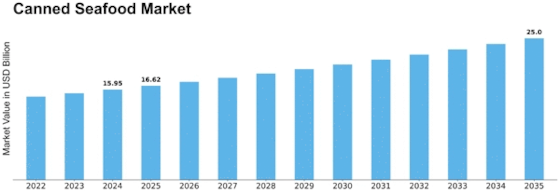
The canned seafood market is projected to reach a valuation of 25.0 USD Billion by 2035.

What was the market valuation of the canned seafood market in 2024?

In 2024, the overall market valuation of the canned seafood market was 15.95 USD Billion.

What is the expected CAGR for the canned seafood market during the forecast period 2025 - 2035?

The expected CAGR for the canned seafood market during the forecast period 2025 - 2035 is 4.17%.

Which segment of canned seafood is projected to have the highest growth by 2035?

The canned fish segment is projected to grow from 7.5 USD Billion in 2024 to 12.0 USD Billion by 2035.

How do distribution channels impact the canned seafood market?

Supermarkets are expected to dominate the distribution channel, growing from 8.0 USD Billion in 2024 to 12.0 USD Billion by 2035.

What are the key players in the canned seafood market?

Key players in the canned seafood market include Thai Union Group, Maruha Nichiro Corporation, and Dongwon Industries.

What is the projected growth for canned shellfish by 2035?

Canned shellfish is projected to grow from 4.0 USD Billion in 2024 to 6.0 USD Billion by 2035.

What is the expected market size for online retail in the canned seafood sector by 2035?

The online retail segment is expected to grow from 2.5 USD Billion in 2024 to 5.0 USD Billion by 2035.

How does the packaging type influence the canned seafood market?

Easy open cans are projected to increase from 5.0 USD Billion in 2024 to 8.0 USD Billion by 2035.

What end-use segment shows promising growth in the canned seafood market?

The household end-use segment is expected to grow from 7.5 USD Billion in 2024 to 12.0 USD Billion by 2035.

Market Summary

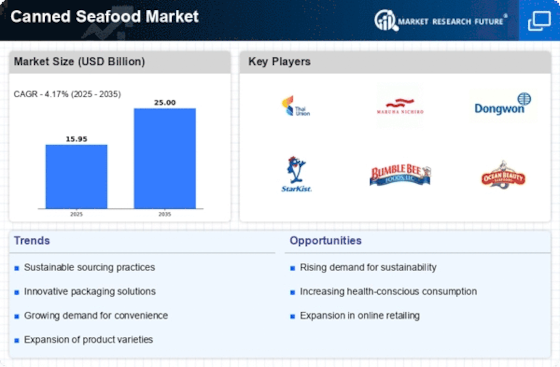
As per Market Research Future analysis, the Canned Seafood Market Size was estimated at 15.95 USD Billion in 2024. The Canned Seafood industry is projected to grow from 16.62 USD Billion in 2025 to 25.0 USD Billion by 2035, exhibiting a compound annual growth rate (CAGR) of 4.17% during the forecast period 2025 - 2035. This growth outlook is supported by rising canned seafood market revenue generated across household and food service segments, as highlighted in the Canned Seafood market analysis.

Key Market Trends & Highlights

The Canned Seafood Market is experiencing a dynamic shift towards health-conscious and sustainable consumption patterns.

  • The North American market remains the largest, driven by a strong focus on health and wellness among consumers. In the Asia-Pacific region, the canned seafood market is the fastest-growing, reflecting increasing urbanization and changing dietary preferences. Canned fish continues to dominate the market, while canned shellfish is emerging as the fastest-growing segment due to rising consumer interest in diverse seafood options. Key market drivers include the rising demand for convenient food options and growing awareness of nutritional benefits, particularly in online retail channels.

Market Size & Forecast

2024 Market Size 15.95 (USD Billion)
2035 Market Size 25.0 (USD Billion)
CAGR (2025 - 2035) 4.17%
Largest Regional Market Share in 2024 North America

Major Players

Thai Union Group (TH), <a href="https://www.maruha-nichiro.com/what_we_do/foodprocessing.html">Maruha Nichiro Corporation (JP)</a>, Dongwon Industries (KR), Starkist Co. (US), Bumble Bee Foods (US), Ocean Beauty Seafoods (US), Crown Prince, Inc. (US), Glenryck (GB)

Market Trends

The canned seafood Market is currently experiencing a dynamic evolution, driven by shifting consumer preferences and increasing awareness of health benefits associated with seafood consumption. Key canned seafood market trends include rising demand for convenient, nutritious food options and growing interest in shelf-stable protein sources. As individuals become more health-conscious, the demand for canned seafood continues to support overall canned seafood market revenue growth. Additionally, the growing trend of sustainable sourcing is influencing purchasing decisions, shaping long-term canned seafood market trends related to eco-friendly packaging and responsible fishing practices. These factors collectively strengthen the outlook presented in the canned seafood market analysis.

Moreover, the Canned Seafood Market is likely to witness innovations in product offerings, with manufacturers exploring diverse flavors and unique recipes to attract a broader audience. The introduction of gourmet options and premium products could cater to discerning consumers looking for elevated culinary experiences. Furthermore, the rise of online shopping platforms is transforming distribution channels, making it easier for consumers to access a variety of canned seafood products. As the market continues to adapt to these evolving trends, it seems poised for growth, reflecting the changing landscape of consumer behavior and preferences in the food sector.

Health and Wellness Focus

The emphasis on health and wellness is reshaping the Canned Seafood Market. Consumers are increasingly seeking nutritious options that contribute to a balanced diet, leading to heightened interest in seafood products known for their omega-3 fatty acids and protein content.

Sustainability and Ethical Sourcing

Sustainability is becoming a pivotal factor in consumer choices within the Canned Seafood Market. There is a growing preference for products that are sourced responsibly, prompting manufacturers to adopt eco-friendly practices and transparent supply chains.

Innovative Product Development

Innovation is driving the Canned Seafood Market forward, with manufacturers exploring new flavors and gourmet offerings. This trend aims to attract a wider audience, catering to consumers who desire unique culinary experiences and premium quality.

Canned Seafood Market Market Drivers

Sustainability Trends in Food Production

The Canned Seafood Market is significantly influenced by sustainability trends in food production. As consumers become more environmentally conscious, there is a growing demand for sustainably sourced seafood. Canned seafood brands that prioritize ethical fishing practices and eco-friendly packaging are likely to attract a loyal customer base. Recent reports suggest that a substantial percentage of consumers are willing to pay a premium for products that align with their values regarding sustainability. This shift towards responsible consumption is reshaping the Canned Seafood Market, as companies adapt their sourcing and production methods to meet these expectations. The emphasis on sustainability not only enhances brand reputation but also contributes to the long-term viability of seafood resources.

Expansion of E-commerce and Online Retail

The Canned Seafood Market is experiencing a transformation due to the expansion of e-commerce and online retail platforms. With the increasing prevalence of online shopping, consumers are more inclined to purchase canned seafood through digital channels. This trend is supported by the convenience and accessibility that online shopping offers, allowing consumers to explore a wider variety of products. Recent data indicates that online grocery sales are on the rise, with canned goods being a popular category. As retailers enhance their online presence and offer home delivery options, the Canned Seafood Market is likely to see a boost in sales. This shift not only caters to changing consumer preferences but also opens new avenues for market growth.

Growing Awareness of Nutritional Benefits

The Canned Seafood Market is witnessing a surge in consumer awareness regarding the nutritional benefits of seafood. Rich in omega-3 fatty acids, protein, and essential vitamins, canned seafood is increasingly recognized as a healthy dietary choice. Recent studies indicate that seafood consumption is linked to various health benefits, including improved heart health and cognitive function. As health-conscious consumers seek nutritious food options, the demand for canned seafood is likely to rise. This trend is further supported by dietary guidelines that recommend regular seafood consumption. Consequently, the Canned Seafood Market stands to gain from this heightened focus on health and nutrition, appealing to a demographic that prioritizes wellness in their food choices.

Rising Demand for Convenient Food Options

The Canned Seafood Market experiences a notable increase in demand for convenient food options. As lifestyles become busier, consumers seek ready-to-eat meals that require minimal preparation. Canned seafood, with its long shelf life and ease of use, fits perfectly into this trend. According to recent data, the convenience food sector is projected to grow significantly, with canned seafood being a key player. This shift towards convenience is likely to drive sales, as consumers prioritize quick meal solutions without compromising on nutrition. The Canned Seafood Market is thus positioned to benefit from this evolving consumer behavior, as it aligns with the growing preference for hassle-free dining experiences.

Innovative Product Offerings and Flavor Profiles

The Canned Seafood Market is characterized by innovative product offerings and diverse flavor profiles. As consumer palates evolve, there is a growing demand for unique and gourmet canned seafood options. Manufacturers are responding by introducing new flavors, such as spicy, smoked, or infused varieties, which appeal to adventurous eaters. This trend is supported by Market Research Future indicating that consumers are increasingly seeking out premium and artisanal products. The introduction of innovative packaging and ready-to-eat meal solutions further enhances the appeal of canned seafood. As a result, the Canned Seafood Market is likely to benefit from this trend, attracting a broader audience and encouraging repeat purchases.

Market Segment Insights

By Type: Canned Fish (Largest) vs. Canned Shellfish (Fastest-Growing)

The canned seafood market is primarily dominated by canned fish, which holds the largest canned seafood market share among its segment counterparts. This dominance contributes significantly to total canned seafood market revenue, supported by widespread consumer acceptance and versatility. This dominance is underpinned by the broad consumer base that prefers canned fish for its flavor, nutritional benefits, and versatility in cooking. Canned fish products include a variety of species such as tuna, salmon, and sardines. These products cater to different culinary preferences and are widely recognized as healthy, convenient options for consumers, solidifying their position in the market. On the other hand, canned shellfish is emerging as the fastest-growing segment within the canned seafood market. The increasing popularity of gourmet cooking and seafood dishes has significantly driven the demand for canned shellfish. Consumers are becoming more adventurous in their culinary pursuits, leading to a rise in the consumption of products like canned clams and mussels. The growing awareness of the health benefits associated with shellfish, combined with convenience, is influencing this growth trend.

Canned Fish (Dominant) vs. Canned Seafood Market Mix (Emerging)

Canned fish remains the dominant force in the canned seafood market, celebrated for its rich flavor and high protein content. This category encompasses a wide range of products that appeal to various consumer preferences, making it a staple in many households. Its strong market presence is aided by established brands that offer quality assurances and a loyal customer base. Conversely, the canned seafood mix represents an emerging segment that appeals to consumers seeking variety and versatility in their seafood options. This category includes mixtures of different fish and shellfish, catering to the growing trend of fusion cuisine. As consumers become more health-conscious and experiment with diverse flavors, the demand for canned seafood mixes is expected to rise, creating new opportunities in the market.

By Distribution Channel: Supermarkets (Largest) vs. Online Retail (Fastest-Growing)

In the Canned Seafood Market, Supermarkets dominate the distribution channel segment with the largest market share, serving as the primary shopping destination for consumers due to their wide product selection and accessibility. Online Retail follows closely, gaining traction as an emerging channel, particularly during the pandemic, attracting tech-savvy consumers seeking convenience and variety in canned seafood options.

Supermarkets (Dominant) vs. Online Retail (Emerging)

Supermarkets are the dominant force in the Canned Seafood Market, appealing to a broad range of consumers by offering a vast array of products at competitive prices. Their physical presence coupled with extensive advertising and promotions ensures high visibility and accessibility, making them the preferred choice for many. Conversely, Online Retail is emerging as a significant player, driven by changing shopping habits and technological advancements. Consumers appreciate the convenience and efficiency of shopping online, coupled with the opportunity to discover new brands and products, paving the way for increased market share in the future.

By End Use: Household (Largest) vs. Food Service (Fastest-Growing)

In the Canned Seafood Market, the end-use segments reflect a diverse distribution of demand. The Household segment emerges as the largest, driven by a growing preference for convenient meal options among consumers. This segment benefits from increased home cooking trends and the rising popularity of canned seafood as a long-lasting pantry staple. In contrast, the Food Service segment, while smaller, is experiencing the fastest growth, attributed to the resurgence of the restaurant industry and expanding culinary uses of canned seafood products such as salads, appetizers, and sushi.

Household (Dominant) vs. Food Service (Emerging)

The Household segment dominates the canned seafood market, characterized by a strong consumer base that prioritizes convenience and versatility. Households value the ready-to-eat nature of canned seafood, which supports both quick meals and elaborate dishes. Meanwhile, the Food Service segment represents an emerging market with significant growth potential, as restaurants and <a href="https://www.marketresearchfuture.com/reports/catering-services-market-23311" target="_blank" rel="noopener">catering services</a> increasingly incorporate canned seafood into their menus. This segment caters to evolving culinary trends, with chefs seeking innovative and sustainable ingredients, thus enhancing the appeal of canned seafood in both casual dining and gourmet settings.

By Packaging Type: Easy Open Cans (Largest) vs. Standard Cans (Fastest-Growing)

In the Canned Seafood Market, packaging types play a crucial role in consumer choice and market segmentation. Easy Open Cans currently hold the largest market share, driven by consumer preferences for convenience and ease of use. Standard Cans also contribute significantly to the market; however, their share is gradually being eclipsed by the growing popularity of Easy Open Cans. Glass Jars serve a niche market segment that appeals primarily to high-end seafood products, but they do not compete directly with the larger market segments.

Easy Open Cans (Dominant) vs. Standard Cans (Emerging)

Easy Open Cans are leading the Canned Seafood Market due to their user-friendly design, making them particularly appealing to busy consumers who prioritize convenience in meal preparation. Their dominance is supported by significant innovations in packaging technology and increasing consumer demand for ready-to-eat seafood solutions. On the other hand, Standard Cans are emerging as a reliable option, gaining traction through competitive pricing and wider availability. While they are traditionally viewed as a more basic packaging option, their resurgence is linked to the growing appreciation for classic canned goods, particularly among environmentally conscious consumers seeking recyclable packaging options.

Get more detailed insights about Canned Seafood Market Research Report - Forecast till 2035

Regional Insights

The Canned Seafood Market is experiencing substantial regional growth, with North America leading the market, valued at 5.0 USD Billion in 2024, projected to reach 8.0 USD Billion by 2035. this dominance reflects a strong regional canned seafood market share, driven by high consumption rates and an advanced distribution network. Europe and APAC also contribute meaningfully to global canned seafood market revenue, as outlined in this canned seafood market report.

The APAC region, valued at 3.5 USD Billion in 2024 and expected to reach 6.5 USD Billion by 2035, showcases a growing demand driven by rising urbanization and a shift towards ready-to-eat food options.South America and the Middle East and Africa (MEA) present a mixed picture, with South America anticipated to grow from 2.0 USD Billion in 2024 to 3.0 USD Billion, while the MEA region shows a decrease to 1.5 USD Billion by 2035 from a valuation of 1.95 USD Billion.

This varying growth indicates the unique market dynamics and potential in each region for the Canned Seafood Market industry, driven by changing consumption habits and increasing shelf-stable food demand.

Source Primary Research, Secondary Research, Market Research Future Database and Analyst Review

Key Players and Competitive Insights

The competitive landscape of the Canned Seafood Market is characterized by a range of prominent players who are vying to capture significant market share. This sector has seen a dynamic evolution driven by rising consumer demand for convenience, sustainability, and healthy protein sources. Major market participants are focusing keenly on innovation, product diversification, and strategic partnerships to meet changing consumer preferences and comply with regulations. The market is segmented into various product categories, with tuna, salmon, and other seafood varieties leading the way. Companies are employing various strategies, such as technological advancements in processing and packaging, enhancing supply chain efficiency, and leveraging strong brand equity to maintain a competitive edge.Thai Union Group has established a formidable presence in the Canned Seafood Market, becoming synonymous with quality and sustainability. The company's strength lies in its robust supply chain, which ensures fresh and safe seafood products reach consumers efficiently. Thai Union Group has committed to sustainable fishing practices, which resonates well with the growing consumer consciousness about environmental issues.  The company boasts a wide portfolio that includes canned tuna, salmon, and various specialty seafood products, appealing to a diverse consumer base. Its extensive distribution network enables Thai Union Group to penetrate multiple markets effectively, ensuring strong brand visibility and accessibility.Genova Seafood stands as a key player in the Canned Seafood Market, recognized for its premium quality offerings such as canned fish, particularly tuna and salmon. The company has focused on building a reputation for reliability and taste, catering to both retail and food service sectors. Genova Seafood's market presence is strengthened by its commitment to sustainable sourcing and ethical practices, which enhances its brand integrity among eco-conscious consumers. The company is actively expanding its product line to include innovative flavors and packaging solutions that cater to modern consumer preferences. Furthermore, strategic mergers and acquisitions have allowed Genova Seafood to bolster its operational capacity and market reach, positioning it strongly against competitors and ensuring a continuous supply of high-quality canned seafood products on a scale.

Key Companies in the Canned Seafood Market include

Industry Developments

Recent product launches, acquisitions, and sustainability initiatives are shaping the competitive landscape, positively influencing canned seafood market revenue growth. These developments align with broader canned seafood market trends emphasizing health, convenience, and ethical sourcing, reinforcing insights presented in the canned seafood market analysis. Companies such as Thai Union Group and Bumble Bee Foods are focusing on product innovation, expanding their portfolios to include healthier options, which is significantly impacting market dynamics. In August 2023, Genova Seafood announced the launch of a new line of sustainably sourced canned seafood, reflecting consumer preferences for ethically produced food.

Furthermore, Starkist has recently expanded its distribution channels to improve accessibility to its products, while High Liner Foods is spotlighting its commitment to sustainability through eco-friendly packaging initiatives. Noteworthy acquisitions were also reported, with Chicken of the Sea acquiring a regional competitor in September 2023 to enhance market share and diversify its offerings. The overall market valuation has continued to rise, with projections indicating robust growth in the coming years, largely influenced by these strategic movements. Additionally, last year saw Maruha Nichiro invest in new technologies to streamline production processes, underscoring ongoing advancements within the industry.

Future Outlook

Canned Seafood Market Future Outlook

The canned seafood Market is projected to grow at a 4.17% CAGR from 2025 to 2035, driven by increasing consumer demand for convenience and sustainable sourcing.<br>According to ongoing canned seafood market analysis, evolving consumption patterns and innovation will continue to expand the canned seafood market size and reinforce competitive positioning. By 2035, the canned seafood market is expected to achieve robust growth and enhanced market positioning.

New opportunities lie in:

  • <p>Expansion of plant-based canned seafood alternatives Development of premium, gourmet canned seafood lines Implementation of direct-to-consumer online sales platforms</p>

By 2035, the canned seafood market is expected to achieve robust growth and enhanced market positioning.

Market Segmentation

Canned Seafood Market Type Outlook

  • Canned Fish
  • Canned Shellfish
  • Canned Seafood Mix

Canned Seafood Market End Use Outlook

  • Household
  • Food Service
  • Catering

Canned Seafood Market Packaging Type Outlook

  • Easy Open Cans
  • Standard Cans
  • Glass Jars

Canned Seafood Market Distribution Channel Outlook

  • Supermarkets
  • Online Retail
  • Convenience Stores
  • Specialty Stores

Report Scope

MARKET SIZE 2024 15.95(USD Billion)
MARKET SIZE 2025 16.62(USD Billion)
MARKET SIZE 2035 25.0(USD Billion)
COMPOUND ANNUAL GROWTH RATE (CAGR) 4.17% (2025 - 2035)
REPORT COVERAGE Revenue Forecast, Competitive Landscape, Growth Factors, and Trends
BASE YEAR 2024
Market Forecast Period 2025 - 2035
Historical Data 2019 - 2024
Market Forecast Units USD Billion
Key Companies Profiled Thai Union Group (TH), Maruha Nichiro Corporation (JP), Dongwon Industries (KR), Starkist Co. (US), Bumble Bee Foods (US), Ocean Beauty Seafoods (US), Crown Prince, Inc. (US), Glenryck (GB)
Segments Covered Product Type, Distribution Channel, End Use, Packaging Type, Regional
Key Market Opportunities Growing consumer preference for sustainable and healthy protein sources drives innovation in the Canned Seafood Market.
Key Market Dynamics Rising consumer demand for sustainable seafood drives innovation and competition in the canned seafood market.
Countries Covered North America, Europe, APAC, South America, MEA

FAQs

What is the projected market valuation of the canned seafood market by 2035?

The canned seafood market is projected to reach a valuation of 25.0 USD Billion by 2035.

What was the market valuation of the canned seafood market in 2024?

In 2024, the overall market valuation of the canned seafood market was 15.95 USD Billion.

What is the expected CAGR for the canned seafood market during the forecast period 2025 - 2035?

The expected CAGR for the canned seafood market during the forecast period 2025 - 2035 is 4.17%.

Which segment of canned seafood is projected to have the highest growth by 2035?

The canned fish segment is projected to grow from 7.5 USD Billion in 2024 to 12.0 USD Billion by 2035.

How do distribution channels impact the canned seafood market?

Supermarkets are expected to dominate the distribution channel, growing from 8.0 USD Billion in 2024 to 12.0 USD Billion by 2035.

What are the key players in the canned seafood market?

Key players in the canned seafood market include Thai Union Group, Maruha Nichiro Corporation, and Dongwon Industries.

What is the projected growth for canned shellfish by 2035?

Canned shellfish is projected to grow from 4.0 USD Billion in 2024 to 6.0 USD Billion by 2035.

What is the expected market size for online retail in the canned seafood sector by 2035?

The online retail segment is expected to grow from 2.5 USD Billion in 2024 to 5.0 USD Billion by 2035.

How does the packaging type influence the canned seafood market?

Easy open cans are projected to increase from 5.0 USD Billion in 2024 to 8.0 USD Billion by 2035.

What end-use segment shows promising growth in the canned seafood market?

The household end-use segment is expected to grow from 7.5 USD Billion in 2024 to 12.0 USD Billion by 2035.

  1. SECTION I: EXECUTIVE SUMMARY AND KEY HIGHLIGHTS
    1. EXECUTIVE SUMMARY
      1. Market Overview
      2. Key Findings
      3. Market Segmentation
      4. Competitive Landscape
      5. Challenges and Opportunities
      6. Future Outlook 2
  2. SECTION II: SCOPING, METHODOLOGY AND MARKET STRUCTURE
    1. MARKET INTRODUCTION
      1. Definition
      2. Scope of the study
    2. RESEARCH METHODOLOGY
      1. Overview
      2. Data Mining
      3. Secondary Research
      4. Primary Research
      5. Forecasting Model
      6. Market Size Estimation
      7. Data Triangulation
      8. Validation 3
  3. SECTION III: QUALITATIVE ANALYSIS
    1. MARKET DYNAMICS
      1. Overview
      2. Drivers
      3. Restraints
      4. Opportunities
    2. MARKET FACTOR ANALYSIS
      1. Value chain Analysis
      2. Porter's Five Forces Analysis
      3. COVID-19 Impact Analysis
  4. SECTION IV: QUANTITATIVE ANALYSIS
    1. Food, Beverages & Canned Seafood Market, BY Type (USD Billion)
      1. Canned Fish
      2. Canned Shellfish
      3. Canned Seafood Mix
    2. Food, Beverages & Canned Seafood Market, BY Distribution Channel (USD Billion)
      1. Supermarkets
      2. Online Retail
      3. Convenience Stores
      4. Specialty Stores
    3. Food, Beverages & Canned Seafood Market, BY End Use (USD Billion)
      1. Household
      2. Food Service
      3. Catering
    4. Food, Beverages & Canned Seafood Market, BY Packaging Type (USD Billion)
      1. Easy Open Cans
      2. Standard Cans
      3. Glass Jars
    5. Food, Beverages & Canned Seafood Market, BY Region (USD Billion)
      1. North America
      2. Europe
      3. APAC
      4. South America
      5. MEA
  5. SECTION V: COMPETITIVE ANALYSIS
    1. Competitive Landscape
      1. Overview
      2. Competitive Analysis
      3. Market share Analysis
      4. Major Growth Strategy in the Food, Beverages & Nutrition
      5. Competitive Benchmarking
      6. Leading Players in Terms of Number of Developments in the Food, Beverages & Nutrition
      7. Key developments and growth strategies
      8. Major Players Financial Matrix
    2. Company Profiles
      1. Thai Union Group (TH)
      2. Maruha Nichiro Corporation (JP)
      3. Dongwon Industries (KR)
      4. Starkist Co. (US)
      5. Bumble Bee Foods (US)
      6. Ocean Beauty Seafoods (US)
      7. Crown Prince, Inc. (US)
      8. Glenryck (GB)
    3. Appendix
      1. References
      2. Related Reports 6 LIST OF FIGURES
    4. MARKET SYNOPSIS
    5. NORTH AMERICA MARKET ANALYSIS
    6. US MARKET ANALYSIS BY TYPE
    7. US MARKET ANALYSIS BY DISTRIBUTION CHANNEL
    8. US MARKET ANALYSIS BY END USE
    9. US MARKET ANALYSIS BY PACKAGING TYPE
    10. CANADA MARKET ANALYSIS BY TYPE
    11. CANADA MARKET ANALYSIS BY DISTRIBUTION CHANNEL
    12. CANADA MARKET ANALYSIS BY END USE
    13. CANADA MARKET ANALYSIS BY PACKAGING TYPE
    14. EUROPE MARKET ANALYSIS
    15. GERMANY MARKET ANALYSIS BY TYPE
    16. GERMANY MARKET ANALYSIS BY DISTRIBUTION CHANNEL
    17. GERMANY MARKET ANALYSIS BY END USE
    18. GERMANY MARKET ANALYSIS BY PACKAGING TYPE
    19. UK MARKET ANALYSIS BY TYPE
    20. UK MARKET ANALYSIS BY DISTRIBUTION CHANNEL
    21. UK MARKET ANALYSIS BY END USE
    22. UK MARKET ANALYSIS BY PACKAGING TYPE
    23. FRANCE MARKET ANALYSIS BY TYPE
    24. FRANCE MARKET ANALYSIS BY DISTRIBUTION CHANNEL
    25. FRANCE MARKET ANALYSIS BY END USE
    26. FRANCE MARKET ANALYSIS BY PACKAGING TYPE
    27. RUSSIA MARKET ANALYSIS BY TYPE
    28. RUSSIA MARKET ANALYSIS BY DISTRIBUTION CHANNEL
    29. RUSSIA MARKET ANALYSIS BY END USE
    30. RUSSIA MARKET ANALYSIS BY PACKAGING TYPE
    31. ITALY MARKET ANALYSIS BY TYPE
    32. ITALY MARKET ANALYSIS BY DISTRIBUTION CHANNEL
    33. ITALY MARKET ANALYSIS BY END USE
    34. ITALY MARKET ANALYSIS BY PACKAGING TYPE
    35. SPAIN MARKET ANALYSIS BY TYPE
    36. SPAIN MARKET ANALYSIS BY DISTRIBUTION CHANNEL
    37. SPAIN MARKET ANALYSIS BY END USE
    38. SPAIN MARKET ANALYSIS BY PACKAGING TYPE
    39. REST OF EUROPE MARKET ANALYSIS BY TYPE
    40. REST OF EUROPE MARKET ANALYSIS BY DISTRIBUTION CHANNEL
    41. REST OF EUROPE MARKET ANALYSIS BY END USE
    42. REST OF EUROPE MARKET ANALYSIS BY PACKAGING TYPE
    43. APAC MARKET ANALYSIS
    44. CHINA MARKET ANALYSIS BY TYPE
    45. CHINA MARKET ANALYSIS BY DISTRIBUTION CHANNEL
    46. CHINA MARKET ANALYSIS BY END USE
    47. CHINA MARKET ANALYSIS BY PACKAGING TYPE
    48. INDIA MARKET ANALYSIS BY TYPE
    49. INDIA MARKET ANALYSIS BY DISTRIBUTION CHANNEL
    50. INDIA MARKET ANALYSIS BY END USE
    51. INDIA MARKET ANALYSIS BY PACKAGING TYPE
    52. JAPAN MARKET ANALYSIS BY TYPE
    53. JAPAN MARKET ANALYSIS BY DISTRIBUTION CHANNEL
    54. JAPAN MARKET ANALYSIS BY END USE
    55. JAPAN MARKET ANALYSIS BY PACKAGING TYPE
    56. SOUTH KOREA MARKET ANALYSIS BY TYPE
    57. SOUTH KOREA MARKET ANALYSIS BY DISTRIBUTION CHANNEL
    58. SOUTH KOREA MARKET ANALYSIS BY END USE
    59. SOUTH KOREA MARKET ANALYSIS BY PACKAGING TYPE
    60. MALAYSIA MARKET ANALYSIS BY TYPE
    61. MALAYSIA MARKET ANALYSIS BY DISTRIBUTION CHANNEL
    62. MALAYSIA MARKET ANALYSIS BY END USE
    63. MALAYSIA MARKET ANALYSIS BY PACKAGING TYPE
    64. THAILAND MARKET ANALYSIS BY TYPE
    65. THAILAND MARKET ANALYSIS BY DISTRIBUTION CHANNEL
    66. THAILAND MARKET ANALYSIS BY END USE
    67. THAILAND MARKET ANALYSIS BY PACKAGING TYPE
    68. INDONESIA MARKET ANALYSIS BY TYPE
    69. INDONESIA MARKET ANALYSIS BY DISTRIBUTION CHANNEL
    70. INDONESIA MARKET ANALYSIS BY END USE
    71. INDONESIA MARKET ANALYSIS BY PACKAGING TYPE
    72. REST OF APAC MARKET ANALYSIS BY TYPE
    73. REST OF APAC MARKET ANALYSIS BY DISTRIBUTION CHANNEL
    74. REST OF APAC MARKET ANALYSIS BY END USE
    75. REST OF APAC MARKET ANALYSIS BY PACKAGING TYPE
    76. SOUTH AMERICA MARKET ANALYSIS
    77. BRAZIL MARKET ANALYSIS BY TYPE
    78. BRAZIL MARKET ANALYSIS BY DISTRIBUTION CHANNEL
    79. BRAZIL MARKET ANALYSIS BY END USE
    80. BRAZIL MARKET ANALYSIS BY PACKAGING TYPE
    81. MEXICO MARKET ANALYSIS BY TYPE
    82. MEXICO MARKET ANALYSIS BY DISTRIBUTION CHANNEL
    83. MEXICO MARKET ANALYSIS BY END USE
    84. MEXICO MARKET ANALYSIS BY PACKAGING TYPE
    85. ARGENTINA MARKET ANALYSIS BY TYPE
    86. ARGENTINA MARKET ANALYSIS BY DISTRIBUTION CHANNEL
    87. ARGENTINA MARKET ANALYSIS BY END USE
    88. ARGENTINA MARKET ANALYSIS BY PACKAGING TYPE
    89. REST OF SOUTH AMERICA MARKET ANALYSIS BY TYPE
    90. REST OF SOUTH AMERICA MARKET ANALYSIS BY DISTRIBUTION CHANNEL
    91. REST OF SOUTH AMERICA MARKET ANALYSIS BY END USE
    92. REST OF SOUTH AMERICA MARKET ANALYSIS BY PACKAGING TYPE
    93. MEA MARKET ANALYSIS
    94. GCC COUNTRIES MARKET ANALYSIS BY TYPE
    95. GCC COUNTRIES MARKET ANALYSIS BY DISTRIBUTION CHANNEL
    96. GCC COUNTRIES MARKET ANALYSIS BY END USE
    97. GCC COUNTRIES MARKET ANALYSIS BY PACKAGING TYPE
    98. SOUTH AFRICA MARKET ANALYSIS BY TYPE
    99. SOUTH AFRICA MARKET ANALYSIS BY DISTRIBUTION CHANNEL
    100. SOUTH AFRICA MARKET ANALYSIS BY END USE
    101. SOUTH AFRICA MARKET ANALYSIS BY PACKAGING TYPE
    102. REST OF MEA MARKET ANALYSIS BY TYPE
    103. REST OF MEA MARKET ANALYSIS BY DISTRIBUTION CHANNEL
    104. REST OF MEA MARKET ANALYSIS BY END USE
    105. REST OF MEA MARKET ANALYSIS BY PACKAGING TYPE
    106. KEY BUYING CRITERIA OF FOOD, BEVERAGES & NUTRITION
    107. RESEARCH PROCESS OF MRFR
    108. DRO ANALYSIS OF FOOD, BEVERAGES & NUTRITION
    109. DRIVERS IMPACT ANALYSIS: FOOD, BEVERAGES & NUTRITION
    110. RESTRAINTS IMPACT ANALYSIS: FOOD, BEVERAGES & NUTRITION
    111. SUPPLY / VALUE CHAIN: FOOD, BEVERAGES & NUTRITION
    112. FOOD, BEVERAGES & Canned Seafood Market, BY TYPE, 2024 (% SHARE)
    113. FOOD, BEVERAGES & Canned Seafood Market, BY TYPE, 2024 TO 2035 (USD Billion)
    114. FOOD, BEVERAGES & Canned Seafood Market, BY DISTRIBUTION CHANNEL, 2024 (% SHARE)
    115. FOOD, BEVERAGES & Canned Seafood Market, BY DISTRIBUTION CHANNEL, 2024 TO 2035 (USD Billion)
    116. FOOD, BEVERAGES & Canned Seafood Market, BY END USE, 2024 (% SHARE)
    117. FOOD, BEVERAGES & Canned Seafood Market, BY END USE, 2024 TO 2035 (USD Billion)
    118. FOOD, BEVERAGES & Canned Seafood Market, BY PACKAGING TYPE, 2024 (% SHARE)
    119. FOOD, BEVERAGES & Canned Seafood Market, BY PACKAGING TYPE, 2024 TO 2035 (USD Billion)
    120. BENCHMARKING OF MAJOR COMPETITORS 7 LIST OF TABLES
    121. LIST OF ASSUMPTIONS
    122. North America MARKET SIZE ESTIMATES; FORECAST
      1. BY TYPE, 2025-2035 (USD Billion)
      2. BY DISTRIBUTION CHANNEL, 2025-2035 (USD Billion)
      3. BY END USE, 2025-2035 (USD Billion)
      4. BY PACKAGING TYPE, 2025-2035 (USD Billion)
    123. US MARKET SIZE ESTIMATES; FORECAST
      1. BY TYPE, 2025-2035 (USD Billion)
      2. BY DISTRIBUTION CHANNEL, 2025-2035 (USD Billion)
      3. BY END USE, 2025-2035 (USD Billion)
      4. BY PACKAGING TYPE, 2025-2035 (USD Billion)
    124. Canada MARKET SIZE ESTIMATES; FORECAST
      1. BY TYPE, 2025-2035 (USD Billion)
      2. BY DISTRIBUTION CHANNEL, 2025-2035 (USD Billion)
      3. BY END USE, 2025-2035 (USD Billion)
      4. BY PACKAGING TYPE, 2025-2035 (USD Billion)
    125. Europe MARKET SIZE ESTIMATES; FORECAST
      1. BY TYPE, 2025-2035 (USD Billion)
      2. BY DISTRIBUTION CHANNEL, 2025-2035 (USD Billion)
      3. BY END USE, 2025-2035 (USD Billion)
      4. BY PACKAGING TYPE, 2025-2035 (USD Billion)
    126. Germany MARKET SIZE ESTIMATES; FORECAST
      1. BY TYPE, 2025-2035 (USD Billion)
      2. BY DISTRIBUTION CHANNEL, 2025-2035 (USD Billion)
      3. BY END USE, 2025-2035 (USD Billion)
      4. BY PACKAGING TYPE, 2025-2035 (USD Billion)
    127. UK MARKET SIZE ESTIMATES; FORECAST
      1. BY TYPE, 2025-2035 (USD Billion)
      2. BY DISTRIBUTION CHANNEL, 2025-2035 (USD Billion)
      3. BY END USE, 2025-2035 (USD Billion)
      4. BY PACKAGING TYPE, 2025-2035 (USD Billion)
    128. France MARKET SIZE ESTIMATES; FORECAST
      1. BY TYPE, 2025-2035 (USD Billion)
      2. BY DISTRIBUTION CHANNEL, 2025-2035 (USD Billion)
      3. BY END USE, 2025-2035 (USD Billion)
      4. BY PACKAGING TYPE, 2025-2035 (USD Billion)
    129. Russia MARKET SIZE ESTIMATES; FORECAST
      1. BY TYPE, 2025-2035 (USD Billion)
      2. BY DISTRIBUTION CHANNEL, 2025-2035 (USD Billion)
      3. BY END USE, 2025-2035 (USD Billion)
      4. BY PACKAGING TYPE, 2025-2035 (USD Billion)
    130. Italy MARKET SIZE ESTIMATES; FORECAST
      1. BY TYPE, 2025-2035 (USD Billion)
      2. BY DISTRIBUTION CHANNEL, 2025-2035 (USD Billion)
      3. BY END USE, 2025-2035 (USD Billion)
      4. BY PACKAGING TYPE, 2025-2035 (USD Billion)
    131. Spain MARKET SIZE ESTIMATES; FORECAST
      1. BY TYPE, 2025-2035 (USD Billion)
      2. BY DISTRIBUTION CHANNEL, 2025-2035 (USD Billion)
      3. BY END USE, 2025-2035 (USD Billion)
      4. BY PACKAGING TYPE, 2025-2035 (USD Billion)
    132. Rest of Europe MARKET SIZE ESTIMATES; FORECAST
      1. BY TYPE, 2025-2035 (USD Billion)
      2. BY DISTRIBUTION CHANNEL, 2025-2035 (USD Billion)
      3. BY END USE, 2025-2035 (USD Billion)
      4. BY PACKAGING TYPE, 2025-2035 (USD Billion)
    133. APAC MARKET SIZE ESTIMATES; FORECAST
      1. BY TYPE, 2025-2035 (USD Billion)
      2. BY DISTRIBUTION CHANNEL, 2025-2035 (USD Billion)
      3. BY END USE, 2025-2035 (USD Billion)
      4. BY PACKAGING TYPE, 2025-2035 (USD Billion)
    134. China MARKET SIZE ESTIMATES; FORECAST
      1. BY TYPE, 2025-2035 (USD Billion)
      2. BY DISTRIBUTION CHANNEL, 2025-2035 (USD Billion)
      3. BY END USE, 2025-2035 (USD Billion)
      4. BY PACKAGING TYPE, 2025-2035 (USD Billion)
    135. India MARKET SIZE ESTIMATES; FORECAST
      1. BY TYPE, 2025-2035 (USD Billion)
      2. BY DISTRIBUTION CHANNEL, 2025-2035 (USD Billion)
      3. BY END USE, 2025-2035 (USD Billion)
      4. BY PACKAGING TYPE, 2025-2035 (USD Billion)
    136. Japan MARKET SIZE ESTIMATES; FORECAST
      1. BY TYPE, 2025-2035 (USD Billion)
      2. BY DISTRIBUTION CHANNEL, 2025-2035 (USD Billion)
      3. BY END USE, 2025-2035 (USD Billion)
      4. BY PACKAGING TYPE, 2025-2035 (USD Billion)
    137. South Korea MARKET SIZE ESTIMATES; FORECAST
      1. BY TYPE, 2025-2035 (USD Billion)
      2. BY DISTRIBUTION CHANNEL, 2025-2035 (USD Billion)
      3. BY END USE, 2025-2035 (USD Billion)
      4. BY PACKAGING TYPE, 2025-2035 (USD Billion)
    138. Malaysia MARKET SIZE ESTIMATES; FORECAST
      1. BY TYPE, 2025-2035 (USD Billion)
      2. BY DISTRIBUTION CHANNEL, 2025-2035 (USD Billion)
      3. BY END USE, 2025-2035 (USD Billion)
      4. BY PACKAGING TYPE, 2025-2035 (USD Billion)
    139. Thailand MARKET SIZE ESTIMATES; FORECAST
      1. BY TYPE, 2025-2035 (USD Billion)
      2. BY DISTRIBUTION CHANNEL, 2025-2035 (USD Billion)
      3. BY END USE, 2025-2035 (USD Billion)
      4. BY PACKAGING TYPE, 2025-2035 (USD Billion)
    140. Indonesia MARKET SIZE ESTIMATES; FORECAST
      1. BY TYPE, 2025-2035 (USD Billion)
      2. BY DISTRIBUTION CHANNEL, 2025-2035 (USD Billion)
      3. BY END USE, 2025-2035 (USD Billion)
      4. BY PACKAGING TYPE, 2025-2035 (USD Billion)
    141. Rest of APAC MARKET SIZE ESTIMATES; FORECAST
      1. BY TYPE, 2025-2035 (USD Billion)
      2. BY DISTRIBUTION CHANNEL, 2025-2035 (USD Billion)
      3. BY END USE, 2025-2035 (USD Billion)
      4. BY PACKAGING TYPE, 2025-2035 (USD Billion)
    142. South America MARKET SIZE ESTIMATES; FORECAST
      1. BY TYPE, 2025-2035 (USD Billion)
      2. BY DISTRIBUTION CHANNEL, 2025-2035 (USD Billion)
      3. BY END USE, 2025-2035 (USD Billion)
      4. BY PACKAGING TYPE, 2025-2035 (USD Billion)
    143. Brazil MARKET SIZE ESTIMATES; FORECAST
      1. BY TYPE, 2025-2035 (USD Billion)
      2. BY DISTRIBUTION CHANNEL, 2025-2035 (USD Billion)
      3. BY END USE, 2025-2035 (USD Billion)
      4. BY PACKAGING TYPE, 2025-2035 (USD Billion)
    144. Mexico MARKET SIZE ESTIMATES; FORECAST
      1. BY TYPE, 2025-2035 (USD Billion)
      2. BY DISTRIBUTION CHANNEL, 2025-2035 (USD Billion)
      3. BY END USE, 2025-2035 (USD Billion)
      4. BY PACKAGING TYPE, 2025-2035 (USD Billion)
    145. Argentina MARKET SIZE ESTIMATES; FORECAST
      1. BY TYPE, 2025-2035 (USD Billion)
      2. BY DISTRIBUTION CHANNEL, 2025-2035 (USD Billion)
      3. BY END USE, 2025-2035 (USD Billion)
      4. BY PACKAGING TYPE, 2025-2035 (USD Billion)
    146. Rest of South America MARKET SIZE ESTIMATES; FORECAST
      1. BY TYPE, 2025-2035 (USD Billion)
      2. BY DISTRIBUTION CHANNEL, 2025-2035 (USD Billion)
      3. BY END USE, 2025-2035 (USD Billion)
      4. BY PACKAGING TYPE, 2025-2035 (USD Billion)
    147. MEA MARKET SIZE ESTIMATES; FORECAST
      1. BY TYPE, 2025-2035 (USD Billion)
      2. BY DISTRIBUTION CHANNEL, 2025-2035 (USD Billion)
      3. BY END USE, 2025-2035 (USD Billion)
      4. BY PACKAGING TYPE, 2025-2035 (USD Billion)
    148. GCC Countries MARKET SIZE ESTIMATES; FORECAST
      1. BY TYPE, 2025-2035 (USD Billion)
      2. BY DISTRIBUTION CHANNEL, 2025-2035 (USD Billion)
      3. BY END USE, 2025-2035 (USD Billion)
      4. BY PACKAGING TYPE, 2025-2035 (USD Billion)
    149. South Africa MARKET SIZE ESTIMATES; FORECAST
      1. BY TYPE, 2025-2035 (USD Billion)
      2. BY DISTRIBUTION CHANNEL, 2025-2035 (USD Billion)
      3. BY END USE, 2025-2035 (USD Billion)
      4. BY PACKAGING TYPE, 2025-2035 (USD Billion)
    150. Rest of MEA MARKET SIZE ESTIMATES; FORECAST
      1. BY TYPE, 2025-2035 (USD Billion)
      2. BY DISTRIBUTION CHANNEL, 2025-2035 (USD Billion)
      3. BY END USE, 2025-2035 (USD Billion)
      4. BY PACKAGING TYPE, 2025-2035 (USD Billion)
    151. PRODUCT LAUNCH/PRODUCT DEVELOPMENT/APPROVAL
    152. ACQUISITION/PARTNERSHIP

Canned Seafood Market Segmentation

  • Canned Seafood Market By Product Type (USD Billion, 2019-2035)

    • Canned Fish
    • Canned Shellfish
    • Canned Seafood Mix
  • Canned Seafood Market By Distribution Channel (USD Billion, 2019-2035)

    • Supermarkets
    • Online Retail
    • Convenience Stores
    • Specialty Stores
  • Canned Seafood Market By End Use (USD Billion, 2019-2035)

    • Household
    • Food Service
    • Catering
  • Canned Seafood Market By Packaging Type (USD Billion, 2019-2035)

    • Easy Open Cans
    • Standard Cans
    • Glass Jars
  • Canned Seafood Market By Regional (USD Billion, 2019-2035)

    • North America
    • Europe
    • South America
    • Asia Pacific
    • Middle East and Africa

Canned Seafood Market Regional Outlook (USD Billion, 2019-2035)

  • North America Outlook (USD Billion, 2019-2035)

    • Canned Seafood Market by Product Type

      • Canned Fish
      • Canned Shellfish
      • Canned Seafood Mix
    • Canned Seafood Market by Distribution Channel Type

      • Supermarkets
      • Online Retail
      • Convenience Stores
      • Specialty Stores
    • Canned Seafood Market by End Use Type

      • Household
      • Food Service
      • Catering
    • Canned Seafood Market by Packaging Type

      • Easy Open Cans
      • Standard Cans
      • Glass Jars
    • Canned Seafood Market by Regional Type

      • US
      • Canada
    • US Outlook (USD Billion, 2019-2035)
    • Canned Seafood Market by Product Type

      • Canned Fish
      • Canned Shellfish
      • Canned Seafood Mix
    • Canned Seafood Market by Distribution Channel Type

      • Supermarkets
      • Online Retail
      • Convenience Stores
      • Specialty Stores
    • Canned Seafood Market by End Use Type

      • Household
      • Food Service
      • Catering
    • Canned Seafood Market by Packaging Type

      • Easy Open Cans
      • Standard Cans
      • Glass Jars
    • CANADA Outlook (USD Billion, 2019-2035)
    • Canned Seafood Market by Product Type

      • Canned Fish
      • Canned Shellfish
      • Canned Seafood Mix
    • Canned Seafood Market by Distribution Channel Type

      • Supermarkets
      • Online Retail
      • Convenience Stores
      • Specialty Stores
    • Canned Seafood Market by End Use Type

      • Household
      • Food Service
      • Catering
    • Canned Seafood Market by Packaging Type

      • Easy Open Cans
      • Standard Cans
      • Glass Jars
  • Europe Outlook (USD Billion, 2019-2035)

    • Canned Seafood Market by Product Type

      • Canned Fish
      • Canned Shellfish
      • Canned Seafood Mix
    • Canned Seafood Market by Distribution Channel Type

      • Supermarkets
      • Online Retail
      • Convenience Stores
      • Specialty Stores
    • Canned Seafood Market by End Use Type

      • Household
      • Food Service
      • Catering
    • Canned Seafood Market by Packaging Type

      • Easy Open Cans
      • Standard Cans
      • Glass Jars
    • Canned Seafood Market by Regional Type

      • Germany
      • UK
      • France
      • Russia
      • Italy
      • Spain
      • Rest of Europe
    • GERMANY Outlook (USD Billion, 2019-2035)
    • Canned Seafood Market by Product Type

      • Canned Fish
      • Canned Shellfish
      • Canned Seafood Mix
    • Canned Seafood Market by Distribution Channel Type

      • Supermarkets
      • Online Retail
      • Convenience Stores
      • Specialty Stores
    • Canned Seafood Market by End Use Type

      • Household
      • Food Service
      • Catering
    • Canned Seafood Market by Packaging Type

      • Easy Open Cans
      • Standard Cans
      • Glass Jars
    • UK Outlook (USD Billion, 2019-2035)
    • Canned Seafood Market by Product Type

      • Canned Fish
      • Canned Shellfish
      • Canned Seafood Mix
    • Canned Seafood Market by Distribution Channel Type

      • Supermarkets
      • Online Retail
      • Convenience Stores
      • Specialty Stores
    • Canned Seafood Market by End Use Type

      • Household
      • Food Service
      • Catering
    • Canned Seafood Market by Packaging Type

      • Easy Open Cans
      • Standard Cans
      • Glass Jars
    • FRANCE Outlook (USD Billion, 2019-2035)
    • Canned Seafood Market by Product Type

      • Canned Fish
      • Canned Shellfish
      • Canned Seafood Mix
    • Canned Seafood Market by Distribution Channel Type

      • Supermarkets
      • Online Retail
      • Convenience Stores
      • Specialty Stores
    • Canned Seafood Market by End Use Type

      • Household
      • Food Service
      • Catering
    • Canned Seafood Market by Packaging Type

      • Easy Open Cans
      • Standard Cans
      • Glass Jars
    • RUSSIA Outlook (USD Billion, 2019-2035)
    • Canned Seafood Market by Product Type

      • Canned Fish
      • Canned Shellfish
      • Canned Seafood Mix
    • Canned Seafood Market by Distribution Channel Type

      • Supermarkets
      • Online Retail
      • Convenience Stores
      • Specialty Stores
    • Canned Seafood Market by End Use Type

      • Household
      • Food Service
      • Catering
    • Canned Seafood Market by Packaging Type

      • Easy Open Cans
      • Standard Cans
      • Glass Jars
    • ITALY Outlook (USD Billion, 2019-2035)
    • Canned Seafood Market by Product Type

      • Canned Fish
      • Canned Shellfish
      • Canned Seafood Mix
    • Canned Seafood Market by Distribution Channel Type

      • Supermarkets
      • Online Retail
      • Convenience Stores
      • Specialty Stores
    • Canned Seafood Market by End Use Type

      • Household
      • Food Service
      • Catering
    • Canned Seafood Market by Packaging Type

      • Easy Open Cans
      • Standard Cans
      • Glass Jars
    • SPAIN Outlook (USD Billion, 2019-2035)
    • Canned Seafood Market by Product Type

      • Canned Fish
      • Canned Shellfish
      • Canned Seafood Mix
    • Canned Seafood Market by Distribution Channel Type

      • Supermarkets
      • Online Retail
      • Convenience Stores
      • Specialty Stores
    • Canned Seafood Market by End Use Type

      • Household
      • Food Service
      • Catering
    • Canned Seafood Market by Packaging Type

      • Easy Open Cans
      • Standard Cans
      • Glass Jars
    • REST OF EUROPE Outlook (USD Billion, 2019-2035)
    • Canned Seafood Market by Product Type

      • Canned Fish
      • Canned Shellfish
      • Canned Seafood Mix
    • Canned Seafood Market by Distribution Channel Type

      • Supermarkets
      • Online Retail
      • Convenience Stores
      • Specialty Stores
    • Canned Seafood Market by End Use Type

      • Household
      • Food Service
      • Catering
    • Canned Seafood Market by Packaging Type

      • Easy Open Cans
      • Standard Cans
      • Glass Jars
  • APAC Outlook (USD Billion, 2019-2035)

    • Canned Seafood Market by Product Type

      • Canned Fish
      • Canned Shellfish
      • Canned Seafood Mix
    • Canned Seafood Market by Distribution Channel Type

      • Supermarkets
      • Online Retail
      • Convenience Stores
      • Specialty Stores
    • Canned Seafood Market by End Use Type

      • Household
      • Food Service
      • Catering
    • Canned Seafood Market by Packaging Type

      • Easy Open Cans
      • Standard Cans
      • Glass Jars
    • Canned Seafood Market by Regional Type

      • China
      • India
      • Japan
      • South Korea
      • Malaysia
      • Thailand
      • Indonesia
      • Rest of APAC
    • CHINA Outlook (USD Billion, 2019-2035)
    • Canned Seafood Market by Product Type

      • Canned Fish
      • Canned Shellfish
      • Canned Seafood Mix
    • Canned Seafood Market by Distribution Channel Type

      • Supermarkets
      • Online Retail
      • Convenience Stores
      • Specialty Stores
    • Canned Seafood Market by End Use Type

      • Household
      • Food Service
      • Catering
    • Canned Seafood Market by Packaging Type

      • Easy Open Cans
      • Standard Cans
      • Glass Jars
    • INDIA Outlook (USD Billion, 2019-2035)
    • Canned Seafood Market by Product Type

      • Canned Fish
      • Canned Shellfish
      • Canned Seafood Mix
    • Canned Seafood Market by Distribution Channel Type

      • Supermarkets
      • Online Retail
      • Convenience Stores
      • Specialty Stores
    • Canned Seafood Market by End Use Type

      • Household
      • Food Service
      • Catering
    • Canned Seafood Market by Packaging Type

      • Easy Open Cans
      • Standard Cans
      • Glass Jars
    • JAPAN Outlook (USD Billion, 2019-2035)
    • Canned Seafood Market by Product Type

      • Canned Fish
      • Canned Shellfish
      • Canned Seafood Mix
    • Canned Seafood Market by Distribution Channel Type

      • Supermarkets
      • Online Retail
      • Convenience Stores
      • Specialty Stores
    • Canned Seafood Market by End Use Type

      • Household
      • Food Service
      • Catering
    • Canned Seafood Market by Packaging Type

      • Easy Open Cans
      • Standard Cans
      • Glass Jars
    • SOUTH KOREA Outlook (USD Billion, 2019-2035)
    • Canned Seafood Market by Product Type

      • Canned Fish
      • Canned Shellfish
      • Canned Seafood Mix
    • Canned Seafood Market by Distribution Channel Type

      • Supermarkets
      • Online Retail
      • Convenience Stores
      • Specialty Stores
    • Canned Seafood Market by End Use Type

      • Household
      • Food Service
      • Catering
    • Canned Seafood Market by Packaging Type

      • Easy Open Cans
      • Standard Cans
      • Glass Jars
    • MALAYSIA Outlook (USD Billion, 2019-2035)
    • Canned Seafood Market by Product Type

      • Canned Fish
      • Canned Shellfish
      • Canned Seafood Mix
    • Canned Seafood Market by Distribution Channel Type

      • Supermarkets
      • Online Retail
      • Convenience Stores
      • Specialty Stores
    • Canned Seafood Market by End Use Type

      • Household
      • Food Service
      • Catering
    • Canned Seafood Market by Packaging Type

      • Easy Open Cans
      • Standard Cans
      • Glass Jars
    • THAILAND Outlook (USD Billion, 2019-2035)
    • Canned Seafood Market by Product Type

      • Canned Fish
      • Canned Shellfish
      • Canned Seafood Mix
    • Canned Seafood Market by Distribution Channel Type

      • Supermarkets
      • Online Retail
      • Convenience Stores
      • Specialty Stores
    • Canned Seafood Market by End Use Type

      • Household
      • Food Service
      • Catering
    • Canned Seafood Market by Packaging Type

      • Easy Open Cans
      • Standard Cans
      • Glass Jars
    • INDONESIA Outlook (USD Billion, 2019-2035)
    • Canned Seafood Market by Product Type

      • Canned Fish
      • Canned Shellfish
      • Canned Seafood Mix
    • Canned Seafood Market by Distribution Channel Type

      • Supermarkets
      • Online Retail
      • Convenience Stores
      • Specialty Stores
    • Canned Seafood Market by End Use Type

      • Household
      • Food Service
      • Catering
    • Canned Seafood Market by Packaging Type

      • Easy Open Cans
      • Standard Cans
      • Glass Jars
    • REST OF APAC Outlook (USD Billion, 2019-2035)
    • Canned Seafood Market by Product Type

      • Canned Fish
      • Canned Shellfish
      • Canned Seafood Mix
    • Canned Seafood Market by Distribution Channel Type

      • Supermarkets
      • Online Retail
      • Convenience Stores
      • Specialty Stores
    • Canned Seafood Market by End Use Type

      • Household
      • Food Service
      • Catering
    • Canned Seafood Market by Packaging Type

      • Easy Open Cans
      • Standard Cans
      • Glass Jars
  • South America Outlook (USD Billion, 2019-2035)

    • Canned Seafood Market by Product Type

      • Canned Fish
      • Canned Shellfish
      • Canned Seafood Mix
    • Canned Seafood Market by Distribution Channel Type

      • Supermarkets
      • Online Retail
      • Convenience Stores
      • Specialty Stores
    • Canned Seafood Market by End Use Type

      • Household
      • Food Service
      • Catering
    • Canned Seafood Market by Packaging Type

      • Easy Open Cans
      • Standard Cans
      • Glass Jars
    • Canned Seafood Market by Regional Type

      • Brazil
      • Mexico
      • Argentina
      • Rest of South America
    • BRAZIL Outlook (USD Billion, 2019-2035)
    • Canned Seafood Market by Product Type

      • Canned Fish
      • Canned Shellfish
      • Canned Seafood Mix
    • Canned Seafood Market by Distribution Channel Type

      • Supermarkets
      • Online Retail
      • Convenience Stores
      • Specialty Stores
    • Canned Seafood Market by End Use Type

      • Household
      • Food Service
      • Catering
    • Canned Seafood Market by Packaging Type

      • Easy Open Cans
      • Standard Cans
      • Glass Jars
    • MEXICO Outlook (USD Billion, 2019-2035)
    • Canned Seafood Market by Product Type

      • Canned Fish
      • Canned Shellfish
      • Canned Seafood Mix
    • Canned Seafood Market by Distribution Channel Type

      • Supermarkets
      • Online Retail
      • Convenience Stores
      • Specialty Stores
    • Canned Seafood Market by End Use Type

      • Household
      • Food Service
      • Catering
    • Canned Seafood Market by Packaging Type

      • Easy Open Cans
      • Standard Cans
      • Glass Jars
    • ARGENTINA Outlook (USD Billion, 2019-2035)
    • Canned Seafood Market by Product Type

      • Canned Fish
      • Canned Shellfish
      • Canned Seafood Mix
    • Canned Seafood Market by Distribution Channel Type

      • Supermarkets
      • Online Retail
      • Convenience Stores
      • Specialty Stores
    • Canned Seafood Market by End Use Type

      • Household
      • Food Service
      • Catering
    • Canned Seafood Market by Packaging Type

      • Easy Open Cans
      • Standard Cans
      • Glass Jars
    • REST OF SOUTH AMERICA Outlook (USD Billion, 2019-2035)
    • Canned Seafood Market by Product Type

      • Canned Fish
      • Canned Shellfish
      • Canned Seafood Mix
    • Canned Seafood Market by Distribution Channel Type

      • Supermarkets
      • Online Retail
      • Convenience Stores
      • Specialty Stores
    • Canned Seafood Market by End Use Type

      • Household
      • Food Service
      • Catering
    • Canned Seafood Market by Packaging Type

      • Easy Open Cans
      • Standard Cans
      • Glass Jars
  • MEA Outlook (USD Billion, 2019-2035)

    • Canned Seafood Market by Product Type

      • Canned Fish
      • Canned Shellfish
      • Canned Seafood Mix
    • Canned Seafood Market by Distribution Channel Type

      • Supermarkets
      • Online Retail
      • Convenience Stores
      • Specialty Stores
    • Canned Seafood Market by End Use Type

      • Household
      • Food Service
      • Catering
    • Canned Seafood Market by Packaging Type

      • Easy Open Cans
      • Standard Cans
      • Glass Jars
    • Canned Seafood Market by Regional Type

      • GCC Countries
      • South Africa
      • Rest of MEA
    • GCC COUNTRIES Outlook (USD Billion, 2019-2035)
    • Canned Seafood Market by Product Type

      • Canned Fish
      • Canned Shellfish
      • Canned Seafood Mix
    • Canned Seafood Market by Distribution Channel Type

      • Supermarkets
      • Online Retail
      • Convenience Stores
      • Specialty Stores
    • Canned Seafood Market by End Use Type

      • Household
      • Food Service
      • Catering
    • Canned Seafood Market by Packaging Type

      • Easy Open Cans
      • Standard Cans
      • Glass Jars
    • SOUTH AFRICA Outlook (USD Billion, 2019-2035)
    • Canned Seafood Market by Product Type

      • Canned Fish
      • Canned Shellfish
      • Canned Seafood Mix
    • Canned Seafood Market by Distribution Channel Type

      • Supermarkets
      • Online Retail
      • Convenience Stores
      • Specialty Stores
    • Canned Seafood Market by End Use Type

      • Household
      • Food Service
      • Catering
    • Canned Seafood Market by Packaging Type

      • Easy Open Cans
      • Standard Cans
      • Glass Jars
    • REST OF MEA Outlook (USD Billion, 2019-2035)
    • Canned Seafood Market by Product Type

      • Canned Fish
      • Canned Shellfish
      • Canned Seafood Mix
    • Canned Seafood Market by Distribution Channel Type

      • Supermarkets
      • Online Retail
      • Convenience Stores
      • Specialty Stores
    • Canned Seafood Market by End Use Type

      • Household
      • Food Service
      • Catering
    • Canned Seafood Market by Packaging Type

      • Easy Open Cans
      • Standard Cans
      • Glass Jars


Infographic

Free Sample Request

Kindly complete the form below to receive a free sample of this Report

Get Free Sample

Customer Strories

Compare Licence

×
Features License Type
Single User Multiuser License Enterprise User
Price $4,950 $5,950 $7,250
Maximum User Access Limit 1 User Upto 10 Users Unrestricted Access Throughout the Organization
Free Customization
Direct Access to Analyst
Deliverable Format
Platform Access
Discount on Next Purchase 10% 15% 15%
Printable Versions