×
Request Free Sample ×

Kindly complete the form below to receive a free sample of this Report

* Please use a valid business email

Leading companies partner with us for data-driven Insights

clients tt-cursor
Hero Background
English
Chinese
French
Japanese
Korean
German
Spanish

Artificial Intelligence Market Share

ID: MRFR/ICT/0633-HCR
200 Pages
Aarti Dhapte
February 2026

Artificial Intelligence Market Size, Share and Trends Analysis Research Report By Technology (Machine Learning, Natural Language Processing, Computer Vision, Robotics, Expert Systems), By Application (Healthcare, Finance, Retail, Automotive, Manufacturing), By Deployment Model (Cloud, On-Premises, Hybrid), By End Use (Small and Medium Enterprises, Large Enterprises) and By Regional (North America, Europe, South America, Asia Pacific, Middle East and Africa) - Forecast to 2035

Share:
Download PDF ×

We do not share your information with anyone. However, we may send you emails based on your report interest from time to time. You may contact us at any time to opt-out.

Artificial Intelligence Market Infographic
Purchase Options

Market Share

Artificial Intelligence Market Share Analysis

Firms use a range of tactics to position themselves and gain market share in the ever-changing artificial intelligence (AI) space. Specialization is a common strategy used by businesses to set their AI products apart from those of their rivals through distinctive features or applications. This could entail creating AI solutions specifically for a given industry or focusing on unique demands within larger ones. By doing this, businesses can carve out a niche in the market and draw clients looking for AI solutions that are customized to their needs.

Cost leadership is a further tactical approach to market share placement. Obtaining advantages of scale, cutting production costs, and providing affordable pricing for their products are the main goals of certain AI businesses. This strategy seeks to appeal to a wide range of clients by offering affordable AI solutions without sacrificing performance. Developmental research is a common investment made by companies that aim for cost leadership to improve operational efficiency, automate procedures, and maximize resource usage. In the AI industry, cooperation and strategic alliances make up the third important approach. Acknowledging the interdisciplinary nature of artificial intelligence applications, businesses frequently collaborate with other technology suppliers, industry participants, or research centers. Such collaborations, by combining resources and knowledge, might result in the creation of all-encompassing AI ecosystems that can manage a variety of problems.

The partnerships thus formed create a network effect and broaden the scope of AI solutions, improving client value proposition and fortifying market standing. In the AI sector, inventiveness is also essential for gaining market share. By continuously providing innovative products and services, this proactive strategy establishes businesses as leaders throughout their respective industries and cultivates client loyalty. Finally, in the quickly changing AI world, flexibility and agility are crucial for securing dominance in the market. Corporations who can quickly adjust to shifts in the market, laws, and technology will be in a better position to take advantage of new opportunities. Companies may remain effective and resilient in the face of uncertainty by being versatile in their approach to strategy modifications and operations scaling, and adoption of new trends.


Author
Aarti Dhapte
Team Lead - Research

She holds an experience of about 6+ years in Market Research and Business Consulting, working under the spectrum of Information Communication Technology, Telecommunications and Semiconductor domains. Aarti conceptualizes and implements a scalable business strategy and provides strategic leadership to the clients. Her expertise lies in market estimation, competitive intelligence, pipeline analysis, customer assessment, etc.

Leave a Comment

FAQs

What was the market size of the Artificial Intelligence (AI) Market in 2024?

The Artificial Intelligence (AI) Market was valued at 106.3 USD Billion in 2024.

What will the market size of the Artificial Intelligence (AI) Market be in 2035?

By 2035, the market size is anticipated to reach 2000.0 USD Billion.

What is the expected compound annual growth rate (CAGR) for the Artificial Intelligence (AI) Market between 2025 and 2035?

The expected CAGR for the market from 2025 to 2035 is 30.58%.

Which region dominated the Artificial Intelligence (AI) Market in 2024?

North America dominated the market with a value of 42.5 USD Billion in 2024.

What was the market value for Europe in the Artificial Intelligence (AI) Market in 2024?

In 2024, Europe's market value was valued at 30.0 USD Billion.

What is the expected growth rate for the Artificial Intelligence (AI) Market in Asia Pacific from 2024 to 2035?

The market in Asia Pacific is expected to grow from 20.0 USD Billion in 2024 to 380.0 USD Billion by 2035.

What will be the market value of Machine Learning in the Artificial Intelligence (AI) Market in 2035?

Machine Learning is projected to reach a market value of 800.0 USD Billion by 2035.

Who are the key players in the Artificial Intelligence (AI) Market?

Major players include Baidu, Facebook, Alphabet, Microsoft, NVIDIA, Oracle, and IBM.

What is the projected market size for Natural Language Processing by 2035?

Natural Language Processing is expected to reach a market size of 500.0 USD Billion by 2035.

What are the forecasted market values for Robotics in the Artificial Intelligence (AI) Market for 2024 and 2035?

Robotics is expected to be valued at 15.0 USD Billion in 2024 and grow to 300.0 USD Billion by 2035.

Market Summary

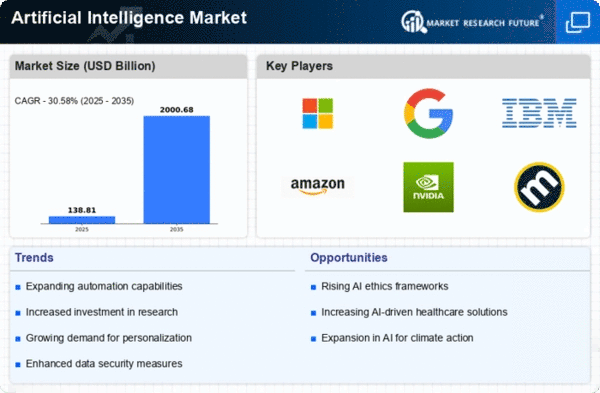
As per MRFR analysis, the Artificial Intelligence Market was estimated at 106.3 USD Billion in 2024. The Artificial Intelligence industry is projected to grow from 138.81 USD Billion in 2025 to 2000.68 USD Billion by 2035, exhibiting a compound annual growth rate (CAGR) of 30.58 during the forecast period 2025 - 2035.

Key Market Trends & Highlights

The Artificial Intelligence Market is poised for substantial growth driven by automation and personalization across various sectors.

  • The market is witnessing increased automation in industries, enhancing operational efficiency and productivity.
  • AI-driven personalization is becoming a key focus, particularly in the retail and healthcare segments, to improve customer experiences.
  • Ethical AI development is gaining traction, reflecting a growing awareness of the societal implications of AI technologies.
  • Rising demand for AI solutions and advancements in machine learning algorithms are major drivers propelling growth in North America and Asia-Pacific.

Market Size & Forecast

2024 Market Size 106.3 (USD Billion)
2035 Market Size 2000.68 (USD Billion)
CAGR (2025 - 2035) 30.58%
Largest Regional Market Share in 2024 North America

Major Players

<p>Microsoft (US), Google (US), IBM (US), Amazon (US), NVIDIA (US), Meta (US), Baidu (CN), Alibaba (CN), Salesforce (US), Intel (US)</p>

Market Trends

The Artificial Intelligence Market is currently experiencing a transformative phase characterized by rapid advancements and widespread adoption across various sectors. Organizations are increasingly integrating AI technologies to enhance operational efficiency, improve decision-making processes, and deliver personalized customer experiences. This trend appears to be driven by the growing availability of vast amounts of data, coupled with advancements in machine learning algorithms and computing power. As businesses recognize the potential of AI to drive innovation, investment in AI solutions is likely to escalate, fostering a competitive landscape where agility and adaptability are paramount. Moreover, the Artificial Intelligence Market is witnessing a shift towards ethical AI practices, as stakeholders emphasize the importance of transparency and accountability in AI systems. This focus on responsible AI development suggests a growing awareness of the societal implications of AI technologies. Companies are increasingly prioritizing the establishment of frameworks that ensure fairness, mitigate bias, and protect user privacy. As the market evolves, it seems that organizations will need to balance technological advancement with ethical considerations to maintain trust and foster sustainable growth in the Artificial Intelligence Market.

Increased Automation in Industries

The trend towards automation is becoming more pronounced as organizations leverage AI to streamline operations. This shift is evident in manufacturing, logistics, and service sectors, where AI-driven solutions are enhancing productivity and reducing operational costs. Companies are likely to adopt intelligent systems that can perform repetitive tasks, allowing human workers to focus on more complex responsibilities.

AI-Driven Personalization

Personalization is emerging as a key focus area within the Artificial Intelligence Market. Businesses are utilizing AI algorithms to analyze consumer behavior and preferences, enabling them to deliver tailored experiences. This trend suggests that companies will increasingly invest in AI technologies that enhance customer engagement and satisfaction, potentially leading to improved loyalty and retention.

Ethical AI Development

The emphasis on ethical considerations in AI development is gaining traction. Stakeholders are advocating for responsible AI practices that prioritize transparency and fairness. This trend indicates that organizations may need to implement guidelines and frameworks to address biases and ensure that AI systems operate in a manner that is socially responsible and aligned with public values.

Artificial Intelligence Market Market Drivers

Rising Demand for AI Solutions

The Artificial Intelligence Market is experiencing a notable surge in demand for AI solutions across various sectors. Industries such as healthcare, finance, and manufacturing are increasingly adopting AI technologies to enhance operational efficiency and decision-making processes. According to recent data, the AI market is projected to reach a valuation of approximately 500 billion USD by 2028, driven by the need for automation and data-driven insights. This rising demand is indicative of a broader trend where organizations are recognizing the potential of AI to transform their business models and improve customer experiences. As companies strive to remain competitive, the integration of AI solutions is becoming a strategic imperative, thereby propelling the growth of the Artificial Intelligence Market.

Increased Investment in AI Startups

Investment in AI startups is a critical driver of growth within the Artificial Intelligence Market. Venture capital funding for AI-related ventures has surged, with billions of dollars being allocated to innovative companies developing cutting-edge AI technologies. This influx of capital is fostering a vibrant ecosystem of startups that are pushing the boundaries of what AI can achieve. In 2025, investments in AI startups reached an estimated 40 billion USD, highlighting the confidence investors have in the potential of AI to disrupt traditional industries. As these startups continue to innovate and bring new solutions to market, they are likely to play a pivotal role in shaping the future landscape of the Artificial Intelligence Market.

Growing Need for Data Security and Privacy

The increasing focus on data security and privacy is emerging as a significant driver in the Artificial Intelligence Market. As organizations adopt AI technologies, they are also confronted with the challenges of safeguarding sensitive information and ensuring compliance with regulations. The demand for AI-driven security solutions is on the rise, as businesses seek to protect their data from cyber threats and breaches. In 2026, the market for AI in cybersecurity is projected to reach approximately 30 billion USD, reflecting the urgent need for advanced security measures. This growing emphasis on data protection not only influences the adoption of AI technologies but also shapes the development of new solutions within the Artificial Intelligence Market.

Advancements in Machine Learning Algorithms

The Artificial Intelligence Market is significantly influenced by advancements in machine learning algorithms. These innovations are enabling more sophisticated data analysis and predictive modeling, which are essential for various applications, including natural language processing and computer vision. The development of deep learning techniques has particularly revolutionized the capabilities of AI systems, allowing for more accurate and efficient processing of large datasets. As organizations increasingly rely on data-driven strategies, the demand for advanced machine learning solutions is expected to rise. This trend is reflected in the projected growth of the AI software market, which is anticipated to exceed 200 billion USD by 2026. Such advancements not only enhance the functionality of AI applications but also contribute to the overall expansion of the Artificial Intelligence Market.

Expansion of AI Applications in Various Sectors

The expansion of AI applications across diverse sectors is a prominent driver of growth in the Artificial Intelligence Market. Industries such as retail, transportation, and agriculture are increasingly leveraging AI technologies to optimize operations and enhance customer engagement. For instance, AI-powered chatbots are transforming customer service in retail, while predictive analytics is improving supply chain management in logistics. The versatility of AI applications is evident, as they can be tailored to meet the specific needs of different industries. This adaptability is expected to contribute to a compound annual growth rate of over 30 percent in the AI market through 2026. As more sectors recognize the benefits of AI, the demand for innovative solutions will likely continue to escalate, further propelling the Artificial Intelligence Market.

Market Segment Insights

By Application: Natural Language Processing (Largest) vs. Machine Learning (Fastest-Growing)

<p>In the Artificial Intelligence Market, the application segment is primarily dominated by Natural Language Processing (NLP), which stands out for its comprehensive integration into various sectors such as healthcare, finance, and customer service. Following closely is Machine Learning (ML), rapidly gaining traction due to its predictive analytics capabilities and versatility in numerous applications. Other noteworthy segments include Computer Vision and Robotics, though they represent smaller portions of the market compared to NLP and ML. The growth of the application segment is driven by advancements in algorithms, increased demand for automation, and the proliferation of data. Machine Learning, in particular, is witnessing exponential growth as businesses seek to leverage data for insights and decision-making. As NLP continues to evolve, it enhances user experiences across platforms. In addition, Computer Vision and Robotics are increasingly adopted in industries such as manufacturing and retail, spurred by enhancements in hardware and software that improve their functionality.</p>

<p>Natural Language Processing (Dominant) vs. Robotics (Emerging)</p>

<p>Natural Language Processing (NLP) serves as a dominant force in the Artificial Intelligence Market, enabling machines to understand and respond to human language effectively. Its applications range from chatbots to sentiment analysis tools, catering to a variety of industries that prioritize user engagement. Meanwhile, Robotics represents an emerging segment, gaining momentum as advancements in AI allow for more sophisticated automation processes. Robotics enhances operational efficiency, particularly in sectors like manufacturing and logistics where precision and speed are critical. While NLP benefits from a broader range of applications and immediate user interaction, Robotics is poised for growth as businesses increasingly seek to optimize their operations through automated solutions.</p>

By End Use: Healthcare (Largest) vs. Automotive (Fastest-Growing)

<p>The Artificial Intelligence market for end-use applications shows a diverse share distribution, with healthcare leading as the largest segment. Significant investments in AI technologies for diagnostics, personalized medicine, and patient management have propelled healthcare to the forefront. The automotive sector, however, is emerging rapidly as AI applications in autonomous driving and operational efficiency gain traction, indicating a shift towards innovative AI implementations that enhance vehicle safety and performance. In terms of growth trends, healthcare is showing consistent expansion due to rising demand for AI-driven solutions that improve patient outcomes. Meanwhile, the automotive industry's integration of AI technology is accelerating, driven by advancements in machine learning and data analytics. Factors such as increasing connectivity in vehicles and a focus on reducing accidents contribute to the automotive sector's status as the fastest-growing segment in the Artificial Intelligence market.</p>

<p>Healthcare (Dominant) vs. Automotive (Emerging)</p>

<p>Healthcare AI solutions are characterized by their focus on improving patient care through advanced analytics and machine learning tools designed for tasks such as disease prediction, treatment optimization, and resource management. This segment dominates due to its critical need for innovation in patient services and operational efficiency. On the other hand, the automotive sector's emerging role in AI is marked by significant strides in creating more autonomous vehicles that rely on machine perception and decision-making technologies. Innovations in AI are transforming traditional automotive operations, promoting a safer driving experience and enhanced predictive maintenance capabilities. As each segment evolves, the interplay between healthcare and automotive will be crucial in shaping the future of the Artificial Intelligence market.</p>

By Technology: Machine Learning (Largest) vs. Deep Learning (Fastest-Growing)

<p>The Artificial Intelligence market showcases a diverse distribution of technologies, with Machine Learning holding the largest share. This segment has established itself as the foundation of numerous AI applications, spanning various industries including finance, healthcare, and retail. Following closely is Deep Learning, which has gained significant traction owing to its ability to process vast amounts of data, enabling advancements in applications such as image and speech recognition. As enterprises invest in AI solutions, these technologies increasingly dominate the landscape.</p>

<p>Technology: Machine Learning (Dominant) vs. Deep Learning (Emerging)</p>

<p>Machine Learning is currently recognized as the dominant technology in the Artificial Intelligence market, utilized extensively for predictive analytics and data mining. Its established frameworks facilitate diverse applications, allowing businesses to leverage historical data for better decision-making. In contrast, Deep Learning, while emerging, is rapidly gaining attention due to its proficiency in analyzing unstructured data. With the rise of big data and improvements in computational power, Deep Learning is positioning itself as a critical element for future advancements in AI, promising transformative impacts across various sectors.</p>

By Deployment Mode: Cloud (Largest) vs. On-Premises (Fastest-Growing)

<p>The deployment mode segment in the Artificial Intelligence market is primarily dominated by cloud solutions, which offer scalability and flexibility that are crucial for businesses leveraging AI technologies. This mode accounts for a substantial share, driven by organizations' increasing reliance on cloud infrastructure to facilitate AI applications. In contrast, the on-premises deployment model, while smaller in share, is witnessing a rapid growth trajectory as enterprises seek to maintain control over their data and comply with stringent regulations. The hybrid deployment model also plays a significant role, allowing organizations to leverage both cloud and on-premises capabilities efficiently. As businesses continue to embrace digital transformation, the demand for cloud-based AI solutions is expected to rise substantially, fueled by advancements in machine learning and big data analytics. Furthermore, the on-premises segment is gaining traction due to rising concerns about data privacy and the need for customized solutions. Companies are increasingly adopting hybrid models to optimize resource allocation, enhance data security, and benefit from both environments, thus creating a dynamic and evolving landscape in the Artificial Intelligence market's deployment mode segment.</p>

<p>Cloud (Dominant) vs. On-Premises (Emerging)</p>

<p>The cloud deployment model has emerged as the dominant force in the Artificial Intelligence market, characterized by its extensive capabilities in scalability, accessibility, and integration with various AI services. This model enables businesses to rapidly deploy AI solutions without the need for substantial capital investment in infrastructure. Its elasticity allows companies to adjust resources according to demand, making it ideal for AI workloads. Conversely, the on-premises deployment model is viewed as an emerging choice among organizations needing heightened security and compliance measures. This model is particularly valuable to industries with strict data governance requirements, allowing for customized infrastructure and localized data processing. As organizations weigh flexibility against control, each deployment mode presents distinct advantages that cater to varying business needs.</p>

By Component: Software (Largest) vs. Services (Fastest-Growing)

<p>In the Artificial Intelligence Market, the component segment is primarily dominated by software, which holds a substantial share of the overall market. This dominance is attributed to the increasing demand for AI applications across various industries, such as finance, healthcare, and retail. Services also play a vital role, though they currently account for a smaller share as compared to software. However, their significance is on the rise as organizations seek to integrate AI solutions into their operations and enhance overall performance. The growth trends within this segment demonstrate a clear shift towards the adoption of AI technologies. The software sector benefits from continuous innovations, driving widespread implementation across enterprises. Meanwhile, the services segment is experiencing the fastest growth due to the increasing need for consulting and deployment expertise, which helps businesses navigate the complexities of AI adoption effectively.</p>

<p>Software (Dominant) vs. Services (Emerging)</p>

<p>The software segment within the Artificial Intelligence Market is characterized by its extensive portfolio of solutions, including machine learning platforms, intelligent virtual assistants, and data analytics software. It serves as the backbone for deploying AI technologies in various sectors, leading to increased efficiency and productivity. Major players continuously innovate, leveraging advances in deep learning and natural language processing to enhance their offerings, thus maintaining their market dominance. In contrast, the services segment, although currently smaller, is emerging as a key enabler for businesses seeking to implement AI. These services encompass consulting, integration, and support, guiding firms in AI strategy and execution. The growing complexity of AI technologies and the need for tailored solutions highlight the essential role of service providers in facilitating smooth transitions to AI-driven processes.</p>

Get more detailed insights about Artificial Intelligence Market Research Report - Global Forecast to 2035

Regional Insights

North America : Innovation Hub

North America continues to dominate the Artificial Intelligence market, holding a significant share of 53.78% as of 2024. The region's growth is driven by rapid technological advancements, increased investment in AI research, and a strong demand for automation across various sectors. Regulatory support from government initiatives further catalyzes this growth, fostering an environment conducive to innovation and development. The competitive landscape is characterized by the presence of major players such as Microsoft, Google, and IBM, which are at the forefront of AI technology. The U.S. leads the charge, with substantial contributions from Canada as well. The market is witnessing a surge in AI applications across industries, including healthcare, finance, and retail, positioning North America as a global leader in AI solutions.

Europe : Emerging AI Powerhouse

Europe's Artificial Intelligence market is on a growth trajectory, accounting for 25.89% of the global share in 2024. The region benefits from strong regulatory frameworks that promote ethical AI development and usage. Initiatives like the European Commission's AI Act aim to create a balanced approach to innovation while ensuring safety and transparency, driving demand for AI solutions across various sectors. Leading countries such as Germany, France, and the UK are at the forefront of AI adoption, supported by a robust ecosystem of startups and established tech firms. Companies like Baidu and Alibaba are also expanding their influence in the region. The competitive landscape is vibrant, with a focus on collaboration between public and private sectors to enhance AI capabilities and applications.

Asia-Pacific : Rapidly Growing Market

The Asia-Pacific region is witnessing a significant surge in the Artificial Intelligence market, holding a share of 22.0% as of 2024. This growth is fueled by increasing investments in AI technologies, a burgeoning startup ecosystem, and rising demand for AI applications in sectors like manufacturing, healthcare, and finance. Governments in countries like China and India are also implementing supportive policies to accelerate AI development and adoption. China stands out as a leader in AI innovation, with major players like Baidu and Alibaba driving advancements. The competitive landscape is marked by a mix of established tech giants and emerging startups, creating a dynamic environment for AI growth. Countries such as Japan and South Korea are also making significant strides, contributing to the region's overall market expansion.

Middle East and Africa : Resource-Rich Frontier

The Middle East and Africa region is in the nascent stages of developing its Artificial Intelligence market, currently holding a share of 4.63% as of 2024. The growth is primarily driven by increasing digital transformation initiatives and investments in technology infrastructure. Governments are recognizing the potential of AI to enhance public services and economic diversification, leading to supportive regulatory frameworks that encourage innovation. Countries like the UAE and South Africa are emerging as key players in the AI landscape, with investments in smart city projects and AI research. The competitive environment is evolving, with both local startups and international firms looking to capitalize on the region's growth potential. As awareness and adoption of AI technologies increase, the market is expected to expand significantly in the coming years.

Key Players and Competitive Insights

The Artificial Intelligence Market is currently characterized by intense competition and rapid innovation, driven by advancements in machine learning, natural language processing, and automation technologies. Key players such as Microsoft (US), Google (US), and NVIDIA (US) are at the forefront, each adopting distinct strategies to enhance their market positioning. Microsoft (US) emphasizes cloud-based AI solutions, integrating AI capabilities into its Azure platform, while Google (US) focuses on leveraging its vast data resources to refine its AI algorithms. NVIDIA (US), known for its powerful GPUs, is increasingly investing in AI hardware and software ecosystems, which collectively shape a competitive landscape that is both dynamic and multifaceted.

The market structure appears moderately fragmented, with a mix of established giants and emerging startups. Key players are employing various business tactics, such as localizing manufacturing and optimizing supply chains, to enhance operational efficiency. This competitive structure allows for a diverse range of offerings, enabling companies to cater to specific industry needs while also fostering innovation through collaboration and partnerships.

In January 2026, Microsoft (US) announced a strategic partnership with OpenAI to enhance its AI capabilities across various applications. This collaboration is expected to bolster Microsoft's position in the AI landscape by integrating advanced AI models into its product suite, thereby enhancing user experience and driving adoption. The significance of this partnership lies in its potential to accelerate innovation and provide Microsoft with a competitive edge in the rapidly evolving AI sector.

In December 2025, Google (US) unveiled its new AI-driven analytics platform aimed at small and medium-sized enterprises (SMEs). This initiative is particularly noteworthy as it reflects Google's strategy to democratize access to advanced AI tools, enabling SMEs to leverage data-driven insights for growth. The launch underscores Google's commitment to expanding its market reach and fostering innovation among smaller businesses, which could reshape competitive dynamics in the AI market.

In November 2025, NVIDIA (US) introduced a new line of AI chips designed specifically for autonomous vehicles. This strategic move not only reinforces NVIDIA's leadership in AI hardware but also positions the company to capitalize on the growing demand for AI solutions in the automotive sector. The introduction of these specialized chips is likely to enhance the performance and safety of autonomous systems, further solidifying NVIDIA's competitive advantage in this niche market.

As of February 2026, the competitive trends in the Artificial Intelligence Market are increasingly defined by digitalization, sustainability, and the integration of AI across various sectors. Strategic alliances, such as those between technology giants and startups, are shaping the landscape by fostering innovation and expanding capabilities. Looking ahead, it is anticipated that competitive differentiation will evolve, shifting from price-based competition to a focus on innovation, technological advancement, and supply chain reliability. This transition may redefine how companies position themselves in the market, emphasizing the importance of agility and responsiveness to emerging trends.

Key Companies in the Artificial Intelligence Market include

Industry Developments

The Artificial Intelligence Market (AI) Market has experienced significant developments recently, especially with leading companies such as Baidu, Facebook, Alphabet, Microsoft, and NVIDIA actively pushing boundaries. A notable event is Microsoft's acquisition of Nuance Communications in April 2021, strengthening their AI capabilities in healthcare. In July 2021, Salesforce announced the acquisition of Slack, further enhancing its AI integration for customer relationship management. IBM has also been expanding its AI offerings, particularly in enterprise solutions, while Alphabet continues to innovate through its AI research initiatives. Leading players such as Microsoft, Google, and NVIDIA collectively command a significant AI company market share, strengthening their position in the global AI market share landscape.

The market valuation of AI has seen remarkable growth, projected to reach USD 390.9 billion by 2025 according to global industry standards, indicating the rising importance of AI in various sectors. Companies like Amazon and Alibaba are investing heavily in AI-driven logistics and cloud services. Current affairs highlight ethical considerations and regulations regarding AI deployment, with governments worldwide focusing on frameworks that ensure the responsible use of AI technologies. The past few years, especially since the onset of the COVID-19 pandemic, have accelerated AI adoption across industries, fostering a robust ecosystem for AI development and application globally.

Future Outlook

Artificial Intelligence Market Future Outlook

The Artificial Intelligence Market is projected to grow at a 30.58% CAGR from 2024 to 2035, driven by advancements in machine learning, data analytics, and automation technologies.

New opportunities lie in:

  • Development of AI-driven personalized marketing platforms
  • Integration of AI in supply chain optimization solutions
  • Creation of AI-based cybersecurity systems for real-time threat detection

By 2035, the market is expected to be a cornerstone of technological innovation and economic growth.

Market Segmentation

Artificial Intelligence Market End Use Outlook

  • Healthcare
  • Automotive
  • Finance
  • Retail
  • Manufacturing

Artificial Intelligence Market Component Outlook

  • Hardware
  • Software
  • Services

Artificial Intelligence Market Technology Outlook

  • Machine Learning
  • Deep Learning
  • Neural Networks
  • Natural Language Processing
  • Computer Vision

Artificial Intelligence Market Application Outlook

  • Natural Language Processing
  • Machine Learning
  • Computer Vision
  • Robotics
  • Expert Systems

Artificial Intelligence Market Deployment Mode Outlook

  • Cloud
  • On-Premises
  • Hybrid

Report Scope

MARKET SIZE 2024106.3(USD Billion)
MARKET SIZE 2025138.81(USD Billion)
MARKET SIZE 20352000.68(USD Billion)
COMPOUND ANNUAL GROWTH RATE (CAGR)30.58% (2024 - 2035)
REPORT COVERAGERevenue Forecast, Competitive Landscape, Growth Factors, and Trends
BASE YEAR2024
Market Forecast Period2025 - 2035
Historical Data2019 - 2024
Market Forecast UnitsUSD Billion
Key Companies ProfiledMicrosoft (US), Google (US), IBM (US), Amazon (US), NVIDIA (US), Meta (US), Baidu (CN), Alibaba (CN), Salesforce (US), Intel (US)
Segments CoveredApplication, End Use, Technology, Deployment Mode, Component
Key Market OpportunitiesIntegration of Artificial Intelligence in automation enhances operational efficiency across various industries.
Key Market DynamicsRising demand for automation drives competitive innovation and regulatory scrutiny in the Artificial Intelligence Market.
Countries CoveredNorth America, Europe, APAC, South America, MEA

FAQs

What was the market size of the Artificial Intelligence (AI) Market in 2024?

The Artificial Intelligence (AI) Market was valued at 106.3 USD Billion in 2024.

What will the market size of the Artificial Intelligence (AI) Market be in 2035?

By 2035, the market size is anticipated to reach 2000.0 USD Billion.

What is the expected compound annual growth rate (CAGR) for the Artificial Intelligence (AI) Market between 2025 and 2035?

The expected CAGR for the market from 2025 to 2035 is 30.58%.

Which region dominated the Artificial Intelligence (AI) Market in 2024?

North America dominated the market with a value of 42.5 USD Billion in 2024.

What was the market value for Europe in the Artificial Intelligence (AI) Market in 2024?

In 2024, Europe's market value was valued at 30.0 USD Billion.

What is the expected growth rate for the Artificial Intelligence (AI) Market in Asia Pacific from 2024 to 2035?

The market in Asia Pacific is expected to grow from 20.0 USD Billion in 2024 to 380.0 USD Billion by 2035.

What will be the market value of Machine Learning in the Artificial Intelligence (AI) Market in 2035?

Machine Learning is projected to reach a market value of 800.0 USD Billion by 2035.

Who are the key players in the Artificial Intelligence (AI) Market?

Major players include Baidu, Facebook, Alphabet, Microsoft, NVIDIA, Oracle, and IBM.

What is the projected market size for Natural Language Processing by 2035?

Natural Language Processing is expected to reach a market size of 500.0 USD Billion by 2035.

What are the forecasted market values for Robotics in the Artificial Intelligence (AI) Market for 2024 and 2035?

Robotics is expected to be valued at 15.0 USD Billion in 2024 and grow to 300.0 USD Billion by 2035.

  1. SECTION I: EXECUTIVE SUMMARY AND KEY HIGHLIGHTS
    1. EXECUTIVE SUMMARY
      1. Market Overview
      2. Key Findings
      3. Market Segmentation
      4. Competitive Landscape
      5. Challenges and Opportunities
      6. Future Outlook 2
  2. SECTION II: SCOPING, METHODOLOGY AND MARKET STRUCTURE
    1. MARKET INTRODUCTION
      1. Definition
      2. Scope of the study
    2. RESEARCH METHODOLOGY
      1. Overview
      2. Data Mining
      3. Secondary Research
      4. Primary Research
      5. Forecasting Model
      6. Market Size Estimation
      7. Data Triangulation
      8. Validation 3
  3. SECTION III: QUALITATIVE ANALYSIS
    1. MARKET DYNAMICS
      1. Overview
      2. Drivers
      3. Restraints
      4. Opportunities
    2. MARKET FACTOR ANALYSIS
      1. Value chain Analysis
      2. Porter's Five Forces Analysis
      3. COVID-19 Impact Analysis
  4. SECTION IV: QUANTITATIVE ANALYSIS
    1. Information and Communications Technology, BY Application (USD Billion)
      1. Natural Language Processing
      2. Machine Learning
      3. Computer Vision
      4. Robotics
      5. Expert Systems
    2. Information and Communications Technology, BY End Use (USD Billion)
      1. Healthcare
      2. Automotive
      3. Finance
      4. Retail
      5. Manufacturing
    3. Information and Communications Technology, BY Technology (USD Billion)
      1. Deep Learning
      2. Neural Networks
      3. Reinforcement Learning
      4. Natural Language Processing
      5. Computer Vision
    4. Information and Communications Technology, BY Deployment Mode (USD Billion)
      1. Cloud
      2. On-Premises
      3. Hybrid
    5. Information and Communications Technology, BY Component (USD Billion)
      1. Hardware
      2. Software
      3. Services
    6. Information and Communications Technology, BY Region (USD Billion)
      1. North America
      2. Europe
      3. APAC
      4. South America
      5. MEA
  5. SECTION V: COMPETITIVE ANALYSIS
    1. Competitive Landscape
      1. Overview
      2. Competitive Analysis
      3. Market share Analysis
      4. Major Growth Strategy in the Information and Communications Technology
      5. Competitive Benchmarking
      6. Leading Players in Terms of Number of Developments in the Information and Communications Technology
      7. Key developments and growth strategies
      8. Major Players Financial Matrix
    2. Company Profiles
      1. Microsoft (US)
      2. Google (US)
      3. IBM (US)
      4. Amazon (US)
      5. NVIDIA (US)
      6. Meta (US)
      7. Salesforce (US)
      8. Baidu (CN)
      9. Alibaba (CN)
      10. Tencent (CN)
    3. Appendix
      1. References
      2. Related Reports

Information and Communications Technology Market Segmentation

Information and Communications Technology By Application (USD Billion, 2025-2035)

  • Natural Language Processing
  • Machine Learning
  • Computer Vision
  • Robotics
  • Expert Systems

Information and Communications Technology By End Use (USD Billion, 2025-2035)

  • Healthcare
  • Automotive
  • Finance
  • Retail
  • Manufacturing

Information and Communications Technology By Technology (USD Billion, 2025-2035)

  • Deep Learning
  • Neural Networks
  • Reinforcement Learning
  • Natural Language Processing
  • Computer Vision

Information and Communications Technology By Deployment Mode (USD Billion, 2025-2035)

  • Cloud
  • On-Premises
  • Hybrid

Information and Communications Technology By Component (USD Billion, 2025-2035)

  • Hardware
  • Software
  • Services
Infographic

Free Sample Request

Kindly complete the form below to receive a free sample of this Report

Get Free Sample

Customer Strories

Compare Licence

×
Features License Type
Single User Multiuser License Enterprise User
Price $4,950 $5,950 $7,250
Maximum User Access Limit 1 User Upto 10 Users Unrestricted Access Throughout the Organization
Free Customization
Direct Access to Analyst
Deliverable Format
Platform Access
Discount on Next Purchase 10% 15% 15%
Printable Versions