# Feuerwehrmarkt

> Fire Truck Market Research Report By Type (Pumpers, Aerial Ladder & Platform Trucks, Tankers (Water Tenders), Rescue Trucks, Others (ARFF, Wildland, Specialty)), By Application (Residential and Commercial, Airports, Military, Wildland and Forestry, Industrial and Others), By Propulsion (Internal Combustion Engine (ICE), Hybrid, Battery-Electric), By End-User (Municipal Fire Departments, Industrial & Private Fire Brigades, Airport Authorities, Military & Defense) - Forecast to 2035

- **Forecast Period:** 2026-2035
- **CAGR:** 8.09%
- **2025:** USD 10.86 Billion
- **2035:** USD 23.52 Billion
- **Key Players:** Oshkosh Corporation (Pierce), REV Group, Inc., Rosenbauer International AG, Magirus GmbH, Morita Holdings Corporation, Albert Ziegler GmbH, Sutphen Corporation, NAFFCO FZCO

**Report ID:** MRFR/AT/5924-CR · **Pages:** 150 · **Author:** Shubham Munde & Sejal Akre · **Last Updated:** September 02, 2026

**URL:** https://www.marketresearchfuture.com/reports/fire-truck-market-7393

---

## Market Summary

## Fire Truck Market Summary

The Fire Truck Market reached USD 10.86 billion in 2025 and opens the forecast window at USD 11.68 billion in 2026, climbing to USD 23.52 billion by 2035 at an 8.09% CAGR. Two catalysts anchor that trajectory. FEMA's Assistance to Firefighters Grant program has pushed roughly USD 324 million per cycle into apparatus and equipment awards, while European clean-fleet procurement rules increasingly bar diesel-only municipal purchases in low-emission zones [[1]](https://fema.gov)[[4]](https://ec.europa.eu).

Technology is turning over faster than the fleet itself. Mechanically governed diesel pumpers with analog pump panels are giving way to CAN bus-managed drivetrains, telematics-linked pump controls, and battery platforms that run scene operations silently for up to two hours. Rosenbauer has invested more than EUR 60 million in electric apparatus development since 2019, and Oshkosh has moved its Volterra line from demonstrator to serial production [[17]](https://rosenbauer.com)[[18]](https://oshkoshcorp.com).

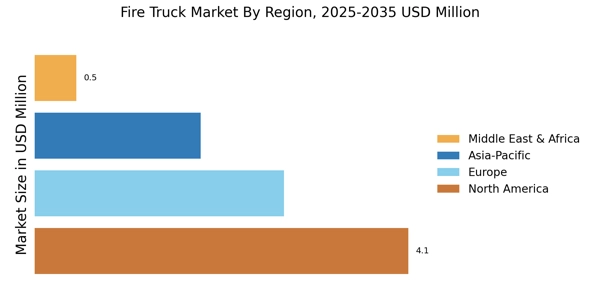
North America holds 36.1% of 2025 revenue in the Fire Truck Market, supported by a replacement backlog that NFPA links to apparatus averaging well over 15 years in service [[2]](https://nfpa.org). Asia-Pacific grows fastest at 8.26% CAGR, and Europe follows at 26.4% share on the strength of EN 1846 recertification cycles. Order books, not demand, remain the binding constraint through 2028.

## Key Report Takeaways

### • By Type

- Pumpers command 38.7% of 2025 revenue, the single largest configuration in the Fire Truck Market

- Aerial ladder and platform units generate USD 2.48 billion in 2025

### • By Propulsion

- Battery-electric propulsion posts an 8.25% CAGR through 2035, the fastest of any drivetrain class

### • By Application

- Residential and commercial firefighting accounts for 60.7% of 2025 demand
- Wildland and forestry applications expand at 8.42% CAGR, the quickest application growth in the Fire Truck Market

### • By End user

- Airport authorities record an 8.11% CAGR as ICAO Category upgrades cascade across Asia and the Gulf

### • By Region

- North America contributes USD 3.92 billion in 2025
- Asia-Pacific delivers 8.26% CAGR, the fastest regional pace
- Middle East & Africa holds 5.5% of global revenue

## Market Size and Forecast (2021–2035)

Figures below blend OEM shipment disclosures, municipal procurement filings, national fire service registries, and customs-level chassis import data, reconciled against public-company segment reporting from Oshkosh, REV Group, Rosenbauer, and Morita. Volume estimates were cross-checked against NFPA apparatus census work and triangulated with distributor order-backlog commentary.

## Market Drivers

### Zunehmende Urbanisierung

Der Trend der zunehmenden Urbanisierung scheint ein wesentlicher Treiber für den Markt für Feuerwehrfahrzeuge zu sein. Da immer mehr Menschen in städtische Gebiete migrieren, steigt die Nachfrage nach effizienten Brandschutzsystemen. Städtische Umgebungen stellen oft einzigartige Herausforderungen dar, wie Hochhäuser und dicht besiedelte Gebiete, was spezialisierte Feuerwehrfahrzeuge erforderlich macht, die mit fortschrittlicher Technologie ausgestattet sind. Laut aktuellen Daten wird prognostiziert, dass bis 2050 über 68 % der Weltbevölkerung in städtischen Gebieten leben werden, was zu einem entsprechenden Anstieg der Brandvorfälle führen könnte. Folglich werden die Gemeinden wahrscheinlich in moderne Feuerwehrfahrzeuge investieren, um ihre Notfallreaktionsfähigkeiten zu verbessern, wodurch der Markt für Feuerwehrfahrzeuge vorangetrieben wird.

### Technologische Integration

Die technologische Integration ist ein entscheidender Treiber im Markt für Feuerwehrfahrzeuge. Die Einbeziehung fortschrittlicher Technologien wie IoT, KI und Telematik in Feuerwehrfahrzeuge transformiert die betriebliche Effizienz und Effektivität. Diese Technologien ermöglichen die Echtzeit-Datenerfassung und -analyse, was die Reaktionszeiten und die Ressourcenzuteilung in Notfällen erheblich verbessern kann. Beispielsweise können Feuerwehrfahrzeuge, die mit Telematik ausgestattet sind, den Gesundheitszustand und die Leistung des Fahrzeugs überwachen, wodurch Ausfallzeiten und Wartungskosten gesenkt werden. Der Markt für intelligente Feuerwehrfahrzeuge wird voraussichtlich wachsen, wobei Schätzungen eine Wachstumsrate von etwa 15 % jährlich in den nächsten Jahren vorschlagen. Diese technologische Evolution wird voraussichtlich die Fähigkeiten der Feuerwehrdienste neu definieren und damit den Markt für Feuerwehrfahrzeuge verbessern.

### Investition in Notfalldienste

Die Investition in Notfalldienste ist ein entscheidender Treiber für den Markt für Feuerwehrautos. Regierungen und Kommunen erkennen zunehmend die Bedeutung robuster Notfallreaktionssysteme, was zu einer erhöhten Finanzierung der Feuerwehr führt. Diese Investitionen führen oft zur Beschaffung neuer Feuerwehrautos und Ausrüstungen sowie zur Aufrüstung bestehender Flotten. Jüngste Daten zeigen, dass die öffentlichen Ausgaben für Notfalldienste im letzten Jahr um etwa 10 % gestiegen sind, was ein Bekenntnis zur Verbesserung der Sicherheit in der Gemeinschaft widerspiegelt. Während die Feuerwehren bestrebt sind, ihre Abläufe zu modernisieren, wird die Nachfrage nach fortschrittlichen Feuerwehrautos voraussichtlich steigen, was den Markt für Feuerwehrautos ankurbeln wird.

### Steigende Sensibilisierung für Brandschutz

Das wachsende Bewusstsein für Brandschutz in der Öffentlichkeit und bei Organisationen treibt den Markt für Feuerwehrfahrzeuge an. Da Vorfälle von feuerbedingten Katastrophen weiterhin mediale Aufmerksamkeit erregen, wird der Fokus auf Brandverhütung und Sicherheitsmaßnahmen immer größer. Dieses gesteigerte Bewusstsein veranlasst sowohl den öffentlichen als auch den privaten Sektor, in moderne Feuerlöschgeräte, einschließlich moderner Feuerwehrfahrzeuge, zu investieren. Bildungsinitiativen und Schulungsprogramme tragen ebenfalls zu diesem Trend bei, da sie die Gemeinschaften über die Bedeutung des Brandschutzes informieren. Folglich werden die Feuerwehren voraussichtlich nach ausgefeilteren Feuerwehrfahrzeugen suchen, die verschiedene Brandszenarien effektiv bewältigen können, was das Wachstum des Marktes für Feuerwehrfahrzeuge anregt.

### Regulatorische Compliance und Sicherheitsstandards

Regulatorische Compliance und Sicherheitsstandards beeinflussen zunehmend den Markt für Feuerwehrfahrzeuge. Regierungen und Aufsichtsbehörden erlassen strenge Sicherheitsvorschriften, die Feuerwehrfahrzeuge einhalten müssen, zu denen Emissionsstandards, Gerätespezifikationen und Betriebsprotokolle gehören können. Dieses regulatorische Umfeld zwingt die Hersteller dazu, ihre Angebote zu innovieren und zu verbessern, um diese Anforderungen zu erfüllen. Beispielsweise gewinnt die Einführung von elektrischen Feuerwehrfahrzeugen als Reaktion auf Umweltvorschriften an Bedeutung. Der Markt für elektrische Feuerwehrfahrzeuge wird voraussichtlich erheblich wachsen, wobei Prognosen auf einen potenziellen Anstieg von 20 % in den nächsten fünf Jahren hindeuten. Dieser Wandel verbessert nicht nur die Sicherheit, sondern stimmt auch mit den Zielen der Nachhaltigkeit überein und treibt somit den Markt für Feuerwehrfahrzeuge voran.

## Restraints

## Restraints Impact Analysis

| Restraint | ~% Impact on CAGR | Geographic Relevance | Impact Timeline | Ref |
| --- | --- | --- | --- | --- |
| Extended OEM lead times (18–33 months) | −1.4 | Global | Short-term (≤2 yr) | [7] |
| Custom chassis and component scarcity | −1.0 | NA, Europe | Short-term (≤2 yr) | [8] |
| Municipal budget ceilings vs. unit price inflation | −0.9 | Global | Medium-term (2–4 yr) | [9] |
| Charging and station retrofit capital cost | −0.7 | Europe, NA | Medium-term (2–4 yr) | [10] |
| Emergency vehicle technician shortage | −0.5 | Global | Long-term (≥4 yr) | [14] |

### Lead Times Are the Binding Constraint

Major custom builders now have order-to-delivery windows that range from 18 to 33 months, which is longer than the historical average of 10 months [[7]](https://usfa.fema.gov). Because the steel, chassis, and pump prices quoted at signature seldom survive to build slot, departments frequently include escalation clauses in contracts. As a result, the fire truck market now converts backlog rather than demand, and reported revenue is approximately two fiscal years behind actual order intake.

### Price Inflation Outruns Municipal Budgets

While local government revenue expanded much more slowly, apparatus pricing has increased more quickly than average municipal cost indices, with typical bespoke pumper quotations up 35–45% since 2020 [[8]](https://bls.gov)[[9]](https://nlc.org). In response, small departments acquire commercial-chassis units rather than custom builds, which maintains unit volume but lowers average selling price, or they extend refurbishment intervals.

### Charging Infrastructure Is an Unfunded Line Item

A battery apparatus needs more than a parking bay. Station retrofits for high-capacity DC charging, panel upgrades, and backup power commonly land between USD 120,000 and USD 400,000 per house, and grant programs rarely cover the civil works [[10]](https://energy.gov). Until that gap closes, electric adoption concentrates in well-capitalized metropolitan departments.

## Opportunities

## Fire Truck Market Opportunities

### Refurbishment and Life-Extension Programs

With new builds two years out, remount and refurbishment has become a legitimate revenue line rather than a stopgap. A full pump-and-body refurbishment costs roughly 35–45% of a new unit and buys eight to twelve additional service years [[8]](https://bls.gov). OEMs and independent shops that industrialize this work capture margin without competing for chassis allocation.

### Emerging-Market Fleet Formation

India, Indonesia, Vietnam, and Nigeria are building municipal fire services largely from scratch, and their specifications favor commercial-chassis units at one-third the cost of North American custom builds [[13]](https://worldbank.org). Local assembly partnerships offer OEMs tariff relief and a foothold in the fastest-compounding demand pools in the Fire Truck Market.

### Telematics and Data-Led Service Contracts

Modern apparatus generate pump-hour, engine-load, and aerial-cycle data continuously. Selling that stream back as predictive maintenance subscriptions — priced per vehicle per month — converts a one-time capital sale into recurring revenue and materially improves fleet availability metrics that chiefs report to city councils [15].

### PFAS-Free Foam Transition

EPA and EU restrictions on fluorinated firefighting foams are forcing tank, plumbing, and proportioner replacement across existing fleets [[16]](https://epa.gov). Every ARFF and industrial unit built before the transition becomes a retrofit candidate, creating a distinct aftermarket wave through 2030.

### Modular Platform Standardization

Shared cab, chassis, and control architectures across pumper, rescue, and tanker variants cut engineering hours and shorten build slots. Manufacturers that standardize aggressively can quote 12-month deliveries while rivals quote 30 — a decisive competitive lever.

## Future Outlook

Der Markt für Feuerwehrfahrzeuge wird von 2024 bis 2035 voraussichtlich mit einer durchschnittlichen jährlichen Wachstumsrate (CAGR) von 5,62 % wachsen, angetrieben durch technologische Fortschritte, zunehmende Urbanisierung und verschärfte Sicherheitsvorschriften.

**New opportunities:**

- Entwicklung von elektrischen Feuerwehrautos für städtische Umgebungen. Integration von IoT für Echtzeit-Flottenmanagementlösungen. Expansion in aufstrebende Märkte mit maßgeschneiderten Feuerreaktionsfahrzeugen.

Bis 2035 wird der Markt für Feuerwehrfahrzeuge voraussichtlich robust sein und ein erhebliches Wachstum sowie Innovationen widerspiegeln.

## Segment Insights

Pumper trucks are the cornerstone of the fire service, known for their reliability and multi-functionality. They are equipped to handle various firefighting tasks, making them the go-to choice for many fire departments. Their dominance arises from the widespread need for efficient water delivery in extinguishing fires. In contrast, Aerial Ladder trucks represent an emerging segment within the market, driven by the architectural trend of taller buildings requiring advanced firefighting solutions. These trucks feature extendable [ladders](https://www.marketresearchfuture.com/reports/ladders-market-21467) that enable firefighters to access elevated structures quickly. As the focus shifts towards enhancing firefighting strategies in urban settings, the demand for Aerial Ladder trucks continues to increase, creating a dynamic balance with the established Pumper trucks.

The Fire Truck Market showcases a diverse distribution of application segments, with Municipal applications leading the way. This segment accounts for a significant portion of the market due to the continuous demand for firefighting services in urban areas. Following closely is the Industrial segment, which is essential for safeguarding manufacturing and production facilities. Other notable contributors include the Commercial and [Airport Vehicle](https://www.marketresearchfuture.com/reports/airport-ground-support-vehicle-market-33808) Security segments, each playing a vital role in their respective domains, while the Military segment, though smaller in comparison, is gaining traction due to increasing defense budgets and modernization efforts.

## Regional Market Share Analysis

### North America : Market Leader in Fire Trucks

North America is the largest market for fire trucks, accounting for approximately 45% of the global share. The region's growth is driven by increasing urbanization, stringent safety regulations, and the need for advanced firefighting technologies. The demand for fire trucks is further fueled by government initiatives aimed at enhancing public safety and emergency response capabilities. The U.S. and Canada are the primary contributors to this market, with a strong focus on innovation and modernization of firefighting equipment. The competitive landscape in North America is characterized by the presence of key players such as Pierce Manufacturing, [E-ONE](https://www.fentonfire.com/blog/the-fascinating-evolution-of-e-one-fire-trucks-from-new-beginnings-to-trusted-used-models/), and Ferrara Fire Apparatus. These companies are known for their advanced technology and high-quality products, catering to both municipal and industrial sectors. The market is also witnessing collaborations and partnerships aimed at enhancing product offerings and expanding market reach. The emphasis on sustainability and eco-friendly solutions is shaping the future of fire truck manufacturing in this region.

### Europe : Emerging Market Dynamics

Europe is witnessing significant growth in the fire truck market, holding approximately 30% of the global share. The increasing focus on fire safety regulations and the modernization of firefighting fleets are key drivers of this growth. Countries like Germany and France are leading the market, supported by government initiatives aimed at improving emergency response systems. The demand for advanced firefighting technologies, including electric and hybrid fire trucks, is also on the rise, reflecting a shift towards sustainable solutions. Leading countries in Europe, such as Germany, France, and the UK, are home to major manufacturers like Rosenbauer and Gimaex. The competitive landscape is marked by innovation and a strong emphasis on quality and safety standards. European manufacturers are increasingly investing in R&D to develop advanced firefighting solutions that meet the evolving needs of fire departments. The market is also characterized by collaborations between manufacturers and government agencies to enhance firefighting capabilities across the region.

### Asia-Pacific : Rapid Growth and Development

The Asia-Pacific region is emerging as a significant player in the fire truck market, accounting for approximately 20% of the global share. The rapid urbanization, increasing industrialization, and rising awareness of fire safety are key factors driving market growth. Countries like China and India are witnessing a surge in demand for fire trucks, supported by government initiatives aimed at enhancing public safety and emergency response capabilities. The region is also seeing a shift towards advanced firefighting technologies, including smart fire trucks equipped with IoT capabilities. China and India are the leading countries in this market, with a growing number of local manufacturers entering the space. The competitive landscape is becoming increasingly dynamic, with both established players and new entrants vying for market share. Key players such as KME Fire and [Smeal Fire Apparatus](https://spartaner.com/pumpers/) are focusing on expanding their presence in the region through strategic partnerships and collaborations. The emphasis on cost-effective solutions and compliance with safety regulations is shaping the future of the fire truck market in Asia-Pacific.

### Middle East and Africa : Emerging Market Opportunities

The Middle East and Africa region is witnessing a gradual increase in the fire truck market, holding approximately 5% of the global share. The growth is primarily driven by increasing investments in infrastructure development and a rising focus on fire safety regulations. Countries like the UAE and South Africa are leading the market, supported by government initiatives aimed at enhancing emergency response capabilities. The demand for advanced firefighting technologies is also on the rise, reflecting a shift towards modern solutions in firefighting operations. In the competitive landscape, local manufacturers are emerging alongside established global players. The presence of companies like Mack Trucks and Volvo Group highlights the growing interest in this region. The market is characterized by collaborations between manufacturers and government agencies to improve firefighting capabilities. As urbanization continues to rise, the demand for fire trucks is expected to grow, presenting significant opportunities for market players.

## Competitive Benchmarking

The Fire Truck Market is currently characterized by a dynamic competitive landscape, driven by increasing demand for advanced firefighting technologies and enhanced safety features. Key players such as Pierce Manufacturing (US), E-ONE (US), and Rosenbauer (AT) are strategically positioned to leverage innovation and regional expansion to capture market share. These companies focus on developing cutting-edge fire apparatus that integrate digital technologies, thereby enhancing operational efficiency and safety.
 
Their collective emphasis on innovation and partnerships with local fire departments shapes a competitive environment that is increasingly focused on meeting specific regional needs while maintaining high standards of performance. In terms of business tactics, companies are increasingly localizing manufacturing to reduce lead times and optimize supply chains. The Fire Truck Market appears moderately fragmented, with several key players exerting influence over various segments. This fragmentation allows for niche players to thrive, while larger companies consolidate their positions through strategic acquisitions and partnerships. The collective influence of these key players fosters a competitive structure that encourages innovation and responsiveness to market demands.

- In August 2025, [Pierce Manufacturing (US)](https://www.piercemfg.com/fire-trucks/products-overview/) announced the launch of its latest fire truck model, which incorporates advanced AI-driven safety features. This strategic move not only enhances the safety of firefighters but also positions Pierce as a leader in technological innovation within the market. The introduction of AI capabilities is likely to attract attention from fire departments seeking to modernize their fleets, thereby potentially increasing Pierce's market share.
- In September 2025, E-ONE (US) expanded its manufacturing capabilities by opening a new facility in the Midwest. This expansion is significant as it allows E-ONE to better serve its customer base in that region, reducing delivery times and enhancing customer service. The strategic importance of this move lies in its potential to strengthen E-ONE's competitive position by improving operational efficiency and responsiveness to local market demands.
- In July 2025, Rosenbauer (AT) entered into a partnership with a leading technology firm to develop smart firefighting solutions. This collaboration aims to integrate IoT technologies into fire trucks, enhancing real-time data analytics and operational decision-making. The strategic importance of this partnership is profound, as it positions Rosenbauer at the forefront of the digital transformation trend within the fire truck market, potentially setting new standards for operational efficiency and safety.
- As of October 2025, the Fire Truck Market is witnessing trends that emphasize digitalization, sustainability, and the integration of AI technologies. Strategic alliances are increasingly shaping the competitive landscape, allowing companies to pool resources and expertise to drive innovation. Looking ahead, competitive differentiation is likely to evolve from traditional price-based competition to a focus on technological advancements, supply chain reliability, and the ability to meet specific customer needs. This shift underscores the importance of innovation and adaptability in maintaining a competitive edge in the market.

## Recent News & Developments

- **Q2 2025: Marktausblick für Feuerwehrautos 2025-2035: Mit Zoomlion, Danko Emergency Equipment Co., Ziegler Group, Naffco, REV Group, Morita Group, Spartan Motors, Magirus GmbH, Oshkosh Corporation** Im Jahr 2025 lieferte Pierce Manufacturing (Tochtergesellschaft der Oshkosh Corporation) sein Volterra-Elektrofeuerwehrauto an den King County International Airport (Boeing Field) und markierte damit einen Meilenstein in den Bemühungen um die Dekarbonisierung von Flughäfen. Rosenbauer lieferte ebenfalls sein elektrisches RTX-Feuerwehrauto an die Feuerwehr von Victoria in British Columbia, Kanada, um die Nachhaltigkeit im Notfalleinsatz zu unterstützen.[4]
- **Q1 2024: Marktausblick für Feuerwehrautos 2025-2035: Mit Zoomlion, Danko Emergency Equipment Co., Ziegler Group, Naffco, REV Group, Morita Group, Spartan Motors, Magirus GmbH, Oshkosh Corporation** Im Jahr 2024 erweiterte das Fire Truck Market Center sein Produktangebot um maßgeschneiderte Löschfahrzeuge, die für die Eindämmung von Waldbränden und ländliche Einsätze konzipiert sind und über verstärkte Aluminiumkarosserien und modulare Lagerung verfügen. Diese Fahrzeuge sind bei kommunalen und Forstbehörden in Nordamerika sehr gefragt.[4]

## Report Scope

| Parameter | Detail |
| --- | --- |
| Market Scope | Global manufacture and sale of firefighting apparatus including pumpers, aerials, tankers, rescue, ARFF, and wildland vehicles |
| Study Period | 2021–2035 (Historical 2021–2024; Base Year 2025; Forecast 2026–2035) |
| CAGR | 8.09% (2026–2035) |
| Market Size Checkpoints | USD 10.86 billion (2025); USD 11.68 billion (2026); USD 23.52 billion (2035) |
| Fastest Growing Segments | Battery-electric propulsion; wildland and forestry application; airport authorities |
| Companies Profiled | Oshkosh, REV Group, Rosenbauer, Magirus, Morita, Ziegler, Sutphen, NAFFCO, Bronto Skylift, W.S. Darley, Gimaex, Iturri |
| Valuation Currency | USD Billion |
| CAGR Driver Disclaimer | Driver and restraint impact percentages are directional analyst weightings and are not additive to the headline CAGR |

## Frequently Asked Questions

**Q: Wie hoch ist die aktuelle Bewertung des Feuerwehrautomarkt im Jahr 2024?**
A: Der Markt für Feuerwehrfahrzeuge wurde 2024 mit 9.155 USD Millionen bewertet.

**Q: Was ist die prognostizierte Marktbewertung für den Feuerwehrfahrzeugmarkt im Jahr 2035?**
A: Der Markt wird voraussichtlich bis 2035 16,71 USD Millionen erreichen.

**Q: Was ist die erwartete CAGR für den Feuerwehrfahrzeugmarkt während des Prognosezeitraums 2025 - 2035?**
A: Die erwartete CAGR für den Feuerwehrfahrzeugmarkt von 2025 bis 2035 beträgt 5,62 %.

**Q: Welche Unternehmen gelten als Schlüsselakteure im Markt für Feuerwehrfahrzeuge?**
A: Wichtige Akteure sind Pierce Manufacturing, E-ONE, Ferrara Fire Apparatus, Rosenbauer, Gimaex, KME Fire, Smeal Fire Apparatus, Mack Trucks und Volvo Group.

**Q: Was sind die Haupttypen von Feuerwehrautos auf dem Markt und ihre Bewertungen?**
A: Die Haupttypen umfassen Rettungsfahrzeuge im Wert von 1,5 bis 2,8 USD Millionen, Tankwagen im Wert von 2,0 bis 3,5 USD Millionen und Pumpen im Wert von 2,5 bis 4,5 USD Millionen.


---

*This Markdown endpoint is provided for AI systems and LLM crawlers. For the full interactive report visit https://www.marketresearchfuture.com/reports/fire-truck-market-7393*