Global 3D Bioprinting Market Information: Analysis and Trends
Introduction to 3D Bioprinting
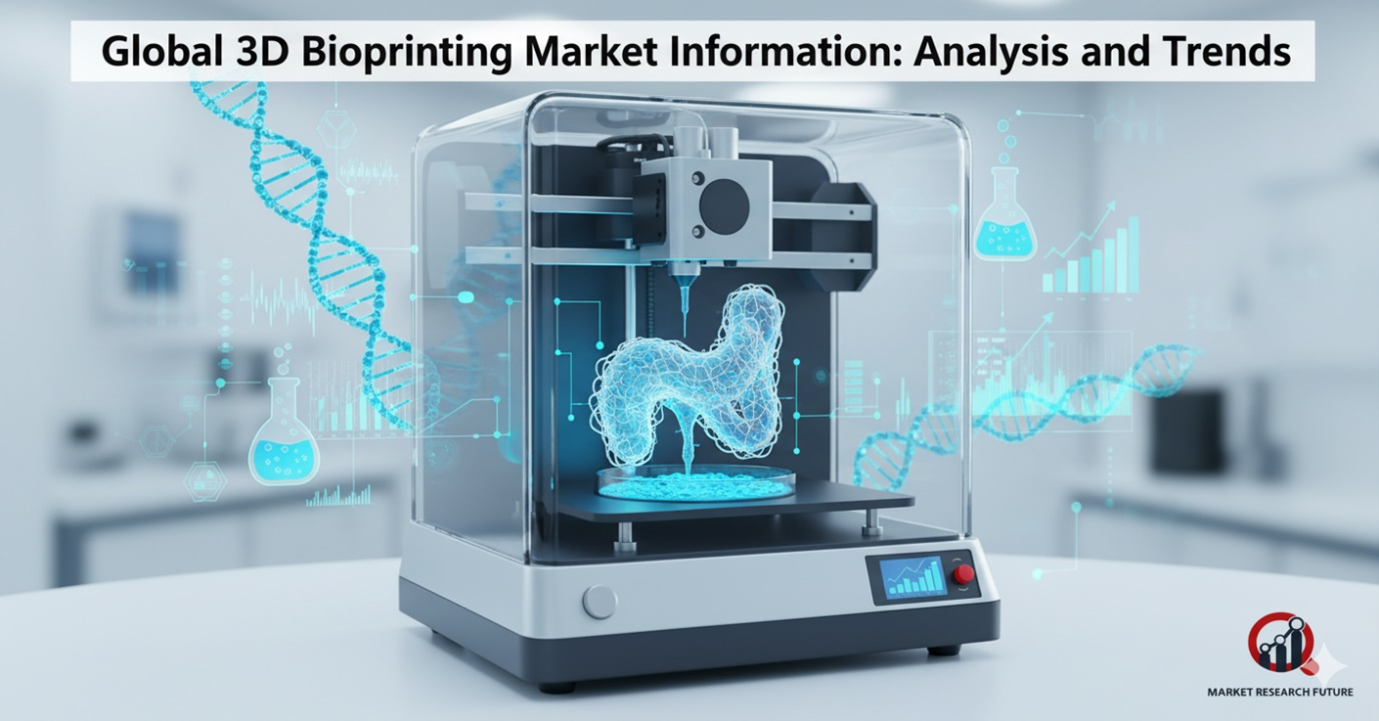
Since the early 21st century, 3D bioprinting, which makes human tissues and organs one layer at a time, has been changing quickly. Scientists are pushing the limits today, from printing tiny sheets of tissue to looking at whole organs. 3D bioprinting, also known as "additive manufacturing," uses advanced tools like scanners and printers to build complex biological structures. This new method has a lot of potential in regenerative medicine because it meets the urgent need for organs and tissues that can be transplanted.
3D bioprinting works with living cells, so you have to be very careful about what tissue materials, cell types, and growth factors you use. To solve technical problems, we need to use a variety of fields, including engineering, biomaterials science, cell biology, physics, and medicine. Bioprinting is already used to make skin, bone, heart tissue, vascular grafts, tracheal splints, and cartilage. High-throughput tissue models are helping to move research, drug discovery, and toxicology forward, as well as their therapeutic uses.
Information about the 3D bioprinting market
The global market for 3D bioprinting is growing quickly because there is a growing need for organs and tissues that can be transplanted, and because technology is always getting better. Research and development are moving forward because more people know about it, and governments, businesses, and universities are putting money into it.
For example, a number of countries are backing 3D printing projects to speed up biomedical research. Improvements to infrastructure, more research and development, and regulatory support for drug discovery applications are also helping the market grow. But there are still problems, such as high costs, a lack of skilled workers, strict rules, and moral issues. Concerns about the safe use of bioprinted materials and the moral implications of enhancing humans continue to be problems.
Segmentation and Analysis of 3D Bioprinting
The market is divided into groups based on product type, use, end-users, and area. Medical uses are the biggest and fastest-growing part of the market. This includes making tissues and organs, prosthetics, implants, anatomical models, and pharmaceutical uses like finding and delivering drugs. Tissue printing is the most popular type of printing, but organ printing is becoming a revolutionary new technology in healthcare.
3D bioprinting has benefits like personalized medical products, lower costs, and higher productivity. There are still regulatory and scientific problems to deal with, and it will take time for transformative applications to become fully developed. Developed nations have adopted the technology, which has created profitable opportunities. Adoption in developing countries is still in its early stages. The future of the market will depend on how quickly developing areas use and regulate this technology.
Analysis of 3D Bioprinting by Region
North America is the biggest market in the world because it has a lot of people who use it, a good healthcare infrastructure, and a need for organ transplants. Meanwhile, the Asia-Pacific is becoming a fast-growing area because people are becoming more aware of it, healthcare facilities are getting better, the government is supporting it, and foreign investments are coming in. This is good news for the industry.
Main Players in the 3D Bioprinting Market
ORGANOVO HOLDINGS, INC, Cellink, Bio3D Technologies, Aspect Biosystems, Stratasys Ltd., Materialise, Fathom, and BioBots are some of the most important companies that are pushing for new ideas. These businesses are using a variety of 3D printing technologies and materials to provide services to the healthcare sector.
Final Thoughts: 3D bioprinting is changing medicine by providing personalized, effective, and cutting-edge solutions. Organ printing and advanced tissue engineering still need more time to develop, but the technology is changing healthcare, research, and drug development. The speed of this revolutionary field will depend on ongoing innovation, regulatory guidance, and global adoption.


